Personally Protected: PII vs. PHI

(Part of the biometric product marketing expert series)

Before you can fully understand the difference between personally identifiable information (PII) and protected health information (PHI), you need to understand the difference between biometrics and…biometrics. (You know sometimes words have two meanings.)

Designed by Google Gemini.

The definitions of biometrics

To address the difference between biometrics and biometrics, I’ll refer to something I wrote over two years ago, in late 2021. In that post, I quoted two paragraphs from the International Biometric Society that illustrated the difference.
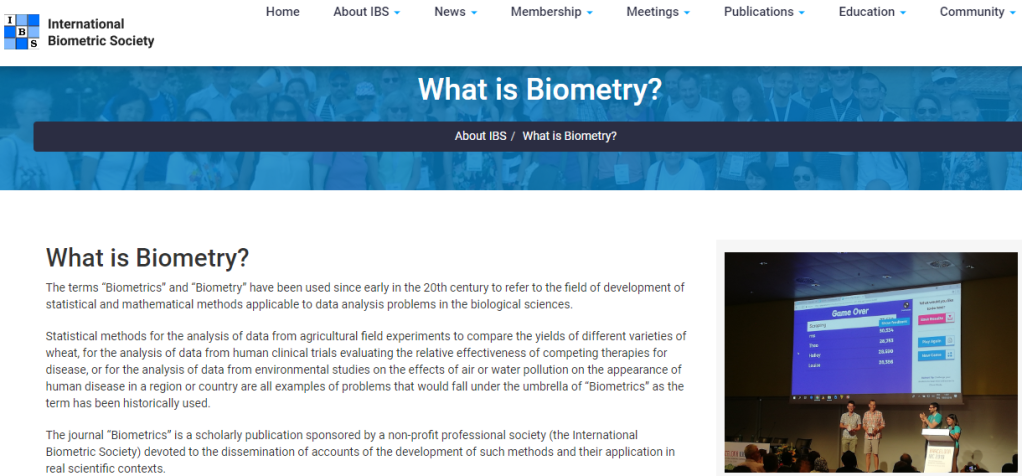
Since the IBS has altered these paragraphs in the intervening years, I will quote from the latest version.

The terms “Biometrics” and “Biometry” have been used since early in the 20th century to refer to the field of development of statistical and mathematical methods applicable to data analysis problems in the biological sciences.

Statistical methods for the analysis of data from agricultural field experiments to compare the yields of different varieties of wheat, for the analysis of data from human clinical trials evaluating the relative effectiveness of competing therapies for disease, or for the analysis of data from environmental studies on the effects of air or water pollution on the appearance of human disease in a region or country are all examples of problems that would fall under the umbrella of “Biometrics” as the term has been historically used….

The term “Biometrics” has also been used to refer to the field of technology devoted to the identification of individuals using biological traits, such as those based on retinal or iris scanning, fingerprints, or face recognition. Neither the journal “Biometrics” nor the International Biometric Society is engaged in research, marketing, or reporting related to this technology. Likewise, the editors and staff of the journal are not knowledgeable in this area. 

From https://www.biometricsociety.org/about/what-is-biometry.

In brief, what I call “broad biometrics” refers to analyzing biological sciences data, ranging from crop yields to heart rates. Contrast this with what I call “narrow biometrics,” which (usually) refers only to human beings, and only to those characteristics that identify human beings, such as the ridges on a fingerprint.

The definition of “personally identifiable information” (PII)

Now let’s examine an issue related to narrow biometrics (and other things), personally identifiable information, or PII. (It’s also represented as personal identifiable information by some.) I’ll use a definition provided by the U.S. National Institute of Standards and Technology, or NIST.

Information that can be used to distinguish or trace an individual’s identity, either alone or when combined with other information that is linked or linkable to a specific individual.

From https://csrc.nist.gov/glossary/term/PII.

Note the key words “alone or when combined.” The ten numbers “909 867 5309” are not sufficient to identify an individual alone, but can identify someone when combined with information from another source, such as a telephone book.

Yes, a telephone book. Deal with it.

By © 2010 by Tomasz Sienicki [user: tsca, mail: tomasz.sienicki at gmail.com] – Photograph by Tomasz Sienicki (Own work)Image intentionally scaled down., CC BY 3.0, https://commons.wikimedia.org/w/index.php?curid=10330603

What types of information can be combined to identify a person? The U.S. Department of Defense’s Privacy, Civil Liberties, and Freedom of Information Directorate provides multifarious examples of PII, including:

  • Social Security Number.
  • Passport number.
  • Driver’s license number.
  • Taxpayer identification number.
  • Patient identification number.
  • Financial account number.
  • Credit card number.
  • Personal address.
  • Personal telephone number.
  • Photographic image of a face.
  • X-rays.
  • Fingerprints.
  • Retina scan.
  • Voice signature.
  • Facial geometry.
  • Date of birth.
  • Place of birth.
  • Race.
  • Religion.
  • Geographical indicators.
  • Employment information.
  • Medical information.
  • Education information.
  • Financial information.

Now you may ask yourself, “How can I identify someone by a non-unique birthdate? A lot of people were born on the same day!”

But the combination of information is powerful, as researchers discovered in a 2015 study cited by the New York Times.

In the study, titled “Unique in the Shopping Mall: On the Reidentifiability of Credit Card Metadata,” a group of data scientists analyzed credit card transactions made by 1.1 million people in 10,000 stores over a three-month period. The data set contained details including the date of each transaction, amount charged and name of the store.

Although the information had been “anonymized” by removing personal details like names and account numbers, the uniqueness of people’s behavior made it easy to single them out.

In fact, knowing just four random pieces of information was enough to reidentify 90 percent of the shoppers as unique individuals and to uncover their records, researchers calculated. And that uniqueness of behavior — or “unicity,” as the researchers termed it — combined with publicly available information, like Instagram or Twitter posts, could make it possible to reidentify people’s records by name.

From https://archive.nytimes.com/bits.blogs.nytimes.com/2015/01/29/with-a-few-bits-of-data-researchers-identify-anonymous-people/.

So much for anonymization. And privacy.

Now biometrics only form part of the multifarious list of data cited above, but clearly biometric data can be combined with other data to identify someone. An easy example is taking security camera footage of the face of a person walking into a store, and combining that data with the same face taken from a database of driver’s license holders. In some jurisdictions, some entities are legally permitted to combine this data, while others are legally prohibited from doing so. (A few do it anyway. But I digress.)

Because narrow biometric data used for identification, such as fingerprint ridges, can be combined with other data to personally identify an individual, organizations that process biometric data must undertake strict safeguards to protect that data. If personally identifiable information (PII) is not adequately guarded, people could be subject to fraud and other harms.

The definition of “protected health information” (PHI)

In this case, I’ll refer to information published by the U.S. Department of Health and Human Services.

Protected Health Information. The Privacy Rule protects all “individually identifiable health information” held or transmitted by a covered entity or its business associate, in any form or media, whether electronic, paper, or oral. The Privacy Rule calls this information “protected health information (PHI).”12

“Individually identifiable health information” is information, including demographic data, that relates to:

the individual’s past, present or future physical or mental health or condition,

the provision of health care to the individual, or

the past, present, or future payment for the provision of health care to the individual,

and that identifies the individual or for which there is a reasonable basis to believe it can be used to identify the individual.13 Individually identifiable health information includes many common identifiers (e.g., name, address, birth date, Social Security Number).

The Privacy Rule excludes from protected health information employment records that a covered entity maintains in its capacity as an employer and education and certain other records subject to, or defined in, the Family Educational Rights and Privacy Act, 20 U.S.C. §1232g.

From https://www.hhs.gov/hipaa/for-professionals/privacy/laws-regulations/index.html

Now there’s obviously an overlap between personally identifiable information (PII) and protected health information (PHI). For example, names, dates of birth, and Social Security Numbers fall into both categories. But I want to highlight two things are are explicitly mentioned as PHI that aren’t usually cited as PII.

  • Physical or mental health data. This could include information that a medical professional captures from a patient, including biometric (broad biometric) information such as heart rate or blood pressure.
  • Health care provided to an individual. This not only includes written information such as prescriptions, but oral information (“take two aspirin and call my chatbot in the morning”). Yes, chatbot. Deal with it. Dr. Marcus Welby and his staff retired a long time ago.
Robert Young (“Marcus Welby”) and Jane Wyatt (“Margaret Anderson” on a different show). By ABC TelevisionUploaded by We hope at en.wikipedia – eBay itemphoto informationTransferred from en.wikipedia by SreeBot, Public Domain, https://commons.wikimedia.org/w/index.php?curid=16472486

Because broad biometric data used for analysis, such as heart rates, can be combined with other data to personally identify an individual, organizations that process biometric data must undertake strict safeguards to protect that data. If protected health information (PHI) is not adequately guarded, people could be subject to fraud and other harms.

Simple, isn’t it?

Actually, the parallels between identity/biometrics and healthcare have fascinated me for decades, since the dedicated hardware to capture identity/biometric data is often similar to the dedicated hardware to capture health data. And now that we’re moving away from dedicated hardware to multi-purpose hardware such as smartphones, the parallels are even more fascinating.
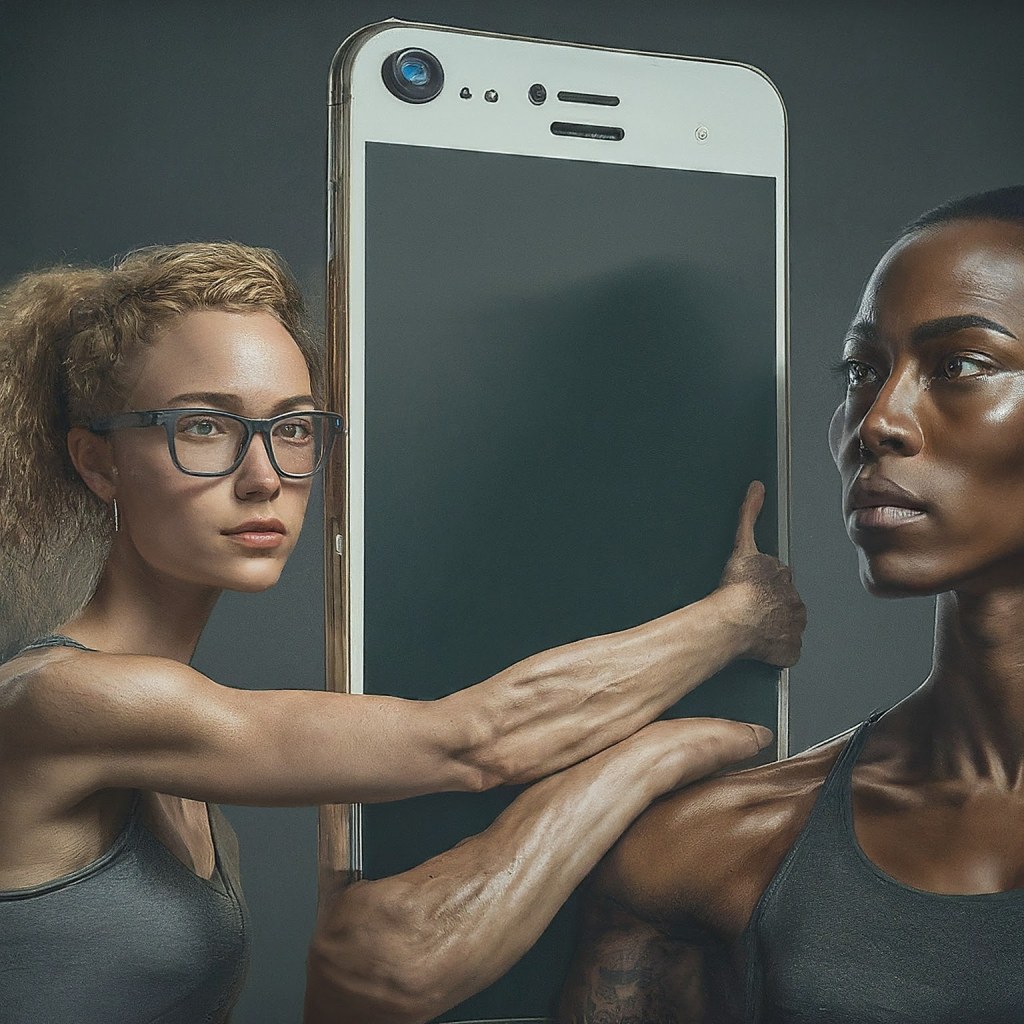

Designed by Google Gemini.

The Pros and Cons of Discriminating Your Product by Quantifying Your Benefits

Some firms make claims and don’t support them, while others support their claims with quantified benefits. But does quantifying help or harm the firms that do it? This pudding post answers this question…and then twists toward the identity/biometrics market at the end.

The “me too” players in the GCP market

Whoops.

In that heading above, I made a huge mistake by introducing an acronym without explaining it. So I’d better correct my error.

GCP stands for Glowing Carbonated Pudding.

I can’t assume that you already knew this acronym, because I just made it up. But I can assure you that the GCP market is a huge market…at least in my brain. All the non-existent kids love the scientifically advanced and maximally cool pudding that glows in the dark and has tiny bubbles in it.

Glowing Carbonated Pudding. Designed by Google Bard. Yeah, Google Bard creates images now.

Now if you had studied this non-existent market like I have, you’ll realize from the outset that most of the players don’t really differentiate their offerings. Here are a few examples of firms with poor product marketing:

  • Jane Spain GCP: “Trust us to provide good GCP.”
  • Betty Brazil GCP: “Trust us to provide really good GCP.”
  • Clara Canada GCP: “Trust us to provide great GCP.”

You can probably figure out what happened here.

  • The CEO at Betty Brazil told the company’s product marketers, “Do what Jane Spain did but do it better.”
  • After that Clara Canada’s CEO commanded, “Do what Betty Brazil did but do it better.” (I’ll let you in on a little secret. Clara Canada’s original slogan refereneced “the best GCP,” but Legal shot that down.)
Designed by Google Bard.

Frankly, these pitches are as powerful as those offered by a 17x certified resume writer.

The quantified GCP

But another company, Wendy Wyoming, decided to differentiate itself, and cited independent research as its differentiator.

Wendy Wyoming Out of This World GCP satisfies you, and we have independent evidence to prove it!

The U.S. National Institute of Standards and Technology, as part of its Pudding User Made (PUM, not FRTE) Test, confirmed that 80% of all Wendy Wyoming Out of This World GCP mixes result in pudding that both glows and is carbonated. (Mix WW3, submitted November 30, 2023; not omnigarde-003)

Treat your child to science-backed cuisine with Wendy Wyoming Out of This World GCP!Wendy Wyoming is a top tier (excluding Chinese mixes) GCP provider.

But there are other competitors…

The indirect competitor who questions the quantified benefits

There are direct competitors that provide the same product as Wendy Wyoming, Jane Spain, and everyone else.

And then there are indirect competitors who provide non-GCP alternatives that can substitute for GCPs.

For example, Polly Pennsylvania is NOT a GCP provider. It makes what the industry calls a POPS, or a Plain Old Pudding Sustenance. Polly Pennsylvania questions everything about GCP…and uses Wendy Wyoming’s own statistics against it.

Designed by Google Bard.

Fancy technologies have failed us.

If you think that one of these GCP puddings will make your family happy, think again. A leading GCP provider has publicly admitted that 1 out of every 5 children who buy a GCP won’t get a GCP. Either it won’t glow, or it’s not carbonated. Do you want to make your kid cry?

Treat your child to the same pudding that has satisfied many generations. Treat your child to Polly Pennsylvania Perfect POPS.

Pennsylvania Perfect remembers.

So who wins?

It looks like Polly Pennsylvania and Wendy Wyoming have a nasty fight on their hands. One that neck-deep marketers like to call a “war.” Except that nobody dies. (Sadly, that’s not true.)

  • Some people think that Wendy Wyoming wins because 4 out of 5 of their customers receive true GCP.
  • Others think that Polly Pennsylvaia wins because 5 out of 5 of their customers get POPS pudding.

But it’s clear who lost.

All the Jane Spains and Betty Brazils who didn’t bother to create a distinctive message.

Don’t be Jane Spain. Explain why your product is the best and all the other products aren’t.

Copying the competition doesn’t differentiate you. Trust me.

The “hungry people” (target audience) for THIS post

Oh, and if you didn’t figure it out already, this post was NOT intended for scientific pudding manufacturers. It was intended for identity/biometric firms who can use some marketing and writing help. Hence the references to NIST and the overused word “trust.”

If you’re hungry to kickstart your identity/biometric firm’s written content, click on the image below to learn about Bredemarket’s services.

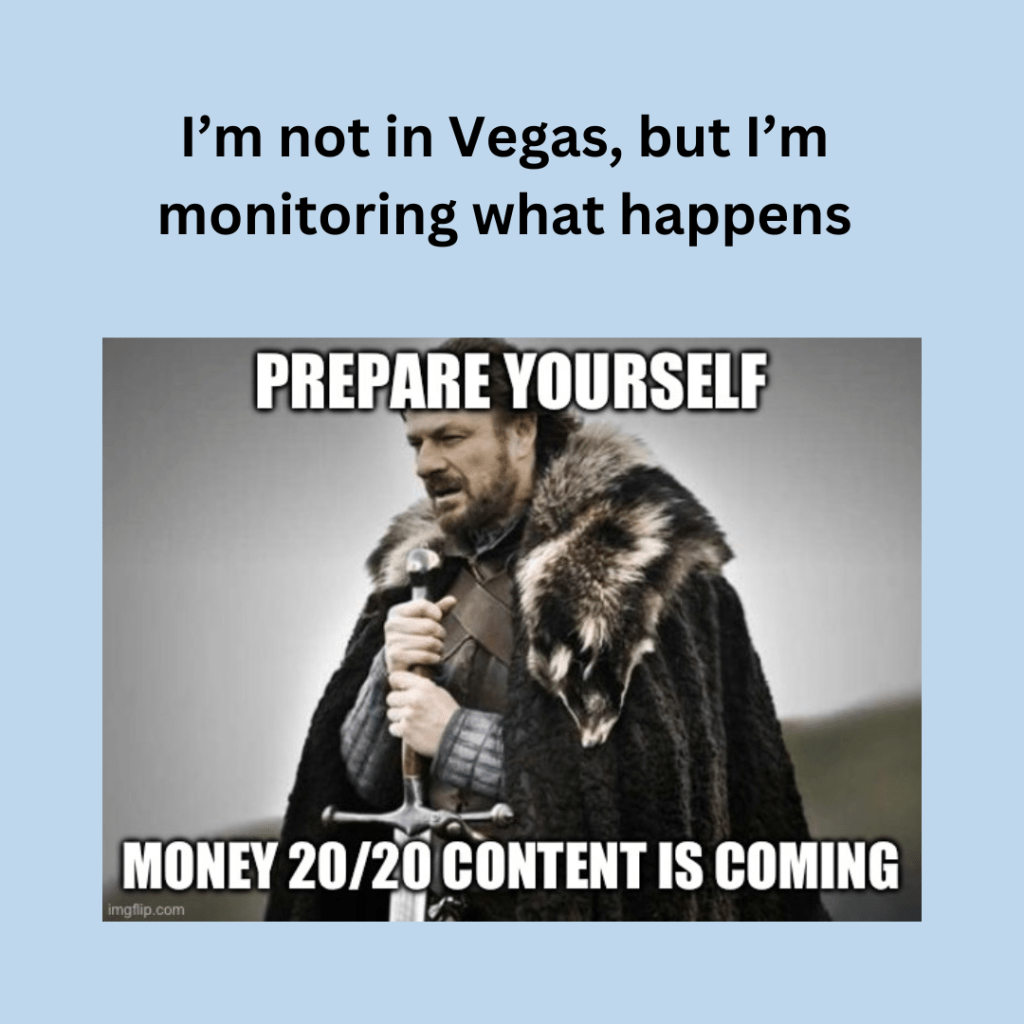
Prepare Yourself

Created by Imgflip.

Money 20/20 is taking place in Las Vegas, Nevada, USA from Sunday, October 22 to Wednesday October 25.

While I am not in Las Vegas, Bredemarket will monitor the goings-on and share relevant news on Facebook (Bredemarket Identity Firm Services group), Instagram (Bredemarket), LinkedIn (Bredemarket Identity Firm Services page), bredemarket.com, and elsewhere.

#biometric

#biometrics

#contentmarketing

#finance

#financialidentity

#fintech

#identity

#money2020

How Identity and Biometrics Firms Can Use Blogging to Grow Their Business

(Updated blog post count 10/23/2023)

Identity and biometrics firms can achieve quantifiable benefits with prospects by blogging. Over 40 identity and biometrics firms are already blogging. Is yours?

Four reasons for blogging

My recent post “The Secret to Beating Half of All Fortune 500 Marketers and Growing Your Business” lists 14 quantifiable benefits from the fresh content from blogging, derived from an infographic at Daily Infographic. Here are the most important four:

  1. Awareness: the average company that blogs generates 55% more website visitors.
  2. Lead generation: B2B marketers that use blogs get 67% more leads than those who do not.
  3. Conversions: marketers who have prioritized blogging are 13x more likely to enjoy positive ROI.
  4. Conversions (again): 92% of companies who blog multiple times per day have acquired a customer from their blog.

Blogging adds value.

Over 40 identity firms that are blogging

These firms (and probably many more) already recognize the value of identity blog post writing, and some of them are blogging frequently to get valuable content to their prospects and customers.

Is your firm on the list? If so, how frequently do you update your blog?

How your identity firm can start blogging

If you need help writing blog posts so that your identity/biometrics firm stands out, I, John E. Bredehoft of Bredemarket, can help.

My identity blog post writing experience benefits firms who identify individuals via fingers, faces, irises, DNA, driver’s licenses, geolocation, and many other factors and modalities. I truly am a biometric content marketing expert and an identity content marketing expert.

A few more things about my blogging offering:

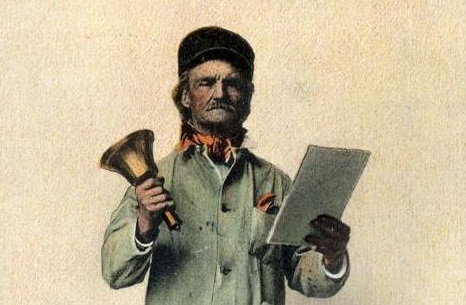
By Unknown author – postcard, Public Domain, https://commons.wikimedia.org/w/index.php?curid=7691878

In most cases, I can provide your blog post via my standard package, the Bredemarket 400 Short Writing Service. I offer other packages and options if you have special needs.

Get in touch with Bredemarket

Authorize Bredemarket, Ontario California’s content marketing expert, to help your firm produce words that return results.

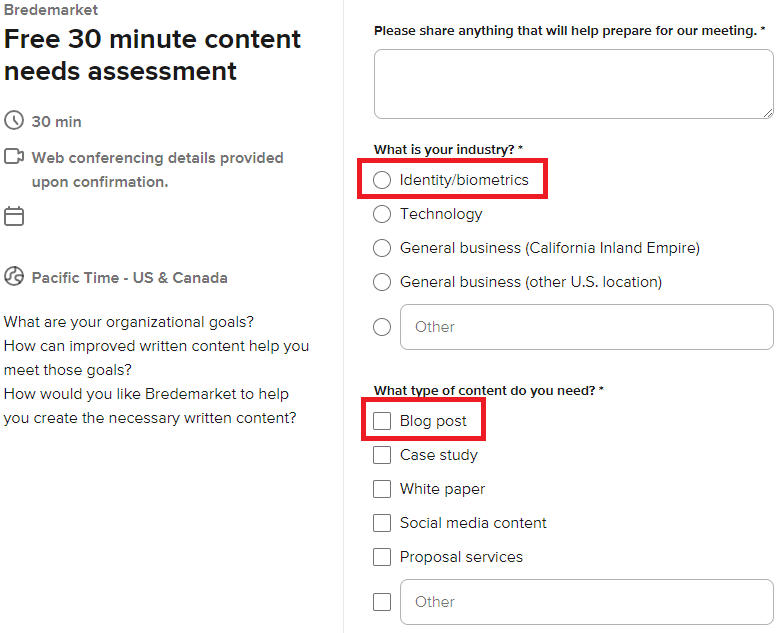
To discuss your identity/biometrics blog post needs further, book a meeting with me at calendly.com/bredemarket. On the questionnaire, select the Identity/biometrics industry and Blog post content.

Updates, updates, updates, updates…

If I hired myself to update the Bredemarket website, I’d be employed full time.

Early June website updates

My “opportunity” that allowed me to service identity clients again necessitated several changes to the website, which I documented in a June 1 post entitled “Updates, updates, updates…

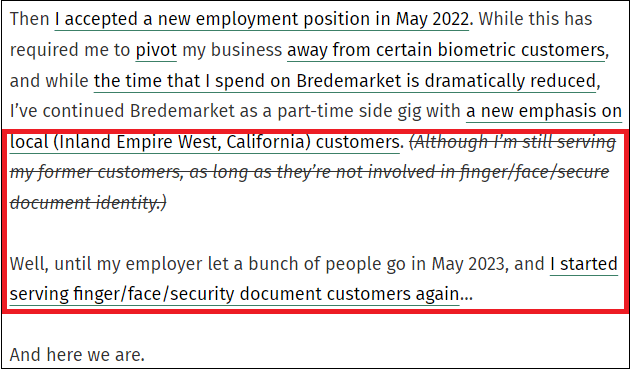
Then I had to return to this website to make some hurried updates, since my April 2022 prohibition on taking certain types of work is no longer in effect as of June 2023. Hence, my home page, my “What I Do” page, and (obviously) my identity page are all corrected.

From https://bredemarket.com/2023/06/01/updates-updates-updates/

Basically, I had gone through great trouble to document that Bredemarket would NOT take identity work, so I had to reverse a lot of pages to say that Bredemarket WOULD take identity work.

I may have found a few additional pages after June 1, but eventually I reached the point where everything on the Bredemarket website was completely and totally updated, and I wouldn’t have to perform any other changes.

You can predict where this is going.

Who I…was

Today it occurred to me that some of the readers of the LinkedIn Bredemarket page may not know the person behind Bredemarket, so I took the opportunity to share Bredemarket’s “Who I Am” web page on the LinkedIn page.

Only then did I read what the page actually said.

So THAT page was also updated (updates in red).

From https://bredemarket.com/who-i-am/ as of August 8, 1:35 pm PDT. Subject to change.

So yes, this biometric content marketing expert/identity content marketing expert IS available for your content marketing needs. If you’re interested in receiving my help with your identity written content, contact me.

To be continued, probably…

There Are Just Five Factors of Authentication. (I want the job.)

As some of you know, I’m seeking full-time employment after my former employer let me go in late May. As part of my job search, I was recently invited to a second interview for a company in my industry. Before that interview, I made an important decision about how I was going to present myself.

If you’ve read any of Bredemarket’s content, there are times when it takes a light tone, in which wildebeests roam the earth while engaging in marketing activities such as elaborating the benefits of crossing the stream.

By Danijel Mihajlovic – https://thenextcrossing.com/wildebeest-migration-kenya, CC BY-SA 4.0, https://commons.wikimedia.org/w/index.php?curid=96024366

Some of that DOES NOT fly in the corporate world. (For most companies, anyway.) If you analyze a wide selection of corporate blogs, you won’t see the word “nothingburger.” But you do here.

So as I prepared for this important job interview, I made sure that I was ready to discuss the five factors of authentication, and my deep experience as an identity content marketing expert with many of those factors.

The five factors of authentication, of course, are:

  • Something you know.
  • Something you have.
  • Something you are.
  • Something you do.
  • Somewhere you are.

“But wait a minute,” some of you are saying. “Didn’t you just say that there is a sixth factor of authentication, ‘Somewhat you why?'”

For the purposes of this job interview, there isn’t! I confined myself to the five factors only during the discussion, using examples such as passwords, driver’s licenses, faces, actions, and smartphone geolocation information.

But in the end, my caution was of no avail. I DIDN’T make it to the next stage of interviews.

Maybe I SHOULD have mentioned “Somewhat you why” after all.

Bredemarket’s Name for the Sixth Factor of Authentication

Depending upon whom you ask, there are either three or five factors of authentication.

Unless you ask me.

I say that there are six.

Let me explain.

First I’ll discuss what factors of authentication are, then I’ll talk about the three factor and five factor school, then I’ll briefly review my thoughts on the sixth factor—now that I know what I’ll call it.

What are factors of authentication?

Before proceeding to factors of authentication, let’s review TechTarget’s definition of authentication.

Authentication is the process of determining whether someone or something is, in fact, who or what it says it is.

From https://www.techtarget.com/searchsecurity/definition/authentication

For purposes of this post I’m going to stay away from the “something” part and concentrate on the “someone” part.

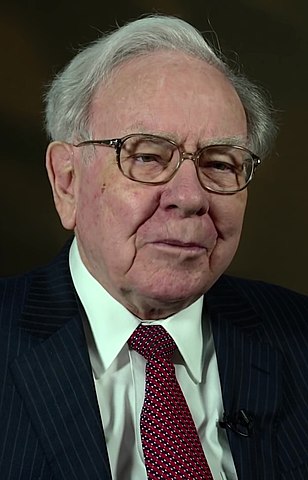
For example, if Warren Buffett has a bank account, and I claim that I am Warren Buffett and am entitled to take money from that bank account, I must complete an authentication process to determine whether I am entitled to Warren Buffett’s money. (Spoiler alert: I’m not.)

So how do I authenticate? There are many different ways to authenticate, which can be grouped into several authentication factors. Here’s how Sumo Logic defines “authentication factor.”

An authentication factor is a special category of security credential that is used to verify the identity and authorization of a user attempting to gain access, send communications, or request data from a secured network, system or application….Each authentication factor represents a category of security controls of the same type. 

From https://www.sumologic.com/glossary/authentication-factor/

When considering authentication factors, the whole group/category/type definition is important. For example, while a certain system may require both a 12-character password and a 4-digit personal identification number (PIN), these are pretty much the same type of authentication. It’s just that the password is longer than the PIN. From a security perspective, you don’t gain a lot by requiring both a password and a PIN. You would gain more by choosing a type of authentication that is substantially different from passwords and PIN.

How many factors of authentication are there?

So how do we define the factors of authentication? Different people have different definitions.

Three factors of authentication

For the most part, I believe that everyone agrees on at least three factors of authentication. As I noted in a prior post on factors of authentication, NIST defines the following three factors:

Factors include: (i) something you know (e.g. password/personal identification number (PIN)); (ii) something you have (e.g., cryptographic identification device, token); or (iii) something you are (e.g., biometric).

From https://csrc.nist.gov/glossary/term/Multi_Factor_Authentication, cited in https://bredemarket.com/2022/03/19/remember-the-newer-factors-of-authentication/

Note that NIST’s three factors are very different from one another. Knowing something (such as a password or a PIN) differs from having something (such as a driver’s license) or being something (a fingerprint or a face).

But some people believe that there are more than three factors of authentication.

Five factors of authentication

Let’s add two factors to the definition trumpeted by NIST. People such as The Cybersecurity Man have included all five in their definition.

  • Something you know.
  • Something you have.
  • Something you are.
  • Something you do.
  • Somewhere you are.

For more information, see my March 2021 post on the five factors of authentication.

But are there only five?

Six factors of authentication

In April 2022, I began wondering if there is a sixth authentication factor. While I struggled to put it into the “some xxx you xxx” format, I was able to encapsulate what this sixth factor was.

What about the authentication factor “why”?

This proposed factor, separate from the other factors, applies a test of intent or reasonableness to any identification request.

From https://bredemarket.com/2022/04/12/the-sixth-factor-of-multi-factor-authentication-you-heard-it-here-first/
Why is this man smoking a cigarette outdoors? By Marek Slusarczyk, CC BY 3.0, https://commons.wikimedia.org/w/index.php?curid=108924712

Over the months, I struggled through some examples of the “why” factor.

  • Why is a person using a credit card at a McDonald’s in Atlantic City? (Link) Or, was the credit card stolen, or was it being used legitimately?
  • Why is a person boarding a bus? (Link) Or, was the bus pass stolen, or was it being used legitimately?
  • Why is a person standing outside a corporate office with a laptop and monitor? (Link) Or, is there a legitimate reason for an ex-employee to gain access to the corporate office?

As I refined my thinking, I came to the conclusion that “why” is a reasonable factor of authentication, and that this was separate from the other authentication factors (such as “something you do”).

And the sixth factor of authentication is called…

You’ll recall that I wanted to cast this sixth authentication factor into the “some xxx you xxx” format.

So, as of today, here is the official Bredemarket list of the six factors of authentication:

  • Something you know.
  • Something you have.
  • Something you are.
  • Something you do.
  • Somewhere you are.

(Drumroll…)

  • Somewhat you why.

Yes, the name of this factor stands out from the others like a sore thumb (probably a loop).

However, the performance of this factor stands out from the others. If we can develop algorithms that accurately measure the “why” reasonableness of something as a way to authenticate identity, then our authentication capabilities will become much more powerful.

Three Ways to Identify and Share Your Identity Firm’s Differentiators

(Part of the biometric product marketing expert series)

Are you an executive with a small or medium sized identity/biometrics firm?

If so, you want to share the story of your identity firm. But what are you going to say?

How will you figure out what makes your firm better than all the inferior identity firms that compete with you?

How will you get the word out about why your identity firm beats all the others?

Are you getting tired of my repeated questions?

Are you ready for the answers?

Your identity firm differs from all others

Over the last 29 years, I (John E. Bredehoft of Bredemarket) have worked for and with over a dozen identity firms, either as an employee or as a consultant.

You’d think that since I have worked for so many different identity firms, it’s an easy thing to start working with a new firm by simply slapping down the messaging that I’ve created for all the other identity firms.

Nothing could be further from the truth.

Designed by Freepik.

Every identity firm needs different messaging.

  • The messaging that I created in my various roles at IDEMIA and its corporate predecessors was dramatically different than the messaging I created as a Senior Product Marketing Manager at Incode Technologies, which was also very different from the messaging that I created for my previous Bredemarket clients.
  • IDEMIA benefits such as “servicing your needs anywhere in the world” and “applying our decades of identity experience to solve your problems” are not going to help with a U.S.-only firm that’s only a decade old.
  • Similarly, messaging for a company that develops its own facial recognition algorithms will necessarily differ from messaging for a company that chooses the best third-party facial recognition algorithms on the market.

So which messaging is right?

It depends on who is paying me.

How your differences affect your firm’s messaging

When creating messaging for your identity firm, one size does not fit all, for the reasons listed above.

The content of your messaging will differ, based upon your differentiators.

  • For example, if you were the U.S.-only firm established less than ten years ago, your messaging would emphasize the newness of your solution and approach, as opposed to the stodgy legacy companies that never updated their ideas.
  • And if your firm has certain types of end users, such as law enforcement users, your messaging would probably feature an abundance of U.S. flags.

In addition, the channels that you use for your messaging will differ.

Identity firms will not want to market on every single social media channel. They will only market on the channels where their most motivated buyers are present.

  • That may be your own website.
  • Or LinkedIn.
  • Or Facebook.
  • Or Twitter.
  • Or Instagram.
  • Or YouTube.
  • Or TikTok.
  • Or a private system only accessible to people with a Top Secret Clearance.
  • Or display advertisements located in airports.
From https://www.youtube.com/watch?v=H02iwWCrXew

It may be more than one of these channels, but it probably won’t be all of them.

But before you work on your content or channels, you need to know what to say, and how to communicate it.

How to know and communicate your differentiators

As we’ve noted, your firm is different than all others.

  • How do you know the differences?
  • How do you know what you want to talk about?
  • How do you know what you DON’T want to talk about?

Here are three methods to get you started on knowing and communicating your differentiators in your content.

Method One: The time-tested SWOT analysis

If you talk to a marketer for more than two seconds about positioning a company, the marketer will probably throw the acronym “SWOT” back at you. I’ve mentioned the SWOT acronym before.

For those who don’t know the acronym, SWOT stands for

  • Strengths. These are internal attributes that benefit your firm. For example, your firm is winning a lot of business and growing in customer count and market share.
  • Weaknesses. These are also internal attributes, but in this case the attributes that detract from your firm. For example, you have very few customers.
  • Opportunities. These are external factors that enhance your firm. One example is a COVID or similar event that creates a surge in demand for contactless solutions.
  • Threats. The flip side is external factors that can harm your firm. One example is increasing privacy regulations that can slow or halt adoption of your product or service.

If you’re interested in more detail on the topic, there are a number of online sources that discuss SWOT analyses. Here’s TechTarget’s discussion of SWOT.

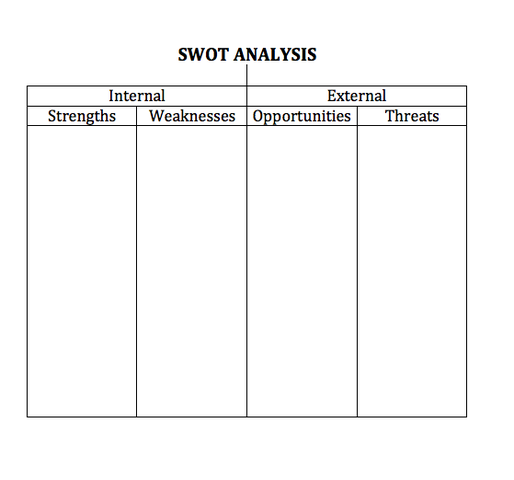
The common way to create the output from a SWOT analysis is to create four boxes and list each element (S, W, O, and T) within a box.

By Syassine – Own work, CC BY-SA 3.0, https://commons.wikimedia.org/w/index.php?curid=31368987

Once this is done, you’ll know that your messaging should emphasize the strengths and opportunities, and downplay or avoid the weaknesses and threats.

Or alternatively argue that the weaknesses and threats are really strengths and opportunities. (I’ve done this before.)

Method Two: Think before you create

Personally, I believe that a SWOT analysis is not enough. Before you use the SWOT findings to create content, there’s a little more work you have to do.

I recommend that before you create content, you should hold a kickoff of the content creation process and figure out what you want to do before you do it.

During that kickoff meeting, you should ask some questions to make sure you understand what needs to be done.

I’ve written about kickoffs and questions before, and I’m not going to repeat what I already said. If you want to know more:

Method Three: Send in the reinforcements

Now that you’ve locked down the messaging, it’s time to actually create the content that differentiates your identity firm from all the inferior identity firms in the market. While some companies can proceed right to content creation, others may run into one of two problems.

  • The identity firm doesn’t have any knowledgeable writers on staff. To create the content, you need people who understand the identity industry, and who know how to write. Some firms lack people with this knowledge and capability.
  • The identity firm has knowledgeable writers on staff, but they’re busy. Some companies have too many things to do at once, and any knowledgeable writers that are on staff may be unavailable due to other priorities.
Your current staff may have too much to do. By Backlit – Own work, CC BY-SA 3.0, https://commons.wikimedia.org/w/index.php?curid=12225421

This is where you supplement you identity firm’s existing staff with one or more knowledgeable writers who can work with you to create the content that leaves your inferior competitors in the dust.

What is next?

So do you need a knowledgeable biometric content marketing expert to create your content?

One who has been in the biometric industry for 29 years?

One who has been writing short and long form content for more than 29 years?

Are you getting tired of my repeated questions again?

Well then I’ll just tell you that Bredemarket is the answer to your identity/biometric content marketing needs.

Are you ready to take your identity firm to the next level with a compelling message that increases awareness, consideration, conversion, and long-term revenue? Let’s talk today!

Why Your Business Needs an Obsessive Content Marketer

Compulsions and obsessions can be bad things, or they can be good things if channeled correctly.

What if Bredemarket provided me an outlet to chnnel my compulsions and obsessions to help your business grow?

Compulsions and obsessions

I recently wrote a three-post series (first post in the series here) that frequently used the word “compulsion.”

I almost used the word “obsession” in conjunction with the word compulsion, but decided not to make light of a medical condition that truly debilitates some people.

I used the word compulsion to refer to two things about me:

Writing compulsion, or writing obsession. Designed by Freepik.

While compulsions and obsessions can certainly be bad things, when harnessed properly they can provide good for the world.

Like a butterfly.

Animotion on embracing an obsession

When people of a certain age hear the word “obsession,” they may think of the 1980s song by the band Animotion.

From https://www.youtube.com/watch?v=hIs5StN8J-0

Unfortunately for us, 90% of the song deals with the negative aspects of a person obsessing over another person. If you pick through the lyrics of the Animotion song “Obsession” and forget about what (or who) the singer is obsessing about, you can find isolated phrases that describe how an obsession can motivate you.

  • “I cannot sleep”
  • “Be still”
  • “I will not accept defeat”

But thankfully, there are more positive ways to embrace an obsession.

Justin Welsh on embracing an obsession

While Justin Welsh’s July 2022 post “TSS #028: Don’t Pick a Niche. Embrace an Obsession” is targeted for solopreneurs, it could just as easily apply to those who work for others. Regardless of your compensation structure, why do you choose to work where you do?

For Welsh, the practice of picking a niche risks commoditization.

They end up looking like, sounding like, and acting like all of their competition. The internet is full of copycats and duplicates.

From https://www.justinwelsh.me/blog/dont-pick-a-niche-embrace-an-obsession

(For example, I’d bet that all of the people who are picking a niche know better than to cite the Animotion song “Obsession” in a blog post promoting their business.)

Perhaps it’s semantics, but in Welsh’s way of thinking, embracing an obsession differs from picking a niche. To describe the power of embracing an obsession, Welsh references a tweet from Daniel Vassalo:

Find something you want to do really badly, and you won’t need any goals, habits, systems, discipline, rewards, or any other mental hacks. When the motivation is intrinsic, those things happen on their own.

From https://twitter.com/dvassallo/status/1547230105805754369

I trust you can see the difference between picking something you HAVE to do, versus obsessing over something you WANT to do.

What’s in it for you?

Welsh was addressing this post to me and people like me, and his message resonates with me.

But frankly, YOU don’t care about me and about whether I’m motivated. All that you care about is that YOU get YOUR content that you need from me.

So why should you care what Justin Welsh and Daniel Vassllo told me?

The obvious answer is that if you contract with Bredemarket for your marketing and writing services, you’ll get a “pry my keyboard out of my cold dead hands” person who WANTS to write your stuff, and doesn’t want to turn the writing process over to some two-year-old bot (except for very small little bits).

Regarding the use of two-year-old bots:

“Pry my keyboard,” indeed.

Do you need someone to obsess over YOUR content?

Of course, if you need someone to write YOUR stuff, then I won’t have time to work on a TikTok dance. This is a good thing for me, you, and the world.

As I’ve stated elsewhere, before I write a thing for a Bredemarket client, I make sure that I understand WHY you do what you do, and understand everything else that is relevant to the content that we create.

As I work on the content, you have opportunities to review it and provide your feedback. This ensures that both of us are happy with the final copy.

And that your end users become obsessed with YOU.

So if you need me to create content for you, please contact me.

Feel free to share YOUR favorite 1980s song if you like.

Even if it’s THIS song that your favorite temperamental writer detests.

From https://www.youtube.com/watch?v=aDgHXiWgKlE

Fill Your Company Gap With A Biometric Content Marketing Expert

Companies often have a lot of things they want to do, but don’t have the people to do them. It takes a long time to hire someone, and it even takes time to find a consultant that knows your industry and can do the work.

This affects identity/biometric companies just like it affects other companies. When an identity/biometric company needs a specific type of expertise and needs it NOW, it’s often hard to find the person they need.

If your company needs a biometric content marketing expert (or an identity content marketing expert) NOW, you’ve come to the right place—Bredemarket. Bredemarket has no identity learning curve, no content learning curve, and offers proven results.

Identity/biometric consulting in the 1990s

I remember when I first started working as an identity/biometric consultant, long before Bredemarket was a thing.

OK, not quite THAT long ago. I started working in biometrics in the 1990s—NOT the 1940s.

In 1994, the proposals department at Printrak International needed additional writers due to the manager’s maternity leave, and she was so valuable that Printrak needed to bring in TWO consultants to take her place.

At least initially, the other consultant and I couldn’t fill the manager’s shoes.

Designed by Freepik.
  • Both of us could write.
  • Both of us could spell “AFIS.”
  • Both of us could spell “RAID.” Not the bug spray, but the storage mechanism that stored all those “huge” fingerprint images.
  • But on that first night that I was cranking out proposal letters for something called a “Latent Station 2000,” I didn’t really know WHAT I was writing about.

As time went on, the other consultant and I learned much more—so much that the company brought both of us on as full-time employees.

After we were hired full-time, we spent a combined 45+ years at Printrak and its corporate successors in proposals, marketing, and product management positions, contributing to industry knowledge.

Which shows that learning how to spell “AFIS” can have long-term benefits.

Printrak’s problem

When Printrak needed biometric proposal writing experts quickly, it found two people who filled the bill. Sort of.

But neither of us knew biometrics before we started consuting at Printrak.

And I had never written a proposal before I started consulting at Printrak. (I had written an RFP. Sort of.)

But frankly, there weren’t a lot of identity/biometric consultants out in the field in the 1990s. There were the 20th century equivalents of Applied Forensic Services LLC, but at the time I don’t think there were any 20th century equivalents of Tandem Technical Writing LLC.

The 21st century solution

Unlike the 1990s, identity/biometric firms that need consulting help have many options. In addition to Applied Forensic Services and Tandem Technical Writing you have…me.

Mike and Laurel can tell you what they can do, and I heartily endorse both of them.

Let me share with you why I call myself a biometric content marketing expert who can help your identity/biometric company get marketing content out now:

  • No identity learning curve
  • No content learning curve
  • Proven results

No identity learning curve

I have worked with finger, face, iris, DNA, and other biometrics, as well as government-issued identity documents and geolocation. If you are interested, you can read my Bredemarket blog posts that mention the following topics:

No content learning curve

Because I’ve produced both external and internal content on identity/biometric topics, I offer the experience to produce your content in a number of formats.

  • External content: account-based marketing content, articles, blog posts (I am the identity/biometric blog expert), case studies, data sheets, partner comarketing content, presentations, proposals, sales literature sheets, scientific book chapters, smartphone application content (events), social media posts, web page content, and white papers.
  • Internal content: battlecards, competitive analyses, demonstration scripts (events), email internal newsletters, FAQs, multi-year plans, playbooks, project plans, proposal templates, quality improvement documents, requirements documents, strategic analyses, and website/social media analyses.

Proven results

Read about them here.

So how can you take advantage of my identity/biometric expertise?

If you need day-one help for an identity/biometric content marketing or proposal writing project, consider Bredemarket.