How Other Experts Refer to “Somewhat You Why”

Unlike most other posts that appear under my name—Bredebot posts are another matter—this post breaks my 2023 rule because most of it was written by Google Gemini, not me.

But I figured that if I wrote a book specifically about SIX factors of authentication…
Four pages from "Proving Humanity: The Six Factors of Identity Verification and Authentication" by John E. Bredehoft, Bredemarket. Click on the image to purchase.
The book.

…it would be nice to know if other experts held similar thoughts.

My prompt to Gemini

Bredemarket has promoted “somewhat you why” as a sixth factor of identity verification / authentication. Has anyone else shared similar observations?

Gemini’s response

Here is the short answer: Yes, industry experts and security frameworks strongly agree with the core observation, though they call it “Authentication Intent,” “Intent Verification,” or “Context-Aware/Risk-Based Authentication” rather than using Bredemarket’s play-on-words.

Shifting Truths. Google Lyria. Public Domain.

John Bredehoft (Bredemarket) coined “somewhat you why” to fit the traditional naming convention (something you know, have, are, do, somewhere you are). His argument is that checking why an action or request is taking place—evaluating intent, transaction risk, or reasonableness—functions as a crucial safeguard, especially in an era of deepfakes and automated AI agents.

While the tongue-in-cheek name is unique to Bredemarket, the concept itself is widely discussed and implemented across the cybersecurity industry under three main paradigms:

1. “Authentication Intent” (NIST Standards)

The National Institute of Standards and Technology (NIST) explicitly addresses intent in NIST SP 800-63B.

  • The Problem: A user might have a valid session token, biometrics, or physical key plugged in, but malware or a session hijack could trigger actions without the user’s conscious decision.
  • The Solution: Systems require an explicit act of intent—like tapping a physical FIDO key, typing a PIN, or responding to a contextual prompt—proving that the user intended to execute that specific action at that moment.

2. Intent Verification for AI & Delegated Actions

With the rise of autonomous AI agents and automated workflows, identity security groups (like the Non-Human Identity/NHI movement) frequently discuss Intent Verification.

  • Conventional authentication proves who logged in, but not whether the user meant to perform this specific action.
  • Intent Verification bridges authentication and authorization by evaluating whether a transaction (e.g., a $35M wire transfer or an API call) aligns with the user’s actual current decision and business policy.

3. Context-Aware and Adaptive Authentication

Identity providers (like Palo Alto Networks, Okta, and Silverfort) build their Adaptive Multi-Factor Authentication (AMFA) around the “why” and “context”:

  • Context Signals: What resource is being accessed? Is this normal business behavior? Does this request make sense given the time, value, and sensitivity?
  • Dynamic Step-Up: If the “why” seems low-risk (e.g., checking internal docs during work hours), access is smooth. If the “why” is high-risk or suspicious (e.g., a wire transfer requested via video call), the system demands step-up verification.

How the Views Compare

While most identity security professionals treat “intent and context” as a governance or risk engine layer wrapping traditional factors rather than a 6th factor itself, everyone agrees with Bredemarket’s baseline premise: verifying who someone is without evaluating what and why they are trying to do it is no longer enough to stop modern fraud.

The Bangladesh Identities Weren’t Synthetic Identities, But They Failed The “Somewhat You Why” Test

Andrew Austin at Sardine has written an eye-catching blog post that discusses a fraud ring exhibiting unusual patterns.

  • Some fraudsters use synthetic identities to fool systems, but good systems can catch the synths.
  • But other fraudsters use mules and other techniques that pass identity verification checks, because the people are REAL people.
Google Gemini.

Austin’s post discusses an example of the latter.

Sign-up patterns in Bangladesh

In this particular case (Example 3 of 3), a gig economy company had discovered a fraud ring operating out of Bangladesh, but the identities were those of real people. The investigator noticed something right off the bat:

“When we looked into it, something was off: all of the locations seemed to be clustered in a few small towns.”

But wait…it gets better.

“The fraudsters were going door-to-door and signing up anyone who was willing to share their information….

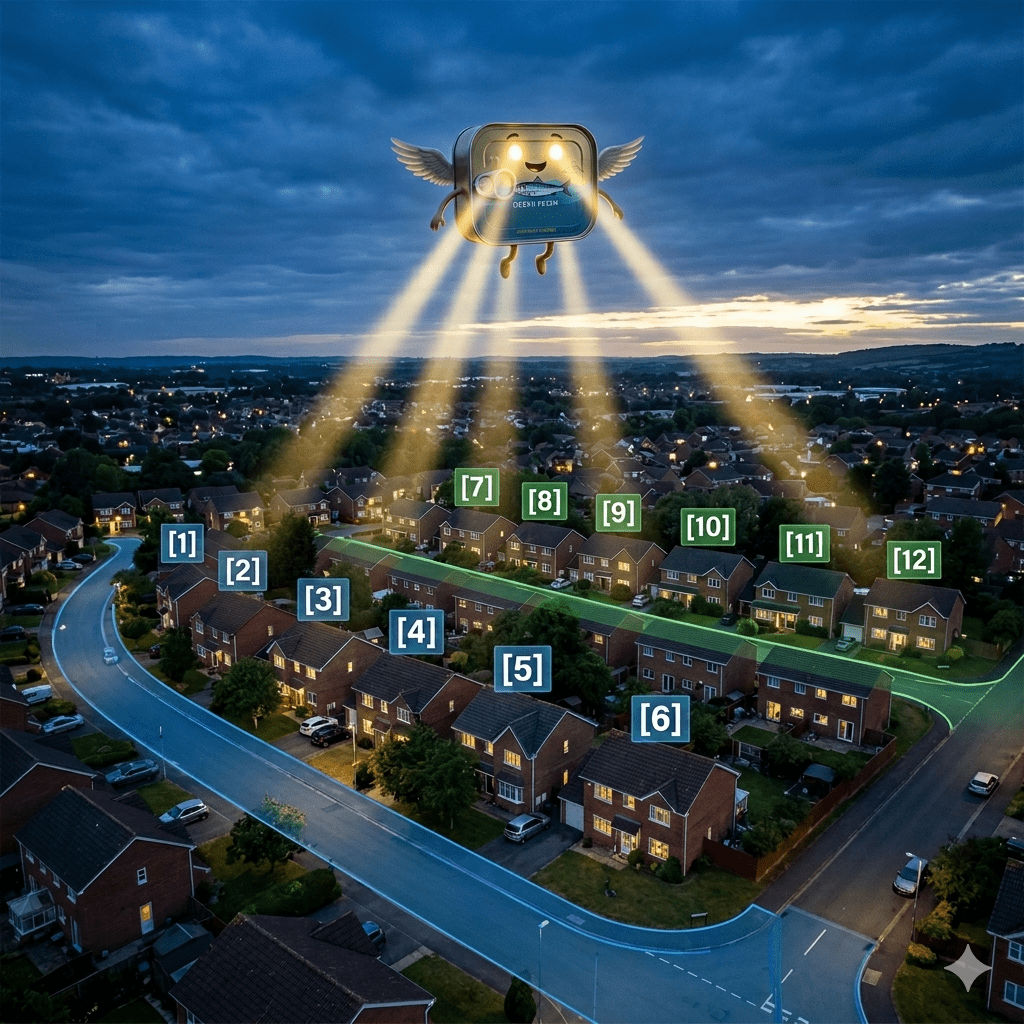
“Dozens of routes snaked through neighborhoods where new accounts were being created, each of them running from North to South and then back to their starting point on the next street over.”

It turns out that the fraudsters were going down each street, paying people to borrow their identities, and then moving on to the next street.

Google Gemini.

How identity factors (in the plural) identified the fraud

In Bredemarket’s view, this raised alarms surrounding two factors of identity verification and authentication.

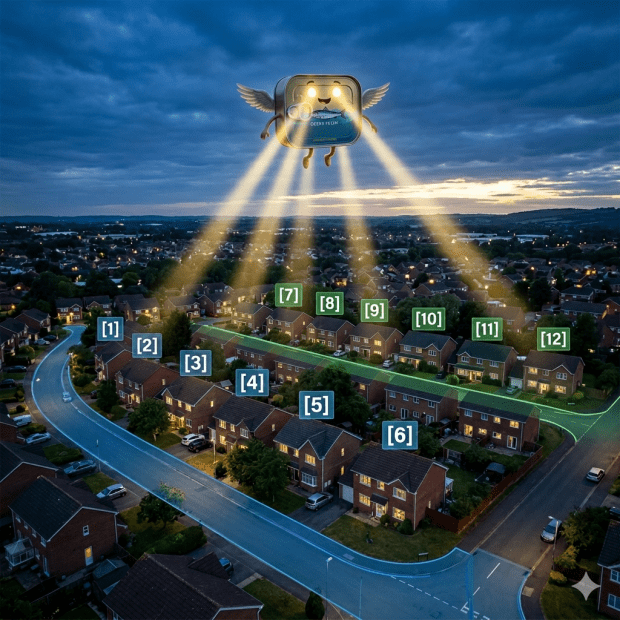
  • The first was geolocation. Once the identities were plotted, it seems strange that all of the identities lined up down each street and on to the next street.
  • The second is what I call somewhat you why. It’s reasonable to believe that if person A signs up for a service, their neighbors may sign up also. But it’s NOT reasonable to believe that people would sign up for the service in address order, moving from street to street. “No, Jim, 158 1st street can’t sign up for the service! 156 1st street hasn’t signed up yet!”

Now even if you don’t believe that “somewhat you why” is a real factor (Sardine prefers to talk about “device and behavior intelligence“), it’s clear that fraudsters were using the identities of real people to engage in a massive fraud scheme.

Look at the patterns, and you can discover from unusual ones.

And now a word from our sponsor

And if you’re wondering why I discuss SIX factors of identity verification and authentication (rather than five or three), check out my ebook “Proving Humanity: The Six Factors of Identity Verification and Authentication.”

Four pages from "Proving Humanity: The Six Factors of Identity Verification and Authentication" by John E. Bredehoft, Bredemarket. Click on the image to purchase.

On Intent

I’ve been playing with the idea of intent (what I call “somewhat you why”) as a factor of identity verification and authentication. And although most people aren’t willing to go that far, intent analysis is becoming more important.

Biometric Update’s Chris Burt quoted RealSense Chief Marketing Officer Mike Nielsen on the company’s ID Pro. In this case, intent detection is used in a non-biometric fashion.

“We now have the ability to detect a person — not just a face — on the module.  Meaning, we can classify body parts (legs, arms, hands, feet) and estimate pose in real time, without any additional external software.  This includes which direction they are walking, how far away they are, and how quickly they are moving. This opens up an enormous opportunity for next-gen applications where you need to know the intent of a person beyond identifying their identity.  And you still get the ability to authenticate faces on the same platform.”

This is definitely NOT identity verification or authentication, but is certainly useful.

If accurate. If a system misreads intent, it can be disastrous.

Returning to Lattice Identity

The last time I delved into lattices, it was in connection with the NIST FIPS 204 Module-Lattice-Based Digital Signature Standard. To understand why the standard is lattice-based, I turned to NordVPN:

“A lattice is a hierarchical structure that consists of levels, each representing a set of access rights. The levels are ordered based on the level of access they grant, from more restrictive to more permissive.”

In essence, the lattice structure allows more elaborate access rights.

This article (“Lattice-Based Identity and Access Management for AI Agents”) discusses lattices more. Well, not explicitly; the word “lattice” only appears in the title. But here is the article’s main point:

“We are finally moving away from those clunky, “if-this-then-that” systems. The shift to deep learning means agents can actually reason through a mess instead of just crashing when a customer uses a slang word or a shipping invoice is slightly blurry.”

It then says

“Deep learning changes this because it uses neural networks to understand intent, not just keywords.”

Hmm…intent? Sounds a little somewhat you why…or maybe it’s just me.

But it appears that we sometimes don’t care about the intent of AI agents.

“If you gave a new employee the keys to your entire office and every filing cabinet on day one, you’d be sweating, right? Yet, that is exactly what many companies do with ai agents by just slapping an api key on them and hoping for the best.”

This is not recommended. See my prior post on attribute-based access control, which led me to focus more on non-person entities (non-human identities).

As should we all.

The Eagles, Geolocation, and Somewhat You (I Can’t Tell You) Why

If you’re not familiar with the complete history of the Eagles, you may not know that they began as practitioners of country rock. Their early songs were therefore softer than the ones from the Joe Walsh years.

One of those songs (actually later, but earlier in feel) was “Lyin’ Eyes.”

And it contains a lyrical oddity.

Glenn Frey and Don Henley could tell stories with the best country songwriters. And this was no exception, with a tale of a woman seeking solace outside of her marriage. Her life gets more scattered, until the singer turns judge and announces, “My, oh my, you sure know how to arrange things.”

But before that, when the singer is merely telling the story, the woman needs to seek solace.

Google Gemini.

So the singer says what the woman is doing:

“She is headed toward the cheatin’ side of town”

Now this is a lyrical fiction.

To my knowledge, no town in California or anywhere else enforces residential zoning regulations that segregate cheaters from non-cheaters. When “the boy” in the song rented his apartment (in Buena Park?), he didn’t need to indicate his receptiveness to desperate housewives. (Different decade, I know.)

Google Gemini.

So if the cheatin’ side of town is not a geolocation, is it perhaps tied to another factor of authentication?

Such as the sixth factor—somewhat you why?

After all, you could use non-identity biometrics such as respiration to discover the intent of a woman, whether she is driving

  • to comfort an old friend who’s feeling down, or
  • to rush into a man’s arms as they fall together.

Cheaterland is a state of mind. My, oh my.

Google Gemini.

And if I may interject an author’s note, I am VERY impressed with Google Gemini (Nano Banana 2) for knowing what a “Thomas Brothers Map” is. Except that I had to change my story setting from North Hollywood to Buena Park to match the images.

“Life in the Fast Lane,” of course, would need a Los Angeles County map.

Access and “Somewhat You Why”

In case you missed it, I’ve been pushing a sixth factor of authentication called “Somewhat You Why.”

“As I refined my thinking, I came to the conclusion that “why” is a reasonable factor of authentication, and that this was separate from the other authentication factors (such as “something you do”).”

And now Identity Jedi Harvey Lee is also asking the “why” question, but specifically in terms of access control.

“[B]ecause we couldn’t determine why someone needed access, we built systems that tried to guess the answer for us….

“Roles were never about “least privilege.” Roles were our attempt to predict intent at scale. And like most predictions, especially in complex systems, they were right until they weren’t….

“Instead of front-loading permissions for every possible future scenario, we authorize the current scenario. Identity might still be the new perimeter — but intent is the new access key.”

Read “Intent Is the New Access Key.”

For example, if a dehydrated man wants to unlock a water tank, I have a pretty good idea of his intent.

Google Gemini.

Continuous Authentication HAS To Be Multi-Factor

If you authenticate a person at the beginning of a session and never authenticate them again, you have a huge security hole.

For example, you may authenticate an adult delivery person and then find a kid illegally making your delivery. 31,000 Brazilians already know how to do this.

By LukaszKatlewa – Own work, CC BY-SA 4.0, https://commons.wikimedia.org/w/index.php?curid=49248622.

That’s why more secure firms practice continuous authentication for high-risk transactions.

But continuous authentication can be intrusive.

How would you feel if you had to press your finger on a fingerprint reader every six seconds?

Grok.

Enough of that and you’ll start using the middle finger to authenticate.

Even face authentication is intrusive, if it’s 3 am and you don’t feel like being on camera.

Now I’ve already said that Amazon doesn’t want to over-authenticate everything. 

Grok.

But Amazon does want to authenticate the critical transactions. Identity Week

“Amazon treats authentication as a continuous process, not a one-time event. It starts with verifying who a user is at login, but risk is assessed throughout the entire session, watching for unusual behaviours or signals to ensure ongoing confidence in the user’s identity.”

That’s right: Amazon uses “somewhat you why” as an authentication factor.

I say they’re smart.

“Somewhat You Why” and Geolocation Stalkerware

Geolocation and “somewhat you why” (my proposed sixth factor of identity verification and authentication) can not only be used to identify and authenticate people.

They can also be used to learn things about people already authenticated, via the objects they might have in their possession.

Stalkerware

404 Media recently wrote an article about “stalkerware” geolocation tools that vendors claim can secretly determine if your partner is cheating on you.

Before you get excited about them, 404 Media reveals that many of these tools are NOT secret.

“Immediately notifies anyone traveling with it.” (From a review)

Three use cases for geolocation tracking

But let’s get back to the tool, and the intent. Because I maintain that intent makes all the difference. Look at these three use cases for geolocation tracking of objects:

  • Tracking an iPhone (held by a person). Many years ago, an iPhone user had to take a long walk from one location to another after dark. This iPhone user asked me to track their whereabouts while on that walk. Both of us consented to the arrangement.
  • Tracking luggage. Recently, passengers have placed AirTags in their luggage before boarding a flight. This lets the passengers know where their luggage is at any given time. But some airlines were not fans of the practice:

“Lufthansa created all sorts of unnecessary confusion after it initially banned AirTags out of concern that they are powered by a lithium battery and could emit radio signals and potentially interfere with aircraft navigation.

“The FAA put an end to those baseless concerns saying, “Luggage tracking devices powered by lithium metal cells that have 0.3 grams or less of lithium can be used on checked baggage”.   The Apple AirTag battery is a third of that size and poses no risk to aircraft operation.”

  • Tracking an automobile. And then there’s the third case, raised by the 404 Media article. 404 Media found countless TikTok advertisements for geolocation trackers with pitches such as “men with cheating wives, you might wanna get one of these.” As mentioned above, the trackers claim to be undetectable, which reinforces the fact that the person whose car is being tracked did NOT consent.

From consent to stalkerware, and the privacy implications

Geolocation technologies are used in every instance. But in one case it’s perfectly acceptable, while it’s less acceptable in the other two cases.

Banning geolocation tracking technology would be heavy-handed since it would prevent legitimate, consent-based uses of the technology.

So how do we set up the business and technical solutions that ensure that any tracking is authorized by all parties?

Does your firm offer a solution that promotes privacy? Do you need Bredemarket’s help to tell prospects about your solution? Contact me.