New content creation carries a level of uncertainty.
Will this future blog post raise awareness about your company’s product?
Will the case study assist those in the consideration phase?
Finally, will your formal proposal result in conversion?
This uncertainty itself creates a giddiness as you await the results of your product marketing. Will this be the one?
So how do you maintain that inner excitement?
Easy.
Never give final approval on the content.
And you can continue to imagine the “what if” rewards.
Bredemarket’s failure
Now this highlights a terrible failure on Bredemarket’s part.
Because my goal isn’t to get you into a “what if” euphoria.
My goal is to complete the work and get it out.
Bredemarket: Services, Process, and Pricing.
If you’ve seen my descriptions of Bredemarket’s services, the final goal is always clearly in sight. I produce a draft, you review the draft, I revise, you review again, I provide the final copy, and you publish it.
Well, that’s the intent.
Business lost…or was it?
I turned a simple blog post draft over to a client, and two months later the client hadn’t reviewed it. I ended the project right there.
So did I lose business? Not really. For short projects I am paid at project completion, and this project was never going to complete.
So if your goal in life is to work on product marketing without ever completing anything, your company is not a fit for Bredemarket.
Archie’s friend Rocky is not getting stuff done. Google Gemini.
For one thing, they’re easy to remember: why, how, what, goal, benefits, hungry people (target audience), emotions.
So I use these questions in actual client work.
The seven questions.
Using these questions with a Bredemarket client
Again, this isn’t just ivory tower stuff. I actually USE these questions. Here’s an anonymized example of how I recently used five of these seven questions to launch a new client project.
The questions I asked
Why is this document needed?
How will this document be used? As a download? As introductory text within proposals? As a demo script, video script, or webinar script?
What funnel stage(s) should this document address? Awareness? Consideration? Conversion?
As a related question, what is the primary goal of this document?
Who should be the target(s) for this document? Decision-makers? Technologists?
Approximate document length?
Just between you and me, “approximate document length” is one of the questions I ask AFTER I’ve asked my initial seven questions. I normally don’t talk about my other questions (if I tell you about them I will have to kill you), but they’re there.
The questions I didn’t ask
And no, I felt no driving need to ask about the benefits of the document. The chief benefit is more sales of the product that the document will describe.
And in this case I didn’t ask about emotions. Perhaps I’ll address that once I have a better feel for the document and start writing it.
It’s too early to say how these questions will shape the final content, because I just asked them. But I believe the answers will give me a rapid head start on creating the client’s deliverable.
So what?
But you don’t care about my client (unless you ARE my client and are reading this). You care about YOUR content.
How can my question process help you create stellar content and more sales of YOUR product?
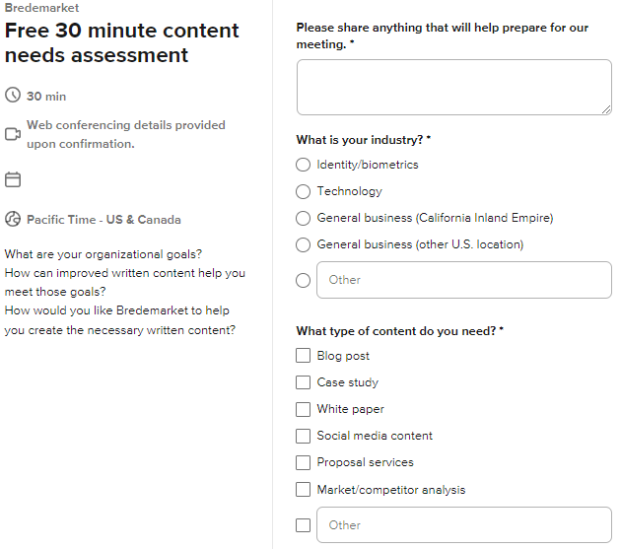
If you want me to annoy YOU with a lot of questions (in the same way that I annoy my existing clients), set up a free meeting.
Are you a technology marketing leader, struggling to market your products to your prospects for maximum awareness, consideration, and conversion?
I’m John E. Bredehoft. For over 30 years, I’ve created strategy and tactics to market technical products for over 20 B2B/B2G companies and consulting clients.
While updating my resume today, I discovered that I have now written over 700 blog posts on the Bredemarket site alone. This is number 725, in case you’re keeping score.
And that doesn’t count the myriad of blog posts I’ve written for consulting clients or employers, plus the posts I’ve written for other blogs over the years dating back to 2003.
So in case you’re wondering: yes, I’ve written blog posts before.
And I can augment your company’s resources by writing blog posts (for example, via the Bredemarket 400 Short Writing Service) that drive awareness, consideration, and/or conversion.
With over 29 years of identity/biometric experience, John Bredehoft of Bredemarket is the biometric product marketing expert that can move your company forward.
Bredemarket has consistently preached benefits, benefits, benefits, since customers want to know what’s in it for them. Customers don’t care if Bredemarket has been in business for three years; they care about how Bredemarket will facilitate consideration of their offerings.
But Tamara Grominsky, in her article “High-Converting Homepages,” points out one significant exception to the “benefits over features” rule—or, in alternate terms, the “outcomes over capabilities” rule.
We’ve been taught to market the benefit, not the feature. The team at Fletch PMM believes there’s a better way. They focus on capabilities over outcomes.
In the startup world especially, buyers need to know the “how”. You don’t have the credibility yet to skip over what the product is and how it works. Buyers don’t believe the outcomes until these more basic questions are answered.
The remainder of Grominsky’s article, which you can read here, lists five steps that you and I can follow to ensure that prospects understand our capabillities so that they will “believe the outcomes.” Step 4, for example, includes Fletch PMM’s handy-dandy value proposition builder.
Now I just have to absorb this and get a little more feature-centric about my marketing and writing services.
No, not THAT type of engagement, although there are parallels between engagement with a person and engagement with content.
In the same way that content impressions can move a prospect to awareness, content engagement can move a prospect to consideration. And even if you don’t believe in the traditional funnel, it’s obviously a good idea to get prospects to engage with your content.
Morisette’s six-step strategy
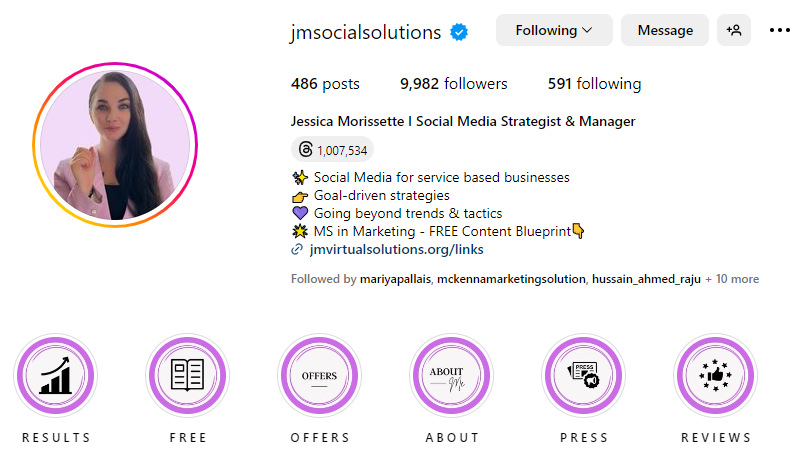
Jessica Morisette of JM Virtual Solutions recently wrote a blog post entitled “Increase Instagram Engagement With This One-Hour Strategy.” Although I’m sure that she wouldn’t object if you spent 59 or 61 minutes (rather than an exact 60 minutes) on daily engagement, and she DEFINITELY wouldn’t mind if you took some of her techniques and applied them to social media platforms other than Instagram.
Personally, I started trying to put her engagement strategy in practice over the weekend, both on Instagram and (with some adaptation) on LinkedIn. Depending upon time, I may try to apply it on your favorite social platform.
Building engagement on Instagram involves creating a genuine connection with your audience. It’s not just about getting likes and comments; it’s about creating meaningful interactions that lead to brand loyalty and growth. To achieve this, you need a strategy that focuses on targeted accounts, not just random.
She then lists six steps to her suggested media engagement strategy. Now I could rip her off and reprint all six here, but then you wouldn’t read her post (which you should do).
So instead I’m going to briefly cover her step 5, engaging with your peers and community.
Skipping to step 5
After devoting time to particular portions of the Instagram platform, Morisette suggests that you start engagement with particular segments. One of those segments is peers and community.
Why?
Supporting others in your niche can encourage them to reciprocate.
I know that content creators are often perceived to be in competition with other content creators, but since each of us is targeting different ideal clients, that competition is less than you think. Since content creators are all in this together, there’s a clear benefit from us supporting each other.
In fact, Morisette believes that this mutual support is so important that she recommends that you engage with your peers and community BEFORE you engage with your ideal client (step 6).
Technologists, you know how tough it is to create a technology product.
You have to assemble the technology, or perhaps create the technology yourself.
You have to work on the most minute details and make sure that everything is just right.
It takes a great deal of effort.
What if your product story is ignored?
But when you want to tell the story about your product, and all the effort you put into it, your prospects ignore everything you say. You might as well not be there.
Because they don’t care about you. It’s all about them.
People want to satisfy their own needs
But the “it’s all about me” attitude is actually a GOOD thing, if you can harness it in your messaging. Let’s face it; we all have an “it’s all about me” attitude because we want to satisfy our needs.
You want to satisfy your own needs because you only care about selling your product.
I want to satisfy my own needs because I only care about selling Bredemarket’s services. (I’ll get to the selling part later.)
And your prospects want to satisfy their own needs because they only care about their problems. And because of your customers’ self-focus, they’re only going to care about your product if it solves their problems.
So when it’s time to tell the story about your product, don’t talk about your technology.
One of the biggest reasons so much marketing today sounds the same (“exceptional customer service,” “commitment to quality,” “expertise that adds value,” etc.) is that companies fall back on what’s easy and what they believe they’re supposed to do: talk about themselves.
Seems like it should make sense, but it doesn’t.
Turns out, this “learn more about us!” approach will put you in the fast lane to bland, overused, cookie-cutter marketing (and results)….
If everyone follows the same marketing approach, everyone ends up with the same results: mediocrity.
(UPDATE OCTOBER 23, 2023: “SIX QUESTIONS YOUR CONTENT CREATOR SHOULD ASK YOU IS SO 2022. DOWNLOAD THE NEWER “SEVEN QUESTIONS YOUR CONTENT CREATOR SHOULD ASK YOU” HERE.)
If I may talk about myself for a moment (but hopefully in a differentiating way), this is one of the main benefits of my inclusion of the “why” question as part of the six questions that I like to ask potential Bredemarket clients. When I ask one of my prospects why their company exists, I get some valuable answers that help differentiate the prospect from everyone else.
If your product suddenly disappeared from the world, would your target audience (or, in marketing-speak, personas) care?
Would your target audience be just as happy with the competitive offerings, or would the target audience lose out if your product’s distinctive benefits were suddenly no longer available?
Hopefully, the world WILL feel a loss if your product disappeared.
But too often a company’s products appear to be just like the products from all the other companies, which makes the consideration phase (where prospects try to differentiate between products) difficult.
For example, I am familiar with a particular industry that has over 80 competitors. And most of those competitors use the word “trust” as a key part of their marketing strategy. (Not just a tactic; a strategy.) Spend some time reading the websites of all of the companies in this particular industry, and you’ll see the word “trust” so many times that it will become mind-numbing.
Kasey Jones alerted me to the phrase “trust funnel,” and I’ve been thinking about it and its relationship to content marketing. Here are my thoughts.
The sales funnel
Many of us are familiar with the concept of sales funnels. The idea is that there are a bunch of people at the top of the funnel, and people move through the sales process.
As people move down, the funnel gets narrower and narrower as some people exit the funnel. At the bottom of the funnel, there is a very small hole that represents the customers who have converted, or who have actually purchased something.
In a rare instance of my championing simplicity, I like to use an easy three-step sales funnel model with awareness, consideration, and conversion.
From Venn Marketing, “Awareness, Consideration, Conversion: A 4 Minute Intro To Marketing 101.” (Link)
You may use a more complex sales funnel, but the exact number of steps in the funnel really doesn’t matter. What does matter is that your content marketers create content that addresses each step in your funnel.
In early steps of the funnel, the content goal is to ensure that prospects know that you’re out there and you have a solution that benefits the prospects.
In later steps of the funnel, the content goal is to move prospects to the point where they will purchase something from you, rather than purchasing it from one of your competitors or not purchasing anything at all.
Some of the approaches to sales funnel-based content marketing are based upon the faulty assumption that people progress through the funnel in a logical and predictable manner. In the logical model, you present an awareness piece of content, then follow that with a consideration piece of content, then finally present content to convert the prospect into a customer.
It’s about time we redefine the classic marketing funnel. It describes the user journey as a rather linear path, while the reality is a lot more messy, complex, and unpredictable.
Let’s scrap the dated marketing funnel and try to map out the real user journey.
It starts with a trigger, and then it goes into an almost infinite loop between exploration and evaluation – over and over again. And finally, the user exits the loop by making a decision or a purchase.
Oh, and in addition to assuming logic, standard content creation methods assume that your firm knows where every buyer is on their journey. This assumption is essential so that your firm can detect a prospect in the awareness phase and take the necessary steps to move them downward into the funnel (or toward the endless loop pictured above).
Kasey Jones and the trust funnel
I mentioned Kasey Jones at the beginning of this blog post, based upon something she shared on LinkedIn. She started with an inconvenient truth that blew the second assumption out of the water.
Your buyers will probably never like or comment on your posts.
So much for all of those fancy tools that identify the sources of interaction with your content. They don’t work if people don’t interact with your content.
Yet Jones notes that these people are still buying. Three of them reached out to her in the last two weeks.
Each mentioned my content as why they wanted to work with me.
But they have never, not once, engaged with anything I’ve done on here.
Still, they were in my trust funnel, just the same.
It’s different from the sales funnel that we are laboriously tracking in our customer relationship management (CRM) tool. For content marketers, these things literally pop up out of the blue from a “trust funnel” that we know nothing about, even though we’re building it with our content.
If I wished, I could name multiple examples of people reaching out to me because of my content or Bredemarket’s content.
Jones’ point in all this was to emphasize that you need to keep on creating “scroll-stopping content” to attract DREAM (her capitalization) clients.
Even though you don’t know who you are attracting.
You’re not a sausage grinder making sausages. You’re a flower attracting bees.
By The original uploader was Y6y6y6 at English Wikipedia. – Original image located at PDPhoto.org. Transferred from en.wikipedia to Commons by Drilnoth using CommonsHelper., Public Domain, https://commons.wikimedia.org/w/index.php?curid=7365698
Now I could end this discussion right here with Kasey Jones’ comments, but I thought I’d perform a LinkedIn search to see who else was talking about the trust funnel.
And I found Kevin Schmitz.
Kevin Schmitz and the trust funnel
Schmitz approached the topic from a different perspective in his post from earlier this week. He focused on a particular piece of content: a person’s LinkedIn profile and activity.
Schmitz asserted that if someone approaches you with a meeting request, and the person’s LinkedIn presence is (his words) “bare bones,” you’re less likely to take the meeting. But if a meeting requester posts engaging, relevant content, perhaps you’ll take that call.
Schmitz went on to say:
Your presence on LinkedIn is not a “lead funnel”.
It’s a “trust funnel”.
We work so damn hard to establish trust in the meeting.
Yet, most of us are person 1 (the “bare bones” person) with an uphill battle each and every meeting.
Kevin Schmitz LinkedIn post, 8/22/2023 ot 8/23/2023. (Link)
If you’re interested, Schmitz’s post goes on to suggest ways to make your LinkedIn presence more engaging.
The meaning for content marketing
So what does the idea of “creating content that resonates with your invisible trust funnel” mean for content marketing?
Most people realize (or I hope they realize) that organic content often does not have an immediate payoff, especially for complex B2B sales. Even if I write the most amazing automated biometric identification system (ABIS) content for a Bredemarket client, the client won’t get orders within the first three days of posting the content. (I’ll have more to say about “three days” in a future post discussing go-to-market efforts.) Even if I am the biometric content marketing expert. (I’ve been working on promoting THAT piece of content for a while now.)
It takes longer than three days for content marketing to yield results. One source estimates four to five months. Another source says six to twelve months. Joe Pulizzi (quoted by Neil Patel) estimates 15 to 17 months. And all the sources say that their estimates may not apply to your particular case.
But Bredemarket (and I in my personal communications) will continue to cater to that invisible trust funnel and see what happen.
And if you’re reading this post in Janury 2025, thank you. If you want to talk to me about content creation, some of these links may still work!













 Bredemarket