All the Cool Kids Are Performing Injection Attack Detection Testing

I talk endlessly about presentation attack detection independent testing, but I occasionally discuss injection attack detection independent testing also, who performs the test (as more entities do so), and who has been tested.

The testing entities perform the test according to the European Committee for Standardization (CEN) standard CEN/TS 18099:2025.

“This document provides an overview of: 

– Definitions of biometric data injection attacks; 

– Use cases for injection attacks with biometric data on essential hardware components of biometric systems used for enrollment and verification; 

– Tools for injection attacks on systems using one or more biometric modalities. 

This document provides guidance for: 

– Injection Attack Instrument Detection System (defined in 3.12); 

– adequate risk mitigation for injection attack tools; 

– Creation of a test plan for the evaluation of an injection attack detection system (defined in 3.9).”

And Ingenium and BixeLab have developed their own testing methods.

iBeta and Injection Attack Detection Testing

And if you need a third choice of a testing lab, there is one. Via a sponsored post, iBeta joined the party.

“A new testing solution from iBeta Quality Assurance meets a growing need for evaluations of injection attack detection (IAD) products. The lab’s IAD testing launches today, and will be part of what iBeta showcases at Identity Week 2026 in Amsterdam next week. It includes testing up to Level 3, against the European standard CENS/TS 18099: 2025, across multiple platforms. And it presages the planned 2027 publication of the ISO/IEC standard dedicated to injection attack testing. iBeta will release a IAD testing solution for the ISO standard when it is released.”

Changes

The Biometric Update quote about the forthcoming ISO/IEC standard illustrates the challenge in testing when standards change, and new standards are adopted.

Something the Kantara Initiative recently addressed:

“Kantara Initiative announces the formal publication of the Kantara Initiative International Assurance Program: SP 800-63A-4 Service Assessment Criteria (SAC) & Statement of Criteria Applicability (SoCA), aligned to NIST Special Publication 800-63A Revision 4 – Identity Proofing.

“Following completion of the public review process and consideration of community feedback, the assessment criteria have been finalized and are effective immediately.”

NIST Special Publication 800-63A Revision 4 is the successor to Revision 3. Kantara Initiative previously offered assessments against the older standard, and can now assess against the newer one.

This illustrates the ripple effect of standards revisions…and in the case of injection attack detection, upcoming new standards.

Aware and Injection Attack Detection

Taking a holistic approach to presentation, deepfake, and injection attack detection still requires you to pursue each type of attack individually.

Which is why Aware has made specific efforts on injection attack detection.

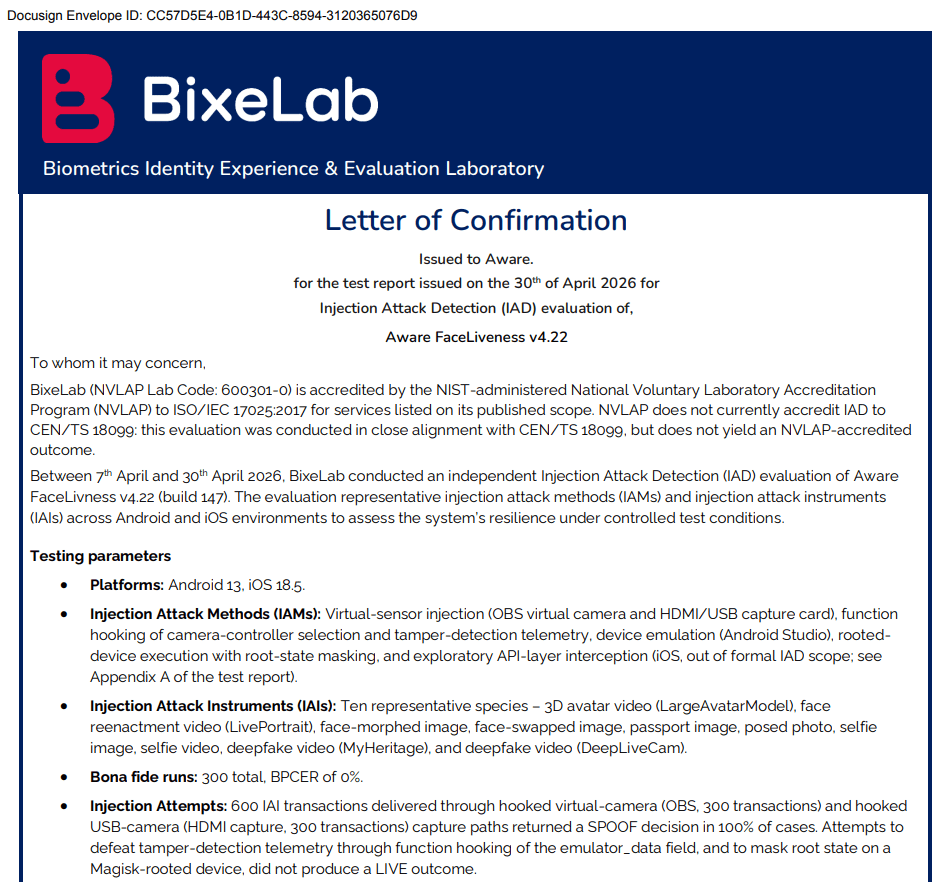
“Aware, Inc. (NASDAQ: AWRE)…announced the successful completion of an independent Injection Attack Detection (IAD) evaluation of its Aware Intelligent Liveness solution, conducted by BixeLab, a globally recognized authority in biometric testing and certification.”

The tests were conducted in accordance with CEN/TS 18099, just like iProov’s earlier testing.

BixeLab’s confirmation letter for Aware can be found here.

The May 6, 2026 List of PAD 3 Conforming Solutions

Update to the April 2 version. Added Shufti.

VendorModalityConfirming LabLink/Date
AwareFaceBixeLabNovember 2025
BioIDFaceTüvitAugust 2025 (1) (2)
FaceTecFaceBixeLabOctober 2025
IncodeFaceiBetaFebruary 2026
Oz ForensicsFaceBixeLabMarch 2026
ParavisionFaceIngeniumSeptember 2025
ShuftiFaceiBetaApril 2026
YotiFaceiBetaJanuary 2026

When Your “Hungry People”…Is You

I prefer the term “hungry people” to the term “target audience” because it conveys the idea of those who really really want your product.

The buffet.

And therefore it stands to reason that you want to write content for your hungry people.

For example, if you’re selling automated fingerprint identification systems to cops, your content should probably talk about protecting residents by identifying bad people and keeping them off the street.

But Isabel Sterne warns that you don’t want to go overboard in this.

Why not?

“When you spend your time scanning your environment, adapting to those around you, and adjusting your communication style accordingly, you can start to lose yourself, lose sight of your message, and become forgettable.”

Let’s face it. If everyone mirrors their target audience, and they have the same target audience, how can you tell them apart?

I hope that Scott Swann and Ajay Amlani forgive me, but I’m going to use them as examples.

  • Years ago Ajay, Scott, and I were associated with IDEMIA and/or MorphoTrak, but we have each gone our separate ways.
  • Ajay Amlani is now at Aware, a U.S.-based biometric company that sells to multiple audiences, including law enforcement.
  • Scott Swann is now at ROC (formerly Rank One Computing), a U.S.-based biometric company that sells to multiple audiences, including law enforcement.

Aware and ROC could simply mirror the needs and desires of U.S. law enforcement and mirror them back. But if they did that, Aware and ROC would appear identical and interchangeable.

And they’re not.

Aware has been around for several decades and offers everything from components and tools to full-blown automated biometric identification systems. Amlani, a new arrival, has a background that extends back to the FIRST version of CLEAR, along with multiple roles within the federal government and the private sector (including the aforementioned IDEMIA, where we did early work on venue identity verification solutions).

ROC is a newer arrival with a laser focus on several biometric modalities. Swann joined ROC after a long career at the U.S. Federal Bureau of Investigation and other federal government entities, followed by time in the private sector with MorphoTrak (where we worked on Morpho Video Investigator together, a potential solution for Boston Marathon bombing events) and IDEMIA National Security Solutions.

What is Sterne’s advice for Amlani, Swann, and others who don’t want to simply reflect their prospects? Here is what Sterne does:

“I write about what I’m interested in, and while I do write for all of you (and hope you get some value from what I share), I mostly write for myself, to explore ideas. In other words, I forget about the room when I write….

“When you write for yourself without considering a person or group of people, you end up writing more personally and often more universally.

“The irony is that by writing for yourself, you usually create something that others can connect to more deeply….

“And the more you write from this place, the clearer you get on your voice, priorities, and overarching ideas, the better able you are to create something that resonates.”

Personally, my hope is that my infusion of myself in my writing helps me to stand out and to better communicate what Bredemarket can provide to identity/biometric firms.

Is it working? You be the judge.

My buddies and me are getting real well known.

The April 2, 2026 List of PAD 3 Conforming Solutions

Update to the March 25 version. Added BioID.

VendorModalityConfirming LabLink/Date
AwareFaceBixeLabNovember 2025
BioIDFaceTüvitAugust 2025 (1) (2)
FaceTecFaceBixeLabOctober 2025
IncodeFaceiBetaFebruary 2026
Oz ForensicsFaceBixeLabMarch 2026
ParavisionFaceIngeniumSeptember 2025
YotiFaceiBetaJanuary 2026

I’m slowly finding these vendors. I won’t maintain this list forever, but as long as there are so few Level 3 solutions, I want to highlight them.

Coincidentally, I just reviewed an eBook by one of the vendors listed above, detailing things that you should seek in your liveness detection vendor.

  • The eBook listed several items.
  • To no one’s surprise, this particular vendor provided ALL of these items in its liveness detection solution.
  • Surprisingly, however, the vendor did NOT mention independent confirmation of PAD capabilities.

The March 25, 2026 List of PAD 3 Conforming Solutions

Update to the March 3 version. Added Oz Forensics.

VendorModalityConfirming LabLink/Date
AwareFaceBixeLabNovember 2025
FaceTecFaceBixeLabOctober 2025
IncodeFaceiBetaFebruary 2026
Oz ForensicsFaceBixeLabMarch 2026
ParavisionFaceIngeniumSeptember 2025
YotiFaceiBetaJanuary 2026

The March 3, 2026 List (Probably Still Inaccurate) of PAD 3 Conforming Solutions

Update to the February 27 version. Added Incode.

VendorModalityConfirming LabLink/Date
AwareFaceBixeLabNovember 2025
FaceTecFaceBixeLabOctober 2025
IncodeFaceiBetaFebruary 2026
ParavisionFaceIngeniumSeptember 2025
YotiFaceiBetaJanuary 2026

The Latest, Probably Still Inaccurate, List of PAD 3 Conforming Solutions

I remember when I was working in Anaheim and keeping track of the latest BIPA lawsuits, back when you could count them on one hand…then on two hands…then there were too many.

I feel the same way about my previous attempts to track the vendors that offer solutions that conform to ISO 30107-3 Presentation Attack Detection Level 3. I thought I’d found them all, then I’d find another one.

So here’s my current (Friday afternoon) list of the PAD 3 conforming solutions.

VendorModalityConfirming LabLink/Date
AwareFaceBixeLabNovember 2025
FaceTecFaceBixeLabOctober 2025
ParavisionFaceIngeniumSeptember 2025
YotiFaceiBetaJanuary 2026

While Google Gemini informed me that Veridas had also received Level 3 confirmation from iBeta, that turned out to be a hallucination. Veridas realizes the importance of Level 3, though, as do other selected vendors, so I suspect this table will be outdated soon.

Oh, and just to confuse things further, some of the other tests, such as CEN/TS 18099 injection attack detection tests, also may apply in some way to presentation attacks. Or maybe not. We’ll see.

Even More On Presentation Attack Detection Level 3

This morning’s post listed three companies with independently demonstrated conformance to ISO 30107-3 presentation attack detection level 3: Aware, FaceTec, and Yoti.

The independent evaluators were BixeLab and iBeta.

But Ingenium provides PAD level 3 conformance assessments also.

And Ingenium testified to Paravision’s conformance.

So that’s a total of four companies at PAD Level 3: Aware, FaceTec, Paravision, and Yoti.

Who else did I miss?

And I will revisit my earlier question. Will consumers perceive that THEIR data is valuable enough to warrant Level 3 liveness detection? And avoid the solutions with “only” Level 2 conformance?

Four companies (so far) are betting on it.

More On Presentation Attack Detection Level 3

If you needed any confirmation that Presentation Attack Detection Level 2 is so last year, you have it now.

Last month I talked about Yoti achieving confirmation of PAD Level 3 in iBeta testing.

But iBeta isn’t the only entity performing PAD Level 3 testing.

  • FaceTec’s algorithm received PAD Level 3 confirmation from BixeLab in October.
  • Aware received a similar confirmation in November.

Will PAD Level 3 become the new floor for liveness detection? It depends upon your needs. Here’s how Mantra explains the difference between levels 2 and 3.

Level 2 (L2):

More realistic spoofs-high-quality 3D masks, composite fingers, better materials. Harder to detect, but still lab-craft attacks.

Level 3 (L3):

Advanced adversary scenarios-custom molds, hyper-realistic masks, lab-grade fabrication. Represents attackers with serious resources.

The “serious resources” part is key. Fraudsters will only spend “serious resources” if the target is valuable enough.

But will consumers perceive that THEIR data is valuable enough to warrant Level 3 liveness detection? And avoid the solutions with “only” Level 2 conformance?

Three companies (so far) are betting on it.

(Actually four. See my update.)

(And yes, the three hands on the fraudster should have been a giveaway…)