How Other Experts Refer to “Somewhat You Why”

Unlike most other posts that appear under my name—Bredebot posts are another matter—this post breaks my 2023 rule because most of it was written by Google Gemini, not me.

But I figured that if I wrote a book specifically about SIX factors of authentication…
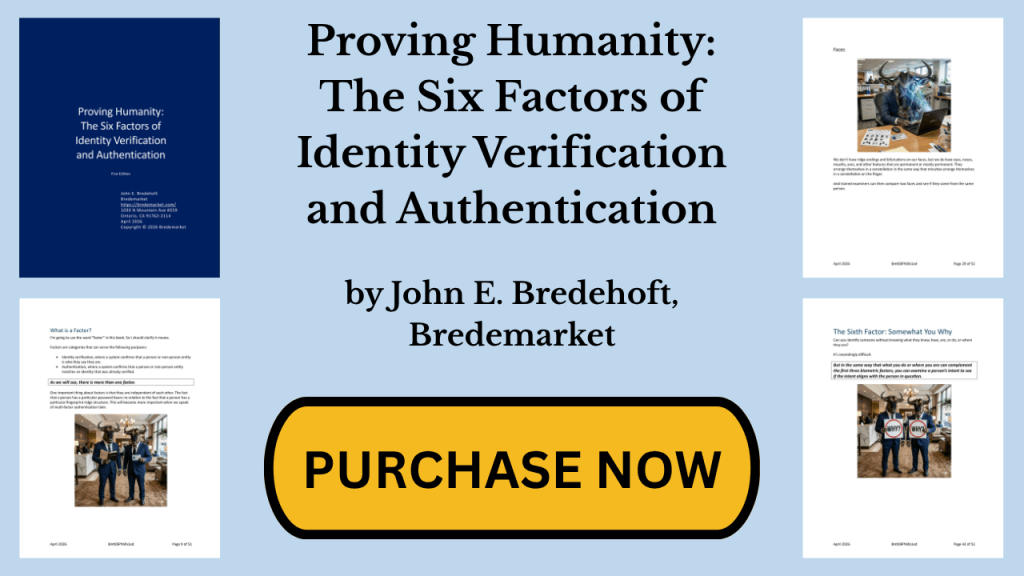
Four pages from "Proving Humanity: The Six Factors of Identity Verification and Authentication" by John E. Bredehoft, Bredemarket. Click on the image to purchase.
The book.

…it would be nice to know if other experts held similar thoughts.

My prompt to Gemini

Bredemarket has promoted “somewhat you why” as a sixth factor of identity verification / authentication. Has anyone else shared similar observations?

Gemini’s response

Here is the short answer: Yes, industry experts and security frameworks strongly agree with the core observation, though they call it “Authentication Intent,” “Intent Verification,” or “Context-Aware/Risk-Based Authentication” rather than using Bredemarket’s play-on-words.

Shifting Truths. Google Lyria. Public Domain.

John Bredehoft (Bredemarket) coined “somewhat you why” to fit the traditional naming convention (something you know, have, are, do, somewhere you are). His argument is that checking why an action or request is taking place—evaluating intent, transaction risk, or reasonableness—functions as a crucial safeguard, especially in an era of deepfakes and automated AI agents.

While the tongue-in-cheek name is unique to Bredemarket, the concept itself is widely discussed and implemented across the cybersecurity industry under three main paradigms:

1. “Authentication Intent” (NIST Standards)

The National Institute of Standards and Technology (NIST) explicitly addresses intent in NIST SP 800-63B.

  • The Problem: A user might have a valid session token, biometrics, or physical key plugged in, but malware or a session hijack could trigger actions without the user’s conscious decision.
  • The Solution: Systems require an explicit act of intent—like tapping a physical FIDO key, typing a PIN, or responding to a contextual prompt—proving that the user intended to execute that specific action at that moment.

2. Intent Verification for AI & Delegated Actions

With the rise of autonomous AI agents and automated workflows, identity security groups (like the Non-Human Identity/NHI movement) frequently discuss Intent Verification.

  • Conventional authentication proves who logged in, but not whether the user meant to perform this specific action.
  • Intent Verification bridges authentication and authorization by evaluating whether a transaction (e.g., a $35M wire transfer or an API call) aligns with the user’s actual current decision and business policy.

3. Context-Aware and Adaptive Authentication

Identity providers (like Palo Alto Networks, Okta, and Silverfort) build their Adaptive Multi-Factor Authentication (AMFA) around the “why” and “context”:

  • Context Signals: What resource is being accessed? Is this normal business behavior? Does this request make sense given the time, value, and sensitivity?
  • Dynamic Step-Up: If the “why” seems low-risk (e.g., checking internal docs during work hours), access is smooth. If the “why” is high-risk or suspicious (e.g., a wire transfer requested via video call), the system demands step-up verification.

How the Views Compare

While most identity security professionals treat “intent and context” as a governance or risk engine layer wrapping traditional factors rather than a 6th factor itself, everyone agrees with Bredemarket’s baseline premise: verifying who someone is without evaluating what and why they are trying to do it is no longer enough to stop modern fraud.

Okta Talks About Evil Twins

Public wi-fi can be fun, especially when you don’t realize which networks were legitimately set up by the business.

And they’re really fun when someone pulls the “evil twin” trick, described by Okta.

“A hacker looks for a location with free, popular WiFi. The hacker takes note of the Service Set Identifier (SSID) name. Then, the hacker uses a tool like a WiFi Pineapple to set up a new account with the same SSID. Connected devices can’t differentiate between legitimate connections and fake versions.”

The next steps are to trick users into providing the authentication details for the “good” network, lure people into logging in to the “evil” network, then steal any unencrypted data.

Of course you don’t have to go to those extremes. If the business fails to publicize what the “good” network is called, just set up a network called “ReelOffishelWiFi” and see how many suckers you get.

(Imagen 4)

If Your Identity System Only Manages People, It Is Flawed

This is painful, but it has to be done.

I’ve spent 30 years working with the identities of PEOPLE and ensuring that all PEOPLE accessing a system are properly identified.

In other words, leaving a huge GAPING security hole.

Look at what Okta is doing;

“[N]ew Okta Platform capabilities…help businesses secure AI agents and other non-human identities with the same level of visibility, control, governance, and automation as human ones. The Okta Platform will now bring a unified, end-to-end identity security fabric to organizations for managing and securing all types of identities across their ecosystem, from AI agents to API keys to employees.”

I think that “unified” will take the place of “trust” as the identity buzzword. Thankfully.

If you’re only selling biometrics, or maybe biometrics and ID cards, where will your customers go to get the rest of their systems? Or will you just be a commodity supplier to the companies that provide the REAL systems?

(Unified security AI picture from Imagen 3)

How Identity and Biometrics Firms Can Use Blogging to Grow Their Business

(Updated blog post count 10/23/2023)

Identity and biometrics firms can achieve quantifiable benefits with prospects by blogging. Over 40 identity and biometrics firms are already blogging. Is yours?

Four reasons for blogging

My recent post “The Secret to Beating Half of All Fortune 500 Marketers and Growing Your Business” lists 14 quantifiable benefits from the fresh content from blogging, derived from an infographic at Daily Infographic. Here are the most important four:

  1. Awareness: the average company that blogs generates 55% more website visitors.
  2. Lead generation: B2B marketers that use blogs get 67% more leads than those who do not.
  3. Conversions: marketers who have prioritized blogging are 13x more likely to enjoy positive ROI.
  4. Conversions (again): 92% of companies who blog multiple times per day have acquired a customer from their blog.

Blogging adds value.

Over 40 identity firms that are blogging

These firms (and probably many more) already recognize the value of identity blog post writing, and some of them are blogging frequently to get valuable content to their prospects and customers.

Is your firm on the list? If so, how frequently do you update your blog?

How your identity firm can start blogging

If you need help writing blog posts so that your identity/biometrics firm stands out, I, John E. Bredehoft of Bredemarket, can help.

My identity blog post writing experience benefits firms who identify individuals via fingers, faces, irises, DNA, driver’s licenses, geolocation, and many other factors and modalities. I truly am a biometric content marketing expert and an identity content marketing expert.

A few more things about my blogging offering:

By Unknown author – postcard, Public Domain, https://commons.wikimedia.org/w/index.php?curid=7691878

In most cases, I can provide your blog post via my standard package, the Bredemarket 400 Short Writing Service. I offer other packages and options if you have special needs.

Get in touch with Bredemarket

Authorize Bredemarket, Ontario California’s content marketing expert, to help your firm produce words that return results.

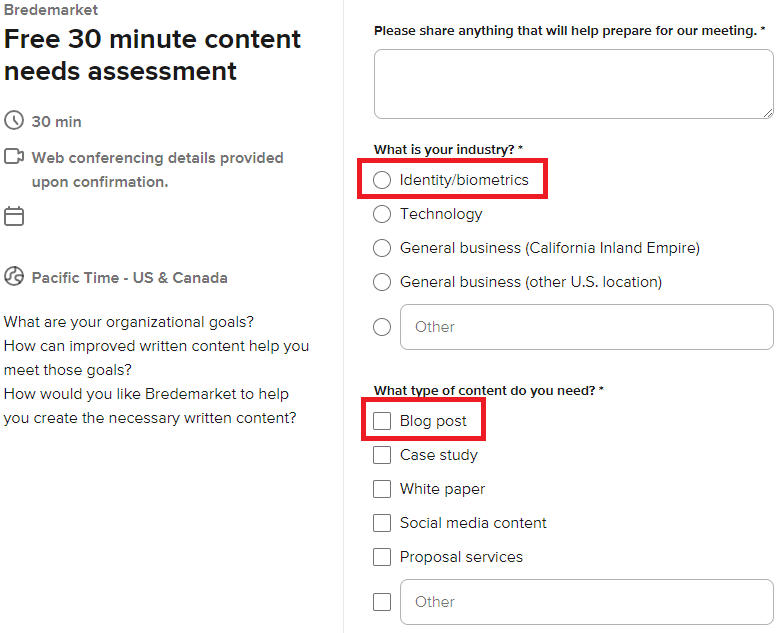
To discuss your identity/biometrics blog post needs further, book a meeting with me at calendly.com/bredemarket. On the questionnaire, select the Identity/biometrics industry and Blog post content.