I’m pausing activity on some Bredemarket social channels (and some related personal channels) that have no subscribers, exhibit no interest, or yield no responses.
This channel is unaffected, and may benefit from increased focus.
As further proof that I am celebrating, rather than hiding, my “seasoned” experience—and you know what the code word “seasoned” means—I am entitling this blog post “Take Me to the Pilot.”
Although I’m thinking about a different type of “pilot”—a pilot to establish that Login.gov can satisfy Identity Assurance Level 2 (IAL2).
The link in that sentence directs the kind reader to a post I wrote in November 2023, detailing that fact that the GSA Inspector General criticized…the GSA…for implying that Login.gov was IAL2-compliant when it was not. The November post references a GSA-authored August blog post which reads in part (in bold):
Login.gov is on a path to providing an IAL2-compliant identity verification service to its customers in a responsible, equitable way.
Specifically, over the next few months, Login.gov will:
Pilot facial matching technology consistent with the National Institute of Standards and Technology’s Digital Identity Guidelines (800-63-3) to achieve evidence-based remote identity verification at the IAL2 level….
Using proven facial matching technology, Login.gov’s pilot will allow users to match a live selfie with the photo on a self-supplied form of photo ID, such as a driver’s license. Login.gov will not allow these images to be used for any purpose other than verifying identity, an approach which reflects Login.gov’s longstanding commitment to ensuring the privacy of its users. This pilot is slated to start in May with a handful of existing agency-partners who have expressed interest, with the pilot expanding to additional partners over the summer. GSA will simultaneously seek an independent third party assessment (Kantara) of IAL2 compliance, which GSA expects will be completed later this year.
In short, GSA’s April 11 press release about the Login.gov pilot says that it expects to complete IAL2 compliance later this year. So it’s going to take more than a year for the GSA to repair the gap that its Inspector General identified.
My seasoned response
Once I saw Steve’s update this morning, I felt it sufficiently important to share the news among Bredemarket’s various social channels.
With a picture.
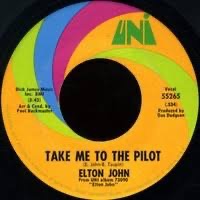
B-side of Elton John “Your Song” single issued 1970.
For those of you who are not as “seasoned” as I am, the picture depicts the B-side of a 1970 vinyl 7″ single (not a compact disc) from Elton John, taken from the album that broke Elton in the United States. (Not literally; that would come a few years later.)
By the way, while the original orchestrated studio version is great, the November 1970 live version with just the Elton John – Dee Murray – Nigel Olsson trio is OUTSTANDING.
Back to Bredemarket social media. If you go to my Instagram post on this topic, I was able to incorporate an audio snippet from “Take Me to the Pilot” (studio version) into the post. (You may have to go to the Instagram post to actually hear the audio.)
Not that the song has anything to do with identity verification using government ID documents paired with facial recognition. Or maybe it does; Elton John doesn’t know what the song means, and even lyricist Bernie Taupin doesn’t know what the song means.
So from now on I’m going to say that “Take Me to the Pilot” documents future efforts toward IAL2 compliance. Although frankly the lyrics sound like they describe a successful iris spoofing attempt.
Through a glass eye, your throne Is the one danger zone
Identity/biometrics firms don’t just create social media channels for the firms themselves. Sometimes they create social media channels dedicated to specific products and services.
That’s the good news.
Here’s the bad news.
[REDACTED]
As I write this, it’s March 3. A firm hasn’t updated one of its product-oriented social media channels since February 20.
That’s February 20, 2020…back when most of us were still working in offices.
It’s not like the product no longer exists…but to the casual viewer it seems like it. As I noted in a previous post, a 2020 survey showed that 76% of B2B buyers make buying decisions primarily based on the winning vendor’s online content.
Have you ever seen those posts from self-appointed gurus?
Specifically, the ones that authoritatively state the BEST time to WRITE a post on Instagram, or LinkedIn, or TikTok, or whatever?
I religiously ignore those posts for a simple reason: My country has multiple time zones. So the best time in one time zone may be the worst time in another time zone.
However, I can tell you the WORST time to READ a post in the PACIFIC Time Zone…if the post concerns pizza.
And I’ll explain what all this means…eventually.
Ophir Tal on awareness
In addition to saying WHEN to post, the gurus also provide authoritative (and often contradictory) advice about WHAT to post.
For example, some gurus assert that you MUST prioritize bottom of funnel (conversion) content over top of funnel (awareness) content because it’s most important to get people to buy.
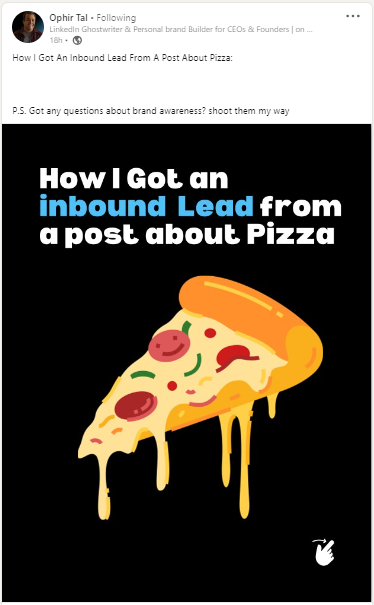
Ophir Tal disagrees, and has evidence to support his position.
This hook caught my attention. People want leads, and people like pizza, so I paid attention. But I also paid attention for a third reason that I’ll discuss later.
Tal then noted that the gurus would have recommended NOT posting this because he was “doing it wrong.” Specifically:
The post didn’t solve a problem for his potential clients. (Unless they regularly drop slices of pizza, I guess.)
It didn’t have a strong call to action.
It wasn’t targeted to his ideal clients. (Again, unless they regularly drop slices of pizza, or unless they love chicken wings.)
But despite doing everything wrong, that particular piece of content attracted the attention of someone “at a 6 figure ecom company.” After viewing the content, the reader looked at Tal’s profile and realized Tal could meet their need for ghostwriting services.
And now I’ll tell you the third reason why I paid attention to Tal’s post.
John Bredehoft on birthdays
As I noted above, I paid attention to Ophir Tal’s pizza post for two reasons:
People want leads.
People like pizza.
Now let’s jump back to a post I wrote all the way back in 2023, one that described why I’ve soured on the term “target audience.” (Or, in Tal’s words, “ideal clients.”) I started that post by wondering if the term “needy people” would be better than “target audience.” Yes, but not good enough.
I’ll grant that “needy people” has a negative connotation, like the person who is sad when people forget their birthday.
It turns out that these people had a VERY GOOD reason for forgetting my birthday. However, I cannot reveal this reason to you because the disclosure would force me to reveal someone’s personal identifiable information, or PII. (Mine.)
So after they remembered my birthday, one of them asked what I did for my birthday…and I told them that my wife, father-in-law, and brother-in-law went out to dinner.
For pizza.
And I also told them that there were leftovers, which my wife and I enjoyed a few days later.
Leftover pizza is the best pizza. Preparation credit: Pizza N Such, Claremont, California. Can I earn free pizza as a powerful influencer? Probably not, but I’ll disclose on the 0.00001% chance that I do.
A nice story, and while I was reading Ophir Tal’s story on dropped pizza, I realized that I had missed an opportunity to tell my own story about leftover pizza.
Time to channel Steve Jobs…
Oh, and there’s one more thing
I forgot to mention one thing about the Ophir Tal story.
When I read the story, it was around 4:00 pm in California.
So when I read about Tal’s dropped pizza, and thought about my leftover pizza (which I had already eaten)…I was hungry.
A firm’s content should address the needs of its target audience. For Bredemarket, that is people in identity, biometrics, technology, and general business whose firms aren’t marketing effectively.
Narrow target audiences are the enemy of virality.
Unless you create attention-grabbing content that doesn’t contribute to your core business, but only grabs attention.
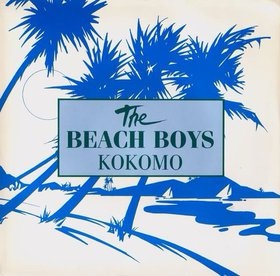
For example, you could proclaim that “Kokomo” is the absolute best Beach Boys song ever.
Fair
But I couldn’t bear to write such drivel myself, so I assigned the task to Google Bard, who wrote all the “hot take” text under this paragraph. (I hate myself now.)
Kokomo: The Underrated Gem that Shines Brighter than California Sun
Beach Boys fans, brace yourselves for a hot take. While classics like “Surfin’ U.S.A.” and “California Girls” hold their place in the pantheon of summer anthems, there’s one song, often relegated to the realm of guilty pleasures, that deserves a crown of seashells and a chorus of seagulls: “Kokomo.”
Yes, I said it. Kokomo is not just The Beach Boys’ best song, it’s a pop masterpiece, a sonic escape hatch to a tropical paradise, and a testament to the band’s enduring musical magic. Here’s why:
1. The Escape: From the first steel drum lick, “Kokomo” whisks you away from the everyday. Mike Love’s smooth vocals paint a picture of turquoise waters, swaying palm trees, and worries lost in the trade winds. It’s wanderlust in a song, a daydream of bare feet in the sand, perfectly capturing the yearning for escape that made The Beach Boys icons.
2. The Melody: It’s impossible not to hum along. The chorus, a catchy earworm built on layered harmonies and a driving beat, burrows deep into your brain and stays there like a souvenir seashell. It’s a pop hook that rivals anything in The Beach Boys’ discography, a testament to their mastery of crafting unforgettable melodies.
3. The Production: Lush, vibrant, and layered, the production on “Kokomo” is a sonic tapestry. Tropical instruments, steel drums, and gentle percussion create a soundscape that’s both playful and sophisticated. It’s a sonic cocktail that transports you to the heart of that island paradise, with every layer adding a new dimension to the musical journey.
4. The Unexpectedness: Released in 1988, “Kokomo” arrived at a time when The Beach Boys were navigating a new musical landscape. But instead of feeling dated or derivative, it embraced a contemporary sound while retaining the band’s signature harmonies and sun-drenched spirit. It’s a testament to their ability to adapt and evolve, proving their musical magic had never truly faded.
5. The Heart: At its core, “Kokomo” is a song about longing and connection. It’s about finding solace in the arms of a loved one, escaping the mundane with someone special. It’s a love letter to shared dreams and simple pleasures, reminding us that sometimes, all we need is a little sunshine, a sandy beach, and the one we love.
So, next time you reach for a Beach Boys record, don’t just skip to the hits. Give “Kokomo” a chance. Let its infectious melody wash over you, close your eyes, and imagine yourself beneath the swaying palm trees. You might just find yourself singing along, realizing you’ve stumbled upon a hidden gem, the one song that truly captures the essence of The Beach Boys and their timeless sound.
Now, go forth and spread the gospel of Kokomo! Let’s give this underrated masterpiece the recognition it deserves. After all, it’s not just a song, it’s a state of mind, a passport to paradise, and the ultimate proof that The Beach Boys’ magic truly is endless.
P.S. Don’t forget to pack your sunscreen and your dancing shoes!
As identity/biometric professionals well know, there are five authentication factors that you can use to gain access to a person’s account. (You can also use these factors for identity verification to establish the person’s account in the first place.)
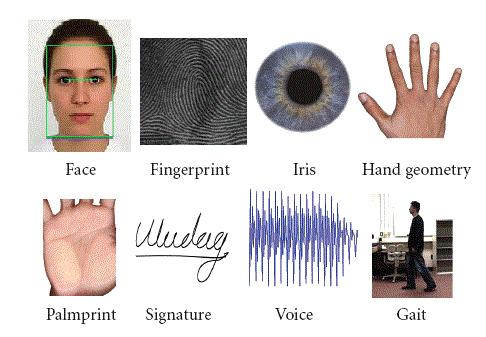
Something You Are. I’ve spent…a long time with this factor, since this is the factor that includes biometrics modalities (finger, face, iris, DNA, voice, vein, etc.). It also includes behavioral biometrics, provided that they are truly behavioral and relatively static.
As I mentioned in August, there are a number of biometric modalities, including face, fingerprint, iris, hand geometry, palm print, signature, voice, gait, and many more.
If your firm offers an identity solution that partially depends upon “something you are,” then you need to create content (blog, case study, social media, white paper, etc.) that converts prospects for your identity/biometric product/service and drives content results.
This post talks about the Bredemarket 2800 Medium Writing Service, describes why your firm would elect that service over three of my other services, and explains how the Bredemarket 2800 Medium Writing Service works.
Four ways that Bredemarket provides written content
I know that the experts say that you’re NOT supposed to give your prospects a multitude of choices, and that you should keep your offerings simple. Sometimes REALLY simple.
But I’ve ignored the experts (again) and I’m giving Bredemarket’s prospects four options for content creation. I’ll briefly touch on three of them before describing the fourth one, the Bredemarket 2800 Medium Writing Service. Once I’m done, you’ll know when you want to elect Bredemarket 2800, and when you’ll want to elect one of the other three options:
Bredemarket 4000 (by the hour),
Bredemarket 4444 (by the month), or
Bredemarket 400 (by the small project).
One: by the hour (Bredemarket 4000 Long Writing Service)
Sometimes you don’t know the parameters of your project, or perhaps you may have multiple projects that require Bredemarket’s assistance. In those cases, Bredemarket bills by the hour using something I call the Bredemarket 4000 Long Writing Service.
Whether it’s proposal work or something else, I do the work (however much work there is) and bill you for the hours that I worked.
Two: by the month (Bredemarket 4444 Partner Retainer)
Perhaps you have ongoing needs and just need me to be available for a certain number of hours each month, yet you’re not ready to hire a full-time person to do the work. In that case, the Bredemarket 4444 Partner Retainer is the package that is best for you. With this level of commitment, I am embedded as part of your organization.
As I assert in the post “Three Levels of Engagement With Your Content Creator,” a retainer offers a happy middle ground between full-time employment and single project work. It gives you work flexibility, budget predictability, and consultant accessibility.
Three: by the small project (Bredemarket 400 Short Writing Service)
But what if you know the scope of your project, and it is a single simple project? If you only need between 400 and 600 words of text, then the ideal package for you is the Bredemarket 400 Short Writing Service.
If your project only requires 400 to 600 words (give or take), the Bredemarket 400 Short Writing Service is ideal for you.
But what if you need more words than that? A lot more?
Why would you need 3,000 words?
There are a few cases in which your firm may need roughly 3,000 words of text, rather than the roughtly 500 words of text described above.
Longer blog posts. Often blog posts are pretty short and fit well within a 400 to 600 word limit. But sometimes you need longer, more detailed blog posts that delve into a topic more deeply. If you need 3,000 words to tell your story, tell it.
Longer LinkedIn articles. In most cases, social media postings will not hit the 3,000 word mark. (For some social media platforms it’s near impossible to hit that limit anyway.) One notable exception is LinkedIn articles, which can enter into the same detail as a long blog post. If your audience is on LinkedIn, then place your content natively on LinkedIn (repurposing it to your blog for your non-LinkedIn prospects if you like).
Longer case studies. Case studies can vary in length. As it turns out, the case studies that Bredemarket has written for its clients are simple two-pagers (including graphics) and fit well within the Bredemarket 400 parameters. But perhaps your case study demands richer detail.
White papers. While one may debate about the semantics of what is a white paper vs. what is not a white paper, you may demand a document that requires around 3,000 words of detail.
The content type that you know about, but I don’t. You may require a particular piece of content that doesn’t fit into the nice neat categories above, but requires text of between 2,800 and 3,200 words.
In these cases, the Bredemarket 2800 Medium Writing Service provides the content you need.
But is Bredemarket 2800 the same as Bredemarket 400, with more words and a higher price?
No.
Longer content requires a slightly different process.
How the Bredemarket 2800 process differs from the Bredemarket 400 process
Admittedly there are some obvious similarities between Bredemarket 400 and Bredemarket 2800.
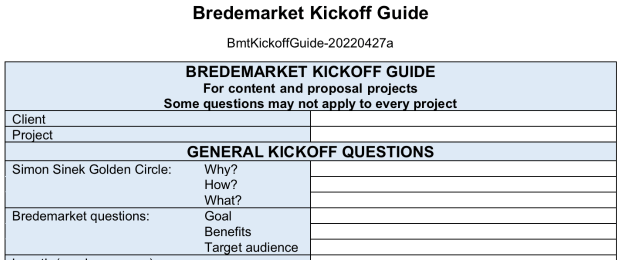
The kickoff is an important part of the content creation process, since the questions I ask during the kickoff (since expanded) ensure that I produce the right content at the end of the process.
The kickoff ensures that the final written content (a) answers the WHY/HOW/WHAT questions about you, (b) advances your GOAL, (c) communicates your BENEFITS, and (d) speaks to your TARGET AUDIENCE. It is both iterative and collaborative.
The beginning of the Bredemarket Kickoff Guide that I use. There are many, many more questions that I haven’t disclosed. Do you want to learn them? Buy the service.
The basic work during the kickoff is pretty much the same as for Bredemarket 400, although you and I will probably go in-depth on certain items, and there is a higher chance that the content specifications will be more detailed (for example, goals for each subsection of the content).
You and Bredemarket agree upon the topic, goal, benefits, and target audience (and, if necessary, outline, section sub-goals, relevant examples, and relevant key words/hashtags, and interim and final due dates).
For complex content requiring input and approval of multiple subject matter experts, you and Bredemarket agree on a preliminary list of tasks, assigned persons, and due dates.
For content that must be incorporated into your content management system, you and Bredemarket agree on the necessary format and other parameters. Otherwise, the final copy will be provided in Microsoft Word docx format, including (as appropriate) callout indicators, hyperlinks, key words, and/or hashtags.
For projects requiring multiple related pieces of content, you and Bredemarket agree upon the desired frequency of content.
The Bredemarket 2800 prework
Sometimes one or two additional things will happen before I start writing the first draft.
I may need to interview one of your customers or subject matter experts—for example, to obtain the facts necessary for a case study or white paper.
I may need to conduct additional research, as agreed upon by us during the kickoff.
The Bredemarket 2800 drafts
Once I’m ready, I start writing.
Between you and me, I create a draft 0.5, sleep on it (sometimes literally), and then create a much more succinct draft 1.0. See “Your writers (in this case me) should be succinct,” in my post “Which Words Should Your Marketers Use? My Four Suggestions.”
It shouldn’t surprise you to learn that it takes longer to write 3,000 words than it takes to write only 500 words. Therefore, I allow myself up to seven days (actual days, not working days) to produce the first draft. (Contrast this with Bredemarket 400, in which I commit to create a draft within three days.)
Then I hand the draft over to you for the first review.
After I receive your review comments, I work on the second draft (again, taking up to seven days) and hand it over for the second review.
Then (if necessary) I work on the third draft and hand it over for the third review. Unlike Bredemarket 400, which only includes two reviews, Bredemarket 2800 includes three reviews because of the higher complexity of the content.
At the end, I provide you with the final copy.
But what if you need your content much more quickly than the 1-2 months it may take to go through all three of the draft and review cycles?
Then we’ll mutually adjust the parameters (and the billing) accordingly.
However, remember that when I adjust my deliverable schedule, it also affects your deliverable schedule as described below.
The Bredemarket 2800 reviews
As decribed above, you will receive up to three review copies during the process.
Because this is a collaborative process, your participation is important to ensure that I create the proper content for your firm. So be prepared to spent the time necessary to ensure that the content is right.
I realize that you probably don’t have a lot of time to review consultant content. If you did have a lot of time, then you’d probably write the content yourself rather than asking a consultant to do it. For this reason, I give you seven days to review each draft, rather than the three days that I give to firms that elect the Bredemarket 400 Short Writing Service.
Of course, if you require a more rapid turnaround, then you’ll need to review the drafts much more quickly, in the same way that I’ll need to write the drafts much more quickly.
The Bredemarket 2800 end product
After the kickoffs, drafts, and reviews, I’ll provide the final copy in Microsoft Word docx format, unless we’ve agreed on some other format. This will give you the content you need to put in your blog, in an article on your LinkedIn page, or in whatever content you need.
I can’t share work samples that I created for Bredemarket clients, because they are ghostwritten “works for hire” that are not publicly attributed to Bredemarket.
(For the same reason, I can’t share most work samples that I created for my previous employers.)
But I CAN share work samples that I created for…Bredemarket.
The video containing this image can be found on various Bredemarket properties.
Actually, you can search through the entire Bredemarket website and social media outlets and find them.
Or you can just watch the video below, which summarizes everything.
But what if I want to know how to work with Bredemarket?
Glad you asked.
After reading Mace’s LinkedIn post, I realized that I have a bunch of different online sources that explain how to work with Bredemarket, but they’re scattered all over the place. This post groups them all the “how to work with Bredemarket” content together, following an outline similar (yet slightly different) to Mace’s.
And no, it’s not a stand-alone PDF, but as you read the content below you’ll discover two stand-alone PDFs that address critical portions of the process.
Question 1: Why would I work with Bredemarket?
As you’ll see below, “why” is a very important question, even more important than “how.” Here are some reasons to work with Bredemarket.
You require the words to communicate the benefits of your identity/biometrics product/service. I offer 29 years of experience in the identity/biometrics industry and am a biometric content marketing expert and an identity content marketing expert. I have created multiple types of content (see below) to share critical points about identity/biometrics offerings.
You require the words to communicate the benefits of your technology product/service. I have also created multiple types of content to share critical points about technology offerings.
You require the words to communicate the benefits of a product/service you provide to California’s Inland Empire. I’ve lived in the Inland Empire for…well, for more than 29 years. I know the area—its past, its present, and its future.
You require one of the following types of content. Blogs, case studies / testimonials, data sheets, e-books, proposals, social media posts / Xs (or whatever tweets are called today), white papers, or anything. I’ve done these for others and can do it for you.
Question 2: Why WOULDN’T I work with Bredemarket?
This question is just as important as the prior one. If you need the following, you WON’T want to work with Bredemarket.
You require high quality graphics. Sorry, that’s not me.
I did not draw this myself. Originally created by Jleedev using Inkscape and GIMP. Redrawn as SVG by Ben Liblit using Inkscape. – Own work, Public Domain, link.
You are based outside of the United States. Foreign laws and exchange rates make my brain hurt, so I only pursue business domestically. But depending upon where you are, I may be able to recommend a content marketer for you.
Question 3: What are Bredemarket’s most popular packages? How much do they cost?
Here are the three most common packages that Bredemarket offers.
Note that these are the standard packages. If your needs are different, I can adapt them, or charge you an hourly rate if the need is not well defined. (But as you will see below, I try to work with you at the outset to define the project.)
If you follow the link above for your desired package and download the first brochure on each page, you’ll get a description of the appropriate service. The pricing is at the bottom of each brochure.
Each brochure also explains how I kick off a project, but the procedure is fairly common for each package.
Question 4: What are Bredemarket’s working practices?
But that’s not all that we address in the kickoff. There are some other lower-level questions that I ask you (such as the long and short form of your company name).
Once we have defined the project, I iteratively provide draft copy and you iteratively review it. The number and length of review cycles varies depending upon the content length and your needs. For example, I use up to two review cycles of up to three days each for short content.
Eventually I provide the final copy, you publish it and pay me, and both of us are happy.




















 Bredemarket