The listed artist for this song is Royalty Free Music Background.
The song title is “Future Electronic (Upbeat Music).”
I had been using an AI music generator in Canva, but since that is now restricted to non-commercial use I switched to another music app within Canva for Bredemarket’s videos.
Taking great care to select videos that are royalty free.
Since I liked this particular song, I used it in two videos, the first of which was only 8 seconds long, the second 64 seconds long.
And then I merrily uploaded both videos to the Bredemarket blog, LinkedIn, various Meta properties, and Bluesky with no problem.
Until I got to YouTube.
The 8 second video uploaded fine, but the 64 second version was blocked worldwide because of a copyright violation.
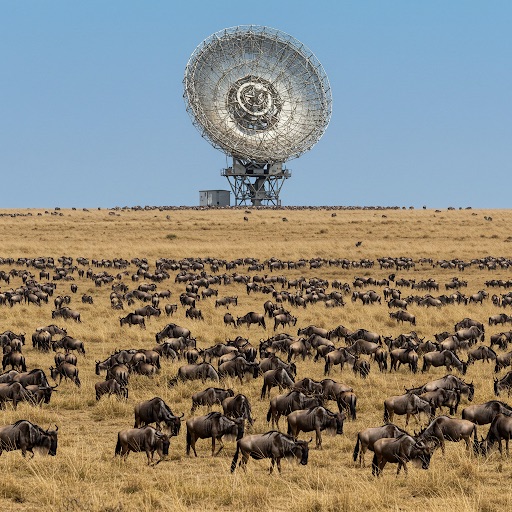
Bredemarket, the curious wildebeest, wanted to learn more about LinkedIn Audio Events. So I hosted my own. Based upon my now-extensive experience in this medium, I can share my five secrets to hosting a successful LinkedIn Audio Event.
Don’t start early
Um…I failed to do this. The event was supposed to start at 8:00 am Pacific Daylight Time, and I started at 7:58.
Meticulously plan
I didn’t do this either. I scheduled the event at 7:41, 19 minutes before it was supposed to start, and only 17 minutes before it actually started.
Use the best audio equipment for stellar sound
Um…this was on my phone, with no headset.
Host from a quiet place with no distractions
I definitely failed here. I started the event outside the (former) Yangtze Reataurant on very busy Euclid Avenue in Ontario, California. If anyone had joined the last-minute event, they would have heard all sorts of traffic noises.
Have a purpose for the event
This is the only thing I did right. My purpose? To learn the mechanics behind LinkedIn Audio Events. I didn’t learn everything—since I was the only attendee, I couldn’t channel my inner Anna Morgan and invite another speaker to the stage. But I figured out some of the mechanics.
Lessons learned
(Personal preference: I don’t refer to this as a “post mortem.” No one died.)
In addition to the lessons implied above (plan, ensure a superior audio experience, etc.), I learned that you will never get to listen to this morning’s event. LinkedIn doesn’t post recordings of the event after the fact. So I can lie and say that I shared the most scintillating details, even though I didn’t.
But I achieved my purpose, and maybe I will host a real audio event some day.
I did some more experimentation this morning, but my other experiments were live video tests on Facebook, on the Bredemarket page (not the groups; another lesson learned).
You’ve probably noticed that I’ve created a lot of Bredemarket videos lately.
My longer ones last a minute. That’s the length of a video I haven’t shared in the Bredemarket blog (it’s on Instagram) summarizing my client work over the last four years. My early July identity and Inland Empire reels are almost a minute long.
Researchers in Canada surveyed 2,000 participants and studied the brain activity of 112 others using electroencephalograms (EEGs). Microsoft found that since the year 2000 (or about when the mobile revolution began) the average attention span dropped from 12 seconds to eight seconds.
As many noted, a goldfish’s attention span is 9 seconds.
Some argue that the 8 second attention span is not universal and varies according to the task. For example, a 21 minute attention span has been recorded for drivers. If drivers had an 8 second attention span, we would probably all be dead by now.
But watching a video is not a life-or-death situation. Viewers will happily jump away if there’s no reason to watch.
So I have my challenge.
Ironically, I learned about the 8 second rule while watching a LinkedIn Learning course about the 3 minute rule. I haven’t finished the course yet, so I haven’t yet learned how to string someone along for 22.5 8-second segments.
This week has been a busy week in Bredemarket-land, including work on some of the following client projects:
Creating the first deliverable as part of a three-part series of deliverables.
Reworking that first deliverable for more precision.
Preparing to start work on the second deliverable.
Drafting a blog post for a client.
Gathering information for an email newsletter for a client.
Following up on a couple of consulting opportunities that take advantage of my identity/biometric expertise.
Creating a promotional reel based upon the grapes in my backyard. (Yet another reel. I plan to reveal it next week.)
Engaging in other promotional activities on Bredemarket’s key social media channels.
Plus I’ve been working on some non-Bredemarket deliverables and meetings with a significant time commitment.
But there’s one more Bredemarket deliverable that I haven’t mentioned—because I’m about to discuss it now.
The task
Without going into detail, a client required me to repurpose a piece of third-party government-authored (i.e. non-copyrighted) text, originally written for a particular market.
Shorten the text so it would be more attractive to the new market.
Simplify the presentation of the text to make it even more attractive to the new market.
The request was clear, and I’ve already completed the first draft of the text and am working on the second draft.
But I wanted to dive into the three steps above—not regarding this particular client writing project, but in a more general way.
Step 1: Rewrite
When you’ve worked in a lot of different industries, you learn that each industry has its own language, including things you say—and things you don’t say.
I’ll give you an example that doesn’t reflect the particular project I was working on, but does reflect why rewriting is often necessary.
When I started in biometrics, the first two industries that I wrote about were law enforcement and benefits administration.
Law enforcement’s primary purpose is to catch bad people, although sometimes it can exonerate good people. So when you’re talking about law enforcement applications, you frequently use a lot of terms that are negative in nature, such as “surveillance,” “suspect,” and “mugshot.”
Benefits administration’s primary purpose is to help good people, although sometimes it can catch bad people who steal benefits from good people. So when you’re talking about benefits administration applications, you tend toward more positive terms such as “beneficiary.” And if you take a picture of a beneficiary’s face, for heaven’s sake DON’T REFER TO THE FACIAL IMAGE AS A “MUGSHOT.”
These two examples illustrate why something originally written for “market 1” must often be rewritten for “market 2.”
But sometimes a simple rewrite isn’t enough.
Step 2: Shorten
Now I don’t play in the B2C market in which crisp text is extremely necessary. But it’s needed in the various B2G and B2B markets also—some more than others.
If you are writing for more scientific markets, your readers are more accustomed to reading long, academic, “Sage”-like blocks of text.
But if you are writing for other markets, such as hospitality, your readers not only don’t want to read long blocks of text, but actively despise it.
You need to “get to the point.”
Tim Conway (Sr.), as repeatedly played during Jim Healy’s old radio show. Sourced from the Jim Healy Tribute Site.
In my particular project, “market 1” was one of those markets that valued long-windedness, while “market 2” clearly didn’t. So I had to cut the text down significantly, using the same techniques that I use when rewriting my “draft 0.5” (which a client NEVER sees) to my “draft 1” (which I turn over to the client).
But sometimes a simple shorten isn’t enough.
Step 3: Simplify
If you know me, you know I’m not graphically inclined.
Someday I will reach this level of graphic creativity. Originally created by Jleedev using Inkscape and GIMP. Redrawn as SVG by Ben Liblit using Inkscape. – Own work, Public Domain, link.
But I still pay attention to the presentation of my words.
Remember those long blocks of text that I mentioned earlier? One way to break them up is to use bullets.
Bullets break up long blocks of text into manageable chunks.
Bullets are easier to read.
So your reader will be very happy.
But as I was editing this particular piece of content, sometimes I ran into long lists of bullets, which weren’t really conducive to the reading experience.
Question
Answer
What does this mean?
Why are long lists of bullets bad?
Because with enough repetition, they’re just as bad as long blocks of text.
Your readers will tune you out.
How can you format long lists of bullets into something easier to read?
One way is to convert the bullets into a table with separate entries.
Your readers will enjoy a more attractive presentation.
What do tables do for your reader?
They arrange the content in two dimensions rather than one.
The readers’ eyes move in two directions, rather than just one.
Hey, wait a minute…
Yeah, I just plugged my seven questions again by intentionally using the first three: why, how, and what.
You can go here to download the e-book “Seven Questions Your Content Creator Should Ask You.”
I don’t have the skill to make WordPress tables look as attractive as Microsoft Word tables. But even this table breaks up the monotony of paragraphs and lists, don’t you think?
So what happened?
After I had moved through the three steps of rewriting, shortening, and simplifying the original content, I had a repurposed piece of content that was much more attractive to the “hungry people” (target audience) who were going to read it.
These people wouldn’t fall asleep while reading the content, and they wouldn’t be offended by some word that didn’t apply to them (such as “mugshot”).
So don’t be afraid to repurpose—even for a completely different market.
I do it all the time.
Look at two of my recent reels. Note the differences. But note the similarities.
The identity/biometrics version of the reel.
The Inland Empire version of the same reel.
So which of Bredemarket’s markets do you think will receive the “grapes” reel?
I wanted to share the latter on NextDoor, but that service wouldn’t accept the video.
Thinking the 45 second length was the issue, I decided to create a 15 second version of the Inland Empire video…and a 15 second version of the (50 second) identity/biometrics video while I was at it.
For those of you who would like to”a nice surprise…every once in a while.”
Identity/biometric.
Inland Empire.
By the way, I’m considering creating a new Inland Empire video…with an agricultural theme. (Fruits, not cows.)








 Bredemarket