Always take advantage of your competitors’ weaknesses.
This post describes an easy way to take advantage of your competitors. If they’re not blogging, make sure your firm is blogging. And the post provides hard numbers that demonstrate why your firm should be blogging.
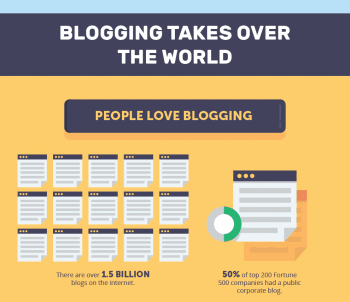
Which means that half of those companies don’t have a public corporate blog.
The same infographic also revealed the following:
86% of B2B companies are blogging. (Or, 14% are not.)
68% of social media marketers use blogs in their social media strategy. (Or, 32% don’t.)
45% of marketers saying blogging is the #1 most important piece of their content strategy.
Small businesses under 10 employees allocate 42% of their marketing budget to content marketing.
So obviously some firms believe blogging is important, while others don’t.
What difference does this make for your firm?
What results do blogging companies receive?
In my view, the figures above are way too low. 100% of all Fortune 500 companies, 100% of B2B companies should be blogging, and 100% of social media marketers should incorporate blogging.
Getting leads from blogging is nice, but show me the money! What about conversions?
Marketers who have prioritized blogging are 13x more likely to enjoy positive ROI.
92% of companies who blog multiple times per day have acquired a customer from their blog.
Take a look at those last two bullets related to conversion again. Blogging is correlated with positive ROI (I won’t claim causation, but anecdotally I believe it), and blogging helps firms acquire customers. So if your firm wants to make money, get blogging.
What should YOUR company do?
With numbers like this, shouldn’t all companies be blogging?
But don’t share these facts with your competitors. Keep them to yourself so that you gain a competitive advantage over them.
Now you just need to write those blog posts.
How can I help?
And if you need help with the actual writing, I, John E Bredehoft of Bredemarket, can help.
And if you’re not in the identity/biometric industry, my general content marketing expertise also applies to technology firms and general business firms.
In most cases, I can provide your blog post via my standard package, the Bredemarket 400 Short Writing Service. I offer other packages and options if you have special needs.
Authorize Bredemarket, Ontario California’s content marketing expert, to help your firm produce words that return results.
I mentioned something in passing in Bredemarket’s recent go-to-market post that I think needs a little more highlighting. So here is a deeper dive into the 22 types of content that product marketers create. (Well, at least 22. I’m probably missing some.)
And by the way, I have created all 22 of these types of content, from blog posts and battlecards to smartphone application content and scientific book chapters. And I can create it for you.
Why is it that so many business-to-business (B2B) marketers confuse product marketing with content marketing?
Because it requires a lot of discipline. That’s why.
B2B marketers who get it right understand the difference between these two fundamentally different types of marketing, what their purposes are and how to use them correctly.
Some firms (especially startups) don’t have the luxury to enforce such definitions. They don’t have separate teams to create awareness content, consideration content, and conversion content. They have one team (or perhaps one person) to create all that content PLUS other stuff that I’ll discuss later.
For example, during my most recent stint as a product marketing employee at a startup, the firm had no official content marketers, so the product marketers had to create a lot of non-product related content. So we product marketers were the de facto content marketers for the company too. (Sadly, we didn’t get two salaries for filling two roles.)
Why did the product marketers end up as content marketers? It turns out that it makes sense—after all, people who write about your product in the lower funnel stages can also write about your product in the upper funnel stages, and also can certainly write about OTHER things, such as company descriptions, speaker submissions, and speaker biographies.
As a result, I’ve written a ton of stuff over my last 29 years in identity/biometrics. It didn’t take a great leap for me to self-identify as the identity content marketing expert and the biometric content marketing expert (and other expert definitions; I’m an expert in creating expert titles).
I’ve compiled a summary of the types of content that I’ve created over the years, not only for Bredemarket’s clients, but also for my employers at Incode Technologies, IDEMIA, MorphoTrak, Motorola, and Printrak.
Not all of these were created when I was in a formal product marketing role, but depending upon your product or service, you may need any of these content types to support the marketing of your product/service.
It’s helpful to divide the list into two parts: the external (customer-facing) content, and the internal (company-only) content.
10 types of external content I have created
External content is what most people think of when they talk about product marketing or content marketing. After all, this is the visible stuff that the prospects see, and which can move them toward a purchase (conversion). The numbers after some content types indicate the quantities of pieces of collateral that I have created.
Articles
Blog Posts (500+, including this one)
Briefs/Data/Literature Sheets
Case Studies (12+)
Proposals (100+)
Scientific Book Chapters
Smartphone Application Content
Social Media (Facebook, Instagram, LinkedIn, Threads, TikTok, Twitter)
Web Page Content
White Papers and E-Books
Here’s an video showing some of the external content that I have created for Bredemarket.
While external content is sexy, internal content is extremely important, since it’s what equips the people inside a firm to promote your product or service. The numbers after some content types indicate the quantities of pieces of collateral that I have created.
Battlecards (80+)
Competitive Analyses
Event/Conference/Trade Show Demonstration Scripts
Plans
Playbooks
Proposal Templates
Quality Improvement Documents
Requirements
Strategic Analyses
And here are 3 more types
Some content can either be external or internal. Again, numbers indicate the quantities of pieces of collateral I have created.
Email Newsletters (200+)
FAQs
Presentations
Content I can create for you
Does your firm need help creating one of these types of content?
Maybe two?
Maybe 22?
I can create content full-time for you
If your firm needs to create a lot of content types for your products, then consider hiring me as your full-time Senior Product Marketing Manager. My LinkedIn profile is here, documenting my 29 years of experience in identity/biometric technology as a product marketer, a strategist, and in other roles.
I just took a look over the last few calls to action that Bredemarket has published.
Whatever you need, talk to me. And be prepared for me to ask you six (or more) questions.
And if you’re reading this post in Janury 2025, thank you. If you want to talk to me about content creation, some of these links may still work!
Perhaps Bredemarket, the technology content marketing expert, can help you select the words to tell your story. If you’re interested in talking, let me know.
If I can help your firm:
From various Bredemarket blog posts.
All of my most recent calls to action were variations on “Contact me.”
And all the CTAs werre kinda so-so and yawn-inducing.
Since I was open to other ideas, I viewed @yourfavcontentcreator_’s recent Instagram reel with four suggestions. Two of them didn’t make sense for Bredemarket’s business, but the first and fourth resonated with me.
I’ve reproduced those two below.
👉 “Get started on your journey to [desired outcome] today.” 👉 “Ready to see real results? Explore our [product/service] now.”
At first I thought I’d simply incorporate “journey” into my CTA…
Don’t stop believin’ in your content!
…but then I decided that “results” would be better.
At the same time, the CTA has to be Brede-distinctive, captivate prospects better than “contact me,” and ideally appeal to all of Bredemarket’s target audiences (identity/biometrics, technology, local).
So, identity/biometric and technology firms, will the paragraph below the logo make you MORE likely to engage with Bredemarket for marketing and writing services? If not, I’ll continue to tweak it in an agile fashion.
Kasey Jones alerted me to the phrase “trust funnel,” and I’ve been thinking about it and its relationship to content marketing. Here are my thoughts.
The sales funnel
Many of us are familiar with the concept of sales funnels. The idea is that there are a bunch of people at the top of the funnel, and people move through the sales process.
As people move down, the funnel gets narrower and narrower as some people exit the funnel. At the bottom of the funnel, there is a very small hole that represents the customers who have converted, or who have actually purchased something.
In a rare instance of my championing simplicity, I like to use an easy three-step sales funnel model with awareness, consideration, and conversion.
From Venn Marketing, “Awareness, Consideration, Conversion: A 4 Minute Intro To Marketing 101.” (Link)
You may use a more complex sales funnel, but the exact number of steps in the funnel really doesn’t matter. What does matter is that your content marketers create content that addresses each step in your funnel.
In early steps of the funnel, the content goal is to ensure that prospects know that you’re out there and you have a solution that benefits the prospects.
In later steps of the funnel, the content goal is to move prospects to the point where they will purchase something from you, rather than purchasing it from one of your competitors or not purchasing anything at all.
Some of the approaches to sales funnel-based content marketing are based upon the faulty assumption that people progress through the funnel in a logical and predictable manner. In the logical model, you present an awareness piece of content, then follow that with a consideration piece of content, then finally present content to convert the prospect into a customer.
It’s about time we redefine the classic marketing funnel. It describes the user journey as a rather linear path, while the reality is a lot more messy, complex, and unpredictable.
Let’s scrap the dated marketing funnel and try to map out the real user journey.
It starts with a trigger, and then it goes into an almost infinite loop between exploration and evaluation – over and over again. And finally, the user exits the loop by making a decision or a purchase.
Oh, and in addition to assuming logic, standard content creation methods assume that your firm knows where every buyer is on their journey. This assumption is essential so that your firm can detect a prospect in the awareness phase and take the necessary steps to move them downward into the funnel (or toward the endless loop pictured above).
Kasey Jones and the trust funnel
I mentioned Kasey Jones at the beginning of this blog post, based upon something she shared on LinkedIn. She started with an inconvenient truth that blew the second assumption out of the water.
Your buyers will probably never like or comment on your posts.
So much for all of those fancy tools that identify the sources of interaction with your content. They don’t work if people don’t interact with your content.
Yet Jones notes that these people are still buying. Three of them reached out to her in the last two weeks.
Each mentioned my content as why they wanted to work with me.
But they have never, not once, engaged with anything I’ve done on here.
Still, they were in my trust funnel, just the same.
It’s different from the sales funnel that we are laboriously tracking in our customer relationship management (CRM) tool. For content marketers, these things literally pop up out of the blue from a “trust funnel” that we know nothing about, even though we’re building it with our content.
If I wished, I could name multiple examples of people reaching out to me because of my content or Bredemarket’s content.
Jones’ point in all this was to emphasize that you need to keep on creating “scroll-stopping content” to attract DREAM (her capitalization) clients.
Even though you don’t know who you are attracting.
You’re not a sausage grinder making sausages. You’re a flower attracting bees.
By The original uploader was Y6y6y6 at English Wikipedia. – Original image located at PDPhoto.org. Transferred from en.wikipedia to Commons by Drilnoth using CommonsHelper., Public Domain, https://commons.wikimedia.org/w/index.php?curid=7365698
Now I could end this discussion right here with Kasey Jones’ comments, but I thought I’d perform a LinkedIn search to see who else was talking about the trust funnel.
And I found Kevin Schmitz.
Kevin Schmitz and the trust funnel
Schmitz approached the topic from a different perspective in his post from earlier this week. He focused on a particular piece of content: a person’s LinkedIn profile and activity.
Schmitz asserted that if someone approaches you with a meeting request, and the person’s LinkedIn presence is (his words) “bare bones,” you’re less likely to take the meeting. But if a meeting requester posts engaging, relevant content, perhaps you’ll take that call.
Schmitz went on to say:
Your presence on LinkedIn is not a “lead funnel”.
It’s a “trust funnel”.
We work so damn hard to establish trust in the meeting.
Yet, most of us are person 1 (the “bare bones” person) with an uphill battle each and every meeting.
Kevin Schmitz LinkedIn post, 8/22/2023 ot 8/23/2023. (Link)
If you’re interested, Schmitz’s post goes on to suggest ways to make your LinkedIn presence more engaging.
The meaning for content marketing
So what does the idea of “creating content that resonates with your invisible trust funnel” mean for content marketing?
Most people realize (or I hope they realize) that organic content often does not have an immediate payoff, especially for complex B2B sales. Even if I write the most amazing automated biometric identification system (ABIS) content for a Bredemarket client, the client won’t get orders within the first three days of posting the content. (I’ll have more to say about “three days” in a future post discussing go-to-market efforts.) Even if I am the biometric content marketing expert. (I’ve been working on promoting THAT piece of content for a while now.)
It takes longer than three days for content marketing to yield results. One source estimates four to five months. Another source says six to twelve months. Joe Pulizzi (quoted by Neil Patel) estimates 15 to 17 months. And all the sources say that their estimates may not apply to your particular case.
But Bredemarket (and I in my personal communications) will continue to cater to that invisible trust funnel and see what happen.
And if you’re reading this post in Janury 2025, thank you. If you want to talk to me about content creation, some of these links may still work!
But what if I want to know how to work with Bredemarket?
Glad you asked.
After reading Mace’s LinkedIn post, I realized that I have a bunch of different online sources that explain how to work with Bredemarket, but they’re scattered all over the place. This post groups them all the “how to work with Bredemarket” content together, following an outline similar (yet slightly different) to Mace’s.
And no, it’s not a stand-alone PDF, but as you read the content below you’ll discover two stand-alone PDFs that address critical portions of the process.
Question 1: Why would I work with Bredemarket?
As you’ll see below, “why” is a very important question, even more important than “how.” Here are some reasons to work with Bredemarket.
You require the words to communicate the benefits of your identity/biometrics product/service. I offer 29 years of experience in the identity/biometrics industry and am a biometric content marketing expert and an identity content marketing expert. I have created multiple types of content (see below) to share critical points about identity/biometrics offerings.
You require the words to communicate the benefits of your technology product/service. I have also created multiple types of content to share critical points about technology offerings.
You require the words to communicate the benefits of a product/service you provide to California’s Inland Empire. I’ve lived in the Inland Empire for…well, for more than 29 years. I know the area—its past, its present, and its future.
You require one of the following types of content. Blogs, case studies / testimonials, data sheets, e-books, proposals, social media posts / Xs (or whatever tweets are called today), white papers, or anything. I’ve done these for others and can do it for you.
Question 2: Why WOULDN’T I work with Bredemarket?
This question is just as important as the prior one. If you need the following, you WON’T want to work with Bredemarket.
You require high quality graphics. Sorry, that’s not me.
I did not draw this myself. Originally created by Jleedev using Inkscape and GIMP. Redrawn as SVG by Ben Liblit using Inkscape. – Own work, Public Domain, link.
You are based outside of the United States. Foreign laws and exchange rates make my brain hurt, so I only pursue business domestically. But depending upon where you are, I may be able to recommend a content marketer for you.
Question 3: What are Bredemarket’s most popular packages? How much do they cost?
Here are the three most common packages that Bredemarket offers.
Note that these are the standard packages. If your needs are different, I can adapt them, or charge you an hourly rate if the need is not well defined. (But as you will see below, I try to work with you at the outset to define the project.)
If you follow the link above for your desired package and download the first brochure on each page, you’ll get a description of the appropriate service. The pricing is at the bottom of each brochure.
Each brochure also explains how I kick off a project, but the procedure is fairly common for each package.
Question 4: What are Bredemarket’s working practices?
But that’s not all that we address in the kickoff. There are some other lower-level questions that I ask you (such as the long and short form of your company name).
Once we have defined the project, I iteratively provide draft copy and you iteratively review it. The number and length of review cycles varies depending upon the content length and your needs. For example, I use up to two review cycles of up to three days each for short content.
Eventually I provide the final copy, you publish it and pay me, and both of us are happy.
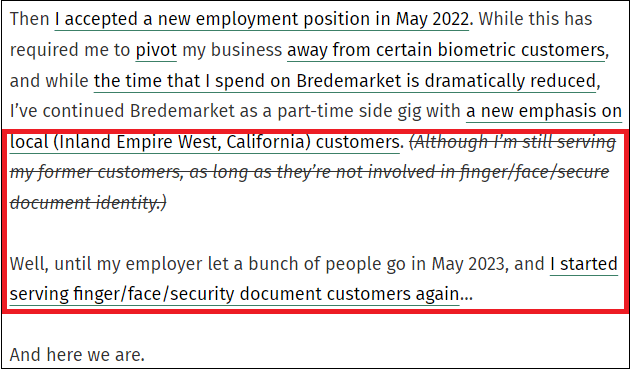
Basically, I had gone through great trouble to document that Bredemarket would NOT take identity work, so I had to reverse a lot of pages to say that Bredemarket WOULD take identity work.
I may have found a few additional pages after June 1, but eventually I reached the point where everything on the Bredemarket website was completely and totally updated, and I wouldn’t have to perform any other changes.
You can predict where this is going.
Who I…was
Today it occurred to me that some of the readers of the LinkedIn Bredemarket page may not know the person behind Bredemarket, so I took the opportunity to share Bredemarket’s “Who I Am” web page on the LinkedIn page.
So yes, this biometric content marketing expert/identity content marketing expert IS available for your content marketing needs. If you’re interested in receiving my help with your identity written content, contact me.
I know that I’m the guy who likes to say that it’s all semantics. After all, I’m the person who has referred to five-page long documents as “battlecards.”
But sometimes the semantics are critically important. Take the terms “factors” and “modalities.” On the surface they sound similar, but in practice there is an extremely important difference between factors of authentication and modalities of authentication. Let’s discuss.
What is a factor?
To answer the question “what is a factor,” let me steal from something I wrote back in 2021 called “The five authentication factors.”
Something You Know. Think “password.” And no, passwords aren’t dead. But the use of your mother’s maiden name as an authentication factor is hopefully decreasing.
Something You Have. I’ve spent much of the last ten years working with this factor, primarily in the form of driver’s licenses. (Yes, MorphoTrak proposed driver’s license systems. No, they eventually stopped doing so. But obviously IDEMIA North America, the former MorphoTrust, has implemented a number of driver’s license systems.) But there are other examples, such as hardware or software tokens.
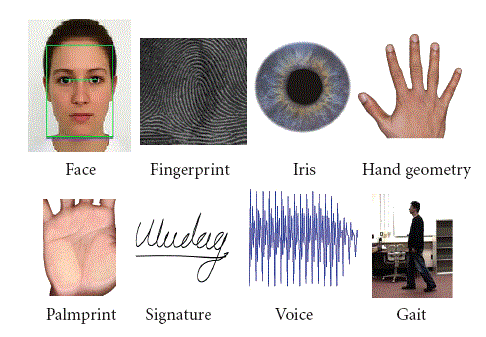
Something You Are. I’ve spent…a long time with this factor, since this is the factor that includes biometrics modalities (finger, face, iris, DNA, voice, vein, etc.). It also includes behavioral biometrics, provided that they are truly behavioral and relatively static.
Something You Do. The Cybersecurity Man chose to explain this in a non-behavioral fashion, such as using swiping patterns to unlock a device. This is different from something such as gait recognition, which supposedly remains constant and is thus classified as behavioral biometrics.
Somewhere You Are. This is an emerging factor, as smartphones become more and more prevalent and locations are therefore easier to capture. Even then, however, precision isn’t always as good as we want it to be. For example, when you and a few hundred of your closest friends have illegally entered the U.S. Capitol, you can’t use geolocation alone to determine who exactly is in Speaker Pelosi’s office.
(By the way, if you search the series of tubes for reading material on authentication factors, you’ll find a lot of references to only three authentication factors, including references from some very respectable sources. Those sources are only 60% right, since they leave off the final two factors I listed above. It’s five factors of authentication, folks. Maybe.)
The one striking thing about the five factors is that while they can all be used to authenticate (and verify) identities, they are inherently different from one another. The ridges of my fingerprint bear no relation to my 16 character password, nor do they bear any relation to my driver’s license. These differences are critical, as we shall see.
What is a modality?
In identity usage, a modality refers to different variations of the same factor. This is most commonly used with the “something you are” (biometric) factor, but it doesn’t have to be.
[M]any businesses and individuals (are adopting) biometric authentication as it been established as the most secure authentication method surpassing passwords and pins. There are many modalities of biometric authentication to pick from, but which method is the best?
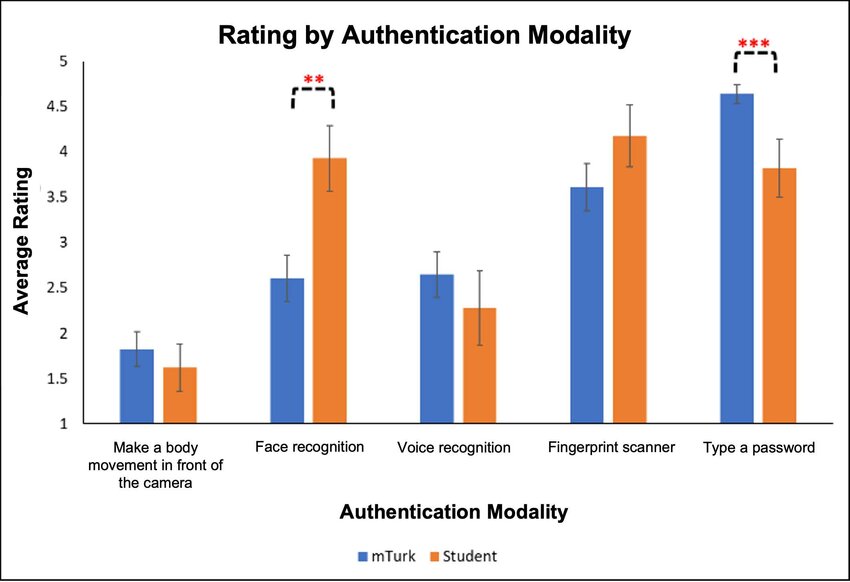
After looking at fingerprints, faces, voices, and irises, Aware basically answered its “best” question by concluding “it depends.” Different modalities have their own strengths and weaknesses, depending upon the use case. (If you wear thick gloves as part of your daily work, forget about fingerprints.)
ID R&D goes a step further and argues that it’s best to use multimodal biometrics, in which the two biometrics are face and voice. (By an amazing coincidence, ID R&D offers face and voice solutions.)
The three modalities in the middle—face, voice, and fingerprint—are all clearly biometric “something you are” modalities.
But the modality on the left, “Make a body movement in front of the camera,” is not a biometric modality (despite its reference to the body), but is an example of “something you do.”
Passwords, of course, are “something you know.”
In fact, each authentication factor has multiple modalities.
For example, a few of the modalities associated with “something you have” include driver’s licenses, passports, hardware tokens, and even smartphones.
Why multifactor is (usually) more robust than multimodal
Modalities within a single authentication factor are more closely related than modalities within multiple authentication factors. As I mentioned above when talking about factors, there is no relationship between my fingerprint, my password, and my driver’s license. However, there is SOME relationship between my driver’s license and my passport, since the two share some common information such as my legal name and my date of birth.
What does this mean?
If I’ve fraudulently created a fake driver’s license in your name, I already have some of the information that I need to create a fake passport in your name.
If I’ve fraudulently created a fake iris, there’s a chance that I might already have some of the information that I need to create a fake face.
However, if I’ve bought your Coinbase password on the dark web, that doesn’t necessarily mean that I was able to also buy your passport information on the dark web (although it is possible).
Can an identity content marketing expert help you navigate these issues?
As you can see, you need to be very careful when writing about modalities and factors.
You need a biometric content marketing expert who has worked with many of these modalities.
Actually, you need an identity content marketing expert who has worked with many of these factors.
So if you are with an identity company and need to write a blog post, LinkedIn article, white paper, or other piece of content that touches on multifactor and multimodal issues, why not engage with Bredemarket to help you out?
If you’re interested in receiving my help with your identity written content, contact me.
I didn’t either. Frankly, I didn’t even work in biometrics professionally until I was in my 30s.
If you have a mad adult desire to become a biometric content marketing expert, here are five topics that I (a self-styled biometric content marketing expert) think you need to understand.
Topic One: Biometrics
Sorry to be Captain Obvious, but if you’re going to talk about biometrics you need to know what you’re talking about.
The days in which an expert could confine themselves to a single biometric modality are long past. Why? Because once you declare yourself an iris expert, someone is bound to ask, “How does iris recognition compare to facial recognition?”
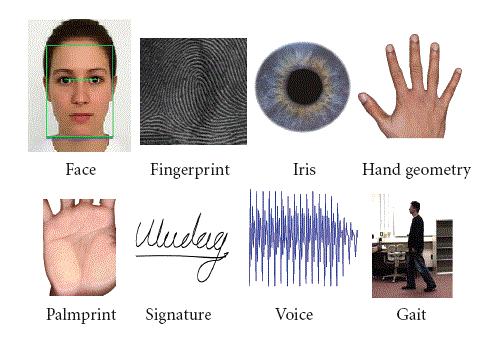
And there are a number of biometric modalities. In addition to face and iris, the Biometrics Institute has cataloged a list of other biometric modalities, including fingerprints/palmprints, voice, DNA, vein, finger/hand geometry, and some more esoteric ones such as gait, keystrokes, and odor. (I wouldn’t want to manage the NIST independent testing for odor.)
As far as I’m concerned, the point isn’t to select the best biometric and ignore all the others. I’m a huge fan of multimodal biometrics, in which a person’s identity is verified or authenticated by multiple biometric types. It’s harder to spoof multiple biometrics than it is to spoof a single one. And even if you spoof two of them, what if the system checks for odor and you haven’t spoofed that one yet?
Topic Two: All the other factors
In the same way that I don’t care for people who select one biometric and ignore the others, I don’t care for some in the “passwords are dead” crowd who go further and say, “Passwords are dead. Use biometrics instead.”
Although I admire the rhyming nature of the phrase.
If you want a robust identity system, you need to use multiple factors in identity verification and authentication.
Something you know.
Something you have.
Something you are (i.e. biometrics).
Something you do.
Somewhere you are.
Again, use of multiple factors protects against spoofing. Maybe someone can create a gummy fingerprint, but can they also create a fake passport AND spoof the city in which you are physically located?
It’s not enough to understand the technical ins and outs of biometric capture, matching, and review. You need to know how biometrics are used.
One-to-one vs. one-to-many. Is the biometric that you acquire only compared to a single biometric samples, or to a database of hundreds, thousands, millions, or billions of other biometric samples?
Markets. When I started in biometrics, I only participated in two markets: law enforcement (catch bad people) and benefits (get benefit payments to the right people). There are many other markets. Just recently I have written about financial identity and educational identity. I’ve worked with about a dozen other markets personally, and there are many more.
Use cases. Related to markets, you need to understand the use cases that biometrics can address. Taking the benefits example, there’s a use case in which a person enrolls for benefits, and the government agency wants to make sure that the person isn’t already enrolled under another name. And there’s a use cases when benefits are paid to make sure that the authorized recipient receives their benefits, and no one else receives their benefits.
Legal and privacy issues. It is imperative that you understand the legal ramifications that affect your chosen biometric use case in your locality. For example, if your house has a doorbell camera that uses “familiar face detection” to identify the faces of people that come to your door, and the people that come to your door are residents of the state of Illinois, you have a BIG BIPA (Biometric Information Privacy Act) problem.
Any identity content marketing expert or biometric content marketing expert worth their salt will understand these and related issues.
Topic Four: Content marketing
This is another Captain Obvious point. If you want to present yourself as a biometric contet marketing expert or identity content marketing expert, you have to have a feel for content marketing.
The definition of content marketing is simple: It’s the process of publishing written and visual material online with the purpose of attracting more leads to your business. These can include blog posts, pages, ebooks, infographics, videos, and more.
But content marketers need to be comfortable with creating at least one type of content.
Topic Five: How L-1 Identity Solutions came to be
Yes, an identity content marketing expert needs to thoroughly understand how L-1 Identity Solutions came to be.
I’m only half joking.
Back in the late 1990s and early 2000s (I’ll ignore FpVTE results for a moment), the fingerprint world in which I worked recognized four major vendors: Cogent, NEC, Printrak (later part of Motorola), and Sagem Morpho.
And then there were all these teeny tiny vendors that offered biometric and non-biometric solutions, including the fierce competitors Identix and Digital Biometrics, the fierce competitors Viisage and Visionics, and a bunch of other companies like Iridian.
Wel, there WERE all these teeny tiny vendors.
Until Bob LaPenta bought them all up and combined them into a single company, L-1 Identity Solutions. (LaPenta was one of the “Ls” in L-3, so he chose the name L-1 when he started his own company.)
So around 2008 the Big Four (including a post-FpVTE Motorola) became the Big Five, since L-1 Identity Solutions was now at the table with the big boys.
But then several things happened:
Motorola started selling off parts of itself. One of those parts, its Biometric Business Unit, was purchased by Safran (the company formed after Sagem and Snecma merged). This affected me because I, a Motorola employee, became an employee of MorphoTrak, the subsidiary formed when Sagem Morpho de facto acquired “Printrak” (Motorola’s Biometric Business Unit). So now the Big Five were the Big Four.
Make that the Big Three, because Safran also bought L-1 Identity Solutions, which became MorphoTrust. MorphoTrak and MorphoTrust were separate entities, and in fact competed against each other, so maybe we should say that the Big Four still existed.
Oh, and by the way, the independent company Cogent was acquired by 3M (although NEC considered buying it).
A few years later, 3M sold bits of itself (including the Cogent bit) to Gemalto.
Then in 2017, Advent International (which owned Oberthur) acquired bits of Safran (the “Morpho” part) and merged them with Oberthur to form IDEMIA. As a consequence of this, MorphoTrust de facto acquired MorphoTrak, ending the competition but requiring me to have two separate computers to access the still-separate MorphoTrust and MorphoTrak computer networks. (In passing, I have heard from two sources, but have not confirmed myself, that the possible sale of IDEMIA is on hold.)
Why do I mention all this? Because all these mergers and acquisitions have resulted in identity practitioners working for a dizzying number of firms.
As of August 2023, I myself have worked for five identity firms, but in reality four of the five are the same firm because the original Printrak International kept on getting acquired (Motorola, Safran, IDEMIA).
And that’s nothing. One of my former Printrak coworkers (R.M.) has also worked for Digital Biometrics (now part of IDEMIA), Cross Match Technologies (now part of ASSA ABLOY), Iridian (now part of IDEMIA), Datastrip, Creative Information Technology, AGNITiO, iTouch Biometrics, NDI Recognition Systems, iProov, and a few other firms here and there.
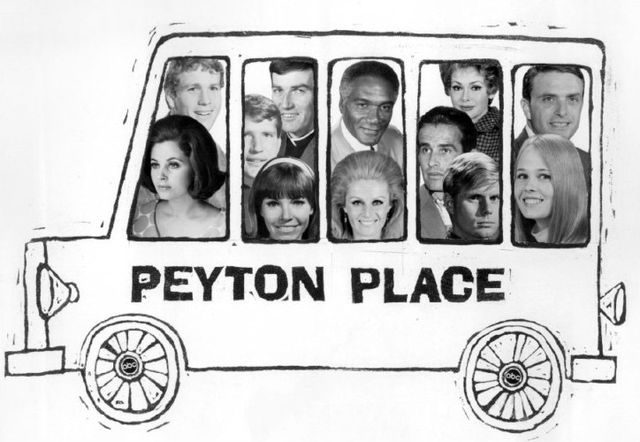
The point is that everybody knows everybody because everybody has worked with (and against) everybody. And with all the job shifts, it’s a regular Peyton Place.
Not sure which one is me, which one is R.M., and who the other people are.
Do you need an identity content marketing expert today?
Do you need someone who not only knows biometrics and content marketing, but also all the other factors, their uses, and even knows the tangled history of L-1?
Whether a student is attending a preschool, a graduate school, or something in between, the educational institution needs to know who is accessing their services. This post discusses the types of identity verification and authentication that educational institutions may employ.
Why do educational institutions need to verify and authenticate identities?
Whether little Johnny is taking his blanket to preschool, or Johnny’s mother is taking her research notes to the local university, educational institutions such as schools, colleges, and universities need to know who the attendees are. It doesn’t matter whether the institution has a physical campus, like Chaffey High School’s campus in the video above, or if the institution has a virtual campus in which people attend via their computers, tablets, or phones.
Access boils down to two questions:
Who is allowed within the educational institution?
Who is blocked from the educational institution?
Who is allowed within the educational institution?
Regardless of the type of institution, there are certain people who are allowed within the physical and/or virtual campus.
Students.
Instructors, including teachers, teaching assistants/aides, and professors.
Administrators.
Staff.
Parents of minor students (but see below).
Others.
All of these people are entitled to access to at least portions of the campus, with different people having access to different portions of the campus. (Students usually can’t enter the teacher’s lounge, and hardly anybody has full access to the computer system where grades are kept.)
Before anyone is granted campus privileges, they have to complete identity verification. This may be really rigorous, but in some cases it can’t be THAT rigorous (how many preschoolers have a government ID?). Often, it’s not rigorous at all (“Can you show me a water bill? Is this your kid? OK then.”).
Once an authorized individual’s identity is verified, they need to be authenticated when they try to enter the campus. This is a relatively new phenomenon, in response to security threats at schools. Again, this could be really rigorous. For example, when students at a University of Rhode Island dining hall want to purchase food from the cafeteria, many of then consent to have their fingerprints scanned.
But some authentiation is much less rigorous. In these cases, people merely show an ID (hopefully not a fake ID) to authenticate themselves, or a security guard says “I know Johnny.”
(Again, all this is new. Many years ago, I accompanied a former college classmate to a class at his new college, the College of Marin. If I had kept my mouth shut, the professor wouldn’t have known that an unauthenticated student was in his class.)
Who is blocked from the educational institution?
At the same time, there are people who are clearly NOT allowed within the physical and/or virtual campus. Some of these people can enter campus with special permission, while some are completely blocked.
Former students. Once a student graduates, their privileges are usually revoked, and they need special permission if they want to re-enter campus to visit teachers or friends. (Admittedly this isn’t rigorously enforced.)
Expelled students. Well, some former students have a harder time returning to campus. If you brought a gun on campus, it’s going to be much harder for you to re-enter.
Former instructors, administrators, and staff. Again, people who leave the employ of the institution may not be allowed back, and certain ones definitely won’t be allowed back.
Non-custodial parents of minor students. In some cases, a court order prohibits a natural parent from contact with their child. So the educational institutions are responsible for enforcing this court order and ensuring that the minor student leaves campus only with someone who is authorized to take the child.
Others.
So how do you keep these people off campus? There are two ways.
If they’re not on the allowlist, they can’t enter campus anyway. As part of the identity verification process for authorized individuals, there is a list of people who can enter the campus. By definition, the 8 billion-plus people who are not on that “allowlist” can’t get on campus without special permission.
Sometimes they can be put on a blocklist. Or maybe you want to KNOW that certain people can’t enter campus. The inverse of an allowlist, people who are granted access, is a blocklist, people who are prevented from getting access. (You may know “blocklist” by the older term “blacklist,” and “allowlist” by the older term “whitelist.” The Security Industry Association and the National Institute of Standards and Technology recommend updated terminology.)
There’s just one teeny tiny problem with blocklists. Sometimes they’re prohibited by law.
In some cases (but not in others), a person is required to give consent before they are enrolled in a biometric system. If you’re the ex-student who was expelled for brining a gun on campus, how motivated will you be to allow that educational institution to capture your biometrics to keep you off campus?
And yes, I realize that the expelled student’s biometrics were captured while they were a student, but once they were no longer a student, the institution would have on need to retain those biometrics. Unless they felt like it.
This situation becomes especially sticky for campuses that use video surveillance systems. Like Chaffey High School.
Chaffey High School, Ontario, California.
Now the mere installation of a video surveillance system does not (usually) result in legally prohibited behavior. It just depends upon what is done with the video.
If the video is not integrated with a biometric facial recognition system, there may not be an issue.
If Chaffey High School has its own biometric facial recognition system, then a whole host of legal factors may come into play.
If Chaffey High School does not have a biometric facial recognition system, but it gives the video to a police agency or private entity that does have a biometric facial recognition system, then some legal factors may emerge.
As you can see, educational identity is not as clear-cut as financial identity, both because financial institutions are more highly regulated and because blocklists are more controversial in educational identity. Vladimir Putin may not be able to open a financial account at a U.S. bank, but I bet he’d be allowed to enroll in an online course at a U.S. community college.
So if you are an educational institution or an identity firm who serves educational institutions, people who write for you need to know all of these nuances.
You need to provide the right information to your customers, and write it in a way that will motivate your customers to take the action you want them to take.
Speaking of motivating customers, are you with an identity firm or educational institution and need someone to write your marketing text?
Someone with 29 years of identity/biometric marketing experience?
Someone who understands that technological, organizational, and legal issues surrounding the use of identity solutions?
Someone who will explain why your customers should care about these issues, and the benefits a compliant solution provides to them?
If I can help you create your educational identity content, we need to talk.
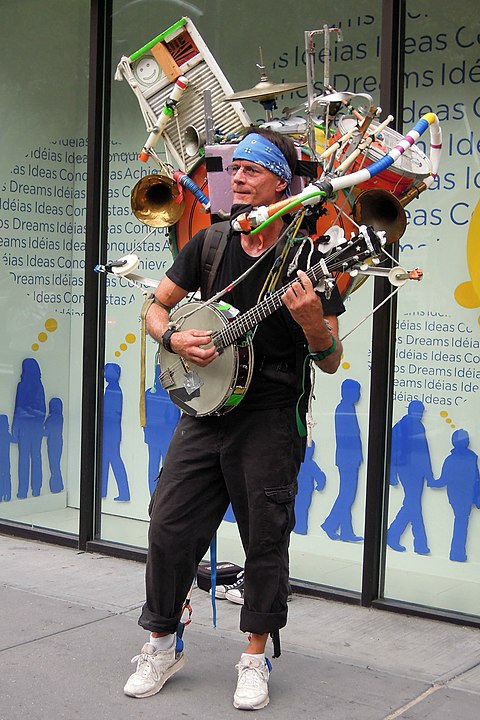
Stump the Experts at WWDC 2010 Stefan Haubold • CC BY-SA 3.0
One way for your firm to publicize its offerings is through company LinkedIn articles. My LinkedIn article, written by my company Bredemarket, discusses…well, company LinkedIn articles. It also discusses:
Why you should write LinkedIn articles.
Why companies should write LinkedIn articles under their own names.
How to create LinkedIn articles.
Finally, who can write your LinkedIn articles. (I have a suggestion.)













 Bredemarket
