Financial Identity: Which Firms Can Remotely Onboard Financial Customers?

Bank of America, Euclid Avenue, Ontario, California.

Here’s a sign of the times from Ontario, California. The sign at the end of this video appears on the door of a bank branch in downtown Ontario, and basically says that if you wanted to go to THIS branch on Saturday, you’re out of luck.

Of course, that assumes that you actually WANT to go to a physical bank branch location. Unlike the old days, when banks were substantive buildings that you visited to deposit and withdraw money, now banks can be found in our smartphones.

What locational, technological, and organizational changes have taken place at banks over the last 50 years? And now that you can open an account to buy crypto on your smartphone, does your financial institution’s onboarding solution actually WORK in determining financial identity?

Three changes in banking over the last fifty years

Over the last fifty years, banking has changed to the point where someone from 1973 wouldn’t even recognize “banking” today. Stick around to see a video from a company called “Apple” showing you how to use a “wallet” on a “smartphone” to pay for things even if you’re not carrying your “chip card.” Karl Malden would be spinning in his grave. So let’s talk about the three changes:

  1. The locational change.
  2. The technological change.
  3. The organizational change.

The locational change: from stand-alone buildings to partitioned grocery store sections

When I was growing up, a “bank” (or a “savings & loan,” which we will discuss later) was located in a building where you would go on weekdays (or even Saturdays!) and give money to, or get money from, a person referred to as a teller.

By Dennis Brown – Own work, CC BY 3.0, https://commons.wikimedia.org/w/index.php?curid=5214388

There was this whole idea of “going to the bank,” perhaps on your lunch hour because you couldn’t go to the bank on Sunday at midnight, could you?

The first crack in the whole idea of “going to the bank” was the ability to bank without entering the door of the bank…and being able to bank on Sunday at midnight if you felt like it. Yes, I’m talking about Automated Teller Machines (ATMs), where the “teller,” instead of being a person, was a bunch of metal and a TV screen. The first ATM appeared in 1967, but they didn’t really become popular until several years later.

Actor Reg Varney using the world’s first cash machine at Barclays Bank, Enfield, north London on 27 June 1967. https://en.wikipedia.org/w/index.php?curid=12747908

For the most part, these ATMs were located at the bank buildings themselves. But those buildings were costly, and as competition between banks increased, banks sought alternatives. By 1996, a new type of banking location emerged (PDF):

The largest U.S. commercial banks are restructuring their retail operations to reduce the cost disadvantage resulting from a stagnant deposit base and stiffer competition. As part of this effort, some banks are opening “supermarket,” or “in-store,” branches: a new type of banking office within a large retail outlet. An alternative to the traditional bank office, the supermarket branch enables banks to improve the efficiency of the branch network and offer greater convenience to customers.

From https://www.newyorkfed.org/medialibrary/media/research/current_issues/ci2-13.pdf

To traditionalists, these bank branches looked pretty flimsy. Where are the brick and (fake) marble walls that protect my cash? Heck, anyone can walk into the store and just steal all my money, right?

Well, these newfangled bank branches apparently WERE able to protect our cash, and the idea of banking right in the grocery store proved to be very popular because of its convenience.

But the changes were just beginning.

The technological change: from store sections to smartphones

As banks changed where they were located, there were technological changes also.

During the 1990s, more and more people were using home computers. As the computers and their security became more and more sophisticated, some people asked why we needed to “go to the bank” (either a stand-alone building or a partitioned area next to the cigarettes) at all. Why not just bank at the computer? So PC banking emerged.

Interpol and Deutsche Bank. The cover art can be obtained from Kling Klang and EMI Electrola., Fair use, https://en.wikipedia.org/w/index.php?curid=42639079

The term “PC banking” refers to the online access of banking information from a personal computer. A solution for both personal or business banking needs, this type of financial management allows you to conduct transactions using an Internet connection and your computer in lieu of a trip to the local bank branch or the use of an ATM. PC banking enables an account holder to perform real-time account activities and effectively manage finances in a way that avoids the hassle of daytime bank visits and eliminates the postage required to pay bills by mail.

From https://smallbusiness.chron.com/pc-banking-72403.html

Ah yes; there was another benefit. You could use the computer to pay your bills electronically. The U.S. Postal Service was NOT a fan of this change.

As we crossed into the new millennium, the online banking ideas got even wilder. Cellular telephones, which followed a modified version of the “Princess phone” form factor, became more complex devices with their own teeny-tiny screens, just like their larger computer cousins. Eventually, banks began offering their services on these “smartphones,” so that you didn’t even need a computer to perform your banking activities.

Imagine putting the video below on 8mm film and traveling back in time to show it to a 1973 banking customer. They would have no idea what was going on in the film.

From https://www.youtube.com/watch?v=znIOqQLbNFk

But are PC and smartphone banking secure? After all, smartphones don’t have brick or (fake) marble walls. We’ll get to that question.

The organizational change: from banks to…who knows what?

The third change was not locational or technological, but a change in terms of business organization. Actually, many changes.

Back in 1973, the two major types of banks were banks, and something called “savings & loans.” Banks had been around for centuries, but savings & loans were a little newer, having started in 1831. They were regulated a little differently: banks were insured by the FDIC, S&Ls by the FSLIC.

Everything was all hunky dory until the 1980s, when the S&Ls started collapsing. This had monumental effects; for example, this PDF documenting the S&L crisis is hosted on the FDIC website, because the FSLIC was abolished many years ago.

After savings & loans became less popular, other “banks” emerged.

But there was one similarity between banks, savings & loans, credit unions, and payday loans. They all dealt in U.S. dollars (or the currency of the nation where they were located).

Enter the crypto providers, who traded cryptocurrencies that weren’t backed by any government. Since they were very new entrants, they didn’t have to make the locational and technological changes that banks and related entities had to make; they zoomed straight to the newest methods. Everything was performed on your smartphone (or computer), and you never went to a physical place.

Now, let’s open a financial account

Back in 1973, the act of opening an account required you to travel to a bank branch, fill out some forms, and give the teller some form of U.S. dollars.

You can still do that today, for the most part. But it was hard to do that in the summer and fall of 2020 when Bredemarket started.

Bredemarket pretty much started because of the COVID-19 pandemic, and those first few months of Bredemarket’s existence were adversely affected by COVID-19. When I wanted to start a bank account for Bredemarket, I COULDN’T travel to my nearby bank branch to open an account. I HAD to open my account with my computer.

So, without a teller (human or otherwise) even meeting me, I had to prove that I was a real person, and give my bank enough information during onboarding so that they knew I wasn’t a money-laundering terrorist. Banks had to follow government regulations (know your customer, anti-money laundering, know your business), even in the midst of a worldwide pandemic.

This onboarding process had to be supported whether you were or were not at a physical location of a financial institution.

  • Whether you were conducting business in person, on a computer, or on a smartphone.
  • Whether you were working with U.S. dollars or (as crypto regulations tightened) something named after a dog or an entire planet or whatever.

How can you support all that?

Liminal’s “Link™ Index for
Account Opening in Financial Services”

Back in 2020 when I was onboarding the new-fashioned way, I had no way of predicting that in less than two years, I would be working for a company that helped financial institutions onboard customers the new-fashioned way.

At the time, I estimated that there were over 80 companies that provided such services.

According to Liminal, my estimate was too low. Or maybe it was too high.

Liminal’s July 2023 report, “Link™ Index for Account Opening in Financial Services,” covers companies that provide onboarding services that allow financial institutions to use their smartphone apps (or web pages) to sign up new clients.

Account opening solutions for the financial services industry are critical to ensuring compliance and preventing fraud, enabling companies to effectively identify new users during customer registration and deliver a seamless onboarding experience. The primary purpose of these solutions is to facilitate mandatory compliance checks, with a particular emphasis on the Know Your Customer (KYC) process.

From https://liminal.co/research/link-index/account-opening-financial-services/

If I can summarize KYC in layperson terms, it basically means that the person opening a financial institution account is who they say they are. For example, it ensures that Vladimir Putin can’t open a U.S. bank acccount under the name “Alan Smithee” to evade U.S. bans on Russian national transctions.

Remember how I found over 80 identify proofing vendors? Liminal found a few more who claimed to offer identity proofing, but thinks that less than 80 firms can actually deliver.

Around 150 vendors claim to offer account opening compliance and fraud solutions in banking, but only 32 (21.3%) have the necessary product features to meet buyer demands.

From https://liminal.co/research/link-index/account-opening-financial-services/

The firms identified by Liminal include my (now former) employer Incode Technologies, plus some others in the industry.

Leading Vendors Profiled

Alloy, Au10tix, Bureau, Caf, Contactable, Effectiv, Experian, FrankieOne, GBG, GeoComply, IDnow, ID.me, iDenfy, IDMERIT, Incode, Jumio, LexisNexis Risk Solutions, MetaMap, Mitek, Onfido, Persona, Plaid, Prove, Refinitiv, ShuftiPro, Signicat, Signzy, Socure, Sumsub, TransUnion, Trulioo, Veriff.

From https://liminal.co/research/link-index/account-opening-financial-services/

Now I have not purchased the entire Liminal report, and even the Executive Summary (which I do have) is “privileged and confidential” so I can’t reprint it here. But I guess that I can say that Liminal used something called the “Link Score” to determine which vendors made the top category, and which didn’t.

I’m not sure how the vendors who DIDN’T make the top category are reacting to their exclusion, but I can bet that they’re not happy.

Writing about Financial Identity

As you can gather, there are a number of issues that you have to address if you want to employ identity proofing at a financial institution.

And if you’re an identity firm or financial institution, you need to provide the right information to your customers, and write it in a way that will motivate your customers to take the action you want them to take.

Speaking of motivating customers, are you with an identity firm or financial institution and need someone to write your marketing text?

  • Someone with 29 years of identity/biometric marketing experience?
  • Someone who consistently tosses around acronyms like ABM, FRVT, KYB, KYC, and PAD, but who would never dump undefined acronyms on your readers? (If you’re not a financial/identity professional and don’t know these acronyms, they stand for anti-money laundering, Face Recognition Vendor Test, Know Your Business, Know Your Customer, and Presentation Attack Detection.)
  • Someone who will explain why your customers should care about these acronyms, and the benefits a compliant solution provides to them?

If I can help you create your financial identity content, we need to talk.

How Remote Work Preserves Your Brain

I remember the day that my car skidded down Monterey Pass Road in Monterey Park, California, upside down, my seatbelt saving my brain from…um…very bad things. (I promised myself that I’d make this post NON-gory.)

Monterey Pass Road and South Fremont Avenue, Monterey Park, California. https://www.google.com/maps/@34.0586679,-118.1445677,19z?entry=ttu

I was returning from lunch to my employer farther south on Monterey Pass Road when a car hit me from the side, flipping my car over so that it skidded down Monterey Pass Road, upside down. Only my seat belt saved my from certain death.

(Mini-call to action: wear seat belts.)

By The cover art can be obtained from Liberty Records., Fair use, https://en.wikipedia.org/w/index.php?curid=25328218

Now some of you who know me are asking, “John, you’ve lived in Ontario and Upland for the past several decades. Why were you 30 miles away, in Monterey Park?”

Well, back in 1991, after working for Rancho Cucamonga companies for several years, I ended up commuting to a company in Monterey Park, California, at least an hour’s drive one way from my home. Driving toward downtown Los Angeles in the morning, and away from downtown Los Angeles in the afternoon. If you know, you know.

After I left the Monterey Park company, I consulted or worked for companies in Pomona, Brea, Anaheim, Irvine, and other cities. But for most of the next three decades, I was still driving at least an hour one-way every day to get from home to work.

And it’s not just a problem in Southern California. By B137 – Own work, CC BY-SA 4.0, https://commons.wikimedia.org/w/index.php?curid=48998674

As I’ll note later in this post, some people are still commuting today. And for all I know I may commute again also.

I learn the acronym WFH

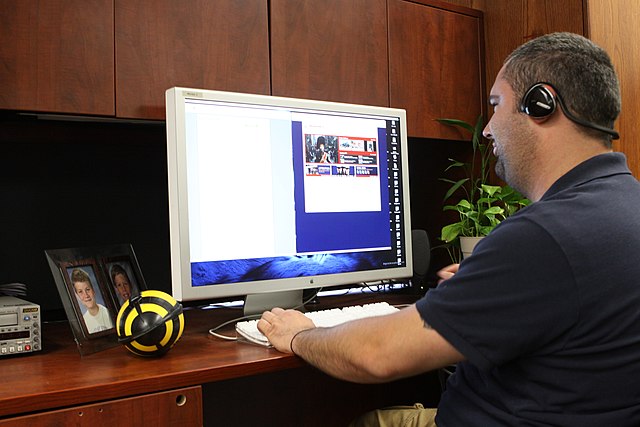
That all stopped in March 2020 when a worldwide pandemic sent all non-essential personnel at IDEMIA’s Anaheim office to work from home (WFH). Now there were some IDEMIA employees, such as salespeople, who had been working from home for years, but this was the first time that a whole bunch of us were doing it.

Some of us had to upgrade our home equipment: mesh networks, special face illumination lighting, and other things. And now, instead of having a couple of people participating in meetings remotely, ALL of us were doing so. (Before 2020, the two words “Zoom background” would be incomprehensible to me. After 2020, I understood those words intimately.)

This new work practice continued after I left IDEMIA, as I started Bredemarket, joined Incode Technologies for a little over a year, and returned (for now) to Bredemarket again.

The U.S. Marine Corps supported WFH (for certain positions) in 2010, long before COVID. This image was released by the United States Marine Corps with the ID 100324-M-6847A-001 (next). This tag does not indicate the copyright status of the attached work. A normal copyright tag is still required. See Commons:Licensing.العربية ∙ বাংলা ∙ Deutsch ∙ Deutsch (Sie-Form) ∙ English ∙ español ∙ euskara ∙ فارسی ∙ français ∙ italiano ∙ 日本語 ∙ 한국어 ∙ македонски ∙ മലയാളം ∙ Plattdüütsch ∙ Nederlands ∙ polski ∙ پښتو ∙ português ∙ slovenščina ∙ svenska ∙ Türkçe ∙ українська ∙ 简体中文 ∙ 繁體中文 ∙ +/−, Public Domain, https://commons.wikimedia.org/w/index.php?curid=23181833

WFH benefits

There are two benefits to working from home:

  • First, it preserves your brain. Not just from the horrible results of a commuting automobile accident. For the last three-plus years, I’ve gotten more rest and sleep since I’m not waking up before 6am and getting home after 6pm. And I’m not sitting in traffic on the 57, waiting for an accident to clear.
  • Second, it provides the best talent to your employer. Why? Because it can hire you. I just spent over a year working for a company headquartered in San Francisco, and I didn’t have to move to San Francisco to do it. In fact, when my product marketing team reached its apex, we had two people in Southern California, one in England, and one in Sweden. None of us had to move to San Francisco to work there, and my company was not restricted to hiring people who could get to San Francisco every day.

But that doesn’t stop some companies from insisting on office work

In-office presence controversy predates COVID (remember Marissa Mayer and Yahoo?), and now that COVID has receded, the “return to office” drumbeat has gotten louder.

Laith Masarweh shared the story of a woman who, like me, is tiring of the L.A. freeway grind.

So she asked her boss for help–

And he told her to change her mindset.

“That’s just life,“ he said. “Everyone has to commute.”…

All she asked for was some flexibility, and he shut her down.

So he’s going to lose her.

Laith Masarweh, LinkedIn. (link)

Now I’m not saying I’ll never work on-site again. Maybe someday I’ll even accept an on-site position in Monterey Park.

But I’m not that thrilled about going down Monterey Pass Road again.

In the meantime…

…since I’m NOT full-time employed, and since my home office is well equipped (I have Nespresso!), I have the time to make YOUR company’s messaging better.

If you can use Bredemarket’s expertise for your biometric, identity, technology, or general blog posts, case studies, white papers, or other written content, contact me.

From https://open.spotify.com/track/2BPEPkeifa5LoOg2Cq9bkx

When the “Wrong” Content Goes Viral

Have you ever had a piece of content go viral, but wish that ANOTHER piece of content had gone viral instead? Join the club.

Three examples of unintentional viral content

Here are three examples in which the “wrong” content went viral. Two of the examples are personal, but the first example has nothing to do with me, the Internet, or even the 21st century.

Example 1: Steam behind the wrong song

Back in the 1960s, a singer named Gary DeCarlo was working under the pseudonym Garrett Scott. “Garrett Scott” needed a single, so he was slotted to record a song called “Sweet Laura Lee.”

Because it was a 1960s single, it needed to have a B-side. You couldn’t let all that vinyl on the back of the record go to waste. Any song would do, since it was just filler for “Sweet Laura Lee.”

So DeCarlo and two of his friends resurrected a 1961 song called “Kiss Him Goodbye,” went to the studio, added a silly chant because the 1961 song lacked a chorus, and cranked out the B-side in an evening session. They did it so quickly that the chorus didn’t even have any real words, just “na na.” Actually, the B-side was SUPPOSED to be bad so that disc jockeys would play the A-side:

B-sides in the ’60s were often ad-hoc affairs designed to be clearly inferior to the A-side so that disc jockeys wouldn’t flip the record. The three musicians who recorded this had that in mind for this song, and kept it simple: there is no bass or guitar on the track….

From https://www.songfacts.com/facts/steam/na-na-hey-hey-kiss-him-goodbye

The song “Sweet Laura Lee” went nowhere, but who cares? The record company liked the B-side, invented a fake band name Steam, and the song “Na Na Hey Hey Kiss Him Goodbye” went to the number 1 position on the Billboard charts. A real band named Steam was formed and went on tour…without Gary DeCarlo (although DeCarlo received songwriting royalties).

From https://open.spotify.com/track/5xMLcSEstX1jN4arpNXqtX

Example 2: Becoming the unintentional Shipley expert

Fast forward to the 21st century and my creation of blog content for Bredemarket.

I needed to populate my blog with both content marketing-related content and proposal-related content, so in December 2021 I wrote a post entitled “96 Smiles: All about the Shipley Business Development Lifecycle.” I’ve been familiar with the Shipley lifecycle for decades, but probably not as familiar as hundreds if not thousands of proposal practitioners.

But I’m the one who wrote the blog post about it.

And it kinda sorta became popular. I went to Google on Friday morning and searched for the words shipley 96 step, and these are the results:

So now, right behind Shipley Associates itself, the next leading authority on the Shipley Business Development Lifecycle is…ME.

So now the bredemarket.com website is getting all sorts of traffic related to Shipley, and my Ubersuggest account is, um, suggesting that I optimize the website to capture even more Shipley traffic.

Except that I’m not really doing much with the Shipley process itself; I just talked about it.

Of course, the traffic may have nothing to do with capture and proposal management, since the post makes several explicit and implicit references to the ? and the Mysterians song “96 Tears.”

From https://open.spotify.com/track/4PEeZ2U4UfP2Jo8EtIOjus

You may detect a music theme in these examples. It gets better.

Example 3: When neglected music becomes more popular than my current gig

Bredemarket started in August 2020, but it isn’t my first foray into Internet money-making.

I’ve been creating instrumental music for decades, and in 2017 I started creating and selling music on Bandcamp under the name “Ontario Emperor.” While I haven’t created any new music there since 2019, and while I haven’t done any promotion in years, I did do a little bit of promotion back in 2017, going so far as to set up a Facebook page called “ontarioemperor,” which I’ve mostly ignored.

What I HAVEN’T ignored is the slew of social media channels for Bredemarket. Some of you are aware of this, since you’ve recently received invitations from me to follow Bredemarket on LinkedIn, Facebook, Instagram, Threads, TikTok, and YouTube. If you haven’t, feel free to click on the appropriate links and subscribe now.

So as I’ve been building up my Bredemarket social/content presence and spending a lot of time on this, I received a notification from Facebook this week that, with no effort on my own, my neglected ontarioemperor Facebook page now has over 600 followers.

So as long as you’re following me everywhere else, go ahead and follow me there also.

Now I’m not sure how much Ontario Emperor’s Facebook popularity can benefit Bredemarket, since there’s little or no discernable overlap between synthetic music fans and people requiring marketing and writing services. But who knows? I could be wrong there also.

Sadly there is no Spotify link here since Ontario Emperor’s music has never been uploaded to Spotify, but you can listen to the song “For a Meaningful Apocryphal Animation” on Bandcamp. Coincidentally, I recently posted a free version (with no listening restrictions) on one of the Bredemarket web pages. Or you can listen to it below.

“For a Meaningful Apocryphal Animation.” Recorded May 15, 2017 in Ontario, California. Composed by John E. Bredehoft. © All rights reserved.

A final thought

Jerry Springer. By Justin Hoch, CC BY 2.0, https://commons.wikimedia.org/w/index.php?curid=16673259

So sometimes things you want to promote don’t get popular, and things you don’t necessary want to promote get popular.

Rather than being disappointed, just go with the flow, say “na na” to the naysayers, and speak about Shipley with soothing instrumental music behind you.

Take care of yourself, and each other.

Applying the “Six Questions” to LinkedIn Self-promotion

(UPDATE OCTOBER 23, 2023: “SIX QUESTIONS YOUR CONTENT CREATOR SHOULD ASK YOU IS SO 2022. DOWNLOAD THE NEWER “SEVEN QUESTIONS YOUR CONTENT CREATOR SHOULD ASK YOU” HERE.)

I’ve previously talked about the six questions your content creator should ask you. And I eat my own wildebeest food. I used the six questions to create a self-promotion blog post and LinkedIn post.

But since you care about YOUR self-promotion rather than mine, I’ll provide three tips for writing and promoting your own LinkedIn post.

How I promoted my content

Before I wrote the blog post or the LinkedIn post, I used my six questions to guide me. For my specific example, here are the questions and the answers.

QuestionPrimary AnswerSecondary Answer (if applicable)
Why?I want full-time employmentI want consulting work
How?State identity and marketing qualifications, ask employers to hire meState identity and marketing qualifications, ask consulting clients to contract with me
What?Blog post (jebredcal), promoted by a personal LinkedIn postBlog post (jebredcal), promoted by a Bredemarket Identity Firm Services LinkedIn post
Goal?Employers contact me for full-time employmentConsulting prospects contact me for contract work
Benefits?(1) No identity learning curve
(2) No content learning curve
(3) Proven results
(same)
Target Audience?Identity companies hiring Senior Product Marketing Managers and Senior Content Marketing ManagersIdentity companies contracting with content marketing consultants
For more information on the six questions, see https://bredemarket.com/2022/12/18/six-questions-your-content-creator-should-ask-you-the-e-book-version/.

You’ll notice that I immediately broke a cardinal rule by having both a primary goal and a secondary goal. When you perform your own self-promotion, you will probably want to make things less messy by having only a single goal.

So based upon these responses, I created…

First, the blog post

The Bredemarket blog is primarily to promote my consulting work. I have a different blog (jebredcal) to promote my full-time employment (or attempts to secure full-time employment).

Because the primary goal was to secure full-time employment, I posted to jebredcal instead of Bredemarket.

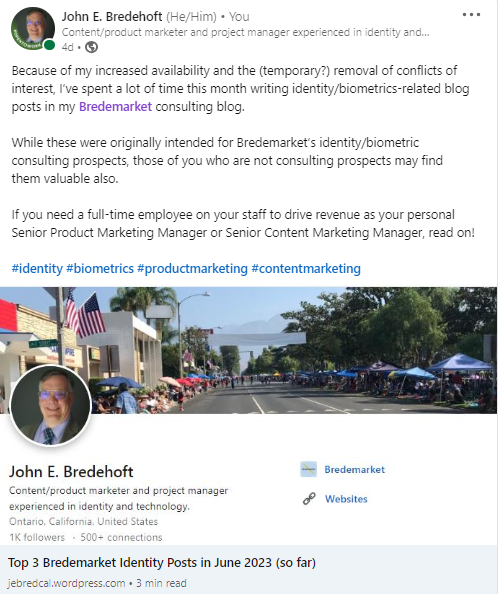
After the introduction (pictured above) with its “If you need a full-time employee” call to action, I then shared three identity-related blog posts from the Bredemarket blog to establish my “biometric content marketing expert” (and “identity content marketing expert”) credentials. I then closed with a dual call to action for employers and potential consulting clients. (I told you it is messy to have two goals.)

If you want to see my jebredcal post “Top 3 Bredemarket Identity Posts in June 2023 (so far),” click here.

So how did I get the word out about this personal blog post? I chose LinkedIn. (In my case, hiring managers probably aren’t going to check my two Instagram accounts.)

Second, the LinkedIn post

I often reshare my Bredemarket blog posts on various Bredemarket social media accounts. In this instance I only reshared it on LinkedIn, since that’s where the hiring managers are. While I shared the blog post to my Bredemarket Identity Firm Services LinkedIn page (since the post talked about identity), my primary goal was to share it to my personal LinkedIn feed.

It was simple to write the LinkedIn text, since I repurposed the introduction of the blog post itself. I added four hashtags, and then the post went live. You can see it here.

And by the way, feel free to like the LinkedIn post, comment on it, or even reshare it. I’ll explain why below.

Third, the “LinkedIn Love” promotion

So how did I promote it? Via the “LinkedIn Love” concept. (Some of you know where I learned about LinkedIn Love.)

To get LinkedIn love, I asked a few trusted friends in the identity industry to like, comment, or reshare the post. This places the post on my friends’ feeds, where their identity contacts will see it.

A few comments:

  • I don’t do this for every post, or else I will have no friends. In fact, this is the first time that I’ve employed “LinkedIn Love” in months.
  • I only asked friends in the identity industry, since these friends have followers who are most likely to hire a Senior Product Marketing Manager or Senior Content Marketing Manager.
  • I only asked a few friends in the identity industry, although eventually some friends that I didn’t ask ended up engaging with the post anyway.

I have wonderful friends. After several of them gave “LinkedIn Love,” The post received significant engagement. As of Friday morning, the post had acquired over 1,700 impresions. That’s many, many more than my posts usually acquire.

I don’t know if this activity will directly result in full-time employment or increased consulting work. But it certainly won’t hurt.

Three steps to promote YOUR content

But the point of this post isn’t MY job search. It’s YOURS (or whatever it is you want to promote).

For example, one of my friends who is also seeking full-time employment wanted to know how to use a LinkedIn post to promote THEIR OWN job search.

Now you don’t need to use my six questions. You don’t need to create a blog post before creating the LinkedIn post. And you certainly don’t need to create two goals. (Please don’t…unless you want to.)

In fact, you can create and promote your own LinkedIn post in just THREE steps.

Step One: What do you want to say?

My six questions obviously aren’t the only method to collect your thoughts. There are many, many other tools that achieve the same purpose. The important thing is to figure out what you want to say.

  • Start at the end. What action do you want the reader to take after reading your LinkedIn post? Do you want them to read your LinkedIn profile, or download your resume, or watch your video, or join your mailing list, or email or call you? Whatever it is, make sure your LinkedIn post includes the appropriate “call to action.”
  • Work on the rest. Now that you know how your post will end, you can work on the rest of the post. Persuade your reader to follow your call to action. Explain how you will benefit them. Address the post to the reader, your customer (for example, a potential employer), and adopt a customer focus.

Step Two: Say it.

If you don’t want to write the post yourself, then ask a consultant, a friend, or even a generative AI tool to write something for you. (Just because I’m a “get off my lawn” guy regarding generative AI doesn’t mean that you have to be.)

(And before you ask, there are better consultants than Bredemarket for THIS writing job. My services are designed and priced for businesses, not individuals.)

After your post is written by you or someone (or something) else, have one of your trusted friends review it and see if the written words truly reflect how amazing and outstanding you are.

Once you’re ready, post it to LinkedIn. Don’t delay, even if it isn’t perfect. (Heaven knows this blog post isn’t perfect, but I posted it anyway.) Remember that if you don’t post your promotional LinkedIn post, you are guaranteed to get a 0% response to it.

Step Three: Promote it.

Your trusted friends will come in handy for the promotion part—if they have LinkedIn accounts. Privately ask your trusted friends to apply “LinkedIn Love” to your post in the same way that my trusted friends did it for me.

By the way—if I know you, and you’d like me to promote your LinkedIn post, contact me via LinkedIn (or one of the avenues on the Bredemarket contact page) and I’ll do what I can.

And even if I DON’T know you, I can promote it anyway.

I’ve never met Mary Smith in my life, but she says that she read my Bredemarket blog post “Applying the “Six Questions” to LinkedIn Self-promotion.” Because she selects such high-quality reading material, I’m resharing Mary’s post about how she wants to be the first human to visit Venus. If you can help her realize her dream, scroll to the bottom of her post and donate to her GoFundMe.

Hey, whatever it takes to get the word out.

Let me know if you use my tips…or if you have better ways to achieve the same purpose.

Three Ways to Identify and Share Your Identity Firm’s Differentiators

(Part of the biometric product marketing expert series)

Are you an executive with a small or medium sized identity/biometrics firm?

If so, you want to share the story of your identity firm. But what are you going to say?

How will you figure out what makes your firm better than all the inferior identity firms that compete with you?

How will you get the word out about why your identity firm beats all the others?

Are you getting tired of my repeated questions?

Are you ready for the answers?

Your identity firm differs from all others

Over the last 29 years, I (John E. Bredehoft of Bredemarket) have worked for and with over a dozen identity firms, either as an employee or as a consultant.

You’d think that since I have worked for so many different identity firms, it’s an easy thing to start working with a new firm by simply slapping down the messaging that I’ve created for all the other identity firms.

Nothing could be further from the truth.

Designed by Freepik.

Every identity firm needs different messaging.

  • The messaging that I created in my various roles at IDEMIA and its corporate predecessors was dramatically different than the messaging I created as a Senior Product Marketing Manager at Incode Technologies, which was also very different from the messaging that I created for my previous Bredemarket clients.
  • IDEMIA benefits such as “servicing your needs anywhere in the world” and “applying our decades of identity experience to solve your problems” are not going to help with a U.S.-only firm that’s only a decade old.
  • Similarly, messaging for a company that develops its own facial recognition algorithms will necessarily differ from messaging for a company that chooses the best third-party facial recognition algorithms on the market.

So which messaging is right?

It depends on who is paying me.

How your differences affect your firm’s messaging

When creating messaging for your identity firm, one size does not fit all, for the reasons listed above.

The content of your messaging will differ, based upon your differentiators.

  • For example, if you were the U.S.-only firm established less than ten years ago, your messaging would emphasize the newness of your solution and approach, as opposed to the stodgy legacy companies that never updated their ideas.
  • And if your firm has certain types of end users, such as law enforcement users, your messaging would probably feature an abundance of U.S. flags.

In addition, the channels that you use for your messaging will differ.

Identity firms will not want to market on every single social media channel. They will only market on the channels where their most motivated buyers are present.

  • That may be your own website.
  • Or LinkedIn.
  • Or Facebook.
  • Or Twitter.
  • Or Instagram.
  • Or YouTube.
  • Or TikTok.
  • Or a private system only accessible to people with a Top Secret Clearance.
  • Or display advertisements located in airports.
From https://www.youtube.com/watch?v=H02iwWCrXew

It may be more than one of these channels, but it probably won’t be all of them.

But before you work on your content or channels, you need to know what to say, and how to communicate it.

How to know and communicate your differentiators

As we’ve noted, your firm is different than all others.

  • How do you know the differences?
  • How do you know what you want to talk about?
  • How do you know what you DON’T want to talk about?

Here are three methods to get you started on knowing and communicating your differentiators in your content.

Method One: The time-tested SWOT analysis

If you talk to a marketer for more than two seconds about positioning a company, the marketer will probably throw the acronym “SWOT” back at you. I’ve mentioned the SWOT acronym before.

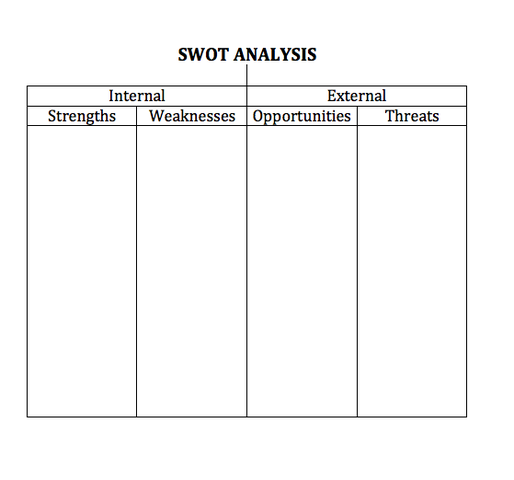
For those who don’t know the acronym, SWOT stands for

  • Strengths. These are internal attributes that benefit your firm. For example, your firm is winning a lot of business and growing in customer count and market share.
  • Weaknesses. These are also internal attributes, but in this case the attributes that detract from your firm. For example, you have very few customers.
  • Opportunities. These are external factors that enhance your firm. One example is a COVID or similar event that creates a surge in demand for contactless solutions.
  • Threats. The flip side is external factors that can harm your firm. One example is increasing privacy regulations that can slow or halt adoption of your product or service.

If you’re interested in more detail on the topic, there are a number of online sources that discuss SWOT analyses. Here’s TechTarget’s discussion of SWOT.

The common way to create the output from a SWOT analysis is to create four boxes and list each element (S, W, O, and T) within a box.

By Syassine – Own work, CC BY-SA 3.0, https://commons.wikimedia.org/w/index.php?curid=31368987

Once this is done, you’ll know that your messaging should emphasize the strengths and opportunities, and downplay or avoid the weaknesses and threats.

Or alternatively argue that the weaknesses and threats are really strengths and opportunities. (I’ve done this before.)

Method Two: Think before you create

Personally, I believe that a SWOT analysis is not enough. Before you use the SWOT findings to create content, there’s a little more work you have to do.

I recommend that before you create content, you should hold a kickoff of the content creation process and figure out what you want to do before you do it.

During that kickoff meeting, you should ask some questions to make sure you understand what needs to be done.

I’ve written about kickoffs and questions before, and I’m not going to repeat what I already said. If you want to know more:

Method Three: Send in the reinforcements

Now that you’ve locked down the messaging, it’s time to actually create the content that differentiates your identity firm from all the inferior identity firms in the market. While some companies can proceed right to content creation, others may run into one of two problems.

  • The identity firm doesn’t have any knowledgeable writers on staff. To create the content, you need people who understand the identity industry, and who know how to write. Some firms lack people with this knowledge and capability.
  • The identity firm has knowledgeable writers on staff, but they’re busy. Some companies have too many things to do at once, and any knowledgeable writers that are on staff may be unavailable due to other priorities.
Your current staff may have too much to do. By Backlit – Own work, CC BY-SA 3.0, https://commons.wikimedia.org/w/index.php?curid=12225421

This is where you supplement you identity firm’s existing staff with one or more knowledgeable writers who can work with you to create the content that leaves your inferior competitors in the dust.

What is next?

So do you need a knowledgeable biometric content marketing expert to create your content?

One who has been in the biometric industry for 29 years?

One who has been writing short and long form content for more than 29 years?

Are you getting tired of my repeated questions again?

Well then I’ll just tell you that Bredemarket is the answer to your identity/biometric content marketing needs.

Are you ready to take your identity firm to the next level with a compelling message that increases awareness, consideration, conversion, and long-term revenue? Let’s talk today!

Fill Your Company Gap With A Biometric Content Marketing Expert

Companies often have a lot of things they want to do, but don’t have the people to do them. It takes a long time to hire someone, and it even takes time to find a consultant that knows your industry and can do the work.

This affects identity/biometric companies just like it affects other companies. When an identity/biometric company needs a specific type of expertise and needs it NOW, it’s often hard to find the person they need.

If your company needs a biometric content marketing expert (or an identity content marketing expert) NOW, you’ve come to the right place—Bredemarket. Bredemarket has no identity learning curve, no content learning curve, and offers proven results.

Identity/biometric consulting in the 1990s

I remember when I first started working as an identity/biometric consultant, long before Bredemarket was a thing.

OK, not quite THAT long ago. I started working in biometrics in the 1990s—NOT the 1940s.

In 1994, the proposals department at Printrak International needed additional writers due to the manager’s maternity leave, and she was so valuable that Printrak needed to bring in TWO consultants to take her place.

At least initially, the other consultant and I couldn’t fill the manager’s shoes.

Designed by Freepik.
  • Both of us could write.
  • Both of us could spell “AFIS.”
  • Both of us could spell “RAID.” Not the bug spray, but the storage mechanism that stored all those “huge” fingerprint images.
  • But on that first night that I was cranking out proposal letters for something called a “Latent Station 2000,” I didn’t really know WHAT I was writing about.

As time went on, the other consultant and I learned much more—so much that the company brought both of us on as full-time employees.

After we were hired full-time, we spent a combined 45+ years at Printrak and its corporate successors in proposals, marketing, and product management positions, contributing to industry knowledge.

Which shows that learning how to spell “AFIS” can have long-term benefits.

Printrak’s problem

When Printrak needed biometric proposal writing experts quickly, it found two people who filled the bill. Sort of.

But neither of us knew biometrics before we started consuting at Printrak.

And I had never written a proposal before I started consulting at Printrak. (I had written an RFP. Sort of.)

But frankly, there weren’t a lot of identity/biometric consultants out in the field in the 1990s. There were the 20th century equivalents of Applied Forensic Services LLC, but at the time I don’t think there were any 20th century equivalents of Tandem Technical Writing LLC.

The 21st century solution

Unlike the 1990s, identity/biometric firms that need consulting help have many options. In addition to Applied Forensic Services and Tandem Technical Writing you have…me.

Mike and Laurel can tell you what they can do, and I heartily endorse both of them.

Let me share with you why I call myself a biometric content marketing expert who can help your identity/biometric company get marketing content out now:

  • No identity learning curve
  • No content learning curve
  • Proven results

No identity learning curve

I have worked with finger, face, iris, DNA, and other biometrics, as well as government-issued identity documents and geolocation. If you are interested, you can read my Bredemarket blog posts that mention the following topics:

No content learning curve

Because I’ve produced both external and internal content on identity/biometric topics, I offer the experience to produce your content in a number of formats.

  • External content: account-based marketing content, articles, blog posts (I am the identity/biometric blog expert), case studies, data sheets, partner comarketing content, presentations, proposals, sales literature sheets, scientific book chapters, smartphone application content (events), social media posts, web page content, and white papers.
  • Internal content: battlecards, competitive analyses, demonstration scripts (events), email internal newsletters, FAQs, multi-year plans, playbooks, project plans, proposal templates, quality improvement documents, requirements documents, strategic analyses, and website/social media analyses.

Proven results

Read about them here.

So how can you take advantage of my identity/biometric expertise?

If you need day-one help for an identity/biometric content marketing or proposal writing project, consider Bredemarket.

Three Reasons Why You Need the Bredemarket 404 Web/Social Media Checkup

I haven’t mentioned my “Bredemarket 404 Web/Social Media Checkup” in years, but we need the service more than ever. In fact, as I mention below, I should probably buy the service for myself.

What is the Bredemarket 404 Web/Social Media Checkup?

Why do I offer the Bredemarket 404 Web/Social Media Checkup? To ensure that your web and social properties are correctly communicating your business benefits and values to prospects and customers.

How do I provide the service? I not only analyze every page on your business website, but also analyze every social media account associated with your business (and, if you choose, your personal social media accounts also).

What do I do? For each social media account and page within each account, Bredemarket checks for these and other items:

  • Broken links
  • Outdated information
  • Other text and image errors
  • Synchronization between the web page and the social media accounts
  • Content synchronization between the web page and the social media accounts
  • Hidden web pages that still exist

Bredemarket then reports the results to you with recommended actions.

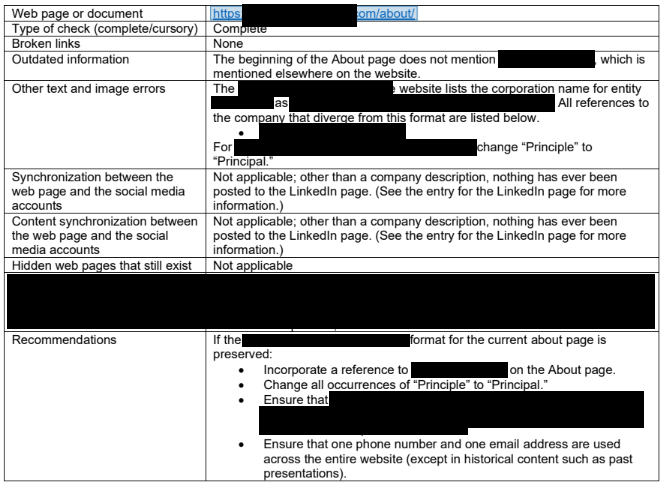
Redacted example of one page of a multi-page Bredemarket 404 report.

If requested, Bredemarket prepares a simple social media communications process for you.

Three reasons why you need a web/social media check

If you’re wondering why your business may need such a check, here are three things that I’ve observed over the years that adversely impact your marketing (and, um, my marketing).

Stale, dated material

Designed by Freepik.

Perhaps you wrote the text for your website or your social media page several years ago. And it was great…at the time. But as the months and years pass, the text becomes outdated.

I’ve discussed the problem of non-current content before, giving examples such as sites that mention Windows 7 support long after Microsoft stopped supporting Windows 7. But sadly, I recently ran across another offender, and this time I’m going to name names.

The company who kept stale content online was…Bredemarket.

As some of you know, last week I announced changes in Bredemarket’s scope and business hours. This necessitated some changes on my website.

Then I had to return to this website to make some hurried updates, since my April 2022 prohibition on taking certain types of work is no longer in effect as of June 2023. Hence, my home page, my “What I Do” page, and (obviously) my identity page are all corrected.

From https://bredemarket.com/2023/06/01/updates-updates-updates/

But earlier this week when I was cruising around the site, I noticed a page that I had missed:

From https://bredemarket.com/biometric-content-marketing-expert/ as of the morning of June 8, 2023.

“Biometric content marketing expert” my…(you know what). By the time you read this post, I will hopefully have fixed this. You can check for yourself to make sure I did fix it, and call me out if I didn’t. (Pressure’s on, Johnny.)

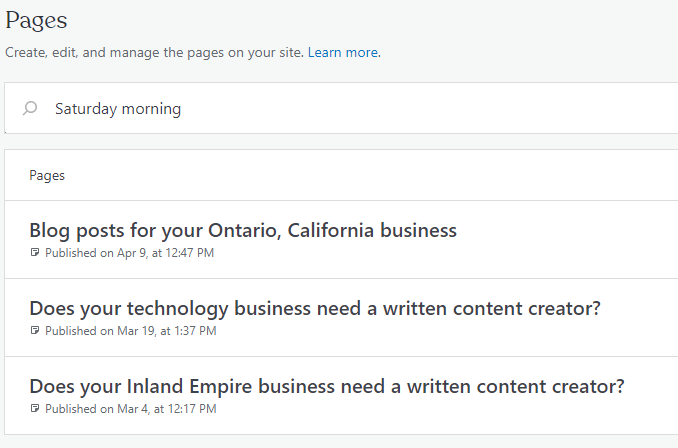
Oh, and there are three other pages that mention the words “Saturday morning” (as in booking a Saturday morning meeting with me). I have to fix those also.

WordPress listing of Bredemarket pages that include(d) the words “Saturday morning.”

Heroic sprints, only partially executed

Designed by Freepik.

In addition to stale, dated, material, sometimes the material on your online properties is only partially complete.

Perhaps you’ve worked with organizations that have sudden inspirations and want to implement them NOW.

From https://www.youtube.com/watch?v=rziG2gn-eQ0

So you’re going to mount a heroic sprint to just do it, process be damned. You’re going to steamroll ahead, working nights and weekends, and get the thing done.

And then, bleary-eyed, you get it done.

But you didn’t get all the other stuff done that needed to be completed along with the heroic sprint.

Maybe you completed a heroic sprint to document something on one of your properties…but you completely forgot to document that same thing on another of your properties. So one property mentions six items, while the other one only mentions five. Hopefully your prospect will go to the property that mentions the correct number of items.

If you’re lucky. Authentically lucky.

From https://www.youtube.com/watch?v=38mE6ba3qj8

(As an aside, a company that relies on heroic sprints is only hurting itself and its employees. See this Moira Lethbridge & Toni Collis LinkedIn article, “Why Having Superhuman Expectations Is Killing Your Career.“)

Forgotten online properties

Designed by Freepik.

A third common problem that your company may face is the existence of old online properties that you may have forgotten about.

  • Maybe you established an online property and completely forgot about it. So as you update all of your other online properties, you neglect to update that one. What happens if the only online property your prospect sees is the one you never bother to update?
  • Maybe you established an online property, then established a second one on the same platform. I previously cited an example in which a company established a Twitter account, then established a second one later without letting followers of the first account know. Guess which Twitter account had fewer followers? The new one.

Forgotten online properties result in disjointed views of your firm, and a confusing online presence.

Here’s how to obtain a web/social media check for yourself

Do your website and social media accounts suffer from these inconsistencies and errors?

Would you like an independent person to analyze your online properties and report the issues so you can fix them?

If you need Bredemarket’s services:

How Can Your Identity Business Create the RIGHT Written Content?

Does your identity business provide biometric or non-biometric products and services that use finger, face, iris, DNA, voice, government documents, geolocation, or other factors or modalities?

Does your identity business need written content, such as blog posts (from the identity/biometric blog expert), case studies, data sheets, proposal text, social media posts, or white papers?

How can your identity business (with the help of an identity content marketing expert) create the right written content?

For the answer, click here.

Using “Multispectral” and “Liveness” in the Same Sentence

(Part of the biometric product marketing expert series)

Now that I’m plunging back into the fingerprint world, I’m thinking about all the different types of fingerprint readers.

  • The optical fingerprint and palm print readers are still around.
  • And the capacitive fingerprint readers still, um, persist.
  • And of course you have the contactless fingerprint readers such as MorphoWave, one that I know about.
  • And then you have the multispectral fingerprint readers.

What is multispectral?

Bayometric offers a web page that covers some of these fingerprint reader types, and points out the drawbacks of some of the readers they discuss.

Latent prints are usually produced by sweat, skin debris or other sebaceous excretions that cover up the palmar surface of the fingertips. If a latent print is on the glass platen of the optical sensor and light is directed on it, this print can fool the optical scanner….

Capacitive sensors can be spoofed by using gelatin based soft artificial fingers.

From https://www.bayometric.com/fingerprint-reader-technology-comparison/

There is another weakness of these types of readers. Some professions damage and wear away a person’s fingerprint ridges. Examples of professions whose practitioners exhibit worn ridges include construction workers and biometric content marketing experts (who, at least in the old days, handled a lot of paper).

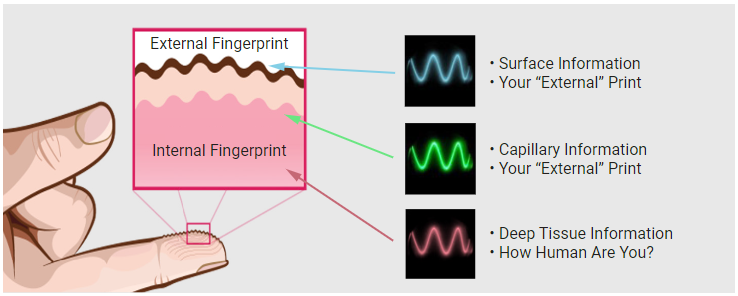
The solution is to design a fingerprint reader that not only examines the surface of the finger, but goes deeper.

From HID Global, “A Guide to MSI Technology: How It Works,” https://blog.hidglobal.com/2022/10/guide-msi-technology-how-it-works

The specialty of multispectral sensors is that it can capture the features of the tissue that lie below the skin surface as well as the usual features on the finger surface. The features under the skin surface are able to provide a second representation of the pattern on the fingerprint surface.

From https://www.bayometric.com/fingerprint-reader-technology-comparison/

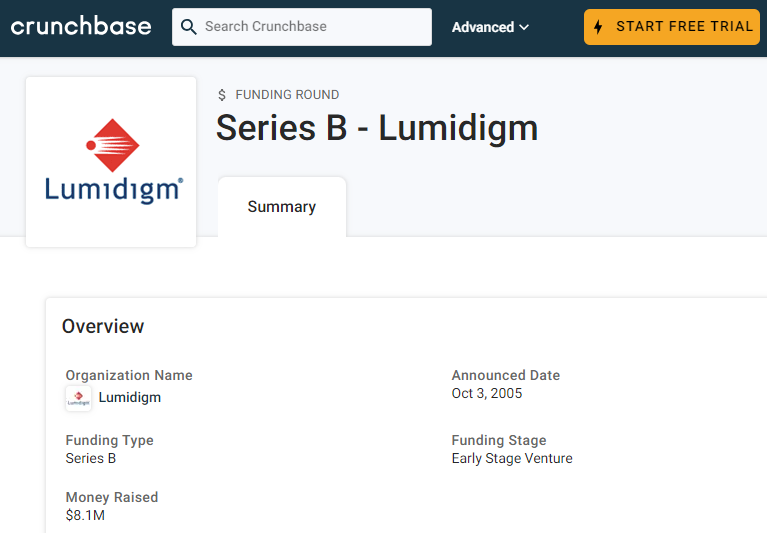
Multispectral sensors are nothing new. When I worked for Motorola, Motorola Ventures had invested in a company called Lumidigm that produced multispectral fingerprint sensors; they were much more expensive than your typical optical or capacitive sensor, but were much more effective in capturing true fingerprints to the subdermal level.

Lumidigm was eventually acquired in 2014: not by Motorola (who sold off its biometric assets such as Printrak and Symbol), but by HID Global. This company continues to produce Lumidigm-branded multispectral fingerprint sensors to this day.

But let’s take a look at the other word I bandied about.

What is liveness?

KISS, Alive! By Obtained from allmusic.com., Fair use, https://en.wikipedia.org/w/index.php?curid=2194847

“Gelatin based soft artificial fingers” aren’t the only way to fool a biometric sensor, whether you’re talking about a fingerprint sensor or some other sensor such as a face sensor.

Regardless of the biometric modality, the intent is the same; instead of capturing a true biometric from a person, the biometric sensor is fooled into capturing a fake biometric: an artificial finger, a face with a mask on it, or a face on a video screen (rather than a face of a live person).

This tomfoolery is called a “presentation attack” (becuase you’re attacking security with a fake presentation).

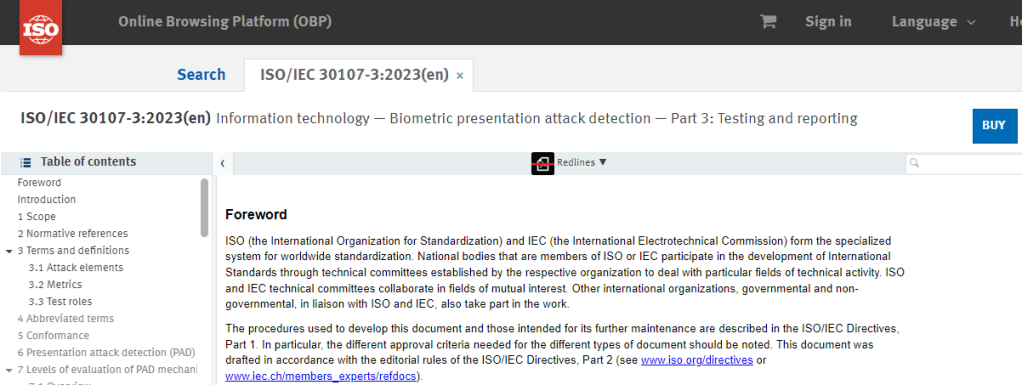
But the standards folks have developed ISO/IEC 30107-3:2023, Information technology — Biometric presentation attack detection — Part 3: Testing and reporting.

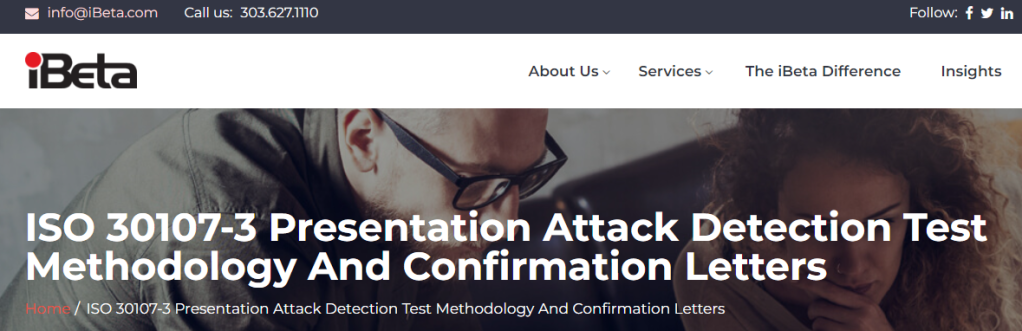
And an organization called iBeta is one of the testing facilities authorized to test in accordance with the standard and to determine whether a biometric reader can detect the “liveness” of a biometric sample.

(Friends, I’m not going to get into passive liveness and active liveness. That’s best saved for another day.)

[UPDATE 4/24/2024: I FINALLY ADDRESSED THE DIFFERENCE BETWEEN ACTIVE AND PASSIVE LIVENESS HERE.]

Multispectral liveness

While multispectral fingerprint readers aren’t the only fingerprint readers, or the only biometric readers, that iBeta has tested for liveness, the HID Global Lumidigm readers conform to Level 2 (the higher level) of iBeta testing.

There’s a confirmation letter and everything.

From the iBeta website.

This letter was issued in 2021. For some odd reason, HID Global decided to publicize this in 2023.

Oh well. It’s good to occasionally remind people of stuff.

Updates, updates, updates…

When keeping your websites updated, I advise you to do as I say, not as I do. Two of my websites were significantly out of date and needed hurried corrections.

Designed by Freepik.

I realized this morning that the “My Experience” page on my jebredcal website was roughly a year out of date, so I hurriedly added content to it. Now the page will turn up in searches for the acronym “ABM” (OK, maybe not on the first page of the search results).

Then I had to return to this website to make some hurried updates, since my April 2022 prohibition on taking certain types of work is no longer in effect as of June 2023. Hence, my home page, my “What I Do” page, and (obviously) my identity page are all corrected.

Oh yeah, I updated my Calendly availability hours also. Which is good, because I already have two meetings booked this week.

Which reminds me…if you need Bredemarket’s services: