The post discussed the evolution of the large Automated Fingerprint Identification System vendors, now large Automated Biometric System vendors that support face and other biometric modalities.
And the evolution will continue.
From 1986 to March 2009
Although I could have gone back to Autonetics in the 1960s, I didn’t. I started my version of the story in the 1980s, when the “big 3” were:
De La Rue Printrak.
Morpho Systems.
NEC.
The 2023 post detailed a number of changes over the next two decades, including the emergence of new companies, the results of a particular NIST test (FpVTE 2003) that put a temporary damper on my professional life, and some acquisitions.
A lot of acquisitions.
For our purposes I will fast forward to March 2009, when I argue there were a “Big 5”:
Cogent Systems.
L-1 Identity Solutions.
Motorola (my employer).
NEC.
Safran.
Sounds nice and neat, but I said to “hang on to your seats.”
From April 2009 to 2011
Because everything changed in the next two years. Here’s how I described it in the 2023 post:
By 2009, Safran (resulting from the merger of Sagem and Snecma) was an international powerhouse in aerospace and defense and also the had identity/biometric interests. Motorola, in the meantime, was no longer enjoying the success of its RAZR phone and was looking at trimming down (prior to its eventual, um, bifurcation). In response to these dynamics, Safran announced its intent to purchase Motorola’s Biometric Business Unit in October 2008, an effort that was finalized in April 2009. The Biometric Business Unit (adopting its former name Printrak) was acquired by Sagem Morpho and became MorphoTrak. On a personal level, Dorothy Bullard moved out of Proposals and I moved into Proposals, where I got to work with my new best friends that had previously slammed Motorola for losing the Kansas and New Mexico deals. (Seriously, Cindy and Ron are great folks.)
By 2011, Safran decided that it needed additional identity capabilities, so it acquired L-1 Identity Solutions and renamed the acquisition as MorphoTrust.
From 2011 to 2023
So now there were just three again: 3M, NEC, and Safran. And that’s where we remain today, with some name changes: part of 3M was carved off to become part of Gemalto, part of Safran was carved off to become part of IDEMIA, and all of Gemalto was absorbed by Thales.
So by the time C. Maxine Most identified her “Big 3 ID,” they were:
ROC (previously known as Rank One Computing) posted this about its latest resukts in the NIST Friction Ridge Image and Features Technology Evaluation Exemplar One-to-Many (FRIF TE E1N) evaluation.
“ROC’s performance in the NIST FRIF TE E1N evaluation, including #1 global ranking in Class B slap fingerprints, a critical capture format for high-scale civil and government identity programs, proves that American technology can now lead at the highest levels of global biometric performance….
“The NIST Friction Ridge Image and Features Technology Evaluation Exemplar One-to-Many evaluation, known as NIST FRIF TE E1N, evaluates one-to-many fingerprint identification at massive scale, testing how accurately algorithms can identify a subject from large enrollment repositories. Across the evaluation, ROC delivered top-tier performance in every category tested, including Class A, Class B, and Class C. “
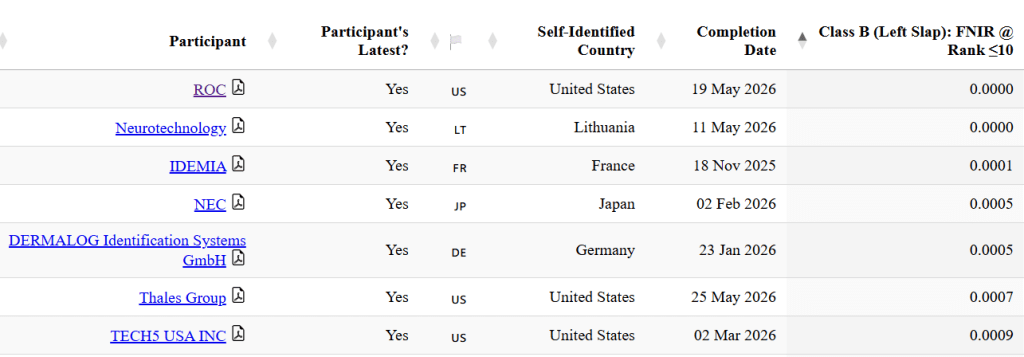
As with every NIST biometric test, FRIF yields a massive amount of data. Just looking at the Class B slap data alone, here is what you can find, showing the top 7 entries out of 12 for the Class B Left Slap FNIR (another acronym: false negativce identification rate) at rank less than or equal to 10. Even this view excludes all other slap data and all other ranking data (1, 2, and 5).
(Data captured Friday, May 29, 2026 and may become outdated when new algorithms are tested.)
National Institute of Standards and Technology.
With this massive wealth of data, just about every vendor probably performed well in something, which is why ROC took the time to point out why Class B slap results are important.
“ROC’s most significant milestone came in Class B slap fingerprints. This performance is especially important for high-scale ABIS environments, including national ID programs, border management, civil enrollment, and high-stakes criminal justice workflows, where handling immense scale without sacrificing accuracy is mandatory.”
Although ROC may be the only entity trumpeting May results, other vendors have promotede earlier NIST FRIF TE E1N achievements, including IDEMIA, Identy.IO, Innovatrics, and Neurotechnology.
But they’re foreign. (As is Thales Group, for those keeping score.)
I’ll confess: there is a cybersecurity threat so…um…threatening that I didn’t even want to think about it.
You know the drill. The bad people use technology to come up with some security threat, and then the good people use technology to thwart it.
That’s what happens with antivirus. That’s what happens with deepfakes.
But I kept on hearing rumblings about a threat that would make all this obsolete.
The quantum threat and the possible 2029 “Q Day”
Today’s Q word is “quantum.”
But with great power comes great irresponsibility. Gartner said it:
“By 2029, ‘advances in quantum computing will make conventional asymmetric cryptography unsafe to use,’ Gartner said in a study.”
Frankly, this frightened me. Think of the possibilities that come from calculation superpowers. Brute force generation of passcodes, passwords, fingerprints, faces, ID cards, or whatever is necessary to hack into a security system. A billion different combinations? No problem.
“The good news is that technology companies, governments and standards agencies are well aware of the deadline. They are working on defensive strategies to meet the challenge — inventing cryptographic algorithms that run not just on quantum computers but on today’s conventional components.
“This technology has a name: post-quantum cryptography.
“There have already been notable breakthroughs. In the last few days, Thales launched a quantum-resistant smartcard: MultiApp 5.2 Premium PQC. It is the first smartcard to be certified by ANSSI, France’s national cybersecurity agency.
“The product uses new generation cryptographic signatures to protect electronic ID cards, health cards, driving licences and more from attacks by quantum computers.”
So what’s so special about the technology in the MultiApp 5.2 Premium PQC?
Thales used the NIST “FIPS 204 standard to define a digital signature algorithm for a new quantum-resistant smartcard: MultiApp 5.2 Premium PQC.”
Google Gemini.
The NIST FIPS 204 standard, “Module-Lattice-Based Digital Signature Standard,” can be found here. This is the abstract:
“Digital signatures are used to detect unauthorized modifications to data and to authenticate the identity of the signatory. In addition, the recipient of signed data can use a digital signature as evidence in demonstrating to a third party that the signature was, in fact, generated by the claimed signatory. This is known as non-repudiation since the signatory cannot easily repudiate the signature at a later time. This standard specifies ML-DSA, a set of algorithms that can be used to generate and verify digital signatures. ML-DSA is believed to be secure, even against adversaries in possession of a large-scale quantum computer.”
ML-DSA stands for “Module-Lattice-Based Digital Signature Algorithm.”
Google Gemini.
Now I’ll admit I don’t know a lattice from a vertical fence post, especially when it comes to quantum computing, so I’ll have to take NIST’s word for it that modules and lattice are super-good security.
Certification, schmertification
The Thales technology was then tested by researchers to determine its Evaluation Assurance Level (EAL). The result? “Thales’ product won EAL6+ certification (the highest is EAL7).” (TechTarget explains the 7 evaluation assurance levels here.)
France’s national cybersecurity agency (ANSSI) then certified it.
However…
…remember that certifications mean squat.
For all we know, the fraudsters have already broken the protections in the FIPS 204 standard.
Google Gemini.
And the merry-go-round between fraudsters and fraud fighters continues.
If you need help spreading the word about YOUR anti-fraud solution, quantum or otherwise, schedule a free meeting with Bredemarket.
“This openness to facial recognition could signal a turning point that could affect the biometric industry.
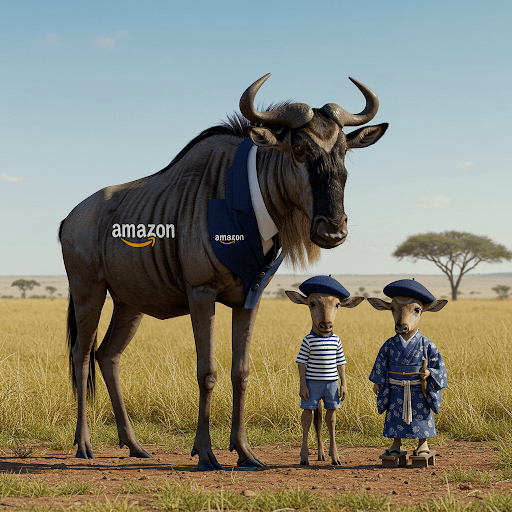
“The so-called “big” biometric players such as IDEMIA, NEC, and Thales are teeny tiny compared to companies like Meta, Alphabet, and Amazon. If the big tech players ever consented to enter the law enforcement and surveillance market in a big way, they could put IDEMIA, NEC, and Thales out of business.
“However, wholesale entry into law enforcement/surveillance could damage their consumer business, so the big tech companies have intentionally refused to get involved – or if they have gotten involved, they have kept their involvement a deep dark secret.”
Then I thought about the “Really Big Bunch” product that offered the greatest threat to the “Big 3” (IDEMIA, NEC, and Thales)—Amazon Rekognition, which directly competed in Washington County, Oregon until Amazon imposed a one-year moratorium on police use of facial recognition in June 2020. The moratorium was subsequently extended until further notice.
“Have appropriately trained humans review all decisions to take action that might impact a person’s civil liberties or equivalent human rights.”
“Train personnel on responsible use of facial recognition systems.”
“Provide public disclosures of your use of facial recognition systems.”
“In all cases, facial comparison matches should be viewed in the context of other compelling evidence, and shouldn’t be used as the sole determinant for taking action.” (In other words, INVESTIGATIVELEAD only.)
Nothing controversial at all, and I am…um…99% certain (geddit?) that IDEMIA, NEC, and Thales would endorse all these points.
But why does Amazon even need such a page, if Rekognition is only used to find missing children?
Maybe this is a pre-June 2020 page that Amazon forgot to take down.
Or maybe not.
Couple this with the news about Meta, and there’s the possibility that the Really Big Bunch may enter the markets currently dominated by the Big Three.
Imagine if the DHS HART system, delayed for years, were resurrected…with Alphabet or Amazon or Meta technology.
I should properly open this post by stating any necessary disclosures…but I don’t have any. I know NOTHING about the goings-on reported in this post other than what I read in the papers.
However, I do know the history of Thales and mobile driver’s licenses. Which makes the recent announcements from Florida and Thales even more surprising.
Gemalto’s pioneering mobile driver’s license pilots
Back when I worked for IDEMIA from 2017 to 2020, many states were performing some level of testing of mobile driver’s licenses. Rather than having to carry a physical driver’s license card, you would be able to carry a virtual one on your phone.
Some of these states were working with the company Gemalto to create pilots for mobile driver’s licenses. As early as 2016, Gemalto announced its participation in pilot mDL projects in Colorado, Idaho, Maryland, and Washington DC. As I recall, at the time Gemalto had more publicly-known pilots in process than any other vendor, and appeared to be leading the pack in the effort to transition driver’s licenses from the (physical) wallet to the smartphone.
Thales’ operational mobile driver’s license
By the time Gemalto was acquired by and absorbed into Thales, the company won the opportunity to provide an operational (as opposed to pilot) driver’s license. The Florida Smart ID app has been available to both iPhone and Android users since 2021.
One of the most important pieces of new information was a revised set of Frequently Asked Questions (or “Question,” or “Statement”) on the “Florida Smart ID” section of the Florida Highway Safety and Motor Vehicles website.
The Florida Smart ID applications will be updated and improved by a new vendor. At this time, the Florida Department of Highway Safety and Motor Vehicles is removing the current Florida Smart ID application from the app store. Please email FloridaSmartID@flhsmv.gov to receive notification of future availability.
Um…that was abrupt.
But a second piece of information, a Thales statement shared by PC Mag, explained the abruptness…in part.
In a statement provided to PCMag, a Thales spokesperson said the company’s contract with the FLHSMV expired on June 30, 2024.
“The project has now entered a new phase in which the FLHSMV requirements have evolved, necessitating a retender,” Thales says. “Thales chose not to compete in this tender. However, we are pleased to have been a part of this pioneering solution and wishes it continued success.”
The new vendor and/or the State of Florida chose not to begin providing services when the Thales contract expired on June 30.
Thales and/or the State of Florida chose not to temporarily renew the existing contract until the new vendor was providing services in 2025.
This third point is especially odd. I’ve known of situations where Company A lost a renewal bid to Company B, Company B was unable to deliver the new system on time, and Company A was all too happy to continue to provide service until Company B (or in some cases the government agency itself) got its act together.
Anyway, for whatever reason, those who had Florida mobile driver’s licenses have now lost them, and will presumably have to go through an entirely new process (with an as-yet unknown vendor) to get their mobile driver’s licenses again.
I’m not sure how much more we will learn publicly, and I don’t know how much is being whispered privately. Presumably the new vendor, whoever it is, has some insight, but they’re not talking.
Something You Are. This is the factor that identifies people. It includes biometrics modalities (finger, face, iris, DNA, voice, vein, etc.). It also includes behavioral biometrics, provided that they are truly behavioral and relatively static.
Something You Have. While this is used to identify people, in truth this is the factor that identifies things. It includes driver’s licenses and hardware or software tokens.
Actually more than a decade, since my car’s picture was taken in Montclair, California a couple of decades ago doing something it shouldn’t have been doing. I ended up in traffic school for that one.
Now license plate recognition isn’t that reliable of an identifier, since within a minute I can remove a license plate from a vehicle and substitute another one in its place. However, it’s deemed to be reliable enough that it is used to identify who a car is.
Note my intentional use of the word “who” in the sentence above.
Because when my car made a left turn against a red light all those years ago, the police didn’t haul MY CAR into court.
Using then-current technology, it identified the car, looked up the registered owner, and hauled ME into court.
These days, it’s theoretically possible (where legally allowed) to identify the license plate of the car AND identify the face of the person driving the car.
But you still have this strange merger of who and what in which the non-human characteristics of an entity are used to identify the entity.
What you are.
But that’s nothing compared to what’s emerged over the past few years.
We Are The Robots
When the predecessors to today’s Internet were conceived in the 1960s, they were intended as a way for people to communicate with each other electronically.
And for decades the Internet continued to operate this way.
Until the Internet of Things (IoT) became more and more prominent.
Application programming interfaces (APIs) are the connective tissue behind digital modernization, helping applications and databases exchange data more effectively. The State of API Security in 2024 Report from Imperva, a Thales company, found that the majority of internet traffic (71%) in 2023 was API calls.
Couple this with the increasing use of chatbots and other artificial intelligence bots to generate content, and the result is that when you are communicating with someone on the Internet, there is often no “who.” There’s a “what.”
What you are.
Between the cars and the bots, there’s a lot going on.
What does this mean?
There are numerous legal and technical ramifications, but I want to concentrate on the higher meaning of all this. I’ve spent 29 years professionally devoted to the identification of who people are, but this focus on people is undergoing a seismic change.
The science fiction stories of the past, including TV shows such as Knight Rider and its car KITT, are becoming the present as we interact with automobiles, refrigerators, and other things. None of them have true sentience, but it doesn’t matter because they have the power to do things.
On September 30, FindBiometrics and Acuity Market Intelligence released the production version of the Biometric Digital Identity Prism Report. You can request to download it here.
But FindBiometrics and Acuity Market Intelligence didn’t invent the Big 3. The concept has been around for 40 years. And two of today’s Big 3 weren’t in the Big 3 when things started. Oh, and there weren’t always 3; sometimes there were 4, and some could argue that there were 5.
So how did we get from the Big 3 of 40 years ago to the Big 3 of today?
The Big 3 in the 1980s
Back in 1986 (eight years before I learned how to spell AFIS) the American National Standards Institute, in conjunction with the National Bureau of Standards, issued ANSI/NBS-ICST 1-1986, a data format for information interchange of fingerprints. The PDF of this long-superseded standard is available here.
When creating this standard, ANSI and the NBS worked with a number of law enforcement agencies, as well as companies in the nascent fingerprint industry. There is a whole list of companies cited at the beginning of the standard, but I’d like to name four of them.
De La Rue Printrak, Inc.
Identix, Inc.
Morpho Systems
NEC Information Systems, Inc.
While all four of these companies produced computerized fingerprinting equipment, three of them had successfully produced automated fingerprint identification systems, or AFIS. As Chapter 6 of the Fingerprint Sourcebook subsequently noted:
Morpho Systems resulted from French AFIS efforts, separate from those of the FBI. These efforts launched Morpho’s long-standing relationship with the French National Police, as well as a similar relationship (now former relationship) with Pierce County, Washington.
NEC had deployed AFIS equipment for the National Police Academy of Japan, and (after some prodding; read Chapter 6 for the story) the city of San Francisco. Eventually the state of California obtained an NEC system, which played a part in the identification of “Night Stalker” Richard Ramirez.
After the success of the San Francisco and California AFIS systems, many other jurisdictions began clamoring for AFIS of their own, and turned to these three vendors to supply them.
The Big 4 in the 1990s
But in 1990, these three firms were joined by a fourth upstart, Cogent Systems of South Pasadena, California.
While customers initially preferred the Big 3 to the upstart, Cogent Systems eventually installed a statewide system in Ohio and a border control system for the U.S. government, plus a vast number of local systems at the county and city level.
Between 1991 and 1994, the (Immigfation and Naturalization Service) conducted several studies of automated fingerprint systems, primarily in the San Diego, California, Border Patrol Sector. These studies demonstrated to the INS the feasibility of using a biometric fingerprint identification system to identify apprehended aliens on a large scale. In September 1994, Congress provided almost $30 million for the INS to deploy its fingerprint identification system. In October 1994, the INS began using the system, called IDENT, first in the San Diego Border Patrol Sector and then throughout the rest of the Southwest Border.
I was a proposal writer for Printrak (divested by De La Rue) in the 1990s, and competed against Cogent, Morpho, and NEC in AFIS procurements. By the time I moved from proposals to product management, the next redefinition of the “big” vendors occurred.
The Big 3 in 2003
There are a lot of name changes that affected AFIS participants, one of which was the 1988 name change of the National Bureau of Standards to the National Institute of Standards and Technology (NIST). As fingerprints and other biometric modalities were increasingly employed by government agencies, NIST began conducting tests of biometric systems. These tests continue to this day, as I have previously noted.
One of NIST’s first tests was the Fingerprint Vendor Technology Evaluation of 2003 (FpVTE 2003).
For those who are familiar with NIST testing, it’s no surprise that the test was thorough:
FpVTE 2003 consists of multiple tests performed with combinations of fingers (e.g., single fingers, two index fingers, four to ten fingers) and different types and qualities of operational fingerprints (e.g., flat livescan images from visa applicants, multi-finger slap livescan images from present-day booking or background check systems, or rolled and flat inked fingerprints from legacy criminal databases).
Eighteen vendors submitted their fingerprint algorithms to NIST for one or more of the various tests, including Bioscrypt, Cogent Systems, Identix, SAGEM MORPHO (SAGEM had acquired Morpho Systems), NEC, and Motorola (which had acquired Printrak). And at the conclusion of the testing, the FpVTE 2003 summary (PDF) made this statement:
Of the systems tested, NEC, SAGEM, and Cogent produced the most accurate results.
Which would have been great news if I were a product manager at NEC, SAGEM, and Cogent.
Unfortunately, I was a product manager at Motorola.
The effect of this report was…not good, and at least partially (but not fully) contributed to Motorola’s loss of its long-standing client, the Royal Canadian Mounted Police, to Cogent.
The Big 3, 4, or 5 after 2003
So what happened in the years after FpVTE was released? Opinions vary, but here are three possible explanations for what happened next.
Did the Big 3 become the Big 4 again?
Now I probably have a bit of bias in this area since I was a Motorola employee, but I maintain that Motorola overcame this temporary setback and vaulted back into the Big 4 within a couple of years. Among other things, Motorola deployed a national 1000 pixels-per-inch (PPI) system in Sweden several years before the FBI did.
Did the Big 3 remain the Big 3?
Motorola’s arch-enemies at Sagem Morpho had a different opinion, which was revealed when the state of West Virginia finally got around to deploying its own AFIS. A bit ironic, since the national FBI AFIS system IAFIS was located in West Virginia, or perhaps not.
Anyway, Motorola had a very effective sales staff, as was apparent when the state issued its Request for Proposal (RFP) and explicitly said that the state wanted a Motorola AFIS.
That didn’t stop Cogent, Identix, NEC, and Sagem Morpho from bidding on the project.
After the award, Dorothy Bullard and I requested copies of all of the proposals for evaluation. While Motorola (to no one’s surprise) won the competition, Dorothy and I believed that we shouldn’t have won. In particular, our arch-enemies at Sagem Morpho raised a compelling argument that it should be the chosen vendor.
Their argument? Here’s my summary: “Your RFP says that you want a Motorola AFIS. The states of Kansas (see page 6 of this PDF) and New Mexico (see this PDF) USED to have a Motorola AFIS…but replaced their systems with our MetaMorpho AFIS because it’s BETTER than the Motorola AFIS.”
But were Cogent, Motorola, NEC, and Sagem Morpho the only “big” players?
Did the Big 3 become the Big 5?
While the Big 3/Big 4 took a lot of the headlines, there were a number of other companies vying for attention. (I’ve talked about this before, but it’s worthwhile to review it again.)
Identix, while making some efforts in the AFIS market, concentrated on creating live scan fingerprinting machines, where it competed (sometimes in court) against companies such as Digital Biometrics and Bioscrypt.
The fingerprint companies started to compete against facial recognition companies, including Viisage and Visionics.
Oh, and there were also iris companies such as Iridian.
And there were other ways to identify people. Even before 9/11 mandated REAL ID (which we may get any year now), Polaroid was making great efforts to improve driver’s licenses to serve as a reliable form of identification.
In short, there were a bunch of small identity companies all over the place.
But in the course of a few short years, Dr. Joseph Atick (initially) and Robert LaPenta (subsequently) concentrated on acquiring and merging those companies into a single firm, L-1 Identity Solutions.
These multiple mergers resulted in former competitors Identix and Digital Biometrics, and former competitors Viisage and Visionics, becoming part of one big happy family. (A multinational big happy family when you count Bioscrypt.) Eventually this company offered fingerprint, face, iris, driver’s license, and passport solutions, something that none of the Big 3/Big 4 could claim (although Sagem Morpho had a facial recognition offering). And L-1 had federal contracts and state contracts that could match anything that the Big 3/Big 4 offered.
So while L-1 didn’t have a state AFIS contract like Cogent, Motorola, NEC, and Sagem Morpho did, you could argue that L-1 was important enough to be ranked with the big boys.
So for the sake of argument let’s assume that there was a Big 5, and L-1 Identity Solutions was part of it, along with the three big boys Motorola, NEC, and Safran (who had acquired Sagem and thus now owned Sagem Morpho), and the independent Cogent Systems. These five companies competed fiercly with each other (see West Virginia, above).
In a two-year period, everything would change.
The Big 3 after 2009
Hang on to your seats.
The Motorola RAZR was hugely popular…until it wasn’t. Eventually Motorola split into two companies and sold off others, including the “Printrak” Biometric Business Unit. By NextG50 – Own work, CC BY-SA 4.0, https://commons.wikimedia.org/w/index.php?curid=130206087
By 2009, Safran (resulting from the merger of Sagem and Snecma) was an international powerhouse in aerospace and defense and also had identity/biometric interests. Motorola, in the meantime, was no longer enjoying the success of its RAZR phone and was looking at trimming down (prior to its eventual, um, bifurcation). In response to these dynamics, Safran announced its intent to purchase Motorola’s Biometric Business Unit in October 2008, an effort that was finalized in April 2009. The Biometric Business Unit (adopting its former name Printrak) was acquired by Sagem Morpho and became MorphoTrak. On a personal level, Dorothy Bullard moved out of Proposals and I moved into Proposals, where I got to work with my new best friends that had previously slammed Motorola for losing the Kansas and New Mexico deals. (Seriously, Cindy and Ron are great folks.)
By 2011, Safran decided that it needed additional identity capabilities, so it acquired L-1 Identity Solutions and renamed the acquisition as MorphoTrust.
If you’re keeping notes, the Big 5 have now become the Big 3: 3M, Safran, and NEC (the one constant in all of this).
While there were subsequent changes (3M sold Cogent and other pieces to Gemalto, Safran sold all of Morpho to Advent International/Oberthur to form IDEMIA, and Gemalto was acquired by Thales), the Big 3 has remained constant over the last decade.
And that’s where we are today…pending future developments.
If Alphabet or Amazon reverse their current reluctance to market their biometric offerings to governments, the entire landscape could change again.
Or perhaps a new AI-fueled competitor could emerge.
The 1 Biometric Content Marketing Expert
This was written by John Bredehoft of Bredemarket.
If you work for the Big 3 or the Little 80+ and need marketing and writing services, the biometric content marketing expert can help you. There are several ways to get in touch:
Book a meeting with me at calendly.com/bredemarket. Be sure to fill out the information form so I can best help you.
I didn’t either. Frankly, I didn’t even work in biometrics professionally until I was in my 30s.
If you have a mad adult desire to become a biometric content marketing expert, here are five topics that I (a self-styled biometric content marketing expert) think you need to understand.
Topic One: Biometrics
Sorry to be Captain Obvious, but if you’re going to talk about biometrics you need to know what you’re talking about.
The days in which an expert could confine themselves to a single biometric modality are long past. Why? Because once you declare yourself an iris expert, someone is bound to ask, “How does iris recognition compare to facial recognition?”
And there are a number of biometric modalities. In addition to face and iris, the Biometrics Institute has cataloged a list of other biometric modalities, including fingerprints/palmprints, voice, DNA, vein, finger/hand geometry, and some more esoteric ones such as gait, keystrokes, and odor. (I wouldn’t want to manage the NIST independent testing for odor.)
As far as I’m concerned, the point isn’t to select the best biometric and ignore all the others. I’m a huge fan of multimodal biometrics, in which a person’s identity is verified or authenticated by multiple biometric types. It’s harder to spoof multiple biometrics than it is to spoof a single one. And even if you spoof two of them, what if the system checks for odor and you haven’t spoofed that one yet?
Topic Two: All the other factors
In the same way that I don’t care for people who select one biometric and ignore the others, I don’t care for some in the “passwords are dead” crowd who go further and say, “Passwords are dead. Use biometrics instead.”
Although I admire the rhyming nature of the phrase.
If you want a robust identity system, you need to use multiple factors in identity verification and authentication.
Something you know.
Something you have.
Something you are (i.e. biometrics).
Something you do.
Somewhere you are.
Again, use of multiple factors protects against spoofing. Maybe someone can create a gummy fingerprint, but can they also create a fake passport AND spoof the city in which you are physically located?
It’s not enough to understand the technical ins and outs of biometric capture, matching, and review. You need to know how biometrics are used.
One-to-one vs. one-to-many. Is the biometric that you acquire only compared to a single biometric samples, or to a database of hundreds, thousands, millions, or billions of other biometric samples?
Markets. When I started in biometrics, I only participated in two markets: law enforcement (catch bad people) and benefits (get benefit payments to the right people). There are many other markets. Just recently I have written about financial identity and educational identity. I’ve worked with about a dozen other markets personally, and there are many more.
Use cases. Related to markets, you need to understand the use cases that biometrics can address. Taking the benefits example, there’s a use case in which a person enrolls for benefits, and the government agency wants to make sure that the person isn’t already enrolled under another name. And there’s a use cases when benefits are paid to make sure that the authorized recipient receives their benefits, and no one else receives their benefits.
Legal and privacy issues. It is imperative that you understand the legal ramifications that affect your chosen biometric use case in your locality. For example, if your house has a doorbell camera that uses “familiar face detection” to identify the faces of people that come to your door, and the people that come to your door are residents of the state of Illinois, you have a BIG BIPA (Biometric Information Privacy Act) problem.
Any identity content marketing expert or biometric content marketing expert worth their salt will understand these and related issues.
Topic Four: Content marketing
This is another Captain Obvious point. If you want to present yourself as a biometric contet marketing expert or identity content marketing expert, you have to have a feel for content marketing.
The definition of content marketing is simple: It’s the process of publishing written and visual material online with the purpose of attracting more leads to your business. These can include blog posts, pages, ebooks, infographics, videos, and more.
But content marketers need to be comfortable with creating at least one type of content.
Topic Five: How L-1 Identity Solutions came to be
Yes, an identity content marketing expert needs to thoroughly understand how L-1 Identity Solutions came to be.
I’m only half joking.
Back in the late 1990s and early 2000s (I’ll ignore FpVTE results for a moment), the fingerprint world in which I worked recognized four major vendors: Cogent, NEC, Printrak (later part of Motorola), and Sagem Morpho.
And then there were all these teeny tiny vendors that offered biometric and non-biometric solutions, including the fierce competitors Identix and Digital Biometrics, the fierce competitors Viisage and Visionics, and a bunch of other companies like Iridian.
Wel, there WERE all these teeny tiny vendors.
Until Bob LaPenta bought them all up and combined them into a single company, L-1 Identity Solutions. (LaPenta was one of the “Ls” in L-3, so he chose the name L-1 when he started his own company.)
So around 2008 the Big Four (including a post-FpVTE Motorola) became the Big Five, since L-1 Identity Solutions was now at the table with the big boys.
But then several things happened:
Motorola started selling off parts of itself. One of those parts, its Biometric Business Unit, was purchased by Safran (the company formed after Sagem and Snecma merged). This affected me because I, a Motorola employee, became an employee of MorphoTrak, the subsidiary formed when Sagem Morpho de facto acquired “Printrak” (Motorola’s Biometric Business Unit). So now the Big Five were the Big Four.
Make that the Big Three, because Safran also bought L-1 Identity Solutions, which became MorphoTrust. MorphoTrak and MorphoTrust were separate entities, and in fact competed against each other, so maybe we should say that the Big Four still existed.
Oh, and by the way, the independent company Cogent was acquired by 3M (although NEC considered buying it).
A few years later, 3M sold bits of itself (including the Cogent bit) to Gemalto.
Then in 2017, Advent International (which owned Oberthur) acquired bits of Safran (the “Morpho” part) and merged them with Oberthur to form IDEMIA. As a consequence of this, MorphoTrust de facto acquired MorphoTrak, ending the competition but requiring me to have two separate computers to access the still-separate MorphoTrust and MorphoTrak computer networks. (In passing, I have heard from two sources, but have not confirmed myself, that the possible sale of IDEMIA is on hold.)
Why do I mention all this? Because all these mergers and acquisitions have resulted in identity practitioners working for a dizzying number of firms.
As of August 2023, I myself have worked for five identity firms, but in reality four of the five are the same firm because the original Printrak International kept on getting acquired (Motorola, Safran, IDEMIA).
And that’s nothing. One of my former Printrak coworkers (R.M.) has also worked for Digital Biometrics (now part of IDEMIA), Cross Match Technologies (now part of ASSA ABLOY), Iridian (now part of IDEMIA), Datastrip, Creative Information Technology, AGNITiO, iTouch Biometrics, NDI Recognition Systems, iProov, and a few other firms here and there.
The point is that everybody knows everybody because everybody has worked with (and against) everybody. And with all the job shifts, it’s a regular Peyton Place.
Not sure which one is me, which one is R.M., and who the other people are.
Do you need an identity content marketing expert today?
Do you need someone who not only knows biometrics and content marketing, but also all the other factors, their uses, and even knows the tangled history of L-1?
I have not been to an identity trade show in years, and sadly I won’t be in Washington DC next week for connect:ID…although I’ll be thinking about it.
I’ve only been to connect:ID once, in 2015. Back in those days I was a strategic marketer with MorphoTrak, and we were demonstrating the MorphoWay. No, not the Morpho Way; the MorphoWay.
As an aside, you’ll notice how big MorphoWay is…which renders it impractical for use in U.S. airports, since space is valuable and therefore security features need a minimum footprint. MorphoWay has a maximum footprint…just ask the tradespeople who were responsible for getting it on and off the trade show floor.
I still remember several other things from this conference. For example, in those days one of Safran’s biometric competitors was 3M. Of course both Safran and 3M have exited the biometric industry, but at the time they were competing against each other. Companies always make a point of checking out the other companies at these conferences, but when I went to 3M’s booth, the one person I knew best (Teresa Wu) was not at the booth. Later that year, Teresa would leave 3M and (re)join Safran, where she remains to this day.
Yes, there is a lot of movement of people between firms. Looking over the companies in the connect:ID 2021 Exhibitor Directory, I know people at a number of these firms. Obviously people from IDEMIA, of course (IDEMIA was the company that bought Safran’s identity business), but I also know people at other companies, all of whom who were former coworkers at IDEMIA or one of its predecessor companies:
Aware.
Clearview AI.
GET Group North America.
HID Global.
Integrated Biometrics.
iProov.
NEC.
Paravision.
Rank One Computing.
SAFR/RealNetworks.
Thales.
Probably some others that I missed.
And I know people at some of the other companies, organizations, and governmental entities that are at connect:ID this year.
Some of these entities didn’t even exist when I was at connect:ID six years ago, and some of these entities (such as Thales) have entered the identity market due to acquisitions (in Thales’ case, the acquisition of Gemalto, which had acquired 3M’s biometric business).
So while I’m not crossing the country next week, I’m obviously thinking of everything that will be going on there.
Incidentally, this is one of the last events of the trade show season, which is starting to wind down for the year. But it will ramp up again next spring (for you Northern Hemisphere folks).