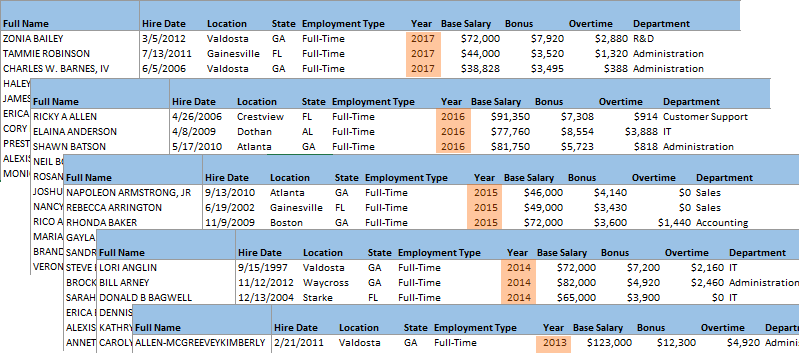
When talking about marketing tools, two words that don’t seem to go together are “marketing” and “Excel” (the Microsoft spreadsheet product). Because I’m in marketing, I encounter images like this all the time.
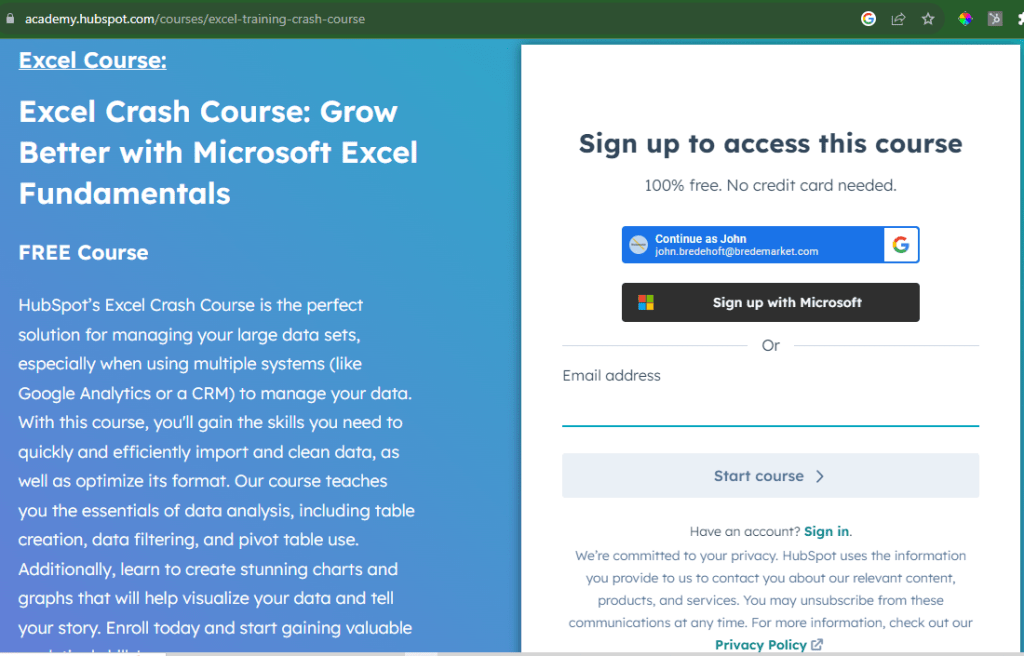
It’s true that marketing analytics requires a ton of Excel work. I’m not going to talk about marketing analytics here, but if you have an interest in using Excel for marketing analytics, you may want to investigate HubSpot Academy’s free Excel crash course.
As I write this, Bredemarket is neck-deep in a research project for a client. A SECRET research project.
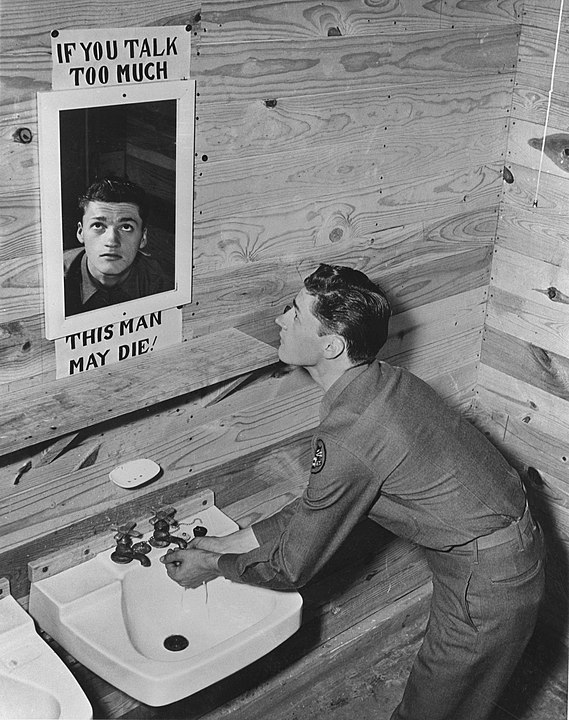
By Unnamed photographer for Office of War Information. – U.S. Office of War Information photo, via Library of Congress website [1], converted from TIFF to .jpg and border cropped before upload to Wikimedia Commons., Public Domain, https://commons.wikimedia.org/w/index.php?curid=8989847
While I won’t reveal the name of the client or the specifics about the research project, I can say that the project requires me to track the following information:
Organization name.
Organization type (based upon fairly common classifications).
Organization geographic location.
Vendor providing services to the organization.
Information about the contract between the vendor and the organization.
A multitude of information sources about the organization, the vendor, and the relationship between the two.
To attack the data capture for this project, I did what I’ve done for a number of similar projects for Bredemarket, Incode, IDEMIA, MorphoTrak, et al.
I threw all the data into a worksheet in an Excel workbook.
I can then sort and filter it to my heart’s content. Ror example, if I want to just view the rows for which I have contract information, I can just look at that.
Bredemarket as an identity/biometric research service
For one organization I created a number of different worksheets within a single workbook, in which the worksheet data all fed into a summary worksheet. This allowed my clients to view data either at the detailed level or at the summary level.
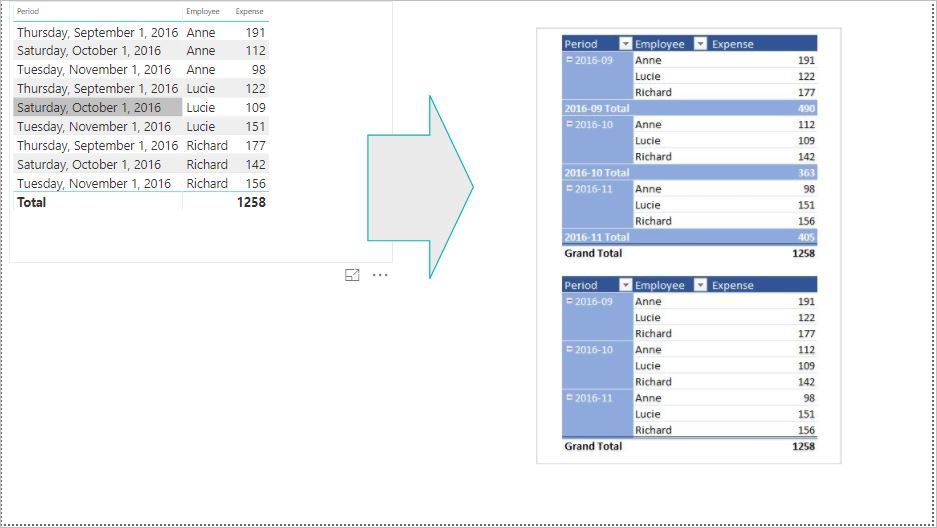
For another organization I collected the data from an external source, opened it in Excel, performed some massaging, and then pivoted the data into a new view so that it could then be exported out of Excel and into a super-secret document that I cannot discuss here.
Now none of this (well, except maybe for the pivot) is fancy stuff, and most of it (except for the formulas linking the summary and detailed worksheets) is all that hard to do. But it turns out that Excel is an excellent tool to deal with this data in certain cases.
Which brings me to YOUR research needs.
After all, Bredemarket doesn’t just write stuff.
Sometimes it researches stuff, especially in the core area of biometrics and identity.
After all, I offer 29 years of experience in this area, and I draw on that experience to get answers to your questions.
Unlike the better-bounded projects that require only a single blog post or a single white paper, I quote research projects at an hourly rate or on retainer (where I’m embedded with you).
As identity/biometric professionals well know, there are five authentication factors that you can use to gain access to a person’s account. (You can also use these factors for identity verification to establish the person’s account in the first place.)
Something You Are. I’ve spent…a long time with this factor, since this is the factor that includes biometrics modalities (finger, face, iris, DNA, voice, vein, etc.). It also includes behavioral biometrics, provided that they are truly behavioral and relatively static.
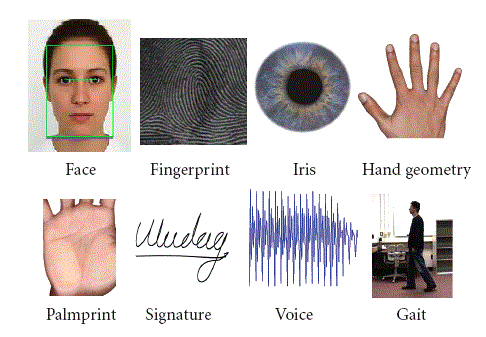
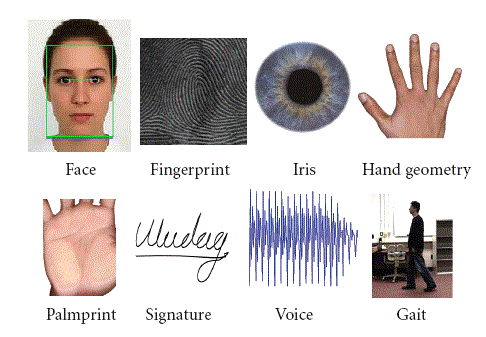
As I mentioned in August, there are a number of biometric modalities, including face, fingerprint, iris, hand geometry, palm print, signature, voice, gait, and many more.
If your firm offers an identity solution that partially depends upon “something you are,” then you need to create content (blog, case study, social media, white paper, etc.) that converts prospects for your identity/biometric product/service and drives content results.
And one of those records was so unmemorable that it was memorable.
The album, recorded in the early to mid 1960s, trumpeted the fact that the group that recorded the album was extremely versatile. You see, the record not only included surf songs, but also included car songs!
The only problem? The album was NOT by the Beach Boys.
Instead, the album was from some otherwise unknown band that was trying to achieve success by doing what the competition did. (In this case, the Beach Boys.)
I can’t remember the name of the band, and I bet no one else can either.
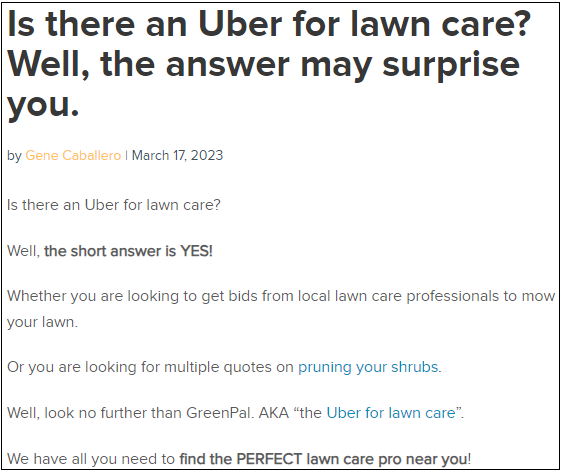
“Me too” in computing and lawn care
Sadly, this tactic of Xeroxing (or Mitaing) the competition is not confined to popular music. Have you noticed that so many recipes for marketing success involve copying what your competitors do?
Semrush: “Analyze your competitors’ keywords that you are not ranking for to discover gaps in your SEO strategy.”
iSpionage: “If you can emulate your competitors but do things slightly better you have a good chance of being successful.”
Someone who shall remain nameless: “Look at this piece of collateral that one of our competitors did. We should do something just like that.”
And of course the tactic of slavishly copying competitors has been proven to work. For example, remember when Apple Computer adopted the slogan “Think The Same” as the company dressed in blue, ensured all its computers could run MS-DOS, and otherwise imitated everything that IBM did?
“But John,” you are saying. “That’s unfair. Not everyone can be Apple.”
My point exactly. Everyone can’t be Apple because they’re so busy trying to imitate someone else—either a competitor or some other really popular company.
Personally, I’m waiting for some company to claim to be “the Bredemarket of satellite television. (Which would simply mean that the company would have a lot of shows about wildebeests.) But I’ll probably have to wait a while for some company to be the Bredemarket of anything.
(An aside: while talking with a friend, I compared the British phrase “eating your pudding” to the American phrase “eating your own dog food,” although I noted that “I like to say ‘eating your own wildebeest food‘ just to stand out.” Let’s see ChatGPT do THAT.)
“Me too” in identity verification
Now I’ll tread into more dangerous territory.
Here’s an example from the identity/biometric world. Since I self-identity (heh) as the identity content marketing expert, I’m supremely qualified to cite this example.
I spent a year embedded in the identity verification industry, and got to see the messaging from my own company and by the competition.
After a while, I realized that most of the firms in the industry were saying the same thing. Here are a few examples. See if you can spot the one word that EVERY company is using:
(Company I) “Reimagine trust.”
(Company J) “To protect against fraud and financial crime, businesses online need to know and trust that their customers are who they claim to be — and that these customers continue to be trustworthy.”
(Company M) “Trust is the core of any successful business relationship. As the digital revolution continues to push businesses and financial industries towards digital-first services, gaining digital trust with consumers will be of utmost importance for survival.”
(Company O) “Create trust at onboarding and beyond with a complete, AI-powered digital identity solution built to help you know your customers online.”
(Company P) “Trust that users are who they say they are, and gain their trust by humanizing the identity experience.”
(Company V) “Stop fraud. Build trust. Identity verification made simple.”
Yes, these companies, and many others, prominently feature the t-word in their messaging.
Now perhaps some of you would argue that trust is essential to identity verification in the same way that water is essential to an ocean, and that therefore EVERYBODY HAS to use the t-word in their communications.
After all, if I was going to create content for this prospect, we had to ensure that the content stood out from their competitors.
Without revealing confidential information, I can say that I asked the firm why they were better than every other firm out there, and why all the other firms sucked. And the firm provided me with a compelling answer to that question. I can’t reveal that answer, but you can probably guess that the word “trust” was not involved.
A final thought
So let me ask you:
Why is YOUR firm better than every other firm out there, and why do all or YOUR competitors suck?
Your firm’s survival may depend upon communicating that answer.
Identity and biometrics firms can achieve quantifiable benefits with prospects by blogging. Over 40 identity and biometrics firms are already blogging. Is yours?
These firms (and probably many more) already recognize the value of identity blog post writing, and some of them are blogging frequently to get valuable content to their prospects and customers.
Is your firm on the list? If so, how frequently do you update your blog?
In most cases, I can provide your blog post via my standard package, the Bredemarket 400 Short Writing Service. I offer other packages and options if you have special needs.
Get in touch with Bredemarket
Authorize Bredemarket, Ontario California’s content marketing expert, to help your firm produce words that return results.
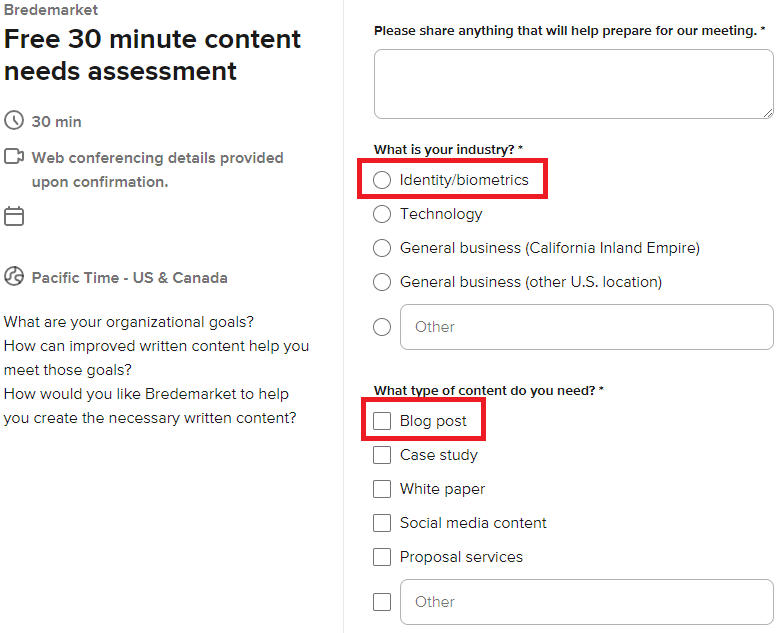
To discuss your identity/biometrics blog post needs further,book a meeting with me at calendly.com/bredemarket. On the questionnaire, select the Identity/biometrics industry and Blog post content.
Always take advantage of your competitors’ weaknesses.
This post describes an easy way to take advantage of your competitors. If they’re not blogging, make sure your firm is blogging. And the post provides hard numbers that demonstrate why your firm should be blogging.
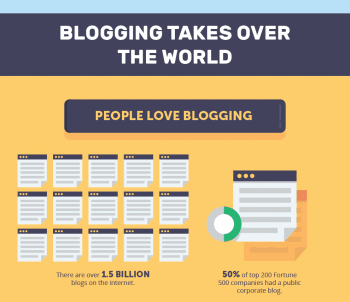
Which means that half of those companies don’t have a public corporate blog.
The same infographic also revealed the following:
86% of B2B companies are blogging. (Or, 14% are not.)
68% of social media marketers use blogs in their social media strategy. (Or, 32% don’t.)
45% of marketers saying blogging is the #1 most important piece of their content strategy.
Small businesses under 10 employees allocate 42% of their marketing budget to content marketing.
So obviously some firms believe blogging is important, while others don’t.
What difference does this make for your firm?
What results do blogging companies receive?
In my view, the figures above are way too low. 100% of all Fortune 500 companies, 100% of B2B companies should be blogging, and 100% of social media marketers should incorporate blogging.
Getting leads from blogging is nice, but show me the money! What about conversions?
Marketers who have prioritized blogging are 13x more likely to enjoy positive ROI.
92% of companies who blog multiple times per day have acquired a customer from their blog.
Take a look at those last two bullets related to conversion again. Blogging is correlated with positive ROI (I won’t claim causation, but anecdotally I believe it), and blogging helps firms acquire customers. So if your firm wants to make money, get blogging.
What should YOUR company do?
With numbers like this, shouldn’t all companies be blogging?
But don’t share these facts with your competitors. Keep them to yourself so that you gain a competitive advantage over them.
Now you just need to write those blog posts.
How can I help?
And if you need help with the actual writing, I, John E Bredehoft of Bredemarket, can help.
And if you’re not in the identity/biometric industry, my general content marketing expertise also applies to technology firms and general business firms.
In most cases, I can provide your blog post via my standard package, the Bredemarket 400 Short Writing Service. I offer other packages and options if you have special needs.
Authorize Bredemarket, Ontario California’s content marketing expert, to help your firm produce words that return results.
I mentioned something in passing in Bredemarket’s recent go-to-market post that I think needs a little more highlighting. So here is a deeper dive into the 22 types of content that product marketers create. (Well, at least 22. I’m probably missing some.)
And by the way, I have created all 22 of these types of content, from blog posts and battlecards to smartphone application content and scientific book chapters. And I can create it for you.
Why is it that so many business-to-business (B2B) marketers confuse product marketing with content marketing?
Because it requires a lot of discipline. That’s why.
B2B marketers who get it right understand the difference between these two fundamentally different types of marketing, what their purposes are and how to use them correctly.
Some firms (especially startups) don’t have the luxury to enforce such definitions. They don’t have separate teams to create awareness content, consideration content, and conversion content. They have one team (or perhaps one person) to create all that content PLUS other stuff that I’ll discuss later.
For example, during my most recent stint as a product marketing employee at a startup, the firm had no official content marketers, so the product marketers had to create a lot of non-product related content. So we product marketers were the de facto content marketers for the company too. (Sadly, we didn’t get two salaries for filling two roles.)
Why did the product marketers end up as content marketers? It turns out that it makes sense—after all, people who write about your product in the lower funnel stages can also write about your product in the upper funnel stages, and also can certainly write about OTHER things, such as company descriptions, speaker submissions, and speaker biographies.
As a result, I’ve written a ton of stuff over my last 29 years in identity/biometrics. It didn’t take a great leap for me to self-identify as the identity content marketing expert and the biometric content marketing expert (and other expert definitions; I’m an expert in creating expert titles).
I’ve compiled a summary of the types of content that I’ve created over the years, not only for Bredemarket’s clients, but also for my employers at Incode Technologies, IDEMIA, MorphoTrak, Motorola, and Printrak.
Not all of these were created when I was in a formal product marketing role, but depending upon your product or service, you may need any of these content types to support the marketing of your product/service.
It’s helpful to divide the list into two parts: the external (customer-facing) content, and the internal (company-only) content.
10 types of external content I have created
External content is what most people think of when they talk about product marketing or content marketing. After all, this is the visible stuff that the prospects see, and which can move them toward a purchase (conversion). The numbers after some content types indicate the quantities of pieces of collateral that I have created.
Articles
Blog Posts (500+, including this one)
Briefs/Data/Literature Sheets
Case Studies (12+)
Proposals (100+)
Scientific Book Chapters
Smartphone Application Content
Social Media (Facebook, Instagram, LinkedIn, Threads, TikTok, Twitter)
Web Page Content
White Papers and E-Books
Here’s an video showing some of the external content that I have created for Bredemarket.
While external content is sexy, internal content is extremely important, since it’s what equips the people inside a firm to promote your product or service. The numbers after some content types indicate the quantities of pieces of collateral that I have created.
Battlecards (80+)
Competitive Analyses
Event/Conference/Trade Show Demonstration Scripts
Plans
Playbooks
Proposal Templates
Quality Improvement Documents
Requirements
Strategic Analyses
And here are 3 more types
Some content can either be external or internal. Again, numbers indicate the quantities of pieces of collateral I have created.
Email Newsletters (200+)
FAQs
Presentations
Content I can create for you
Does your firm need help creating one of these types of content?
Maybe two?
Maybe 22?
I can create content full-time for you
If your firm needs to create a lot of content types for your products, then consider hiring me as your full-time Senior Product Marketing Manager. My LinkedIn profile is here, documenting my 29 years of experience in identity/biometric technology as a product marketer, a strategist, and in other roles.
I just took a look over the last few calls to action that Bredemarket has published.
Whatever you need, talk to me. And be prepared for me to ask you six (or more) questions.
And if you’re reading this post in Janury 2025, thank you. If you want to talk to me about content creation, some of these links may still work!
Perhaps Bredemarket, the technology content marketing expert, can help you select the words to tell your story. If you’re interested in talking, let me know.
If I can help your firm:
From various Bredemarket blog posts.
All of my most recent calls to action were variations on “Contact me.”
And all the CTAs werre kinda so-so and yawn-inducing.
Since I was open to other ideas, I viewed @yourfavcontentcreator_’s recent Instagram reel with four suggestions. Two of them didn’t make sense for Bredemarket’s business, but the first and fourth resonated with me.
I’ve reproduced those two below.
👉 “Get started on your journey to [desired outcome] today.” 👉 “Ready to see real results? Explore our [product/service] now.”
At first I thought I’d simply incorporate “journey” into my CTA…
Don’t stop believin’ in your content!
…but then I decided that “results” would be better.
At the same time, the CTA has to be Brede-distinctive, captivate prospects better than “contact me,” and ideally appeal to all of Bredemarket’s target audiences (identity/biometrics, technology, local).
So, identity/biometric and technology firms, will the paragraph below the logo make you MORE likely to engage with Bredemarket for marketing and writing services? If not, I’ll continue to tweak it in an agile fashion.
Does your firm fight crooks who try to fraudulently use synthetic identities? If so, how do you communicate your solution?
This post explains what synthetic identities are (with examples), tells four ways to detect synthetic identities, and closes by providing an answer to the communication question.
While this post is primarily intended for identity firms who can use Bredemarket’s marketing and writing services, anyone else who is interested in synthetic identities can read along.
What are synthetic identities?
To explain what synthetic identities are, let me start by telling you about Jason Brown.
Jason Brown wasn’t Jason Brown
You may not have heard of him unless you lived in Atlanta, Georgia in 2019 and lived near the apartment he rented.
Jason Brown’s renting of an apartment isn’t all that unusual.
If you were to visit Brown’s apartment in February 2019, you would find credit cards and financial information for Adam M. Lopez and Carlos Rivera.
Now that’s a little unusual, especially since Lopez and Rivera never existed.
For that matter, Jason Brown never existed either.
A Georgia man was sentenced Sept. 1 (2022) to more than seven years in federal prison for participating in a nationwide fraud ring that used stolen social security numbers, including those belonging to children, to create synthetic identities used to open lines of credit, create shell companies, and steal nearly $2 million from financial institutions….
Cato joined conspiracies to defraud banks and illegally possess credit cards. Cato and his co-conspirators created “synthetic identities” by combining false personal information such as fake names and dates of birth with the information of real people, such as their social security numbers. Cato and others then used the synthetic identities and fake ID documents to open bank and credit card accounts at financial institutions. Cato and his co-conspirators used the unlawfully obtained credit cards to fund their lifestyles.
Talking about synthetic identity at Victoria Gardens
Here’s a video that I created on Saturday that describes, at a very high level, how synthetic identities can be used fraudulently. People who live near Rancho Cucamonga, California will recognize the Victoria Gardens shopping center, proof that synthetic identity theft can occur far away from Georgia.
Note that synthetic identity theft different from stealing someone else’s existing identity. In this case, a new identity is created.
So how do you catch these fraudsters?
Catching the identity synthesizers
If you’re renting out an apartment, and Jason Brown shows you his driver’s license and provides his Social Security Number, how can you detect if Brown is a crook? There are four methods to verify that Jason Brown exists, and that he’s the person renting your apartment.
Method One: Private Databases
One way to check Jason Brown’s story is to perform credit checks and other data investigations using financial databases.
Did Jason Brown just spring into existence within the past year, with no earlier credit record? That seems suspicious.
Does Jason Brown’s credit record appear TOO clean? That seems suspicious.
Does Jason Brown share information such as a common social security number with other people? Are any of those other identities also fraudulent? That is DEFINITELY suspicious.
This is one way that many firms detect synthetic identities, and for some firms it is the ONLY way they detect synthetic identities. And these firms have to tell their story to their prospects.
If your firm offers a tool to verify identities via private databases, how do you let your prospects know the benefits of your tool, and why your solution is better than all other solutions?
Method Two: Check That Driver’s License (or other government document)
What about that driver’s license that Brown presented? There are a wide variety of software tools that can check the authenticity of driver’s licenses, passports, and other government-issued documents. Some of these tools existed back in 2019 when “Brown” was renting his apartment, and a number of them exist today.
Maybe your firm has created such a tool, or uses a tool from a third party.
If your firm offers this capability, how can your prospects learn about its benefits, and why your solution excels?
Method Three: Check Government Databases
Checking the authenticity of a government-issued document may not be enough, since the document itself may be legitimate, but the implied credentials may no longer be legitimate. For example, if my California driver’s license expires in 2025, but I move to Minnesota in 2023 and get a new license, my California driver’s license is no longer valid, even though I have it in my possession.
Why not check the database of the Department of Motor Vehicles (or the equivalent in your state) to see if there is still an active driver’s license for that person?
The American Association of Motor Vehicle Administrators (AAMVA) maintains a Driver’s License Data Verification (DLDV) Service in which participating jurisdictions allow other entities to verify the license data for individuals. Your firm may be able to access the DLDV data for selected jurisdictions, providing an extra identity verification tool.
If your firm offers this capability, how can your prospects learn where it is available, what its benefits are, and why it is an important part of your solution?
Method Four: Conduct the “Who You Are” Test
There is one more way to confirm that a person is real, and that is to check the person. Literally.
If someone on a smartphone or videoconference says that they are Jason Brown, how do you know that it’s the real Jason Brown and not Jim Smith, or a previous recording or simulation of Jason Brown?
This is where tools such as facial recognition and liveness detection come to play.
You can ensure that the live face matches any face on record.
You can also confirm that the face is truly a live face.
In addition to these two tests, you can compare the face against the face on the presented driver’s license or passport to offer additional confirmation of true identity.
Now some companies offer facial recognition, others offer liveness detection, others match the live face to a face on a government ID, and many companies offer two or three of these capabilities.
One more time: if your firm offers these capabilities—either your own or someone else’s—what are the benefits of your algorithms? (For example, are they more accurate than competing algorithms? And under what conditions?) And why is your solution better than the others?
This is for the firms who fight synthetic identities
While most of this post is of general interest to anyone dealing with synthetic identities, this part of this post is specifically addressed to identity and biometric firms who provide synthetic identity-fighting solutions.
When you communicate about your solutions, your communicator needs to have certain types of experience.
Industry experience. Perhaps you sell your identity solution to financial institutions, or educational institutions , or a host of other industries (gambling/gaming, healthcare, hospitality, retailers, or sport/concert venues, or others). You need someone with this industry experience.
Solution experience. Perhaps your communications require someone with 29 years of experience in identity, biometrics, and technology marketing, including experience with all five factors of authentication (and verification).
Communication experience. Perhaps you need to effectively communicate with your prospects in a customer focused, benefits-oriented way. (Content that is all about you and your features won’t win business.)
If you haven’t read a Bredemarket blog post before, or even if you have, you may not realize that this post is jam-packed with additional information well beyond the post itself. This post alone links to the following Bredemarket posts and other content. You may want to follow one or more of the 13 links below if you need additional information on a particular topic:
Here’s my latest brochure for the Bredemarket 400 Short Writing Service, my standard package to create your 400 to 600 word blog posts and LinkedIn articles. Be sure to check the Bredemarket 400 Short Writing Service page for updates.
But what if I want to know how to work with Bredemarket?
Glad you asked.
After reading Mace’s LinkedIn post, I realized that I have a bunch of different online sources that explain how to work with Bredemarket, but they’re scattered all over the place. This post groups them all the “how to work with Bredemarket” content together, following an outline similar (yet slightly different) to Mace’s.
And no, it’s not a stand-alone PDF, but as you read the content below you’ll discover two stand-alone PDFs that address critical portions of the process.
Question 1: Why would I work with Bredemarket?
As you’ll see below, “why” is a very important question, even more important than “how.” Here are some reasons to work with Bredemarket.
You require the words to communicate the benefits of your identity/biometrics product/service. I offer 29 years of experience in the identity/biometrics industry and am a biometric content marketing expert and an identity content marketing expert. I have created multiple types of content (see below) to share critical points about identity/biometrics offerings.
You require the words to communicate the benefits of your technology product/service. I have also created multiple types of content to share critical points about technology offerings.
You require the words to communicate the benefits of a product/service you provide to California’s Inland Empire. I’ve lived in the Inland Empire for…well, for more than 29 years. I know the area—its past, its present, and its future.
You require one of the following types of content. Blogs, case studies / testimonials, data sheets, e-books, proposals, social media posts / Xs (or whatever tweets are called today), white papers, or anything. I’ve done these for others and can do it for you.
Question 2: Why WOULDN’T I work with Bredemarket?
This question is just as important as the prior one. If you need the following, you WON’T want to work with Bredemarket.
You require high quality graphics. Sorry, that’s not me.
I did not draw this myself. Originally created by Jleedev using Inkscape and GIMP. Redrawn as SVG by Ben Liblit using Inkscape. – Own work, Public Domain, link.
You are based outside of the United States. Foreign laws and exchange rates make my brain hurt, so I only pursue business domestically. But depending upon where you are, I may be able to recommend a content marketer for you.
Question 3: What are Bredemarket’s most popular packages? How much do they cost?
Here are the three most common packages that Bredemarket offers.
Note that these are the standard packages. If your needs are different, I can adapt them, or charge you an hourly rate if the need is not well defined. (But as you will see below, I try to work with you at the outset to define the project.)
If you follow the link above for your desired package and download the first brochure on each page, you’ll get a description of the appropriate service. The pricing is at the bottom of each brochure.
Each brochure also explains how I kick off a project, but the procedure is fairly common for each package.
Question 4: What are Bredemarket’s working practices?
But that’s not all that we address in the kickoff. There are some other lower-level questions that I ask you (such as the long and short form of your company name).
Once we have defined the project, I iteratively provide draft copy and you iteratively review it. The number and length of review cycles varies depending upon the content length and your needs. For example, I use up to two review cycles of up to three days each for short content.
Eventually I provide the final copy, you publish it and pay me, and both of us are happy.




















 Bredemarket