From the 2022 Cruisin’ Reunion in Ontario, California. The 2023 edition takes place this weekend.
(Updated blog post count 10/23/2023)
There are many ways for Inland Empire firms to raise awareness about their offerings. For certain firms, blogging provides quantifiable benefits. Can your firm take advantage of blogging’s fresh immediacy?
In most cases, I can provide your blog post via my standard package, the Bredemarket 400 Short Writing Service. I offer other packages and options if you have special needs.
Get in touch
Authorize Bredemarket, Ontario California’s content marketing expert, to help your firm produce words that return results.
Identity and biometrics firms can achieve quantifiable benefits with prospects by blogging. Over 40 identity and biometrics firms are already blogging. Is yours?
These firms (and probably many more) already recognize the value of identity blog post writing, and some of them are blogging frequently to get valuable content to their prospects and customers.
Is your firm on the list? If so, how frequently do you update your blog?
In most cases, I can provide your blog post via my standard package, the Bredemarket 400 Short Writing Service. I offer other packages and options if you have special needs.
Get in touch with Bredemarket
Authorize Bredemarket, Ontario California’s content marketing expert, to help your firm produce words that return results.
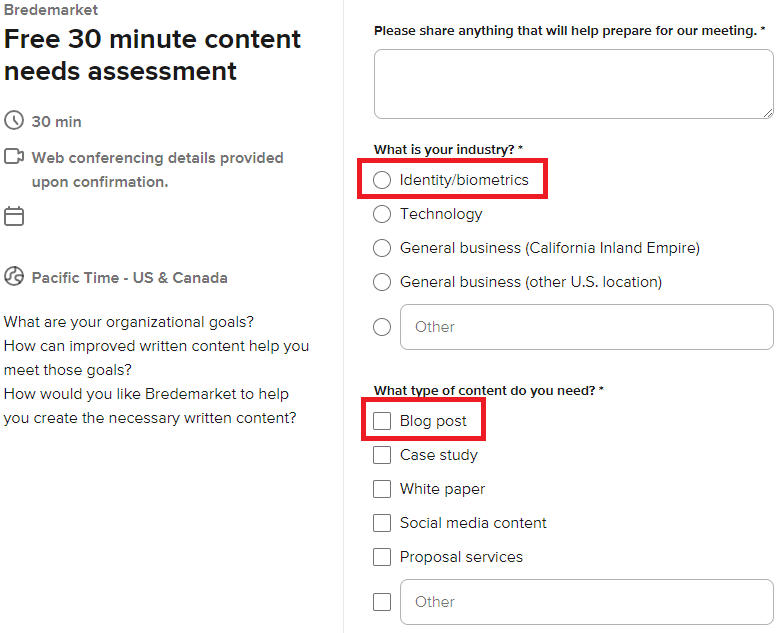
To discuss your identity/biometrics blog post needs further,book a meeting with me at calendly.com/bredemarket. On the questionnaire, select the Identity/biometrics industry and Blog post content.
Always take advantage of your competitors’ weaknesses.
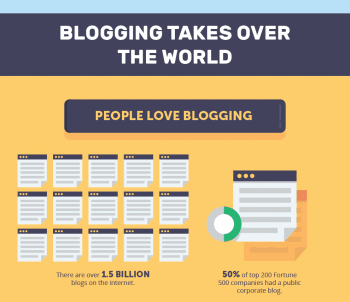
This post describes an easy way to take advantage of your competitors. If they’re not blogging, make sure your firm is blogging. And the post provides hard numbers that demonstrate why your firm should be blogging.
Which means that half of those companies don’t have a public corporate blog.
The same infographic also revealed the following:
86% of B2B companies are blogging. (Or, 14% are not.)
68% of social media marketers use blogs in their social media strategy. (Or, 32% don’t.)
45% of marketers saying blogging is the #1 most important piece of their content strategy.
Small businesses under 10 employees allocate 42% of their marketing budget to content marketing.
So obviously some firms believe blogging is important, while others don’t.
What difference does this make for your firm?
What results do blogging companies receive?
In my view, the figures above are way too low. 100% of all Fortune 500 companies, 100% of B2B companies should be blogging, and 100% of social media marketers should incorporate blogging.
Getting leads from blogging is nice, but show me the money! What about conversions?
Marketers who have prioritized blogging are 13x more likely to enjoy positive ROI.
92% of companies who blog multiple times per day have acquired a customer from their blog.
Take a look at those last two bullets related to conversion again. Blogging is correlated with positive ROI (I won’t claim causation, but anecdotally I believe it), and blogging helps firms acquire customers. So if your firm wants to make money, get blogging.
What should YOUR company do?
With numbers like this, shouldn’t all companies be blogging?
But don’t share these facts with your competitors. Keep them to yourself so that you gain a competitive advantage over them.
Now you just need to write those blog posts.
How can I help?
And if you need help with the actual writing, I, John E Bredehoft of Bredemarket, can help.
And if you’re not in the identity/biometric industry, my general content marketing expertise also applies to technology firms and general business firms.
In most cases, I can provide your blog post via my standard package, the Bredemarket 400 Short Writing Service. I offer other packages and options if you have special needs.
Authorize Bredemarket, Ontario California’s content marketing expert, to help your firm produce words that return results.
This post talks about the Bredemarket 2800 Medium Writing Service, describes why your firm would elect that service over three of my other services, and explains how the Bredemarket 2800 Medium Writing Service works.
Four ways that Bredemarket provides written content
I know that the experts say that you’re NOT supposed to give your prospects a multitude of choices, and that you should keep your offerings simple. Sometimes REALLY simple.
But I’ve ignored the experts (again) and I’m giving Bredemarket’s prospects four options for content creation. I’ll briefly touch on three of them before describing the fourth one, the Bredemarket 2800 Medium Writing Service. Once I’m done, you’ll know when you want to elect Bredemarket 2800, and when you’ll want to elect one of the other three options:
Bredemarket 4000 (by the hour),
Bredemarket 4444 (by the month), or
Bredemarket 400 (by the small project).
One: by the hour (Bredemarket 4000 Long Writing Service)
Sometimes you don’t know the parameters of your project, or perhaps you may have multiple projects that require Bredemarket’s assistance. In those cases, Bredemarket bills by the hour using something I call the Bredemarket 4000 Long Writing Service.
Whether it’s proposal work or something else, I do the work (however much work there is) and bill you for the hours that I worked.
Two: by the month (Bredemarket 4444 Partner Retainer)
Perhaps you have ongoing needs and just need me to be available for a certain number of hours each month, yet you’re not ready to hire a full-time person to do the work. In that case, the Bredemarket 4444 Partner Retainer is the package that is best for you. With this level of commitment, I am embedded as part of your organization.
As I assert in the post “Three Levels of Engagement With Your Content Creator,” a retainer offers a happy middle ground between full-time employment and single project work. It gives you work flexibility, budget predictability, and consultant accessibility.
Three: by the small project (Bredemarket 400 Short Writing Service)
But what if you know the scope of your project, and it is a single simple project? If you only need between 400 and 600 words of text, then the ideal package for you is the Bredemarket 400 Short Writing Service.
If your project only requires 400 to 600 words (give or take), the Bredemarket 400 Short Writing Service is ideal for you.
But what if you need more words than that? A lot more?
Why would you need 3,000 words?
There are a few cases in which your firm may need roughly 3,000 words of text, rather than the roughtly 500 words of text described above.
Longer blog posts. Often blog posts are pretty short and fit well within a 400 to 600 word limit. But sometimes you need longer, more detailed blog posts that delve into a topic more deeply. If you need 3,000 words to tell your story, tell it.
Longer LinkedIn articles. In most cases, social media postings will not hit the 3,000 word mark. (For some social media platforms it’s near impossible to hit that limit anyway.) One notable exception is LinkedIn articles, which can enter into the same detail as a long blog post. If your audience is on LinkedIn, then place your content natively on LinkedIn (repurposing it to your blog for your non-LinkedIn prospects if you like).
Longer case studies. Case studies can vary in length. As it turns out, the case studies that Bredemarket has written for its clients are simple two-pagers (including graphics) and fit well within the Bredemarket 400 parameters. But perhaps your case study demands richer detail.
White papers. While one may debate about the semantics of what is a white paper vs. what is not a white paper, you may demand a document that requires around 3,000 words of detail.
The content type that you know about, but I don’t. You may require a particular piece of content that doesn’t fit into the nice neat categories above, but requires text of between 2,800 and 3,200 words.
In these cases, the Bredemarket 2800 Medium Writing Service provides the content you need.
But is Bredemarket 2800 the same as Bredemarket 400, with more words and a higher price?
No.
Longer content requires a slightly different process.
How the Bredemarket 2800 process differs from the Bredemarket 400 process
Admittedly there are some obvious similarities between Bredemarket 400 and Bredemarket 2800.
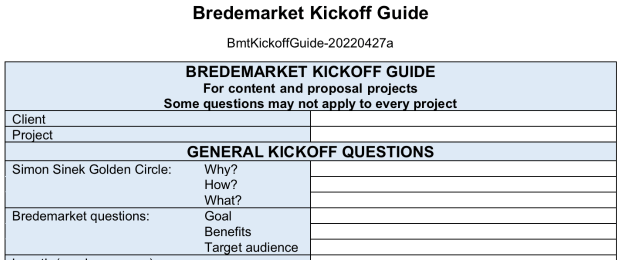
The kickoff is an important part of the content creation process, since the questions I ask during the kickoff (since expanded) ensure that I produce the right content at the end of the process.
The kickoff ensures that the final written content (a) answers the WHY/HOW/WHAT questions about you, (b) advances your GOAL, (c) communicates your BENEFITS, and (d) speaks to your TARGET AUDIENCE. It is both iterative and collaborative.
The beginning of the Bredemarket Kickoff Guide that I use. There are many, many more questions that I haven’t disclosed. Do you want to learn them? Buy the service.
The basic work during the kickoff is pretty much the same as for Bredemarket 400, although you and I will probably go in-depth on certain items, and there is a higher chance that the content specifications will be more detailed (for example, goals for each subsection of the content).
You and Bredemarket agree upon the topic, goal, benefits, and target audience (and, if necessary, outline, section sub-goals, relevant examples, and relevant key words/hashtags, and interim and final due dates).
For complex content requiring input and approval of multiple subject matter experts, you and Bredemarket agree on a preliminary list of tasks, assigned persons, and due dates.
For content that must be incorporated into your content management system, you and Bredemarket agree on the necessary format and other parameters. Otherwise, the final copy will be provided in Microsoft Word docx format, including (as appropriate) callout indicators, hyperlinks, key words, and/or hashtags.
For projects requiring multiple related pieces of content, you and Bredemarket agree upon the desired frequency of content.
The Bredemarket 2800 prework
Sometimes one or two additional things will happen before I start writing the first draft.
I may need to interview one of your customers or subject matter experts—for example, to obtain the facts necessary for a case study or white paper.
I may need to conduct additional research, as agreed upon by us during the kickoff.
The Bredemarket 2800 drafts
Once I’m ready, I start writing.
Between you and me, I create a draft 0.5, sleep on it (sometimes literally), and then create a much more succinct draft 1.0. See “Your writers (in this case me) should be succinct,” in my post “Which Words Should Your Marketers Use? My Four Suggestions.”
It shouldn’t surprise you to learn that it takes longer to write 3,000 words than it takes to write only 500 words. Therefore, I allow myself up to seven days (actual days, not working days) to produce the first draft. (Contrast this with Bredemarket 400, in which I commit to create a draft within three days.)
Then I hand the draft over to you for the first review.
After I receive your review comments, I work on the second draft (again, taking up to seven days) and hand it over for the second review.
Then (if necessary) I work on the third draft and hand it over for the third review. Unlike Bredemarket 400, which only includes two reviews, Bredemarket 2800 includes three reviews because of the higher complexity of the content.
At the end, I provide you with the final copy.
But what if you need your content much more quickly than the 1-2 months it may take to go through all three of the draft and review cycles?
Then we’ll mutually adjust the parameters (and the billing) accordingly.
However, remember that when I adjust my deliverable schedule, it also affects your deliverable schedule as described below.
The Bredemarket 2800 reviews
As decribed above, you will receive up to three review copies during the process.
Because this is a collaborative process, your participation is important to ensure that I create the proper content for your firm. So be prepared to spent the time necessary to ensure that the content is right.
I realize that you probably don’t have a lot of time to review consultant content. If you did have a lot of time, then you’d probably write the content yourself rather than asking a consultant to do it. For this reason, I give you seven days to review each draft, rather than the three days that I give to firms that elect the Bredemarket 400 Short Writing Service.
Of course, if you require a more rapid turnaround, then you’ll need to review the drafts much more quickly, in the same way that I’ll need to write the drafts much more quickly.
The Bredemarket 2800 end product
After the kickoffs, drafts, and reviews, I’ll provide the final copy in Microsoft Word docx format, unless we’ve agreed on some other format. This will give you the content you need to put in your blog, in an article on your LinkedIn page, or in whatever content you need.
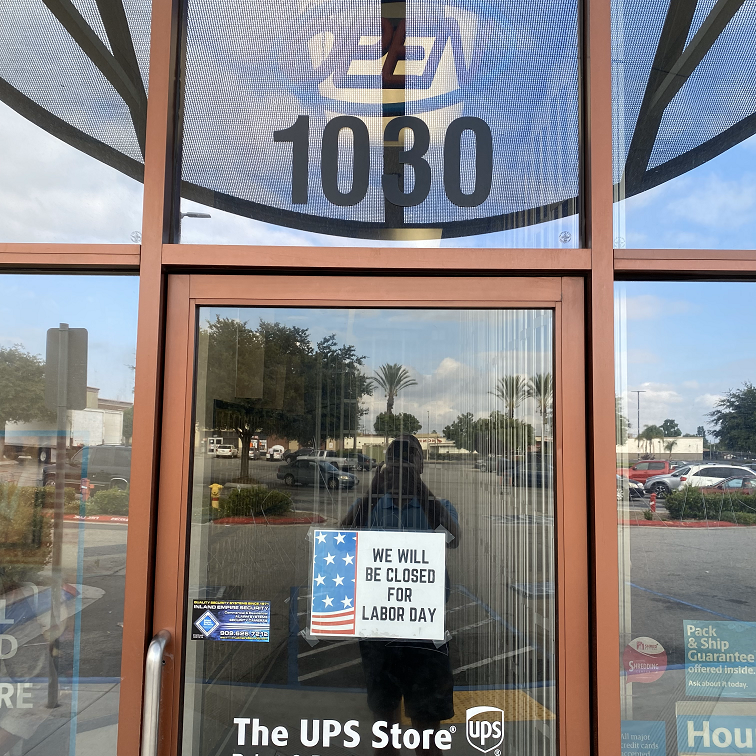
I wasn’t going to labor on this Labor Day, but I ended up renewing my City of Ontario business license. (This coming year will be the fourth that Bredemarket has conducted business in Ontario.)
The UPS Store, 1030 N Mountain Ave, Ontario CA 91762.They WERE closed for Labor Day (but boxholders have keys).Bredemarket’s mailing address is 1030 N Mountain Ave #259, Ontario CA 91762-2114.
Now most people don’t interact with Bredemarket via my physical mailing address. The few that do include the City of Ontario, and three of my clients who have chosen to pay me via paper checks. (I’m flexible.)
This got me curious.
What if?
What if the Internet were to disappear tomorrow? What if the only way my clients could interact with Bredemarket was through my Bredemarket physical mailing address? Could Bredemarket still conduct business?
Possibly.
Some of my business would disappear overnight. Blog posts, for example, are meaningless in a non-Internet world, unless companies choose to post long text-based communications on utility poles. Or in laundromats.
This used to be my laundromat. 454 N Mountain Ave, Ontario, CA 91762.
Even if the Internet were to disappear, I could still write text for case studies (maintaining my Inland Empire case study writing business) and white papers. I could send my client a Microsoft Word file (perhaps an old version of Word), and the firm could send the file to their printer. But how would I send the file? Put a CD in the mail?
If your Inland Empire company doesn’t have an online presence, one quick way to create one is to create a business page on Facebook.
This post outlines the benefits of establishing an online presence via a Facebook business page. It also provides four examples of Facebook business pages. Finally, the post addresses the thorny question of creating content for your Facebook business page.
Why Faceboook may be the best online presence for your business
For the first time in years, I attended an Ontario IDEA Exchange meeting at AmPac Business Capital on Tuesday afternoon. There was a mixture of attendees: some who had established several businesses, some like me who had run one business for some time, and a few who were just starting out in business.
The ones who were starting out were still trying to figure out all the things you need to do to start a business: figuring out why the business exists in the first place, getting the appropriate business licenses (and in some cases professional licenses), printing business cards (or creating the online equivalent), setting up SOME kind of way to track prospects and customers…and establishing an online presence.
Now some businesses choose to establish their online presence by creating a website.
But even the simplest website can involve a lot of complexity—bredemarket.com currently has 57 pages, not counting tag pages and individual blog post pages.
For many small businesses, it may be much easier to create a Facebook business page then to create an entire website.
Facebook business pages are free. (Well, unless you run ads.)
Facebook business pages are easy to create.
Facebook business pages potentially reach billions of people, including your prospects and customers.
Creating a Facebook business page
So how do you create a Facebook business page?
There’s no need for me to document all of that in detail, since many have already done so.
Don’t worry if you don’t have all the optional items, such as a page cover picture. You can add them later. This will get you going.
Other guides to creating Facebook business pages are available from Buffer (with pictures), Hootsuite (with pictures). Sprout Social (with pictures), and a number of other sources.
But before you create YOUR Facebook business page, let me show you four varied examples of EXISTING Facebook business pages.
Four examples of Facebook business pages
Let’s take a look at some pages that already exist. Perhaps one or more of these will give you ideas for your own page.
The artist page (Paso Artis)
Paso Artis is a European business whose proprietor is a painter who sells her paintings.
The menu options at the bottom of the picture above (some of which cannot be seen) illustrate some of the elements you can include in a Facebook page. Here are just a few of the page elements that Paso Artis uses:
Posts. This is the equivalent of a blog on a website, and allows you to post text, images, videos, and other types of content.
About. This is where you provide contact and other basic information about your business.
Shop. Facebook allows you to include a shop, which Paso Artis uses to sell her paintings.
Photos. As you can imagine for an artist’s page, photos of the artwork are essential.
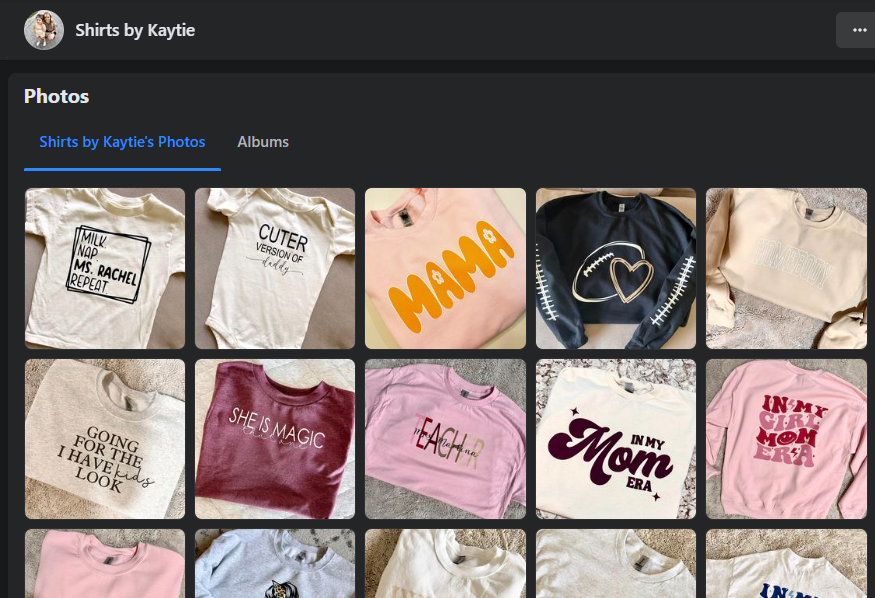
The shirtmaker page (Shirts by Kaytie)
(UPDATE 10/20/2023: Because Shirts by Kaytie is sadly no longer in business, I have removed the, um, live links to her Facebook page.)
Let’s leave Europe and go to Illinois where we find another artist, but her work is not displayed on paintings, but on shirts. Here is the Shirts by Kaytie Facebook page.
You’ll notice that Shirts by Kaytie has a different menu item order (and different menu items) than Paso Artis. For example, Shirts by Kaytie doesn’t have a Facebook “shop” element; you need to contact her directly to purchase items.
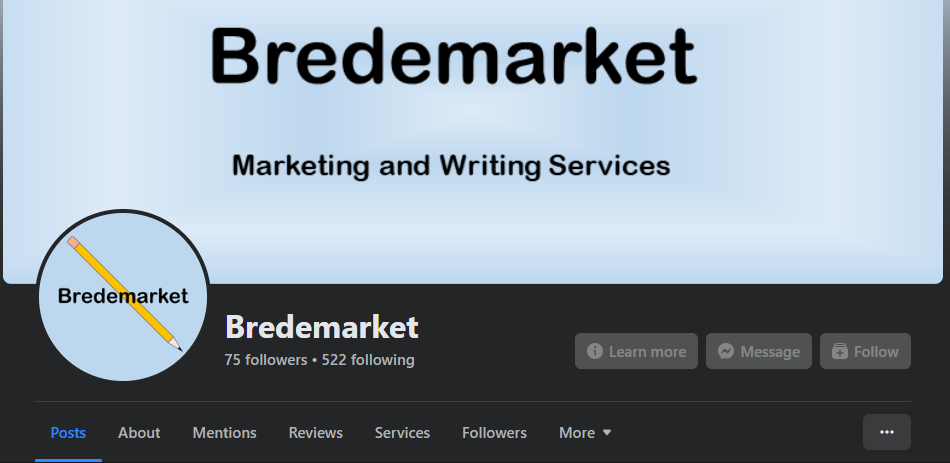
Enough of such exotic locations as Europe and Illinois. Let’s head to California’s Inland Empire and look at my favorite marketing/writing services Facebook page, the Bredemarket Facebook page.
First, Bredemarket (unlike Paso Artis and Shirts by Kaytie) provides services rather than tangible products. Therefore, I chose to include a “Services” element as part of my Facebook page.
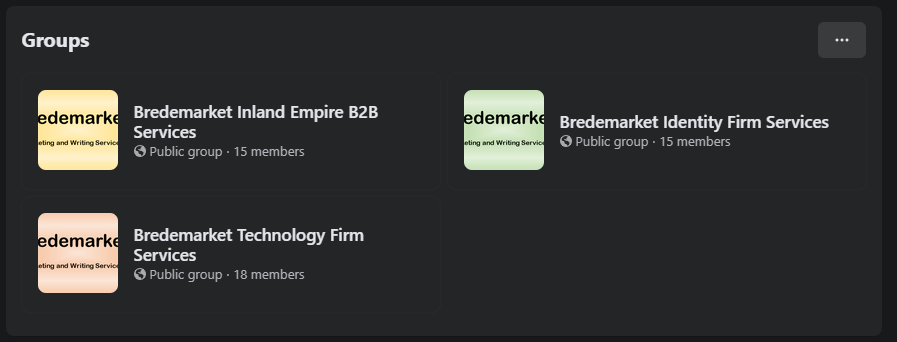
Second, Bredemarket has chosen to implement Facebook’s “groups” feature. In Bredemarket’s case, there are three separate groups that focus on various aspects of Bredemarket’s business. Inland Empire businesses can read the content in the Bredemarket Inland Empire B2B Services group and not get bogged down in out-of-area identity discussions about the change from FRVT to FRTE. (They’re missing out.)
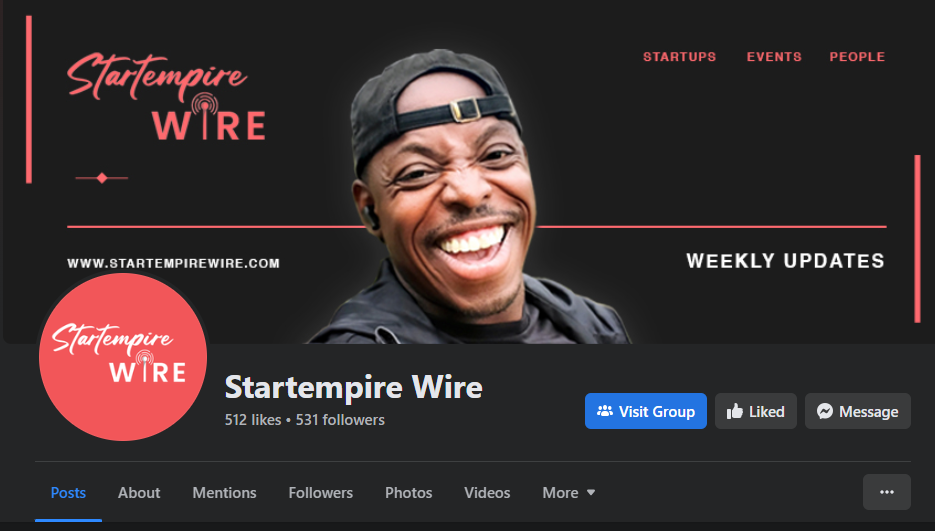
By the way, if you are an Inland Empire business—especially an Inland Empire startup technology business—and you have never heard of Startempire Wire, STOP READING MY POST and go follow Startempire Wire’s Facebook pageNOW. Startempire Wire is THE news source for Inland Empire startup tech information, and is a strong champion of the IE tech community.
So what does Startempire Wire’s Facebook page offer? Posts, photos, weekly videos, and the “Inland Empire Startup Scene” group. All of the content is jam-packed with information.
Facebook pages are essential to these firms’ strategies
Now in some cases the Facebook pages are only part of the online presence for these firms. Both Bredemarket and Startempire Wire have their own web pages, and both firms are also active on other online properties such as LinkedIn. (Bredemarket is almost everywhere, but not on Snapchat.) But Facebook is an essential part of the outreach for all four of these firms, allowing them to reach prospects and clients who are only on Facebook and nowhere else.
Perhaps a Facebook page is a perfect solution for YOUR firm’s online presence.
Let’s talk about content
But creating a Facebook page is not enough.
You need to populate it with content, such as images, videos…and posts.
Now I’m not saying that you HAVE to update your Facebook page daily, but it’s a good idea to add new content at least once a month.
But what if you aren’t a writer, or don’t have time to write? Do you have to resort to ChatGPT?
Heavens no. (I’ll say more about that later.)
Well, online content creation is where Bredemarket comes in. I help firms create blog posts, Facebook posts, LinkedIn articles, case studies, white papers, and other content (22 different types of content at last count).
Does your product (or company) need these 22 content types?
Let me help you populate your Facebook page (or other online content).
Authorize Bredemarket, Ontario California’s content marketing expert, to help your firm produce words that return results.
Companies always strive to obtain some sort of recognition. I tried to do the same for Bredemarket, but my effort got derailed into a common local Inland Empire joke.
Aware’s biometric blog recognition
So what recognition did I want to receive? The same recognition that noted biometric company Aware received in 2020.
The Best Biometrics Blogs from thousands of Biometrics blogs on the web using search and social metrics. Subscribe to these websites because they are actively working to educate, inspire, and empower their readers with frequent updates and high-quality information.
Not that I necessarily consider myself equal to Aware or some of the other noted companies on the current list, but as the self-acknowledged identity/biometric blog expert, with hundreds of identity posts over the last three years, I figured I had a shot of making the list. The benefit to me, of course, is that if I made the list, I had a better chance of securing identity blog post writing clients and other clients.
So far I haven’t made the biometric blogs list.
But I did make another list.
Which is somewhat problematic.
Ontario blogs? True.
You see, earlier this morning I received an email that stated the following.
I would like to personally congratulate you as your blog Bredemarket Blog has been selected by our panelist as one of the Top 45 Ontario Bloggers on the web.
I personally give you a high-five and want to thank you for your contribution to this world. This is the most comprehensive list of Top 45 Ontario Bloggers on the internet and I’m honored to have you as part of this!
We’d be grateful if you can help us spread the word by briefly mentioning about the Top 45 Ontario Bloggers list in any of your upcoming post.
Yup. The people who created the feed think that I’m in CANADA.
But if you think my listing is messed up, take a look at the number 1 listing, for the official news site for the Government of Ontario. This IS a Canadian website, as evidenced by its URL of https://news.ontario.ca/newsroom/en, and the fact that it discusses people like Doug Ford. But take a real close look at the logo at the left of the listing.
And our websites down here don’t offer French as one of the two main languages.
If you live in Canada, don’t read this section
But at least the Bredemarket blog is listed SOMEWHERE, because I help a lot of U.S. companies (sorry, no Canadian companies) create the words they need to drive awareness and eventually revenue. Services such as the Bredemarket 400 Short Writing Service let Bredemarket collaborate with you to create the text your firm needs.
If you are reading this on your laptop (or your desktop), point your smartphone to the QR code on your laptop (or desktop) screen to read my first e-book, “Six Questions Your Content Creator Should Ask You.”
(UPDATE OCTOBER 22, 2023: “SIX QUESTIONS YOUR CONTENT CREATOR SHOULD ASK YOU IS SO 2022. DOWNLOAD THE NEWER “SEVEN QUESTIONS YOUR CONTENT CREATOR SHOULD ASK YOU” HERE.)
As I said before, QR codes are sometimes useful, and sometimes not.
If you want to know the “why” about the e-book-see what I did there?-visit my announcement of the e-book. You can view the e-book there also.
By the way, I just checked my WordPress stats. Since this e-book was published in December 2022, it’s been downloaded over 160 times. I hope it’s helping people.
We often use the phrase “four-letter word” to refer to cuss words that shouldn’t be said in polite company. Occasionally, we have our own words that we personally consider to be four-letter words. (Such as “BIPA.”)
There are some times when we resign ourselves to the fact that “tech” can be a four-letter word also. But there’s actually a good reason for the problems we have with today’s technology.
Tech can be dim
Just this week I was doing something on my smartphone and my screen got really dim all of a sudden, with no explanation.
So I went to my phone’s settings, and my brightness setting was down at the lowest level.
For no reason.
“Any sufficiently advanced technology is indistinguishable from magic.”
So I increased my screen’s brightness, and everything was back to normal. Or so I thought.
A little while later, my screen got dim again, so I went to the brightness setting…and was told that my brightness was very high. (Could have fooled me.)
I can’t remember what I did next (because when you are trying to fix something you can NEVER remember what you did next), but later my screen brightness was fine.
Was Arthur C. Clarke right? And if so, WHY was he right?
Perhaps it’s selective memory, but I don’t recall having this many technology problems when I was younger.
The shift to multi-purpose devices
Part of the reason for the increasing complexity of technology is that we make fewer and fewer single-purpose devices, and are manufacturing more and more multi-purpose devices.
One example of the shift: if I want to write a letter today, I can write it on my smartphone. (Assuming the screen is bright enough.) This same smartphone can perform my banking activities, play games, keep track of Bredemarket’s earnings…oh, and make phone calls.
Technological convergence is a term that describes bringing previously unrelated technologies together, often in a single device. Smartphones might be the best possible example of such a convergence. Prior to the widespread adoption of smartphones, consumers generally relied on a collection of single-purpose devices. Some of these devices included telephones, wrist watches, digital cameras and global positioning system (GPS) navigators. Today, even low-end smartphones combine the functionality of all these separate devices, easily replacing them in a single device.
From a consumer perspective, technological convergence is often synonymous with innovation.
And the smartphone example certainly demonstrates innovation from the previous-generation single-purpose devices.
When I was a kid, if I wanted to write a letter, I had two choices:
I could set a piece of paper on the table and write the letter with a writing implement such as a pen or pencil.
I could roll a piece of paper into a typewriter and type the letter.
These were, for the most part, single purpose devices. Sure I could make a paper airplane out of the piece of paper, but I couldn’t use the typewriter to play a game or make a phone call.
Turning our attention to the typewriter, it certainly was a manufacturing marvel, and intricate precision was required to design the hammers that would hit the typewritter ribbon and leave their impressions on the piece of paper. And typewriters could break, and repairmen (back then they were mostly men) could fix them.
A smartphone is much more innovative than a smartphone. But it’s infinitely harder to figure out what is wrong with a smartphone.
The smartphone hardware alone is incredibly complex, with components from a multitude of manufacturers. Add the complexities of the operating system and all the different types of software that are loaded on a smartphone, and a single problem could result from a myriad of causes.
No wonder it seems like magic, even for the best of us.
Explaining technology
But this complexity has provided a number of jobs:
The helpful person at your cellular service provider who has acquired just enough information to recognize and fix an errant application.
The many people in call centers (the legitimate call centers, not the “we found a problem with your Windows computer” call scammers) who perform the same tasks at a distance.
All the people who write instructions on how to use and fix all of our multi-purpose devices, from smartphones to computers to remote controls.
Oh, and the people that somehow have to succinctly explain to prospects why these multi-purpose devices are so great.
Because no one’s going to run into problems with technology unless they acquire the technology. And your firm has to get them to acquire your technology.
Crafting a technology marketing piece
So your firm’s marketer or writer has to craft some type of content that will make a prospect aware of your technology, and/or induce the prospect to consider purchasing the technology, and/or ideally convert the prospect into a paying customer.
Before your marketer or writer crafts the content, they have to answer some basic questions.
Using a very simple single-purpose example of a hammer, here are the questions with explanations:
Why does the prospect need this technology? And why do you provide this technology? This rationale for why you are in business, and why your product exists, will help you make the sale. Does your prospect want to buy a hammer from a company that got tired of manufacturing plastic drink stirrers, or do they want to buy a hammer from a forester who wants to empower people to build useful items?
How does your firm provide this technology? If I want to insert a nail into a piece of wood, do I need to attach your device to an automobile or an aircraft carrier? No, the hammer will fit in your hand. (Assuming you have hands.)
What is the technology? Notice that the “why” and “how” questions come before the “what” question, because “why” and “how” are more critical. But you still have to explain what the technology is (with the caveat I mention below). Perhaps some of your prospects have no idea what a hammer is. Don’t assume they already know.
What is the goal of the technology? Does a hammer help you floss your teeth? No, it puts nails into wood.
What are the benefitsof the technology? When I previously said that you should explain what the technology is, most prospects aren’t looking for detailed schematics. They primarily care about what the technology will do for them. For example, that hammer can keep their wooden structure from falling down. They don’t care about the exact composition of the metal in the hammer head.
Finally, who is the target audience for the technology? I don’t want to read through an entire marketing blurb and order a basic hammer, only to discover later that the product won’t help me keep two diamonds together but is really intended for wood. So don’t send an email to jewelers about your hammer. They have their own tools.
(UPDATE OCTOBER 23, 2023: “SIX QUESTIONS YOUR CONTENT CREATOR SHOULD ASK YOU IS SO 2022. DOWNLOAD THE NEWER “SEVEN QUESTIONS YOUR CONTENT CREATOR SHOULD ASK YOU” HERE.)
Once you answer these questions (more about the six questions in the Bredemarket e-book available here), your marketer or writer can craft your content.
Or, if you need help, Bredemarket (the technology content marketing expert) can craft your content, whether it’s a blog post, case study, white paper, or something else.
I’ve helped other technology firms explain their “hammers” to their target audiences, explaining the benefits, and answering the essential “why” questions about the hammers.
Can I help your technology firm communicate your message? Contact me.
I can’t share work samples that I created for Bredemarket clients, because they are ghostwritten “works for hire” that are not publicly attributed to Bredemarket.
(For the same reason, I can’t share most work samples that I created for my previous employers.)
But I CAN share work samples that I created for…Bredemarket.
The video containing this image can be found on various Bredemarket properties.
Actually, you can search through the entire Bredemarket website and social media outlets and find them.
Or you can just watch the video below, which summarizes everything.
























 Bredemarket