I am repurposing my recent e-book “Seven Questions Your Content Creator Should Ask You” as a post series on the Bredemarket Instagram account. I am doing this because series are cool and stuff. Whether or not my readers are anticipating each new post in the series is up for debate. Maybe all of them have read the e-book already. (Or maybe not.)
Monday’s Instagram post on the goal of your content
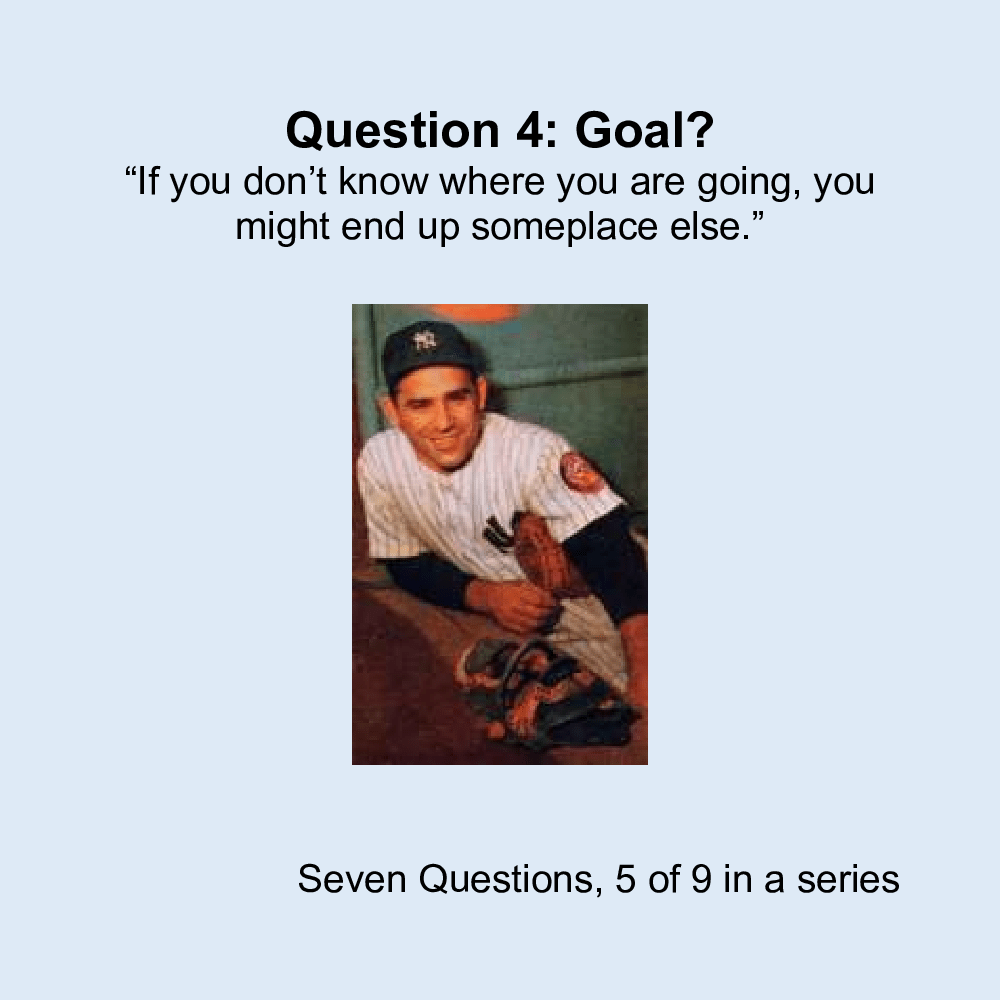
Anyway, on Monday I got to the fifth post in the Instagram series. Here’s what the post image looks like. (The Yogi Berra-themed image is timely with baseball’s World Series going on right now, even though the Yankees are nowhere near it.)
And here’s the text that accompanied the Instagram post:
The fourth of the seven questions your content creator should ask you is Goal? It’s important that you set a goal. Maybe awareness. Maybe consideration. Maybe conversion. Maybe something else. As Yogi Berra reportedly said, “if you don’t know where you are going, you might end up someplace else.” And that “someplace else” might not be where you want to be. #bredemarket7questions#contentmarketing#contentmarketingexpert#goal#goals
Well, as long as I had created the post series for Instagram, I figured I’d share the same series on two other Bredemarket social channels, one of which was the Bredemarket LinkedIn page.
You can express a single thought on multiple channels. And as far as I’m concerned, the more the merrier.
Me on “expert” advice on social media channel adoption
Incidentally, that’s why I object to the “expert” advice that I master one social media channel first before branching out into others.
If I adopt that strategy and ONLY market on LinkedIn and ignore Instagram and TikTok, I am automatically GUARANTEEING that the potential Instagram and TikTok audiences will never hear about my offer.
“How I Expanded 1 Idea into 31 Pieces of Content”
I’ve expressed my thoughts on this social media “expert” advice before:
The latter post, entitled “How I Expanded 1 Idea into 31 Pieces of Content,” described how…well, the title is pretty self-explanatory. I created 31 pieces of content based on a single idea.
The 31 pieces of content, published both through the Bredemarket channels (see above) and via my personal channels (including my jebredcal blog and my LinkedIn page), all increased the chance that SOMEONE would see the underlying message: “Your prospects don’t care about your technology.” Each piece of content was tuned for the particular channel and its target audience, ensuring that the message would resonate.
Speaking of repurposing, I’ve already adapted the words above and published them in four different ways (this is the fourth)…and counting. No TikTok video yet though.
Can Bredemarket help you repurpose or create content?
And if I can do this for me, I can do this for you.
Bredemarket can help you create content that converts prospects and drives content results. Why?
If you’re sold on using Bredemarket to create customer-focused messaging (remember: your prospects don’t care about your technology), or even if you’re not and just want to talk about your needs, there are three ways to move forward with your content project. Or you can just join the Bredemarket mailing list to stay informed.
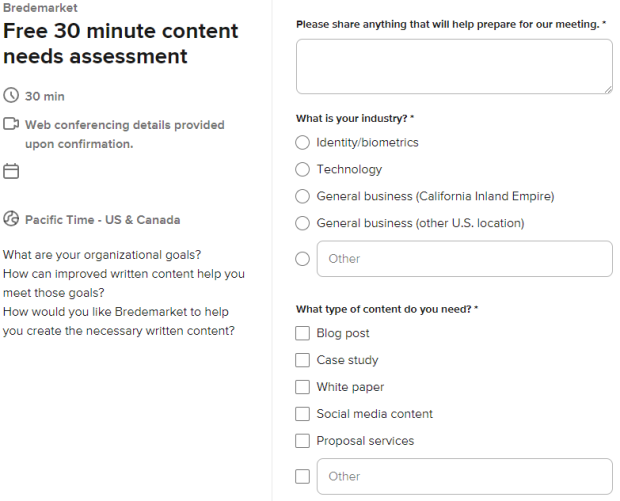
Book a meeting with me at calendly.com/bredemarket. Be sure to fill out the information form so I can best help you.
If you’re familiar with Bredemarket’s “six questions your content creator should ask you”…I came up with a seventh question because I feared the six questions were not enough, and I wanted to provide you with better confidence that Bredemarket-authored content will achieve your goals.
To no one’s surprise, I’ll tell you WHY and HOW I added a seventh question.
If you want to skip to the meat, go to the WHAT section where you can download the new e-book.
Why?
Early Sunday morning I wrote something on LinkedIn and Facebook that dealt with three “e” words: entertainment, emotion, and engagement, and how the first and second words affect the third. The content was very long, and I don’t know if the content itself was engaging. But I figured that this wasn’t the end of the story:
I know THIS content won’t receive 250 engagements, and certainly won’t receive 25,000 impressions, but maybe I can repurpose the thoughts in some future content. (#Repurposing is good.)
Rather than delving into my content with over 25,000 impressions but less than 250 engagements, and rather than delving into the social media group I discussed, and rather than delving into the Four Tops and the Sons of the Pioneers (not as a single supergroup), I decided that I needed to delve into a single word: indifference, and how to prevent content indifference.
Because if your prospects are indifferent to your content, nothing else matters. And indifference saddens me.
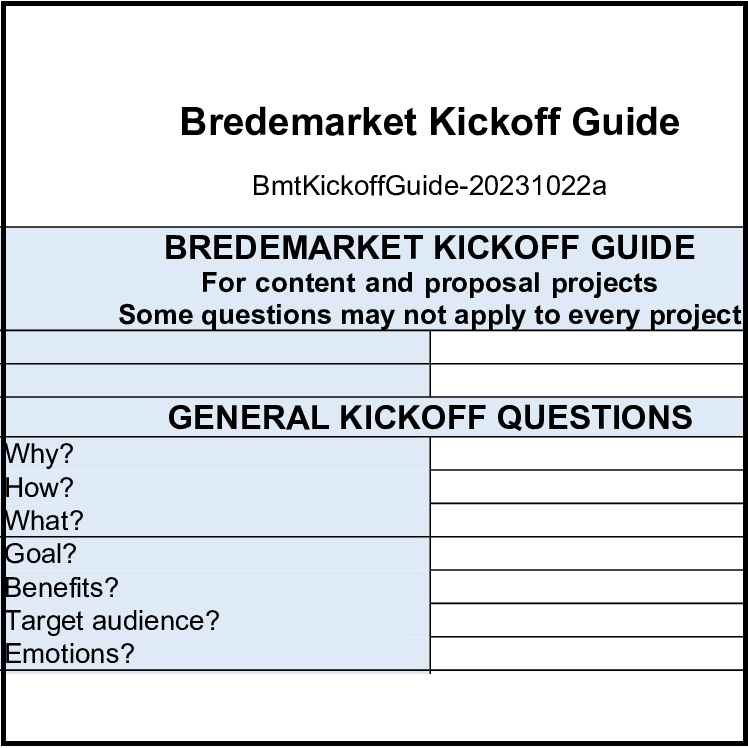
The first questions in the Bredemarket Kickoff Guide, BmtKickoffGuide-20231022a. No, you can’t have the guide; it’s proprietary.
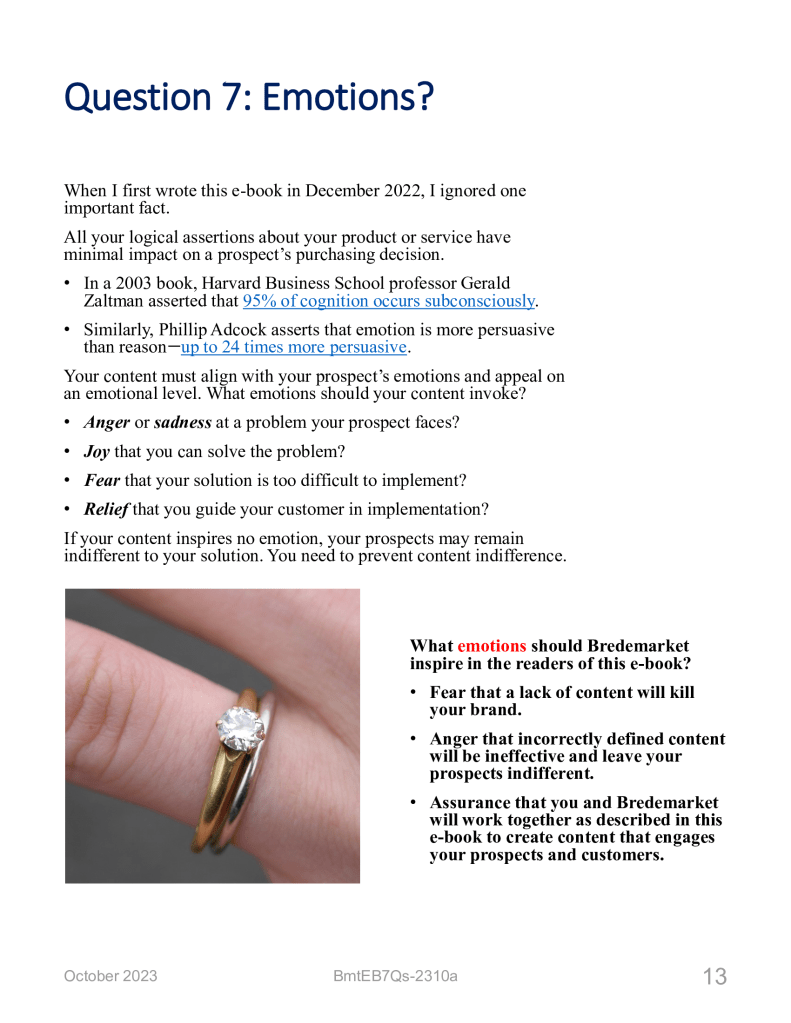
I decided that I needed to update my process, as well as that e-book, and add a seventh question, “Emotions?”
What?
For those who have raced ahead to this section, Bredemarket has a new downloadable e-book (revised from an earlier version) entitled “Seven Questions Your Content Creator Should Ask You.” It includes a new page, “Emotions,” as well as minor revisions to the other pages. You can download it below.
All too often, Bredemarket confines its writing discussions to the traditional ABCW (articles, blog posts, case studies, white papers) categories.
But what if your content needs are non-traditional and fall outside of the usual nice neat business writing categories?
From the 2023 Route 66 Cruisin’ Reunion, Saturday, September 16, 2023.
If you are an Inland Empire business who needs words, but not in the traditional “ABCW” (articles, blog posts, case studies, white papers) business types, Bredemarket will help you with your non-traditional writing needs.
Take a look at the examples I’ve provided below, and if these spark interest within you, authorize Bredemarket, Ontario California’s content marketing expert, to help your firm produce words that return results.
Book a meeting with me at calendly.com/bredemarket. Be sure to fill out the information form so I can best help you. For example, if you’re an Inland Empire business requiring non-traditional content, fill out the form accordingly.
I won’t go into all 22 types again, especially since some of them are internal content rather than customer-facing content. But I’d like to highlight the “ABCW” four types that I mentioned at the beginning of this blog post, plus a couple of others.
Articles and blog posts
I’m lumping articles and blog posts together, because while some “experts” try to draw hard-and-fast distinctions between the two, they’re pretty much the same thing.
Whether it’s a blog post on your website, a post or article on LinkedIn, or even some extended text associated with an Instagram picture or a TikTok video, what you’re creating is some text that entertains, persuades, inspires, or educates your reader, or perhaps all four. You set the goal for the article or blog post, then tailor the content to meet the goal. (I’ll talk more about goals later.)
Case studies
From “How Bredemarket Can Help You Win Business,” available via this post.
Case studies show your readers how your solution was applied to someone else’s problem, and how your solution can benefit your prospects with similar problems.
Maybe your prospect is a city police agency that needs a tool to solve crimes, and your case study describes how your solution solved crimes in a similar city. Again, you set the goal for the case study, then tailor the content to meet the goal.
White papers
On the surface, white papers are informational, but when a company issues a white paper, the “information” that the white paper provides should gently guide the reader toward doing business with the company that issued the paper. Using the example above, you could write a white paper that outlines “Five Critical Elements for a Local Crime-Solving Solution.” By remarkable coincidence, your own solution happens to include all five of those critical elements. Again, you set the goal and tailor the content.
Briefs, data sheets, and literature sheets
One-page sheet for the Bredemarket 400 Short Writing Service. More information here.
Perhaps you need to provide handouts to your prospects that describe your product or service.
Regardless of whether you call these handouts briefs, data, sheets, literature sheets, or something else, they should at a minimum contain both “educate” and “persuade” elements—educate your prospects on the benefits of your product or service, and persuade your prospects to move closer to a sale (conversion).
Again, you set the goal and tailor the content.
Web page content
If your business has a web page, I hope that it has more words than “Under construction.” Whether you have imagery, video, audio, text, or all four on your web page, it needs to answer the questions that your prospects and customers have.
You know what I’m going to say here, but it’s still important. You set the goal and tailor the content.
But…what if your business needs content that doesn’t fall into these traditional business categories?
Non-traditional content: going to a car show
I went to a car show this weekend—specifically, this year’s Route 66 Cruisin’ Reunion in downtown Ontario, California. (Yes, I know that Route 66 actually passed three miles north of downtown Ontario, but work with me here.)
While some of the exhibitors were personal, some of them were businesses. As businesses, what was the major marketing collateral that they generated?
Not a blog post, or LinkedIn article, or any of the traditional business media collateral.
In addition to the car itself, this exhibitor included poster boards with words describing the car.
Another exhibitor did the same thing.
So while these car show exhibitors didn’t choose a traditional way to convey their words, they shared written text anyway.
Your non-traditional business communication needs
Maybe you don’t have a classic car. Maybe you don’t have a car at all. Do you need to share words with your prospects and customers anyway?
Now I don’t know your business communication needs. You do. But I can guess a few things.
Do you need to tell your clients/potential clients why you do what you do?
Do you need to tell them how you do it?
And last but not least, do you need to tell them what you do?
I know that this may seem like an unusual order to you. Why not start with what you do?
Because your customers don’t care about what you do. Your customers care about themselves.
If you keep the focus on your customers, the answer to the “why” question will induce your customers to care about you, because it shows how you can solve their problems.
Let’s illustrate this.
Why and how Bredemarket creates non-traditional content
You may be asking why I create content in the first place. There are countless content creators, both human and non-human. Why turn to me when OpenAI and its bot buddies are a lot cheaper and faster?
Normally I include my recent professional picture, but I have been writing since my college days (on a typewriter back then).
Bredemarket’s service is independent of content type. I don’t have a “Bredemarket blog writing service” or “Bredemarket data sheet writing service” or “Bredemarket case study writing service.” My services are based on word length, not content type, with my most popular service targeted to customers who need between 400 and 600 words of text. From this perspective, I don’t care if you want the words to appear on your website or your social media channel or a paper flyer or a sign next to your car or a really really long banner towed behind an airplane. (Read about the Bredemarket 400 Short Writing Service here.)
Before I write a thing, I ask your some questions. It won’t surprise you to learn that my first questions to you are why, how, and what. I then move on to questions about your goal for the content, the benefits of your solution, the target audience for your solution, and many additional questions. (Read about the Six Questions Your Content Creator Should Ask You here.)
Once the questions are out of the way, content creation is collaborative and iterative. I create a draft, you review it, and we repeat. The Bredemarket 400 service includes two review cycles; longer content needs include three review cycles. The goal is to ensure that both of us are happy with the final product.
Bredemarket’s process applies regardless of the specific content type, so I should be able to support whatever content you need, whether it’s traditional or non-traditional.
From the 2022 Cruisin’ Reunion in Ontario, California. The 2023 edition takes place this weekend.
(Updated blog post count 10/23/2023)
There are many ways for Inland Empire firms to raise awareness about their offerings. For certain firms, blogging provides quantifiable benefits. Can your firm take advantage of blogging’s fresh immediacy?
In most cases, I can provide your blog post via my standard package, the Bredemarket 400 Short Writing Service. I offer other packages and options if you have special needs.
Get in touch
Authorize Bredemarket, Ontario California’s content marketing expert, to help your firm produce words that return results.
Identity and biometrics firms can achieve quantifiable benefits with prospects by blogging. Over 40 identity and biometrics firms are already blogging. Is yours?
These firms (and probably many more) already recognize the value of identity blog post writing, and some of them are blogging frequently to get valuable content to their prospects and customers.
Is your firm on the list? If so, how frequently do you update your blog?
In most cases, I can provide your blog post via my standard package, the Bredemarket 400 Short Writing Service. I offer other packages and options if you have special needs.
Get in touch with Bredemarket
Authorize Bredemarket, Ontario California’s content marketing expert, to help your firm produce words that return results.
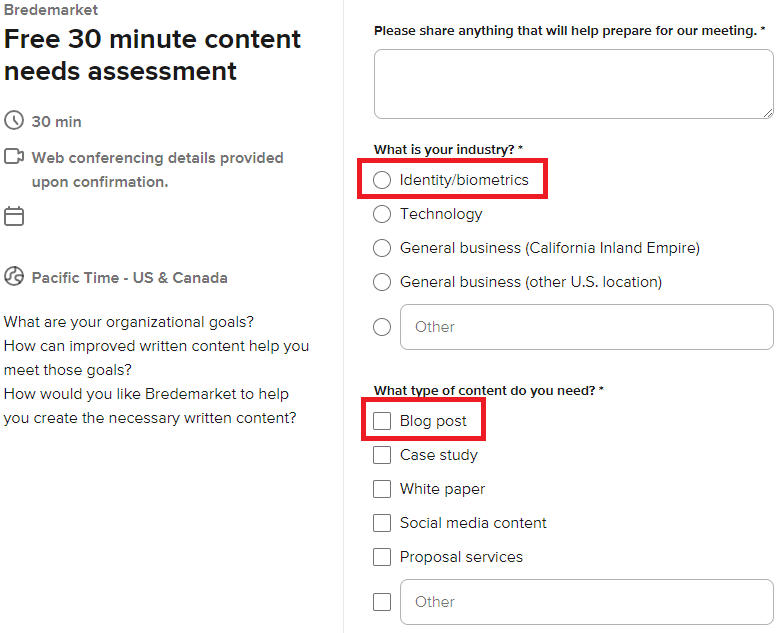
To discuss your identity/biometrics blog post needs further,book a meeting with me at calendly.com/bredemarket. On the questionnaire, select the Identity/biometrics industry and Blog post content.
Always take advantage of your competitors’ weaknesses.
This post describes an easy way to take advantage of your competitors. If they’re not blogging, make sure your firm is blogging. And the post provides hard numbers that demonstrate why your firm should be blogging.
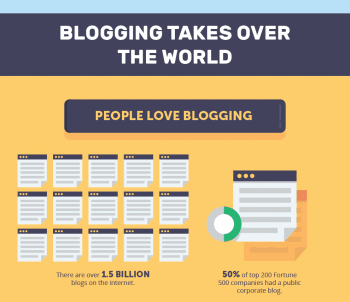
Which means that half of those companies don’t have a public corporate blog.
The same infographic also revealed the following:
86% of B2B companies are blogging. (Or, 14% are not.)
68% of social media marketers use blogs in their social media strategy. (Or, 32% don’t.)
45% of marketers saying blogging is the #1 most important piece of their content strategy.
Small businesses under 10 employees allocate 42% of their marketing budget to content marketing.
So obviously some firms believe blogging is important, while others don’t.
What difference does this make for your firm?
What results do blogging companies receive?
In my view, the figures above are way too low. 100% of all Fortune 500 companies, 100% of B2B companies should be blogging, and 100% of social media marketers should incorporate blogging.
Getting leads from blogging is nice, but show me the money! What about conversions?
Marketers who have prioritized blogging are 13x more likely to enjoy positive ROI.
92% of companies who blog multiple times per day have acquired a customer from their blog.
Take a look at those last two bullets related to conversion again. Blogging is correlated with positive ROI (I won’t claim causation, but anecdotally I believe it), and blogging helps firms acquire customers. So if your firm wants to make money, get blogging.
What should YOUR company do?
With numbers like this, shouldn’t all companies be blogging?
But don’t share these facts with your competitors. Keep them to yourself so that you gain a competitive advantage over them.
Now you just need to write those blog posts.
How can I help?
And if you need help with the actual writing, I, John E Bredehoft of Bredemarket, can help.
And if you’re not in the identity/biometric industry, my general content marketing expertise also applies to technology firms and general business firms.
In most cases, I can provide your blog post via my standard package, the Bredemarket 400 Short Writing Service. I offer other packages and options if you have special needs.
Authorize Bredemarket, Ontario California’s content marketing expert, to help your firm produce words that return results.










 Bredemarket