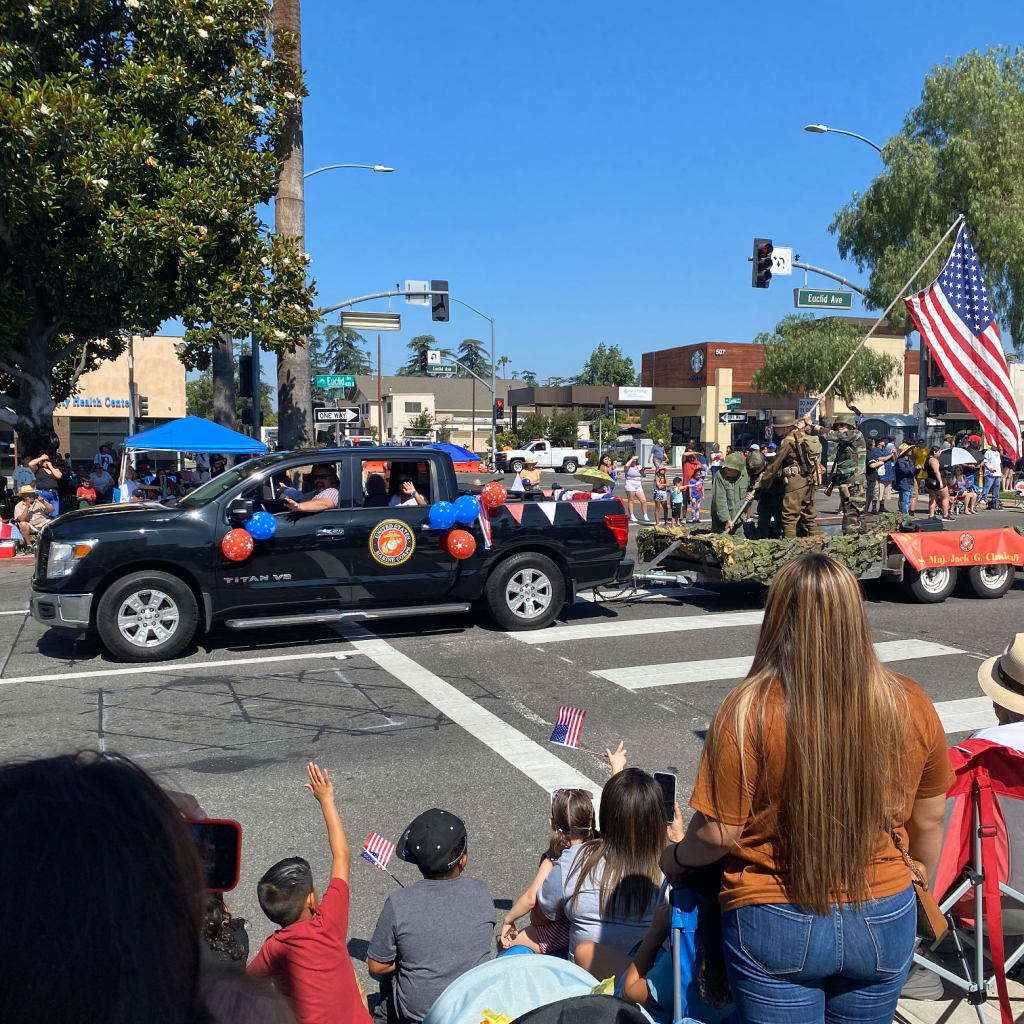
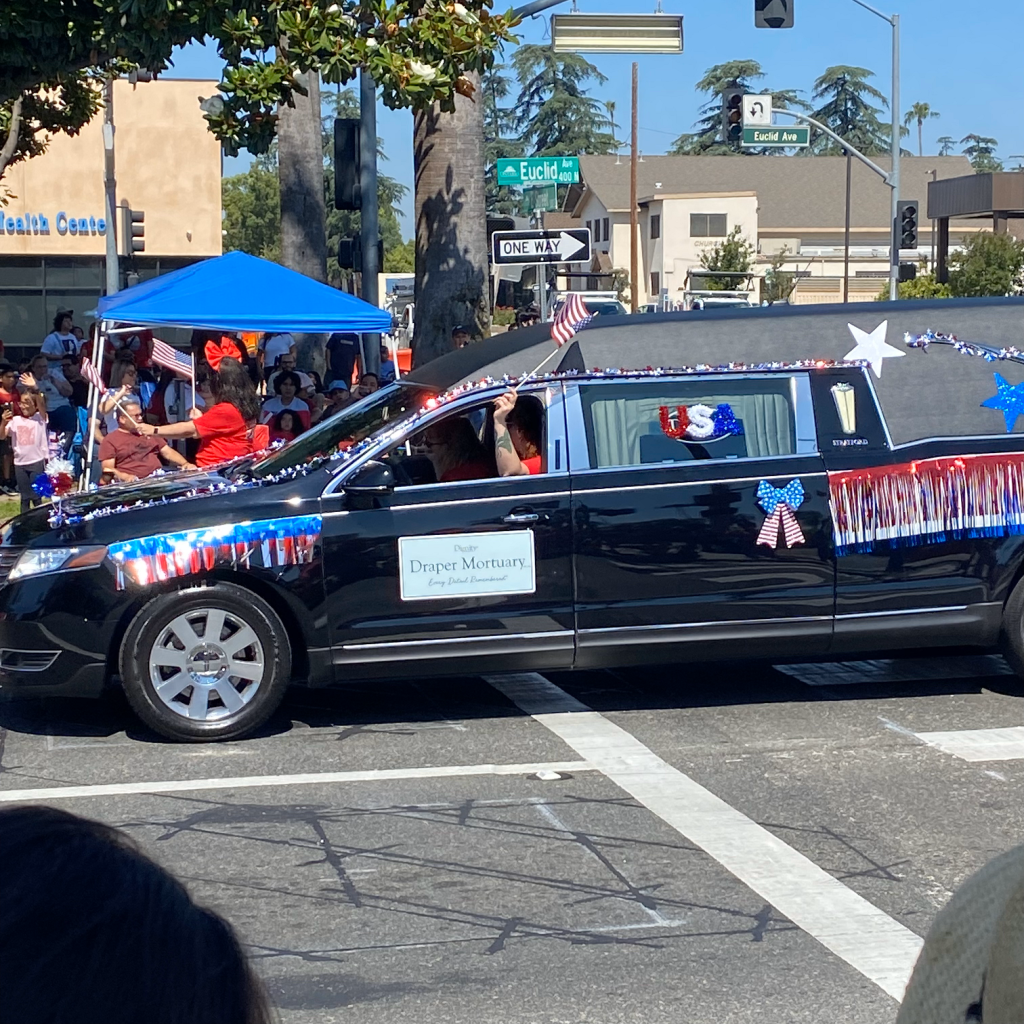
I know a lot of people who write today’s date as 4/7. In other words, they do not live in the United States. Most of these people have never experienced a U.S. July 4 celebration, and this post is a convenient way to share a 4th of July parade with them.
There are a lot of businesspeople in California’s Inland Empire. They write the date as 7/4, and these businesspeople need to communicate with their prospects and clients. If Bredemarket can’t fulfill their videography needs, then what the heck CAN Bredemarket do for them? A lot, as I’ll explain at the end of this post.
But first let’s look at some parade videos and pictures.
The Chaffey High School marching band. To ensure that I didn’t violate copyright restrictions on various social media platforms, I made sure to create this video when the band was NOT playing its long-standing theme song, “Eye of the Tiger.” From https://www.youtube.com/watch?v=eoLiObu_l04
Obviously this is not a complete document of today’s parade, which had well over 50 participating entries. There were a few notable omissions:
Horses. Sorry for not capturing any horse videos or pictures this year.
Twirlers. The girls (and at least one guy) who were twirling were exceptionally good.
Itty bitty cars. I didn’t see the Shriners this year, but there were at least a couple of participants who drove itty bitty cars around.
Those danged bagpipes. Locals know who I’m talking about. I lived near Upland High School for a few years, and was “blessed” to hear them practice early on some mornings. Jeff Pope, they’re yours.
But at least the videos and pictures that I DID take give you a little bit of a taste of what a U.S. July 4th is like.
IE businesses are now wondering what Bredemarket CAN do for them
My European friends can tune out here. This next part is addressed to local businesses.
Specifically, I’m talking to local businesses who need to communicate to their prospects and clients, and therefore have a need for written content that inspires your prospects to find out more about your products and services, and hopefully purchase those products and services.
But before you create that written content yourself, or have someone (such as Bredemarket’s John E. Bredehoft) work with you to create the content, you need to make sure you create the right written content.
Click below to find out how to create the right written content.
I’ll admit that I previously thought that age estimation was worthless, but I’ve since changed my mind about the necessity for it. Which is a good thing, because the U.S. National Institute of Standards and Technology (NIST) is about to add age estimation to its Face Recognition Vendor Test suite.
What is age estimation?
Before continuing, I should note that age estimation is not a way to identify people, but a way to classify people. For once, I’m stepping out of my preferred identity environment and looking at a classification question. Not “gender shades,” but “get off my lawn” (or my tricycle).
Age estimation uses facial features to estimate how old a person is, in the absence of any other information such as a birth certificate. In a Yoti white paper that I’ll discuss in a minute, the Western world has two primary use cases for age estimation:
First, to estimate whether a person is over or under the age of 18 years. In many Western countries, the age of 18 is a significant age that grants many privileges. In my own state of California, you have to be 18 years old to vote, join the military without parental consent, marry (and legally have sex), get a tattoo, play the lottery, enter into binding contracts, sue or be sued, or take on a number of other responsibilities. Therefore, there is a pressing interest to know whether the person at the U.S. Army Recruiting Center, a tattoo parlor, or the lottery window is entitled to use the service.
Second, to estimate whether a person is over or under the age of 13 years. Although age 13 is not as great a milestone as age 18, this is usually the age at which social media companies allow people to open accounts. Thus the social media companies and other companies that cater to teens have a pressing interest to know the teen’s age.
Why was I against age estimation?
Because I felt it was better to know an age, rather than estimate it.
My opinion was obviously influenced by my professional background. When IDEMIA was formed in 2017, I became part of a company that produced government-issued driver’s licenses for the majority of states in the United States. (OK, MorphoTrak was previously contracted to produce driver’s licenses for North Carolina, but…that didn’t last.)
With a driver’s license, you know the age of the person and don’t have to estimate anything.
And estimation is not an exact science. Here’s what Yoti’s March 2023 white paper says about age estimation accuracy:
Our True Positive Rate (TPR) for 13-17 year olds being correctly estimated as under 25 is 99.93% and there is no discernible bias across gender or skin tone. The TPRs for female and male 13-17 year olds are 99.90% and 99.94% respectively. The TPRs for skin tone 1, 2 and 3 are 99.93%, 99.89% and 99.92% respectively. This gives regulators globally a very high level of confidence that children will not be able to access adult content.
Our TPR for 6-11 year olds being correctly estimated as under 13 is 98.35%. The TPRs for female and male 6-11 year olds are 98.00% and 98.71% respectively. The TPRs for skin tone 1, 2 and 3 are 97.88%, 99.24% and 98.18% respectively so there is no material bias in this age group either.
Yoti’s facial age estimation is performed by a ‘neural network’, trained to be able to estimate human age by analysing a person’s face. Our technology is accurate for 6 to 12 year olds, with a mean absolute error (MAE) of 1.3 years, and of 1.4 years for 13 to 17 year olds. These are the two age ranges regulators focus upon to ensure that under 13s and 18s do not have access to age restricted goods and services.
While this is admirable, is it precise enough to comply with government regulations? Mean absolute errors of over a year don’t mean a hill of beans. By the letter of the law, if you are 17 years and 364 days old and you try to vote, you are breaking the law.
Why did I change my mind?
Over the last couple of months I’ve thought about this a bit more and have experienced a Jim Bakker “I was wrong” moment.
How many 13 year olds do you know that have driver’s licenses? Probably none.
How many 13 year olds do you know that have government-issued REAL IDs? Probably very few.
How many 13 year olds do you know that have passports? Maybe a few more (especially after 9/11), but not that many.
Even at age 18, there is no guarantee that a person will have a government-issued REAL ID.
So how are 18 year olds, or 13 year olds, supposed to prove that they are old enough for services? Carry their birth certificate around?
You’ll note that Yoti didn’t target a use case for 21 year olds. This is partially because Yoti is a UK firm and therefore may not focus on the strict U.S. laws regarding alcohol, tobacco, and casino gambling. But it’s also because it’s much, much more likely that a 21 year old will have a government-issued ID, eliminating the need for age estimation.
Sometimes.
In some parts of the world, no one has government IDs
Over the past several years, I’ve analyzed a variety of identity firms. Earlier this year I took a look at Worldcoin. While Worldcoin’s World ID emphasizes privacy so much that it does not conclusively prove a person’s identity (it only proves a person’s uniqueness), and makes no attempt to provide the age of the person with the World ID, Worldcoin does have something to say about government issued IDs.
Online services often request proof of ID (usually a passport or driver’s license) to comply with Know your Customer (KYC) regulations. In theory, this could be used to deduplicate individuals globally, but it fails in practice for several reasons.
KYC services are simply not inclusive on a global scale; more than 50% of the global population does not have an ID that can be verified digitally.
IDs are issued by states and national governments, with no global system for verification or accountability. Many verification services (i.e. KYC providers) rely on data from credit bureaus that is accumulated over time, hence stale, without the means to verify its authenticity with the issuing authority (i.e. governments), as there are often no APIs available. Fake IDs, as well as real data to create them, are easily available on the black market. Additionally, due to their centralized nature, corruption at the level of the issuing and verification organizations cannot be eliminated.
Same source as above.
Now this (in my opinion) doesn’t make the case for Worldcoin, but it certainly casts some doubt on a universal way to document ages.
So we’d better start measuring the accuracy of age estimation.
If only there were an independent organization that could measure age estimation, in the same way that NIST measures the accuracy of fingerprint, face, and iris identification.
You know where this is going.
How will NIST test age estimation?
Yes, NIST is in the process of incorporating an age estimation test in its battery of Face Recognition Vendor Tests.
Facial age verification has recently been mandated in legislation in a number of jurisdictions. These laws are typically intended to protect minors from various harms by verifying that the individual is above a certain age. Less commonly some applications extend benefits to groups below a certain age. Further use-cases seek only to determine actual age. The mechanism for estimating age is usually not specified in legislation. Face analysis using software is one approach, and is attractive when a photograph is available or can be captured.
In 2014, NIST published a NISTIR 7995 on Performance of Automated Age Estimation. The report showed using a database with 6 million images, the most accurate age estimation algorithm have accurately estimated 67% of the age of a person in the images within five years of their actual age, with a mean absolute error (MAE) of 4.3 years. Since then, more research has dedicated to further improve the accuracy in facial age verification.
Note that this was in 2014. As we have seen above, Yoti asserts a dramatically lower error rate in 2023.
NIST is just ramping up the testing right now, but once it moves forward, it will be possible to compare age estimation accuracy of various algorithms, presumably in multiple scenarios.
Well, for those algorithm providers who choose to participate.
Does your firm need to promote its age estimation solution?
Does your company have an age estimation solution that is superior to all others?
Do you need an experienced identity professional to help you spread the word about your solution?
(UPDATE OCTOBER 23, 2023: “SIX QUESTIONS YOUR CONTENT CREATOR SHOULD ASK YOU IS SO 2022. DOWNLOAD THE NEWER “SEVEN QUESTIONS YOUR CONTENT CREATOR SHOULD ASK YOU” HERE.)
But since you care about YOUR self-promotion rather than mine, I’ll provide three tips for writing and promoting your own LinkedIn post.
How I promoted my content
Before I wrote the blog post or the LinkedIn post, I used my six questions to guide me. For my specific example, here are the questions and the answers.
Question
Primary Answer
Secondary Answer (if applicable)
Why?
I want full-time employment
I want consulting work
How?
State identity and marketing qualifications, ask employers to hire me
State identity and marketing qualifications, ask consulting clients to contract with me
What?
Blog post (jebredcal), promoted by a personal LinkedIn post
Blog post (jebredcal), promoted by a Bredemarket Identity Firm Services LinkedIn post
You’ll notice that I immediately broke a cardinal rule by having both a primary goal and a secondary goal. When you perform your own self-promotion, you will probably want to make things less messy by having only a single goal.
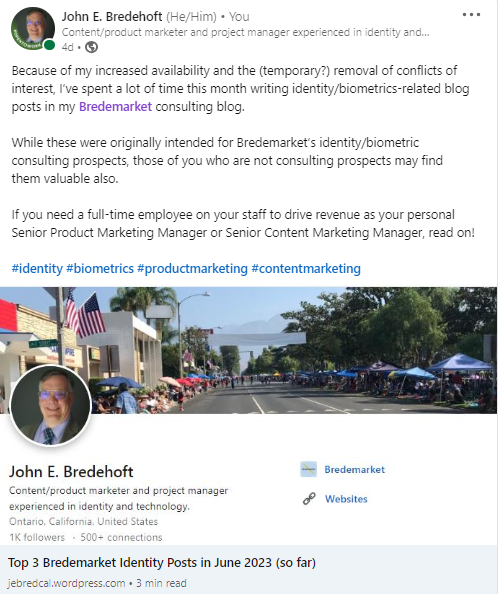
After the introduction (pictured above) with its “If you need a full-time employee” call to action, I then shared three identity-related blog posts from the Bredemarket blog to establish my “biometric content marketing expert” (and “identity content marketing expert”) credentials. I then closed with a dual call to action for employers and potential consulting clients. (I told you it is messy to have two goals.)
If you want to see my jebredcal post “Top 3 Bredemarket Identity Posts in June 2023 (so far),” click here.
So how did I get the word out about this personal blog post? I chose LinkedIn. (In my case, hiring managers probably aren’t going to check my two Instagram accounts.)
It was simple to write the LinkedIn text, since I repurposed the introduction of the blog post itself. I added four hashtags, and then the post went live. You can see it here.
And by the way, feel free to like the LinkedIn post, comment on it, or even reshare it. I’ll explain why below.
Third, the “LinkedIn Love” promotion
So how did I promote it? Via the “LinkedIn Love” concept. (Some of you know where I learned about LinkedIn Love.)
To get LinkedIn love, I asked a few trusted friends in the identity industry to like, comment, or reshare the post. This places the post on my friends’ feeds, where their identity contacts will see it.
A few comments:
I don’t do this for every post, or else I will have no friends. In fact, this is the first time that I’ve employed “LinkedIn Love” in months.
I only asked friends in the identity industry, since these friends have followers who are most likely to hire a Senior Product Marketing Manager or Senior Content Marketing Manager.
I only asked a few friends in the identity industry, although eventually some friends that I didn’t ask ended up engaging with the post anyway.
I have wonderful friends. After several of them gave “LinkedIn Love,” The post received significant engagement. As of Friday morning, the post had acquired over 1,700 impresions. That’s many, many more than my posts usually acquire.
I don’t know if this activity will directly result in full-time employment or increased consulting work. But it certainly won’t hurt.
Three steps to promote YOUR content
But the point of this post isn’t MY job search. It’s YOURS (or whatever it is you want to promote).
For example, one of my friends who is also seeking full-time employment wanted to know how to use a LinkedIn post to promote THEIR OWN job search.
Now you don’t need to use my six questions. You don’t need to create a blog post before creating the LinkedIn post. And you certainly don’t need to create two goals. (Please don’t…unless you want to.)
In fact, you can create and promote your own LinkedIn post in just THREE steps.
Step One: What do you want to say?
My six questions obviously aren’t the only method to collect your thoughts. There are many, many other tools that achieve the same purpose. The important thing is to figure out what you want to say.
Start at the end. What action do you want the reader to take after reading your LinkedIn post? Do you want them to read your LinkedIn profile, or download your resume, or watch your video, or join your mailing list, or email or call you? Whatever it is, make sure your LinkedIn post includes the appropriate “call to action.”
Work on the rest. Now that you know how your post will end, you can work on the rest of the post. Persuade your reader to follow your call to action. Explain how you will benefit them. Address the post to the reader, your customer (for example, a potential employer), and adopt a customer focus.
Step Two: Say it.
If you don’t want to write the post yourself, then ask a consultant, a friend, or even a generative AI tool to write something for you. (Just because I’m a “get off my lawn” guy regarding generative AI doesn’t mean that you have to be.)
(And before you ask, there are better consultants than Bredemarket for THIS writing job. My services are designed and priced for businesses, not individuals.)
After your post is written by you or someone (or something) else, have one of your trusted friends review it and see if the written words truly reflect how amazing and outstanding you are.
Once you’re ready, post it to LinkedIn. Don’t delay, even if it isn’t perfect. (Heaven knows this blog post isn’t perfect, but I posted it anyway.) Remember that if you don’t post your promotional LinkedIn post, you are guaranteed to get a 0% response to it.
Step Three: Promote it.
Your trusted friends will come in handy for the promotion part—if they have LinkedIn accounts. Privately ask your trusted friends to apply “LinkedIn Love” to your post in the same way that my trusted friends did it for me.
By the way—if I know you, and you’d like me to promote your LinkedIn post, contact me via LinkedIn (or one of the avenues on the Bredemarket contact page) and I’ll do what I can.
And even if I DON’T know you, I can promote it anyway.
I’ve never met Mary Smith in my life, but she says that she read my Bredemarket blog post “Applying the “Six Questions” to LinkedIn Self-promotion.” Because she selects such high-quality reading material, I’m resharing Mary’s post about how she wants to be the first human to visit Venus. If you can help her realize her dream, scroll to the bottom of her post and donate to her GoFundMe.
Hey, whatever it takes to get the word out.
Let me know if you use my tips…or if you have better ways to achieve the same purpose.
As some of you know, I’m applying for full-time employment. Every one of my cover letters has a variation on this sentence.
I am in Southern California, five miles from Ontario International Airport, and can easily travel throughout the United States or to other countries as needed.
You will note that I explicitly state that Ontario International Airport is in Southern California, not Canada. Although the phrase “Ontario CA” can be interpreted as referring to the city in the state of California, or the province in the country of Canada, depending upon how you look at it.
Not that anybody pays attention to my explicit California reference. When I was sharing pictures from the February 18 Ontario Art Walk, and labeling the pictures as originating from Ontario, California, I was still asked to promote one of the pictures on a Canadian Instagram page.
The curse that we endure in the town of the Chaffeys. I bet Mildura doesn’t have this problem.
While Ontario International Airport is not the only airport in the Inland Empire, it is (at present) the largest one, and thus has a dramatic effect on those of us who live here.
One impact? Well, in the same way that I can board a flight from ONT to my future employer in San Francisco or Austin or Paris or wherever, visitors can board flights to ONT.
And some of those visitors are business visitors. Years ago, I was one of them, flying from Portland, Oregon to some town I had never heard of before for a job interview. Not only did I fly into the airport (Terminal 1 in those days), but I also stayed at the Red Lion Inn and spent other money while I was in town for the interview.
Ontario International Airport Terminal 1 as of September 2021, 20 years after airport traffic changed forever.
Postscript: I got the job. And other jobs after that.
The economists assign a monetary impact to the activity attributable to the airport.
The impact of economic activity taking place at Ontario International Airport itself, including the activity of the airport authority, airlines and their suppliers, government workers, airport concessions, and logistics companies is estimated at $3.8 billion in 2022. This will support $2.2 billion in GDP and 27,800 jobs. The bulk of these impacts—71% of the GDP impacts and 76% of the jobs impacts— reflect the impact of visitor spending in the region.
But don’t forget the government, which gets its own goodies.
This $2.2 billion of local economic activity (GDP) will result in a total of $571 million in tax impact. This consists of $319 million in federal tax impacts and $253 million in state and local impacts. As with the GDP impacts, the majority (71%) of these tax impacts are driven by the spending of visitors to the region.
And this doesn’t count the impact of the Inland Empire’s logistics industry.
The total economic impact of the logistics activity in the eight zip codes adjacent to Ontario International Airport was $17.8 billion of economic output, $9.9 billion of GDP, and 122,200 jobs. This activity generated $2.3 billion in federal, state, and local taxes.
But what of non-monetary impacts? As the description of the Ontario International Airport – Inter Agency Collaborative (ONT-IAC) makes clear, some of those impacts are negative.
The ONT-IAC implements the policies and criteria of the Airport Land Use Compatibility Plan (ALUCP) to prevent future incompatible land uses surrounding ONT and minimizing the public’s exposure to excessivie noise and safety hazards.
There’s always a balancing act between positive and negative impacts. While I might appreciate the ability to board a flight to Dallas at 6:00 in the morning, someone who lives near the airport may not be as appreciative. And the referenced “incompatible land uses” restrict the types of businesses that can be located near the airport.
While the Amazon LGB3 warehouse in Eastvale, California is some distance from Ontario International Airport, the airport’s presence has a positive impact on the warehouse and its workers.
But the relatively large amount of open space near the airport (again, our beloved warehouses) has helped to ensure that ONT does not need to implement the severe flight restrictions found at John Wayne and our former airport overlord Los Angeles International Airport.
And for better or worse the airport will remain for some time. It’s not like it’s going to close down or anything.
Although 9/11, the 2008 recession, and COVID tried to close it.
And one more thing about your business…
Does your firm need to create content for Inland Empire residents, Inland Empire visitors, and others who use your firm’s services?
Are you ready to take your Ontario, Eastvale, or Inland Empire firm to the next level with a compelling message that increases awareness, consideration, conversion, and long-term revenue?
When you have tens of thousands of people dying, then the only conscionable response is to ban automobiles altogether. Any other action or inaction is completely irresponsible.
After all, you can ask the experts who want us to ban biometrics because it can be spoofed and is racist, so therefore we shouldn’t use biometrics at all.
I disagree with the calls to ban biometrics, and I’ll go through three “biometrics are bad” examples and say why banning biometrics is NOT justified.
Even some identity professionals may not know about the old “gummy fingers” story from 20+ years ago.
And yes, I know that I’ve talked about Gender Shades ad nauseum, but it bears repeating again.
And voice deepfakes are always a good topic to discuss in our AI-obsessed world.
But the iris security was breached by a “dummy eye” just a month later, in the same way that gummy fingers and face masks have defeated other biometric technologies.
Back in 2002, this news WAS really “scary,” since it suggested that you could access a fingerprint reader-protected site with something that wasn’t a finger. Gelatin. A piece of metal. A photograph.
TECH5 participated in the 2023 LivDet Non-contact Fingerprint competition to evaluate its latest NN-based fingerprint liveness detection algorithm and has achieved first and second ranks in the “Systems” category for both single- and four-fingerprint liveness detection algorithms respectively. Both submissions achieved the lowest error rates on bonafide (live) fingerprints. TECH5 achieved 100% accuracy in detecting complex spoof types such as Ecoflex, Playdoh, wood glue, and latex with its groundbreaking Neural Network model that is only 1.5MB in size, setting a new industry benchmark for both accuracy and efficiency.
TECH5 excelled in detecting fake fingers for “non-contact” reading where the fingers don’t even touch a surface such as an optical surface. That’s appreciably harder than detecting fake fingers that touch contact devices.
I should note that LivDet is an independent assessment. As I’ve said before, independent technology assessments provide some guidance on the accuracy and performance of technologies.
So gummy fingers and future threats can be addressed as they arrive.
Let’s stop right there for a moment and address two items before we continue. Trust me; it’s important.
This study evaluated only three algorithms: one from IBM, one from Microsoft, and one from Face++. It did not evaluate the hundreds of other facial recognition algorithms that existed in 2018 when the study was released.
The study focused on gender classification and race classification. Back in those primitive innocent days of 2018, the world assumed that you could look at a person and tell whether the person was male or female, or tell the race of a person. (The phrase “self-identity” had not yet become popular, despite the Rachel Dolezal episode which happened before the Gender Shades study). Most importantly, the study did not address identification of individuals at all.
However, the findings did find something:
While the companies appear to have relatively high accuracy overall, there are notable differences in the error rates between different groups. Let’s explore.
All companies perform better on males than females with an 8.1% – 20.6% difference in error rates.
All companies perform better on lighter subjects as a whole than on darker subjects as a whole with an 11.8% – 19.2% difference in error rates.
When we analyze the results by intersectional subgroups – darker males, darker females, lighter males, lighter females – we see that all companies perform worst on darker females.
What does this mean? It means that if you are using one of these three algorithms solely for the purpose of determining a person’s gender and race, some results are more accurate than others.
And all the stories about people such as Robert Williams being wrongfully arrested based upon faulty facial recognition results have nothing to do with Gender Shades. I’ll address this briefly (for once):
In the United States, facial recognition identification results should only be used by the police as an investigative lead, and no one should be arrested solely on the basis of facial recognition. (The city of Detroit stated that Williams’ arrest resulted from “sloppy” detective work.)
If you are using facial recognition for criminal investigations, your people had better have forensic face training. (Then they would know, as Detroit investigators apparently didn’t know, that the quality of surveillance footage is important.)
If you’re going to ban computerized facial recognition (even when only used as an investigative lead, and even when only used by properly trained individuals), consider the alternative of human witness identification. Or witness misidentification. Roeling Adams, Reggie Cole, Jason Kindle, Adam Riojas, Timothy Atkins, Uriah Courtney, Jason Rivera, Vondell Lewis, Guy Miles, Luis Vargas, and Rafael Madrigal can tell you how inaccurate (and racist) human facial recognition can be. See my LinkedIn article “Don’t ban facial recognition.”
Obviously, facial recognition has been the subject of independent assessments, including continuous bias testing by the National Institute of Standards and Technology as part of its Face Recognition Vendor Test (FRVT), specifically within the 1:1 verification testing. And NIST has measured the identification bias of hundreds of algorithms, not just three.
Richard Nixon never spoke those words in public, although it’s possible that he may have rehearsed William Safire’s speech, composed in case Apollo 11 had not resulted in one giant leap for mankind. As noted in the video, Nixon’s voice and appearance were spoofed using artificial intelligence to create a “deepfake.”
In early 2020, a branch manager of a Japanese company in Hong Kong received a call from a man whose voice he recognized—the director of his parent business. The director had good news: the company was about to make an acquisition, so he needed to authorize some transfers to the tune of $35 million. A lawyer named Martin Zelner had been hired to coordinate the procedures and the branch manager could see in his inbox emails from the director and Zelner, confirming what money needed to move where. The manager, believing everything appeared legitimate, began making the transfers.
What he didn’t know was that he’d been duped as part of an elaborate swindle, one in which fraudsters had used “deep voice” technology to clone the director’s speech…
Now I’ll grant that this is an example of human voice verification, which can be as inaccurate as the previously referenced human witness misidentification. But are computerized systems any better, and can they detect spoofed voices?
IDVoice Verified combines ID R&D’s core voice verification biometric engine, IDVoice, with our passive voice liveness detection, IDLive Voice, to create a high-performance solution for strong authentication, fraud prevention, and anti-spoofing verification.
Anti-spoofing verification technology is a critical component in voice biometric authentication for fraud prevention services. Before determining a match, IDVoice Verified ensures that the voice presented is not a recording.
This is only the beginning of the war against voice spoofing. Other companies will pioneer new advances that will tell the real voices from the fake ones.
As for independent testing:
ID R&D has participated in multiple ASVspoof tests, and performed well in them.
Back in 2021, it seemed that I was commenting on the EU Digital COVID Certificate (EUDCC) ad nauseum. The EUDCC is the “vaccine passport” that was developed to allow people in member EU countries to prove their COVID vaccination status in another EU country.
August 2021 was the last time that I wrote about the EUDCC in the Bredemarket blog. Until now.
Enter…WHO?
You know how standards are adopted by brute force from big players? Well, one big player has forced itself into the discussion. That player is the World Health Organization, commonly known as WHO.
Stella Kyriakides, the European commissioner for health and food safety (announced) that the voluntary certificate program has already been taken up by almost 80 countries.
Last I checked there were not 80 countries in the EU. So this health standards thing took off after the initial hiccups. Although the Wikipedia list of non-EU adopting countries does not include two big players—the United States and China (the same two countries I cited in my August 2021 post).
WHO’s Global Digital Health Certification Network is an open-source platform, built on robust & transparent standards that establishes the first building block of digital public health infrastructure for developing a wide range of digital products for strengthening pandemic preparedness and to deliver better health for all….
The GDHCN is builds (sic) upon the experience of regional networks for COVID-19 Certificates and takes up the infrastructure and experiences with the digital European Union Digital COVID Certificate (EU DCC) system, which has seen adoption across all Member States of the EU as well as 51 non-EU countries and territories. The GDHCN has been designed to be interoperable with other existing regional networks (e.g., ICAO VSD-NC, DIVOC, LACPass, SMART Health Cards) specifications.
On the surface it sounds great, but we’ll see what happens when it goes live (Borak states that the go-live date is July 1).
And we’ll see how it expands:
To facilitate the uptake of the EU DCC by WHO and contribute to its operation and further development, WHO and the European Commission have agreed to partner in digital health.
This partnership will work to technically develop the WHO system with a staged approach to cover additional use cases, which may include, for example, the digitisation of the International Certificate of Vaccination or Prophylaxis. Expanding such digital solutions will be essential to deliver better health for citizens across the globe.
Suggestion 1: A human should always write the first draft.
Suggestion 2: Only feed bits to the generative AI tool.
An ironclad rule: Don’t share confidential information with the tool.
This post will focus on the first suggestion, although the ironclad rule will come up in the discussion also.
There are several reasons why I believe that a human should write the first draft, and the generative AI tool should only be used to improve the draft. Two of these reasons (I won’t get into the ego part) are as follows:
Iterate on my work to make it better. For me, the process of writing itself lets me tweak the text throughout the written content. In my view this makes the first draft much better, which makes the final version even better still.
Control the tone of my writing. One current drawback of generative AI is that, unless properly prompted, it often delivers bland, boring text. Creating and iterating the text myself lets me dictate the tone of voice and eliminates the need to rewrite the whole thing later to change the tone.
However, there is one drawback to my method. It takes a lot longer.
If you submit a prompt to a generative AI tool and receive results in a minute, and if you tweak the prompt four times to make it better, you’ll have a complete first draft in five minutes.
Using my method, I don’t create a first draft in five minutes. It usually takes me between 60 and 120 minutes (not counting “sleep on it” time) to crank out a first draft the old fashioned way.
Let’s look at a different way to use generative AI in writing.
Guess what this means? All of my personal concerns about sharing confidential data with a generative AI tool are eliminated. Read Writer’s Terms of Service:
7.1. Ownership. All data, information, files, or other materials and content that Customer makes available to Company for the purpose of utilizing the Service (including, without limitation, training data, prompt inputs, and drafts) (“Customer Content”) shall remain the sole property of Customer. Customer shall retain all intellectual property rights in the Customer Content. Company does not screen Customer Content, is not responsible for storing or maintaining backups of any Customer Content, and is not responsible for the content of or any use by Customer of the Customer Content.
[W]hat we did at Writer was simple: customers already had their style guides built into Writer — their writing style, terminology, and must-have language. We used that plus samples of customers’ best blog posts, help articles, headlines, email subject lines, ads, and more. Writer can create first drafts that are significantly better than other tools because the content is modeled off your best content and trained on your voice.
“Create a unique, consistent, and relatable voice that shines through every communication touch point — at scale. Your marketing team doesn’t have time for the copyediting (or scolding).”
“Keep your editorial guidelines up-to-date and easy to access. From punctuation to capitalization rules to grade level and specific terminology, put all your guidance in one place.”
“Make your core messaging easy to repeat. Keep company voice, terms, and boilerplate consistent, no matter who’s writing.”
But is Writer’s output as bland as the reputed “style” from other generative AI tools? If it is, then you won’t save any time by using Writer, since you’ll have to rewrite everything to fit your tone of voice anyway.
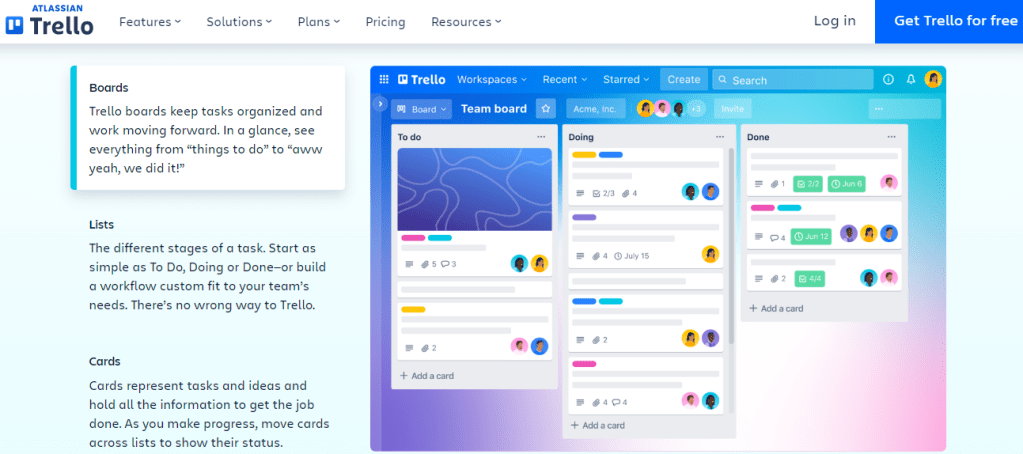
Now I haven’t tested Writer, but Trello has. And it sounds like Trello’s tone of voice has been preserved even when the bots write the content.
Trello avoids the “professional voice” trap traditional software companies fall into (aka stodgy, robotic tone) by treating the person who reads their content like a coworker….With phrases like “go from Trello zero to Trello hero,” you can see that the writers at Trello had permission and encouragement to have fun while writing help content, and that fun translates to a delightful experience for users….
Leah Ryder told us, “With the 10-year anniversary of Trello around the corner, combined with major developments in-product with the new Views feature, it seemed like the right time to update and align our brand and product towards our shared goal of empowering productivity for teams everywhere.”…
Trello’s brand refresh was 1.5 years in the making, and it took a tremendous amount of strategic leadership, partnered with cross-team collaboration to make it happen. It couldn’t have happened without ten years of defining and committing to rule-breaking brand principles. Over the next decade, there’s no doubt the product will change as it adapts to user needs, but with strong brand principles in place, Trellists can always expect a sense of joy built into everything Trello creates.
So if Writer and Trello are correct in their assertions, it IS possible for a well-designed generative AI tool to create a first draft that does NOT require extensive rewrites. Or, if you control your data warehouse, fact-checking. This preserves the ability to save time, since you don’t have to rewrite bland text or correct inaccurate text.
Are you an executive with a small or medium sized identity/biometrics firm?
If so, you want to share the story of your identity firm. But what are you going to say?
How will you figure out what makes your firm better than all the inferior identity firms that compete with you?
How will you get the word out about why your identity firm beats all the others?
Are you getting tired of my repeated questions?
Are you ready for the answers?
Your identity firm differs from all others
Over the last 29 years, I (John E. Bredehoft of Bredemarket) have worked for and with over a dozen identity firms, either as an employee or as a consultant.
You’d think that since I have worked for so many different identity firms, it’s an easy thing to start working with a new firm by simply slapping down the messaging that I’ve created for all the other identity firms.
The messaging that I created in my various roles at IDEMIA and its corporate predecessors was dramatically different than the messaging I created as a Senior Product Marketing Manager at Incode Technologies, which was also very different from the messaging that I created for my previous Bredemarket clients.
IDEMIA benefits such as “servicing your needs anywhere in the world” and “applying our decades of identity experience to solve your problems” are not going to help with a U.S.-only firm that’s only a decade old.
Similarly, messaging for a company that develops its own facial recognition algorithms will necessarily differ from messaging for a company that chooses the best third-party facial recognition algorithms on the market.
So which messaging is right?
It depends on who is paying me.
How your differences affect your firm’s messaging
When creating messaging for your identity firm, one size does not fit all, for the reasons listed above.
The content of your messaging will differ, based upon your differentiators.
For example, if you were the U.S.-only firm established less than ten years ago, your messaging would emphasize the newness of your solution and approach, as opposed to the stodgy legacy companies that never updated their ideas.
And if your firm has certain types of end users, such as law enforcement users, your messaging would probably feature an abundance of U.S. flags.
In addition, the channels that you use for your messaging will differ.
Identity firms will not want to market on every single social media channel. They will only market on the channels where their most motivated buyers are present.
That may be your own website.
Or LinkedIn.
Or Facebook.
Or Twitter.
Or Instagram.
Or YouTube.
Or TikTok.
Or a private system only accessible to people with a Top Secret Clearance.
It may be more than one of these channels, but it probably won’t be all of them.
But before you work on your content or channels, you need to know what to say, and how to communicate it.
How to know and communicate your differentiators
As we’ve noted, your firm is different than all others.
How do you know the differences?
How do you know what you want to talk about?
How do you know what you DON’T want to talk about?
Here are three methods to get you started on knowing and communicating your differentiators in your content.
Method One: The time-tested SWOT analysis
If you talk to a marketer for more than two seconds about positioning a company, the marketer will probably throw the acronym “SWOT” back at you. I’ve mentioned the SWOT acronym before.
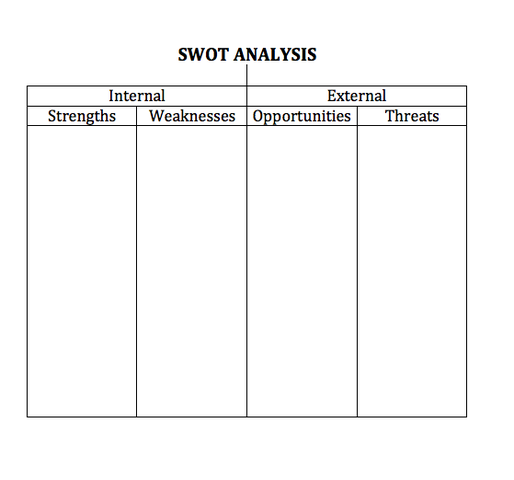
For those who don’t know the acronym, SWOT stands for
Strengths. These are internal attributes that benefit your firm. For example, your firm is winning a lot of business and growing in customer count and market share.
Weaknesses. These are also internal attributes, but in this case the attributes that detract from your firm. For example, you have very few customers.
Opportunities. These are external factors that enhance your firm. One example is a COVID or similar event that creates a surge in demand for contactless solutions.
Threats. The flip side is external factors that can harm your firm. One example is increasing privacy regulations that can slow or halt adoption of your product or service.
If you’re interested in more detail on the topic, there are a number of online sources that discuss SWOT analyses. Here’s TechTarget’s discussion of SWOT.
The common way to create the output from a SWOT analysis is to create four boxes and list each element (S, W, O, and T) within a box.
Once this is done, you’ll know that your messaging should emphasize the strengths and opportunities, and downplay or avoid the weaknesses and threats.
Or alternatively argue that the weaknesses and threats are really strengths and opportunities. (I’ve done this before.)
Method Two: Think before you create
Personally, I believe that a SWOT analysis is not enough. Before you use the SWOT findings to create content, there’s a little more work you have to do.
I recommend that before you create content, you should hold a kickoff of the content creation process and figure out what you want to do before you do it.
During that kickoff meeting, you should ask some questions to make sure you understand what needs to be done.
I’ve written about kickoffs and questions before, and I’m not going to repeat what I already said. If you want to know more:
Now that you’ve locked down the messaging, it’s time to actually create the content that differentiates your identity firm from all the inferior identity firms in the market. While some companies can proceed right to content creation, others may run into one of two problems.
The identity firm doesn’t have any knowledgeable writers on staff. To create the content, you need people who understand the identity industry, and who know how to write. Some firms lack people with this knowledge and capability.
The identity firm has knowledgeable writers on staff, but they’re busy. Some companies have too many things to do at once, and any knowledgeable writers that are on staff may be unavailable due to other priorities.
This is where you supplement you identity firm’s existing staff with one or more knowledgeable writers who can work with you to create the content that leaves your inferior competitors in the dust.
What is next?
So do you need a knowledgeable biometric content marketing expert to create your content?
One who has been in the biometric industry for 29 years?
One who has been writing short and long form content for more than 29 years?
Are you getting tired of my repeated questions again?
Well then I’ll just tell you that Bredemarket is the answer to your identity/biometric content marketing needs.
Are you ready to take your identity firm to the next level with a compelling message that increases awareness, consideration, conversion, and long-term revenue? Let’s talk today!
My compulsion to share stuff about identity and biometrics, which you can see if you visit my Bredemarket Identity Firm Services LinkedIn page and Facebook group.
Unfortunately for us, 90% of the song deals with the negative aspects of a person obsessing over another person. If you pick through the lyrics of the Animotion song “Obsession” and forget about what (or who) the singer is obsessing about, you can find isolated phrases that describe how an obsession can motivate you.
“I cannot sleep”
“Be still”
“I will not accept defeat”
But thankfully, there are more positive ways to embrace an obsession.
Justin Welsh on embracing an obsession
While Justin Welsh’s July 2022 post “TSS #028: Don’t Pick a Niche. Embrace an Obsession” is targeted for solopreneurs, it could just as easily apply to those who work for others. Regardless of your compensation structure, why do you choose to work where you do?
For Welsh, the practice of picking a niche risks commoditization.
They end up looking like, sounding like, and acting like all of their competition. The internet is full of copycats and duplicates.
(For example, I’d bet that all of the people who are picking a niche know better than to cite the Animotion song “Obsession” in a blog post promoting their business.)
Perhaps it’s semantics, but in Welsh’s way of thinking, embracing an obsession differs from picking a niche. To describe the power of embracing an obsession, Welsh references a tweet from Daniel Vassalo:
Find something you want to do really badly, and you won’t need any goals, habits, systems, discipline, rewards, or any other mental hacks. When the motivation is intrinsic, those things happen on their own.
Find something you want to do really badly, and you won’t need any goals, habits, systems, discipline, rewards, or any other mental hacks. When the motivation is intrinsic, those things happen on their own.
I trust you can see the difference between picking something you HAVE to do, versus obsessing over something you WANT to do.
What’s in it for you?
Welsh was addressing this post to me and people like me, and his message resonates with me.
But frankly, YOU don’t care about me and about whether I’m motivated. All that you care about is that YOU get YOUR content that you need from me.
So why should you care what Justin Welsh and Daniel Vassllo told me?
The obvious answer is that if you contract with Bredemarket for your marketing and writing services, you’ll get a “pry my keyboard out of my cold dead hands” person who WANTS to write your stuff, and doesn’t want to turn the writing process over to some two-year-old bot (except for very small little bits).
I’m still working on my TikTok generative AI dance. (Don’t hold your breath.)
“Pry my keyboard,” indeed.
Do you need someone to obsess over YOUR content?
Of course, if you need someone to write YOUR stuff, then I won’t have time to work on a TikTok dance. This is a good thing for me, you, and the world.
As I’ve stated elsewhere, before I write a thing for a Bredemarket client, I make sure that I understand WHY you do what you do, and understand everything else that is relevant to the content that we create.
As I work on the content, you have opportunities to review it and provide your feedback. This ensures that both of us are happy with the final copy.
And that your end users become obsessed with YOU.
So if you need me to create content for you, please contact me.
Companies often have a lot of things they want to do, but don’t have the people to do them. It takes a long time to hire someone, and it even takes time to find a consultant that knows your industry and can do the work.
This affects identity/biometric companies just like it affects other companies. When an identity/biometric company needs a specific type of expertise and needs it NOW, it’s often hard to find the person they need.
If your company needs a biometric content marketing expert (or an identity content marketing expert) NOW, you’ve come to the right place—Bredemarket. Bredemarket has no identity learning curve, no content learning curve, and offers proven results.
Identity/biometric consulting in the 1990s
I remember when I first started working as an identity/biometric consultant, long before Bredemarket was a thing.
OK, not quite THAT long ago. I started working in biometrics in the 1990s—NOT the 1940s.
In 1994, the proposals department at Printrak International needed additional writers due to the manager’s maternity leave, and she was so valuable that Printrak needed to bring in TWO consultants to take her place.
At least initially, the other consultant and I couldn’t fill the manager’s shoes.
Both of us could spell “RAID.” Not the bug spray, but the storage mechanism that stored all those “huge” fingerprint images.
But on that first night that I was cranking out proposal letters for something called a “Latent Station 2000,” I didn’t really know WHAT I was writing about.
As time went on, the other consultant and I learned much more—so much that the company brought both of us on as full-time employees.
After we were hired full-time, we spent a combined 45+ years at Printrak and its corporate successors in proposals, marketing, and product management positions, contributing to industry knowledge.
But neither of us knew biometrics before we started consuting at Printrak.
And I had never written a proposal before I started consulting at Printrak. (I had written an RFP. Sort of.)
But frankly, there weren’t a lot of identity/biometric consultants out in the field in the 1990s. There were the 20th century equivalents of Applied Forensic Services LLC, but at the time I don’t think there were any 20th century equivalents of Tandem Technical Writing LLC.
Unlike the 1990s, identity/biometric firms that need consulting help have many options. In addition to Applied Forensic Services and Tandem Technical Writing you have…me.
Mike and Laurel can tell you what they can do, and I heartily endorse both of them.
Let me share with you why I call myself a biometric content marketing expert who can help your identity/biometric company get marketing content out now:
No identity learning curve
No content learning curve
Proven results
No identity learning curve
I have worked with finger, face, iris, DNA, and other biometrics, as well as government-issued identity documents and geolocation. If you are interested, you can read my Bredemarket blog posts that mention the following topics:
Because I’ve produced both external and internal content on identity/biometric topics, I offer the experience to produce your content in a number of formats.
External content: account-based marketing content, articles, blog posts (I am the identity/biometric blog expert), case studies, data sheets, partner comarketing content, presentations, proposals, sales literature sheets, scientific book chapters, smartphone application content (events), social media posts, web page content, and white papers.
















 Bredemarket