How I Expanded 1 Idea Into 31 Pieces of Content

Whenever I see these pieces that proclaim that the author can help you brainstorm x ideas for content, I ignore them. For better or worse, I have no problem coming up with content ideas.

And when I come up with the content ideas, I don’t just use them in one piece of content. I’ll use the idea in several pieces of content. Yes, I love repurposing.

I think I’ve set a new record for myself over the last few days by creating 31 pieces of content from a single idea.

This post talks about:

The post doesn’t aim to tell you how you should create and reshare your content, but perhaps while you’re reading the post you may get some fresh ideas that fit your own working practices.

Three years of preparation

Before you can share content in numerous places, you need numerous places to share your content. It’s obvious, but it’s true. After all, it would be repetitive to post the exact same content multiple times in the Bredemarket blog.

So since I started Bredemarket in 2020, I not only developed the Bredemarket blog, but I have also developed (or made use of) other social platforms.

But how many social platforms should you use? In July, I noted what the experts advise, and how I responded to that advice.

If you’re starting out in business, you’ve probably heard the advice that as your business branches out into social platforms, you shouldn’t try to do everything at once. Instead you should make sure that your business offering is really solid on one platform before branching out into others.

Yes, I’ve been naughty again and didn’t listen to the expert advice.

From https://bredemarket.com/2023/07/18/is-bredemarket-on-your-favorite-social-platform/

The July post lists all of the social platforms that publish Bredemarket content, but for brevity’s sake, I’ll just note a few of the platforms:

  • Four pages on LinkedIn, not counting my personal profile (we’ll get to my personal profile later).
  • Four pages/groups on Facebook.
  • Other image/text platforms such as Instagram and Threads.
  • Two video-only platforms: TikTok and YouTube.
  • Numerous audio outlets for my podcast.
  • My personal X account.

To the content marketing experts that say that I should just concentrate on LinkedIn and ignore everything else, note that I then have a 0% chance of reaching non-LinkedIn users. Who knows? Perhaps that TikTok video may result in a conversion that I couldn’t have made otherwise.

One idea

The idea that struck me last weekend was not original to me, and it’s been bouncing around in my head (and on these pages) for some time now. But I thought I’d reword it in a different way. After a few tweaks, I came up with the following statement:

Your Customers Don’t Care About Your Product’s Technology

As you will see, I continued to tweak the statement, but that’s the one that I put in my Asana “Content Calendar” project.
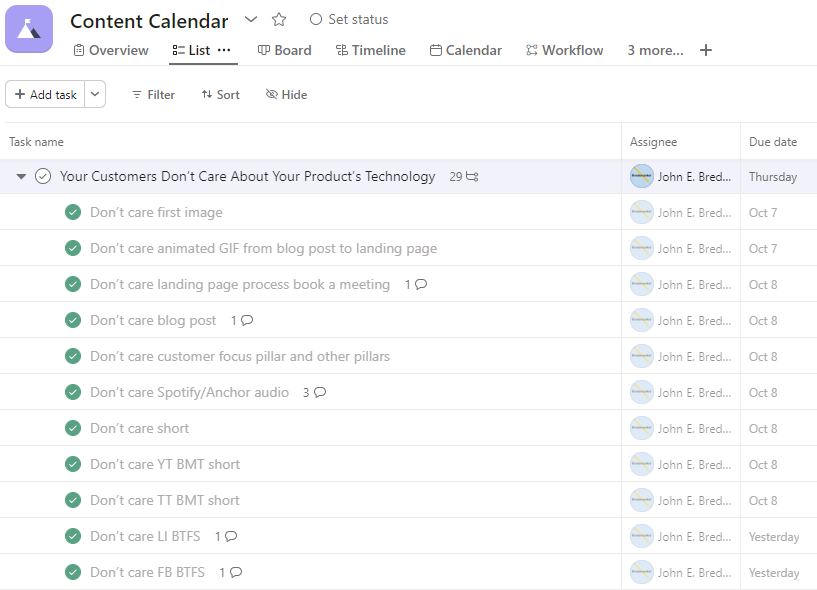
The Asana task that would eventually result in this blog post. Only the first subtasks are shown; as you will see, there are many more.

As I would subsequently reflect, I thought that companies knew that you need to focus on the customer rather than focusing on yourself, but I see too many companies that are self-focused in their marketing. They emphasize the amazing technology features of their product.

I want to put a stop to that, and if necessary I will help companies create customer-focused marketing materials. For a fee, of course.

But enough about me. Let’s illustrate how that one idea can expand into multiple content pieces.

31 pieces of content

So now I had to write about how customers don’t care about your product’s technology.

Content 1: Blog post

The first step was to work on the content required for a blog post on the topic. By the time I was done, the post (now called “Your Prospects Don’t Care About Your Technology“) included:

  • An image, sourced from Wikipedia, of a technologist doing technology things.
  • An image, designed by Freepik, of a customer ignoring someone prattling on about their technology.
  • The “customer focus” illustration that I have used frequently in the past.
  • An animated GIF that beckoned readers to the landing page, described below. The GIF includes the first two images listed above, plus a third from the landing page itself.

Most importantly, the post included all the text that made my original point (“Do you know why your prospects are ignoring you? Because they don’t care about you. It’s all about them.”), along with my argument for customer focus, and my concluding call to action to find out how to “Create Technology Content That Converts.”

Content 2: Landing page

And “Create Technology Content That Converts” was the title of my landing page. Often I put the call to action on the same page as the original point, but sometimes (as in this case) I separate the call to action for a more focused presentation. Plus I have the option of having multiple blog posts point to the same landing page. This post points to the landing page, for example (click the GIF above or one of the other links).

The landing page dug more deeply into why and how Bredemarket can help you create a customer-focused message, talking about the questions I ask, the types of content I can create, and the process.
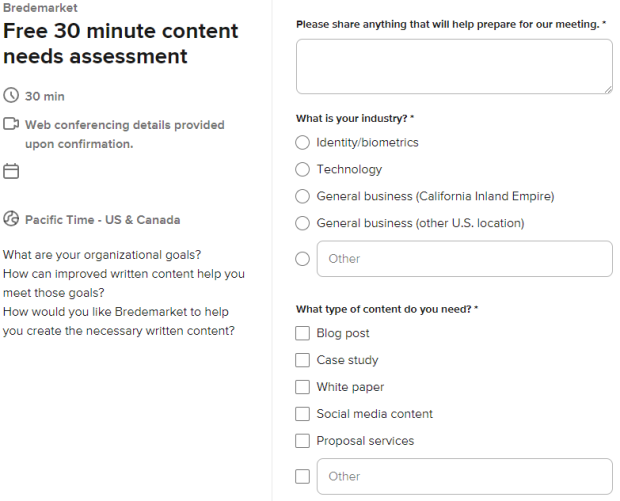
The landing page concluded with the call to action encouraging interested parties to schedule a meeting on my recently-improved Calendly page, email me, or use my contact form. (Or subscribe to my Mailchimp mailing list.)

Once all this was done, everything was set. People who read the blog post could (if so inclined) go to the landing page, and people who read the landing page could (if so inclined) contact me.

But only if they saw the blog post in the first place.

If they don’t find the post on Google or Bing, and if they’re not already subscribing to the blog, then how will they get to the blog post?

Content 3, 4, 5, 6, 7, and 8: Information pages

There are numerous themes that continuously pop up in the Bredemarket blog, and I have created “information pages” (pillars) that link to all of the content that I have written on these themes.

Now perhaps you won’t do all of this, but if there’s a place on your website where you should mention your new blog post, be sure and do it.

For example, if you wrote a blog post about Topic X in 2021, and you’re readdressing Topic X in a 2023 post, then go back and update the 2021 post to say that you have new thoughts on Topic X. Then the people who find your 2021 post can go to the new post and get the latest information.

Content 9: Audio podcast

My podcast is more accurately described as a mini-podcast, because each episode is usually only 1-2 minutes long. Perhaps someday I’ll create hour-long episodes, but not today.

And on Sunday I created a 2-minute episode with a new take. After noting (as I said above) that sometimes we know things that people don’t know, I declared:

Am I smarter than General Electric? Yes I am.

From https://podcasters.spotify.com/pod/show/bredemarket/episodes/Why-Should-I-Care-That-General-Electric-Uses-AI-e2aaenl

I then described a really bad General Electric press release that focused on GE technology and not on customer needs.

Then I plugged the blog post, which was linked in the episode description. And I resued the “technologist doing technology thinks” image from the blog post.

Now I only list this as one piece of content, but really it’s multiple pieces of content. Not only can you access the episode on Spotify for Podcasters (formerly Anchor), but you can also access it on Spotify itself, Apple Podcasts, and numerous other podcast hosting services.

From Spotify.

After this, I returned to the blog post itself and looked for other ways to share it.

Content 10, 11, 12, 13, 14, 15, 16, and 17: Bredemarket LinkedIn and Facebook pages, showcase pages, and groups

Because the blog post explicitly mentioned “technology” in the title, the best fit for a reshare of the blog post was on the Bredemarket Technology Firm Services LinkedIn showcase page (reshare here) and Facebook group (reshare here).

Why do I have a myriad of LinkedIn and Facebook outlets?

Because often people who are interested in technology don’t care about identity, and people who are interested in the Inland Empire don’t care about technology, and people who care about Bredemarket in general don’t care about every identity company reshare that I post.

And of course, some people who love LinkedIn hate Facebook, and some people who love Facebook hate LinkedIn.

So I could have just shared this to the technology outlets, but this particular post had a broader application. Inland Empire businesses, identity companies, and general marketers all have the problem of referring to self rather than the customer.

So I reshared the original technology shares to the other relevant groups.
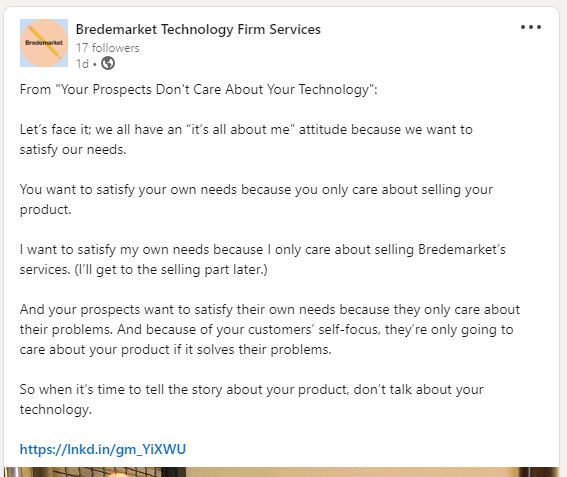
From LinkedIn.

Content 18: Instagram carousel

You know how the Instagram experts say that you should post reels? Or you should post carousels? Or whatever?

I say that you should post a healthy balance of all sorts of things.

I wanted to reshare the blog post on Instagram, so I posted an Instagram carousel post using the two images from the blog post and the “money” image from the landing page.

Even though Instagram is a terrible platform to reshare content on other platforms, because the links aren’t clickable.

Unless you reshare the post as a story and use the “link” feature to embed a link.

Content 19 and 20: Bredemarket Threads and JEBredCal X

Oh, and there are two other places where I reshared the link to the blog post:

  • As a thread.
  • As a xeet or whatever tweets are called these days. (This is not an official Bredemarket X account, but my “professional” X account where I share Bredemarket stuff and other stuff.)

So that encompassed the first set of content reshares. But before I go on…

Content 21: LinkedIn reshare of podcast

All of the stuff listed above was stuff that I meticulously planned by listing subtasks to the original Asana task “Your Customers Don’t Care About Your Product’s Technology.”

But I forgot that I deviated from Asana and also shared a link to the podcast in the Bredemarket Technology Firm Services LinkedIn showcase page.

Some people are horrified that I deviated from Asana and didn’t record this important share. (And they’ll really be horrified later in this post when I create another piece of content and don’t log it in Asana.)

Others are horrified that I put all the other stuff in Asana in the first place.

As for me, well, I got the content out. Cool.

But the blog post wasn’t enough. I needed to convey the same message in a different way, for those who think words and stuff aren’t cool.

Content 22, 23, 24, and 25: The short

In the same way that I created an audio podcast that made the same points as the blog post (while linking to the blog post), I wanted to create a video vertical short that did the same thing.

So I headed out to the Southern California Edison Euclid Substation.
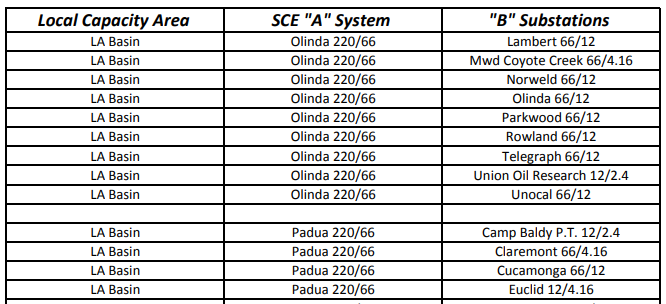
From Southern California Edition PDF.

I then stood in front of some very technological stuff, and filmed 27 seconds of me talking about the prospect’s problems…and your problem…and how Bredemarket can solve your problem.

By the time I was finished, the video short was available on:

Originaly posted at https://bredemarket.com/2023/10/08/a-short-on-non-caring-prospects/

So now both WordPress and Instagram had two pieces of content that kinda sorta said the same thing. But this is good. Maybe some people like the video version, while others like the text version. I’ll catch them one way or ther other.

But before I actually shot the video at the SCE Euclid Substation…

Content 26: Instagram Live/Reel

…I was scouting out locations. (If you know the Talking Heads song “Found a Job” you’ll recognize the phrase.)

When I arrived at the SCE Euclid Substation, I walked around the south and west sides of the substation, looking for the best place to shoot my video.

And I was broadcasting on Instagram Live as I was doing this, offering my adoring fans a rare “behind the scenes” look at Bredmarket activities. And, incidentally, proving that Bredemarket behind the scenes is pretty boring.

But the Instagram Live session was recorded, and was posted as a reel a couple of days before my video short was posted.

I don’t know if it made a huge difference in the subsequent reception of the short, but one of my relatives liked the “behind the scenes” look so that’s good.

So those 26 pieces of content addressed Bredemarket’s views on customer focus and benefits.

But my life is not confined to Bredemarket. Time for one huge repurpose.

Content 27: jebredcal blog post

At the same time that I’m asking Bredemarket prospects to contract with me, I’m asking technology companies (including identity companies) to hire me as a Senior Product Marketing Manager.

And the same message can, with some adaptation, be delivered to hiring companies.

So I wrote a separate blog post on my jebredcal personal blog, “Do Your Prospects Ignore Your Company’s Message?” that addressed the latter target audience.
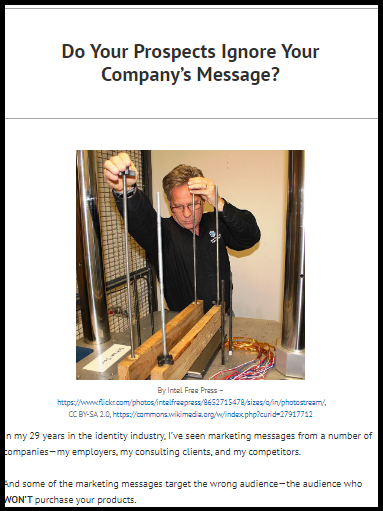
If you compare the jebredcal blog post with the original Bredemarket blog post, you can see some clear similarities…with some noticeable differences. For example, I don’t ask employers to use Bredemarket’s calendly, email, or web messaging channels. I use my personal email and my LinkedIn profile messaging capability instead.

Now that the blog post was written, I was ready to share it on LinkedIn where the employers are. (No Facebook. No TikTok.)

Correction: I was ALMOST ready to share a link to the post on LinkedIn. I had to complete one thing first.

Content 28: Personal short

I decided that on the day before I shared the post on LinkedIn, I’d create a personal video short that introduced the content.

But this one, rather than taking place in front of a cool electrical facility, would be a behind-the-scenes view of Bredemarket’s world headquarters. Since the city of Ontario restricts you from viewing this yourself (restriction 3), this is the only way that you will ever see Bredemarket’s world headquarters.

Exciting?

No, completely boring.

But I did it anyway, and posted the video on LinkedIn yesterday. (And if you look to the left, you can see Bredemarket’s business license as required by restriction 1.)

Content 29: The LinkedIn share of the jebredcal post

After a day’s wait, the jebredcal blog post was shared on LinkedIn. I haven’t been swamped with job offers yet, but content marketing doesn’t work like that.

Content 30: You’re reading it right now

Once I realized that I was going to write one blog post for Bredmarket prospects and one post for potential employers, I decided to write a third post that talked out how you create different content for different target audiences. As I noted above, the two pieces of content have significant similarities, but also significant differences.

But as I thought about it, I thought it would be more important to illustrate how you could take a single idea and repurpose it as 30 different pieces of content.

Well, 30 so far. I still have to figure out how and where to reshare THIS blog post…

Content 31: LinkedIn post about a job rejection

Stop the presses!

And here’s another EXCITING behind-the-scenes look at how Bredemarket works!

By Tuesday afternoon (October 10, 2023), I had substantially completed writing this blog post on “How I Expanded 1 Idea Into 30 Pieces of Content.” But since there was no huge rush to publish the post—after all, I had just published 29 other pieces of content over the past few days—I figured I’d take advantage of the opportunity to “sleep on it” and look at the post one more time before publication.

Then something happened early Wednesday morning.
Every day, potential employers tell thousands of job candidates that they are “moving in a different direction.” By Original: Jack Ver at Dutch Wikipedia Vector: Ponor – Own work based on: Plaatsvector.png by Jack Ver at Dutch Wikipedia, CC BY-SA 4.0, https://commons.wikimedia.org/w/index.php?curid=95477901

I received a “you have not been selected for this position” email from a potential employer. I had only applied for the position two days earlier, on Monday, right in the midst of all of this content creation.

Proving that I can create content out of ANYTHING, I authored a LinkedIn post that began as follows:

If you are one of the lucky talent acquisition professionals who is still employed, there is ONE CRITICAL THING that you MUST impress upon your employers.

Please tell your employers NOT to list positions as “remote/hybrid.”

That’s kind of like listing a food as “vegan/beef.” Is it vegan, or is it beef? It’s a mystery until you take a bite, and there’s a 50% chance you will be disappointed or horrified with what you find.

From LinkedIn.

You may ask what a LinkedIn post about “remote/hybrid” job listings has to do with incorrectly-focused product marketing messaging.

It’s all in the call to action. Those who read to the end of the post encountered these words.

Anyway, if you’ve read this far and are seeking an experienced identity/biometrics/technology Senior Product Marketing Manager for a #remote position (or a position within 25 miles of Ontario, California), please message me. The linked post below includes my contact information, as well as my philosophy on product marketing messaging.

From LinkedIn.

And then I linked to my personal jobseeking blog post “Do Your Prospects Ignore Your Company’s Message?

  • For those keeping score, that blog post was content number 27.
  • Even though I already posted a link to that post on LinkedIn already. See content number 29.
  • And no, I didn’t list this content in Asana either (see content number 21).

I guess this 31st item is a special treat. Like ice cream.

By Baskin-Robbins – Own work based on: Baskin-Robbins logo 2022.png, Public Domain, https://commons.wikimedia.org/w/index.php?curid=116914428

Start Your Engines: Writing Your Non-Traditional Words

All too often, Bredemarket confines its writing discussions to the traditional ABCW (articles, blog posts, case studies, white papers) categories.

But what if your content needs are non-traditional and fall outside of the usual nice neat business writing categories?

From the 2023 Route 66 Cruisin’ Reunion, Saturday, September 16, 2023.

If you are an Inland Empire business who needs words, but not in the traditional “ABCW” (articles, blog posts, case studies, white papers) business types, Bredemarket will help you with your non-traditional writing needs.

Take a look at the examples I’ve provided below, and if these spark interest within you, authorize Bredemarket, Ontario California’s content marketing expert, to help your firm produce words that return results.

  • Email me at john.bredehoft@bredemarket.com.
  • Book a meeting with me at calendly.com/bredemarket. Be sure to fill out the information form so I can best help you. For example, if you’re an Inland Empire business requiring non-traditional content, fill out the form accordingly.
Bredemarket logo

Here’s what I’m going to talk about in this post.

The traditional 22+ content categories

Sometimes I’m guilty of traditional thinking. Too traditional.

I won’t say a lot about this because I’ve said it before, but I’ve defined 22 fairly traditional categories of content that I (and Bredemarket) have created and can create.

22 traditional content types.

I won’t go into all 22 types again, especially since some of them are internal content rather than customer-facing content. But I’d like to highlight the “ABCW” four types that I mentioned at the beginning of this blog post, plus a couple of others.

Articles and blog posts

I’m lumping articles and blog posts together, because while some “experts” try to draw hard-and-fast distinctions between the two, they’re pretty much the same thing.

Whether it’s a blog post on your website, a post or article on LinkedIn, or even some extended text associated with an Instagram picture or a TikTok video, what you’re creating is some text that entertains, persuades, inspires, or educates your reader, or perhaps all four. You set the goal for the article or blog post, then tailor the content to meet the goal. (I’ll talk more about goals later.)

Case studies

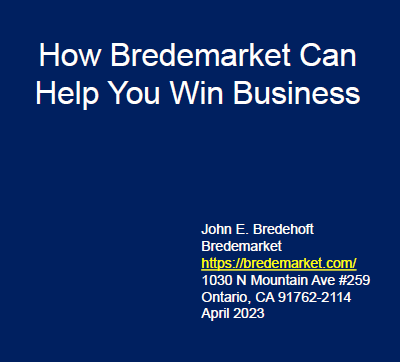
From “How Bredemarket Can Help You Win Business,” available via this post.

Case studies show your readers how your solution was applied to someone else’s problem, and how your solution can benefit your prospects with similar problems.

Maybe your prospect is a city police agency that needs a tool to solve crimes, and your case study describes how your solution solved crimes in a similar city. Again, you set the goal for the case study, then tailor the content to meet the goal.

White papers

On the surface, white papers are informational, but when a company issues a white paper, the “information” that the white paper provides should gently guide the reader toward doing business with the company that issued the paper. Using the example above, you could write a white paper that outlines “Five Critical Elements for a Local Crime-Solving Solution.” By remarkable coincidence, your own solution happens to include all five of those critical elements. Again, you set the goal and tailor the content.

Briefs, data sheets, and literature sheets

One-page sheet for the Bredemarket 400 Short Writing Service. More information here.

Perhaps you need to provide handouts to your prospects that describe your product or service.

Regardless of whether you call these handouts briefs, data, sheets, literature sheets, or something else, they should at a minimum contain both “educate” and “persuade” elements—educate your prospects on the benefits of your product or service, and persuade your prospects to move closer to a sale (conversion).

Again, you set the goal and tailor the content.

Web page content

If your business has a web page, I hope that it has more words than “Under construction.” Whether you have imagery, video, audio, text, or all four on your web page, it needs to answer the questions that your prospects and customers have.

You know what I’m going to say here, but it’s still important. You set the goal and tailor the content.

But…what if your business needs content that doesn’t fall into these traditional business categories?

Non-traditional content: going to a car show

I went to a car show this weekend—specifically, this year’s Route 66 Cruisin’ Reunion in downtown Ontario, California. (Yes, I know that Route 66 actually passed three miles north of downtown Ontario, but work with me here.)

While some of the exhibitors were personal, some of them were businesses. As businesses, what was the major marketing collateral that they generated?

Not a blog post, or LinkedIn article, or any of the traditional business media collateral.

Their marketing tools were the cars themselves.

So perhaps you may assume that car show exhibitors don’t need textual content. Your assumption would be incorrect.

From https://www.youtube.com/shorts/Ed9bn7lmtzA

In addition to the car itself, this exhibitor included poster boards with words describing the car.

Another exhibitor did the same thing.

So while these car show exhibitors didn’t choose a traditional way to convey their words, they shared written text anyway.

Your non-traditional business communication needs

Maybe you don’t have a classic car. Maybe you don’t have a car at all. Do you need to share words with your prospects and customers anyway?

Now I don’t know your business communication needs. You do. But I can guess a few things.

  1. Do you need to tell your clients/potential clients why you do what you do?
  2. Do you need to tell them how you do it?
  3. And last but not least, do you need to tell them what you do?

I know that this may seem like an unusual order to you. Why not start with what you do?

Because your customers don’t care about what you do. Your customers care about themselves.

If you keep the focus on your customers, the answer to the “why” question will induce your customers to care about you, because it shows how you can solve their problems.

Let’s illustrate this.

Why and how Bredemarket creates non-traditional content

You may be asking why I create content in the first place. There are countless content creators, both human and non-human. Why turn to me when OpenAI and its bot buddies are a lot cheaper and faster?

Normally I include my recent professional picture, but I have been writing since my college days (on a typewriter back then).

The simple answer is that I am obsessed with writing, and in this era of self-description, I self-describe as a “you can pry my keyboard out of my cold dead hands” type. (It used to be a typewriter, but let’s stick to this millennium.) And with my many years of personal and professional writing, I’ve honed my ability to take concepts and make them meaningful to readers.

Which brings me to how Bredemarket works.

  1. Bredemarket’s service is independent of content type. I don’t have a “Bredemarket blog writing service” or “Bredemarket data sheet writing service” or “Bredemarket case study writing service.” My services are based on word length, not content type, with my most popular service targeted to customers who need between 400 and 600 words of text. From this perspective, I don’t care if you want the words to appear on your website or your social media channel or a paper flyer or a sign next to your car or a really really long banner towed behind an airplane. (Read about the Bredemarket 400 Short Writing Service here.)
  2. Before I write a thing, I ask your some questions. It won’t surprise you to learn that my first questions to you are why, how, and what. I then move on to questions about your goal for the content, the benefits of your solution, the target audience for your solution, and many additional questions. (Read about the Six Questions Your Content Creator Should Ask You here.)
  3. Once the questions are out of the way, content creation is collaborative and iterative. I create a draft, you review it, and we repeat. The Bredemarket 400 service includes two review cycles; longer content needs include three review cycles. The goal is to ensure that both of us are happy with the final product.

Bredemarket’s process applies regardless of the specific content type, so I should be able to support whatever content you need, whether it’s traditional or non-traditional.

Can I help you?

And as an added bonus, here are some additional images from this weekend’s Cruisin’ Reunion. Enjoy.

From https://www.youtube.com/watch?v=0SboKOAmL5w

Is Your Company Ignoring Your Prospects?

Are you locking your prospects out?

Designed by Freepik.

Ignoring your prospects is NOT a winning business strategy. But a lot of companies do it anyway by not communicating regularly with their prospects.

If you ignore your prospects, your prospects will ignore you.

Meetings and money, via a third party

Of my three Bredemarket meetings (so far) today, the second was the most promising.

A person at a large company needs consulting services from me. All we need to do is work out the mechanics. The large company relies on a third party to manage its indpendent contractor relationships, including onboarding, time cards, and payments for hourly work. I wanted to learn about the third party, but I ran into walls when seeking current information about the firm.

The third party’s website is static

The third party’s website talks about its services, some unique aspects about the business, the story of its founder (a fascinating story), its technology partners, and its call to action. It provides ALMOST everything…with the exception of CURRENT information.

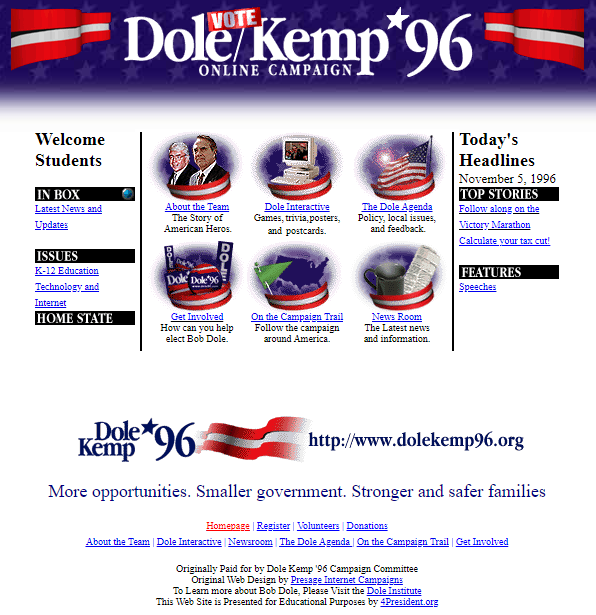
Does your company website look like http://www.dolekemp96.org/main.htm?
  • No press releases from the third party.
  • No links to news articles that mention the third party.
  • Not even a blog.

Basically if you want CURRENT information about the company…

…you get crickets.

African field cricket, Gryllus bimaculatus. By Arpingstone – Own work, Public Domain, https://commons.wikimedia.org/w/index.php?curid=620363

Not literally, but you know what I mean.

Which makes me wonder—is the third party doing anything NOW? Or was all of the existing content set up when the company was founded a decade ago?

If text like this is on your home page, you have a problem. From https://serverfault.com/questions/65952/objective-speed-comparison-of-windows-7-vs-windows-xp, which acknowledges that this text is over 13 years old. Does your site have old text without such an acknowledgement?

Luckily for me, I knew where to find current information on the company. Since the company is a B2B provider, I assumed that the company has a LinkedIn page. And I was right. But…

The third party’s LinkedIn page is also static

As you probably know, company LinkedIn pages have several subpages. The “About” supage talks about the third party company’s services, and the “People” subpage links to the profiles of the company’s employees, including the founder. So I went to the “Posts” subpage for the third party…

…and found crickets.

From https://www.youtube.com/watch?v=oSW6IFt8OpQ

Not literally, but you know what I mean.

In nearly a decade of existence, the company has NEVER written a LinkedIn post to reach out to its prospects or customers.

Ignoring your prospects

As I’ve said before, companies that refuse to generate current content in the form of blog posts or social media posts make it appear that your company is no longer an ongoing, viable concern.

By Yintan at English Wikipedia, CC BY 4.0, https://commons.wikimedia.org/w/index.php?curid=63631702

And this is so easy to fix.

Pay attention to your prospects by providing current content.

If you ignore your prospects, your prospects will ignore you.

Are you ready to stop ignoring your prospects?

If you need help creating content for your blog, your social media platforms, or your website, Bredemarket can help you regain credibility with your prospects and customers.

Authorize Bredemarket, Ontario California’s content marketing expert, to help your firm produce words that return results.

Bredemarket logo

Should Inland Empire Companies Generate Content with ChatGPT (or other generative AI tools)?

An image of a neural network. By DancingPhilosopher – Own work, CC BY-SA 4.0, https://commons.wikimedia.org/w/index.php?curid=135594693

Inland Empire companies are asking the same question that other companies are asking: “Should my business use ChatGPT (or another generative AI tool) to quickly generate content?”

Bear in mind that I have a vested interest in the answer to this question, because Bredemarket’s business is content generation for other businesses. So I don’t have a natural inclination to tell you not to buy my services and use ChatGPT or Bard or whatever instead.

Nevertheless, I’ll outline the advantages and drawbacks of using automation (in this case generative AI tools) to create written content. Then I’ll look at the three options for your business’ content generation needs. (Surprise! One of those options is to contract with Bredemarket. You’ve been warned that a call to action is coming.)

An “exchange” of questions

As I mentioned in my post about creating and populating Facebook business pages, yesterday afternoon was the first time in years that I had attended a monthly Ontario IDEA Exchange meeting. For those who aren’t familiar with these meetings, they allow small business owners from the Ontario, California area to meet and…um…exchange ideas.

By Mack Male – originally posted to Flickr as Ontario Convention Center, CC BY-SA 2.0, https://commons.wikimedia.org/w/index.php?curid=9512928

One of the attendees asked me what I thought of ChatGPT.

If you’ve read the Bredemarket blog or the Bredemarket LinkedIn page, you know that I have some thoughts on this. (If you haven’t seen my thoughts, I’ll share them later in this post.)

It turns out that the attendee had a reason for asking the question that went well beyond generative artificial intelligence (generative AI), and touched on automation in general.

  • Should we use ChatGPT, Bard, or another generative AI tool to generate text content, or should we contact a content marketing expert?
  • Similarly, should we use a generative AI tool to generate image content, or should we contact a graphic design expert?
  • Going beyond generative AI, should we use tax preparation software, or should we contact a tax preparation expert?

You can ask this same question about a variety of business services. Should you opt for the (sometimes) cheaper automated solution, or should you get a real person to perform the service?

This can be a loaded question. After all, I can’t tell you that you should always use a person for these tasks when I personally use Freepik and a well-known tax preparation software package.

Designed by Freepik.

So, returning to content, let’s take a (probably non-objective) look at the pros and cons of using generative AI tools for content creation. After all, some of my best friends use generative AI…and they’re still my friends (and obviously not my customers).

Generative AI content advantages

While generative AI isn’t as trendy a topic as it was a few months ago, people are still talking about using generative AI to create text content. And there are clearly some advantages to it.

  • It’s very fast. No, you won’t create your text in a minute. But with properly written prompts (commands to the generative AI tool) and by using a few iterations, you can probably get generative AI text content in five minutes. You won’t get text content of any length from Bredemarket in five minutes.
  • It’s (usually) free. In most cases, you can obtain your text at no cost to you. Again, Bredemarket doesn’t work for free.
  • It’s easy. You don’t need to know how to write. Sure, you need to know how to write the prompt, but you don’t need to worry about the mechanics of writing the text itself, and when to use “its” or “it’s”. You don’t want to sound like a looser, after all. (That was wrong.)
  • It’s “good enough.” Under most circumstances, the text created by a generative AI tool gets the job done, and is obviously better than no text at all.

Generative AI content drawbacks

Perhaps I’m biased, but I think that we can all agree on the drawbacks that I’ve listed below.

  • Potential accuracy issues. Generative AI content is sourced from the Internet, and you know how accurate the Internet can be at times. For example, when I was working for my former employer, I asked one popular generative AI tool to tell me the weaknesses of my employer’s product. The tool returned two responses, one of which was plain wrong.
  • More potential accuracy issues. The way generative AI tools work, most of them provide their answers as if they were most certainly true, with no attempt to provide the probability that the response is correct or incorrect. In essence, Mr. Gen AI is an automated know-it-all with complete certainty in its answers, even when they are obviously wrong.
  • Potential relevancy issues. Depending upon your generative AI tool, you may not have access to the latest data and may instead rely on older data that was available when the generative AI tool was trained. At one point, several of the popular generative AI tools were trained on data from 2021 or earlier, which meant that they knew nothing about events that happened last week.
  • Potential privacy issues. When you feed prompts to a generative AI tool, the prompts are stored by the tool. What if you’re using a public tool, and you’re feeding confidential data from your company to the tool? What’s going to happen to your company’s private data? (This is especially critical when the data crosses international borders, something that gave Samsung serious concern.)
  • Potential tone of voice issues. If your company feeds a prompt to a generative AI tool, and your competitor feeds the same prompt to the same tool, you will get similar or identical responses. If both companies use these responses, then the companies will sound like bland “me-too” providers, with no differentiation.

I’ve touched on a number of these issues in more detail in pieces that I’ve written on the Bredemarket blog (and in one case on LinkedIn). These explain when I use generative AI, and when I do not.

So what should YOUR business do?

Depending upon your business needs, your budget, and your marketing direction, you have three choices.

(UPDATE OCTOBER 23, 2023: “SIX QUESTIONS YOUR CONTENT CREATOR SHOULD ASK YOU IS SO 2022. DOWNLOAD THE NEWER “SEVEN QUESTIONS YOUR CONTENT CREATOR SHOULD ASK YOU” HERE.)

  • Use a generative AI tool to write your content. It’s fast, it’s free, it’s easy. It may be good enough.
  • Use a low-cost writer to write your content. If you want to spend a little money, you can find writers who will work for pennies per word. That’s more than a generative AI tool, but you have a better chance of getting the content you want.
  • Use Bredemarket. I cost more than pennies per word (the cost for my standard 400-600 word writing package is in the brochure on my Bredemarket 400 Short Writing Service page), but Bredemarket’s collaborative kickoff process, including the opening six questions that I ask you, helps to ensure that your firm will get the content that you need.

Authorize Bredemarket, Ontario California’s content marketing expert, to help your firm produce words that return results.

Bredemarket logo

Bonus: here’s what Google Bard says on the topic (written by Google, not by me)

Sure, here are three advantages and three drawbacks of using generative AI to create written content:

Advantages:

  • Speed: Generative AI can create content much faster than humans. This can be a major advantage for businesses that need to produce a lot of content quickly, such as content marketing agencies or news organizations.
  • Cost-effectiveness: Generative AI can be a more cost-effective way to create content than hiring human writers. This is especially true for tasks that are repetitive or time-consuming, such as writing product descriptions or blog posts.
  • Accuracy: Generative AI can be very accurate in generating content that is factually correct. This is because it is trained on large datasets of text and code.

Drawbacks:

  • Creativity: Generative AI is not as creative as humans. It can only generate content that is based on the data it has been trained on. This means that it may not be able to come up with new ideas or insights.
  • Bias: Generative AI can be biased, depending on the data it is trained on. This is a concern because it could lead to the creation of content that is inaccurate or harmful.
  • Plagiarism: Generative AI can sometimes plagiarize content from other sources. This is because it is trained on a variety of text data, including some that may not be properly cited.

Overall, generative AI can be a valuable tool for creating written content. However, it is important to be aware of its limitations and to use it responsibly.

Here are some additional things to keep in mind when using generative AI to create written content:

  • Always fact-check the content before publishing it. Generative AI can sometimes make mistakes, so it is important to double-check the information.
  • Be clear about the purpose of the content. Are you trying to inform, persuade, or entertain? The purpose of the content will help you determine the tone and style of the writing.
  • Be aware of the audience. Who are you writing for? What are their interests and needs? Tailor the content to your audience.
  • Use generative AI as a tool, not a replacement for human creativity. Generative AI can be a great way to get started with a writing project, but it is important to put your own unique spin on the content.

The 22 (or more) Types of Content That Product Marketers Create

(Part of the biometric product marketing expert series)

(Updated blog post count 10/23/2023)

I mentioned something in passing in Bredemarket’s recent go-to-market post that I think needs a little more highlighting. So here is a deeper dive into the 22 types of content that product marketers create. (Well, at least 22. I’m probably missing some.)

And by the way, I have created all 22 of these types of content, from blog posts and battlecards to smartphone application content and scientific book chapters. And I can create it for you.

Taylor Swift "22" single cover.
By “22” (Single by Taylor Swift) on 7digital, Fair use, https://en.wikipedia.org/w/index.php?curid=39857014

“But John,” you’re saying, “Don’t you know anything? Content is created by content marketers!”

Read on.

The NON difference between product marketing and content marketing

If you consult with the experts, they will tell you that there is a distinct division between product marketing and content marketing, and that they are two entirely separate disciplines.

Janus, two-headed.
By Loudon dodd – Own work, CC BY-SA 3.0, https://commons.wikimedia.org/w/index.php?curid=7404342

Why is it that so many business-to-business (B2B) marketers confuse product marketing with content marketing?

Because it requires a lot of discipline. That’s why.

B2B marketers who get it right understand the difference between these two fundamentally different types of marketing, what their purposes are and how to use them correctly.

From https://www.forbes.com/sites/forbescommunicationscouncil/2019/08/27/is-your-business-confusing-product-marketing-and-content-marketing/?sh=2edf86f51d88

There certainly is a difference—if you work in a firm that enforces strict definitions and separation between the two.

U.S. - Mexico border.
No dark sarcasm in the blog post. By US Border Patrol – Department of Homeland Security, United States Border Patrol http://www.dhs.gov/xlibrary/photos/sand-dune-fence.jpg, Public Domain, https://commons.wikimedia.org/w/index.php?curid=11951642

Some firms (especially startups) don’t have the luxury to enforce such definitions. They don’t have separate teams to create awareness content, consideration content, and conversion content. They have one team (or perhaps one person) to create all that content PLUS other stuff that I’ll discuss later.

One-man band.
sin, a one-man band in New York City. By slgckgc – https://www.flickr.com/photos/slgc/8037345945/, CC BY 2.0, https://commons.wikimedia.org/w/index.php?curid=47370848

For example, during my most recent stint as a product marketing employee at a startup, the firm had no official content marketers, so the product marketers had to create a lot of non-product related content. So we product marketers were the de facto content marketers for the company too. (Sadly, we didn’t get two salaries for filling two roles.)

Why did the product marketers end up as content marketers? It turns out that it makes sense—after all, people who write about your product in the lower funnel stages can also write about your product in the upper funnel stages, and also can certainly write about OTHER things, such as company descriptions, speaker submissions, and speaker biographies.

Creating external content and internal content

Man holding a huge pencil.
Designed by Freepik.

And when you find a “you can pry my keyboard out of my cold dead hands” person, you’ll naturally want to get them to write other things.

As a result, I’ve written a ton of stuff over my last 29 years in identity/biometrics. It didn’t take a great leap for me to self-identify as the identity content marketing expert and the biometric content marketing expert (and other expert definitions; I’m an expert in creating expert titles).

I’ve compiled a summary of the types of content that I’ve created over the years, not only for Bredemarket’s clients, but also for my employers at Incode Technologies, IDEMIA, MorphoTrak, Motorola, and Printrak.

Not all of these were created when I was in a formal product marketing role, but depending upon your product or service, you may need any of these content types to support the marketing of your product/service.

It’s helpful to divide the list into two parts: the external (customer-facing) content, and the internal (company-only) content.

10 types of external content I have created

External content is what most people think of when they talk about product marketing or content marketing. After all, this is the visible stuff that the prospects see, and which can move them toward a purchase (conversion). The numbers after some content types indicate the quantities of pieces of collateral that I have created.

  • Articles
  • Blog Posts (500+, including this one)
  • Briefs/Data/Literature Sheets
  • Case Studies (12+)
  • Proposals (100+)
  • Scientific Book Chapters
  • Smartphone Application Content
  • Social Media (Facebook, Instagram, LinkedIn, Threads, TikTok, Twitter)
  • Web Page Content
  • White Papers and E-Books

Here’s an video showing some of the external content that I have created for Bredemarket.

Bredemarket Work Samples, August 2023. Previously posted at https://bredemarket.com/2023/08/14/bredemarket-work-samples-the-video-edition/

9 types of internal content I have created

While external content is sexy, internal content is extremely important, since it’s what equips the people inside a firm to promote your product or service. The numbers after some content types indicate the quantities of pieces of collateral that I have created.

  • Battlecards (80+)
  • Competitive Analyses
  • Event/Conference/Trade Show Demonstration Scripts
  • Plans
  • Playbooks
  • Proposal Templates
  • Quality Improvement Documents
  • Requirements
  • Strategic Analyses

And here are 3 more types

Some content can either be external or internal. Again, numbers indicate the quantities of pieces of collateral I have created.

  • Email Newsletters (200+)
  • FAQs
  • Presentations

Content I can create for you

Does your firm need help creating one of these types of content?

Maybe two?

Maybe 22?

I can create content full-time for you

If your firm needs to create a lot of content types for your products, then consider hiring me as your full-time Senior Product Marketing Manager. My LinkedIn profile is here, documenting my 29 years of experience in identity/biometric technology as a product marketer, a strategist, and in other roles.

Or I can consult for you

But if your firm needs a more limited amount of content and can’t employ me on a full-time basis, then you can contract with me through my consulting firm Bredemarket. For example, I could write a single 400-600 word blog post or short article for you.

Or 2 blog posts/articles.

Or 22 blog posts/articles. (The more the merrier.)

Do you need these services?

Authorize Bredemarket, Ontario California’s content marketing expert, to help your firm produce words that return results.

Bredemarket logo

And yes, I know this post had two separate calls to action. What do you expect from a guy who thinks product marketers are content marketers?

And here’s one for the Swifties. No, it’s not “Taylor’s version.” But we all know that she is the only person who can reconcile differences between so-called standards bodies, since any standard Swift champions will become the de facto standard.

From https://www.youtube.com/watch?v=AgFeZr5ptV8

On “Go-to-Market”

After I slept on my “trust funnel” post, I decided that it was too long and took the entire “go-to-market” section out. But I saved it and am sharing it with you here.

This little piggy went to market

By Rklawton – Own work, CC BY-SA 2.5, https://commons.wikimedia.org/w/index.php?curid=735848

(Yes, I know that the little piggy didn’t go to market to do their own shopping. But bear with me here.)

If you are creating content as part of the formal launch of a product or service, you are creating SOME type of go-to-market (GTM) plan.

  • Perhaps it’s a well-defined plan.
  • Perhaps it’s a simple document.
  • Maybe it’s a haphazard dictate to “go to market in three days.”

About the “three days” thing

  • product,
  • marketing,
  • product marketing (if it is separate from the first two departments),
  • engineering,
  • customer success/customer service,
  • finance,
  • sales, and
  • legal.

But there ARE teeny tiny GTM efforts

One exception to the four-month guidance: if your “product” or “service” is VERY small (like a single blog post), you can obviously go-to-market much more quickly.

For example, here’s my Asana-based “GTM plan” for a single blog post, “I Changed My Mind on Age Estimation.

From the private Bredemarket Asana Content Calendar, back in the days when Twitter (TW) was still Twitter.

Sometimes. At other times I skip Asana altogether and just take pictures and post stuff, like what I did with my “Coldest Beer in Town” and “Classy by Definition” posts from earlier today. Variety is good.

Back to normal GTM

But when your product or service is more complex, then you need to plan your GTM campaign and make sure that it answers all questions about your product or service.

There are all sorts of GTM guidelines out there, and I was part of a team who collaboratively created three different flavors of GTM guidelines over the course of several months, starting with the complex and ending with the ridiculously simple. And the team STILL couldn’t get the other teams to agree on the parameters of the guidelines.

I’m not going to dictate MY ideas on GTM guidelines, but I will say that whatever guidelines you create, make sure that by the time a GTM effort created under these guidelines is finished, both your prospects and your employees will gain the appropriate understanding of your product or service, and the GTM content will answer all of their questions.

(UPDATE OCTOBER 23, 2023: “SIX QUESTIONS YOUR CONTENT CREATOR SHOULD ASK YOU IS SO 2022. DOWNLOAD THE NEWER “SEVEN QUESTIONS YOUR CONTENT CREATOR SHOULD ASK YOU” HERE.)

If you don’t know what questions to ask, my six questions (why, how, what goal, benefits, target audience) can be adapted for GTM purposes.

What about your GTM content?

Are you executing a go-to-market plan and need to create some content?

  • Do you need customer-facing external content (blog posts, white papers, whatever)?
  • Do you need employee-facing internal content (FAQs, battlecards, whatever)?

Regardless of the content you need, Bredemarket can help you. Here’s a list of the types of content I’ve created over the years:

Articles • Battlecards (80+) • Blog Posts (400+) • Briefs/Data/Literature Sheets • Case Studies (12+) • Competitive Analyses • Email Newsletters (200+) • Event/Conference/Trade Show Demonstration Scripts • FAQs • Plans • Playbooks • Presentations • Proposal Templates • Proposals (100+) • Quality Improvement Documents • Requirements • Scientific Book Chapters • Smartphone Application Content • Social Media (Facebook, Instagram, LinkedIn, Threads, TikTok, Twitter) • Strategic Analyses • Web Page Content • White Papers and E-Books

Whatever you need, talk to me. And be prepared for me to ask you six (or more) questions.

Bredemarket logo

You Need a Laptop AND a Smartphone For This To Work. Or You Don’t.

If you are reading this on your laptop (or your desktop), point your smartphone to the QR code on your laptop (or desktop) screen to read my first e-book, “Six Questions Your Content Creator Should Ask You.”

(UPDATE OCTOBER 22, 2023: “SIX QUESTIONS YOUR CONTENT CREATOR SHOULD ASK YOU IS SO 2022. DOWNLOAD THE NEWER “SEVEN QUESTIONS YOUR CONTENT CREATOR SHOULD ASK YOU” HERE.)

If you are reading this on your smartphone, just click on this link: https://bredemarket.com/wp-content/uploads/2022/12/bmteb6qs-2212a.pdf.

As I said before, QR codes are sometimes useful, and sometimes not.

If you want to know the “why” about the e-book-see what I did there?-visit my announcement of the e-book. You can view the e-book there also.

By the way, I just checked my WordPress stats. Since this e-book was published in December 2022, it’s been downloaded over 160 times. I hope it’s helping people.

There’s a Reason Why “Tech” is a Four-Letter Word

By Tomia, original image en:User:Polylerus – Own work (Vector drawing based on Image:Profanity.JPG), Public Domain, https://commons.wikimedia.org/w/index.php?curid=3332425

We often use the phrase “four-letter word” to refer to cuss words that shouldn’t be said in polite company. Occasionally, we have our own words that we personally consider to be four-letter words. (Such as “BIPA.”)

There are some times when we resign ourselves to the fact that “tech” can be a four-letter word also. But there’s actually a good reason for the problems we have with today’s technology.

Tech can be dim

Just this week I was doing something on my smartphone and my screen got really dim all of a sudden, with no explanation.

So I went to my phone’s settings, and my brightness setting was down at the lowest level.

For no reason.

“Any sufficiently advanced technology is indistinguishable from magic.”

– Arthur C. Clarke, quoted here.

So I increased my screen’s brightness, and everything was back to normal. Or so I thought.

A little while later, my screen got dim again, so I went to the brightness setting…and was told that my brightness was very high. (Could have fooled me.)

I can’t remember what I did next (because when you are trying to fix something you can NEVER remember what you did next), but later my screen brightness was fine.

For no reason.

Was Arthur C. Clarke right? And if so, WHY was he right?

Perhaps it’s selective memory, but I don’t recall having this many technology problems when I was younger.

The shift to multi-purpose devices

Part of the reason for the increasing complexity of technology is that we make fewer and fewer single-purpose devices, and are manufacturing more and more multi-purpose devices.

One example of the shift: if I want to write a letter today, I can write it on my smartphone. (Assuming the screen is bright enough.) This same smartphone can perform my banking activities, play games, keep track of Bredemarket’s earnings…oh, and make phone calls.

Smartphones are an example of technologial convergence:

Technological convergence is a term that describes bringing previously unrelated technologies together, often in a single device. Smartphones might be the best possible example of such a convergence. Prior to the widespread adoption of smartphones, consumers generally relied on a collection of single-purpose devices. Some of these devices included telephones, wrist watches, digital cameras and global positioning system (GPS) navigators. Today, even low-end smartphones combine the functionality of all these separate devices, easily replacing them in a single device.

From a consumer perspective, technological convergence is often synonymous with innovation.

From https://www.techtarget.com/searchdatacenter/definition/technological-convergence

And the smartphone example certainly demonstrates innovation from the previous-generation single-purpose devices.

When I was a kid, if I wanted to write a letter, I had two choices:

  1. I could set a piece of paper on the table and write the letter with a writing implement such as a pen or pencil.
  2. I could roll a piece of paper into a typewriter and type the letter.

These were, for the most part, single purpose devices. Sure I could make a paper airplane out of the piece of paper, but I couldn’t use the typewriter to play a game or make a phone call.

Turning our attention to the typewriter, it certainly was a manufacturing marvel, and intricate precision was required to design the hammers that would hit the typewritter ribbon and leave their impressions on the piece of paper. And typewriters could break, and repairmen (back then they were mostly men) could fix them.

A smartphone is much more innovative than a smartphone. But it’s infinitely harder to figure out what is wrong with a smartphone.

The smartphone hardware alone is incredibly complex, with components from a multitude of manufacturers. Add the complexities of the operating system and all the different types of software that are loaded on a smartphone, and a single problem could result from a myriad of causes.

No wonder it seems like magic, even for the best of us.

Explaining technology

But this complexity has provided a number of jobs:

  • The helpful person at your cellular service provider who has acquired just enough information to recognize and fix an errant application.
  • The many people in call centers (the legitimate call centers, not the “we found a problem with your Windows computer” call scammers) who perform the same tasks at a distance.
By Earl Andrew at English Wikipedia – Own work, Public Domain, https://commons.wikimedia.org/w/index.php?curid=17793658
  • All the people who write instructions on how to use and fix all of our multi-purpose devices, from smartphones to computers to remote controls.

Oh, and the people that somehow have to succinctly explain to prospects why these multi-purpose devices are so great.

Because no one’s going to run into problems with technology unless they acquire the technology. And your firm has to get them to acquire your technology.

Crafting a technology marketing piece

So your firm’s marketer or writer has to craft some type of content that will make a prospect aware of your technology, and/or induce the prospect to consider purchasing the technology, and/or ideally convert the prospect into a paying customer.

Before your marketer or writer crafts the content, they have to answer some basic questions.

By Evan-Amos – Own work, Public Domain, https://commons.wikimedia.org/w/index.php?curid=11293857

Using a very simple single-purpose example of a hammer, here are the questions with explanations:

  • Why does the prospect need this technology? And why do you provide this technology? This rationale for why you are in business, and why your product exists, will help you make the sale. Does your prospect want to buy a hammer from a company that got tired of manufacturing plastic drink stirrers, or do they want to buy a hammer from a forester who wants to empower people to build useful items?
  • How does your firm provide this technology? If I want to insert a nail into a piece of wood, do I need to attach your device to an automobile or an aircraft carrier? No, the hammer will fit in your hand. (Assuming you have hands.)
  • What is the technology? Notice that the “why” and “how” questions come before the “what” question, because “why” and “how” are more critical. But you still have to explain what the technology is (with the caveat I mention below). Perhaps some of your prospects have no idea what a hammer is. Don’t assume they already know.
  • What is the goal of the technology? Does a hammer help you floss your teeth? No, it puts nails into wood.
  • What are the benefits of the technology? When I previously said that you should explain what the technology is, most prospects aren’t looking for detailed schematics. They primarily care about what the technology will do for them. For example, that hammer can keep their wooden structure from falling down. They don’t care about the exact composition of the metal in the hammer head.
  • Finally, who is the target audience for the technology? I don’t want to read through an entire marketing blurb and order a basic hammer, only to discover later that the product won’t help me keep two diamonds together but is really intended for wood. So don’t send an email to jewelers about your hammer. They have their own tools.
By Mauro Cateb – Own work, CC BY-SA 4.0, https://commons.wikimedia.org/w/index.php?curid=90944472

(UPDATE OCTOBER 23, 2023: “SIX QUESTIONS YOUR CONTENT CREATOR SHOULD ASK YOU IS SO 2022. DOWNLOAD THE NEWER “SEVEN QUESTIONS YOUR CONTENT CREATOR SHOULD ASK YOU” HERE.)

Once you answer these questions (more about the six questions in the Bredemarket e-book available here), your marketer or writer can craft your content.

Or, if you need help, Bredemarket (the technology content marketing expert) can craft your content, whether it’s a blog post, case study, white paper, or something else.

I’ve helped other technology firms explain their “hammers” to their target audiences, explaining the benefits, and answering the essential “why” questions about the hammers.

Can I help your technology firm communicate your message? Contact me.

Bredemarket logo

How Bredemarket Works

Bredemarket logo

(Updated question count 10/23/2023)

I’m stealing an idea from Matthew Mace and adapting it to explain how Bredemarket works.

What am I stealing from Matthew Mace?

Matthew Mace is a freelance content writer who recently posted the following on LinkedIn:

Do you need a freelance content writer but don’t know what to expect?

I created a “work with me” pdf that explains what I do and how I can help you.

From https://www.linkedin.com/posts/matthewmace-contentmarketing_cycling-running-wellness-activity-7094675414727450624-8U_Y/

His post then explains what is included in his “work with me” PDF. If you’d like his PDF, send him a message via his LinkedIn profile.

But what if I want to know how to work with Bredemarket?

Glad you asked.

After reading Mace’s LinkedIn post, I realized that I have a bunch of different online sources that explain how to work with Bredemarket, but they’re scattered all over the place. This post groups them all the “how to work with Bredemarket” content together, following an outline similar (yet slightly different) to Mace’s.

And no, it’s not a stand-alone PDF, but as you read the content below you’ll discover two stand-alone PDFs that address critical portions of the process.

Question 1: Why would I work with Bredemarket?

As you’ll see below, “why” is a very important question, even more important than “how.” Here are some reasons to work with Bredemarket.

  • You require the words to communicate the benefits of your identity/biometrics product/service. I offer 29 years of experience in the identity/biometrics industry and am a biometric content marketing expert and an identity content marketing expert. I have created multiple types of content (see below) to share critical points about identity/biometrics offerings.
  • You require the words to communicate the benefits of your technology product/service. I have also created multiple types of content to share critical points about technology offerings.
  • You require the words to communicate the benefits of a product/service you provide to California’s Inland Empire. I’ve lived in the Inland Empire for…well, for more than 29 years. I know the area—its past, its present, and its future.
  • You require one of the following types of content. Blogs, case studies / testimonials, data sheets, e-books, proposals, social media posts / Xs (or whatever tweets are called today), white papers, or anything. I’ve done these for others and can do it for you.

Question 2: Why WOULDN’T I work with Bredemarket?

This question is just as important as the prior one. If you need the following, you WON’T want to work with Bredemarket.

  • You require high quality graphics. Sorry, that’s not me.
I did not draw this myself. Originally created by Jleedev using Inkscape and GIMP. Redrawn as SVG by Ben Liblit using Inkscape. – Own work, Public Domain, link.
  • You are based outside of the United States. Foreign laws and exchange rates make my brain hurt, so I only pursue business domestically. But depending upon where you are, I may be able to recommend a content marketer for you.

Question 3: What are Bredemarket’s most popular packages? How much do they cost?

Here are the three most common packages that Bredemarket offers.

By Staff Sgt. Michael L. Casteel – [1], Public Domain, https://commons.wikimedia.org/w/index.php?curid=2407244

Note that these are the standard packages. If your needs are different, I can adapt them, or charge you an hourly rate if the need is not well defined. (But as you will see below, I try to work with you at the outset to define the project.)

If you follow the link above for your desired package and download the first brochure on each page, you’ll get a description of the appropriate service. The pricing is at the bottom of each brochure.

Each brochure also explains how I kick off a project, but the procedure is fairly common for each package.

Question 4: What are Bredemarket’s working practices?

When I work with a client, I hold a kickoff to make sure that we have a common understanding at the beginning of the project.

The first seven questions that we address are critical. In fact, I wrote an e-book that addresses these seven questions alone.

  1. Why?
  2. How?
  3. What?
  4. Goal?
  5. Benefits?
  6. Target Audience?
  7. Emotions?

But that’s not all that we address in the kickoff. There are some other lower-level questions that I ask you (such as the long and short form of your company name).

Once we have defined the project, I iteratively provide draft copy and you iteratively review it. The number and length of review cycles varies depending upon the content length and your needs. For example, I use up to two review cycles of up to three days each for short content.

Eventually I provide the final copy, you publish it and pay me, and both of us are happy.

Question 5: What about samples and testimonials?

Because I usually function as a ghostwriter, I cannot publicly provide samples or identity my clients. But I’ve written yet another e-book that anonymously describes some sample projects that I’ve performed for clients, including a testimonial from one of them.

Question 6: What are the next steps to work with Bredemarket?

If you believe that I can help you create the content your firm needs, let’s talk.

Or if Matthew Mace’s content services better fit your needs, use him.

Human Cloning Via Artificial Intelligence: It’s Starting

Years ago, I joked that Printrak/Motorola/MorphoTrak/IDEMIA’s research and development group shouldn’t be researching fingerprint algorithms, but should REALLY be researching human cloning. This would allow the company to have multiple “Peter Lo” entities researching and developing new fingerprint algorithms.

Today the jokes are becoming reality. Not for biometric scientists (yet), but for online gamers.

What (or who) is Kwebbelkop AI?

The Publish Press’ most recent daily newsletter begins with the article “Kwebbelkop Turns to VTubing.” I can forgive you if two of the four words in that article are puzzling; I hadn’t heard of Kwebbelkop or “VTubing” either.

(Before I proceed to explain Kwebbelkop and VTubing, I’d like to encourage you to subscribe to The Publish Press yourself, via my link. You get an informative daily newsletter focused on creators, while I get stickers and stuff.)

Back to Kwebbelkop (real name Jordi Van Den Bussche), who is a YouTuber who has posted over 5,200 videos. That’s a lot of work. So he needed some help.

A recent Kwebbelkop video included the debut of “Kwebbelkop AI.” That’s him in the corner. That’s him in the spotlight.

From https://www.youtube.com/watch?v=ghDcOhx_TsI

Now I’m not familiar enough with Kwebbelkop to know if this is truly an AI-generated bot, or just a Max Headroom-like deception. But here’s what is claimed:

“The Digital Kwebbelkop,” as the new character is known, was developed at Van Den Bussche’s company, JVDBStudios. The gamer and his team have revealed several new tools: They are training VTubers to mimic specific creators (Kwebbelkop, in this case) and using AI technology to streamline the video production process. The result, at least in the first Digital Kwebbelkop video, is a character who looks like Van Den Bussche, sounds like him, and plays Minecraft like him.

From https://www.tubefilter.com/2023/08/02/kwebbelkop-gaming-star-ai-vtuber-character-bloo/

What (or who) are AI VTubers?

It’s important to differentiate between VTubers, where a person controls the animated appearance of the avatar (a la our old friend Max Headroom), and an AI VTuber, where AI controls all the actions of the avatar.

Kwebbelkop AI is not the first AI VTuber. In fact, this is the second AI VTuber that Kwebbelkop has created himself; his first one is Bloo.

Another AI VTuber is Neuro-sama. This Live3D article discusses the “AI” part of Neuro-sama:

Deep Learning: Deep learning endows AI avatar with the ability to understand viewers chats in stream. It uses large text database training to enable AI vtuber to have the ability to understand and answer questions.

From https://live3d.io/blog/what-is-AI-vtuber

What’s next?

It is a very tough problem to create an AI VTuber who can appear to play video games in a realistic manner, and even converse with people watching it (them) play.

It’s an even tougher problem to to create an AI entity that can create accurate biometric algorithms.

And the toughest problem of all is to create an AI-generated content marketing expert who can address your customer needs in your company’s tone of voice.

OK, maybe the biometric algorithm expert is a little tougher than the content marketing expert.

Maybe.

Oh no, I’ve said too much. I haven’t said enough.

From https://www.youtube.com/watch?v=xwtdhWltSIg