When the Users Don’t Care What the Buyers Bought

“We paid good money for this, and you don’t use it!”

That’s not just said by parents who buy organizers for their school-age children.

It’s also said by companies who buy products for their employees.

I will start this post with the story about how a government contracted for a billion dollar system but never implemented it. Then I’ll talk about a number of issues that prevent users from using a product that a company already purchased. Finally I’ll discuss how to get users to use those products.

The impressive AFIS purchased in 1998 but never implemented

I was a Printrak employee in 1998 when we signed a huge (for us) contract for US$45 million. We were a subcontractor to Siemens Nixdorf, but since the contract was for a national Automated Fingerprint Identification System, and Printrak built and sold Automated Fingerprint Identification Systems, our portion of the contract was substantial. Well, seemingly substantial; we’ll get to that.

And because Printrak was a publicly traded company (with the ticker symbol AFIS), I was certain the investor community would love this.

It didn’t. I recall that our stock price actually went down the day of the announcement.

But the system was still impressive. In those days most AFIS were law enforcement systems, although there were tentative efforts to use fingerperints for welfare benefits distribution. The Siemens-Printrak system for Argentina was something else entirely.

“When citizens enroll for a new ID card–the country already has an identification system–their fingerprints will be taken on paper, then scanned digitally and added to a massive database. They will then be issued a card with a bar code that will access their prints. These cards, available to all Argentine citizens, will be used to confirm their identity when they apply for jobs, school, immigration status and voting.”

Too bad it was never built.

Google Gemini.

The first issue: the cost

Part of the reason that the system was never built was because of a change of governments in Argentina. As later reported by the U.S. Department of Justice (I’ll say why DOJ got involved in a minute):

“In May 1999, according to the indictment, the Argentine government suspended the DNI [Documentos Nacionales de Identidad] project, due in part to instability in the local economy and an impending presidential election.”

A new government took power in that election, headed by Fernando de la Rúa. This new administration questioned the US$1 billion cost. (Printrak’s portion of the project was relatively small.) Eventually in May 2001 the entire project was terminated.

By that time Printrak was no longer an independent company, having been acquired by Motorola in 2000. But the people who didn’t buy Printrak stock in 1998 made the right decision.

They definitely did.

The second issue: the massive bribery scheme

This is out of scope for this particular Bredemarket post, which concentrates on companies that buy things and don’t use them, but there was an even bigger problem with the Siemens project. It turns out that Siemens officials paid more in bribes to Argentine officials (US$100 million) than the amount that Printrak was supposed to get (US$45 million).

  • “[D]uring the bidding and implementation phases of the project, the defendants and their co-conspirators caused Siemens to commit to paying nearly $100 million in bribes to sitting officials of the Argentine government, members of the opposition party and candidates for office who were likely to come to power during the performance of the project.”
  • (After the change in government) “members of the conspiracy allegedly committed Siemens to paying additional bribes to the incoming officials and to satisfying existing obligations to officials of the outgoing administration, many of whom remained in influential positions within the government.”
  • “When the project was terminated in May 2001, members of the conspiracy allegedly responded with a multi-faceted strategy to overcome the termination. According to the indictment, the conspirators sought to recover the anticipated proceeds of the DNI project, notwithstanding the termination, by causing Siemens AG to file a fraudulent arbitration claim against the Republic of Argentina in Washington, D.C. The claim alleged wrongful termination of the contract for the DNI project and demanded nearly $500 million in lost profits and expenses.”
  • “In four installments between 2002 and 2007, members of the conspiracy allegedly caused Siemens to pay approximately $28 million in further satisfaction of the obligations.”

This was not known until about a decade later, after guilty pleas in 2008 from Siemens and its Argentina subsidiary regarding criminal violations of the Foreign Corrupt Practice Act (the fraudulent arbitration claim), the 2011 indictment of eight former executives and agents of Siemens, the convictions of three of them (Truppel, Reichert, and Bock), and a civil settlement with a fourth (Sharef). The other four avoided setting foot in a U.S. courtroom because of extradition issues.

And all this took a long time. Reichert’s conviction occurred 20 years after the initial award.

But I seem to have strayed from my original topic.

When companies buy something but people never implement it

Forget everything I just said. For purposes of this post, the Argentine government spent a billion dollars on a system, and decided a few months later to not implement it.

This happens all too often. A company buys something and then says “nah.” Sometimes the company still has to pay for the product even though it never implemented it.

Why don’t companies buy something they paid for? I easily identified five fatal issues.

Issue 1: They bought it by mistake

In 2015 my then-employer MorphoTrak went through some significant transitions. One affected me personally: I moved out of proposals into strategic/product marketing. The others tangentially affected me, as two of my marketing superiors were informed that their services to MorphoTrak would no longer be needed after several months, and another marketing expert left a competitor and joined MorphoTrak.

At the time MorphoTrak had an annual contract with a services company. I won’t name the company, but when you put a heat source next to a block of ice, something happens. This annual contract had an auto-renew policy, and the company informed the known officials that this auto-renew was coming.

The known officials being the two marketing superiors who had already left MorphoTrak, and therefore never responded to the hot ice company.

Neither I nor the new executive from the competitor knew about the auto-renew policy. By the time I contacted the company and said we didn’t want to renew, the company icily informed me, “You already did.”

So I immediately cancelled the contract, ensuring that it wouldn’t auto renew a year later. And even though we were paying for nearly a year of the services, I never used them.

In the end, it all didn’t matter. When MorphoTrust de facto acquired MorphoTrak in 2017, MorphoTrust had an existing contract with the hot ice company. So I used them again until 2020.

Issue 2: The users didn’t care what the company mandated

In theory, large organizations have a defined process for deciding which products to adopt, and which to not adopt.

For example (and this is based upon a real situation albeit anonymous), a company may mandate that all employees use Asana to track projects. The company buys a corporate Asana license covering all employees.

So an employee starts a project and tells the team that the work will be tracked in Asana.

The decision is not universally accepted.

  • “Asana sucks! Monday is much better!”
  • “I’m tracking all my stuff in Trello, and I’m not going to change platforms just for your dumb project!”
  • “My department uses Jira. Our VP requires it.”
  • “Five years ago we used Microsoft Project for everything, I still use it, and the VP of Product loves my reports. If we don’t use Project she’ll ignore our work.”
  • “Why are you idiots using project management software? You can do this in Microsoft Excel. Just look at this-“
  • “A Redmond slave? You can do this in Google Sheets!”
  • “Can’t we just take care of this via email?”

Google Gemini.

So the Asana license sits unused as the project people use other means. Some already paid for by the company. Some via free versions. And some via purchases that their managers habitually approve.

Issue 3: No benefit to the employee

When decisions flow down, resistance flows up.

Let’s say management needs information about the work habits of hourly employees. Management wants this so they don’t overpay employees.

So management mandates a time clock system. When employees arrive at work they clock in. When they leave they clock out.

What benefit does this provide the employee? For some employees it actually hurts them. Jim the employee who habitually arrives at 8:05, or Grace the employee who habitually leaves at 4:55, actually lose from this new product.

Until Jim and Grace get together and start thinking.

  • When Grace arrives, she clocks in both herself and Jim before 8.
  • When Jim leaves, he clocks out both himself and Grace after 5.

Google Gemini.

And now you know why we have biometric time clocks.

And why we have liveness detection so fraudsters can’t use gummy fingers.

Issue 4: The learning curve

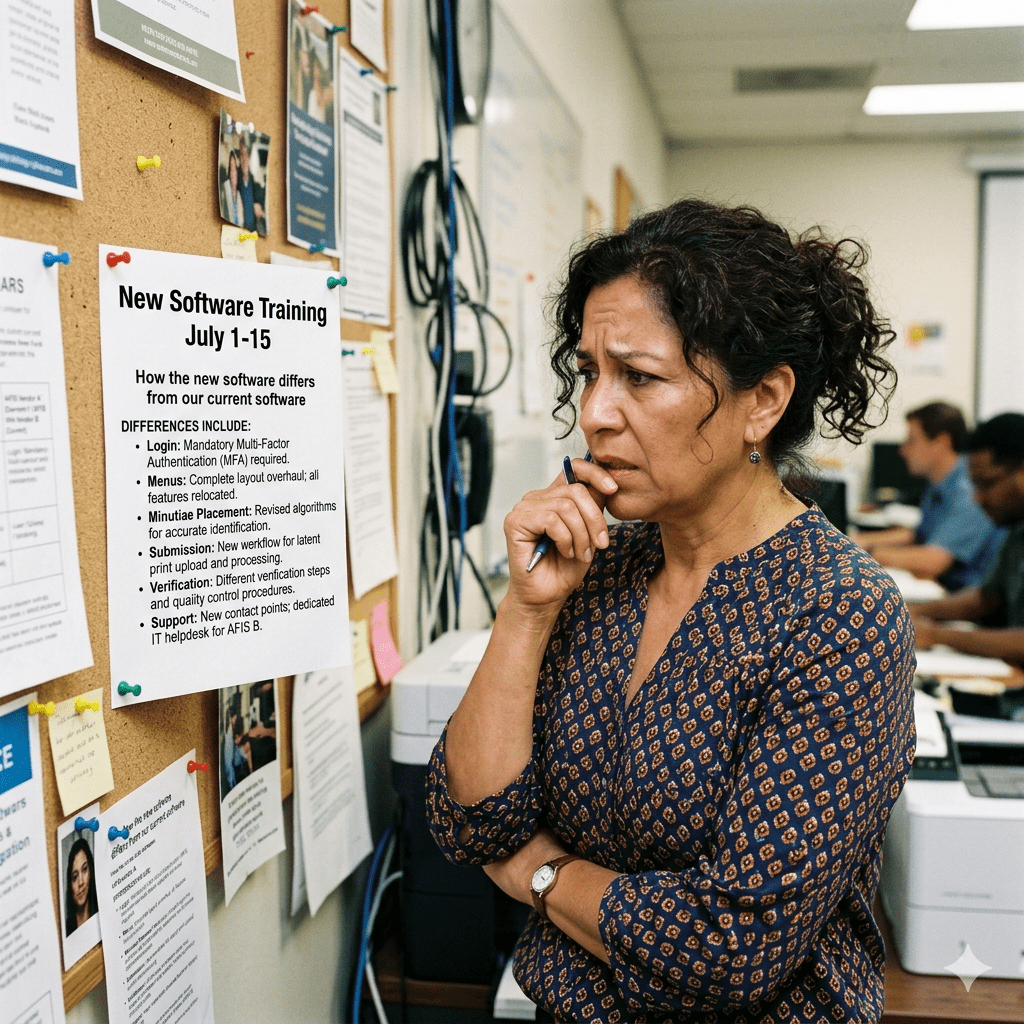
Monica had been a latent examiner for 30 years when her boss made the announcement that the company had awarded the latest AFIS bid to NEC.

Which meant that Monica would no longer use the IDEMIA software. Successor to the MorphoTrak software. Successor to the Motorola software. Successor to the Printrak software.
Google Gemini.

Monica was then informed that mandatory training would take place in three months. Including how to place minutiae in the new system.

She muttered under her breath, saddened that she couldn’t retire in the next three months and avoid putting up with this nonsense.

Issue 5: Leadership doesn’t care about the new tool

But before Monica could stew over that, she received an urgent email from her boss.

“How many hours did you work last week?”

“45. I already entered them in Workday.”

Thankfully, Monica’s employer didn’t use time and attendance machines. You just entered your hours into the official corporate application, in this case Workday.

The boss then sent a follow-up.

“In the future, please send your hours to me via email.”

When leadership mandates a particular process (in this case to enter hours in Workday), but leadership itself doesn’t follow the process, employees get the message.

How do you get people to use mandated and purchased products?

I recently had a conversation with a services company that provides its services to secondary companies. In some cases, the company even donates the necessary hardware and software to the secondary companies.

Having no idea whether the secondary company will even use the donation, or let it gather dust.

For project success, you want adoption. Champions who will encourage others to use your product. Steps to remove roadblocks to using the product.

Internal go-to-market

This is why the best go-to-market projects have both an external AND an internal component.

  • Externally, the company has to convince prospects that the new product meets their needs and provides real benefits.
  • Internally, the company has to enable sales by explaining why the new product is important, how the prospects will benefit from it, and how sales itself will benefit by learning how to sell it.

If your go-to-market doesn’t address internal stakeholders, then they won’t learn how to sell or support your product, and the product willl fail.

Do you want your employees to push your new product? Bredemarket will apply its product marketing expertise to plan and provide both external and internal collateral for a go-to-market plan. Let’s talk about your needs and the possibilities.
The Reality of Content Calendars and Content Management

(Imagen 3)

I have worked with several companies’ content calendars over the years.

  • Two of Bredemarket’s clients are using Jira to manage their content calendars.
  • Another of Bredemarket’s clients doesn’t (as far as I know) have an official content calendar, but is tracking some content in a go-to-market Excel workbook.
  • If I remember correctly, MorphoTrak also used Excel for content management. MorphoTrak’s parent Morpho used a social media management platform, but I can’t remember which one.
  • At the time I was at Incode, the company used Asana to host its content calendar. (I have no idea how Incode has managed its content since May 2023.)

Bredemarket creates its own content (this is an example), and I also use Asana as my official content management platform.

Sharp-eyed people spotted how I worded that last sentence.

What did I just say?

If you read it again, you’ll see that I only discussed my OFFICIAL content management platform.

Some content, including this blog post/LinkedIn post/wherever else the text ends up, never gets logged in Asana. I just started writing it in iOS Notes and I will add various checkboxes up top as I share it on the blog and social channels.

Some other content, also not logged in Bredemarket’s Asana, is repeatable content that I store in Notes and repost periodically.

Something I post to my identity-related social channels (BIFS = Bredemarket Identity Firm Services).

And sometimes—a lot of the time, actually—I just go to a platform and WRITE stuff.

As a sole proprietor, I enjoy absolute control over Bredemarket’s messaging, and therefore the blog and social media approval process is very…streamlined. That isn’t the case elsewhere, where even a simple tweet requires approval. This makes it hard to live-tweet an event when the approver is unavailable…but there are workarounds. Perhaps I will reveal them one day.

What about process?

But if your corporate environment requires you to impose a strict content management structure, where all content is logged in the content calendar and all content requires approval, make sure that your content logging and approval process protects your company but DOESN’T silence it.

Because if your content approvals are too onerous, you will end up with no content at all.

Or you will end up with…perhaps I will reveal that one day.

My Gmail Labels Need a Draft 0.5 to Draft 1 Conversion

(All images from Imagen 3)

I’ve previously discussed my writing process, which consists of a draft 0.5 which I normally don’t show to anyone, and then (preferably after sleeping on it) a draft 1 in which I hack a bunch of the junk out of draft 0.5 to streamline the messaging.

I need to apply that elsewhere.

Like my Gmail labels.

Creating a content calendar

Bredemarket just started providing content services for a new consulting client (no proposal or analysis services—yet), and one of my first tasks was to set up a shared content calendar for the client.

Keeping a content calendar in an email or a document or a workbook works, and I’ve done this before. But keeping it on an accessible, shared platform is better because everyone has the same view and you don’t have to worry about synchronization issues.

Creating a content calendar in Jira

While Bredemarket’s own content calendars (internal and external) are in Asana, this client requested that I use Jira. Another client uses Jira for a content calendar, so I knew it would work fine.

If you’re curious, the content calendar I set up has the following statuses:

  • Backlog
  • On Hold
  • To Do
  • Doing
  • Done

Bredemarket’s external content calendar is more complex, but that’s because I know that everything on that calendar goes through my iterative review cycle process, and because most of my external projects require an invoicing step at the end. So “Doing” involves a lot of sub-statuses before I’m “Done.” My client obviously didn’t need all this. 

So I set up the content calendar, and the first issue (CC-1, create content calendar) is Done. (No confetti, Jira? Asana provides confetti.)

As Steve Taylor spoke in “Jung and the Restless,” “So what’s the problem?”

Creating email labels

The problem is one of my other obsessive habits, labeling or tagging my emails so that I can easily find them.

All my content work for this client generates a lot of emails. And I decided that the best way to label these emails was with their Jira issue number.

So emails concerning the creation of the content calendar bear the label jiracc001.

And emails concerning another issue are labeled jiracc005.

Did I mention that we already have 28 Jira issues so far? (Mostly in the Backlog.)

I shudder to think what my email will look like a week from now. I will find the relevant emails, but will have to wade through dozens or hundreds of labels first.

Proposal Tools of the 2020s

When I was last a full-time Proposal Manager a decade ago (for MorphoTrak), a proposal due date extension did not necessitate an update to an Asana task end date. Asana existed (its iOS and Android apps were both released by 2015), but MorphoTrak wasn’t using them.

Things are different now.

My consulting firm Bredemarket has helped (at least) four identity/biometric companies with proposal work over the years, including RFI responses, RFP responses, proposal letters, and similar communications; proposal templates; and proposal standard text (what the machinists call “boilerplate”).

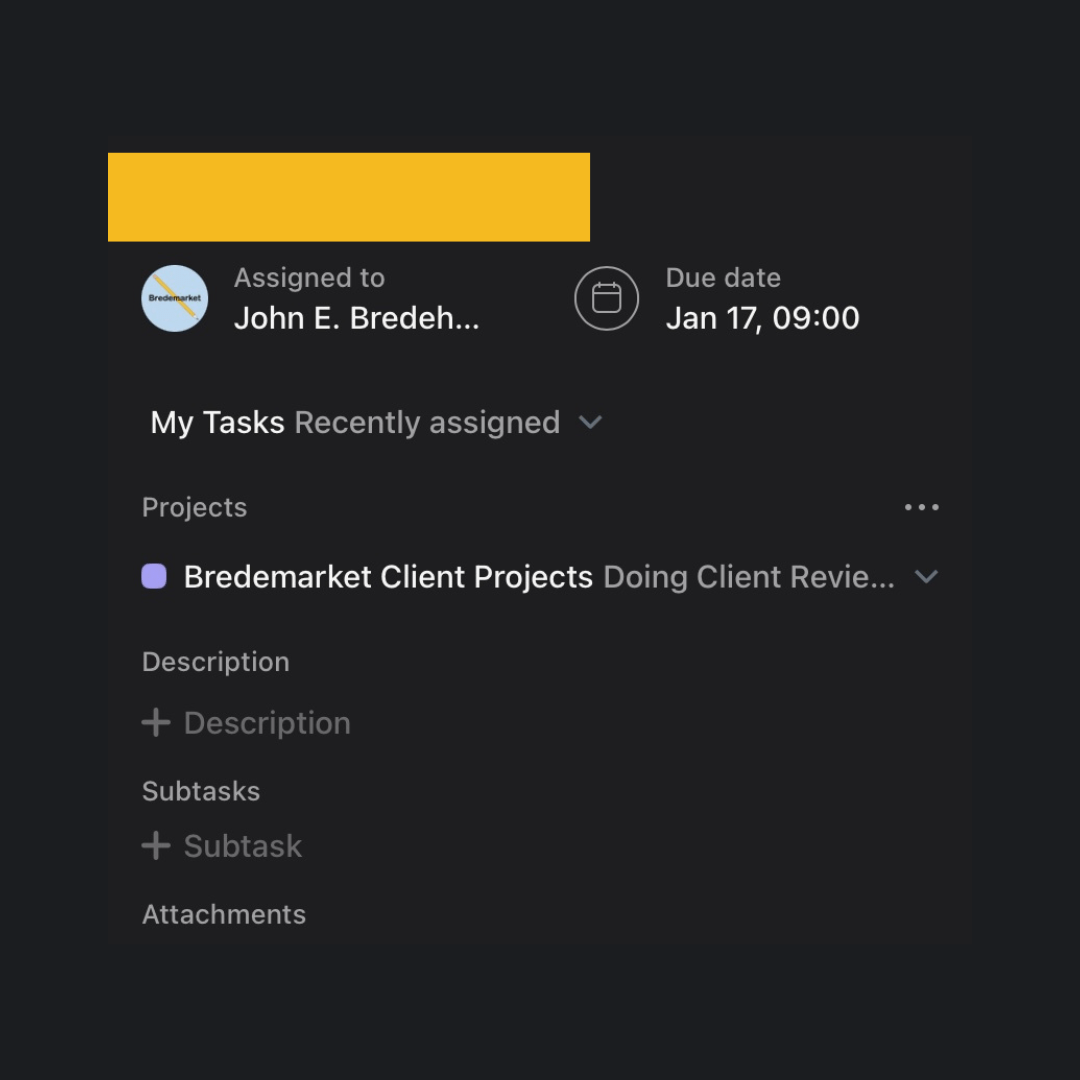
I signed non-disclosure agreements with all these companies, which is why I redacted my current client’s name and its prospective customer from the accompanying image. But if my client wins, I will celebrate. Quietly.

Incidentally, since my Asana is only accessible to me, it only includes minimal information. In Asana, this entire response is a single entry. I use other means to communicate the more detailed schedule to my clients.

Incidentally, if you were one of MY prospects and received a communication saying that I was wrapping up a project today…I’m not. But it’s almost wrapped up, bearing in mind that any gas fills up the available space.

But if you want me to work on your gas, contact me via Bredemarket’s “CPA” page

Proposal work (the P) is just one of several services Bredemarket provides to identity, biometric, and technology clients. In fact, all 4 of the referenced Proposal clients have also used my Content services, my Analysis services, or both.

CPA

The Bredemarket Rule of Corporate Tool Adoption

(12/7: Thanks for catching the typo, Orlando!)

Whoops, I forgot something.

Bredemarket hasn’t proposed any rules.

This may not seem to be a significant gap to you, but it is to me.

I’ve proposed rules on my prior platforms, but haven’t proposed one from Bredemarket. Here’s a list of some of the “Empoprises Rules” I’ve proposed in the past. My favorite:

The Phineas-Hirshfield score measures, on a scale of 0 to 100, the probability that someone will ask exactly what the Phineas-Hirshfield score is.

From https://empoprise-bi.blogspot.com/2012/12/what-is-your-phineas-hirshfield-score.html. The Phineas-Hirshfield score is copyright 2012 by John E. Bredehoft.
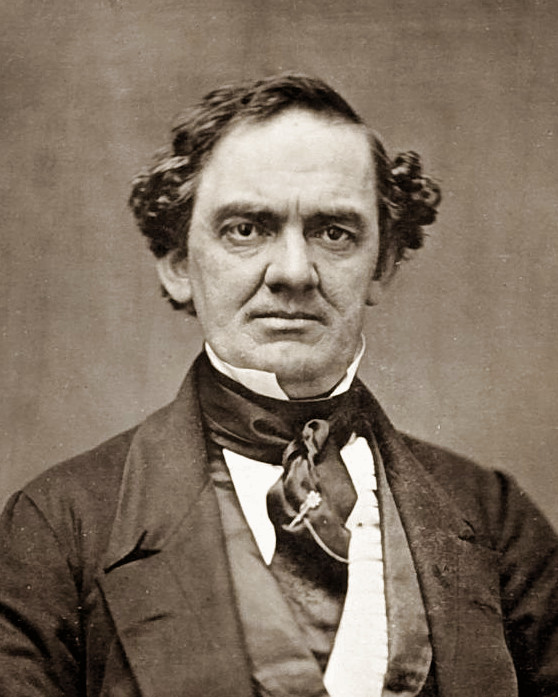
Phineas T. Barnum. By unattributed – Harvard Library, Public Domain, https://commons.wikimedia.org/w/index.php?curid=47588191

Time for me to make a cryptic LinkedIn post. Although now that I’m sharing the secret here, I’ll have to lower the score to 89.

Bredemarket’s first rule

But before I share my revised Phineas-Hirshfield score, I need to share the first Bredemarket Rule, the Bredemarket Rule of Corporate Tool Adoption. (Copyright 2023 Bredemarket.)

In any organization, the number of adopted tools that perform the exact same function is always in excess of one.

In other words, if there’s someone in your organization who is using an iPhone, there is someone else in your organization who is using an Android phone.

Or someone has a Mac, and another person has a Windows computer.

Or someone has one brand of software, while someone else has the competitior brand.

Even if an organization dictates that everyone will use a single tool, there will be someone somewhere who will rebel against the organization and use a different tool.

By Alberto Korda – Museo Che Guevara, Havana Cuba, Public Domain, https://commons.wikimedia.org/w/index.php?curid=6816940

Three reasons why the Bredemarket Rule of Corporate Tool Adoption is true

Here is why this rule is true:

  1. Except in very rare circumstances, there are always multiple tools that perform the exact same function.
  2. Except in very rare circumstances (Bredemarket being a counter-example), organizations are made up of multiple people.
  3. In all circumstances, different people have experienced different realities and therefore like different things.

For example, on Wednesday morning I attended a Product Marketing Alliance-sponsored panel discussion in which one of the panelists mentioned that Asana was a valuable tool that helps product marketers get work done.

Another panelist was a Monday user.

Presumably the first panelist was exposed to Asana at one point and liked it, while the second panelist was exposed to Monday and liked it.

Or, since the panelists were from two different companies, maybe each company standardized on one or the other. Or maybe the departments within their companies standardized on a particular tool, but if you poll the entire company, you’ll find some Monday departments and some Asana departments.

Multiple tools in a single department

Even in the same department you may find multiple tools. Let me cite an example.

  • Several of the people who were in the Marketing department of Incode Technologies have since left the company, and I’m working with one of them on a project this week.
  • I had to send a PDF to him, and was also going to also send him the source Microsoft Word document…until I remembered from our days at Incode that he was (and I guess still is) a Google Docs guy.
  • (As I’ve shared previously, I’m not a Google Docs guy except when a client requires it.)

Even brute force will not invalidate the Rule

Of course, there are times in which an entire organization agrees on a single tool, but those times never last.

My mid-1990s employer, Printrak International, was preparing to go public. The head of Printrak determined that the company needed some help in this, and brought several staffers on board who were expert in Initial Public Offerings (IPOs).

One of these people took the role of Chief Financial Officer, preparing Printrak for its IPO and for two post-IPO acquisitions, one of which profoundly and positively impacted the future of the firm.

Along the way, he established the rule that Printrak would become a Lotus Notes shop.

By Ndamanakis – Own work, CC BY-SA 4.0, https://commons.wikimedia.org/w/index.php?curid=126610779

For those who don’t remember Lotus Notes, it was one of those Lotus-like products that could do multiple things out of the box. And because the CFO was the CFO, he could enforce Lotus Notes usage.

Until the CFO left a couple of years later to assist another company, and the impetus to use Lotus Notes dropped off significantly.

And that, my friends, is why my former colleagues in IDEMIA aren’t using HCL Notes (the successor to Lotus Notes and IBM Notes) today.

So how do you settle the Tool Wars?

Do you know how you settle the Tool Wars?

You don’t. It’s an eternal battle.

In the case of Bredemarket, I can dictate which tools I use…unless my clients tell me otherwise. Then the client’s word is law…unless there’s a compelling reason why my tool should be used instead of the client’s tool. In Bredemarket’s 3+ years of existence, I haven’t encountered such a compelling reason…yet.

Just be flexible enough to use whatever tool you need to use, and you’ll be fine.

How I Expanded 1 Idea Into 31 Pieces of Content

Whenever I see these pieces that proclaim that the author can help you brainstorm x ideas for content, I ignore them. For better or worse, I have no problem coming up with content ideas.

And when I come up with the content ideas, I don’t just use them in one piece of content. I’ll use the idea in several pieces of content. Yes, I love repurposing.

I think I’ve set a new record for myself over the last few days by creating 31 pieces of content from a single idea.

This post talks about:

The post doesn’t aim to tell you how you should create and reshare your content, but perhaps while you’re reading the post you may get some fresh ideas that fit your own working practices.

Three years of preparation

Before you can share content in numerous places, you need numerous places to share your content. It’s obvious, but it’s true. After all, it would be repetitive to post the exact same content multiple times in the Bredemarket blog.

So since I started Bredemarket in 2020, I not only developed the Bredemarket blog, but I have also developed (or made use of) other social platforms.

But how many social platforms should you use? In July, I noted what the experts advise, and how I responded to that advice.

If you’re starting out in business, you’ve probably heard the advice that as your business branches out into social platforms, you shouldn’t try to do everything at once. Instead you should make sure that your business offering is really solid on one platform before branching out into others.

Yes, I’ve been naughty again and didn’t listen to the expert advice.

From https://bredemarket.com/2023/07/18/is-bredemarket-on-your-favorite-social-platform/

The July post lists all of the social platforms that publish Bredemarket content, but for brevity’s sake, I’ll just note a few of the platforms:

  • Four pages on LinkedIn, not counting my personal profile (we’ll get to my personal profile later).
  • Four pages/groups on Facebook.
  • Other image/text platforms such as Instagram and Threads.
  • Two video-only platforms: TikTok and YouTube.
  • Numerous audio outlets for my podcast.
  • My personal X account.

To the content marketing experts that say that I should just concentrate on LinkedIn and ignore everything else, note that I then have a 0% chance of reaching non-LinkedIn users. Who knows? Perhaps that TikTok video may result in a conversion that I couldn’t have made otherwise.

One idea

The idea that struck me last weekend was not original to me, and it’s been bouncing around in my head (and on these pages) for some time now. But I thought I’d reword it in a different way. After a few tweaks, I came up with the following statement:

Your Customers Don’t Care About Your Product’s Technology

As you will see, I continued to tweak the statement, but that’s the one that I put in my Asana “Content Calendar” project.

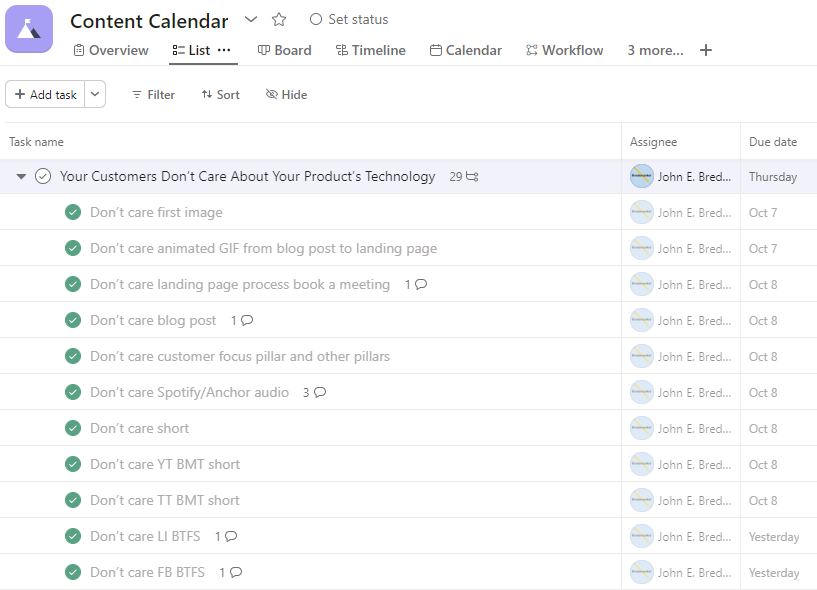
The Asana task that would eventually result in this blog post. Only the first subtasks are shown; as you will see, there are many more.

As I would subsequently reflect, I thought that companies knew that you need to focus on the customer rather than focusing on yourself, but I see too many companies that are self-focused in their marketing. They emphasize the amazing technology features of their product.

I want to put a stop to that, and if necessary I will help companies create customer-focused marketing materials. For a fee, of course.

But enough about me. Let’s illustrate how that one idea can expand into multiple content pieces.

31 pieces of content

So now I had to write about how customers don’t care about your product’s technology.

Content 1: Blog post

The first step was to work on the content required for a blog post on the topic. By the time I was done, the post (now called “Your Prospects Don’t Care About Your Technology“) included:

  • An image, sourced from Wikipedia, of a technologist doing technology things.
  • An image, designed by Freepik, of a customer ignoring someone prattling on about their technology.
  • The “customer focus” illustration that I have used frequently in the past.
  • An animated GIF that beckoned readers to the landing page, described below. The GIF includes the first two images listed above, plus a third from the landing page itself.

Most importantly, the post included all the text that made my original point (“Do you know why your prospects are ignoring you? Because they don’t care about you. It’s all about them.”), along with my argument for customer focus, and my concluding call to action to find out how to “Create Technology Content That Converts.”

Content 2: Landing page

And “Create Technology Content That Converts” was the title of my landing page. Often I put the call to action on the same page as the original point, but sometimes (as in this case) I separate the call to action for a more focused presentation. Plus I have the option of having multiple blog posts point to the same landing page. This post points to the landing page, for example (click the GIF above or one of the other links).

The landing page dug more deeply into why and how Bredemarket can help you create a customer-focused message, talking about the questions I ask, the types of content I can create, and the process.

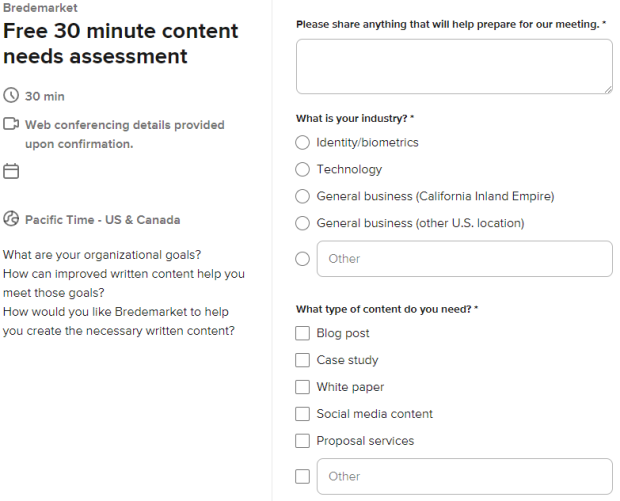
The landing page concluded with the call to action encouraging interested parties to schedule a meeting on my recently-improved Calendly page, email me, or use my contact form. (Or subscribe to my Mailchimp mailing list.)

Once all this was done, everything was set. People who read the blog post could (if so inclined) go to the landing page, and people who read the landing page could (if so inclined) contact me.

But only if they saw the blog post in the first place.

If they don’t find the post on Google or Bing, and if they’re not already subscribing to the blog, then how will they get to the blog post?

Content 3, 4, 5, 6, 7, and 8: Information pages

There are numerous themes that continuously pop up in the Bredemarket blog, and I have created “information pages” (pillars) that link to all of the content that I have written on these themes.

Now perhaps you won’t do all of this, but if there’s a place on your website where you should mention your new blog post, be sure and do it.

For example, if you wrote a blog post about Topic X in 2021, and you’re readdressing Topic X in a 2023 post, then go back and update the 2021 post to say that you have new thoughts on Topic X. Then the people who find your 2021 post can go to the new post and get the latest information.

Content 9: Audio podcast

My podcast is more accurately described as a mini-podcast, because each episode is usually only 1-2 minutes long. Perhaps someday I’ll create hour-long episodes, but not today.

And on Sunday I created a 2-minute episode with a new take. After noting (as I said above) that sometimes we know things that people don’t know, I declared:

Am I smarter than General Electric? Yes I am.

From https://podcasters.spotify.com/pod/show/bredemarket/episodes/Why-Should-I-Care-That-General-Electric-Uses-AI-e2aaenl

I then described a really bad General Electric press release that focused on GE technology and not on customer needs.

Then I plugged the blog post, which was linked in the episode description. And I resued the “technologist doing technology thinks” image from the blog post.

Now I only list this as one piece of content, but really it’s multiple pieces of content. Not only can you access the episode on Spotify for Podcasters (formerly Anchor), but you can also access it on Spotify itself, Apple Podcasts, and numerous other podcast hosting services.

From Spotify.

After this, I returned to the blog post itself and looked for other ways to share it.

Content 10, 11, 12, 13, 14, 15, 16, and 17: Bredemarket LinkedIn and Facebook pages, showcase pages, and groups

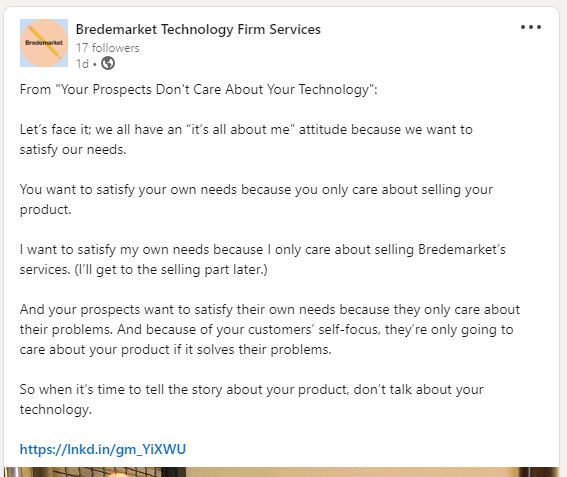
Because the blog post explicitly mentioned “technology” in the title, the best fit for a reshare of the blog post was on the Bredemarket Technology Firm Services LinkedIn showcase page (reshare here) and Facebook group (reshare here).

Why do I have a myriad of LinkedIn and Facebook outlets?

Because often people who are interested in technology don’t care about identity, and people who are interested in the Inland Empire don’t care about technology, and people who care about Bredemarket in general don’t care about every identity company reshare that I post.

And of course, some people who love LinkedIn hate Facebook, and some people who love Facebook hate LinkedIn.

So I could have just shared this to the technology outlets, but this particular post had a broader application. Inland Empire businesses, identity companies, and general marketers all have the problem of referring to self rather than the customer.

So I reshared the original technology shares to the other relevant groups.

From LinkedIn.

Content 18: Instagram carousel

You know how the Instagram experts say that you should post reels? Or you should post carousels? Or whatever?

I say that you should post a healthy balance of all sorts of things.

I wanted to reshare the blog post on Instagram, so I posted an Instagram carousel post using the two images from the blog post and the “money” image from the landing page.

Even though Instagram is a terrible platform to reshare content on other platforms, because the links aren’t clickable.

Unless you reshare the post as a story and use the “link” feature to embed a link.

Content 19 and 20: Bredemarket Threads and JEBredCal X

Oh, and there are two other places where I reshared the link to the blog post:

  • As a thread.
  • As a xeet or whatever tweets are called these days. (This is not an official Bredemarket X account, but my “professional” X account where I share Bredemarket stuff and other stuff.)

So that encompassed the first set of content reshares. But before I go on…

Content 21: LinkedIn reshare of podcast

All of the stuff listed above was stuff that I meticulously planned by listing subtasks to the original Asana task “Your Customers Don’t Care About Your Product’s Technology.”

But I forgot that I deviated from Asana and also shared a link to the podcast in the Bredemarket Technology Firm Services LinkedIn showcase page.

Some people are horrified that I deviated from Asana and didn’t record this important share. (And they’ll really be horrified later in this post when I create another piece of content and don’t log it in Asana.)

Others are horrified that I put all the other stuff in Asana in the first place.

As for me, well, I got the content out. Cool.

But the blog post wasn’t enough. I needed to convey the same message in a different way, for those who think words and stuff aren’t cool.

Content 22, 23, 24, and 25: The short

In the same way that I created an audio podcast that made the same points as the blog post (while linking to the blog post), I wanted to create a video vertical short that did the same thing.

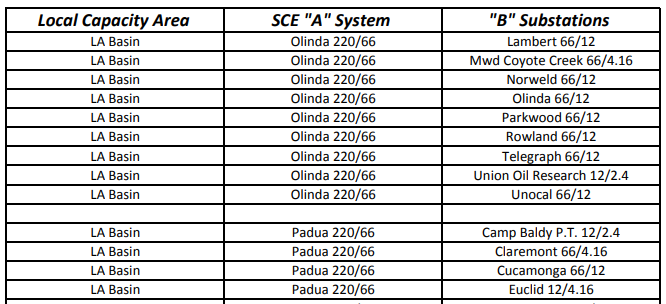
So I headed out to the Southern California Edison Euclid Substation.

From Southern California Edition PDF.

I then stood in front of some very technological stuff, and filmed 27 seconds of me talking about the prospect’s problems…and your problem…and how Bredemarket can solve your problem.

By the time I was finished, the video short was available on:

Originaly posted at https://bredemarket.com/2023/10/08/a-short-on-non-caring-prospects/

So now both WordPress and Instagram had two pieces of content that kinda sorta said the same thing. But this is good. Maybe some people like the video version, while others like the text version. I’ll catch them one way or ther other.

But before I actually shot the video at the SCE Euclid Substation…

Content 26: Instagram Live/Reel

…I was scouting out locations. (If you know the Talking Heads song “Found a Job” you’ll recognize the phrase.)

When I arrived at the SCE Euclid Substation, I walked around the south and west sides of the substation, looking for the best place to shoot my video.

And I was broadcasting on Instagram Live as I was doing this, offering my adoring fans a rare “behind the scenes” look at Bredmarket activities. And, incidentally, proving that Bredemarket behind the scenes is pretty boring.

But the Instagram Live session was recorded, and was posted as a reel a couple of days before my video short was posted.

I don’t know if it made a huge difference in the subsequent reception of the short, but one of my relatives liked the “behind the scenes” look so that’s good.

So those 26 pieces of content addressed Bredemarket’s views on customer focus and benefits.

But my life is not confined to Bredemarket. Time for one huge repurpose.

Content 27: jebredcal blog post

At the same time that I’m asking Bredemarket prospects to contract with me, I’m asking technology companies (including identity companies) to hire me as a Senior Product Marketing Manager.

And the same message can, with some adaptation, be delivered to hiring companies.

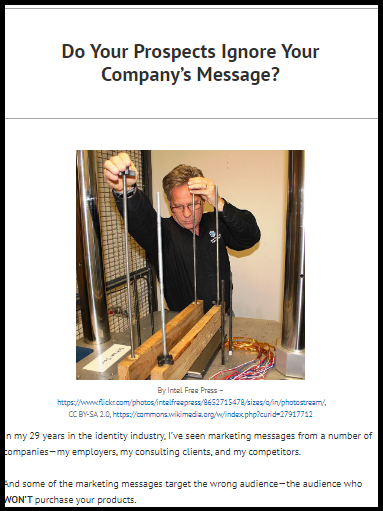
So I wrote a separate blog post on my jebredcal personal blog, “Do Your Prospects Ignore Your Company’s Message?” that addressed the latter target audience.

If you compare the jebredcal blog post with the original Bredemarket blog post, you can see some clear similarities…with some noticeable differences. For example, I don’t ask employers to use Bredemarket’s calendly, email, or web messaging channels. I use my personal email and my LinkedIn profile messaging capability instead.

Now that the blog post was written, I was ready to share it on LinkedIn where the employers are. (No Facebook. No TikTok.)

Correction: I was ALMOST ready to share a link to the post on LinkedIn. I had to complete one thing first.

Content 28: Personal short

I decided that on the day before I shared the post on LinkedIn, I’d create a personal video short that introduced the content.

But this one, rather than taking place in front of a cool electrical facility, would be a behind-the-scenes view of Bredemarket’s world headquarters. Since the city of Ontario restricts you from viewing this yourself (restriction 3), this is the only way that you will ever see Bredemarket’s world headquarters.

Exciting?

No, completely boring.

But I did it anyway, and posted the video on LinkedIn yesterday. (And if you look to the left, you can see Bredemarket’s business license as required by restriction 1.)

Content 29: The LinkedIn share of the jebredcal post

After a day’s wait, the jebredcal blog post was shared on LinkedIn. I haven’t been swamped with job offers yet, but content marketing doesn’t work like that.

Content 30: You’re reading it right now

Once I realized that I was going to write one blog post for Bredmarket prospects and one post for potential employers, I decided to write a third post that talked out how you create different content for different target audiences. As I noted above, the two pieces of content have significant similarities, but also significant differences.

But as I thought about it, I thought it would be more important to illustrate how you could take a single idea and repurpose it as 30 different pieces of content.

Well, 30 so far. I still have to figure out how and where to reshare THIS blog post…

Content 31: LinkedIn post about a job rejection

Stop the presses!

And here’s another EXCITING behind-the-scenes look at how Bredemarket works!

By Tuesday afternoon (October 10, 2023), I had substantially completed writing this blog post on “How I Expanded 1 Idea Into 30 Pieces of Content.” But since there was no huge rush to publish the post—after all, I had just published 29 other pieces of content over the past few days—I figured I’d take advantage of the opportunity to “sleep on it” and look at the post one more time before publication.

Then something happened early Wednesday morning.

Every day, potential employers tell thousands of job candidates that they are “moving in a different direction.” By Original: Jack Ver at Dutch Wikipedia Vector: Ponor – Own work based on: Plaatsvector.png by Jack Ver at Dutch Wikipedia, CC BY-SA 4.0, https://commons.wikimedia.org/w/index.php?curid=95477901

I received a “you have not been selected for this position” email from a potential employer. I had only applied for the position two days earlier, on Monday, right in the midst of all of this content creation.

Proving that I can create content out of ANYTHING, I authored a LinkedIn post that began as follows:

If you are one of the lucky talent acquisition professionals who is still employed, there is ONE CRITICAL THING that you MUST impress upon your employers.

Please tell your employers NOT to list positions as “remote/hybrid.”

That’s kind of like listing a food as “vegan/beef.” Is it vegan, or is it beef? It’s a mystery until you take a bite, and there’s a 50% chance you will be disappointed or horrified with what you find.

From LinkedIn.

You may ask what a LinkedIn post about “remote/hybrid” job listings has to do with incorrectly-focused product marketing messaging.

It’s all in the call to action. Those who read to the end of the post encountered these words.

Anyway, if you’ve read this far and are seeking an experienced identity/biometrics/technology Senior Product Marketing Manager for a #remote position (or a position within 25 miles of Ontario, California), please message me. The linked post below includes my contact information, as well as my philosophy on product marketing messaging.

From LinkedIn.

And then I linked to my personal jobseeking blog post “Do Your Prospects Ignore Your Company’s Message?

  • For those keeping score, that blog post was content number 27.
  • Even though I already posted a link to that post on LinkedIn already. See content number 29.
  • And no, I didn’t list this content in Asana either (see content number 21).

I guess this 31st item is a special treat. Like ice cream.

By Baskin-Robbins – Own work based on: Baskin-Robbins logo 2022.png, Public Domain, https://commons.wikimedia.org/w/index.php?curid=116914428