(This post addresses something that I already announced last week to the Bredemarket mailing list. If you are already subscribed to the mailing list, then you can skip this post. If not, (1) subscribe via the http://eepurl.com/hdHIaT link, and (2) read the post below to catch up on what you missed last week.)
There are three ways that your firm can engage with your content creator.
On one extreme, your firm can hire the content creator as a full-time employee. This gives you the benefit of content creator availability at any time (or at least during office hours; don’t make TOO many 3:00 am calls to your employees).
On the other extreme, your firm can contract with the content creator for a single project. Maybe a blog post. Maybe a white paper. Maybe a tweet. Maybe a proposal responding to a Request for Proposal (RFP).
These extremes satisfy most firms. But a few firms—perhaps yours—need something between these two extremes.
The Drawbacks of Per-Project Content Creation
There are three potential issues with engaging content creators on a per-project basis.
The first issue is work flexibility. If you engage a content creator to write a blog post for you, you get that work done easily. But when you need something else, you need to re-engage the content creator under a separate project.
The second issue is budget predictability. Sure, only engaging content creators on a project-by-project basis helps you save costs (to some extent), but it’s very hard to predict what your future costs will be. Do you think you’ll need two new white papers four months from now, or five months from now.
The third issue is consultant accessibility. You may approach a content creator for a project that you need, only to find that the content creator is completely booked for the next few weeks.
Is there a way to ensure work flexibility, budget predictability, and consultant accessibility—short of hiring the consultant as a full-time employee?
Announcing the Bredemarket 4444 Partner Retainer
My new offering, announced last week to the Bredemarket mailing list, is a retainer offering that allows you to use Bredemarket for ANY writing task, up to a set number of hours per month. In effect, I’m embedded in your organization to serve you as needed.
Within the hours you select in the partner retainer contract, Bredemarket can create any content you need—blogs, case studies / testimonials, data sheets, e-books, proposals, social media posts / Xs (or whatever tweets are called today), white papers, or anything.
In addition, the retainer hours are discounted from my usual rate, so you save money that you would have spent if you contracted with me separately for multiple projects.
How can you learn more?
To learn more how the Bredemarket 4444 Partner Retainer works,
From Venn Marketing, “Awareness, Consideration, Conversion: A 4 Minute Intro To Marketing 101.” (Link)
The picture above shows a simple sales funnel example. The second of the three items in the funnel is the “consideration” phase.
In that phase, those people who are aware of you can then consider your products and services.
If they like what they see, they move on to conversion and hopefully buy your products and services.
But how do prospects in the funnel consideration phase evaluate your offering as opposed to competitor offerings? Is it truly a quantitative and logical process, or is it in reality qualitative and emotional?
Quantitative consideration
For purposes of this post, let’s assume that there are two competing companies, Bredemarket and Debamarket, who are fighting each other for business.
Second, let’s assume that Bredemarket and Debamarket offer similar services to their prospects and customers:
Blog posts
Case studies
White papers
Finally, let’s assume that a big government agency (the BGA) has issued a Request for Proposal (RFP) for blog/case study/white paper services, and Bredemarket and Debamarket are the two companies competing for the award.
A pre-acquisition consultant will develop a Source Selection Plan (SSP). In competitive procurements such as the one in this example, the SSP will state exactly how proposals will be evaluated, and how the best proposal will be selected.
Here is the U.S. Government’s guidance on Source Selection Plans. (link)
SSPs can be very complex for certain opportunities, and not so complex for others. In all cases, the SSP dictates the evaluation criteria used to select the best vendor.
The weighted scoring approach breaks down your RFP evaluation criteria and assigns a value to each question or section. For example, your RFP criteria may consider questions of technical expertise, capabilities, data security, HR policies and diversity and sustainability. Weighted scoring prioritizes the criteria that are most important to your business by assigning them a point or percentage value. So your weighted scoring criteria may look like this:
Technical expertise – 25%
Capabilities – 40%
Data security – 10%
HR policies – 10%
Diversity and sustainability – 15%
RFP360, “A guide to RFP evaluation criteria: Basics, tips and examples.” (Link)
Individual question evaluation
In most cases the evaluator doesn’t look at the entire technical expertise section and give it a single score. In large RFPs, the technical expertise section may consist of 96 questions (or even 960 questions), each of which is evaluated and fed into the total technical expertise score.
For example, the RFP may include a question such as this one, and the responses from the bidders (Bredemarket and Debamarket) are evaluated.
Question
Bredemarket
Debamarket
96. The completed blog post shall include no references to 1960s songs.
Example evaluation of a proposal response to an individual RFP question.
Final quantitative recommendation for award
Now repeat this evaluation method for every RFP question in every RFP category and you end up with a report in which one of the vendors receives more points than the other and is clearly the preferred bidder. Here’s an example from a U.S. Nuclear Regulatory Commission proposal source selection process. (And you can bet that a nuclear agency doesn’t use an evaluation method that is, um, haphazard.)
From U.S. Nuclear Regulatory Commission, “FINAL EVALUATION RECOMMENDATION REPORT FOR PROPOSALS SUBMITTED UNDER RFP NO. RQ-CIO-01-0290 ENTITLED, “INFRASTRUCTURE SERVICES AND SUPPORT CONTRACT (ISSC).”” (link)
So what does this example show us? It shows that L-3 Communications/EER received a total score of 83.8, while its closest competitor Logicon only received a score of 80. So EER is the preferred bidder.
So in our example, BGA would evaluate Bredemarket and Debamarket, come up with a number for each bidder, and award the contract to the bidder with the highest evaluation score.
Quantitative recommendation for the little guys
Perhaps people who aren’t big government agencies don’t go to this level of detail, but many prospects who reach the consideration phase use some type of quantitative method.
For example, if the (non-weighted) pros for an item under consideration outnumber the cons, go for it.
Now of course the discussion above assumes that everyone is a logical being who solely evaluates based on objective criteria.
But even Sages such as myself may deviate from the objective norm. Here’s a story of one time when I did just that.
As I previously mentioned, I had never written a proposal response before I started consulting for Printrak. But I had written a Request for Proposal before I joined Printrak. For a prior employer (located in Monterey Park), I worked with an outside consultant to develop an RFP to help my employer select a vendor for a computer system. The questions posed to the bidders were not complex. Frankly, it was a simple checklist. Does your computer system perform function A? Does it perform function B?
The outside consultant and I sent the final RFP to several computer system providers, and received several proposals in response.
A few of the proposals checked every box, saying that they could do anything and everything. We threw those proposals out, because we knew that no one could meet every one of our demanding requirements. (“I can’t trust that response.”)
We focused on the proposals that included more realistic responses. (“That respondent really thought about the questions.”)
As you can see, we introduced a qualitative, emotional element into our consideration phase.
According to Kaye Putnam, this is not uncommon.
Qualitative consideration
Humans think that we are very logical when we consider alternatives, and that our consideration processes are logical and quantitative. Putnam has looked into this assertion and says that it’s hogwash. Take a look at this excerpt from Putnam’s first brand psychology secret:
Your brand has to meet people at that emotional level – if you want them to buy. (And I know you do!)
Findings from several studies support this, but one of the most seminal was outlined in Harvard professor Gerald Zellman’s 2003 book, The Subconscious Mind of the Consumer. Zellman’s research and learnings prompted him to come to the industry-rocking conclusion that, “95 percent of our purchase decision making takes place in the subconscious mind.”
From Kaye Putnam, “7 Brand Psychology Secrets – Revealed!” (link)
But how can the subconscious mind affect quantitative evaluations?
While logic still has to play SOME role in a purchase decision (as Putnam further explains in her first and second brand psychology secrets), a positive or negative predisposition toward a bidder can influence the quantitative scores.
Imagine if the evaluators got together and discussed the Bredmarket and Debamarket responses to question 96, above. The back and forth between the evaluators may sound like this:
“OK, we’re up to question 96. That’s a no brainer, because no one would ever put song references in a BGA blog post.”
“Yeah, but did you see Bredemarket’s own post that has multiple references to the song ‘Dead Man’s Curve’?”
“So what? Bredemarket would never do that when writing for a government agency. That piece was solely for Bredemarket.”
“How do you KNOW that Bredemarket would never slip a song reference into a BGA post? You know, I really don’t trust that guy. He wore two different colored shoes to the orals presentation, a brown one and a black one. Someone as slopy as that could do anything, with huge consequences for BGA communications. I’m deducting points from Bredemarket for question 96.”
“OK. I think you’re being ridiculous, but if you say so.”
And just like that, your quantitative logical consideration process is exposed as a bunch of subconscious emotional feelings.
How does qualitative consideration affect you?
As you develop your collateral for the consideration phase, you need to go beyond logic (even if you have a Sage predisposition) and speak to the needs and pain points of your prospects.
Spock is behaving illogically. Jayenkai, “Pain – Star Trek Remix.” (link)
Here’s a example from my law enforcement automated fingerprint identificaiton system (AFIS) days.
If your prospect is a police chief who is sick and tired of burglars ransacking homes and causing problems for the police department, don’t tell your prospect about your AFIS image detail or independent accuracy testing results. After all, 1000 ppi and 99.967 accuracy are only numbers.
Provide the police chief with customer-focusedbenefit statements about how quickly your AFIS will clean up the burglary problem in the town, giving residents peace of mind and the police department less stress.
If you can appeal to those emotions, that police chief will consider you more highly and move on to conversion (purchase).
Can I help?
If your messaging concentrates on things your prospects don’t care about, most of them will ignore you and not shower you with money. Using the wrong words with your customers impacts your livelihood, and may leave you poor and destitute with few possessions.
If you need a writer to work with you to ensure that your written content includes the right words that speak directly to your prospects, hire…Debamarket!
Have you ever had a piece of content go viral, but wish that ANOTHER piece of content had gone viral instead? Join the club.
Three examples of unintentional viral content
Here are three examples in which the “wrong” content went viral. Two of the examples are personal, but the first example has nothing to do with me, the Internet, or even the 21st century.
Example 1: Steam behind the wrong song
Back in the 1960s, a singer named Gary DeCarlo was working under the pseudonym Garrett Scott. “Garrett Scott” needed a single, so he was slotted to record a song called “Sweet Laura Lee.”
Because it was a 1960s single, it needed to have a B-side. You couldn’t let all that vinyl on the back of the record go to waste. Any song would do, since it was just filler for “Sweet Laura Lee.”
So DeCarlo and two of his friends resurrected a 1961 song called “Kiss Him Goodbye,” went to the studio, added a silly chant because the 1961 song lacked a chorus, and cranked out the B-side in an evening session. They did it so quickly that the chorus didn’t even have any real words, just “na na.” Actually, the B-side was SUPPOSED to be bad so that disc jockeys would play the A-side:
B-sides in the ’60s were often ad-hoc affairs designed to be clearly inferior to the A-side so that disc jockeys wouldn’t flip the record. The three musicians who recorded this had that in mind for this song, and kept it simple: there is no bass or guitar on the track….
The song “Sweet Laura Lee” went nowhere, but who cares? The record company liked the B-side, invented a fake band name Steam, and the song “Na Na Hey Hey Kiss Him Goodbye” went to the number 1 position on the Billboard charts. A real band named Steam was formed and went on tour…without Gary DeCarlo (although DeCarlo received songwriting royalties).
Example 2: Becoming the unintentional Shipley expert
Fast forward to the 21st century and my creation of blog content for Bredemarket.
I needed to populate my blog with both content marketing-related content and proposal-related content, so in December 2021 I wrote a post entitled “96 Smiles: All about the Shipley Business Development Lifecycle.” I’ve been familiar with the Shipley lifecycle for decades, but probably not as familiar as hundreds if not thousands of proposal practitioners.
So now, right behind Shipley Associates itself, the next leading authority on the Shipley Business Development Lifecycle is…ME.
So now the bredemarket.com website is getting all sorts of traffic related to Shipley, and my Ubersuggest account is, um, suggesting that I optimize the website to capture even more Shipley traffic.
Except that I’m not really doing much with the Shipley process itself; I just talked about it.
Of course, the traffic may have nothing to do with capture and proposal management, since the post makes several explicit and implicit references to the ? and the Mysterians song “96 Tears.”
What I HAVEN’T ignored is the slew of social media channels for Bredemarket. Some of you are aware of this, since you’ve recently received invitations from me to follow Bredemarket on LinkedIn, Facebook, Instagram, Threads, TikTok, and YouTube. If you haven’t, feel free to click on the appropriate links and subscribe now.
So as I’ve been building up my Bredemarket social/content presence and spending a lot of time on this, I received a notification from Facebook this week that, with no effort on my own, my neglected ontarioemperor Facebook page now has over 600 followers.
Now I’m not sure how much Ontario Emperor’s Facebook popularity can benefit Bredemarket, since there’s little or no discernable overlap between synthetic music fans and people requiring marketing and writing services. But who knows? I could be wrong there also.
So sometimes things you want to promote don’t get popular, and things you don’t necessary want to promote get popular.
Rather than being disappointed, just go with the flow, say “na na” to the naysayers, and speak about Shipley with soothing instrumental music behind you.
This post explains what “pillar pages” are, the pros and cons of Bredemarket’s pillar pages, what I’ve learned from the “Target Audience” pillar page that I created, and how this can help your business deliver effective, converting messages to your prospects.
What are pillar pages?
I’ve been working on “pillar pages” for the Bredemarket website for over a year now.
As I stated before in an April 2022 blog post, a “pillar page” is simply a central “cluster” page on your website that discusses an important topic, and which is linked to other pages that provide more detail on the topic.
Think of a wheel with a hub and spokes. The pillar page is the hub, and the related pages are the spokes.
Now these pillar pages aren’t as mature as I’d like them to be.
I haven’t really multi-layered my keywords that link to the pillar; currently things are fairly simplistic where benefit “spoke” blog posts link to the benefits “hub” pillar. I haven’t explicitly optimized the “hub and spokes” for people who search for, say, features.
Similarly, the organization of each pillar page is fairly simplistic. Each pillar starts with a brief discussion of the topic in question, and is then followed by excerpts from and links to blog posts that provide more detail on the topic. (And the blog posts themselves link back to the pillar, providing bidirectional…um, benefits.) It’s functional, but perhaps you’d be better served if the pillars grouped subtopics together, rather than listing all the blog posts in reverse chronological order.
But the pillars do their work in terms of navigation and search engine optimization. If you want to find out what Bredemarket says about a topic such as benefits, it’s fairly easy to find this.
What have I learned from the Bredemarket Target Audience pillar page?
This post delves into the fifth of my five pillar pages, the Target Audience page.
I’ve recently worked on beefing up this pillar page by linking to more Bredemarket blog posts that discuss target audiences. And in the process of making these additions, I’ve realized some things about target audiences that I wanted to summarize here. (Repurposing content refocuses the mind, I guess.)
In the process of improving my pillar page, I’ve gleaned five truths about target audiences:
You need to define at least one target audience.
It’s not illegal to have multiple target audiences.
Different target audiences get different messages.
You can create personas, or you can not create personas. Whatever floats your boat.
Target audience definition focuses your content.
I’ll discuss each of these truths and suggest how they can improve your firm’s content.
One: You Need to Define At Least One Target Audience.
The first and most important thing is that you need a target audience before you start writing.
If you have no target audience, who is receiving your message? How do you know what to say?
For example, the primary target audience for THIS blog post is anyone from any type of company who could use Bredemarket’s marketing and writing services. It’s not limited to just the identity folks, or just the Inland Empire folks. If it were, I’d write it differently.
The content addressed two target audiences at the same time, although this post prioritized the companies looking for full-time employees.
As long as you know in advance what you’re going to do, you can define multiple target audiences. Just don’t define a dozen target audiences for a 288-character tweet.
Three: Different Target Audiences Get Different Messages.
Perhaps you are writing a single piece of content that must address multiple target audiences. A proposal is an example of this. For example, a proposal in response to a request for proposal (RFP) for an automated biometric identification system (ABIS) affects multiple target audiences.
Here’s an example of multiple target audiences for a theoretical Ontario, California ABIS proposal, taken from a May 2021 Bredemarket post:
Field investigators.
Examiners.
People who capture biometrics.
Information Technologies.
Purchasing.
The privacy advocate.
The mayor.
Others.
That’s a lot of target audiences, but if you’re submitting a 300 page proposal that answers hundreds of individual questions, you have the ability to customize each of the hundreds of responses to address the affected target audience(s).
For example, if the RFP asks about the maximum resolution of captured latent fingerprint images, your response will address the needs of the “examiner” target audience. Your response to that question won’t need to say anything about your compliance with city purchasing regulations. (Unless you have a really weird city, which is possible I guess.)
At the same time, if the RFP asks if you comply with E-Verify, this is NOT the time to brag about supporting 4,000 pixels per inch image capture.
Four: You Can Create Personas, Or You Can Not Create Personas. Whatever Floats Your Boat.
If you haven’t read the Bredemarket blog that much, you should know that I’m not very hung up on processes—unless my client (or my employer) insists on them. Then they’re the most important thing in the world.
If you find yourself trapped in a room (preferably padded) with a bunch of certified marketing professionals, they’ll probably toss around the word “persona” a lot. A persona helps you visualize your target audience by writing to someone with a particular set of attributes. Here’s an example from the October 2022 post I cited earlier:
Jane Smith is a 54 year old single white owner of a convenience store in a rural area with an MBA and a love for Limp Bizkit…
If I’m going to write a particular piece of content, this persona helps me focus my writing. As I write, I can picture Jane in my mind, fetching the giant cups for the soda dispenser, planning her next trip to the big city, and wondering if her customers would mind if she started blasting this song.
Not the Seldom Scene.
Having this persona in my mind can be an excellent writing support.
What would Jane think about a list of target audience truths?
What would Jane think if a Limp Bizkit song appeared in the middle of the list? (She’d like that.)
So you can create personas, either on the fly (take a LinkedIn profile of a real person and change a few facts so that the persona becomes Jim, a 35 year old product/content marketer who specializes in healthcare) or through an extensive and expensive persona research program.
But what if you escape from the padded room, run away from the marketing professionals, and swear up and down that you will never ever create a persona?
Will your marketing efforts die?
No they won’t.
You can still target your writing without inventing demographic information about the person reading your content.
It depends upon the effort you want to invest in the task.
Five: Target Audience Definition Focuses Your Content.
I kind of already said this, but I wanted to explicitly repeat it and emphasize it.
Regardless of whether your target audience is defined by an expensive research effort, a tweak of a real person’s LinkedIn profile, or the simple statement “we want to target latent fingerprint examiners,” the simple act of defining your target audience focuses your content.
Your text addresses the target audience, and doesn’t go off on tangents that bear no relation to your target audience.
This makes your message much more effective.
But is the message of this post resonating with companies needing content creators?
If you’re still reading, I guess it is.
Bredemarket can help you define your target audience for your content, and can help you define other things also that are necessary for effective content.
Would you like to talk to me about the content you want to create, and the message you want to deliver to your target audience?
Are you ready to take your firm to the next level with a compelling message that addresses your target audience(s) and increases awareness, consideration, conversion, and long-term revenue?
Companies often have a lot of things they want to do, but don’t have the people to do them. It takes a long time to hire someone, and it even takes time to find a consultant that knows your industry and can do the work.
This affects identity/biometric companies just like it affects other companies. When an identity/biometric company needs a specific type of expertise and needs it NOW, it’s often hard to find the person they need.
If your company needs a biometric content marketing expert (or an identity content marketing expert) NOW, you’ve come to the right place—Bredemarket. Bredemarket has no identity learning curve, no content learning curve, and offers proven results.
Identity/biometric consulting in the 1990s
I remember when I first started working as an identity/biometric consultant, long before Bredemarket was a thing.
OK, not quite THAT long ago. I started working in biometrics in the 1990s—NOT the 1940s.
In 1994, the proposals department at Printrak International needed additional writers due to the manager’s maternity leave, and she was so valuable that Printrak needed to bring in TWO consultants to take her place.
At least initially, the other consultant and I couldn’t fill the manager’s shoes.
Both of us could spell “RAID.” Not the bug spray, but the storage mechanism that stored all those “huge” fingerprint images.
But on that first night that I was cranking out proposal letters for something called a “Latent Station 2000,” I didn’t really know WHAT I was writing about.
As time went on, the other consultant and I learned much more—so much that the company brought both of us on as full-time employees.
After we were hired full-time, we spent a combined 45+ years at Printrak and its corporate successors in proposals, marketing, and product management positions, contributing to industry knowledge.
But neither of us knew biometrics before we started consuting at Printrak.
And I had never written a proposal before I started consulting at Printrak. (I had written an RFP. Sort of.)
But frankly, there weren’t a lot of identity/biometric consultants out in the field in the 1990s. There were the 20th century equivalents of Applied Forensic Services LLC, but at the time I don’t think there were any 20th century equivalents of Tandem Technical Writing LLC.
Unlike the 1990s, identity/biometric firms that need consulting help have many options. In addition to Applied Forensic Services and Tandem Technical Writing you have…me.
Mike and Laurel can tell you what they can do, and I heartily endorse both of them.
Let me share with you why I call myself a biometric content marketing expert who can help your identity/biometric company get marketing content out now:
No identity learning curve
No content learning curve
Proven results
No identity learning curve
I have worked with finger, face, iris, DNA, and other biometrics, as well as government-issued identity documents and geolocation. If you are interested, you can read my Bredemarket blog posts that mention the following topics:
Because I’ve produced both external and internal content on identity/biometric topics, I offer the experience to produce your content in a number of formats.
External content: account-based marketing content, articles, blog posts (I am the identity/biometric blog expert), case studies, data sheets, partner comarketing content, presentations, proposals, sales literature sheets, scientific book chapters, smartphone application content (events), social media posts, web page content, and white papers.
Does your identity business provide biometric or non-biometric products and services that use finger, face, iris, DNA, voice, government documents, geolocation, or other factors or modalities?
Does your identity business need written content, such as blog posts (from the identity/biometric blog expert), case studies, data sheets, proposal text, social media posts, or white papers?
How can your identity business (with the help of an identity content marketing expert) create the right written content?
A little over a year ago, Bredemarket announced two changes in my business scope and business hours. I stopped accepting work from clients who marketed systems to identify individuals, and I reduced my business hours to Saturday mornings only.
Generated at craiyon.com.
I had to change my business scope and business hours. On May 9, 2022, I started a full-time position with a company in the identity industry, which meant that I couldn’t consult on weekdays and couldn’t consult on identity projects.
But things change.
As of May 31, 2023, I will no longer be employed at my day job.
Which is my misfortune…um…opportunity.
Generated at craiyon.com.
Has Bredemarket changed its business scope and business hours a second time?
Yes.
As of June 1, 2023:
If you need a consultant for marketing or proposal work, and your company is involved in the identification of individuals, Bredemarket can accept the work.
If you need a consultant who can meet with you during normal business hours, Bredemarket can accept the work.
So what?
My…um…opportunity is your opportunity.
Now that I can expand my business scope and business hours again, you can take advantage of my extensive marketing expertise, including deep experience in the identity industry.
This means you can obtain quickly-generated and expert content with an agreed-upon focus.
This means you can get content that increases your revenue.
These two e-books explain (a) how Bredemarket starts a project with you, and (b) how Bredemarket has helped other businesses over the years.
(UPDATE OCTOBER 22, 2023: “SIX QUESTIONS YOUR CONTENT CREATOR SHOULD ASK YOU IS SO 2022. DOWNLOAD THE NEWER “SEVEN QUESTIONS YOUR CONTENT CREATOR SHOULD ASK YOU” HERE.)
If I could demonstrate that Bredemarket benefited a firm via a case study, that could help Bredemarket get business from other firms. I said so myself:
A well-crafted case study can be the first step in convincing a potential customer to become a paying customer.
But once I started writing the document, I decided that one case study wasn’t enough.
So I wrote four mini-case studies in the same document, briefly describing how I helped four Bredemarket clients create different types of content so that they could win more business.
I helped one client to quickly generate consistent proposals. One of the client’s salespeople even provided me with a testimonial. (You may have seen it before.)
I helped another client share persuasive case studies. The client kept on coming back to me for more case studies—a dozen in all—and other work.
I helped a third client position via blogs and a white paper.
Finally, I helped position a sole proprietor.
After the four mini-case studies, I briefly described how Bredemarket works with clients. (Sleep is involved.)
I didn’t get into my six questions, since I already wrote an e-book on that topic, but I did provide an overview of the initial meeting, the content iteration process, and my work for hire policy (which explains why I didn’t name the four clients listed above).
So would you like to read my four mini-case studies?
Here is my latest e-book, “How Bredemarket Can Help You Win Business.”
Instead of writing “online,” I should have written “offline.”
I don’t know whether I just made a typo, or if I intentionally wrote “online,” but I shouldn’t have.
Why QR codes rarely make sense online
Because if you’re online, you don’t need a QR code, since you presumably have access to a clickable URL.
But if you’re offline—for example, if you’re watching a commercial on an old-fashioned TV screen—a QR code makes perfect sense. Well, as long as you explicitly identify where the QR code will lead you, something Coinbase failed to do in 2022. “Just click on the bouncing QR code and don’t worry where you’ll go!”
But there’s one more place where QR codes make sense. I didn’t explicitly refer to it in my 2021 post, but QR codes make sense when you’re looking at printed material, such as printed restaurant menus.
Or COVID questionnaires.
Which reminds me…
What I didn’t tell you about the Ontario Art Walk
…there’s one story about the Ontario Art Walk that I didn’t share in yesterday’s post.
After leaving Dragon Fruit Skincare, but before visiting the Chaffey Community Museum of Art, I visited one other location that I won’t identify. This location wanted you to answer a COVID questionnaire, which you accessed via a QR code.
I figured I’d do the right thing and answer the questionnaire, since I had nothing to worry about.
I was vaccinated.
I was boosted.
I hadn’t been around anyone with COVID.
I didn’t have a fever.
I entered the “right” response to every single question, except for the one that asked if I had a runny or stuffy nose. Since I had a stuffy nose, I indicated this.
But hey, it’s just a stuffy nose. What could go wrong?
When I finished the questionnaire, I was told that based on my answers, I was not allowed in the premises, and if I was already in the premises I should leave immediately.
Which I did.
And which is why I didn’t write about that particular location in yesterday’s post.
Bredemarket, pressing the flesh (sometimes six feet away)
But back to non-health related aspects of QR codes.
The Ontario Art Walk was actually the second in-person event that I had attended that week. As I noted on Instagram, I also went to a City of Ontario information session about a proposed bike lane.
Now that COVID has (mostly) receded, more of us are going to these in-person events. My target market (businesspeople in the United States) is mostly familiar with the century-old term “press the flesh.” While it usually applies to politicians attending in-person events, it can equally apply to non-political events.
Whenever I go out to these local events, I like to have some printed Bredemarket collateral handy in case I find a local businessperson looking for marketing services. After all, since I am the Ontario, California content marketing expert, I should let relevant people in Ontario know this.
In those cases, a QR code makes sense, since I can hand it to the person, the person can scan the QR code on their phone, and the person can immediately access whatever web page or other content I want to share with them.
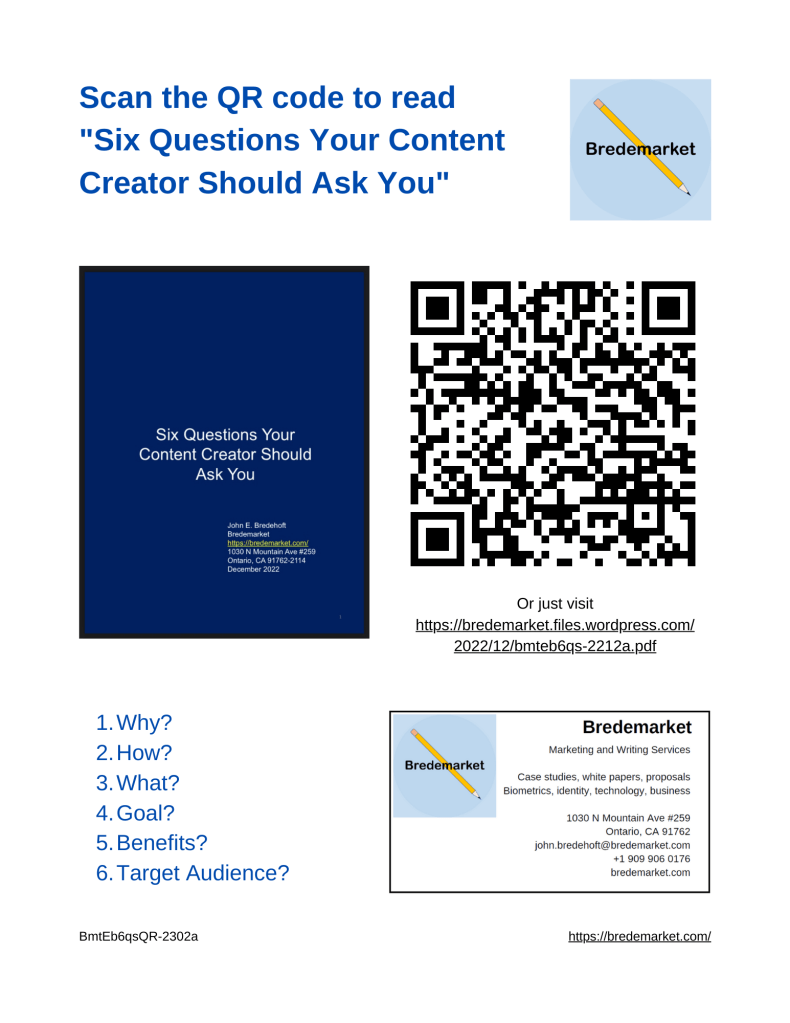
On Saturday, it occurred to me that if I ran across a possible customer during the Ontario Art Walk, I could use a QR code to share my e-book “Six Questions Your Content Creator Should Ask You.”
Unfortunately, this bright idea came to my mind at 5:30 pm for an event that started at 6. I dummied up a quick and dirty page with the cover and a QR code, but it was…dirty. Just as well I didn’t share that on Saturday.
But now that I have more time, I’ve created a better-looking printed handout so that I’m ready at the next in-person event I attend.
If we meet, ask me for it.
Making myself look less smart
Well, now that I’ve gone through all of this trouble explaining how QR codes are great for offline purposes, I’m going to share the aforementioned handout…online.
(UPDATE OCTOBER 22, 2023: “SIX QUESTIONS YOUR CONTENT CREATOR SHOULD ASK YOU IS SO 2022. DOWNLOAD THE NEWER “SEVEN QUESTIONS YOUR CONTENT CREATOR SHOULD ASK YOU” HERE.)
Which has probably prompted the following question from you.
“Why?”
Four reasons:
It gave me the excuse to post the question “Why?” above, thus reiterating one of the major points of the e-book.
Because I felt like sharing it.
Just in case you don’t make “Event X” that I attend in the future, you can experience the joy of printing the flyer and scanning the QR code yourself. Just like you were there!
To demonstrate that even when you provide a piece of content with a QR code, it’s also helpful to explicitly reveal the URL where you’ll head if you scan the code. (Look just below the QR code in the flyer above.) And if you receive the flyer in online form rather than printed form, that URL is clickable.
This gave me an opportunity to revisit the topic and add critical information on wildebeests, George (H.W.) Bush, and Yogi Berra.
But more importantly, it allows me to share my thoughts with a wider audience.
If you missed the October blog post, I state that there are six critical questions that your content creator must ask before creating content. These questions apply whether your content creator is a consultant, an employee at your company, or you.
The e-book discusses each of these six questions:
Why?
How?
What?
Goal?
Benefits?
Target Audience?
And as I note in the e-book, that’s just the beginning of the content creation process.
Whether you intend to use Bredemarket as your content creator, use someone else as your content creator, or create your own content, the points in this e-book are helpful. They can be applied to content creation (case studies, white papers, blog posts) or proposal work, and apply whether you are writing for Inland Empire West businesses or businesses anywhere.
And if you read the e-book, you’ll discover why I’m NOT sharing it on the Bredemarket Identity Firm Services LinkedIn page and Facebook group.
You can download the e-book here. And you can be a content marketing expert also.
(UPDATE OCTOBER 22, 2023: “SIX QUESTIONS YOUR CONTENT CREATOR SHOULD ASK YOU IS SO 2022. DOWNLOAD THE NEWER “SEVEN QUESTIONS YOUR CONTENT CREATOR SHOULD ASK YOU” HERE.)













 Bredemarket