If you’re familiar with Bredemarket’s “six questions your content creator should ask you”…I came up with a seventh question because I feared the six questions were not enough, and I wanted to provide you with better confidence that Bredemarket-authored content will achieve your goals.
To no one’s surprise, I’ll tell you WHY and HOW I added a seventh question.
If you want to skip to the meat, go to the WHAT section where you can download the new e-book.
Why?
Early Sunday morning I wrote something on LinkedIn and Facebook that dealt with three “e” words: entertainment, emotion, and engagement, and how the first and second words affect the third. The content was very long, and I don’t know if the content itself was engaging. But I figured that this wasn’t the end of the story:
I know THIS content won’t receive 250 engagements, and certainly won’t receive 25,000 impressions, but maybe I can repurpose the thoughts in some future content. (#Repurposing is good.)
Rather than delving into my content with over 25,000 impressions but less than 250 engagements, and rather than delving into the social media group I discussed, and rather than delving into the Four Tops and the Sons of the Pioneers (not as a single supergroup), I decided that I needed to delve into a single word: indifference, and how to prevent content indifference.
Because if your prospects are indifferent to your content, nothing else matters. And indifference saddens me.
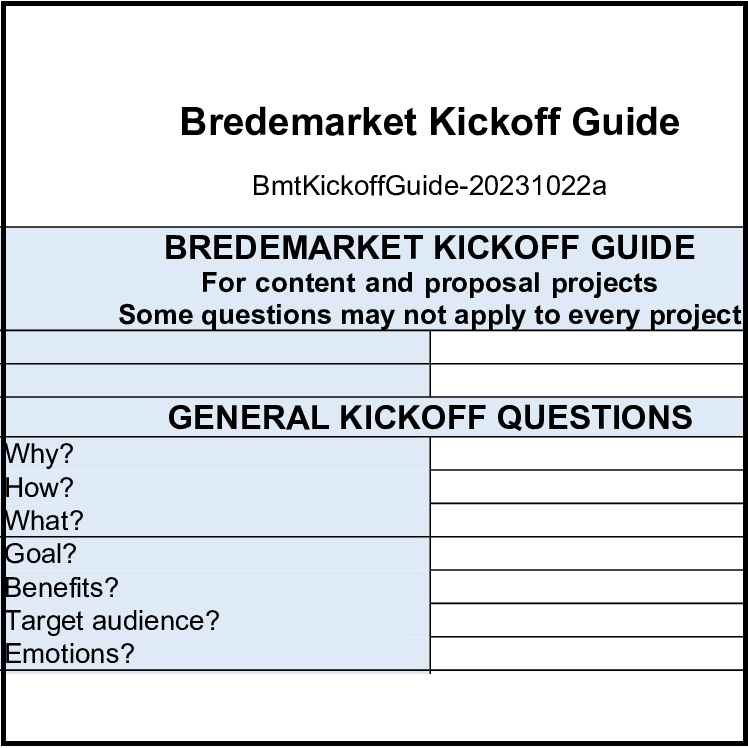
The first questions in the Bredemarket Kickoff Guide, BmtKickoffGuide-20231022a. No, you can’t have the guide; it’s proprietary.
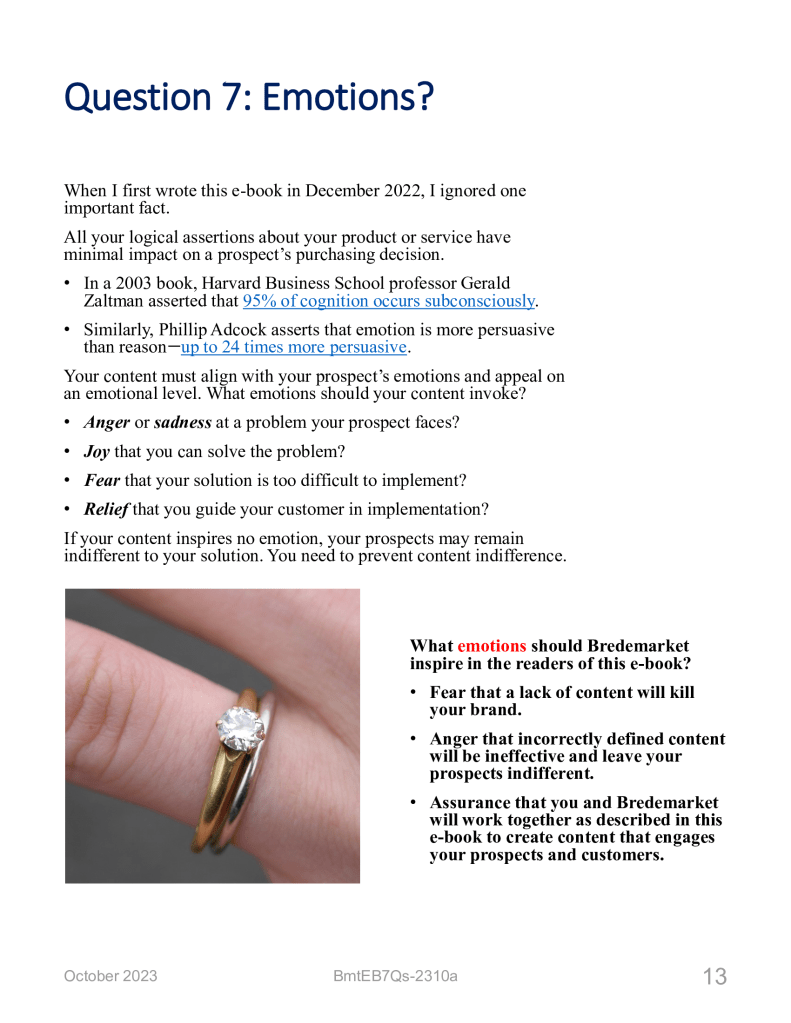
I decided that I needed to update my process, as well as that e-book, and add a seventh question, “Emotions?”
What?
For those who have raced ahead to this section, Bredemarket has a new downloadable e-book (revised from an earlier version) entitled “Seven Questions Your Content Creator Should Ask You.” It includes a new page, “Emotions,” as well as minor revisions to the other pages. You can download it below.
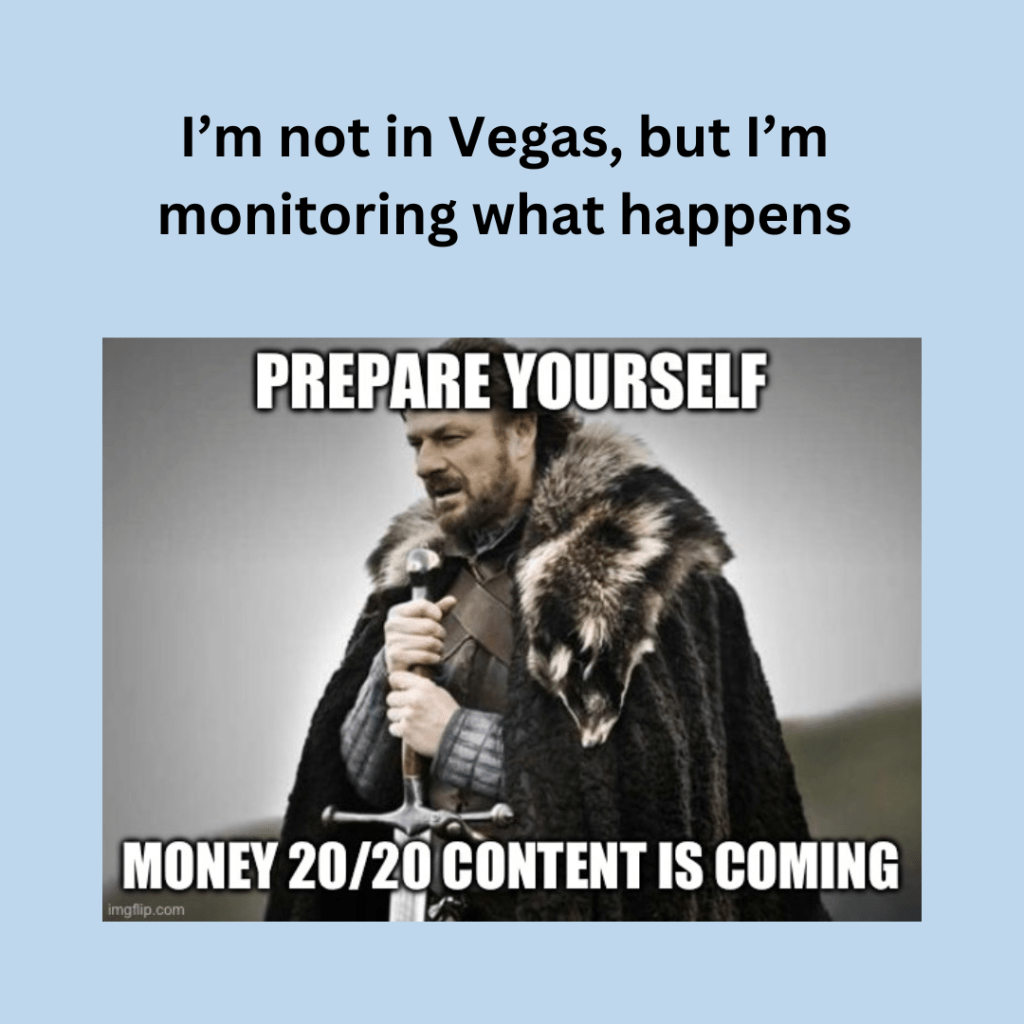
Money 20/20 is taking place in Las Vegas, Nevada, USA from Sunday, October 22 to Wednesday October 25.
While I am not in Las Vegas, Bredemarket will monitor the goings-on and share relevant news on Facebook (Bredemarket Identity Firm Services group), Instagram (Bredemarket), LinkedIn (Bredemarket Identity Firm Services page), bredemarket.com, and elsewhere.
I constantly preach that firms should not adopt “me too” messaging. Ideally, a firm’s messaging should not copy its competitors, but should instead state why the firm is better than all others, and why all the other firms are worthless in comparison.
But when a firm differentiates itself, there is always a danger that the firm will forget one important thing: how will the customersreact to the firm’s differentiated messaging? Will the differentiation turn the customers off?
Trust me, it can happen.
A multinational’s great idea that backfired
Some time ago, I was working for a multinational firm that clearly differentiated itself from all of its competitors. This multinational had been around for some time and was known for its particular tone.
I’m not going to reveal the name of the particular multinational firm, or the tone it radiated.
The IBM illustrative example
But the tone used by that multinational was just as powerful as the tone IBM exuded in the mid-20th century.
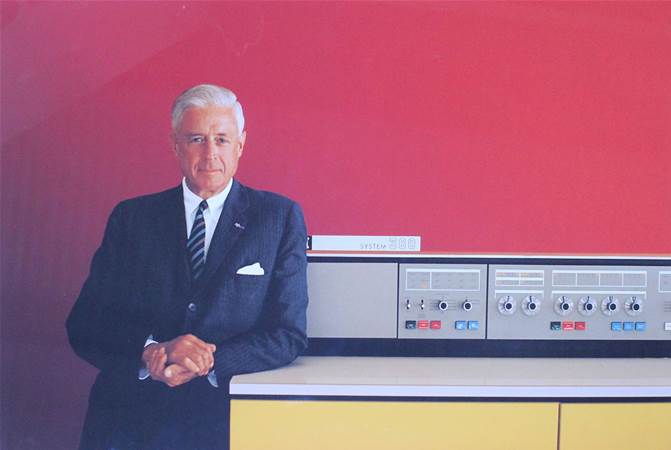
In the 1950s and 1960s, “Big Blue” meant a particular style.
The men of IBM didn’t wear facial hair and wore only white shirts….IBM wanted to make sure they did not offend a prospect or a customer. Research had shown them that some people don’t like facial hair…so no facial hair. Research had also shown that people assume a degree of professionalism with a white shirt that may not be assumed if a person wore a blue or yellow shirt. So white shirts it is!
Let’s leave the theoretical example and return to the situation at my distinctive multinational.
Now the multinational that employed me long ago didn’t have a “blue suit-white shirt” dress code, but in other ways the multinational had a distinctive tone that radiated from the executive level down to the ranks of the worker bees like myself.
We all embodied this tone.
We spoke in this tone.
And our marketing messages also spoke in this tone, regardless of the market segment to which our marketers were speaking.
Even if the market segment had a very different tone than the one the multinational was projecting. (Imagine the Military Police selling the Vietnam War in Haight-Ashbury.)
By By S.Sgt. Albert R. Simpson. Department of Defense. Department of the Army. Office of the Deputy Chief of Staff for Operations. U.S. Army Audiovisual Center. – This tag does not indicate the copyright status of the attached work. A normal copyright tag is still required. See Commons:Licensing., Public Domain, https://commons.wikimedia.org/w/index.php?curid=1111279
When my multinational sent its marketing collateral out to prospects who used a very different tone than that used by the multinational, the prospects hated it. The marketing department received multiple complaints from salespeople whose clients were repelled by the material.
One of my coworkers surveyed the negative campaign reaction with dismay. The coworker had joined the company after the marketing tone was adopted. My coworker asked a simple question: “What type of customer focus group testing was conducted before we used this tone on a marketing campaign?”
“We didn’t conduct any focus group testing,” my coworker was told. “We didn’t need any.”
In retrospect, I guess we did need to test the messaging before we delivered it.
Four ways to balance customer focus and a firm’s distinctive messaging
If you’ve been reading recent Bredemarket blog posts, you’re probably not surprised that this is turning into yet another blog post aboutcustomer focus. But how do you balance a firm’s distinctive differentiators with a focus on its customers?
Fourth, your messaging needs some smarts. Just because your prospect bought a refrigerator on Monday doesn’t mean that they’ll want a second refrigerator on Tuesday.
If you follow these and similar steps, then it (almost) doesn’t matter if your firm’s generic messaging is antithetical to the values of your prospects. Because your prospects won’t get generic messaging, but messaging that is focused for them.
Whenever I see these pieces that proclaim that the author can help you brainstorm x ideas for content, I ignore them. For better or worse, I have no problem coming up with content ideas.
And when I come up with the content ideas, I don’t just use them in one piece of content. I’ll use the idea in several pieces of content. Yes, I love repurposing.
I think I’ve set a new record for myself over the last few days by creating 31 pieces of content from a single idea.
The post doesn’t aim to tell you how you should create and reshare your content, but perhaps while you’re reading the post you may get some fresh ideas that fit your own working practices.
Three years of preparation
Before you can share content in numerous places, you need numerous places to share your content. It’s obvious, but it’s true. After all, it would be repetitive to post the exact same content multiple times in the Bredemarket blog.
So since I started Bredemarket in 2020, I not only developed the Bredemarket blog, but I have also developed (or made use of) other social platforms.
If you’re starting out in business, you’ve probably heard the advice that as your business branches out into social platforms, you shouldn’t try to do everything at once. Instead you should make sure that your business offering is really solid on one platform before branching out into others.
Yes, I’ve been naughty again and didn’t listen to the expert advice.
Four pages on LinkedIn, not counting my personal profile (we’ll get to my personal profile later).
Four pages/groups on Facebook.
Other image/text platforms such as Instagram and Threads.
Two video-only platforms: TikTok and YouTube.
Numerous audio outlets for my podcast.
My personal X account.
To the content marketing experts that say that I should just concentrate on LinkedIn and ignore everything else, note that I then have a 0% chance of reaching non-LinkedIn users. Who knows? Perhaps that TikTok video may result in a conversion that I couldn’t have made otherwise.
One idea
The idea that struck me last weekend was not original to me, and it’s been bouncing around in my head (and on these pages) for some time now. But I thought I’d reword it in a different way. After a few tweaks, I came up with the following statement:
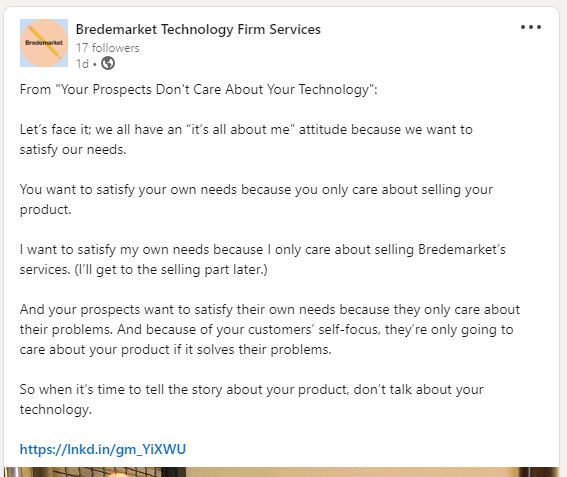
Your Customers Don’t Care About Your Product’s Technology
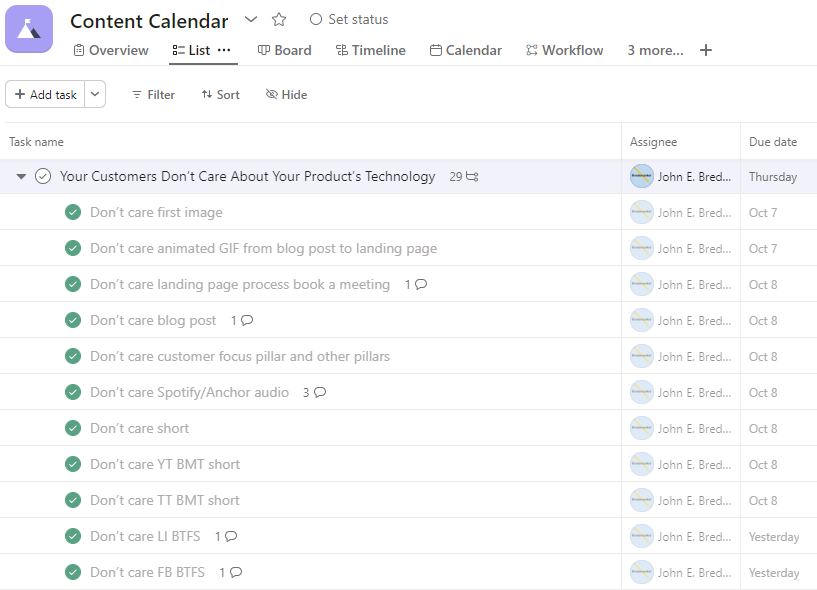
As you will see, I continued to tweak the statement, but that’s the one that I put in my Asana “Content Calendar” project.
The Asana task that would eventually result in this blog post. Only the first subtasks are shown; as you will see, there are many more.
As I would subsequently reflect, I thought that companies knew that you need to focus on the customer rather than focusing on yourself, but I see too many companies that are self-focused in their marketing. They emphasize the amazing technology features of their product.
I want to put a stop to that, and if necessary I will help companies create customer-focused marketing materials. For a fee, of course.
But enough about me. Let’s illustrate how that one idea can expand into multiple content pieces.
31 pieces of content
So now I had to write about how customers don’t care about your product’s technology.
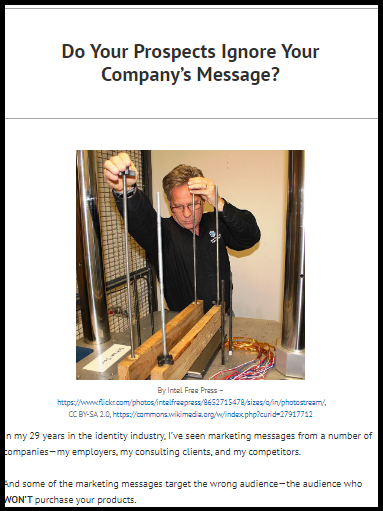
An image, sourced from Wikipedia, of a technologist doing technology things.
An image, designed by Freepik, of a customer ignoring someone prattling on about their technology.
The “customer focus” illustration that I have used frequently in the past.
An animated GIF that beckoned readers to the landing page, described below. The GIF includes the first two images listed above, plus a third from the landing page itself.
Most importantly, the post included all the text that made my original point (“Do you know why your prospects are ignoring you? Because they don’t care about you. It’s all about them.”), along with my argument for customer focus, and my concluding call to action to find out how to “Create Technology Content That Converts.”
Content 2: Landing page
And “Create Technology Content That Converts” was the title of my landing page. Often I put the call to action on the same page as the original point, but sometimes (as in this case) I separate the call to action for a more focused presentation. Plus I have the option of having multiple blog posts point to the same landing page. This post points to the landing page, for example (click the GIF above or one of the other links).
The landing page dug more deeply into why and how Bredemarket can help you create a customer-focused message, talking about the questions I ask, the types of content I can create, and the process.
Once all this was done, everything was set. People who read the blog post could (if so inclined) go to the landing page, and people who read the landing page could (if so inclined) contact me.
But only if they saw the blog post in the first place.
If they don’t find the post on Google or Bing, and if they’re not already subscribing to the blog, then how will they get to the blog post?
Content 3, 4, 5, 6, 7, and 8: Information pages
There are numerous themes that continuously pop up in the Bredemarket blog, and I have created “information pages” (pillars) that link to all of the content that I have written on these themes.
Now perhaps you won’t do all of this, but if there’s a place on your website where you should mention your new blog post, be sure and do it.
For example, if you wrote a blog post about Topic X in 2021, and you’re readdressing Topic X in a 2023 post, then go back and update the 2021 post to say that you have new thoughts on Topic X. Then the people who find your 2021 post can go to the new post and get the latest information.
Content 9: Audio podcast
My podcast is more accurately described as a mini-podcast, because each episode is usually only 1-2 minutes long. Perhaps someday I’ll create hour-long episodes, but not today.
And on Sunday I created a 2-minute episode with a new take. After noting (as I said above) that sometimes we know things that people don’t know, I declared:
I then described a really bad General Electric press release that focused on GE technology and not on customer needs.
Then I plugged the blog post, which was linked in the episode description. And I resued the “technologist doing technology thinks” image from the blog post.
Now I only list this as one piece of content, but really it’s multiple pieces of content. Not only can you access the episode on Spotify for Podcasters (formerly Anchor), but you can also access it on Spotify itself, Apple Podcasts, and numerous other podcast hosting services.
After this, I returned to the blog post itself and looked for other ways to share it.
Content 10, 11, 12, 13, 14, 15, 16, and 17: Bredemarket LinkedIn and Facebook pages, showcase pages, and groups
Because the blog post explicitly mentioned “technology” in the title, the best fit for a reshare of the blog post was on the Bredemarket Technology Firm Services LinkedIn showcase page (reshare here) and Facebook group (reshare here).
Why do I have a myriad of LinkedIn and Facebook outlets?
Because often people who are interested in technology don’t care about identity, and people who are interested in the Inland Empire don’t care about technology, and people who care about Bredemarket in general don’t care about every identity company reshare that I post.
And of course, some people who love LinkedIn hate Facebook, and some people who love Facebook hate LinkedIn.
So I could have just shared this to the technology outlets, but this particular post had a broader application. Inland Empire businesses, identity companies, and general marketers all have the problem of referring to self rather than the customer.
So I reshared the original technology shares to the other relevant groups.
You know how the Instagram experts say that you should post reels? Or you should post carousels? Or whatever?
I say that you should post a healthy balance of all sorts of things.
I wanted to reshare the blog post on Instagram, so I posted an Instagram carousel post using the two images from the blog post and the “money” image from the landing page.
Even though Instagram is a terrible platform to reshare content on other platforms, because the links aren’t clickable.
Unless you reshare the post as a story and use the “link” feature to embed a link.
Content 19 and 20: Bredemarket Threads and JEBredCal X
Oh, and there are two other places where I reshared the link to the blog post:
As a xeet or whatever tweets are called these days. (This is not an official Bredemarket X account, but my “professional” X account where I share Bredemarket stuff and other stuff.)
So that encompassed the first set of content reshares. But before I go on…
Content 21: LinkedIn reshare of podcast
All of the stuff listed above was stuff that I meticulously planned by listing subtasks to the original Asana task “Your Customers Don’t Care About Your Product’s Technology.”
But I forgot that I deviated from Asana and also shared a link to the podcast in the Bredemarket Technology Firm Services LinkedIn showcase page.
Some people are horrified that I deviated from Asana and didn’t record this important share. (And they’ll really be horrified later in this post when I create another piece of content and don’t log it in Asana.)
Others are horrified that I put all the other stuff in Asana in the first place.
As for me, well, I got the content out. Cool.
But the blog post wasn’t enough. I needed to convey the same message in a different way, for those who think words and stuff aren’t cool.
Content 22, 23, 24, and 25: The short
In the same way that I created an audio podcast that made the same points as the blog post (while linking to the blog post), I wanted to create a video vertical short that did the same thing.
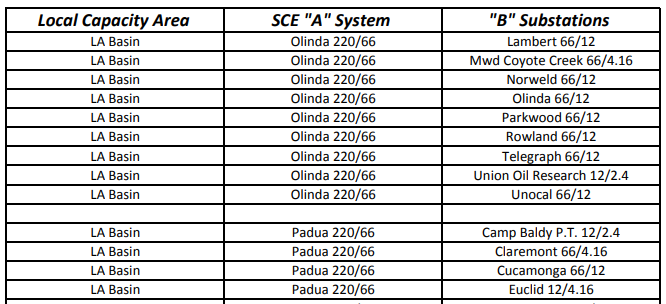
So I headed out to the Southern California Edison Euclid Substation.
I then stood in front of some very technological stuff, and filmed 27 seconds of me talking about the prospect’s problems…and your problem…and how Bredemarket can solve your problem.
By the time I was finished, the video short was available on:
So now both WordPress and Instagram had two pieces of content that kinda sorta said the same thing. But this is good. Maybe some people like the video version, while others like the text version. I’ll catch them one way or ther other.
But before I actually shot the video at the SCE Euclid Substation…
Content 26: Instagram Live/Reel
…I was scouting out locations. (If you know the Talking Heads song “Found a Job” you’ll recognize the phrase.)
When I arrived at the SCE Euclid Substation, I walked around the south and west sides of the substation, looking for the best place to shoot my video.
And I was broadcasting on Instagram Live as I was doing this, offering my adoring fans a rare “behind the scenes” look at Bredmarket activities. And, incidentally, proving that Bredemarket behind the scenes is pretty boring.
But the Instagram Live session was recorded, and was posted as a reel a couple of days before my video short was posted.
I don’t know if it made a huge difference in the subsequent reception of the short, but one of my relatives liked the “behind the scenes” look so that’s good.
So those 26 pieces of content addressed Bredemarket’s views on customer focus and benefits.
But my life is not confined to Bredemarket. Time for one huge repurpose.
Content 27: jebredcal blog post
At the same time that I’m asking Bredemarket prospects to contract with me, I’m asking technology companies (including identity companies) to hire me as a Senior Product Marketing Manager.
And the same message can, with some adaptation, be delivered to hiring companies.
If you compare the jebredcal blog post with the original Bredemarket blog post, you can see some clear similarities…with some noticeable differences. For example, I don’t ask employers to use Bredemarket’s calendly, email, or web messaging channels. I use my personal email and my LinkedIn profile messaging capability instead.
Now that the blog post was written, I was ready to share it on LinkedIn where the employers are. (No Facebook. No TikTok.)
Correction: I was ALMOST ready to share a link to the post on LinkedIn. I had to complete one thing first.
Content 28: Personal short
I decided that on the day before I shared the post on LinkedIn, I’d create a personal video short that introduced the content.
But this one, rather than taking place in front of a cool electrical facility, would be a behind-the-scenes view of Bredemarket’s world headquarters. Since the city of Ontario restricts you from viewing this yourself (restriction 3), this is the only way that you will ever see Bredemarket’s world headquarters.
Exciting?
No, completely boring.
But I did it anyway, and posted the video on LinkedIn yesterday. (And if you look to the left, you can see Bredemarket’s business license as required by restriction 1.)
Content 29: The LinkedIn share of the jebredcal post
Once I realized that I was going to write one blog post for Bredmarket prospects and one post for potential employers, I decided to write a third post that talked out how you create different content for different target audiences. As I noted above, the two pieces of content have significant similarities, but also significant differences.
But as I thought about it, I thought it would be more important to illustrate how you could take a single idea and repurpose it as 30 different pieces of content.
Well, 30 so far. I still have to figure out how and where to reshare THIS blog post…
Content 31: LinkedIn post about a job rejection
Stop the presses!
And here’s another EXCITING behind-the-scenes look at how Bredemarket works!
By Tuesday afternoon (October 10, 2023), I had substantially completed writing this blog post on “How I Expanded 1 Idea Into 30 Pieces of Content.” But since there was no huge rush to publish the post—after all, I had just published 29 other pieces of content over the past few days—I figured I’d take advantage of the opportunity to “sleep on it” and look at the post one more time before publication.
Then something happened early Wednesday morning.
Every day, potential employers tell thousands of job candidates that they are “moving in a different direction.” By Original: Jack Ver at Dutch Wikipedia Vector: Ponor – Own work based on: Plaatsvector.png by Jack Ver at Dutch Wikipedia, CC BY-SA 4.0, https://commons.wikimedia.org/w/index.php?curid=95477901
I received a “you have not been selected for this position” email from a potential employer. I had only applied for the position two days earlier, on Monday, right in the midst of all of this content creation.
If you are one of the lucky talent acquisition professionals who is still employed, there is ONE CRITICAL THING that you MUST impress upon your employers.
Please tell your employers NOT to list positions as “remote/hybrid.”
That’s kind of like listing a food as “vegan/beef.” Is it vegan, or is it beef? It’s a mystery until you take a bite, and there’s a 50% chance you will be disappointed or horrified with what you find.
You may ask what a LinkedIn post about “remote/hybrid” job listings has to do with incorrectly-focused product marketing messaging.
It’s all in the call to action. Those who read to the end of the post encountered these words.
Anyway, if you’ve read this far and are seeking an experienced identity/biometrics/technology Senior Product Marketing Manager for a #remote position (or a position within 25 miles of Ontario, California), please message me. The linked post below includes my contact information, as well as my philosophy on product marketing messaging.
And one of those records was so unmemorable that it was memorable.
The album, recorded in the early to mid 1960s, trumpeted the fact that the group that recorded the album was extremely versatile. You see, the record not only included surf songs, but also included car songs!
The only problem? The album was NOT by the Beach Boys.
Instead, the album was from some otherwise unknown band that was trying to achieve success by doing what the competition did. (In this case, the Beach Boys.)
I can’t remember the name of the band, and I bet no one else can either.
“Me too” in computing and lawn care
Sadly, this tactic of Xeroxing (or Mitaing) the competition is not confined to popular music. Have you noticed that so many recipes for marketing success involve copying what your competitors do?
Semrush: “Analyze your competitors’ keywords that you are not ranking for to discover gaps in your SEO strategy.”
iSpionage: “If you can emulate your competitors but do things slightly better you have a good chance of being successful.”
Someone who shall remain nameless: “Look at this piece of collateral that one of our competitors did. We should do something just like that.”
And of course the tactic of slavishly copying competitors has been proven to work. For example, remember when Apple Computer adopted the slogan “Think The Same” as the company dressed in blue, ensured all its computers could run MS-DOS, and otherwise imitated everything that IBM did?
“But John,” you are saying. “That’s unfair. Not everyone can be Apple.”
My point exactly. Everyone can’t be Apple because they’re so busy trying to imitate someone else—either a competitor or some other really popular company.
Personally, I’m waiting for some company to claim to be “the Bredemarket of satellite television. (Which would simply mean that the company would have a lot of shows about wildebeests.) But I’ll probably have to wait a while for some company to be the Bredemarket of anything.
(An aside: while talking with a friend, I compared the British phrase “eating your pudding” to the American phrase “eating your own dog food,” although I noted that “I like to say ‘eating your own wildebeest food‘ just to stand out.” Let’s see ChatGPT do THAT.)
“Me too” in identity verification
Now I’ll tread into more dangerous territory.
Here’s an example from the identity/biometric world. Since I self-identity (heh) as the identity content marketing expert, I’m supremely qualified to cite this example.
I spent a year embedded in the identity verification industry, and got to see the messaging from my own company and by the competition.
After a while, I realized that most of the firms in the industry were saying the same thing. Here are a few examples. See if you can spot the one word that EVERY company is using:
(Company I) “Reimagine trust.”
(Company J) “To protect against fraud and financial crime, businesses online need to know and trust that their customers are who they claim to be — and that these customers continue to be trustworthy.”
(Company M) “Trust is the core of any successful business relationship. As the digital revolution continues to push businesses and financial industries towards digital-first services, gaining digital trust with consumers will be of utmost importance for survival.”
(Company O) “Create trust at onboarding and beyond with a complete, AI-powered digital identity solution built to help you know your customers online.”
(Company P) “Trust that users are who they say they are, and gain their trust by humanizing the identity experience.”
(Company V) “Stop fraud. Build trust. Identity verification made simple.”
Yes, these companies, and many others, prominently feature the t-word in their messaging.
Now perhaps some of you would argue that trust is essential to identity verification in the same way that water is essential to an ocean, and that therefore EVERYBODY HAS to use the t-word in their communications.
After all, if I was going to create content for this prospect, we had to ensure that the content stood out from their competitors.
Without revealing confidential information, I can say that I asked the firm why they were better than every other firm out there, and why all the other firms sucked. And the firm provided me with a compelling answer to that question. I can’t reveal that answer, but you can probably guess that the word “trust” was not involved.
A final thought
So let me ask you:
Why is YOUR firm better than every other firm out there, and why do all or YOUR competitors suck?
Your firm’s survival may depend upon communicating that answer.
While I don’t use all the marketing tools at my disposal, I am certainly curious about them. After all, such tools provide marketers with powerful insights on their prospects and customers.
I became especially curious about one marketing tool when re-examining a phrase I use often.
I use the phrase “biometric content marketing expert” in a non-traditional way. When I use it, I am attempting to say that I am a content marketing expert on the use of biometrics for identification. In other words, I can create multiple types of content that discusses fingerprint identification, facial recognition, and similar technologies.
But if you speak to a normal person, they will assume that a “biometric content marketing expert” is someone who uses biometrics (the broader term, not the narrower term) to support content marketing. This is something very different—something that is generally known as “facial coding,” a technique that purports to provide information to marketers.
We all know that our face conveys emotions through facial expressions; facial coding is the process of measuring those human emotions. With the help of computer vision, powered by AI and machine learning, emotions can be detected via webcam or mobile cam. The tech tracks every muscle movement on the face or all-action units (AU) based on the FACS (facial action coding system).
The differences between facial coding and facial recognition
Unlike the topics in which I usually dwell, facial coding:
Does not identify individuals. Many people can share the same emotions, so detection of a particular emotion does not serve as individualization.
Does not provide permanent information. In the course of watching a movie or even a short advertisement, viewers often exhibit a wide range of emotions. Just because you exhibit a particular emotion at the beginning of an ad doesn’t mean you’ll exhibit the same emotion at the conclusion.
As Rathi describes the practice, it preserves privacy by allowing people to opt-in, and to record the emotions anonymously.
So, the user’s permission is required to access their camera and all this data is captured with consent. And no video is shared. Only the emotion data of the users are captured through their facial expressions and shared in real-time. The emotions on a person’s face are captured as binary units (0 and 1). Hence no PII (Personally Identifiable Information) related to race, ethnicity, gender, or age is captured at any point in time.
But what if another firm chooses to gather more data, thus reducing the anonymity of the data collected? “I don’t only want to know how people react to the content. I want to know how black women in their 30s react to the content.”
And what if another firm (or a government agency, such as the Transportation Security Administration) chooses to gather the data without explicit consent, or with consent buried deep in the terms of service? In that case, people may not even realize that their facial expressions are being watched.
Examining facial expressions is not the only way to decipher what is happening in a person’s mind as they view content. But it’s powerful.
Well, maybe.
Does everyone exhibit the same facial coding?
The underlying assumption behind emotion recognition is that you can identify emotions at a universal level. If content makes me happy, or if it makes a person halfway around the world happy, we will exhibit the same measurable facial characteristics.
Research has not revealed a consistent, physical fingerprint for even a single emotion. When scientists attach electrodes to a person’s face and measure muscle movement during an emotion, they find tremendous variety, not uniformity. They find the same variety with the body and brain. You can experience anger with or without a spike in blood pressure. You can experience fear with or without a change in the amygdala, the brain region tagged as the home of fear.
When scientists set aside the classical view and just look at the data, a radically different explanation for emotion comes to light. We find that emotions are not universal but vary from culture to culture. They are not triggered; you create them. They emerge as a combination of the physical properties of your body, a flexible brain that wires itself to whatever environment it develops in, and your culture and upbringing.
If Barrett is correct, then how reliable is facial coding, even within a particular region? After all, even Southern California does not have a single universal culture, but is made up of many cultures in which people react in many different ways. And if we preserve privacy by NOT collecting this cultural information, then we may not fully understand the codings that the cameras record.
Back to the familiar “biometric” world
And with that, I will retreat from the broader definition of biometrics to the narrower and more familiar one, as described here.
The term “Biometrics” has also been used to refer to the field of technology devoted to the identification of individuals using biological traits, such as those based on retinal or iris scanning, fingerprints, or face recognition. Neither the journal “Biometrics” nor the International Biometric Society is engaged in research, marketing, or reporting related to this technology.
All too often, Bredemarket confines its writing discussions to the traditional ABCW (articles, blog posts, case studies, white papers) categories.
But what if your content needs are non-traditional and fall outside of the usual nice neat business writing categories?
From the 2023 Route 66 Cruisin’ Reunion, Saturday, September 16, 2023.
If you are an Inland Empire business who needs words, but not in the traditional “ABCW” (articles, blog posts, case studies, white papers) business types, Bredemarket will help you with your non-traditional writing needs.
Take a look at the examples I’ve provided below, and if these spark interest within you, authorize Bredemarket, Ontario California’s content marketing expert, to help your firm produce words that return results.
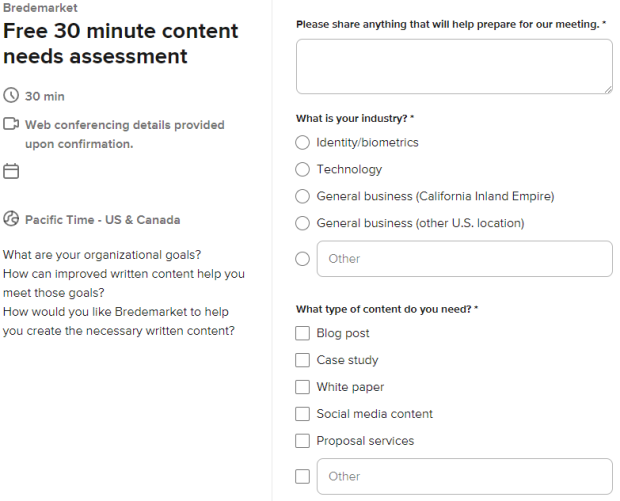
Book a meeting with me at calendly.com/bredemarket. Be sure to fill out the information form so I can best help you. For example, if you’re an Inland Empire business requiring non-traditional content, fill out the form accordingly.
I won’t go into all 22 types again, especially since some of them are internal content rather than customer-facing content. But I’d like to highlight the “ABCW” four types that I mentioned at the beginning of this blog post, plus a couple of others.
Articles and blog posts
I’m lumping articles and blog posts together, because while some “experts” try to draw hard-and-fast distinctions between the two, they’re pretty much the same thing.
Whether it’s a blog post on your website, a post or article on LinkedIn, or even some extended text associated with an Instagram picture or a TikTok video, what you’re creating is some text that entertains, persuades, inspires, or educates your reader, or perhaps all four. You set the goal for the article or blog post, then tailor the content to meet the goal. (I’ll talk more about goals later.)
Case studies
From “How Bredemarket Can Help You Win Business,” available via this post.
Case studies show your readers how your solution was applied to someone else’s problem, and how your solution can benefit your prospects with similar problems.
Maybe your prospect is a city police agency that needs a tool to solve crimes, and your case study describes how your solution solved crimes in a similar city. Again, you set the goal for the case study, then tailor the content to meet the goal.
White papers
On the surface, white papers are informational, but when a company issues a white paper, the “information” that the white paper provides should gently guide the reader toward doing business with the company that issued the paper. Using the example above, you could write a white paper that outlines “Five Critical Elements for a Local Crime-Solving Solution.” By remarkable coincidence, your own solution happens to include all five of those critical elements. Again, you set the goal and tailor the content.
Briefs, data sheets, and literature sheets
One-page sheet for the Bredemarket 400 Short Writing Service. More information here.
Perhaps you need to provide handouts to your prospects that describe your product or service.
Regardless of whether you call these handouts briefs, data, sheets, literature sheets, or something else, they should at a minimum contain both “educate” and “persuade” elements—educate your prospects on the benefits of your product or service, and persuade your prospects to move closer to a sale (conversion).
Again, you set the goal and tailor the content.
Web page content
If your business has a web page, I hope that it has more words than “Under construction.” Whether you have imagery, video, audio, text, or all four on your web page, it needs to answer the questions that your prospects and customers have.
You know what I’m going to say here, but it’s still important. You set the goal and tailor the content.
But…what if your business needs content that doesn’t fall into these traditional business categories?
Non-traditional content: going to a car show
I went to a car show this weekend—specifically, this year’s Route 66 Cruisin’ Reunion in downtown Ontario, California. (Yes, I know that Route 66 actually passed three miles north of downtown Ontario, but work with me here.)
While some of the exhibitors were personal, some of them were businesses. As businesses, what was the major marketing collateral that they generated?
Not a blog post, or LinkedIn article, or any of the traditional business media collateral.
In addition to the car itself, this exhibitor included poster boards with words describing the car.
Another exhibitor did the same thing.
So while these car show exhibitors didn’t choose a traditional way to convey their words, they shared written text anyway.
Your non-traditional business communication needs
Maybe you don’t have a classic car. Maybe you don’t have a car at all. Do you need to share words with your prospects and customers anyway?
Now I don’t know your business communication needs. You do. But I can guess a few things.
Do you need to tell your clients/potential clients why you do what you do?
Do you need to tell them how you do it?
And last but not least, do you need to tell them what you do?
I know that this may seem like an unusual order to you. Why not start with what you do?
Because your customers don’t care about what you do. Your customers care about themselves.
If you keep the focus on your customers, the answer to the “why” question will induce your customers to care about you, because it shows how you can solve their problems.
Let’s illustrate this.
Why and how Bredemarket creates non-traditional content
You may be asking why I create content in the first place. There are countless content creators, both human and non-human. Why turn to me when OpenAI and its bot buddies are a lot cheaper and faster?
Normally I include my recent professional picture, but I have been writing since my college days (on a typewriter back then).
Bredemarket’s service is independent of content type. I don’t have a “Bredemarket blog writing service” or “Bredemarket data sheet writing service” or “Bredemarket case study writing service.” My services are based on word length, not content type, with my most popular service targeted to customers who need between 400 and 600 words of text. From this perspective, I don’t care if you want the words to appear on your website or your social media channel or a paper flyer or a sign next to your car or a really really long banner towed behind an airplane. (Read about the Bredemarket 400 Short Writing Service here.)
Before I write a thing, I ask your some questions. It won’t surprise you to learn that my first questions to you are why, how, and what. I then move on to questions about your goal for the content, the benefits of your solution, the target audience for your solution, and many additional questions. (Read about the Six Questions Your Content Creator Should Ask You here.)
Once the questions are out of the way, content creation is collaborative and iterative. I create a draft, you review it, and we repeat. The Bredemarket 400 service includes two review cycles; longer content needs include three review cycles. The goal is to ensure that both of us are happy with the final product.
Bredemarket’s process applies regardless of the specific content type, so I should be able to support whatever content you need, whether it’s traditional or non-traditional.























 Bredemarket