Some Hallucinations Are GOOD Hallucinations

Most of us treat hallucinations as an evil, scary thing. With some exceptions.

Moody Blues, “Legend Of A Mind.”

This negative perception of hallucinations extends to our views of generative artificial intelligence. Although perhaps what generative AI does is more accurately called “confabulations.”

““A hallucination is a conscious sensory perception that is at variance with the stimuli in the environment. A confabulation, on the other hand, is the making of assertions that are at variance with the facts, such as “the president of France is Francois Mitterrand,” which is currently not the case.”

Whatever you call it, the result is not consciously intended. And it can sometimes be bad.

Lying on a job application

Take those AI tools that jobseekers can use to not only apply for a job, but automatically customize their resume for that particular job.

When automatic resume rewrites are not reviewed, the new resume may end up with confabulations, hallucinations, or outright falsehoods.

If my rewritten resume claims two years’ Python experience, that just ain’t true.

And I could lose a job opportunity if I lie on my resume.

Fly (on) an eagle

But those who praise hallucinations as good are not limited to Timothy Leary.

Take the time I intentionally asked Google Gemini’s image creation engine (Imagen 4 at the time) to make something up.

Google Gemini (Imagen 4).

Perhaps I’m wrong, but I don’t see any harm in creating a Tolkienesque illustration of Theodore Roosevelt riding a flying bald eagle. Actually, TR fans may think it’s pretty cool.

By definition, ANY generative AI engine HAS to invent stuff. A prompt can’t specify everything.

Audio inventiveness

Let’s look at another example, the two-plus minute song that formed the audio for my recent reel “The Cooling Blue.”

“The Cooling Blue.” Google Lyria. Public Domain.

Now here is the prompt that I used to create that audio track.

“Create a moving song with violin, harp, and guitar about overly long meetings. The opening male spoken words are “meeting hour 1, meeting hour 2, meeting hour 3, meeting hour 4.” The female singer, accompanied by a female choir, sings of her despair in pointless meetings with no purpose. The chorus consists of the choir singing “When will this madness end?””

When you review the prompt you can see many of the elements of the final song.

But I never told Lyria to sing “the coffee turned to ink.” Lyria made that up.

But I like that addition.

And I have another example.

Image inventiveness

This example is from the images that appeared throughout the video. These were also created by Google; is the image generation capability still called Nano Banana this month?

Anyway, here is the prompt for the noon scene.

“Edit the picture so the time is noon and the lead wombat is still droning on and on. The attendees are restless.”

Google Gemini.

Google executed my image request.

But look more closely.

Google Gemini.

I did NOT specify that the koala write the note “Make it end…so sleepy.” Or any of the other notes that this particular koala wrote throughout the day.

Nor did I specify the “out of order” note that appeared on the coffee urn at 10:10 am.

(My little secret: that time was NOT supposed to be 10:10. I asked Google to display a time of 10:45. But since so much of the clock training data uses at 10:10 time, Google got confused.)
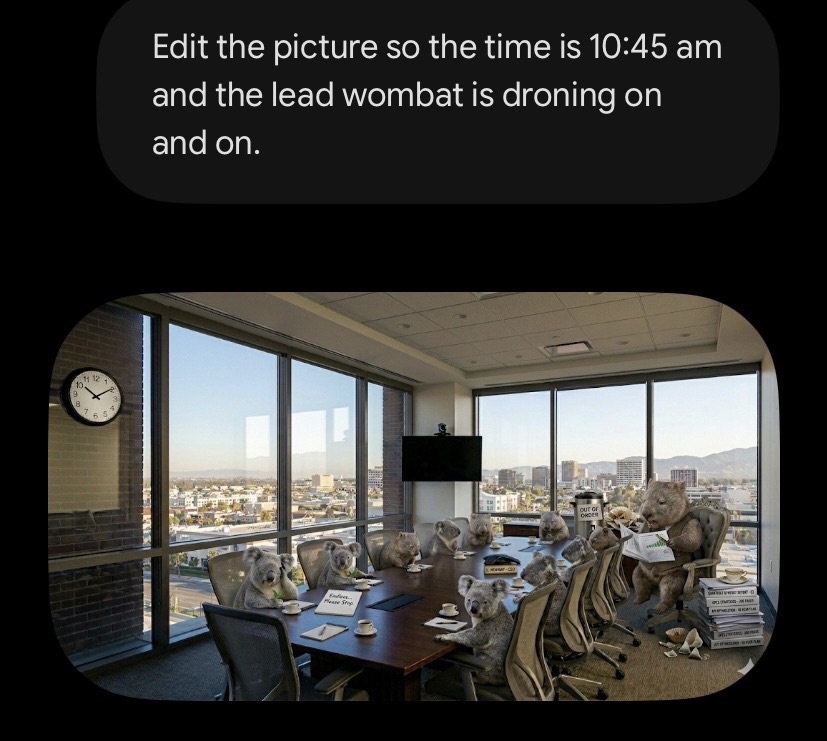
Prompt and response from Google Gemini.

But I like those additions.

Take two minutes and twenty-four seconds and watch the reel again, taking note of the few elements specified by me, and the many elements that were “made up” by Google.

“The Cooling Blue.” Google Gemini/Lyria. Public Domain.

Hallucinations can be good, evil, or indifferent

Adding a koala note of frustration is a good thing.

Lying on a job application is a bad thing.

And showing a time of 10:10 instead of the requested time of 10:45? It didn’t materially affect my story, so I was indifferent to it.

What is Your Tone of Voice?

We relate to firms as entities with personalities…and particular tones of voice. Could you imagine Procter & Gamble speaking in Apple’s tone of voice, or vice versa?

And one more thing…Charmin. Now in black.

(Thunderous applause and royal adoration with no indifference whatsoever.)

Designed by Freepik.

When you contract with a writer

Firms take care to speak in a particular tone of voice. Which means that the people writing their copy have to speak in that same tone of voice.

I have spent time thinking about Bredemarket’s own tone of voice, most recently when I delved into the “royalty” aspects of the Bredemarket family of archetypes. In that family “Sage” is most dominant, but there are also other elements.

Bredemarket’s top archetypes: sage, explorer, royalty, and entertainer.

In Bredemarket’s case, my sage/explorer/royalty/entertainer tone of voice is visible in Bredemarket’s writing. At least in Bredemarket’s SELF-promotional writing.

But MY tone of voice makes no difference to my clients, all of whom are focused on their OWN tones of voice. And Bredemarket has to adjust to EACH CLIENT’S tone of voice.

  • If I’m writing for a toilet paper manufacturer, I will NOT delve into details of how the product is used. Then again, maybe I will. Times have changed since Mr. Whipple.
  • If I’m writing for a cool consumer electronics firm, I definitely WILL delve into product use…if it’s cool.
  • If I’m writing for a technologist, I’m not going to throw a lot of music references into the technologist’s writing. I will emphasize the technologist’s expertise.
  • If I’m writing for a firm dedicated to advancement, I’m not going to throw ancient references into the firm’s writing. I will emphasize the newness of the firm’s approach, using the firm’s own key words.

My hope is that if you see two pieces of ghostwritten (work-for-hire) Bredemarket work for two different clients, you WON’T be able to tell that they were both written by me.

When your writer dons your mask

I’ve addressed the topic of adaptation before, where people don masks to portray characters that they are not.

By JamesHarrison – Own work, Public Domain, https://commons.wikimedia.org/w/index.php?curid=4873863

At the time I said the following:

So when Bredemarket or another content marketing expert starts to write something for you, should you fret and fuss over what your archetype is?

If you feel like it. But it’s not essential.

What is essential is that you have some concept of the tone of voice that you want to use in your communication.

From https://bredemarket.com/2022/10/30/donning-archetypes/

I then led into…well, something that is long outdated. But the gist of what I said at the time is that you need to determine what your firm’s tone of voice is, so that your writers can consistently write in that tone of voice.

Creating content with your tone of voice

So if Bredemarket works with you to create your content, how will I know your desired tone of voice? By one of two ways.

  1. You tell me.
  2. I ask you.
Bredemarket’s first seven questions, the October 30, 2023 version.

As we work through the seven questions that will shape your content, I ensure that I understand the tone of voice that you want to adopt in your content.

And with the review cycles interspersed through the content creation process, you can confirm that the tone is correct, and I can make adjustments as needed.

Unless you absolutely insist that I use a hackneyed phrase like “best of breed.” That requires a significant extra charge.

Do you want to drive content results in your own tone of voice with Bredemarket’s help?

Here’s how.

Brand Archetypes: I Am Royalty, But I Am Not Royalty

When I investigated Bredemarket’s archetypes back in 2021, the Kaye Putnam quiz that I took identified my primary archetype (sage) and three sub-archetypes (explorer, royalty, and entertainer).

Of my four top archetypes, the one that I haven’t really, um, explored is the “Royalty” brand archetype. This archetype was a surprise to me, and upon researching it further it fits me…and it doesn’t fit me.

I am Royalty

By United Kingdom Government – Illustrated magazine, 13 December 1952, p. 14. Copyright label: “CROWN COPYRIGHT RESERVED” (no other labels or attributions)., Public Domain, https://commons.wikimedia.org/w/index.php?curid=64590096

Using Kaye Putnam’s description of the Royalty brand archetype, I found some elements that spoke to me personally.

Whether you resonate with being a boss, aristocrat, king, queen, politician, or manager, your brand possesses the incredible power to evoke feelings of awe, admiration, and the promise of shared success in those who encounter it.

From https://www.kayeputnam.com/brand-archetype-royalty/

Let’s face it: I am the strong-willed person who self-brands as the temperamental writer, often moved to take charge of a situation, and frankly craving admiration and protesting indifference.

For example, for the last several weeks I’ve been tracking both impression and (more importantly) engagement statistics for my personal LinkedIn account and the Bredemarket website. What does engagement mean? In its most basic terms, it can be expressed as (in Sally Field’s words) “you like me.”

From https://www.youtube.com/watch?v=rl_NpdAy3WY

I am not Royalty

The “King” and the “Duke.” By Twain, Mark, 1835-1910 – Adventures of Huckleberry Finn.djvu, Public Domain, https://commons.wikimedia.org/w/index.php?curid=44881563

So those behaviors align with the Royalty archetype. But others do not.

Your brand exudes a sense of impeccable taste, inspiring others to aspire to your level of refinement.

From https://www.kayeputnam.com/brand-archetype-royalty/

I don’t think anyone would use the words “impeccable taste” and “level of refinement” to describe me. Even when I do wear a tie.

John E. Bredehoft at Bredemarket worldwide headquarters in Ontario, California, September 6, 2023.

So maybe I’m not elegant Royalty, just Royalty with an attitude.

Lorde, Reign O’er Me

Ever since I conceived the idea for this blog post, I wanted to work the Lorde song “Royals” into it if possible. But the song doesn’t really fit, since it’s really about established musical royalty who resist young upstarts like Lorde.

(Young but not young. Even a decade ago when the song was released, I was amused at the world-weariness expressed by a teenager. But I digress.)

And as Marc Bodnik notes, the song is contradictory:

The great irony of the lyrics is that “we’ll never be royals” but she keeps talking about becoming Queen and talks about “ruling.”…Will Lorde’s new rule be any better than the current regime? Who knows.

From https://www.huffpost.com/entry/what-does-the-song-royals_b_4310438

In an Abbott and Costello way, “Who” DID know.

The same lyricist who hoped to die before he got old (spoiler: he didn’t) subsequently wrote the lyric

Meet the new boss

Same as the old boss

From https://genius.com/The-who-wont-get-fooled-again-lyrics

Despite my employment background, I’m not a royal with revolutionary tendencies.

But I can don masks, which does matter.

To be continued…

Do You Know the “Three Levels of Importance” (TLOI)?

“Your call is important to us.” Oh, really? Will the CEO answer my call in the next ten seconds?

By Jonathan Mauer – Own work, CC BY-SA 4.0, https://commons.wikimedia.org/w/index.php?curid=50534668

All things are NOT equally important. In fact, there are THREE levels of importance (TLOI):

  1. IMPORTANT.
  2. VERY IMPORTANT.
  3. CRITICALLY IMPORTANT.

Maybe you use different words (perhaps “life-or-death important” or “DEFCON 1”), but the basic point remains. Some things are more important than others.

Make sure that everyone has a common understanding of how important a task is. If you think something is “important” but your partner thinks it is “very important,” your partner may think you are indifferent and have hurt emotions.

Enough theory; let’s apply this. Are you interested in an application of TLOI that answers the following questions?

  1. How is the Eisenhower Matrix flawed by its use of only a SINGLE level of importance?
  2. How does the correction of the Eisenhower Matrix with TLOI affect whether or not you will select Bredemarket as your content marketing expert?

The second question may not have ANY importance to you, but it’s critically important to me.

For the answers to these two questions, read “The Eisenhower Matrix is Flawed” at https://bredemarket.com/2023/10/25/the-eisenhower-matrix-is-flawed/.

#contentmarketing #contentmarketingexpert #eisenhowermatrix #importance #important #indifference

Image by Jonathan Mauer – Own work, CC BY-SA 4.0.

Seven Questions Your Content Creator Should Ask You: the e-book version

No, this is not déjà vu all over again.

If you’re familiar with Bredemarket’s “six questions your content creator should ask you”…I came up with a seventh question because I feared the six questions were not enough, and I wanted to provide you with better confidence that Bredemarket-authored content will achieve your goals.

To no one’s surprise, I’ll tell you WHY and HOW I added a seventh question.

If you want to skip to the meat, go to the WHAT section where you can download the new e-book.

Why?

Early Sunday morning I wrote something on LinkedIn and Facebook that dealt with three “e” words: entertainment, emotion, and engagement, and how the first and second words affect the third. The content was very long, and I don’t know if the content itself was engaging. But I figured that this wasn’t the end of the story:

I know THIS content won’t receive 250 engagements, and certainly won’t receive 25,000 impressions, but maybe I can repurpose the thoughts in some future content. (#Repurposing is good.)

From LinkedIn.

But what to repurpose?

Rather than delving into my content with over 25,000 impressions but less than 250 engagements, and rather than delving into the social media group I discussed, and rather than delving into the Four Tops and the Sons of the Pioneers (not as a single supergroup), I decided that I needed to delve into a single word: indifference, and how to prevent content indifference.

Because if your prospects are indifferent to your content, nothing else matters. And indifference saddens me.

By Mark Marathon – Own work, CC BY-SA 4.0, https://commons.wikimedia.org/w/index.php?curid=72257785

How?

Eventually I decided that I needed to revise an old piece of content from 2022.

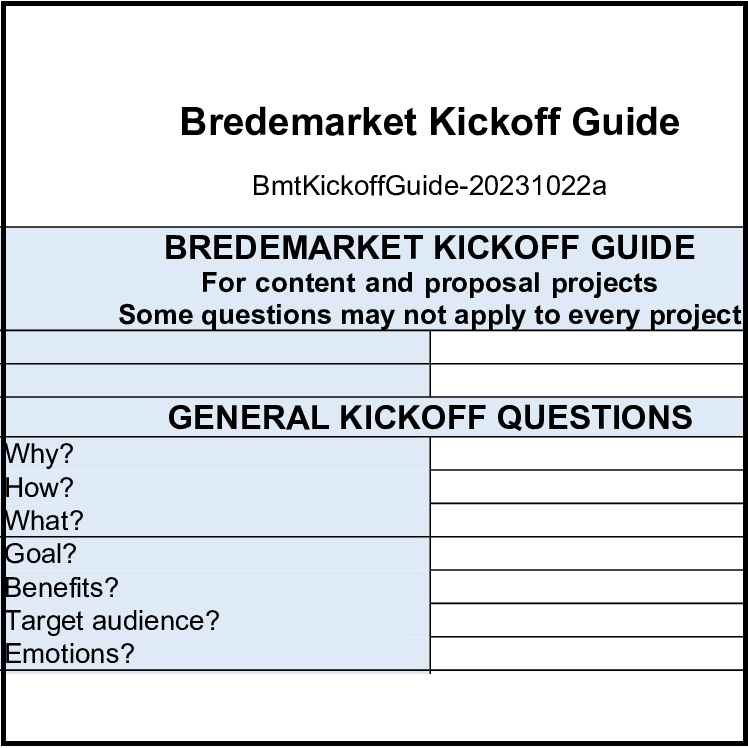
The first questions in the Bredemarket Kickoff Guide, BmtKickoffGuide-20231022a. No, you can’t have the guide; it’s proprietary.

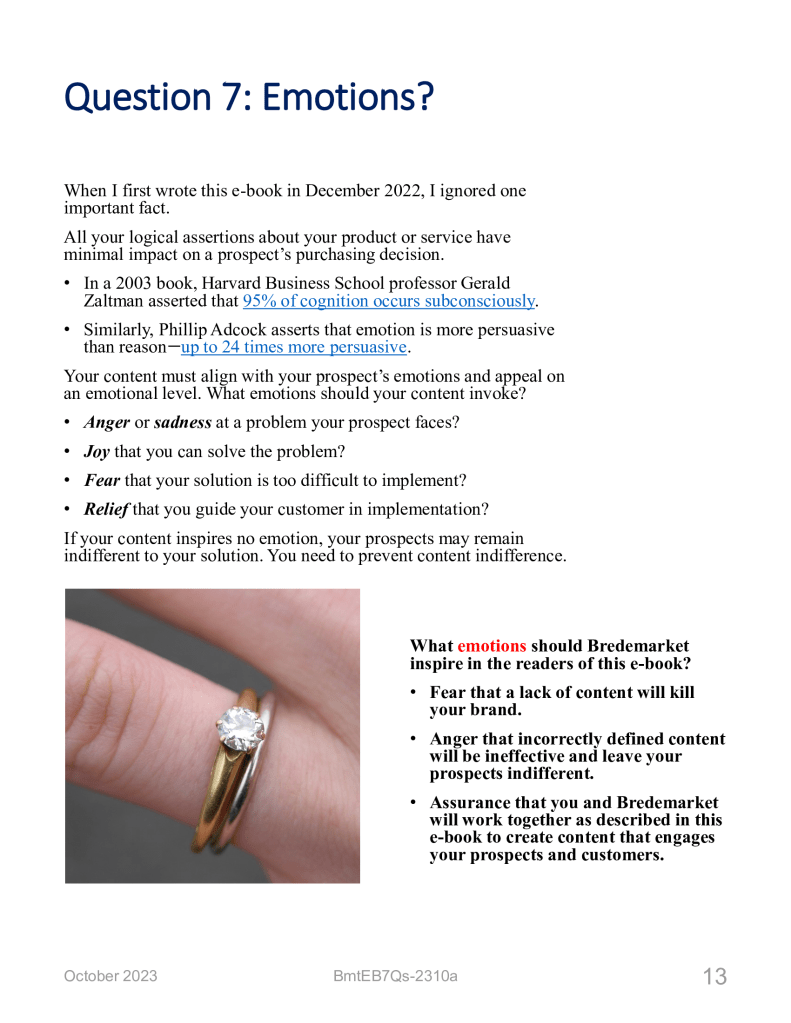
I decided that I needed to update my process, as well as that e-book, and add a seventh question, “Emotions?”

What?

For those who have raced ahead to this section, Bredemarket has a new downloadable e-book (revised from an earlier version) entitled “Seven Questions Your Content Creator Should Ask You.” It includes a new page, “Emotions,” as well as minor revisions to the other pages. You can download it below.

Goal, Benefits, Target Audience, and Emotions

You’ll have to download the e-book to find the answers to the remaining four questions.