As content creators accelerate information generation and distribution, content consumers demand information NOW. Perhaps my prediction of five-minute content creation hasn’t occurred—yet—but firms need to distribute their messages as fast as possible.
This Bredemarket blog post discusses a rapid way for identity/biometric firms to communicate the benefits of their solutions and capture their prospects’ attention immediately.
Blogging provides the rapid content generation your identity/biometric firm needs.
Benefits are essential in your blog post to help convert your readers.
Bredemarket can generate a benefits-laced blog post for your identity/biometric firm…with no learning curve necessary, allowing you to distribute your message quickly.
Why blogging?
While my consultancy Bredemarket creates identity content in a variety of customer-facing formats, including white papers, case studies, and e-books, one of my favorite ways to write about identity is via blog posts.
Blog posts provide an immediate business impact. It’s easier to create a blog post than it is to create a downloadable document. If Bredemarket needs to generate content for its self-marketing, I can get a blog post out in two hours, if not sooner. For a breaking news story, your company’s blogged take may hit your prospects before they’ve even heard about the breaking news story in the first place.
Blog posts are easy to share. You can’t just post your blog content and let it sit there. While over 200 people subscribe to the Bredemarket blog, that means that almost 8 billion people will never see it. I increase my viewing odds (slightly) by resharing my blog posts to my hundreds of additional followers on LinkedIn, Instagram, Facebook, and other platforms.
Blog posts are easy to repurpose. Once people have read your blog post, your work is not done. It’s easy to repurpose blog content into other forms. For example, I created an e-book from a blog post.
Why benefits?
However, if your identity/biometric blog post merely consists of a list of features of your product or service, then you’re wasting your time.
If your post simply states that your new latent fingerprint station captures print evidence at 2000 pixels per inch, most of your prospects are going to say, “So what?”
On the other hand, if your post talks about how your latent fingerprint station’s high capture resolution benefits your prospects by helping experts to solve crimes more quickly and getting bad people off the street, then your prospects are going to care about your product/service—and will convertfrom prospects to paying customers.
Why Bredemarket?
That little tip about benefits vs. features is just one of numerous tips that I’ve picked up over my many years as an identity/biometric blog expert. And you can benefit from my ability to start writing immediately because I require no learning curve. My 29 years of identity/biometric expertise comes in handy when your firm requires identity blog post writing.
OK, perhaps it’s an exaggeration to say that I can start writing immediately. Before I type a single word, we need to ensure a common understanding of why we’re writing this blog post. If you want to know how we achieve this common understanding, read the e-book I mentioned earlier.
If you are ready to purchase my Bredemarket 400 Short Writing Service to create a blog post (or other short content) describing the benefits of your identity/biometric product or service, then we should start talking sooner rather than later.
But what if I want to know how to work with Bredemarket?
Glad you asked.
After reading Mace’s LinkedIn post, I realized that I have a bunch of different online sources that explain how to work with Bredemarket, but they’re scattered all over the place. This post groups them all the “how to work with Bredemarket” content together, following an outline similar (yet slightly different) to Mace’s.
And no, it’s not a stand-alone PDF, but as you read the content below you’ll discover two stand-alone PDFs that address critical portions of the process.
Question 1: Why would I work with Bredemarket?
As you’ll see below, “why” is a very important question, even more important than “how.” Here are some reasons to work with Bredemarket.
You require the words to communicate the benefits of your identity/biometrics product/service. I offer 29 years of experience in the identity/biometrics industry and am a biometric content marketing expert and an identity content marketing expert. I have created multiple types of content (see below) to share critical points about identity/biometrics offerings.
You require the words to communicate the benefits of your technology product/service. I have also created multiple types of content to share critical points about technology offerings.
You require the words to communicate the benefits of a product/service you provide to California’s Inland Empire. I’ve lived in the Inland Empire for…well, for more than 29 years. I know the area—its past, its present, and its future.
You require one of the following types of content. Blogs, case studies / testimonials, data sheets, e-books, proposals, social media posts / Xs (or whatever tweets are called today), white papers, or anything. I’ve done these for others and can do it for you.
Question 2: Why WOULDN’T I work with Bredemarket?
This question is just as important as the prior one. If you need the following, you WON’T want to work with Bredemarket.
You require high quality graphics. Sorry, that’s not me.
I did not draw this myself. Originally created by Jleedev using Inkscape and GIMP. Redrawn as SVG by Ben Liblit using Inkscape. – Own work, Public Domain, link.
You are based outside of the United States. Foreign laws and exchange rates make my brain hurt, so I only pursue business domestically. But depending upon where you are, I may be able to recommend a content marketer for you.
Question 3: What are Bredemarket’s most popular packages? How much do they cost?
Here are the three most common packages that Bredemarket offers.
Note that these are the standard packages. If your needs are different, I can adapt them, or charge you an hourly rate if the need is not well defined. (But as you will see below, I try to work with you at the outset to define the project.)
If you follow the link above for your desired package and download the first brochure on each page, you’ll get a description of the appropriate service. The pricing is at the bottom of each brochure.
Each brochure also explains how I kick off a project, but the procedure is fairly common for each package.
Question 4: What are Bredemarket’s working practices?
But that’s not all that we address in the kickoff. There are some other lower-level questions that I ask you (such as the long and short form of your company name).
Once we have defined the project, I iteratively provide draft copy and you iteratively review it. The number and length of review cycles varies depending upon the content length and your needs. For example, I use up to two review cycles of up to three days each for short content.
Eventually I provide the final copy, you publish it and pay me, and both of us are happy.
“Relevant security, financial services and data protection agencies have commenced inquiries and investigations to establish the authenticity and legality of the aforesaid activities, the safety and protection of the data being harvested, and how the harvesters intend to use the data,” read part of the statement.
“Further, it will be critical that assurances of public safety and the integrity of the financial transactions involving such a large number of citizens be satisfactorily provided upfront.”
And even the iris image data that Worldcoin DOES collect isn’t retained unless people request it.
Since no two people have the same iris pattern and these patterns are very hard to fake, the Orb can accurately tell you apart from everyone else without having to collect any other information about you — not even your name.
Importantly, the images of you and your iris pattern are permanently deleted as soon as you have signed up, unless you opt in to Data Custody to reduce the number of times you may need to go back to an Orb. Either way, the images are not connected to your Worldcoin tokens, transactions, or World ID.
Ah, but Worldcoin does retain…an iris code. A lot of good THAT’S gonna do a scammer.
Your biometric data is first processed locally on the Orb and then permanently deleted. The only data that remains is your iris code. This iris code is a set of numbers generated by the Orb and is not linked to your wallet or any of your personal information. As a result, it really tells us — and everyone else — nothing about you. All it does is stop you from being able to sign up again.
Since you are not required to provide personal information like your name, email address, physical address or phone number, this means that you can easily sign up without us ever knowing anything about you.
And no, you cannot reverse engineer an iris image from the iris code. In fact, you can’t reverse engineer any biometric image from its biometric template.
And even if you could reverse engineer an iris image, what are you going to do with it? You don’t know who owns it. It probably doesn’t belong to Bill Gates. It probably belongs to an impoverished Kenyan. (Good luck getting that person’s US$2.00. Which they probably already sold.)
Because—and here’s the thing that people forget about Worldcoin—”Worldcoin’s World ID emphasizes privacy so much that it does not conclusively prove a person’s identity (it only proves a person’s uniqueness).” (Link)
Companies could pay Worldcoin to use its digital identity system, for example if a coffee shop wants to give everyone one free coffee, then Worldcoin’s technology could be used to ensure that people do not claim more than one coffee without the shop needing to gather personal data, Macieira said.
Yup, that’s the use case. To allow 8 billion people to each claim one cup of coffee.
Not just the people who are members of the coffee company’s rewards club.
Not just the people who have purchased a certain amount of coffee.
Not just the people in the United States and Colombia.
Worldcoin can’t do those things, because even Worldcoin doesn’t know anything about its users.
Which means, by the way, that the World ID can’t be used in elections or national/state government welfare benefits distribution.
Sure it can be used to prove that someone hasn’t voted twice, or received benefits under two different names.
But it has no way of knowing whether the individual is qualified to vote or receive benefits. Maybe the person doesn’t live in the local jurisdiction. For voting, maybe the person lives there but is not a citizen. For benefits, maybe the person has too much income to qualify. Worldcoin doesn’t have a clue if any of these things are true.
So apparently the Kenyan authorities are worried that Worldcoin is gathering too much data.
I’m worried that Worldcoin is gathering not enough data for most practical use cases.
Iris recognition continues to make the news. Let’s review what iris recognition is and its benefits (and drawbacks), why Apple made the news last month, and why Worldcoin is making the news this month.
What is iris recognition?
There are a number of biometric modalities that can identify individuals by “who they are” (one of the five factors of authentication). A few examples include fingerprints, faces, voices, and DNA. All of these modalities purport to uniquely (or nearly uniquely) identify an individual.
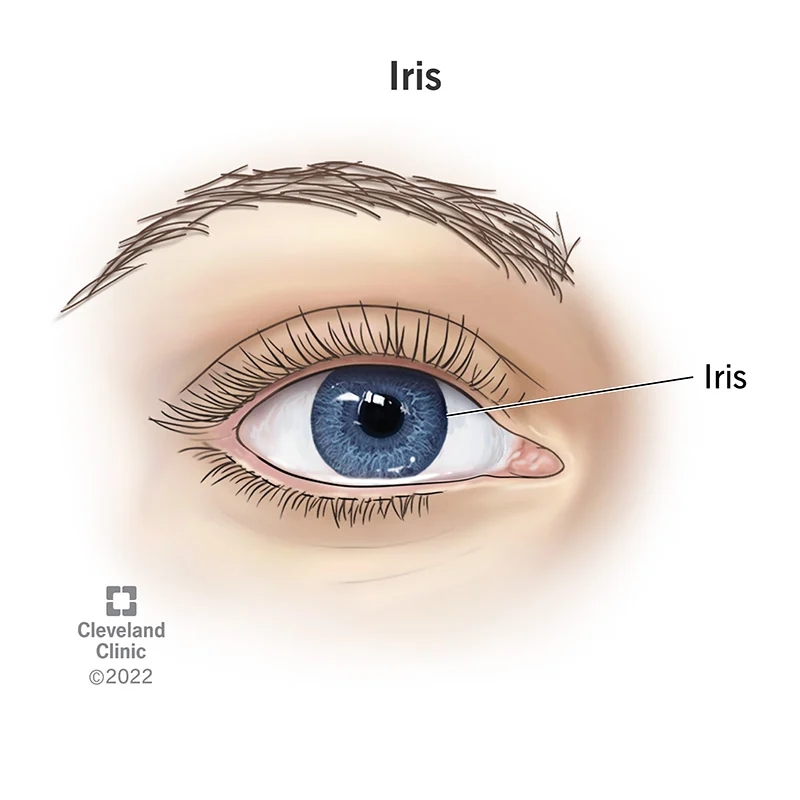
One other way to identify individuals is via the irises in their eyes. I’m not a doctor, but presumably the Cleveland Clinic employs medical professionals who are qualified to define what the iris is.
The iris is the colored part of your eye. Muscles in your iris control your pupil — the small black opening that lets light into your eye.
But why use irises rather than, say, fingerprints and faces? The best person to answer this is John Daugman. (At this point several of you are intoning, “John Daugman.” With reason. He’s the inventor of iris recognition.)
(I)ris patterns become interesting as an alternative approach to reliable visual recognition of persons when imaging can be done at distances of less than a meter, and especially when there is a need to search very large databases without incurring any false matches despite a huge number of possibilities. Although small (11 mm) and sometimes problematic to image, the iris has the great mathematical advantage that its pattern variability among different persons is enormous.
Daugman, John, “How Iris Recognition Works.” IEEE TRANSACTIONS ON CIRCUITS AND SYSTEMS FOR VIDEO TECHNOLOGY, VOL. 14, NO. 1, JANUARY 2004. Quoted from page 21. (PDF)
Or in non-scientific speak, one benefit of iris recognition is that you know it is accurate, even when submitting a pair of irises in a one-to-many search against a huge database. How huge? We’ll discuss later.
Brandon Mayfield and fingerprints
Remember that Daugman’s paper was released roughly two months before Brandon Mayfield was misidentified in a fingerprint comparison. (Everyone now intone “Brandon Mayfield.”)
While some of the issues associated with Mayfield’s misidentification had nothing to do with forensic science (Al Jazeera spends some time discussing bias, and Itiel Dror also looked at bias post-Mayfield), this still shows that fingerprints are remarkably similar and that it takes care to properly identify people.
Police agencies, witnesses, and faces
And of course there are recent examples of facial misidentifications (both by police agencies and witnesses), again not necessarily forensic science related, and again showing the similarity of faces from two different people.
At the root of iris recognition’s accuracy is the data-richness of the iris itself. The IrisAccess system captures over 240 degrees of freedom or unique characteristics in formulating its algorithmic template. Fingerprints, facial recognition and hand geometry have far less detailed input in template construction.
Enough about claims. What about real results? The IREX 10 test, independently administered by the U.S. National Institute of Standards and Technology, measures the identification (one-to-many) accuracy of submitted algorithms. At the time I am writing this, the ten most accurate algorithms provide false negative identification rates (FNIR) between 0.0022 ± 0.0004 and 0.0037 ± 0.0005 when two eyes are used. (Single eye accuracy is lower.) By the time you see this, the top ten algorithms may have changed, because the vendors are always improving.
IREX10 two-eye accuracy, top ten algorithms as of July 28, 2023. (Link)
While the IREX10 one-to-many tests are conducted against databases of less than a million records, it is estimated that iris one-to-many accuracy remains high even with databases of a billion people—something we will return to later in this post.
Iris drawbacks
OK, so if irises are so accurate, why aren’t we dumping our fingerprint readers and face readers and just using irises?
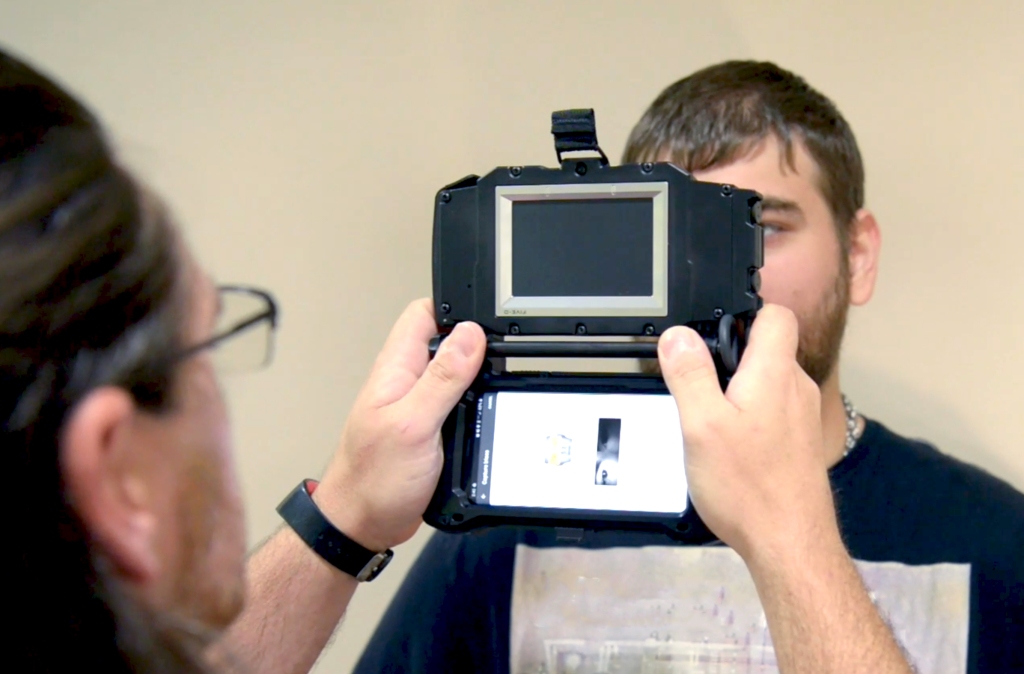
In short, because of the high friction in capturing irises. You can use high-resolution cameras to capture fingerprints and faces from far away, but as of now iris capture usually requires you to get very close to the capture device.
Iris image capture circa 2020 from the U.S. Federal Bureau of Investigation. (Link)
Which I guess is better than the old days when you had to put your eye right up against the capture device, but it’s still not as friendly (or intrusive) as face capture, which can be achieved as you’re walking down a passageway in an airport or sports stadium.
Irises and Apple Vision Pro
So how are irises being used today? You may or may not have hard last month’s hoopla about the Apple Vision Pro, which uses irises for one-to-one authetication.
I’m not going to spend a ton of time delving into this, because I just discussed Apple Vision Pro in June. In fact, I’m just going to quote from what I already said.
In short, as you wear the headset (which by definition is right on your head, not far away), the headset captures your iris images and uses them to authenticate you.
It’s a one-to-one comparison, not the one-to-many comparison that I discussed earlier in this post, but it is used to uniquely identify an individual.
But iris recognition doesn’t have to be used for identification.
Irises and Worldcoin
“But wait a minute, John,” you’re saying. “If you’re not using irises to determine if a person is who they say they are, then why would anyone use irises?”
Over the past several years, I’ve analyzed a variety of identity firms. Earlier this year I took a look at Worldcoin….Worldcoin’s World ID emphasizes privacy so much that it does not conclusively prove a person’s identity (it only proves a person’s uniqueness)…
That’s the only thing that I’ve said about Worldcoin, at least publicly. (I looked at Worldcoin privately earlier in 2023, but that report is not publicly accessible and even I don’t have it any more.)
The Worldcoin Foundation today announced that Worldcoin, a project co-founded by Sam Altman, Alex Blania and Max Novendstern, is now live and in a production-grade state.
The launch includes the release of the World ID SDK and plans to scale Orb operations to 35+ cities across 20+ countries around the world. In tandem, the Foundation’s subsidiary, World Assets Ltd., minted and released the Worldcoin token (WLD) to the millions of eligible people who participated in the beta; WLD is now transactable on the blockchain….
“In the age of AI, the need for proof of personhood is no longer a topic of serious debate; instead, the critical question is whether or not the proof of personhood solutions we have can be privacy-first, decentralized and maximally inclusive,” said Worldcoin co-founder and Tools for Humanity CEO Alex Blania. “Through its unique technology, Worldcoin aims to provide anyone in the world, regardless of background, geography or income, access to the growing digital and global economy in a privacy preserving and decentralized way.”
Worldcoin does NOT positively identify people…but it can still pay you
A very important note: Worldcoin’s purpose is not to determine identity (that a person is who they say they are). Worldcoin’s purpose is to determine uniqueness: namely, that a person (whoever they are) is unique among all the billions of people in the world. Once uniqueness is determined, the person can get money money money with an assurance that the same person won’t get money twice.
Iris biometrics outperform other biometric modalities and already achieved false match rates beyond 1.2× 10−141.2×10⁻¹⁴ (one false match in one trillion[9]) two decades ago[10]—even without recent advancements in AI. This is several orders of magnitude more accurate than the current state of the art in face recognition.
From Venn Marketing, “Awareness, Consideration, Conversion: A 4 Minute Intro To Marketing 101.” (Link)
The picture above shows a simple sales funnel example. The second of the three items in the funnel is the “consideration” phase.
In that phase, those people who are aware of you can then consider your products and services.
If they like what they see, they move on to conversion and hopefully buy your products and services.
But how do prospects in the funnel consideration phase evaluate your offering as opposed to competitor offerings? Is it truly a quantitative and logical process, or is it in reality qualitative and emotional?
Quantitative consideration
For purposes of this post, let’s assume that there are two competing companies, Bredemarket and Debamarket, who are fighting each other for business.
Second, let’s assume that Bredemarket and Debamarket offer similar services to their prospects and customers:
Blog posts
Case studies
White papers
Finally, let’s assume that a big government agency (the BGA) has issued a Request for Proposal (RFP) for blog/case study/white paper services, and Bredemarket and Debamarket are the two companies competing for the award.
A pre-acquisition consultant will develop a Source Selection Plan (SSP). In competitive procurements such as the one in this example, the SSP will state exactly how proposals will be evaluated, and how the best proposal will be selected.
Here is the U.S. Government’s guidance on Source Selection Plans. (link)
SSPs can be very complex for certain opportunities, and not so complex for others. In all cases, the SSP dictates the evaluation criteria used to select the best vendor.
The weighted scoring approach breaks down your RFP evaluation criteria and assigns a value to each question or section. For example, your RFP criteria may consider questions of technical expertise, capabilities, data security, HR policies and diversity and sustainability. Weighted scoring prioritizes the criteria that are most important to your business by assigning them a point or percentage value. So your weighted scoring criteria may look like this:
Technical expertise – 25%
Capabilities – 40%
Data security – 10%
HR policies – 10%
Diversity and sustainability – 15%
RFP360, “A guide to RFP evaluation criteria: Basics, tips and examples.” (Link)
Individual question evaluation
In most cases the evaluator doesn’t look at the entire technical expertise section and give it a single score. In large RFPs, the technical expertise section may consist of 96 questions (or even 960 questions), each of which is evaluated and fed into the total technical expertise score.
For example, the RFP may include a question such as this one, and the responses from the bidders (Bredemarket and Debamarket) are evaluated.
Question
Bredemarket
Debamarket
96. The completed blog post shall include no references to 1960s songs.
Example evaluation of a proposal response to an individual RFP question.
Final quantitative recommendation for award
Now repeat this evaluation method for every RFP question in every RFP category and you end up with a report in which one of the vendors receives more points than the other and is clearly the preferred bidder. Here’s an example from a U.S. Nuclear Regulatory Commission proposal source selection process. (And you can bet that a nuclear agency doesn’t use an evaluation method that is, um, haphazard.)
From U.S. Nuclear Regulatory Commission, “FINAL EVALUATION RECOMMENDATION REPORT FOR PROPOSALS SUBMITTED UNDER RFP NO. RQ-CIO-01-0290 ENTITLED, “INFRASTRUCTURE SERVICES AND SUPPORT CONTRACT (ISSC).”” (link)
So what does this example show us? It shows that L-3 Communications/EER received a total score of 83.8, while its closest competitor Logicon only received a score of 80. So EER is the preferred bidder.
So in our example, BGA would evaluate Bredemarket and Debamarket, come up with a number for each bidder, and award the contract to the bidder with the highest evaluation score.
Quantitative recommendation for the little guys
Perhaps people who aren’t big government agencies don’t go to this level of detail, but many prospects who reach the consideration phase use some type of quantitative method.
For example, if the (non-weighted) pros for an item under consideration outnumber the cons, go for it.
Now of course the discussion above assumes that everyone is a logical being who solely evaluates based on objective criteria.
But even Sages such as myself may deviate from the objective norm. Here’s a story of one time when I did just that.
As I previously mentioned, I had never written a proposal response before I started consulting for Printrak. But I had written a Request for Proposal before I joined Printrak. For a prior employer (located in Monterey Park), I worked with an outside consultant to develop an RFP to help my employer select a vendor for a computer system. The questions posed to the bidders were not complex. Frankly, it was a simple checklist. Does your computer system perform function A? Does it perform function B?
The outside consultant and I sent the final RFP to several computer system providers, and received several proposals in response.
A few of the proposals checked every box, saying that they could do anything and everything. We threw those proposals out, because we knew that no one could meet every one of our demanding requirements. (“I can’t trust that response.”)
We focused on the proposals that included more realistic responses. (“That respondent really thought about the questions.”)
As you can see, we introduced a qualitative, emotional element into our consideration phase.
According to Kaye Putnam, this is not uncommon.
Qualitative consideration
Humans think that we are very logical when we consider alternatives, and that our consideration processes are logical and quantitative. Putnam has looked into this assertion and says that it’s hogwash. Take a look at this excerpt from Putnam’s first brand psychology secret:
Your brand has to meet people at that emotional level – if you want them to buy. (And I know you do!)
Findings from several studies support this, but one of the most seminal was outlined in Harvard professor Gerald Zellman’s 2003 book, The Subconscious Mind of the Consumer. Zellman’s research and learnings prompted him to come to the industry-rocking conclusion that, “95 percent of our purchase decision making takes place in the subconscious mind.”
From Kaye Putnam, “7 Brand Psychology Secrets – Revealed!” (link)
But how can the subconscious mind affect quantitative evaluations?
While logic still has to play SOME role in a purchase decision (as Putnam further explains in her first and second brand psychology secrets), a positive or negative predisposition toward a bidder can influence the quantitative scores.
Imagine if the evaluators got together and discussed the Bredmarket and Debamarket responses to question 96, above. The back and forth between the evaluators may sound like this:
“OK, we’re up to question 96. That’s a no brainer, because no one would ever put song references in a BGA blog post.”
“Yeah, but did you see Bredemarket’s own post that has multiple references to the song ‘Dead Man’s Curve’?”
“So what? Bredemarket would never do that when writing for a government agency. That piece was solely for Bredemarket.”
“How do you KNOW that Bredemarket would never slip a song reference into a BGA post? You know, I really don’t trust that guy. He wore two different colored shoes to the orals presentation, a brown one and a black one. Someone as slopy as that could do anything, with huge consequences for BGA communications. I’m deducting points from Bredemarket for question 96.”
“OK. I think you’re being ridiculous, but if you say so.”
And just like that, your quantitative logical consideration process is exposed as a bunch of subconscious emotional feelings.
How does qualitative consideration affect you?
As you develop your collateral for the consideration phase, you need to go beyond logic (even if you have a Sage predisposition) and speak to the needs and pain points of your prospects.
Spock is behaving illogically. Jayenkai, “Pain – Star Trek Remix.” (link)
Here’s a example from my law enforcement automated fingerprint identificaiton system (AFIS) days.
If your prospect is a police chief who is sick and tired of burglars ransacking homes and causing problems for the police department, don’t tell your prospect about your AFIS image detail or independent accuracy testing results. After all, 1000 ppi and 99.967 accuracy are only numbers.
Provide the police chief with customer-focusedbenefit statements about how quickly your AFIS will clean up the burglary problem in the town, giving residents peace of mind and the police department less stress.
If you can appeal to those emotions, that police chief will consider you more highly and move on to conversion (purchase).
Can I help?
If your messaging concentrates on things your prospects don’t care about, most of them will ignore you and not shower you with money. Using the wrong words with your customers impacts your livelihood, and may leave you poor and destitute with few possessions.
If you need a writer to work with you to ensure that your written content includes the right words that speak directly to your prospects, hire…Debamarket!
While I won’t go into all of the video details here (you should spend a few minutes and watch Putnam’s video yourself), one of the points that Putnam made was that the best content creators need to differentiate themselves from commodity content providers—in other words, to “be irreplaceable.”
If it’s not obvious how your product or service is wildly different, not just better, your ideal clients will resort to looking at you like a commodity.
One of the ways in which content creators can differentiate themselves from their competition is to have a unique process.
In addition to having the emotional appeal and positioning that we already talked about, you can employ tools like having a proprietary process. A unique way of achieving a desired result.
I’d like to look at one such process, the process in which a content creator collaborates with a client, but I’d like to take a look at how two very different content creators achieve the same outcome.
How Bredemarket collaborates with clients
One of the many differentiators between Bredemarket and its marketing and writing competitors is the way that Bredemarket kicks off projects.
Before I work with you, I ask a series of questions to better understand what you need.
(UPDATE OCTOBER 23, 2023: “SIX QUESTIONS YOUR CONTENT CREATOR SHOULD ASK YOU IS SO 2022. DOWNLOAD THE NEWER “SEVEN QUESTIONS YOUR CONTENT CREATOR SHOULD ASK YOU” HERE.)
Now these are not all of the questions that I ask. After all, my process is, um, “Bredemarket-developed.” (I avoid the word “proprietary” because of its negative connotations.) But the limited number of questions that I did share suggests how I try to understand you. Why you do what you do. How you do it. And so forth.
(If you are interested in this topic, I have written an entire e-book focused on the first six questions that I ask you. To download the e-book, visit my blog post “Six Questions Your Content Creator Should Ask You: the e-book version.”)
Yes, this is a Rembrandt painting, anticipating the next section of the blog post. By Rembrandt – The Yorck Project (2002) 10.000 Meisterwerke der Malerei (DVD-ROM), distributed by DIRECTMEDIA Publishing GmbH. ISBN: 3936122202., Public Domain, https://commons.wikimedia.org/w/index.php?curid=157824
But not everyone is a Sage, and other content creators approach collaboration differently.
How Paso Artis collaborates with clients
As I’ve frequently said, my primary emphasis is words. My graphic execution capabilities are somewhat limited.
I did not draw this myself. Originally created by Jleedev using Inkscape and GIMP. Redrawn as SVG by Ben Liblit using Inkscape. – Own work, Public Domain, link.
But there are many, many people who have better graphic execution capabilities than I do.
Get ready to celebrate the power of your creative brand archetype! Whether you resonate with being an Artist, musician, writer, dreamer, builder, or designer, your brand has the incredible ability to amaze and inspire others.
When customers encounter your creative brand, they can’t help but feel captivated. They look at your work and think, “I want to be able to do what they can.” Your brand ignites a spark of inspiration and ignites the imagination within those who connect with it.
One of your innate advantages as a creative brand is your boundless creativity and imagination. You possess the unique ability to see the world in a different light, to think outside the box, and to breathe life into your visions.
Despite our vast differences, Paso Artis and Bredemarket have one similarity.
We both work together with our clients to create a piece of content that satisfies the clients’ needs.
With Bredemarket, it’s a written piece of content.
With Paso Artis, it’s a custom painting.
But because Paso Artis is…well, an artist, she doesn’t use Sage-like words and tables and bullet points to describe her client collaboration process. The Paso Artis-developed (again, I don’t like the word “proprietary”) collaboration process is described much more…artistically.
As an artist, I do feel the responsibility and privilege of taking a vision and turning it into a painting that will hang on the wall for years and be seen every day and regarded with affection.
Don’t be scared of handing over your dream to me.
In order to achieve a happy outcome, you and I will work together.
Note that Paso Artis uses some words that Bredemarket never uses, such as “affection” and “dream.” Now I might use “vision” and “scared” in the proper context, but most of my clients and prospects do not dream of having their customers regard their products and services, or their blog posts or white papers, with affection. Even the Bredemarket client who chose to “truly say thank you for putting these (proposal) templates together” didn’t get affectionate about them. I mean, I love Microsoft Word, but I don’t LOVE Microsoft Word.
So Bredemarket and Paso Artis use a different vocabulary. This happens to come back to another point that Putnam made, to speak the language of your clients.
If you only know Italian and your ideal clients are speaking French, you might get a few people that understand what you mean, but it’s not going to have the transformative effect that we’re looking for. You want to learn to be fluent. In the decision making language of your ideal clients.
“Jay” is a homeowner who loves art and desires a particular type of painting for his home, but does not have the artistic talent to paint it himself. Ideally, the completed painting will be one that brings Jay delight when he sees it in his home, and will also delight his guests. But can he trust anyone to realize his dream?
So Paso Artis (who has years of marketing experience in her day job work) knows that she has to address Jay’s pain points. She first does this by addressing them in her “About” text (“Don’t be scared of handing over your dream to me”), but then addresses them more deeply during her consultation with Jay.
I have never performed a competitive analysis of artists who respond to commission requests, but I’d guess that some are better at collaborating with clients than others.
And the ones that collaborate well earn a positive reputation, which translates to increased revenue over those who don’t collaborate well.
How should YOU collaborate?
But of course Bredemarket doesn’t matter, and Paso Artis doesn’t matter. You matter.
When you collaborate with a partner, either one in which the partner provides a product or service to you, or you provide a product or service to the partner, make sure that both of you are on the same page (or easel) before launching into the work project.
And if you want your blog posts, white papers, case studies, and other content to be regarded with affection (or something like that), contact Bredemarket.
I’m trying to flesh out the usefulness of the Bredemarket website.
Initially, much of the content was benefit-focused.
As the website matured, I began to include and flag more information on features—not only as features relate to benefits, but also discussing features independent of benefits (example: my discussion of the Touch ID feature).
It’s time to throw one other term into the mix.
Using bad statistics, addition of a third term to the two existing terms improves bredemarket.com by a whopping 50%.
Contrast this definition of features with Airfocus’ definition of benefits (which again coincides with my own definition of benefits):
A benefit…is why a prospect would ultimately use a product.
This key benefit provides an emotional hook point that you can leverage in helping the user imagine the positive experiences felt by using your product.
For example: ‘If you don’t waste your time editing and can store more of your best photos, you’ll keep happier memories for longer’.
So again, the feature is a characteristic of a product (or what the product does), while a benefit explains why that characteristic is important to a prospect.
This is good in and of itself, and has served me well for years. I could stop right here, but I’ve just passed 400 Bredemarket blog posts and am on a roll to get up to 500.
So I’m going to tell you that Airfocus expands the feature-benefit model by defining an middle category between features and benefits.
The stage between a feature and a benefit
Airfocus defines the intermediate step between a feature and benefit as follows:
An advantage is what that feature does, and how it helps. These are factual and descriptive but do not yet make a connection as to how it will make users’ life better.
For example: ‘It automatically keeps only the clearest picture of a similar set, and deletes the rest. Your photo storage is reduced on average by 80%.
Perhaps I’m oversimplifying the analysis, but the three terms (features, advantages, and benefits) can be related as follows, using my three favorite question adverbs and incorporating Airfocus’ examples:
Feature
What
Automated photo storage app
Advantage
How
Reduce photo storage 80%
Benefit
Why
Keep happier memories for longer
I’ll use this caption to plug my first e-book, which you can get here.
Since I talk about benefits ad nauseum, you may get the mistaken view that features and advantages don’t matter. They do matter—in the proper context. For example, if you’re working on a data sheet or a user manual (if they still exist), you definitely need a feature list and could probably use an advantage list also.
Now do you have to use a feature-advantage-benefit model, instead of the simpler feature-benefit model?
Are you an Inland Empire business who wants to promote the benefits of your products and services to your clients? If so, don’t assume that these benefits must be quantitative. You can use qualitative benefits also.
Benefits
Before we talk about quantative vs. qualitative benefits, let’s talk about benefits themselves, and how they differ from features.
She explains that your clients don’t care if your meal kit arrives ready to heat (a feature). Your clients care about saving time preparing meals (a benefit).
Quantitative benefits
In certain cases, the client may be even more impressed if the benefits can be expressed in a quantitative way. For example, if you know that your meal kit saves people an average of 37 minutes and 42.634 seconds preparing meals, let your client know this.
I’ll admit that Apple sometimes has some pretty stupid marketing statements (“It’s black!“). But sometimes the company grabs people’s attention with its messaging.
Later in the article, Apple’s chief operating officer (Jeff Williams) emphasizes the power theme: “…they’re no longer passengers on their own health journey. Instead, we want people to be firmly in the driver’s seat.”
Of course, this isn’t the first time that Apple has referred to empowering the individual. The company has done this for decades. Remember (then) Apple Computer’s slogan, “The Power to Be Your Best”? If you missed that particular slogan, here’s a commercial.
There are zero statistics in that commercial. It doesn’t say that the Macintosh computer would equip you to jump 5% higher, or sing on key 99.9% of the time. And Apple Computer didn’t claim that the Macintosh would equip you to draw bridge images 35.2% faster.
But the viewer could see that a Macintosh computer, with its graphical user interface, its support of then-new graphic programs, and (not shown in the ad) the ability to distribute the output of these graphic programs via laser printers, gave Macintosh users the power to…well, the power to be their best.
And some potential computer buyers perceived that this power provided infinite value.
As you work out your benefit statements, don’t give up if the benefits cannot be quantified. As long as the benefits resonate with the customer, qualitative benefits are just fine.
What are your benefits?
Let’s return to you and your Ontario, California area business that needs content marketing promotion. Before you draft your compay’s marketing material, or ask someone to draft it for you, you need to decide what your benefits are.
I’ve written a book about identifying benefits, and five other questions that you need to answer before creating marketing content.
Click on the image below, find the e-book at the bottom of the page, and skip to page 11 to read about benefits.
A little over a year ago, Bredemarket announced two changes in my business scope and business hours. I stopped accepting work from clients who marketed systems to identify individuals, and I reduced my business hours to Saturday mornings only.
Generated at craiyon.com.
I had to change my business scope and business hours. On May 9, 2022, I started a full-time position with a company in the identity industry, which meant that I couldn’t consult on weekdays and couldn’t consult on identity projects.
But things change.
As of May 31, 2023, I will no longer be employed at my day job.
Which is my misfortune…um…opportunity.
Generated at craiyon.com.
Has Bredemarket changed its business scope and business hours a second time?
Yes.
As of June 1, 2023:
If you need a consultant for marketing or proposal work, and your company is involved in the identification of individuals, Bredemarket can accept the work.
If you need a consultant who can meet with you during normal business hours, Bredemarket can accept the work.
So what?
My…um…opportunity is your opportunity.
Now that I can expand my business scope and business hours again, you can take advantage of my extensive marketing expertise, including deep experience in the identity industry.
This means you can obtain quickly-generated and expert content with an agreed-upon focus.
This means you can get content that increases your revenue.
These two e-books explain (a) how Bredemarket starts a project with you, and (b) how Bredemarket has helped other businesses over the years.
(UPDATE OCTOBER 22, 2023: “SIX QUESTIONS YOUR CONTENT CREATOR SHOULD ASK YOU IS SO 2022. DOWNLOAD THE NEWER “SEVEN QUESTIONS YOUR CONTENT CREATOR SHOULD ASK YOU” HERE.)
While I agree with the second part of Bain’s assessment where he won’t enter into a contract that works for him, remember that the other party won’t want to enter into a contract in which Bain gets all the winnings. Or if they do, they’ll mutter about Bain under his breath and find a new contractual partner when the opportunity presents itself.
Hard sell (win-lose) is of limited value. Win-win is better. If you can establish it.
Why should I listen to your pitch? (Or why should you listen to mine?)
A business relationship starts with one party approaching the other. Perhaps it may be a question, or perhaps it may be a pitch. We all get pitches. Some of us (including Bredemarket) give pitches.
What determines whether you respond to a Bredemarket pitch?
If you know that you don’t need marketing content at all, you won’t need Bredemarket. (I can perhaps dispute your assessment, but if you’re not ready to create targeted marketing content, you’re not ready.)
If you already have access to great content creators, you won’t need Bredemarket. Just treat your content creators well so they continue to advance your business.
If your company is outside the United States, you can’t use Bredemarket. My company isn’t mature enough to handle the complexities of international business.
If your company offers finger/face identification services, you can’t use Bredemarket because of that pesky day job.
If you need me to be available Monday-Friday 8-5 Pacific time, you can’t use Bredemarket, again because of that pesky day job.
What determines whether Bredemarket responds to a company’s pitch?
Again, your product or service has to benefit me, Bredemarket, and my current status as a small part-time business.
I don’t need payroll software. I’m a sole proprietor.
I don’t need your phone answering service. I already have a free one, and most of the voicemails I get are spam. I’m not going to pay to get spam.
I’m not interested in your list of leads. The fact that you have me on your own list of leads shows how poor your lists are.
And no, I don’t need your (INSERT SPECULATIVE INVESTMENT SERVICE HERE) offering. If your (INSERT SPECULATIVE INVESTMENT SERVICE HERE) is going to take off like gangbusters in the next 6 months, why are you so stupid as to sell it to me, rather than keeping it for yourself?
Beyond the pitch
So we don’t respond to pitches if they don’t benefit us.
In the same way, we don’t sign contracts if they don’t benefit us. And we certainly don’t remain in long-term business relationships if they don’t benefit us.
Yet people still pursue the win-lose model. If you want to score a single sale and move on from a disappointed customer and find your next target, win-win isn’t for you.
I don’t work that way, in Bredemarket or anywhere else.
Three benefits of win-win relationships
Since I’m writing this to potential Bredemarket clients, let me share three benefits of our working together in a win-win model.
Improved collaboration
From the first six questions onward, you and I will collaborate on the deliverable Bredemarket prepares for you, ensuring that you get precisely what you need.
As we continue to work with each other, I will have an understanding of what you need, and you will have an understanding of what I can deliver. This speeds up the deliverables, an added bonus.
Mutual growth
My hope is that my Bredemarket work will benefit your business.
One of my six questions involves the goal that my deliverable is supposed to satisfy, and after the content is available we can see if the goal was met.
While we both need to realize that inbound marketing is a long-term approach, hopefully the content will start to move the needle forward.
Example: I’m writing this post in April 2023. Will it work as a “secret salesperson” to attract someone to Bredemarket in April 2024?
At the same time, what I learn about your business will benefit me.
For example, I’ve already described (on page 6 of the e-book I talked about here) how the practices of one of my customers influenced Bredemarket’s own practices.
After all, incoming money is a necessary component of business. I get paid for my Bredemarket work, and my work helps you increase your revenue and profit, based on what we decided during our collaboration.
Of course, this assumes that you want to make money. If your goal is to bankrupt your business, Bredemarket could theoretically help you with that also. But I won’t, because that increases the chances that you won’t pay me.
Go out and win-win
So whether you select Bredemarket for your writing needs or not, take care to pursue win-win relationships with your partners. You’ll establish long-term relationships, and (in most cases) you’ll feel better about yourself.

























 Bredemarket