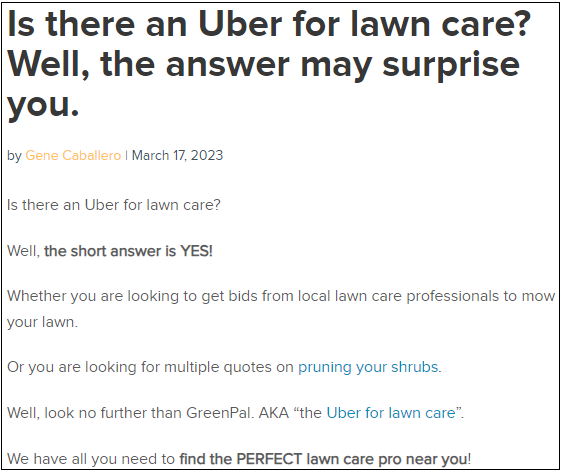
The Pros and Cons of Discriminating Your Product by Quantifying Your Benefits

Some firms make claims and don’t support them, while others support their claims with quantified benefits. But does quantifying help or harm the firms that do it? This pudding post answers this question…and then twists toward the identity/biometrics market at the end.

The “me too” players in the GCP market

Whoops.

In that heading above, I made a huge mistake by introducing an acronym without explaining it. So I’d better correct my error.

GCP stands for Glowing Carbonated Pudding.

I can’t assume that you already knew this acronym, because I just made it up. But I can assure you that the GCP market is a huge market…at least in my brain. All the non-existent kids love the scientifically advanced and maximally cool pudding that glows in the dark and has tiny bubbles in it.

Glowing Carbonated Pudding. Designed by Google Bard. Yeah, Google Bard creates images now.

Now if you had studied this non-existent market like I have, you’ll realize from the outset that most of the players don’t really differentiate their offerings. Here are a few examples of firms with poor product marketing:

  • Jane Spain GCP: “Trust us to provide good GCP.”
  • Betty Brazil GCP: “Trust us to provide really good GCP.”
  • Clara Canada GCP: “Trust us to provide great GCP.”

You can probably figure out what happened here.

  • The CEO at Betty Brazil told the company’s product marketers, “Do what Jane Spain did but do it better.”
  • After that Clara Canada’s CEO commanded, “Do what Betty Brazil did but do it better.” (I’ll let you in on a little secret. Clara Canada’s original slogan refereneced “the best GCP,” but Legal shot that down.)
Designed by Google Bard.

Frankly, these pitches are as powerful as those offered by a 17x certified resume writer.

The quantified GCP

But another company, Wendy Wyoming, decided to differentiate itself, and cited independent research as its differentiator.

Wendy Wyoming Out of This World GCP satisfies you, and we have independent evidence to prove it!

The U.S. National Institute of Standards and Technology, as part of its Pudding User Made (PUM, not FRTE) Test, confirmed that 80% of all Wendy Wyoming Out of This World GCP mixes result in pudding that both glows and is carbonated. (Mix WW3, submitted November 30, 2023; not omnigarde-003)

Treat your child to science-backed cuisine with Wendy Wyoming Out of This World GCP!Wendy Wyoming is a top tier (excluding Chinese mixes) GCP provider.

But there are other competitors…

The indirect competitor who questions the quantified benefits

There are direct competitors that provide the same product as Wendy Wyoming, Jane Spain, and everyone else.

And then there are indirect competitors who provide non-GCP alternatives that can substitute for GCPs.

For example, Polly Pennsylvania is NOT a GCP provider. It makes what the industry calls a POPS, or a Plain Old Pudding Sustenance. Polly Pennsylvania questions everything about GCP…and uses Wendy Wyoming’s own statistics against it.

Designed by Google Bard.

Fancy technologies have failed us.

If you think that one of these GCP puddings will make your family happy, think again. A leading GCP provider has publicly admitted that 1 out of every 5 children who buy a GCP won’t get a GCP. Either it won’t glow, or it’s not carbonated. Do you want to make your kid cry?

Treat your child to the same pudding that has satisfied many generations. Treat your child to Polly Pennsylvania Perfect POPS.

Pennsylvania Perfect remembers.

So who wins?

It looks like Polly Pennsylvania and Wendy Wyoming have a nasty fight on their hands. One that neck-deep marketers like to call a “war.” Except that nobody dies. (Sadly, that’s not true.)

  • Some people think that Wendy Wyoming wins because 4 out of 5 of their customers receive true GCP.
  • Others think that Polly Pennsylvaia wins because 5 out of 5 of their customers get POPS pudding.

But it’s clear who lost.

All the Jane Spains and Betty Brazils who didn’t bother to create a distinctive message.

Don’t be Jane Spain. Explain why your product is the best and all the other products aren’t.

Copying the competition doesn’t differentiate you. Trust me.

The “hungry people” (target audience) for THIS post

Oh, and if you didn’t figure it out already, this post was NOT intended for scientific pudding manufacturers. It was intended for identity/biometric firms who can use some marketing and writing help. Hence the references to NIST and the overused word “trust.”

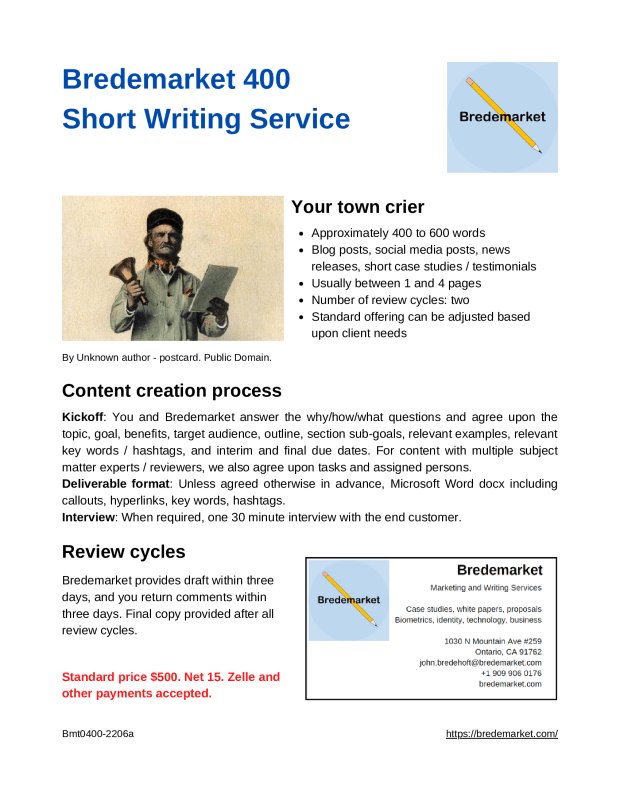
If you’re hungry to kickstart your identity/biometric firm’s written content, click on the image below to learn about Bredemarket’s services.

Are You ConTENT? Balance Your Critical List With Your Prospects’ Critical Lists

Designed by Imgflip.

Normally I talk about CONtent, but today I’m talking about conTENT. (OK, a little bit about CONtent also.)

There are many prospects that may be CRITICALLY IMPORTANT (the highest of my three levels of importance) to your firm—perhaps too many. You can reduce your firm’s list of critically important prospects without losing them altogether. The extra time you receive benefits your firm and your TRUE critically important prospects. And eventually the other prospects may come around anyway.

Let them

You may pursue a prospect because you perceive they have a need. For example, there are identity/biometric companies that have not blogged in over a year, and these companies obviously have a need to increase their visibility with their own prospects by blogging.

But what if the identity/biometric prospects are not HUNGRY to satisfy that need? (Hungry people = true target audience.) Addressing the need may even be “important” to the prospects—but not CRITICALLY important.

  • Now I can create (and have created) content addressing this need and how to fill it. If a prospect searches for this content, they will find it.
  • I can even proactively initiate direct contact with these prospects, and maybe even contact them a second time.

But in most cases a prospect may respond with a “not interested” message—if the prospect even responds at all.

Mel Robbins has a response to this.

Let them.”

When you “Let Them” do whatever it is that they want to do, it creates more control and emotional peace for you and a better relationship with the people in your life.

From https://www.melrobbins.com/podcasts/episode-70.

If the prospect is not hungry for your services at this time, let them.

And at the same time move the prospect from your “critically important” category down to your “important” category. Focus on the critically important prospects, and be content (conTENT) with them rather than stressing out over the uncontrollable prospects.

But don’t eliminate the merely important prospects entirely, because some day they may become hungry for your services. Continue creating content (CONtent) such as your own blogs, plus social media without messaging the merely important people directly. When they DO get hungry, they will emerge from your trust funnel and contact YOU, asking for your services.

Becoming conTENT

What happens when you, in the words of Mel Robbins, “let them”?

You’re focused, your true critically important prospects are happy that you’re paying attention to them, your merely important prospects are happy that you’re no longer pestering them…

…and everyone is conTENT.

(Pizza Stories) Is Your Firm Hungry for Awareness?

Leftover pizza is the best pizza. Preparation credit: Pizza N Such, Claremont, California. Can I earn free pizza as a powerful influencer? Probably not, but I’ll disclose on the 0.00001% chance that I do.

I wrote a post about pizza that concluded as follows:

Tal’s lead was hungry for ghostwriting services, and when they saw that Tal offered such a service, they contacted him.

What does this mean? I’ll go into that in a separate post.

From (Pizza Stories) The Worst Time to READ a Pizza Post on Social Media.

Now that it’s time to write the “separate post,” I really don’t want to get into the mechanics of how posts that attract prospects (hungry people, target audience) increase awareness and help you convert prospects for your products and services.

So forget that. I’m going to tell a story instead about two executives at a fictional company that has a real problem. The executives’ names are Jones and Smith.

The story

Jones was troubled. Sales weren’t increasing, prospects weren’t appearing, and if this malaise continued the company would have to conduct a second round of layoffs. Jones knew that “rightsizing” would be disastrous, so the company needed another solution.

So Jones videoconferenced Smith and asked, “How can we make 2024 better than 2023?”

Smith replied, “Increasing sales calls could help, and ads could help, but there’s another way to increase our awareness with our prospects. We could create content on our website and on our social channels that spreads knowledge of our products and services.”

Jones exclaimed, “That’s great! We could get generative AI to create content for us!”

“No, not that!” Smith replied. “Generative AI text sounds like a bot wrote it, and makes us sound boring, just like everyone else using generative AI text. Do we want to sound like that and put our prospects to sleep?”

By Ilya Repin – Tretyakov Gallery, Moscow, Public Domain, https://commons.wikimedia.org/w/index.php?curid=60387757

“So we need a human writer,” Jones realized, “one who can describe all of the features of our products.”

“Absolutely not,” Smith emphasized. “Customers don’t care about our features. They care about the benefits we can provide to them. If we just list a bunch of features, they’ll say, ‘So what?'”

By Mindaugas Danys from Vilnius, Lithuania, Lithuania – scream and shout, CC BY 2.0, https://commons.wikimedia.org/w/index.php?curid=44907034

“OK, we’ll go with benefits,” said Jones. “But why is content so important?”

Take blogging,” replied Smith. “The average company that blogs generates 55% more website visitors. B2B marketers that use blogs get 67% more leads than those who do not. Marketers who have prioritized blogging are 13x more likely to enjoy positive ROI. And 92% of companies who blog multiple times per day have acquired a customer from their blog.”

“Wow.” Jones was silent for a moment. “How do you know all of this stuff, Smith?”

“Because of the content that I’ve read online from a marketing and writing services company called Bredemarket. The company creates content to urge others to create content. Bredemarket eats its own wildebeest food.”

“Wildebeest?” Jones eyed Smith quizzically.

Black wildebeest. By derekkeats – Flickr: IMG_4955_facebook, CC BY-SA 2.0, https://commons.wikimedia.org/w/index.php?curid=14620744

“Never mind. The important thing is that Bredemarket’s marketing and writing services could help us increase awareness, and vault us over the companies that have blogs but don’t bother to post to them. In one industry, about one-third of the companies with blogs HAVEN’T SAID A SINGLE THING to their prospects and customers in the last two months. If we were in that industry, we could leapfrog over the silent companies.”

“That sounds great,” said Jones. “Let’s contact Bredemarket today.”

“Wonderful idea, Jones. By the way, I hear that Bredemarket excels at repurposing content also.”

The excited Jones asked Smith to contact Bredemarket, and then walked to a nearby venue and sang a song.

From https://www.youtube.com/watch?v=ifhcWeXIOZs

When You MUST Focus on Features

Bredemarket has consistently preached benefits, benefits, benefits, since customers want to know what’s in it for them. Customers don’t care if Bredemarket has been in business for three years; they care about how Bredemarket will facilitate consideration of their offerings.

But Tamara Grominsky, in her article “High-Converting Homepages,” points out one significant exception to the “benefits over features” rule—or, in alternate terms, the “outcomes over capabilities” rule.

We’ve been taught to market the benefit, not the feature. The team at Fletch PMM believes there’s a better way. They focus on capabilities over outcomes.

In the startup world especially, buyers need to know the “how”. You don’t have the credibility yet to skip over what the product is and how it works. Buyers don’t believe the outcomes until these more basic questions are answered.

From https://newsletter.pmmcamp.com/p/edition-52

The remainder of Grominsky’s article, which you can read here, lists five steps that you and I can follow to ensure that prospects understand our capabillities so that they will “believe the outcomes.” Step 4, for example, includes Fletch PMM’s handy-dandy value proposition builder.

Now I just have to absorb this and get a little more feature-centric about my marketing and writing services.

And if you want to receive Tamara Grominsky’s insights in your mailbox every week, go to https://newsletter.pmmcamp.com/subscribe.

What is Your Tone of Voice?

We relate to firms as entities with personalities…and particular tones of voice. Could you imagine Procter & Gamble speaking in Apple’s tone of voice, or vice versa?

And one more thing…Charmin. Now in black.

(Thunderous applause and royal adoration with no indifference whatsoever.)

Designed by Freepik.

When you contract with a writer

Firms take care to speak in a particular tone of voice. Which means that the people writing their copy have to speak in that same tone of voice.

I have spent time thinking about Bredemarket’s own tone of voice, most recently when I delved into the “royalty” aspects of the Bredemarket family of archetypes. In that family “Sage” is most dominant, but there are also other elements.

Bredemarket’s top archetypes: sage, explorer, royalty, and entertainer.

In Bredemarket’s case, my sage/explorer/royalty/entertainer tone of voice is visible in Bredemarket’s writing. At least in Bredemarket’s SELF-promotional writing.

But MY tone of voice makes no difference to my clients, all of whom are focused on their OWN tones of voice. And Bredemarket has to adjust to EACH CLIENT’S tone of voice.

  • If I’m writing for a toilet paper manufacturer, I will NOT delve into details of how the product is used. Then again, maybe I will. Times have changed since Mr. Whipple.
  • If I’m writing for a cool consumer electronics firm, I definitely WILL delve into product use…if it’s cool.
  • If I’m writing for a technologist, I’m not going to throw a lot of music references into the technologist’s writing. I will emphasize the technologist’s expertise.
  • If I’m writing for a firm dedicated to advancement, I’m not going to throw ancient references into the firm’s writing. I will emphasize the newness of the firm’s approach, using the firm’s own key words.

My hope is that if you see two pieces of ghostwritten (work-for-hire) Bredemarket work for two different clients, you WON’T be able to tell that they were both written by me.
When your writer dons your mask

I’ve addressed the topic of adaptation before, where people don masks to portray characters that they are not.

By JamesHarrison – Own work, Public Domain, https://commons.wikimedia.org/w/index.php?curid=4873863

At the time I said the following:

So when Bredemarket or another content marketing expert starts to write something for you, should you fret and fuss over what your archetype is?

If you feel like it. But it’s not essential.

What is essential is that you have some concept of the tone of voice that you want to use in your communication.

From https://bredemarket.com/2022/10/30/donning-archetypes/

I then led into…well, something that is long outdated. But the gist of what I said at the time is that you need to determine what your firm’s tone of voice is, so that your writers can consistently write in that tone of voice.

Creating content with your tone of voice

So if Bredemarket works with you to create your content, how will I know your desired tone of voice? By one of two ways.

  1. You tell me.
  2. I ask you.
Bredemarket’s first seven questions, the October 30, 2023 version.

As we work through the seven questions that will shape your content, I ensure that I understand the tone of voice that you want to adopt in your content.

And with the review cycles interspersed through the content creation process, you can confirm that the tone is correct, and I can make adjustments as needed.

Unless you absolutely insist that I use a hackneyed phrase like “best of breed.” That requires a significant extra charge.

Do you want to drive content results in your own tone of voice with Bredemarket’s help?

Here’s how.

Seven Questions Your Content Creator Should Ask You: the e-book version

No, this is not déjà vu all over again.

If you’re familiar with Bredemarket’s “six questions your content creator should ask you”…I came up with a seventh question because I feared the six questions were not enough, and I wanted to provide you with better confidence that Bredemarket-authored content will achieve your goals.

To no one’s surprise, I’ll tell you WHY and HOW I added a seventh question.

If you want to skip to the meat, go to the WHAT section where you can download the new e-book.

Why?

Early Sunday morning I wrote something on LinkedIn and Facebook that dealt with three “e” words: entertainment, emotion, and engagement, and how the first and second words affect the third. The content was very long, and I don’t know if the content itself was engaging. But I figured that this wasn’t the end of the story:

I know THIS content won’t receive 250 engagements, and certainly won’t receive 25,000 impressions, but maybe I can repurpose the thoughts in some future content. (#Repurposing is good.)

From LinkedIn.

But what to repurpose?

Rather than delving into my content with over 25,000 impressions but less than 250 engagements, and rather than delving into the social media group I discussed, and rather than delving into the Four Tops and the Sons of the Pioneers (not as a single supergroup), I decided that I needed to delve into a single word: indifference, and how to prevent content indifference.

Because if your prospects are indifferent to your content, nothing else matters. And indifference saddens me.

By Mark Marathon – Own work, CC BY-SA 4.0, https://commons.wikimedia.org/w/index.php?curid=72257785

How?

Eventually I decided that I needed to revise an old piece of content from 2022.

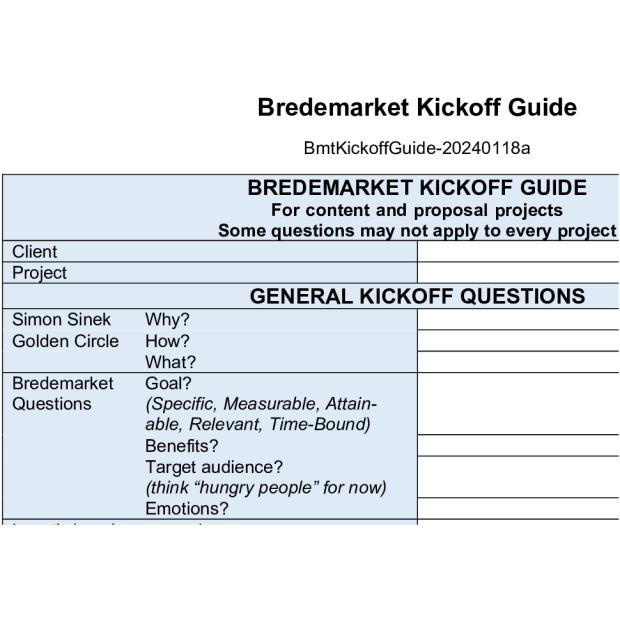
The first questions in the Bredemarket Kickoff Guide, BmtKickoffGuide-20231022a. No, you can’t have the guide; it’s proprietary.

I decided that I needed to update my process, as well as that e-book, and add a seventh question, “Emotions?”

What?

For those who have raced ahead to this section, Bredemarket has a new downloadable e-book (revised from an earlier version) entitled “Seven Questions Your Content Creator Should Ask You.” It includes a new page, “Emotions,” as well as minor revisions to the other pages. You can download it below.

Goal, Benefits, Target Audience, and Emotions

You’ll have to download the e-book to find the answers to the remaining four questions.

Your Prospects Don’t Care About Your Technology

Technologists, you know how tough it is to create a technology product.

  • You have to assemble the technology, or perhaps create the technology yourself.
  • You have to work on the most minute details and make sure that everything is just right.
  • It takes a great deal of effort.

What if your product story is ignored?

But when you want to tell the story about your product, and all the effort you put into it, your prospects ignore everything you say. You might as well not be there.

Designed by Freepik. And yes, you need to woo your prospects.

Do you know why your prospects are ignoring you?

Because they don’t care about you. It’s all about them.

People want to satisfy their own needs

But the “it’s all about me” attitude is actually a GOOD thing, if you can harness it in your messaging. Let’s face it; we all have an “it’s all about me” attitude because we want to satisfy our needs.

  • You want to satisfy your own needs because you only care about selling your product.
  • I want to satisfy my own needs because I only care about selling Bredemarket’s services. (I’ll get to the selling part later.)
  • And your prospects want to satisfy their own needs because they only care about their problems. And because of your customers’ self-focus, they’re only going to care about your product if it solves their problems.

So when it’s time to tell the story about your product, don’t talk about your technology.

Adopt a customer focus

Instead of talking about you, talk about them.

From the Gary Fly / Brooks Group article “7 Tips for Implementing a Customer-Centric Strategy,” at https://brooksgroup.com/sales-training-blog/7-tips-implementing-customer-centric-strategy/

Adopt a customer focus and talk about things that your prospects care about, such as how your product will solve their problems.

  • Do your customers struggle for visibility, or awareness? Will your technology help their visibility?
  • Do your customers struggle when considered against the competition? Will your technology help them stand out?
  • Do your customers struggle to make money (conversion)? Will your technology help them make money?
  • Do your customers require better ease of use, speed, accuracy, or other benefits? Do the features of your technology provide those benefits?

In short, your customers need to understand how you can solve their problems.

How do you adopt a customer focus?

But how can you make sure that your story resonates with your prospects?

Perhaps you need a guide to work with you to craft your story. Yes, I can serve as a guide to solve YOUR problem.

If you’re interested in how Bredemarket, the technology content marketing expert, can help you create a customer-focused story for your prospects, find out how to create technology content that converts

Quick Thoughts on Product Positioning

I’ve already talked about product launches in my recent On “Go-to-Market” post, but having worked in product marketing for some time, I know that there are a lot of tasks that your firm has to perform even when you’re not launching a new product.

One of those tasks is product positioning. And it’s important.

Product positioning isn’t quite as complex as global positioning (a factor of authentication, by the way). By Paulsava – Own work, CC BY-SA 4.0, https://commons.wikimedia.org/w/index.php?curid=47209685

Six questions for product positioning

There are some complex ways to define product positioning, probably even at the level of Shipley 96-step complexity. But when I can, I gravitate for the simple.

Here’s how I define product positioning:

(UPDATE OCTOBER 23, 2023: “SIX QUESTIONS YOUR CONTENT CREATOR SHOULD ASK YOU IS SO 2022. DOWNLOAD THE NEWER “SEVEN QUESTIONS YOUR CONTENT CREATOR SHOULD ASK YOU” HERE.)

  • Why your product (or service) exists.
  • How your product benefits your customers.
  • What your product is (but note that I asked the first two questions before this one).
  • Other facets of your product (goal, benefits, target audience—if this is new to you, catch up by reading my e-book on the six questions your content creator should ask you).

Why the questions matter

If your product suddenly disappeared from the world, would your target audience (or, in marketing-speak, personas) care?

Would your target audience be just as happy with the competitive offerings, or would the target audience lose out if your product’s distinctive benefits were suddenly no longer available?

Choose one (food) to go forever. Reproduced at https://josephmallozzi.com/2020/10/01/october-1-2020-lets-chat/

There are a number of popular memes that ask you to remove one popular food from a list of foods. What would happen if, instead of asking about pizza and tacos, you asked your target audience about your product and eight others? Would your product survive the cut, or would your prospects happily dump it?

Position your product so that it always remains top of mind for your prospects.

  • Answer the questions above.
  • Create content that is focused on the customer (not focused on your firm).
  • Create content that explains benefits (not features) to your prospects.

On “Go-to-Market”

After I slept on my “trust funnel” post, I decided that it was too long and took the entire “go-to-market” section out. But I saved it and am sharing it with you here.

This little piggy went to market

By Rklawton – Own work, CC BY-SA 2.5, https://commons.wikimedia.org/w/index.php?curid=735848

(Yes, I know that the little piggy didn’t go to market to do their own shopping. But bear with me here.)

If you are creating content as part of the formal launch of a product or service, you are creating SOME type of go-to-market (GTM) plan.

  • Perhaps it’s a well-defined plan.
  • Perhaps it’s a simple document.
  • Maybe it’s a haphazard dictate to “go to market in three days.”

About the “three days” thing

  • product,
  • marketing,
  • product marketing (if it is separate from the first two departments),
  • engineering,
  • customer success/customer service,
  • finance,
  • sales, and
  • legal.

But there ARE teeny tiny GTM efforts

One exception to the four-month guidance: if your “product” or “service” is VERY small (like a single blog post), you can obviously go-to-market much more quickly.

For example, here’s my Asana-based “GTM plan” for a single blog post, “I Changed My Mind on Age Estimation.

From the private Bredemarket Asana Content Calendar, back in the days when Twitter (TW) was still Twitter.

Sometimes. At other times I skip Asana altogether and just take pictures and post stuff, like what I did with my “Coldest Beer in Town” and “Classy by Definition” posts from earlier today. Variety is good.

Back to normal GTM

But when your product or service is more complex, then you need to plan your GTM campaign and make sure that it answers all questions about your product or service.

There are all sorts of GTM guidelines out there, and I was part of a team who collaboratively created three different flavors of GTM guidelines over the course of several months, starting with the complex and ending with the ridiculously simple. And the team STILL couldn’t get the other teams to agree on the parameters of the guidelines.

I’m not going to dictate MY ideas on GTM guidelines, but I will say that whatever guidelines you create, make sure that by the time a GTM effort created under these guidelines is finished, both your prospects and your employees will gain the appropriate understanding of your product or service, and the GTM content will answer all of their questions.

(UPDATE OCTOBER 23, 2023: “SIX QUESTIONS YOUR CONTENT CREATOR SHOULD ASK YOU IS SO 2022. DOWNLOAD THE NEWER “SEVEN QUESTIONS YOUR CONTENT CREATOR SHOULD ASK YOU” HERE.)

If you don’t know what questions to ask, my six questions (why, how, what goal, benefits, target audience) can be adapted for GTM purposes.

What about your GTM content?

Are you executing a go-to-market plan and need to create some content?

  • Do you need customer-facing external content (blog posts, white papers, whatever)?
  • Do you need employee-facing internal content (FAQs, battlecards, whatever)?

Regardless of the content you need, Bredemarket can help you. Here’s a list of the types of content I’ve created over the years:

Articles • Battlecards (80+) • Blog Posts (400+) • Briefs/Data/Literature Sheets • Case Studies (12+) • Competitive Analyses • Email Newsletters (200+) • Event/Conference/Trade Show Demonstration Scripts • FAQs • Plans • Playbooks • Presentations • Proposal Templates • Proposals (100+) • Quality Improvement Documents • Requirements • Scientific Book Chapters • Smartphone Application Content • Social Media (Facebook, Instagram, LinkedIn, Threads, TikTok, Twitter) • Strategic Analyses • Web Page Content • White Papers and E-Books

Whatever you need, talk to me. And be prepared for me to ask you six (or more) questions.

Bredemarket logo