Bredemarket and September 2021 on the proposal side

I was looking over the Bredemarket blog posts for September, and I found some posts that addressed the proposal side of Bredemarket’s services. (There are also blog posts that address the content side; see here for a summary of those posts.)

As a starting point, what proposal services has Bredemarket provided for its clients? I quantified these around the middle of the month and came up with this list.

And I’ve been working on additional proposal projects for clients that I haven’t added to the list yet.

Now if you’ve already read my September 2021 content post, it seems like I’ve been repeating myself. Well the repetition ends here, because my other big proposal-related accomplishment for the month was my Association of Proposal Management Professionals Foundation certification.

This will not only allow me to provide better proposal services to biometric firms (yes, yes, I am a biometric proposal writing expert), but also to other firms.

What other firms?

I’ll let you know.

If I can provide proposal services for you:

Bredemarket and September 2021 on the content side

I was looking over the Bredemarket blog posts for September, and I found some posts that addressed the content side of Bredemarket’s services. (There are also blog posts that address the proposal side; see here for a summary of those posts.)

As a starting point, what content services has Bredemarket created for its clients? I quantified these around the middle of the month and came up with this list.

And I’ve been working on additional content projects for clients that I haven’t added to the list yet.

At the same time, in accordance with Bredemarket’s 2021 goals, I’ve been working on expanding my content services beyond the technology arena to address the needs of local businesses in the Ontario, California area.

The Emporia Arts District in downtown Ontario. From https://www.emporiaartsdistrict.com/

So now I am not only providing content for biometric firms (after all, I am a biometric content marketing expert), but also for technology firms (including one for which I completed a project this month) and for local small businesses.

If I can provide content services for you:

Under the lens…and under many other things: Ambarella

You’ll notice that while I do style myself as an expert on some things, I never claim that I know everything…because I obviously don’t.

This became clear to me when I was watching the Paravision Converge 2021 video and noticed its emphasis on optimizing Paravision’s recognition algorithms for Ambarella.

Ambarella-related announcements from https://www.paravision.ai/converge2021/.

I had never heard of Ambarella.

I should have heard of it.

Even in my own little corner of the technology world, Ambarella has made an impact:

We power a majority of the world’s police body cams.

We were the first to enable HD and UHD security with low power; we revolutionized image processing for low-light and high-contrast scenes; and we are an industry leader in next-generation AI video security solutions.

Video has been a key component of face detection, person detection, and face recognition for years. (Not really of iris recognition…yet.) In certain use cases, it’s extremely desirable to move the processing out from a centralized server system to edge devices such as body cams, smart city cameras, and road safety cameras, and Ambarella (and its software partners) optimize this processing.

In addition to professional (and consumer) security, Ambarella is also a player in automotive solutions including autonomous vehicles, non-security consumer applications, and a variety of IoT/industrial/robotics applications.

All of these markets are supported via Ambarella’s specialized chip architecture:

Our CVflow® chip architecture is based on a deep understanding of core computer vision algorithms. Unlike general-purpose CPUs and GPUs, CVflow includes a dedicated vision processing engine programmed with a high-level algorithm description, allowing our architecture to scale performance to trillions of operations per second with extremely low power consumption.

I’ve always been of the opinion that technology is moving away from specialized hardware to COTS hardware. For example, the fingerprint processing and matching that used to require high-end UNIX computers with custom processor boards in the 1990s can now be accomplished on consumer-grade smartphones.

However, the reason that these consumer-grade devices can now perform these operations is because specialized technologies have been miniaturized and optimized for incorporation into the consumer grade devices, such as Yi home video cameras.

Ambarella itself is US-based (in Santa Clara, California), was founded in 2004, is traded on NASDAQ, and is a $200+ million/year company (although revenues and profits have declined over the last few years). While much smaller than more famous semiconductor companies, Ambarella obviously fills a critical niche for (among others) professional security product firms.

So if you, like me, had never heard of Ambarella…now you have.

When I will style myself John E. Bredehoft, CF APMP…and when I won’t

TL;DR: Yesterday I achieved APMP® Bid and Proposal Management Foundation 2021 certification.

This post explains what APMP Foundation certification is, why I pursued the certification, the difference between APMP and APMG, and when I will (and will not) use my shiny new “CF APMP” designation.

What is APMP Foundation certification?

First, for those not familiar with the acronym, “APMP” stands for the Association of Proposal Management Professionals, an organization that I re-rejoined back in July. APMP membership provides many benefits, including improved service to Bredemarket clients because of my access to the APMP Body of Knowledge.

It also provides a mechanism for proposal professionals to certify their mastery of the proposal field. And, as APMP itself notes, certification conveys the following:

Demonstrates a personal commitment to a career and profession.

Improves business development capabilities.

Creates a focus on best team practices.

Gains the respect and credibility of peers, clients and organizational leaders and, in some cases, additional compensation.

Reinforces bid/proposal management as an important role within an organization and not as an ad hoc function that anyone can perform. 

Frankly, most of these won’t matter to YOU, but the process required to achieve certification does improve business development capabilities for Bredemarket’s clients. You can ignore the rest, unless you’re suddenly eager to shower additional compensation on me. I won’t argue.

There are multiple levels of APMP certification, and the very first level is “Foundation” certification. There is an eligibility requirement to pursue this certification, however:

Candidates should have at least one year of experience in a bid and proposals environment; this experience does not have to be continuous. Time spent working or supporting sales and marketing also counts.

So I was eligible to pursue Foundation certification years ago…but I never did.

Why did I pursue APMP Foundation certification?

I already wrote about this on LinkedIn a week ago, but if you missed that explanation here’s an abbreviated version.

Over the years I kept on joining APMP while in a proposals position, then letting my APMP membership lapse when I transferred to a non-proposals position. So by the time I ever thought about seriously pursuing APMP Foundation certification, I was already out of proposals.

This time, I said to myself when I re-rejoined in July, it will be different.

I finally made the move after attending SMA’s weekly town hall and hearing Heather Kirkpatrick present on the various APMP certification levels.

But I acknowledged that certification is not universally desirable:

Yes, I know the debates about whether certifications (or, for that matter, formal education in general) are truly worthwhile, but there are times when checking off that box on that checklist truly matters.

And therefore I began reading the two documents that I had just purchased, including a study guide and a glossary of terms.

Why is the APMG involved in APMP stuff?

However, to actually achieve the certification, I didn’t go to the APMP itself, but to an organization called the APMG.

And no, the APMG was NOT established to confuse proposal practitioners by using a similar acronym. (Seriously; when I saw others’ announcements of proposal certification, I couldn’t figure out why they kept getting the APMP acronym wrong.)

The APM Group is actually a completely separate organization that provides certifications and other services for a number of disciplines. It serves aerospace, business, information technology, cybersecurity, and other disciplines.

In my case, once I had studied and taken a practice exam, I proceeded to sit for the real exam itself…after paying another fee.

(This is why some people oppose certifications; they think they’re a racket just to charge fees all over the place. But I had already determined that in this case, the return on investment would be positive.)

Well…I passed, and therefore can direct interested parties to my shiny new badge.

By the way, I was never asked to provide a reference to verify my experience, but I could have provided dozens of references if asked.

What about the shiny new designation that comes with the shiny new badge?

Oh, and there’s one more thing.

Certified people (as opposed to people who are certifiable) have the option of appending their certification to their name. In the business world, you often see this used by people who have achieved Project Management Professional (PMP) certification. In some countries, MBAs and even BAs append the appropriate designation to their names.

In the same manner, those who have achieved one of the APMP certifications can append the appropriate certification. In the case of APMP Foundation certification, that means that I can style myself as “John E. Bredehoft, CF APMP.” (Or “John E. Bredehoft, MBA, CF APMP, RSBC” if I want to be thorough. But I probably won’t, since “RSBC” stands for “Radio Shack Battery Club.”)

However, the “CF APMP” designation only makes sense if the person reading the designation knows what it means. And it’s a fairly safe bet that if I were to walk into a coffee shop, or even into the main office of a marketing firm, the people there would have no idea what “CF APMP” meant. In fact, it might strike some of them as pretentious.

But it DOES make a difference in some (not all) proposal circles.

Including the attendees at the APMP Western Chapter Training Day next month.

Which I really should attend if possible. After all, I need to maintain my Continuing Education Units (CEUs) to keep my certification up to date.

This one won’t count for my Foundation certification renewal, but it’s nice.

connect:ID 2021 is coming

I have not been to an identity trade show in years, and sadly I won’t be in Washington DC next week for connect:ID…although I’ll be thinking about it.

I’ve only been to connect:ID once, in 2015. Back in those days I was a strategic marketer with MorphoTrak, and we were demonstrating the MorphoWay. No, not the Morpho Way; the MorphoWay.

At connect:ID 2015.

Perhaps you’ve seen the video.

Video by Biometric Update. https://www.youtube.com/watch?v=mqfHAc227As

As an aside, you’ll notice how big MorphoWay is…which renders it impractical for use in U.S. airports, since space is valuable and therefore security features need a minimum footprint. MorphoWay has a maximum footprint…just ask the tradespeople who were responsible for getting it on and off the trade show floor.

I still remember several other things from this conference. For example, in those days one of Safran’s biometric competitors was 3M. Of course both Safran and 3M have exited the biometric industry, but at the time they were competing against each other. Companies always make a point of checking out the other companies at these conferences, but when I went to 3M’s booth, the one person I knew best (Teresa Wu) was not at the booth. Later that year, Teresa would leave 3M and (re)join Safran, where she remains to this day.

Yes, there is a lot of movement of people between firms. Looking over the companies in the connect:ID 2021 Exhibitor Directory, I know people at a number of these firms. Obviously people from IDEMIA, of course (IDEMIA was the company that bought Safran’s identity business), but I also know people at other companies, all of whom who were former coworkers at IDEMIA or one of its predecessor companies:

  • Aware.
  • Clearview AI.
  • GET Group North America.
  • HID Global.
  • Integrated Biometrics.
  • iProov.
  • NEC.
  • Paravision.
  • Rank One Computing.
  • SAFR/RealNetworks.
  • Thales.
  • Probably some others that I missed.

And I know people at some of the other companies, organizations, and governmental entities that are at connect:ID this year.

Some of these entities didn’t even exist when I was at connect:ID six years ago, and some of these entities (such as Thales) have entered the identity market due to acquisitions (in Thales’ case, the acquisition of Gemalto, which had acquired 3M’s biometric business).

So while I’m not crossing the country next week, I’m obviously thinking of everything that will be going on there.

Incidentally, this is one of the last events of the trade show season, which is starting to wind down for the year. But it will ramp up again next spring (for you Northern Hemisphere folks).

Bredemarket remembers the Southern Hemisphere, even though Bredemarket only does business in the United States. https://www.youtube.com/watch?v=HtZCQiN3n50

Regardless of where you are, hopefully the upcoming trade show season will not be adversely impacted by the pandemic.

My 9/21/2021 progress on Bredemarket’s five goals for 2021 (the 1/8/2021 9:30am edition)

Cue the wildebeests. It’s goal revisiting time.

Black wildebeest. By derekkeats – Flickr: IMG_4955_facebook, CC BY-SA 2.0, https://commons.wikimedia.org/w/index.php?curid=14620744

I haven’t taken the opportunity to look at how I’m doing on Bredemarket’s 2021 goals for a while. I last looked at all of the goals back on February 22. Needless to say, a lot has happened in the intervening months, some of which I can’t talk about yet.

But let’s proceed on a goal-by-goal basis.

Goal 1: Help my clients to communicate and reach (and understand) their goals. 

Most notably, I’ve improved my internal processes to ensure that I collaborate with my clients at the very beginning of an engagement. My latest tweaks to my engagement kickoff process were made just recently, but I’ve already been able to incorporate the process in two projects. So far it’s improved things dramatically.

Goal 2: Pursue multiple income streams. 

I’ve done a lot here.

  • For indirect engagements, I’m now signed up with four different “intermediary services.” They haven’t really paid off yet in terms of income, but I’m constantly reminded (by words and actions) that it sometimes takes a LONG time to build up business.
  • For direct engagements, I’m not only working on building up my customer base in my biometric sweet spot, but I’m also working on reinforcing my services for general technology clients AND expanding to local non-technology businesses.

And there are other things in the works.

Goal 3: Pursue multiple communication streams.

A lot has happened here also. Bredemarket is communicating through a number of avenues:

Frankly, a lot of the items on these accounts are simple re-shares, but it helps to get the message to the people who need to see my message, in their preferred location to see my message. As I mentioned previously, I was initially reluctant to create an Instagram account…until I realized that many of my clients, potential clients, and evangelists are active on the platform.

Goal 4: Eat my own iguana food.

My offerings have evolved into two major categories: content creation and proposal services. And I’ve been generating my own content (see Goal 3) and my own proposals: not only to solicit client services, but also to express Bredemarket views on Requests for Comment here and there. (Here is an example.)

Oh, and regarding content, I’m slowly learning how to effectively use Canva, which I’ve used to create my business card and my most recent brochures.

Goal 5: Have fun.

Hey, I’m trying. The local marketing lets you see some interesting things.

One of the pictures I took at Ontario’s “Cruisin Reunion” last weekend. If you followed Bredemarket’s Instagram account you would have already seen it.

Goal 6: Be prepared to change.

I’ve performed SOME efforts to create internal goals that are SMART (specific, measurable, achievable, relevant, time bound), which has helped in the tracking.

As for change, I’m expanding my offerings to local businesses as previously mentioned, and may implement some other changes in the future which I can’t talk about yet. (Can I use the “p” word yet? Better not.)

You know, 2022 is coming.

But I’m not the only one who needs to set goals. You probably have some goals for your business also. Perhaps you set goals for 2021, achieving some, not achieving others. Perhaps you’re already starting to think about your goals for 2022.

Can Bredemarket help you with those goals? Do you have content creation goals? Do you need to improve your proposal process or your proposal standard text (boilerplate)? Do you need an easy-to-use template that conveys your message?

If Bredemarket can help you with any of these things, contact me.

When Instagram’s interests are not your own

Now that I changed my mind and have augmented my personal Instagram account with a Bredemarket Instagram account, Instagram is sending Bredemarket helpful tips and messages. Here’s part of a message I recently received from Instagram.

Let EVERYONE know how to connect with you, including friends and family?

What’s wrong with letting EVERYONE know about your business social media account?

While there is some merit in Instagram’s advice, there’s one very important caveat if you are trying to build a business, rather than just trying to build follower count.

Only invite people to follow your business account who are genuinely interested in your business.

  • Obviously current customers are interested in your business, and inviting them to follow is a good idea.
  • The same goes for potential customers, a category that Instagram inadvertently left out of its pitch.
  • And some of your friends and family who are knowledgeable about the issues in your business may be good invitees, because even if they can’t provide business (and sometimes they can), they can serve as evangelists to others. Someone of my Facebook and LinkedIn friends have already helped me in this capacity.

But I haven’t gone out of my way to invite my friends who do not own or work for identity, biometrics, technology, or local (Inland Empire West) firms to follow the Bredemarket Instagram account. Why not? Because it provides no benefit to Bredemarket.

So why does Instagram want me to invite friends and family to follow the Bredemarket account? Because it does provide benefit to Instagram. The more people engaged on Instagram translates to more opportunities for Instagram to display ads, which benefits Instagram’s bottom line. But it won’t benefit your bottom line as a business.

So if my European daughters’ retired high school teacher is waiting for that Instagram invite from Bredemarket…keep waiting.

Shameless non-sponsored plug for Ray of Social

Incidentally, my thoughts on WHO to invite to follow your business social media accounts have been heavily influenced by Georgia of Ray of Social. Her Instagram account is here. Pay special attention to her “3 things that harm your growth,” especially thing 2 (although thing 1 and thing 3 are also important).

Excuse me, but I have a lot of questions…

I’ve previously shared how I’ve revised my content creation process.

Like any good process, the not-so-new-anymore Bredemarket content creation process asks a lot of questions up front. These questions ensure that I perform the project in accordance with the wishes of my client.

Because, as we all know, it costs more to rework a project at the end than it does at the beginning. (Or maybe you didn’t know that; it’s something I included in some work I did for a client. But the client knows.)

Specifically, early in the engagement I reach agreement with my client on all or most of the following questions on the content:

  • The topic.
  • The goal.
  • The benefits.
  • The target audience.
  • If necessary:
    • The outline.
    • The section sub-goals.
    • Relevant examples.
    • Relevant key words/hashtags.
    • Interim and final due dates.

When you break it out, that’s a lot of stuff.

And there’s more stuff that I need to know from the client that I’m not sharing publicly. But I’ll give you a hint: some of the questions are driven by a recent experience with Google Docs, and the fact that two different people weren’t using the same fonts, sizes, and styles. Well, if Google Docs can’t take care of it automatically, I can ask about fonts/sizes/styles (when applicable) so that the issue can be resolved manually.

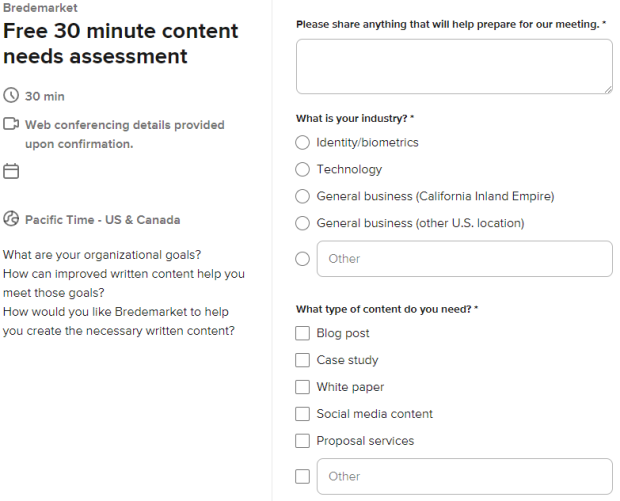
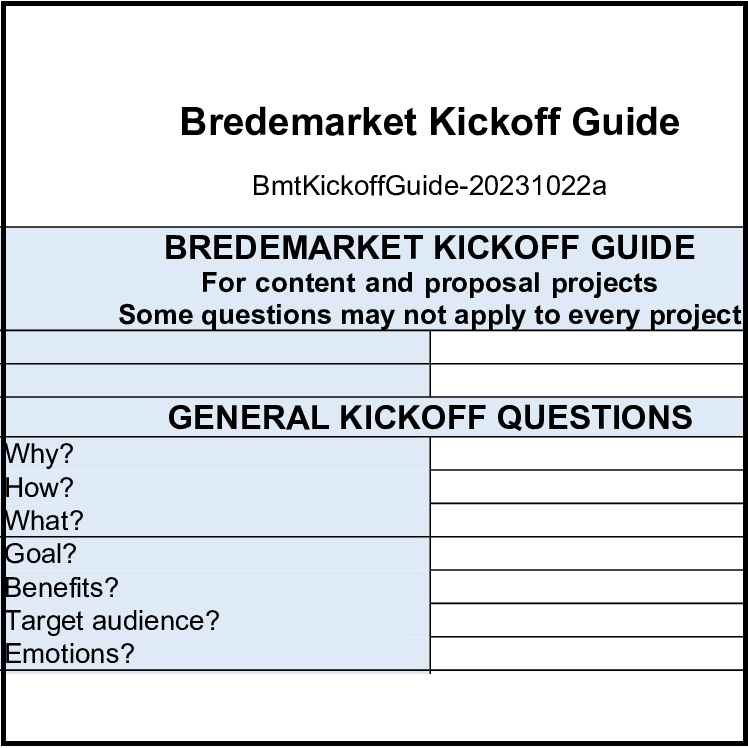
So I’ve created a form that I can use for either the content or proposals sides of the Bredemarket business, and the form contains all of the questions that I need to ask a client at the beginning of an engagement.

My in-house form, first iteration.

Or at least I think it contains all of the questions.

I’m going to try it out with a future client.

And perhaps I’ll iterate it afterwards.

Google Docs format sharing non-standards

In the past, I’ve mentioned that blog posts are often transitory. I hope this one is transitory and that I can come up with a technical or a procedural solution, because as of now I don’t have one.

Most of my writing experience over the past…many years has been with various versions of Microsoft Word, with the exception of a brief period in which I used FullWrite Professional. (The then-current version of Microsoft Word was NOT Mac-like, and FullWrite Professional was reputed to have a more graphical interface. It did…but it was slower than molasses, so we switched back to Word.)

Google Docs. Can’t you tell?

However, two of my recent projects used Google Docs instead of Microsoft Word, primarily because of Google Docs’ excellent collaboration features, including:

  • The ability to share a document with multiple collaborators, even outside of your organization.
  • The ability to restrict collaboration permissions to only allow commenting, or only allow viewing.
  • The ability to assign items to collaborators, and have the collaborators resolve them.
  • The ability for multiple people to edit the document at the same time. (This could be a drawback, but in my experience it was a plus.)

Everything worked well in my first project, a fairly simple project in which my collaborator took final ownership at the end and performed the final formats.

It was a different story with my second project, a much more complex project.

From my experience with Microsoft Word, a person could modify the existing styles, define new styles, and ensure that anyone who edited the document used the defined styles.

Google Docs is…a little different, as I found out the hard way.

First, Google Docs doesn’t allow you to define custom styles. So if I’m doing work for WidgetCorp, I can’t define styles like WidgetCorpAnswer or WidgetCorpHeading1.

Second, even Google Docs’ standard set of styles is limited.

Normal, Title/Subtitle, and six levels of Headings. That’s it. Forget about special styles for captions, table contents, or anything else.

Third, while Google Docs lets you modify these nine standard styles, there’s no good way to let other people use your modified styles. Here’s how I shared the issue in a Google community:

How can style customizations be shared between collaborators to avoid this issue?

Person A and Person B are collaborating on a Google Docs document.

Person A defines custom styles for Heading 1 and Heading 2.

Person B moves text from Heading 2 to Heading 1.

Person B’s heading style (not Person A’s heading style) is applied.

Person A has to reformat the text in Person A’s custom Heading 1 style. 

This happened on a recent project. I was Person B.

I was hoping that there was some easy way for “Person A” to share style definitions with “Person B” without having those become Person B’s defaults. (Because, after all, Person B may eventually collaborate with Person C, who has different style preferences.)

Sadly, my hopes were dashed:

I feel your pain. Sadly, there currently isn’t any way around this, as editors have free rein. The only solution would be to change their access from “Editor” to “Commenter.”

In other words, only one person can perform final formatting of a Google Docs document. While this restriction can apply to some business workflows, it can’t apply to all of them.

So is there a solution that allows multiple people to format a Google Docs document, and use common formatting styles?

(And before you say “Use Word,” I should also add that real-time collaboration is essential.)

As I said, I hope this post is transitory and I can come up with an acceptable solution.

(But even then, there are other drawbacks in Google Docs, including the inability to automatically number figure and table captions…)

Behind the scenes postscript: I was getting ready to write another post that referenced this post, and then I discovered that I had never actually finalized or shared this post. So now I’ve shared it, primarily so that I can reference it in the future without confusing everyone.

Investigative leads and DNA booking stations

(Part of the biometric product marketing expert series)

A July Bredemarket post on Facebook has garnered some attention in September.

I wanted to answer some questions about rapid DNA use in a booking station, how (and when) DNA is used in booking (arrests), what an “investigative lead” is, and whether acquiring DNA at booking is Constitutional.

(TL;DR on the last question is “yes,” per Maryland v. King.)

Are rapid DNA booking stations a Big Brother plot?

The post in question was a Facebook post to the Bredemarket Identity Firm Services Facebook group. I posted this way back in July, when Thermo Fisher Scientific became the second rapid DNA vendor (of two rapid DNA vendors; ANDE is the other) whose system was approved by the U.S. Federal Bureau of Investigation (FBI) for use as a law enforcement booking station.

When I shared this on Facebook, I received some concerned comments:

“Big brother total control”

“Is this Constitutional??? Will the results of this test hold up in courtrooms???”

I’ll address the second question later: not just in regard to rapid DNA, but to DNA in general. At this point, however, I will go ahead and say that the use of rapid DNA in booking was authorized legislatively by the Rapid DNA Act of 2017. This was followed by over three years of procedural stuff until rapid DNA booking station use was authorized this year.

To accurately state what “rapid DNA booking station use” actually means, let me refer to the FBI’s language, starting with the purpose:

The FBI Laboratory Division has been working with the FBI Criminal Justice Information Services (CJIS) Division and the CJIS Advisory Policy Board (CJIS APB) Rapid DNA Task Force to plan the effective integration of Rapid DNA into the booking station process.

By way of definition, a “booking station” is a computer that processes individuals who are “booked,” or arrested. The FBI’s plan was that (when authorized by federal, state, or local law) when an arrested individual’s fingerprints were captured, the individual’s DNA would be captured at the same time. (Again, only when authorized.)

The use of the term “reference sample buccal (cheek) swab” is intentional. The FBI’s current development and validation efforts have been focused on the DNA samples obtained from known individuals (e.g., persons under arrest). Because known reference samples are taken directly from the individual, they contain sufficient amounts of DNA, and there are no mixed DNA profiles that would require a scientist to interpret them. For purposes of uploading or searching CODIS, Rapid DNA systems are not authorized for use on crime scene samples.

“CODIS,” by the way, is the Combined DNA Index System, a combination of federal, state, and local systems.

“Rapid DNA” is an accelerated, automated DNA method that can process DNA samples in less than two hours, as opposed to the more traditional DNA processes that can take a lot longer.

The FBI is NOT ready to use rapid DNA to solve crimes, although some local police agencies have chosen to do so. And until February of this year, the FBI was not ready to use rapid DNA in the booking process either.

So what has been authorized?

The Bureau recognizes that National DNA Index System (NDIS) approval of the Rapid DNA Booking Systems and training of law enforcement personnel using the approved systems are integral to ensuring that Rapid DNA is used in a manner that maintains the quality and integrity of CODIS and NDIS.

Rapid DNA Booking System(s) approved for use at NDIS by a law enforcement booking station are listed below.

ANDE 6C Series G (effective February 1, 2021)

RapidHIT™ ID DNA Booking System v1.0 (effective July 1, 2021) 

If you read the FBI rapid DNA page, you can find links to a number of forensic, security, and other standards that have to be followed when using rapid DNA in a booking environment.

But those aren’t the only restrictions on rapid DNA use.

Can ANY law enforcement agency use rapid DNA in booking?

Um, no.

According to the National Conference of State Legislatures (2013; see PDF), not all states authorize the taking of DNA after an arrest. As of 2013, 20 states did NOT allow the taking of DNA from individuals who had been arrested but not convicted. And of the 30 remaining states, some (such as Connecticut) only allowed taking of DNA for “serious felonies,” some (such as California) for all felonies, and various mixtures in between. Oklahoma, for example, only allowed taking of DNA for “aliens unlawfully present under federal immigration law.”

Now, of course, a rogue police officer could take your DNA when not legally authorized to do so. Then again, a rogue restaurant employee could put laxatives in your food; that doesn’t mean we outlaw laxatives.

An “investigative lead”

So let’s say that you’re arrested for a crime, and your state allows the taking of DNA for your crime at arrest, and your local law enforcement agency has a rapid DNA instrument.

Now let’s assume that your DNA is searched against a DNA database of unsolved crimes, and your DNA matches a sample from another crime. What happens next?

If there is a match, police will likely want to take a closer look.

Wait a minute. There’s a DNA match! Doesn’t that mean that the police can swoop in and arrest the individual, and the individual is immediately convicted?

Um, no. Stop trusting your TV.

It takes more than DNA to convict a person of a crime.

While DNA can provide an investigative lead, DNA in and of itself is not sufficient to convict an individual. The DNA evidence usually has to be supported by additional evidence.

Especially since there may be other explanations of how the DNA got there.

In 2011, Adam Scott’s DNA matched with a sperm sample taken from a rape victim in Manchester—a city Scott, who lived more than 200 miles away, had never visited. Non-DNA evidence subsequently cleared Scott. The mixup was due to a careless mistake in the lab, in which a plate used to analyze Scott’s DNA from a minor incident was accidentally reused in the rape case.

Then there’s the uncomfortable and inconvenient truth that any of us could have DNA present at a crime scene—even if we were never there. Moreover, DNA recovered at a crime scene could have been deposited there at a time other than when the crime took place. Someone could have visited beforehand or stumbled upon the scene afterward. Alternatively, their DNA could have arrived via a process called secondary transfer, where their DNA was transferred to someone else, who carried it to the scene.

But there is a DNA case that was (originally) puzzling. Actually, a whole bunch of DNA cases.

There is an interesting case, known as the Phantom of Heilbonn, that dates from 1993 in Austria, France and Germany. From that year the DNA of an unknown female was detected at crime scenes in those countries, including at six murder scenes, one of the victims being a female police officer from Heilbronn, Germany. Between 1993 and March 2009 the woman’s DNA was detected at 40 crime scenes which ranged from murder to burglaries and robberies. The DNA was found on items ranging from a biscuit to a heroin syringe to a stolen car.

Then it got really weird.

In March 2009 investigators discovered the same DNA on the burned body of a male asylum-seeker in France. Now this presented something of an anomaly: the corpse was male but the DNA was of a female.

You guessed it; it was the swabs themselves that were contaminated.

So a DNA match is just the start of an investigative process, but it could provide the investigative lead that eventually leads to the conviction of an individual.

Perhaps you’ve noticed that I use the phrase “investigative lead” a lot when talking about DNA and about facial recognition. Trust me, it’s important.

But is the taking of DNA at booking Constitutional?

Obviously this is a huge question, because technical ability to do something does not automatically mean that you are Constitutionally authorized to do so. There is, after all, Fourth Amendment language protecting us against “unreasonable searches and seizures.”

Is the taking of DNA from arrestees who have not been convicted (assuming state law allows it) reasonable, or unreasonable?

Alonzo Jay King, Jr. had a vested interest in this question.

Alonzo Jay King Jr…was arrested in 2009 on assault charges. Before he was convicted of that crime, police took a DNA sample pursuant to Maryland’s new law allowing for such collections at the time of arrest in certain offenses….

I want to pause right here to make sure that the key point is highlighted. King, an arrestee who had not been convicted at the time of any crime, was compelled to provide evidence. At the time of arrest, collection of certain types of evidence (such as fingerprints) is “reasonable.” But collection of certain other types of evidence (such as a forced confession) is “unreasonable.”

So King’s DNA was taken and was searched against a Maryland database of DNA from unsolved crimes. You won’t believe what happened next! (Actually, you will.)

The DNA matched a sample from an unsolved 2003 rape case, and Mr. King was convicted of that crime.

Sentenced to life in prison, actually.

Wicomico County Assistant State’s Attorney Elizabeth L. Ireland said she requested the court impose a life sentence on King, not only because of his past criminal convictions, but also because it turned out that he was a friend of the victim’s family. She said this proved King was a continuing danger to the community.

Before you say, “well, if he was the rapist, he should be imprisoned, legal niceties notwithstanding,” think of the implications of that statement. The entire U.S. legal system is based upon the premise that it is better for a guilty person to mistakenly go free than for an innocent person to mistakenly be punished.

And if that doesn’t sink in…what if YOU were arrested and convicted unlawfully? What if a plate analyzing YOUR DNA wasn’t cleaned properly, and you were unjustly convicted of rape? Or what if a confession were coerced from YOU, and used to convict you?

So King’s question was certainly important, regardless of whether or not he actually committed the rape for which he was convicted.

King therefore appealed on Fourth Amendment grounds, the Maryland Court of Appeals overturned his conviction (PDF), and the State of Maryland brought the case to the U.S. Supreme Court in 2013 (Maryland v. King). In a close 5-4 decision (PDF) in which both conservatives and liberals were on both sides of the argument, the Court ruled that the taking of DNA from arrestees WAS Constitutional.

But that wasn’t the end of the argument, because a new case arose in the state of California. But the California Supreme Court ruled in 2018 that the practice was allowed in that state.

So the taking of DNA at booking is not only authorized (in some states, for some charges), it’s also Constitutional. (Although the Supreme Court’s opinion is still widely debated.)

So anyone who gets arrested for a felony in my home state of California should be ready for a buccal (cheek) swab.