(This post addresses something that I already announced last week to the Bredemarket mailing list. If you are already subscribed to the mailing list, then you can skip this post. If not, (1) subscribe via the http://eepurl.com/hdHIaT link, and (2) read the post below to catch up on what you missed last week.)
There are three ways that your firm can engage with your content creator.
On one extreme, your firm can hire the content creator as a full-time employee. This gives you the benefit of content creator availability at any time (or at least during office hours; don’t make TOO many 3:00 am calls to your employees).
On the other extreme, your firm can contract with the content creator for a single project. Maybe a blog post. Maybe a white paper. Maybe a tweet. Maybe a proposal responding to a Request for Proposal (RFP).
These extremes satisfy most firms. But a few firms—perhaps yours—need something between these two extremes.
The Drawbacks of Per-Project Content Creation
There are three potential issues with engaging content creators on a per-project basis.
The first issue is work flexibility. If you engage a content creator to write a blog post for you, you get that work done easily. But when you need something else, you need to re-engage the content creator under a separate project.
The second issue is budget predictability. Sure, only engaging content creators on a project-by-project basis helps you save costs (to some extent), but it’s very hard to predict what your future costs will be. Do you think you’ll need two new white papers four months from now, or five months from now.
The third issue is consultant accessibility. You may approach a content creator for a project that you need, only to find that the content creator is completely booked for the next few weeks.
Is there a way to ensure work flexibility, budget predictability, and consultant accessibility—short of hiring the consultant as a full-time employee?
Announcing the Bredemarket 4444 Partner Retainer
My new offering, announced last week to the Bredemarket mailing list, is a retainer offering that allows you to use Bredemarket for ANY writing task, up to a set number of hours per month. In effect, I’m embedded in your organization to serve you as needed.
Within the hours you select in the partner retainer contract, Bredemarket can create any content you need—blogs, case studies / testimonials, data sheets, e-books, proposals, social media posts / Xs (or whatever tweets are called today), white papers, or anything.
In addition, the retainer hours are discounted from my usual rate, so you save money that you would have spent if you contracted with me separately for multiple projects.
How can you learn more?
To learn more how the Bredemarket 4444 Partner Retainer works,
From Venn Marketing, “Awareness, Consideration, Conversion: A 4 Minute Intro To Marketing 101.” (Link)
The picture above shows a simple sales funnel example. The second of the three items in the funnel is the “consideration” phase.
In that phase, those people who are aware of you can then consider your products and services.
If they like what they see, they move on to conversion and hopefully buy your products and services.
But how do prospects in the funnel consideration phase evaluate your offering as opposed to competitor offerings? Is it truly a quantitative and logical process, or is it in reality qualitative and emotional?
Quantitative consideration
For purposes of this post, let’s assume that there are two competing companies, Bredemarket and Debamarket, who are fighting each other for business.
Second, let’s assume that Bredemarket and Debamarket offer similar services to their prospects and customers:
Blog posts
Case studies
White papers
Finally, let’s assume that a big government agency (the BGA) has issued a Request for Proposal (RFP) for blog/case study/white paper services, and Bredemarket and Debamarket are the two companies competing for the award.
A pre-acquisition consultant will develop a Source Selection Plan (SSP). In competitive procurements such as the one in this example, the SSP will state exactly how proposals will be evaluated, and how the best proposal will be selected.
Here is the U.S. Government’s guidance on Source Selection Plans. (link)
SSPs can be very complex for certain opportunities, and not so complex for others. In all cases, the SSP dictates the evaluation criteria used to select the best vendor.
The weighted scoring approach breaks down your RFP evaluation criteria and assigns a value to each question or section. For example, your RFP criteria may consider questions of technical expertise, capabilities, data security, HR policies and diversity and sustainability. Weighted scoring prioritizes the criteria that are most important to your business by assigning them a point or percentage value. So your weighted scoring criteria may look like this:
Technical expertise – 25%
Capabilities – 40%
Data security – 10%
HR policies – 10%
Diversity and sustainability – 15%
RFP360, “A guide to RFP evaluation criteria: Basics, tips and examples.” (Link)
Individual question evaluation
In most cases the evaluator doesn’t look at the entire technical expertise section and give it a single score. In large RFPs, the technical expertise section may consist of 96 questions (or even 960 questions), each of which is evaluated and fed into the total technical expertise score.
For example, the RFP may include a question such as this one, and the responses from the bidders (Bredemarket and Debamarket) are evaluated.
Question
Bredemarket
Debamarket
96. The completed blog post shall include no references to 1960s songs.
Example evaluation of a proposal response to an individual RFP question.
Final quantitative recommendation for award
Now repeat this evaluation method for every RFP question in every RFP category and you end up with a report in which one of the vendors receives more points than the other and is clearly the preferred bidder. Here’s an example from a U.S. Nuclear Regulatory Commission proposal source selection process. (And you can bet that a nuclear agency doesn’t use an evaluation method that is, um, haphazard.)
From U.S. Nuclear Regulatory Commission, “FINAL EVALUATION RECOMMENDATION REPORT FOR PROPOSALS SUBMITTED UNDER RFP NO. RQ-CIO-01-0290 ENTITLED, “INFRASTRUCTURE SERVICES AND SUPPORT CONTRACT (ISSC).”” (link)
So what does this example show us? It shows that L-3 Communications/EER received a total score of 83.8, while its closest competitor Logicon only received a score of 80. So EER is the preferred bidder.
So in our example, BGA would evaluate Bredemarket and Debamarket, come up with a number for each bidder, and award the contract to the bidder with the highest evaluation score.
Quantitative recommendation for the little guys
Perhaps people who aren’t big government agencies don’t go to this level of detail, but many prospects who reach the consideration phase use some type of quantitative method.
For example, if the (non-weighted) pros for an item under consideration outnumber the cons, go for it.
Now of course the discussion above assumes that everyone is a logical being who solely evaluates based on objective criteria.
But even Sages such as myself may deviate from the objective norm. Here’s a story of one time when I did just that.
As I previously mentioned, I had never written a proposal response before I started consulting for Printrak. But I had written a Request for Proposal before I joined Printrak. For a prior employer (located in Monterey Park), I worked with an outside consultant to develop an RFP to help my employer select a vendor for a computer system. The questions posed to the bidders were not complex. Frankly, it was a simple checklist. Does your computer system perform function A? Does it perform function B?
The outside consultant and I sent the final RFP to several computer system providers, and received several proposals in response.
A few of the proposals checked every box, saying that they could do anything and everything. We threw those proposals out, because we knew that no one could meet every one of our demanding requirements. (“I can’t trust that response.”)
We focused on the proposals that included more realistic responses. (“That respondent really thought about the questions.”)
As you can see, we introduced a qualitative, emotional element into our consideration phase.
According to Kaye Putnam, this is not uncommon.
Qualitative consideration
Humans think that we are very logical when we consider alternatives, and that our consideration processes are logical and quantitative. Putnam has looked into this assertion and says that it’s hogwash. Take a look at this excerpt from Putnam’s first brand psychology secret:
Your brand has to meet people at that emotional level – if you want them to buy. (And I know you do!)
Findings from several studies support this, but one of the most seminal was outlined in Harvard professor Gerald Zellman’s 2003 book, The Subconscious Mind of the Consumer. Zellman’s research and learnings prompted him to come to the industry-rocking conclusion that, “95 percent of our purchase decision making takes place in the subconscious mind.”
From Kaye Putnam, “7 Brand Psychology Secrets – Revealed!” (link)
But how can the subconscious mind affect quantitative evaluations?
While logic still has to play SOME role in a purchase decision (as Putnam further explains in her first and second brand psychology secrets), a positive or negative predisposition toward a bidder can influence the quantitative scores.
Imagine if the evaluators got together and discussed the Bredmarket and Debamarket responses to question 96, above. The back and forth between the evaluators may sound like this:
“OK, we’re up to question 96. That’s a no brainer, because no one would ever put song references in a BGA blog post.”
“Yeah, but did you see Bredemarket’s own post that has multiple references to the song ‘Dead Man’s Curve’?”
“So what? Bredemarket would never do that when writing for a government agency. That piece was solely for Bredemarket.”
“How do you KNOW that Bredemarket would never slip a song reference into a BGA post? You know, I really don’t trust that guy. He wore two different colored shoes to the orals presentation, a brown one and a black one. Someone as slopy as that could do anything, with huge consequences for BGA communications. I’m deducting points from Bredemarket for question 96.”
“OK. I think you’re being ridiculous, but if you say so.”
And just like that, your quantitative logical consideration process is exposed as a bunch of subconscious emotional feelings.
How does qualitative consideration affect you?
As you develop your collateral for the consideration phase, you need to go beyond logic (even if you have a Sage predisposition) and speak to the needs and pain points of your prospects.
Spock is behaving illogically. Jayenkai, “Pain – Star Trek Remix.” (link)
Here’s a example from my law enforcement automated fingerprint identificaiton system (AFIS) days.
If your prospect is a police chief who is sick and tired of burglars ransacking homes and causing problems for the police department, don’t tell your prospect about your AFIS image detail or independent accuracy testing results. After all, 1000 ppi and 99.967 accuracy are only numbers.
Provide the police chief with customer-focusedbenefit statements about how quickly your AFIS will clean up the burglary problem in the town, giving residents peace of mind and the police department less stress.
If you can appeal to those emotions, that police chief will consider you more highly and move on to conversion (purchase).
Can I help?
If your messaging concentrates on things your prospects don’t care about, most of them will ignore you and not shower you with money. Using the wrong words with your customers impacts your livelihood, and may leave you poor and destitute with few possessions.
If you need a writer to work with you to ensure that your written content includes the right words that speak directly to your prospects, hire…Debamarket!
So you’ve decided that you are going to create some content for your business. But which content type should you create first? Audio? Blog post? Case study? Social media post? White paper? Video? Something else?
But coming up with a complex content creation matrix is silly, because selecting a content type isn’t that hard. (This post does have a content creation matrix, but it’s easy to understand and pretty straightforward.)
The first question
What is the first question you have to answer before deciding which content to create?
First, you need to look at your online presence and see which outlets you have, and which ones you don’t have.
Do you have a website?
Do you have a blog?
Do you have social media accounts? If so, which ones, and which types of content do they support? (Threads, for example, supports text, image, audio, and video content.)
If you don’t have a certain outlet, then that makes your decision a lot easier.
For example, if you have social media outlets but don’t have a blog, then don’t worry about creating blog posts (unless you have LinkedIn and want to create LinkedIn articles). You’re not going to create blog posts on Instagram or Threads or Twitter (unless you’re a blue check person).
Similarly, if you’re not on YouTube, TikTok, or Instagram, videos are less important. (Although a lot of services support video.)
Create content for your outlet(s)
So now that you know which content outlets you have, and which you don’t, you can create content that is supported by your outlets.
Here’s a handy-dandy table that suggests the content types you can create, depending upon your online presence. These are suggestions, not hard and fast rules.
Content Type
Website
Blog
Social Media With Audio
Social Media With Images
Social Media With Text
Social Media With Video
Audio
Yes
Blog
Yes
Case Study
Download
Social Media Post
Yes
Yes
Yes
Yes
Video
Yes
White Paper
Download
Some of these are fairly obvious (yes, if you have a blog you can create blog posts), but it helps to say them.
Don’t worry about the content outlets that you don’t have. If you don’t have a blog today, don’t worry about creating one just so you can write blogs. Go with what you have.
(And if you don’t have ANYTHING right now to promote your business, then the easiest thing to do is to create some type of social media account: Facebook, LinkedIn, whatever. They’re free, and it’s easy to create content for them.)
As I said above, these are suggestions, not hard and fast rules. For example, the table above says that case studies and white papers are best if you have a website from which prospects can download documents. But some social media services allow you to embed documents (such as case studies or white papers) into your social media posts.
Think about what you’ve got, and create for it.
Repurpose
And once you’ve created the content, don’t be afraid to distribute it on other channels, or even to repurpose it on other channels.
Have you uploaded a great video to YouTube? Embed the video in a blog post.
Did you write a great blog post? Repurpose it as a downloadable document. (That’s what I did.)
You may choose to only issue a specific piece of content using a single content type. But if you feel like repurposing the material for other content types, go for it.
Don’t be afraid to fail
Finally, don’t be afraid to create content, even if it’s not perfect. I’ve (re)committed myself to video, and spent yesterday creating multiple videos for multiple outlets. Two of the videos that I created ended up havingproblems…but I left them up anyway, and learned in the process.
I figure that the more content that I create, the better that I will get at it.
You will find that the same holds true for you.
Do you need help with textual content?
Now when you are ready to create content, do you need someone to help you create it?
But if you need help with the text for blog posts, case studies, white papers, and the like, I can help you. Especially if your text involves biometrics, identity, or technology. Contact me!
Does your identity business provide biometric or non-biometric products and services that use finger, face, iris, DNA, voice, government documents, geolocation, or other factors or modalities?
Does your identity business need written content, such as blog posts (from the identity/biometric blog expert), case studies, data sheets, proposal text, social media posts, or white papers?
How can your identity business (with the help of an identity content marketing expert) create the right written content?
A little over a year ago, Bredemarket announced two changes in my business scope and business hours. I stopped accepting work from clients who marketed systems to identify individuals, and I reduced my business hours to Saturday mornings only.
Generated at craiyon.com.
I had to change my business scope and business hours. On May 9, 2022, I started a full-time position with a company in the identity industry, which meant that I couldn’t consult on weekdays and couldn’t consult on identity projects.
But things change.
As of May 31, 2023, I will no longer be employed at my day job.
Which is my misfortune…um…opportunity.
Generated at craiyon.com.
Has Bredemarket changed its business scope and business hours a second time?
Yes.
As of June 1, 2023:
If you need a consultant for marketing or proposal work, and your company is involved in the identification of individuals, Bredemarket can accept the work.
If you need a consultant who can meet with you during normal business hours, Bredemarket can accept the work.
So what?
My…um…opportunity is your opportunity.
Now that I can expand my business scope and business hours again, you can take advantage of my extensive marketing expertise, including deep experience in the identity industry.
This means you can obtain quickly-generated and expert content with an agreed-upon focus.
This means you can get content that increases your revenue.
These two e-books explain (a) how Bredemarket starts a project with you, and (b) how Bredemarket has helped other businesses over the years.
(UPDATE OCTOBER 22, 2023: “SIX QUESTIONS YOUR CONTENT CREATOR SHOULD ASK YOU IS SO 2022. DOWNLOAD THE NEWER “SEVEN QUESTIONS YOUR CONTENT CREATOR SHOULD ASK YOU” HERE.)
If I could demonstrate that Bredemarket benefited a firm via a case study, that could help Bredemarket get business from other firms. I said so myself:
A well-crafted case study can be the first step in convincing a potential customer to become a paying customer.
But once I started writing the document, I decided that one case study wasn’t enough.
So I wrote four mini-case studies in the same document, briefly describing how I helped four Bredemarket clients create different types of content so that they could win more business.
I helped one client to quickly generate consistent proposals. One of the client’s salespeople even provided me with a testimonial. (You may have seen it before.)
I helped another client share persuasive case studies. The client kept on coming back to me for more case studies—a dozen in all—and other work.
I helped a third client position via blogs and a white paper.
Finally, I helped position a sole proprietor.
After the four mini-case studies, I briefly described how Bredemarket works with clients. (Sleep is involved.)
I didn’t get into my six questions, since I already wrote an e-book on that topic, but I did provide an overview of the initial meeting, the content iteration process, and my work for hire policy (which explains why I didn’t name the four clients listed above).
So would you like to read my four mini-case studies?
Here is my latest e-book, “How Bredemarket Can Help You Win Business.”
Instead of writing “online,” I should have written “offline.”
I don’t know whether I just made a typo, or if I intentionally wrote “online,” but I shouldn’t have.
Why QR codes rarely make sense online
Because if you’re online, you don’t need a QR code, since you presumably have access to a clickable URL.
But if you’re offline—for example, if you’re watching a commercial on an old-fashioned TV screen—a QR code makes perfect sense. Well, as long as you explicitly identify where the QR code will lead you, something Coinbase failed to do in 2022. “Just click on the bouncing QR code and don’t worry where you’ll go!”
But there’s one more place where QR codes make sense. I didn’t explicitly refer to it in my 2021 post, but QR codes make sense when you’re looking at printed material, such as printed restaurant menus.
Or COVID questionnaires.
Which reminds me…
What I didn’t tell you about the Ontario Art Walk
…there’s one story about the Ontario Art Walk that I didn’t share in yesterday’s post.
After leaving Dragon Fruit Skincare, but before visiting the Chaffey Community Museum of Art, I visited one other location that I won’t identify. This location wanted you to answer a COVID questionnaire, which you accessed via a QR code.
I figured I’d do the right thing and answer the questionnaire, since I had nothing to worry about.
I was vaccinated.
I was boosted.
I hadn’t been around anyone with COVID.
I didn’t have a fever.
I entered the “right” response to every single question, except for the one that asked if I had a runny or stuffy nose. Since I had a stuffy nose, I indicated this.
But hey, it’s just a stuffy nose. What could go wrong?
When I finished the questionnaire, I was told that based on my answers, I was not allowed in the premises, and if I was already in the premises I should leave immediately.
Which I did.
And which is why I didn’t write about that particular location in yesterday’s post.
Bredemarket, pressing the flesh (sometimes six feet away)
But back to non-health related aspects of QR codes.
The Ontario Art Walk was actually the second in-person event that I had attended that week. As I noted on Instagram, I also went to a City of Ontario information session about a proposed bike lane.
Now that COVID has (mostly) receded, more of us are going to these in-person events. My target market (businesspeople in the United States) is mostly familiar with the century-old term “press the flesh.” While it usually applies to politicians attending in-person events, it can equally apply to non-political events.
Whenever I go out to these local events, I like to have some printed Bredemarket collateral handy in case I find a local businessperson looking for marketing services. After all, since I am the Ontario, California content marketing expert, I should let relevant people in Ontario know this.
In those cases, a QR code makes sense, since I can hand it to the person, the person can scan the QR code on their phone, and the person can immediately access whatever web page or other content I want to share with them.
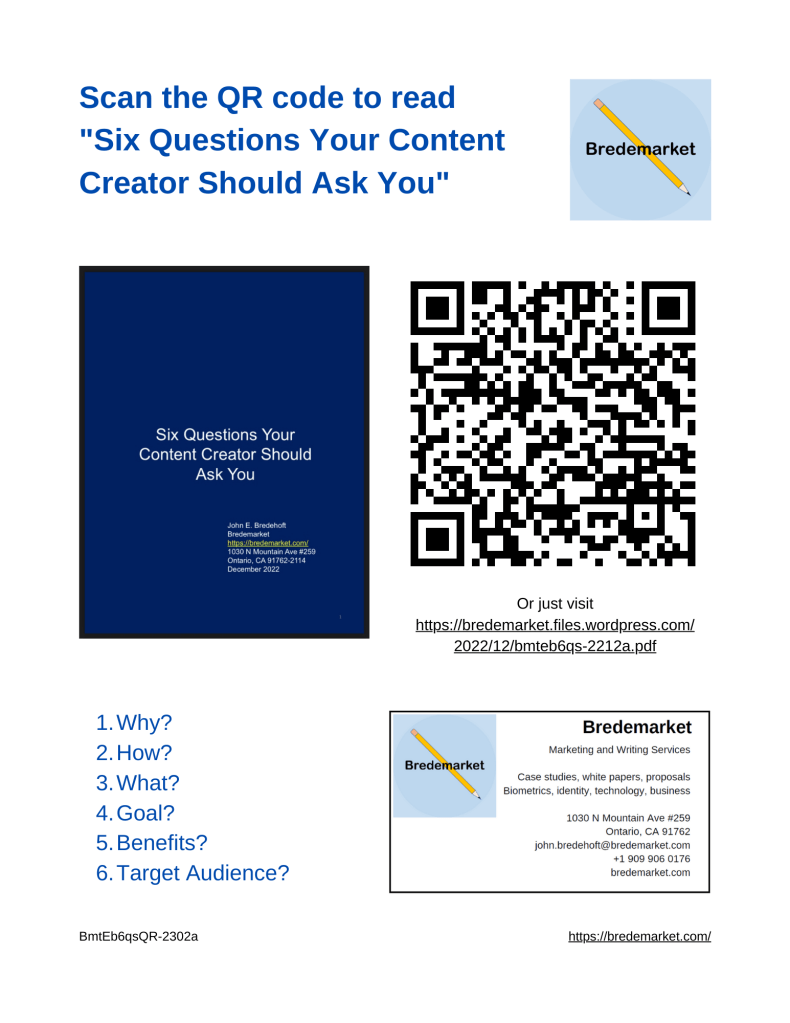
On Saturday, it occurred to me that if I ran across a possible customer during the Ontario Art Walk, I could use a QR code to share my e-book “Six Questions Your Content Creator Should Ask You.”
Unfortunately, this bright idea came to my mind at 5:30 pm for an event that started at 6. I dummied up a quick and dirty page with the cover and a QR code, but it was…dirty. Just as well I didn’t share that on Saturday.
But now that I have more time, I’ve created a better-looking printed handout so that I’m ready at the next in-person event I attend.
If we meet, ask me for it.
Making myself look less smart
Well, now that I’ve gone through all of this trouble explaining how QR codes are great for offline purposes, I’m going to share the aforementioned handout…online.
(UPDATE OCTOBER 22, 2023: “SIX QUESTIONS YOUR CONTENT CREATOR SHOULD ASK YOU IS SO 2022. DOWNLOAD THE NEWER “SEVEN QUESTIONS YOUR CONTENT CREATOR SHOULD ASK YOU” HERE.)
Which has probably prompted the following question from you.
“Why?”
Four reasons:
It gave me the excuse to post the question “Why?” above, thus reiterating one of the major points of the e-book.
Because I felt like sharing it.
Just in case you don’t make “Event X” that I attend in the future, you can experience the joy of printing the flyer and scanning the QR code yourself. Just like you were there!
To demonstrate that even when you provide a piece of content with a QR code, it’s also helpful to explicitly reveal the URL where you’ll head if you scan the code. (Look just below the QR code in the flyer above.) And if you receive the flyer in online form rather than printed form, that URL is clickable.
This gave me an opportunity to revisit the topic and add critical information on wildebeests, George (H.W.) Bush, and Yogi Berra.
But more importantly, it allows me to share my thoughts with a wider audience.
If you missed the October blog post, I state that there are six critical questions that your content creator must ask before creating content. These questions apply whether your content creator is a consultant, an employee at your company, or you.
The e-book discusses each of these six questions:
Why?
How?
What?
Goal?
Benefits?
Target Audience?
And as I note in the e-book, that’s just the beginning of the content creation process.
Whether you intend to use Bredemarket as your content creator, use someone else as your content creator, or create your own content, the points in this e-book are helpful. They can be applied to content creation (case studies, white papers, blog posts) or proposal work, and apply whether you are writing for Inland Empire West businesses or businesses anywhere.
And if you read the e-book, you’ll discover why I’m NOT sharing it on the Bredemarket Identity Firm Services LinkedIn page and Facebook group.
You can download the e-book here. And you can be a content marketing expert also.
(UPDATE OCTOBER 22, 2023: “SIX QUESTIONS YOUR CONTENT CREATOR SHOULD ASK YOU IS SO 2022. DOWNLOAD THE NEWER “SEVEN QUESTIONS YOUR CONTENT CREATOR SHOULD ASK YOU” HERE.)
Bredemarket has always restricted its business to the United States. (Lately I’ve focused more on California’s Inland Empire West, but that’s another story.) So everyone in my target market is celebrating Labor Day today.
Theoretically.
It’s important to note that most other countries celebrate the contributions of labor on May 1, but for several reasons the United States chose a different day. The Massachusetts AFL-CIO page that explained this no longer exists, but I quoted from that page in a tymshft post a decade ago:
Despite the popularity of May Day and the appeal of an international holiday, the American Federation of Labor pushed to secure Labor Day as America’s primary celebration of its workers. This was due to the more radical tone that May Day had taken. Especially after the 1886 Haymarket riot, where several police officers and union members were killed in Chicago, May Day had become a day to protest the arrests of anarchists, socialists, and unionists, as well as an opportunity to push for better working conditions. Samuel Gompers and the AFL saw that the presence of more extreme elements of the Labor Movement would be detrimental to perception of the festival. To solve this, the AFL worked to elevate Labor Day over May Day, and also made an effort to bring a more moderate attitude to the Labor Day festivities. The AFL, whose city labor councils sponsored many of the Labor Day celebrations, banned radical speakers, red flags, internationalist slogans, and anything else that could shed an unfavorable light upon Labor Day or organized labor.
So for over a century, most Americans have chosen to celebrate Labor Day on the first Monday in September.
Well, some Americans.
I took a walk.
My employer for my day job is closed today (at least for its U.S. workers), so I kinda sorta took it a bit leisurely, waking up at…5:35 in the morning.
You see, this is the last week of my company’s wellness challenge, and because of the current heat wave in Southern California, I wanted to get my walking in while the temperatures were still in double digits (on the Fahrenheit scale; that’s something else that Americans do differently than the rest of the world).
I didn’t take any pictures of myself walking today, but here’s one that I took Saturday while I was walking inside (at the Ontario Mills indoor mall).
At Ontario Mills, Saturday, September 3, 2022. It was about 25 degrees cooler inside than it was outside.
Other people were working.
But while I took my early morning Labor Day walk, I ran across a lot of people…working.
There were the people at the Starbucks in downtown Ontario, busily supplying breakfast sandwiches and drinks to people.
There was the woman at a 7-Eleven in Ontario, letting me hydrate with a cold drink. (She may have been the owner, but owners deserve a day off too.)
Finally, I passed two men who have been working on and off on a residential wall, and today was apparently one of the “on” days. I hope they’re not working in the afternoon.
The truth is that, even in the midst of COVID, the entire workforce can’t shut down entirely. Some people have to work on days when many people don’t work. Remember that even in “blue law” states, preachers certainly work on Sundays.
Me too.
But still my morning walk was somewhat relaxing, because even though it was a weekday, I didn’t have to end the walk by 8:00 to start my day job. So while I got my steps in, I did so somewhat leisurely.
And after I write the post, there’s an email that I need to send.
So I guess I didn’t completely take the day off either.
But at least I’m not buliding a wall out of doors.
Oh, and I work on Saturday mornings also.
Of course, since I’m employed full-time, Bredemarket itself is a weekend job for me. My official office hours fall on Saturday mornings, for example.
While this is work, in a way it’s not work, because it’s a refreshing change from my normal work. (And since I enjoy my normal work, that isn’t so much work either. If you’re not working at something you enjoy, then you’re working.)
And if you don’t enjoy creating written content, let Bredemarket help you create it.
There is a LOT going on in Ontario, California that escapes the attention of most of us. For example, only dedicated boxing fans may know what is happening here on May 14.
Former world champion and light heavyweight Mexican boxing star Gilberto “Zurdo” Ramírez (43-0, 29 KOs) of Mazatlán, Mexico, will face former WBA Interim Light Heavyweight World Champion Dominic Boesel (32-2, 12 KOs) of Freyburg, Germany on Saturday, May 14….The event will take place at Toyota Arena in Ontario, CA, and will stream live exclusively on DAZN.
And the Toyota Arena is certainly promoting it. (“Zurdo” is Ramirez’s nickname.) Notice the prominent “BUY TICKETS” call to action. The Toyota Arena wants you to attend the event in-person.
And the DAZN streaming service is obviously talking about it and hoping that you sign up for the service. The yellow “SIGN UP NOW” buttons (two of them in this screen alone) are hard to miss. Unlike the Toyota Arena, DAZN doesn’t require you to be in person to view this fight.
What the Toyota Arena and the DAZN streaming service DIDN’T do when marketing the fight
Let’s look at one aspect of how the fight is being marketed.
Have you ever noticed that some companies believe that the best way to market themselves is to talk about themselves? They’re worse than a self-obsessed narcissist on a date.
Major Frank Burns (portrayed by Larry Linville) of M*A*S*H fame. (Major Margaret “Hot Lips” Houlihan not pictured.) By CBS Television – eBayfrontbackeBayphoto front & release, Public Domain, https://commons.wikimedia.org/w/index.php?curid=30082123
If the “my company is most important” people were promoting this fight, the Toyota Arena could have started its Zurdo vs. Boesel page with the text below.
Toyota Arena, built and owned by the City of Ontario, operated by ASM Global, can accommodate over 11,000 guests. The 225,000 square foot venue features 36 luxury suites located on two levels and a continuous concourse hosting a variety of concession and refreshment stands, merchandise kiosks, the VIP Club and other fan amenities. Toyota Arena hosts over 125 events annually including concerts, family shows, and sporting competitions. The Arena is home to several sport teams including: Ontario Reign (American Hockey League), Ontario Fury (Major Arena Soccer League), Aqua Caliente Clippers of Ontario (G League Basketball), and LA Temptation (Legends Football League).
This text appears on the arena’s “About Us” page. Why not also put it on the page for the fight, to ensure that the readers see it and realize the sheer awesomeness of the arena, the City of Ontario, and ASM Global?
Why not talk about the arena at the beginning of the fight announcement? Because fight promoters are smart. Fight promoters know that to make a sale, they need to maintain a customer focus.
Let’s say that you’re a boxing promoter and YOU have to promote this fight. Which of the following two facts is more important?
Gilberto “Zurdo” Ramírez has a boxing record of 43-0 with 29 knockouts.
The Toyota Arena is a 225,000 square foot facility.
Now perhaps the janitorial staff that has to service the Toyota Arena is more concerned about item 2, but if you want boxing fans to buy tickets or streaming access, you’re going to aggressively promote item 1 and maintain your customer focus.
So what is MY call to action to YOU?
If I were to ask you, there is a high probability that you are not a boxing promoter. I know this because I’m not submitting this post to The Ring as a press release, but am instead sharing it in various Inland Empire West business channels.
However, there is a pretty good probability that you own or manage a local business, and you have your own news that you want to get out.
And this news must resonate with your customers.
Perhaps you want to share a customer success story, case study, or testimonial—a casetimonial, if you will. This document must appeal to your customers, speak to their needs, and ideally lead to them considering your company’s services or products.
Or perhaps you want to share a white paper that addresses your customers’ needs, but also drives them to consider your business. For example, you might distribute a white paper that lists seven critical criteria for customer success—and coincidentally, your company’s offering satisfies all seven critical criteria. (What an amazing coincidence!)
I, John E. Bredehoft, through my Ontario-based DBA Bredemarket, can write casetimonials, white papers, and other types of content, working with you to answer these and other critical questions BEFORE producing the content:
Why, how, and what do you do?
What is the topic of the content?
What is the goal that you want to achieve with the content?
What are the benefits (not features, but benefits) that your end customers can realize by using your product or service?
What is the target audience for the content?
After you’ve provided the relevant information to me, I’ll create the first iteration of the content, and we’ll work together to create your final content. The specifics of how we will work together depend upon whether you have elected the Bredemarket 400 Short Writing Service, the Bredemarket 2800 Medium Writing Service, or something else.
When we’re done, that final content is yours (a “work for hire” arrangement).
If I can help your business, or if you have further questions about Bredemarket’s B2B content creation services, please contact me.





 Bredemarket