“[T]he most extensive scam imaginable was launched against me and against many other writers….
“Two women (or two men? Political prisoners in China–or Nigeria? Or even in Iran?) emailed me. Each impersonated a real editor and a real literary agent. This began on April 23rd and continued on through April 27th or April 28th. They appropriated the name of Marilyn Kreztner at Blackstone Publishing and Caitlin Mahony at William Morris Endeavor….
“Please understand: Given the realities of publishing, most writers are a desperate lot. And oh-so-vulnerable to flattery. If a publishing person praises our work–we melt. We glow. Writers specialize in Big Dreams.”
And despite some lingering suspicions, Chesler sent some of her work to both people. But before she could send $700 for an editorial consultant to “improve” her work, Chesler had already contacted the real Blackstone Publishing and the real Wiolliam Morris Endeavor and confirmed that these were not the real Kreztner or Mahony.
If you’re a writer, you must check the site Chesler recommended, Writer Beware. It include a detailed post about this sort of scam, including examples of the scammer communications.
Reminder: while I write books, mine aren’t sold by publishing houses. Visit my Gumroad site to purchase my ebook, “Proving Humanity: The Six Factors of Identity Verification and Authentication.”
Do you remember ViVi Contras Belleville Brown 429, the long-winded scammer who contacted me at length about a position at “the intersection of Global Supply Chain and Systemic Accountability”?
Well, I guess I’m not the only candidate she targeted. I just received an email that read, in part, as follows. (I’m hiding the identity of the emailer to spare them from other scammers.)
“I received a very similar ‘contact’ from Vivi Brown trying to solicit my employment interest in the same AI/Energy Structure start-up. Oddest ‘interview’ procedure I have ever seen. No concrete job descriptions, organization structures, identification of Founders, etc. All communications mandated on WhatsApp (encrypted). Very verbose ‘corporate speak’ exchanges. When I asked if this was AI, they obviously denied that it was. Answers to background questions don’t necessarily add up. Company startup name given to me was “ARCLight’, and their interest in me reportedly ties to my mgt experience in Energy Structure Development. Numerous pictures (AI driven ?) of the young Vivi Brown have been forwarded with ‘feel good’ influence peddling formats, mixed in ‘business’ answers to my structure comments/questions. It looks like the AI derived Vivi was created as an Influencer on EezyCollab (“catfishing”?).”
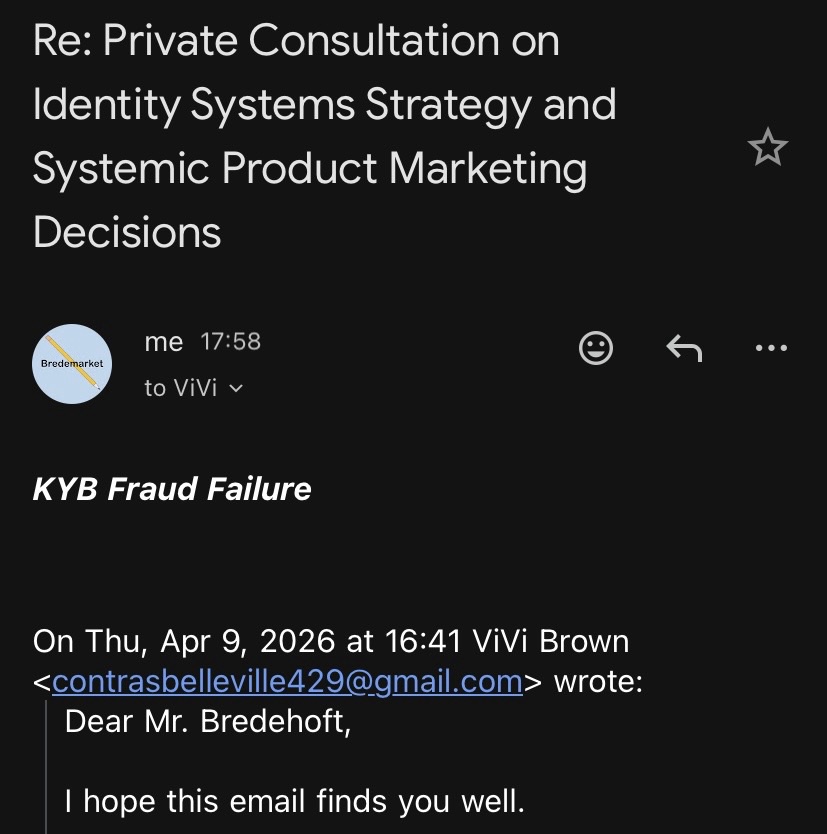
I never encountered the WhatsApp red flag since I applied my KYB Fraud Failure flag early on, but I’m not surprised.
As for EezyCollab (which was NOT part of the scam, but may have been used by the scammer), it “connects AI products with the right creators across global markets — powered by an AI platform of 100M+ creators, direct pricing, and end-to-end delivery.” Plus its founder Yiki Chen is a marketer and vibe coder who has been vibe coding since 2021. Groovy.
Returning to Vivi, I found the website https://www.shvivi.com/#home for A.R.C (sic) Insight. (Not ARCLight.) It includes insights such as the following:
“Vivi Brown’s profile was not built through display. It was formed through consistency, disciplined judgment, and the gradual development of capability — producing a rare combination of written clarity, operational steadiness, and long-range strategic calm.”
This afternoon I received an email from the very verbose ViVi Brown.
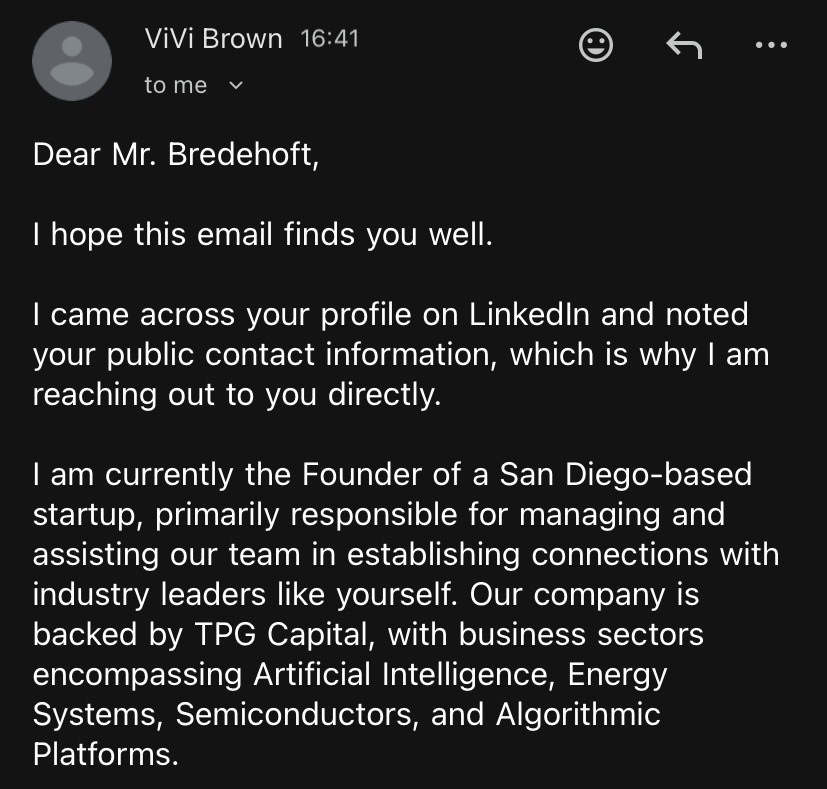
It began with the standard “I hope this email finds you well.” Then the pitch begins.
“I came across your profile on LinkedIn and noted your public contact information, which is why I am reaching out to you directly.”
I couldn’t find Brown’s own LinkedIn profile, by the way. The pitch continues.
“I am currently the Founder of a San Diego-based startup, primarily responsible for managing and assisting our team in establishing connections with industry leaders like yourself. Our company is backed by TPG Capital, with business sectors encompassing Artificial Intelligence, Energy Systems, Semiconductors, and Algorithmic Platforms.”
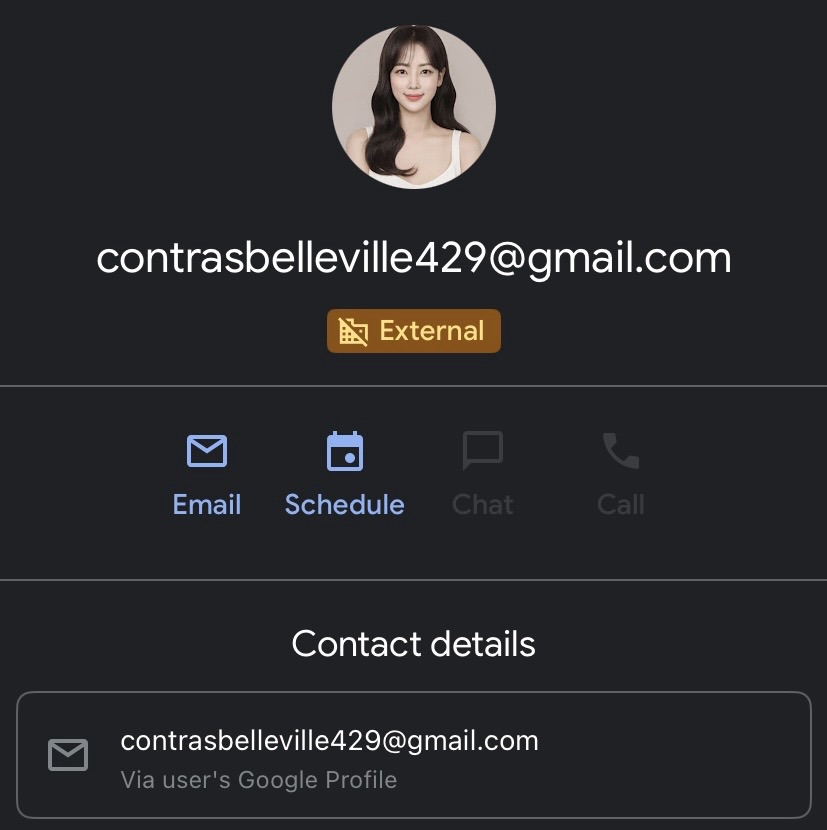
Now this sounds impressive. TPG backing, multiple high-tech business sectors. It’s a little odd that Brown didn’t mention her company name, but I knew I could deduce it from her corporate email address.
Um, 429? At least it’s not 420.
Unless someone is an independent consultant, there’s no need to use a Gmail address that doesn’t have your name and ends in a number. Especially if you are the Founder (and, as we will see, other things) of a TPG-backed multi-sector high tech firm.
Brown continued her pitch, which went on and on and on. Paragraph after paragraph of corporate-speak, such as a reference to “the intersection of Global Supply Chain and Systemic Accountability.” Because obviously my LinkedIn profile screams global supply chain.
Translating corporate-speak to English, apparently ViVi Contras Belleville Brown 429 wants to chat about a Global Strategic Operations Partner position. And to get to know me via a deeper conversation.
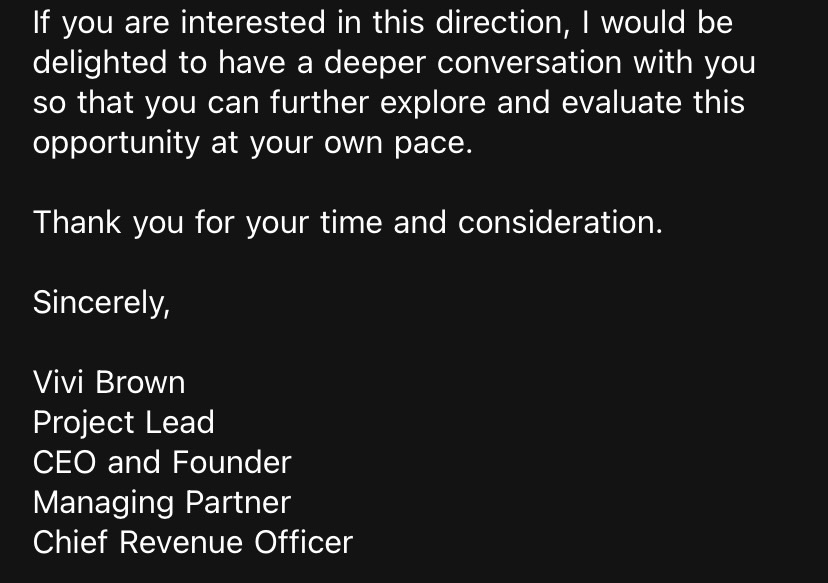
She then closes her email with a signature block listing her positions (but again not her company name).
Signature block?
So she is the Founder, the CEO, the Managing Partner, the Chief Revenue Officer…and the Project Lead? That’s more job titles than I have at Bredemarket—even when you include “Senior Nespresso Operator.”
I don’t know what 429’s scam is. Data harvesting? Identity theft? Financial fraud? For all I know it may be a romance scam. (Run by a 40 year old guy.)
I knew I was going to write about this scam email in the Bredemarket blog and on LinkedIn. Employment fraud is a hot topic on both platforms. But how should I respond to the scammer?
My usual “As an anti-fraud professional, I require that you please provide your corporate email address” would take too much time. So I aimed for surprising brevity:
This is not a comment on the corrupt nature of politics, but a question.
Apparently people in Kennebunk, Maine are receiving emails from their “Board Commissioners.”
“The email claims the permit is ready and approved, but that the “Board Commissioners” just needs a payment of $4,000 via wire transfer to finish it.
“Lee Feldman, deputy director of community development for the department, said Thursday that the email also named a former board member to try to bolster its apparent legitimacy.”
But Kennebunk citizens are smart, and one reported the scam attempt.
Of all the KYx acronyms (Know Your Customer, Know Your Business, etc.), two that interest LinkedIn users are Know Your Employer and Know Your Employee. How do you fight fraudulent employers and employees? And how do your prospects learn about your fraud fighting?
“A recent development is scammers using the name of legitimate companies that are hiring and approaching their victims through LinkedIn’s direct messaging feature. They then create counterfeit websites that look like the websites of the legitimate companies they are posing as and ask the job seekers for personal information…”
And you can guess what happens with that personal information. It doesn’t land you a real job, that’s for sure.
In addition to the tips that Scamicide provides, I have an additional one. BEFORE you provide your resume, before you send them a connection request, or definitely before you engage on Telegram or WhatsApp, ask this question:
“Can you provide me with your corporate email address?”
This usually shuts scammers up very quickly.
But don’t forget that while job applicants are avoiding fraudulent employers, legitimate employers are avoiding fraudulent applicants…perhaps from North Korea.
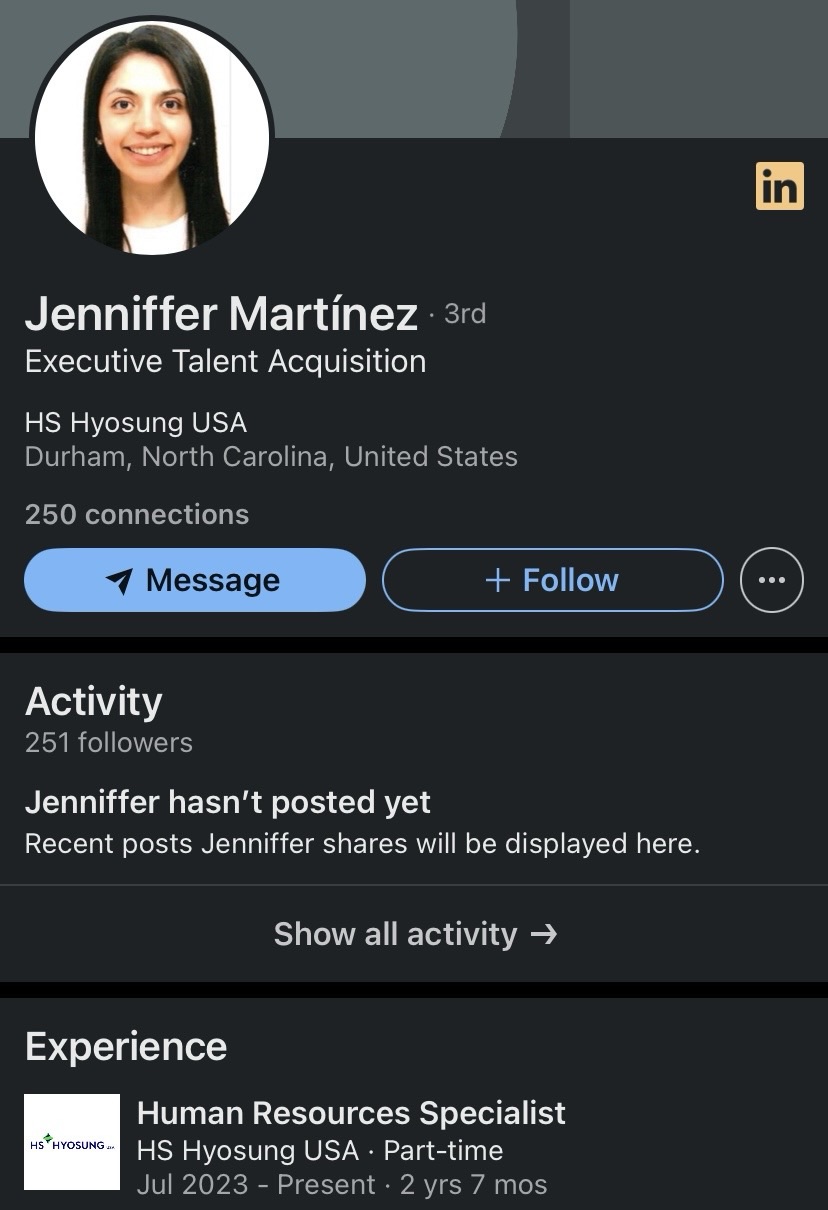
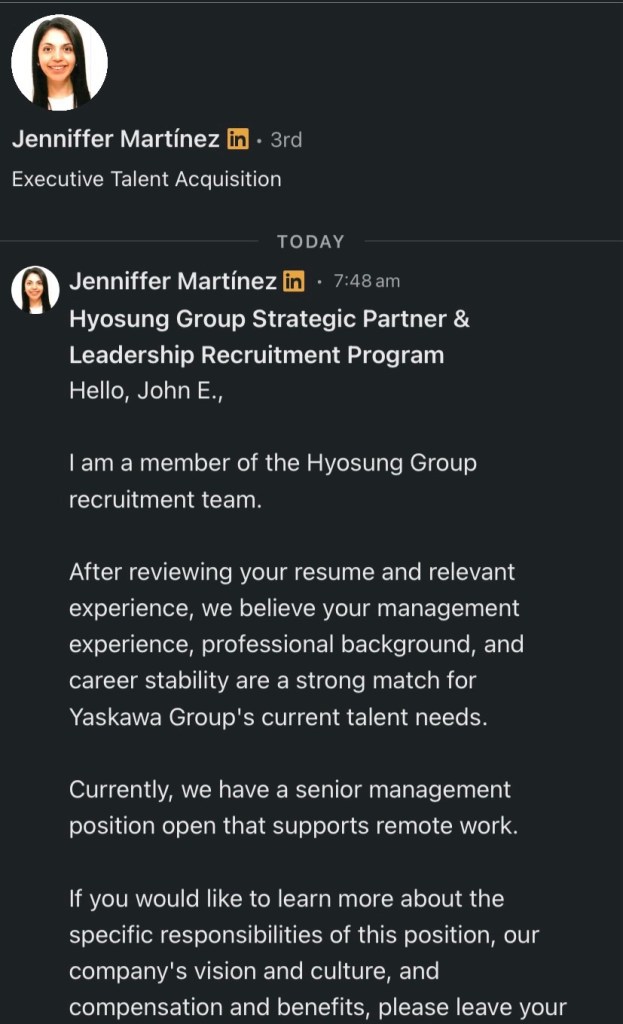
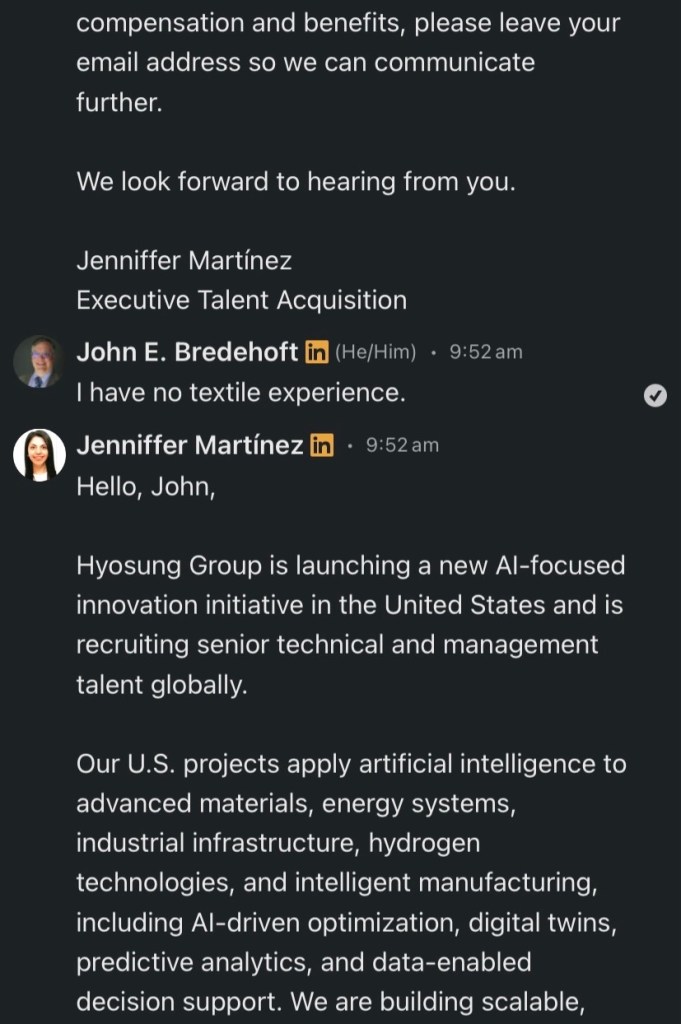
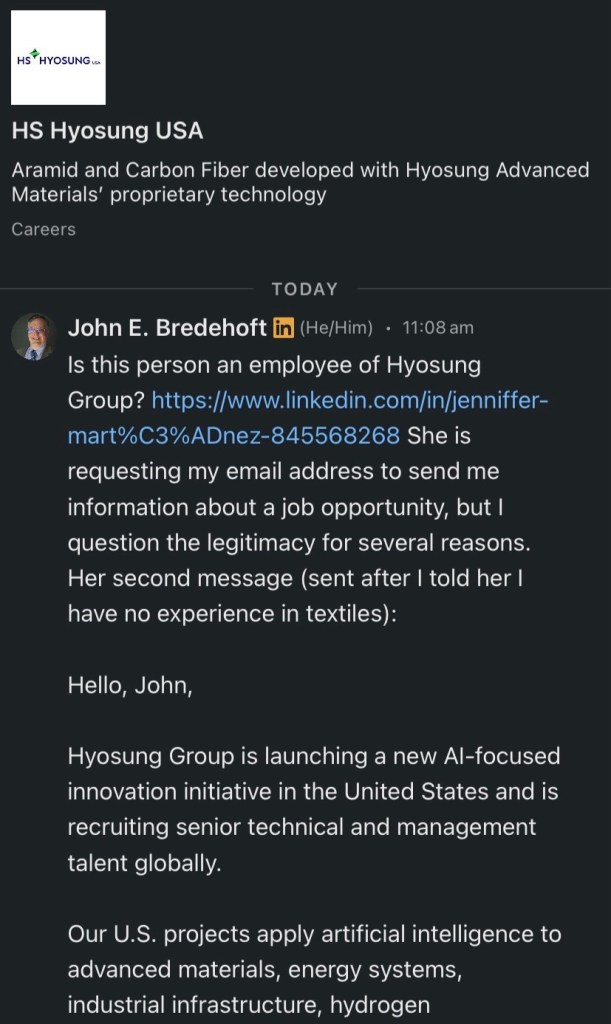
I was messaged on LinkedIn by Jenniffer Martinez, purportedly from HS Hyosung USA. She wanted my email address to send information about a job opportunity.
Why?
“After reviewing your resume and relevant experience, we believe your management experience, professional background, and career stability are a strong match for Yaskawa Group’s current talent needs.”
(Only now did I notice the reference to Yaskawa Group, whatever it is.)
Eventually I told “Jenniffer” that I had contacted her employer directly.
By 11:30 she had deleted her entire conversation, which is why I took screen shots immediately.
And I never even got around to asking her for HER corporate email address.
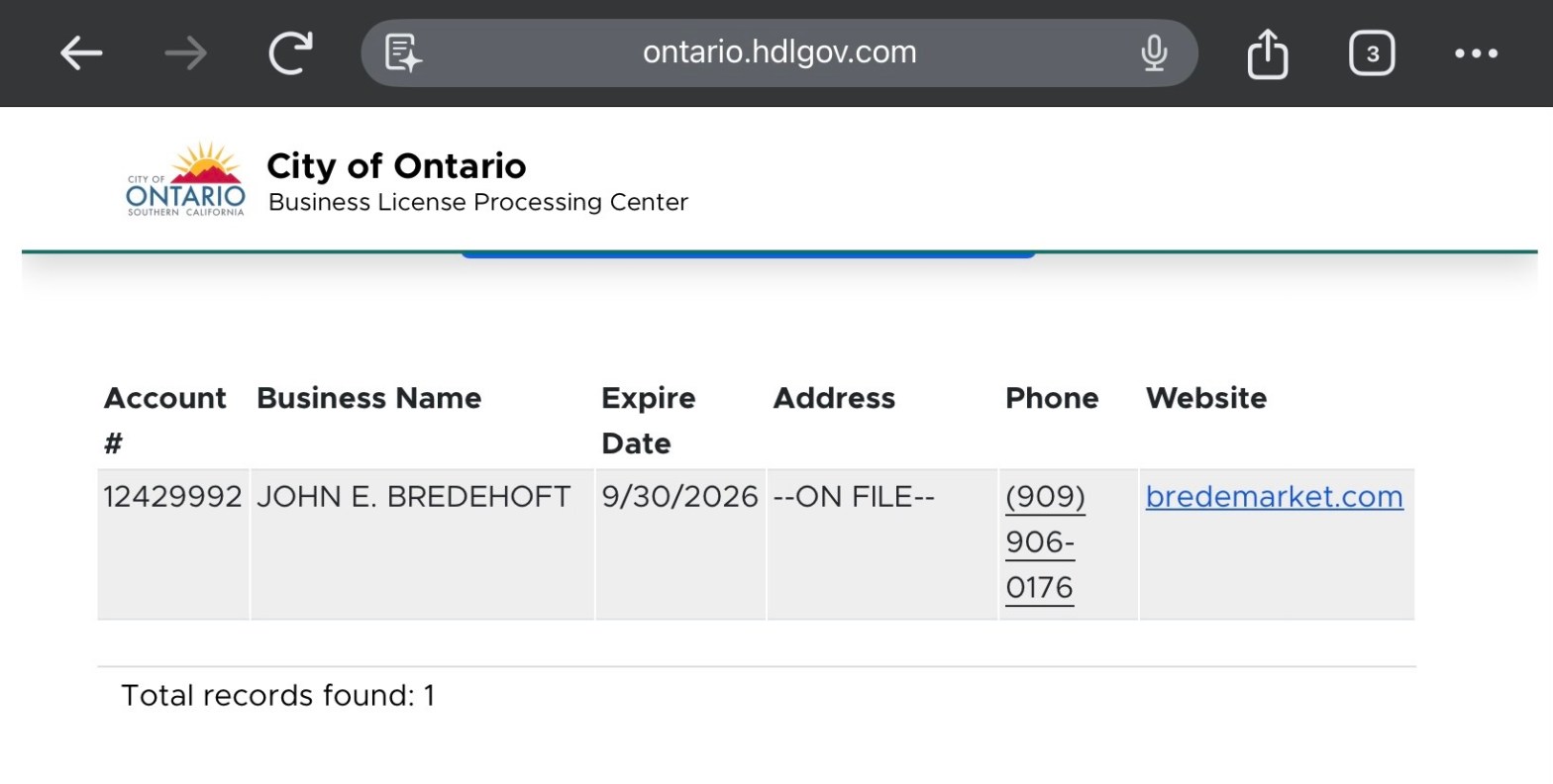
No word from HS Hyosung USA, but it knows all about Jenniffer now (see final screen shot).








 Bredemarket