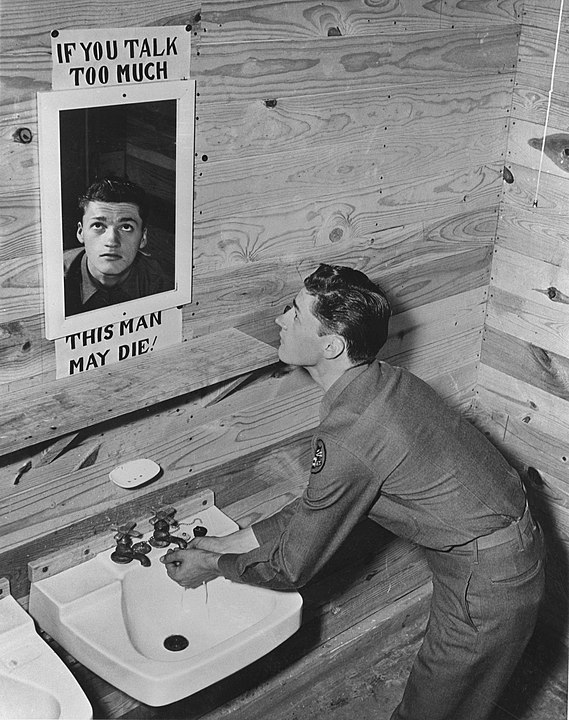
There are many different ways to tell the sellers from the non-sellers, but one key way (at least as far as I’m concerned) is that sellers are saying things.
If you’re not saying things, then you’re not a seller.
And you’re not selling.
If you want to sell, maybe you should say stuff.
Whether you are an identity/biometric firm, a technology firm, or a firm located in California’s Inland Empire, Bredemarket can help you create the blog posts, case studies, white papers, and other content your firm needs.
Click on one of the images below to start to create content that converts prospects for your product/service and drives content results.
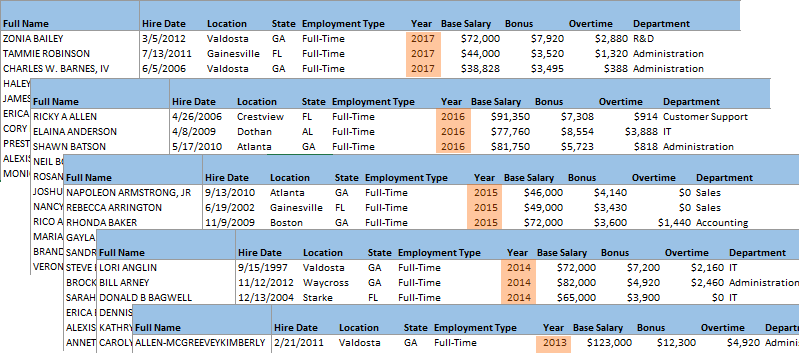
When talking about marketing tools, two words that don’t seem to go together are “marketing” and “Excel” (the Microsoft spreadsheet product). Because I’m in marketing, I encounter images like this all the time.
It’s true that marketing analytics requires a ton of Excel work. I’m not going to talk about marketing analytics here, but if you have an interest in using Excel for marketing analytics, you may want to investigate HubSpot Academy’s free Excel crash course.
As I write this, Bredemarket is neck-deep in a research project for a client. A SECRET research project.
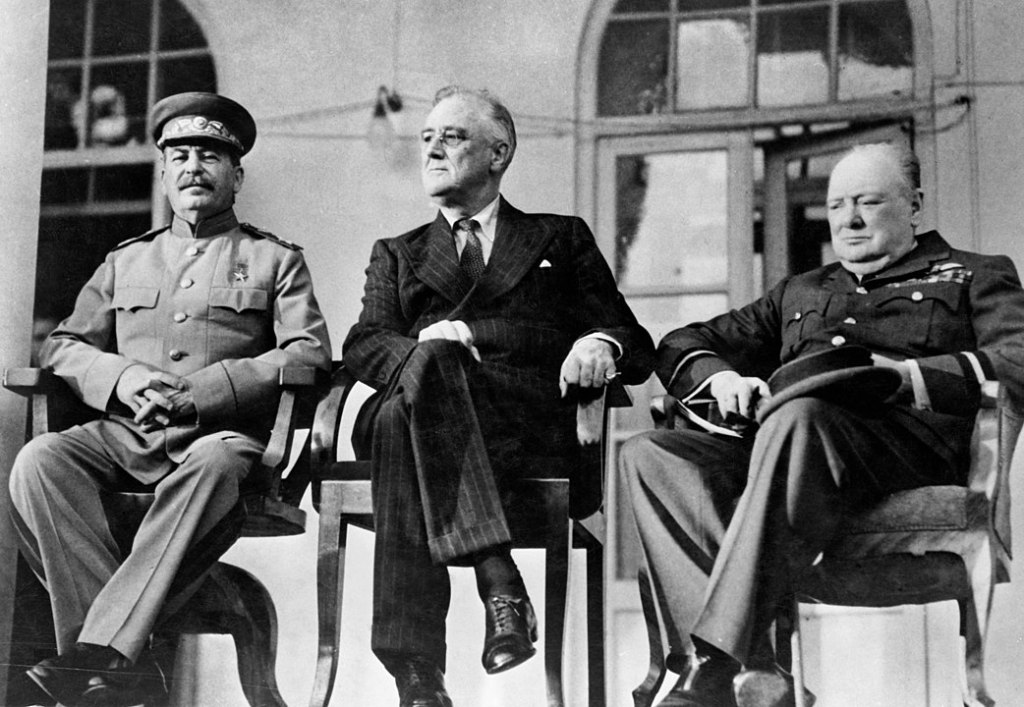
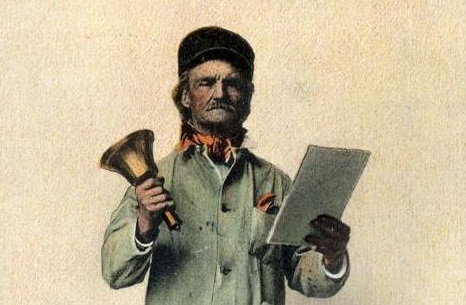
By Unnamed photographer for Office of War Information. – U.S. Office of War Information photo, via Library of Congress website [1], converted from TIFF to .jpg and border cropped before upload to Wikimedia Commons., Public Domain, https://commons.wikimedia.org/w/index.php?curid=8989847
While I won’t reveal the name of the client or the specifics about the research project, I can say that the project requires me to track the following information:
Organization name.
Organization type (based upon fairly common classifications).
Organization geographic location.
Vendor providing services to the organization.
Information about the contract between the vendor and the organization.
A multitude of information sources about the organization, the vendor, and the relationship between the two.
To attack the data capture for this project, I did what I’ve done for a number of similar projects for Bredemarket, Incode, IDEMIA, MorphoTrak, et al.
I threw all the data into a worksheet in an Excel workbook.
I can then sort and filter it to my heart’s content. Ror example, if I want to just view the rows for which I have contract information, I can just look at that.
Bredemarket as an identity/biometric research service
For one organization I created a number of different worksheets within a single workbook, in which the worksheet data all fed into a summary worksheet. This allowed my clients to view data either at the detailed level or at the summary level.
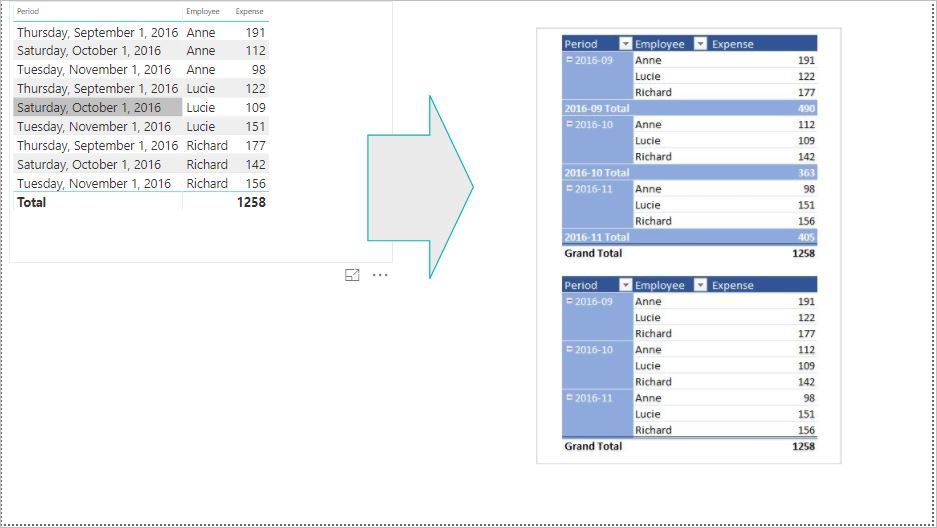
For another organization I collected the data from an external source, opened it in Excel, performed some massaging, and then pivoted the data into a new view so that it could then be exported out of Excel and into a super-secret document that I cannot discuss here.
Now none of this (well, except maybe for the pivot) is fancy stuff, and most of it (except for the formulas linking the summary and detailed worksheets) is all that hard to do. But it turns out that Excel is an excellent tool to deal with this data in certain cases.
Which brings me to YOUR research needs.
After all, Bredemarket doesn’t just write stuff.
Sometimes it researches stuff, especially in the core area of biometrics and identity.
After all, I offer 29 years of experience in this area, and I draw on that experience to get answers to your questions.
Unlike the better-bounded projects that require only a single blog post or a single white paper, I quote research projects at an hourly rate or on retainer (where I’m embedded with you).
As identity/biometric professionals well know, there are five authentication factors that you can use to gain access to a person’s account. (You can also use these factors for identity verification to establish the person’s account in the first place.)
Something You Are. I’ve spent…a long time with this factor, since this is the factor that includes biometrics modalities (finger, face, iris, DNA, voice, vein, etc.). It also includes behavioral biometrics, provided that they are truly behavioral and relatively static.
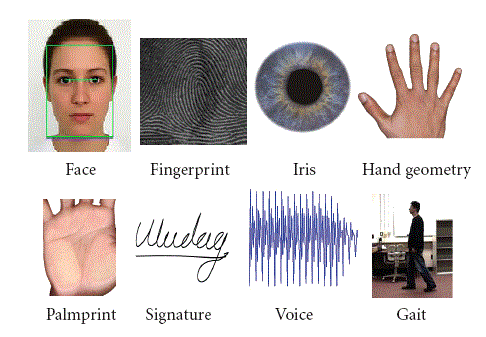
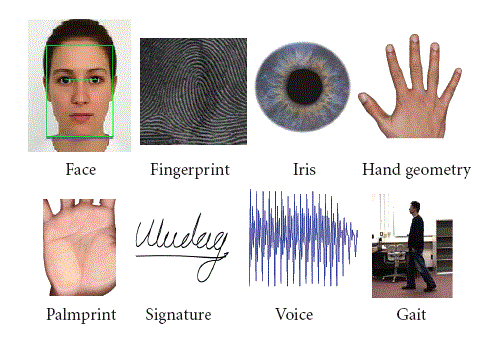
As I mentioned in August, there are a number of biometric modalities, including face, fingerprint, iris, hand geometry, palm print, signature, voice, gait, and many more.
If your firm offers an identity solution that partially depends upon “something you are,” then you need to create content (blog, case study, social media, white paper, etc.) that converts prospects for your identity/biometric product/service and drives content results.
While I don’t use all the marketing tools at my disposal, I am certainly curious about them. After all, such tools provide marketers with powerful insights on their prospects and customers.
I became especially curious about one marketing tool when re-examining a phrase I use often.
I use the phrase “biometric content marketing expert” in a non-traditional way. When I use it, I am attempting to say that I am a content marketing expert on the use of biometrics for identification. In other words, I can create multiple types of content that discusses fingerprint identification, facial recognition, and similar technologies.
But if you speak to a normal person, they will assume that a “biometric content marketing expert” is someone who uses biometrics (the broader term, not the narrower term) to support content marketing. This is something very different—something that is generally known as “facial coding,” a technique that purports to provide information to marketers.
We all know that our face conveys emotions through facial expressions; facial coding is the process of measuring those human emotions. With the help of computer vision, powered by AI and machine learning, emotions can be detected via webcam or mobile cam. The tech tracks every muscle movement on the face or all-action units (AU) based on the FACS (facial action coding system).
The differences between facial coding and facial recognition
Unlike the topics in which I usually dwell, facial coding:
Does not identify individuals. Many people can share the same emotions, so detection of a particular emotion does not serve as individualization.
Does not provide permanent information. In the course of watching a movie or even a short advertisement, viewers often exhibit a wide range of emotions. Just because you exhibit a particular emotion at the beginning of an ad doesn’t mean you’ll exhibit the same emotion at the conclusion.
As Rathi describes the practice, it preserves privacy by allowing people to opt-in, and to record the emotions anonymously.
So, the user’s permission is required to access their camera and all this data is captured with consent. And no video is shared. Only the emotion data of the users are captured through their facial expressions and shared in real-time. The emotions on a person’s face are captured as binary units (0 and 1). Hence no PII (Personally Identifiable Information) related to race, ethnicity, gender, or age is captured at any point in time.
But what if another firm chooses to gather more data, thus reducing the anonymity of the data collected? “I don’t only want to know how people react to the content. I want to know how black women in their 30s react to the content.”
And what if another firm (or a government agency, such as the Transportation Security Administration) chooses to gather the data without explicit consent, or with consent buried deep in the terms of service? In that case, people may not even realize that their facial expressions are being watched.
Examining facial expressions is not the only way to decipher what is happening in a person’s mind as they view content. But it’s powerful.
Well, maybe.
Does everyone exhibit the same facial coding?
The underlying assumption behind emotion recognition is that you can identify emotions at a universal level. If content makes me happy, or if it makes a person halfway around the world happy, we will exhibit the same measurable facial characteristics.
Research has not revealed a consistent, physical fingerprint for even a single emotion. When scientists attach electrodes to a person’s face and measure muscle movement during an emotion, they find tremendous variety, not uniformity. They find the same variety with the body and brain. You can experience anger with or without a spike in blood pressure. You can experience fear with or without a change in the amygdala, the brain region tagged as the home of fear.
When scientists set aside the classical view and just look at the data, a radically different explanation for emotion comes to light. We find that emotions are not universal but vary from culture to culture. They are not triggered; you create them. They emerge as a combination of the physical properties of your body, a flexible brain that wires itself to whatever environment it develops in, and your culture and upbringing.
If Barrett is correct, then how reliable is facial coding, even within a particular region? After all, even Southern California does not have a single universal culture, but is made up of many cultures in which people react in many different ways. And if we preserve privacy by NOT collecting this cultural information, then we may not fully understand the codings that the cameras record.
Back to the familiar “biometric” world
And with that, I will retreat from the broader definition of biometrics to the narrower and more familiar one, as described here.
The term “Biometrics” has also been used to refer to the field of technology devoted to the identification of individuals using biological traits, such as those based on retinal or iris scanning, fingerprints, or face recognition. Neither the journal “Biometrics” nor the International Biometric Society is engaged in research, marketing, or reporting related to this technology.
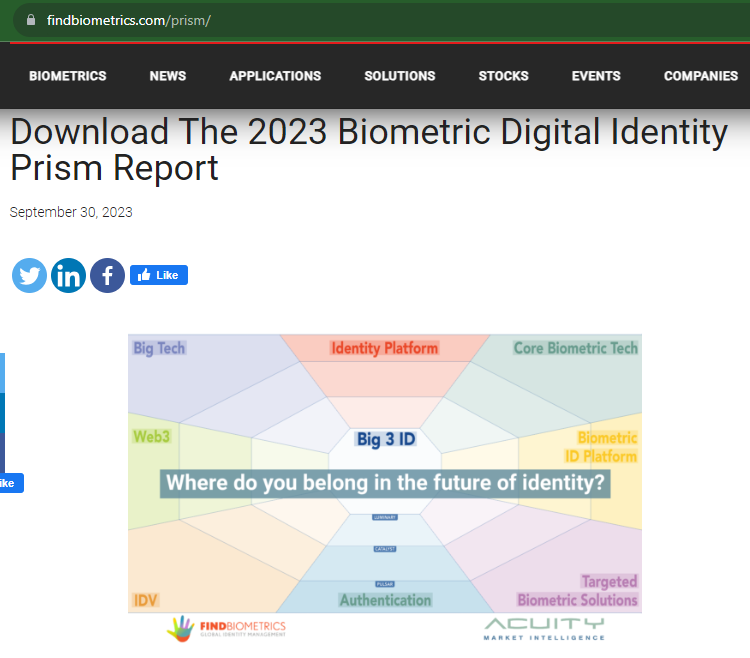
For those who don’t know, the Prism presents an organized view of all of the digital identity companies—or at least the ones that FindBiometrics and Acuity Market Intelligence knew about. In the last few days, they were literally beggin’ to give companies a last chance for inclusion.
On Monday, I began to see a trickle of companies that talked about their place on the Prism, including iProov and Trustmatic.
On September 30, FindBiometrics and Acuity Market Intelligence released the production version of the Biometric Digital Identity Prism Report. You can request to download it here.
But FindBiometrics and Acuity Market Intelligence didn’t invent the Big 3. The concept has been around for 40 years. And two of today’s Big 3 weren’t in the Big 3 when things started. Oh, and there weren’t always 3; sometimes there were 4, and some could argue that there were 5.
So how did we get from the Big 3 of 40 years ago to the Big 3 of today?
The Big 3 in the 1980s
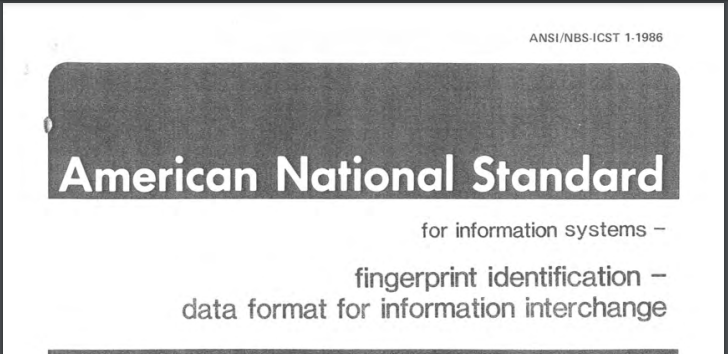
Back in 1986 (eight years before I learned how to spell AFIS) the American National Standards Institute, in conjunction with the National Bureau of Standards, issued ANSI/NBS-ICST 1-1986, a data format for information interchange of fingerprints. The PDF of this long-superseded standard is available here.
When creating this standard, ANSI and the NBS worked with a number of law enforcement agencies, as well as companies in the nascent fingerprint industry. There is a whole list of companies cited at the beginning of the standard, but I’d like to name four of them.
De La Rue Printrak, Inc.
Identix, Inc.
Morpho Systems
NEC Information Systems, Inc.
While all four of these companies produced computerized fingerprinting equipment, three of them had successfully produced automated fingerprint identification systems, or AFIS. As Chapter 6 of the Fingerprint Sourcebook subsequently noted:
Morpho Systems resulted from French AFIS efforts, separate from those of the FBI. These efforts launched Morpho’s long-standing relationship with the French National Police, as well as a similar relationship (now former relationship) with Pierce County, Washington.
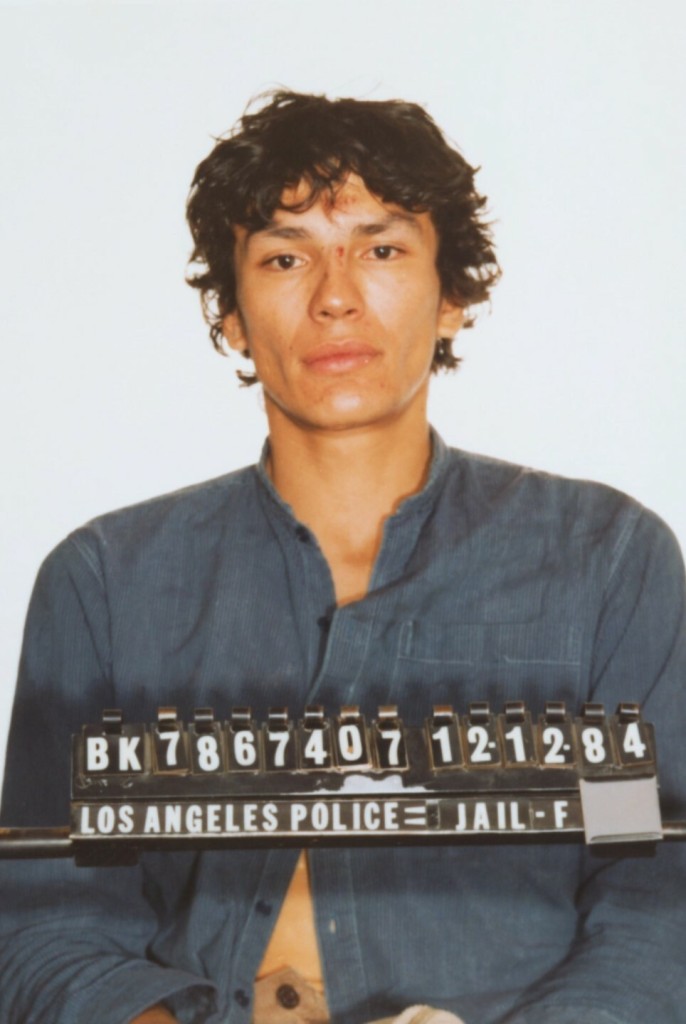
NEC had deployed AFIS equipment for the National Police Academy of Japan, and (after some prodding; read Chapter 6 for the story) the city of San Francisco. Eventually the state of California obtained an NEC system, which played a part in the identification of “Night Stalker” Richard Ramirez.
After the success of the San Francisco and California AFIS systems, many other jurisdictions began clamoring for AFIS of their own, and turned to these three vendors to supply them.
The Big 4 in the 1990s
But in 1990, these three firms were joined by a fourth upstart, Cogent Systems of South Pasadena, California.
While customers initially preferred the Big 3 to the upstart, Cogent Systems eventually installed a statewide system in Ohio and a border control system for the U.S. government, plus a vast number of local systems at the county and city level.
Between 1991 and 1994, the (Immigfation and Naturalization Service) conducted several studies of automated fingerprint systems, primarily in the San Diego, California, Border Patrol Sector. These studies demonstrated to the INS the feasibility of using a biometric fingerprint identification system to identify apprehended aliens on a large scale. In September 1994, Congress provided almost $30 million for the INS to deploy its fingerprint identification system. In October 1994, the INS began using the system, called IDENT, first in the San Diego Border Patrol Sector and then throughout the rest of the Southwest Border.
I was a proposal writer for Printrak (divested by De La Rue) in the 1990s, and competed against Cogent, Morpho, and NEC in AFIS procurements. By the time I moved from proposals to product management, the next redefinition of the “big” vendors occurred.
The Big 3 in 2003
There are a lot of name changes that affected AFIS participants, one of which was the 1988 name change of the National Bureau of Standards to the National Institute of Standards and Technology (NIST). As fingerprints and other biometric modalities were increasingly employed by government agencies, NIST began conducting tests of biometric systems. These tests continue to this day, as I have previously noted.
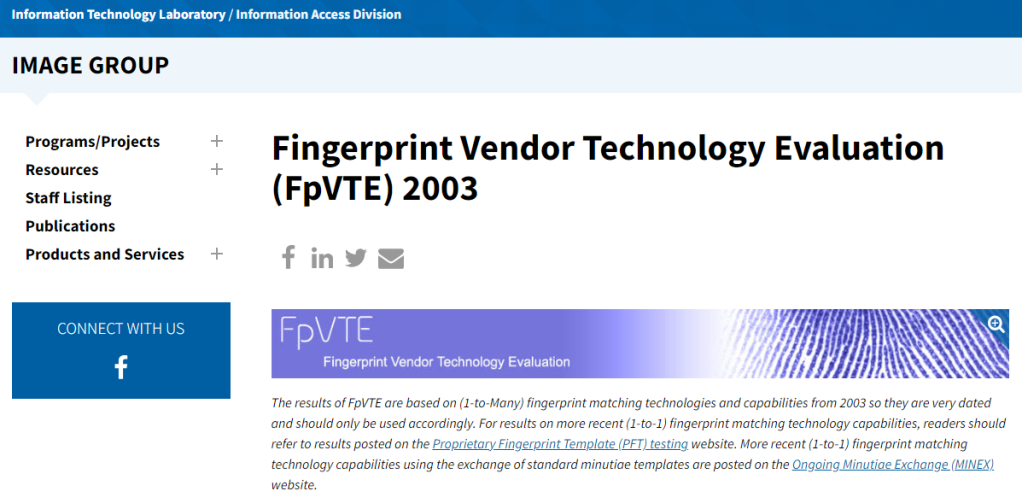
One of NIST’s first tests was the Fingerprint Vendor Technology Evaluation of 2003 (FpVTE 2003).
For those who are familiar with NIST testing, it’s no surprise that the test was thorough:
FpVTE 2003 consists of multiple tests performed with combinations of fingers (e.g., single fingers, two index fingers, four to ten fingers) and different types and qualities of operational fingerprints (e.g., flat livescan images from visa applicants, multi-finger slap livescan images from present-day booking or background check systems, or rolled and flat inked fingerprints from legacy criminal databases).
Eighteen vendors submitted their fingerprint algorithms to NIST for one or more of the various tests, including Bioscrypt, Cogent Systems, Identix, SAGEM MORPHO (SAGEM had acquired Morpho Systems), NEC, and Motorola (which had acquired Printrak). And at the conclusion of the testing, the FpVTE 2003 summary (PDF) made this statement:
Of the systems tested, NEC, SAGEM, and Cogent produced the most accurate results.
Which would have been great news if I were a product manager at NEC, SAGEM, and Cogent.
Unfortunately, I was a product manager at Motorola.
The effect of this report was…not good, and at least partially (but not fully) contributed to Motorola’s loss of its long-standing client, the Royal Canadian Mounted Police, to Cogent.
The Big 3, 4, or 5 after 2003
So what happened in the years after FpVTE was released? Opinions vary, but here are three possible explanations for what happened next.
Did the Big 3 become the Big 4 again?
Now I probably have a bit of bias in this area since I was a Motorola employee, but I maintain that Motorola overcame this temporary setback and vaulted back into the Big 4 within a couple of years. Among other things, Motorola deployed a national 1000 pixels-per-inch (PPI) system in Sweden several years before the FBI did.
Did the Big 3 remain the Big 3?
Motorola’s arch-enemies at Sagem Morpho had a different opinion, which was revealed when the state of West Virginia finally got around to deploying its own AFIS. A bit ironic, since the national FBI AFIS system IAFIS was located in West Virginia, or perhaps not.
Anyway, Motorola had a very effective sales staff, as was apparent when the state issued its Request for Proposal (RFP) and explicitly said that the state wanted a Motorola AFIS.
That didn’t stop Cogent, Identix, NEC, and Sagem Morpho from bidding on the project.
After the award, Dorothy Bullard and I requested copies of all of the proposals for evaluation. While Motorola (to no one’s surprise) won the competition, Dorothy and I believed that we shouldn’t have won. In particular, our arch-enemies at Sagem Morpho raised a compelling argument that it should be the chosen vendor.
Their argument? Here’s my summary: “Your RFP says that you want a Motorola AFIS. The states of Kansas (see page 6 of this PDF) and New Mexico (see this PDF) USED to have a Motorola AFIS…but replaced their systems with our MetaMorpho AFIS because it’s BETTER than the Motorola AFIS.”
But were Cogent, Motorola, NEC, and Sagem Morpho the only “big” players?
Did the Big 3 become the Big 5?
While the Big 3/Big 4 took a lot of the headlines, there were a number of other companies vying for attention. (I’ve talked about this before, but it’s worthwhile to review it again.)
Identix, while making some efforts in the AFIS market, concentrated on creating live scan fingerprinting machines, where it competed (sometimes in court) against companies such as Digital Biometrics and Bioscrypt.
The fingerprint companies started to compete against facial recognition companies, including Viisage and Visionics.
Oh, and there were also iris companies such as Iridian.
And there were other ways to identify people. Even before 9/11 mandated REAL ID (which we may get any year now), Polaroid was making great efforts to improve driver’s licenses to serve as a reliable form of identification.
In short, there were a bunch of small identity companies all over the place.
But in the course of a few short years, Dr. Joseph Atick (initially) and Robert LaPenta (subsequently) concentrated on acquiring and merging those companies into a single firm, L-1 Identity Solutions.
These multiple mergers resulted in former competitors Identix and Digital Biometrics, and former competitors Viisage and Visionics, becoming part of one big happy family. (A multinational big happy family when you count Bioscrypt.) Eventually this company offered fingerprint, face, iris, driver’s license, and passport solutions, something that none of the Big 3/Big 4 could claim (although Sagem Morpho had a facial recognition offering). And L-1 had federal contracts and state contracts that could match anything that the Big 3/Big 4 offered.
So while L-1 didn’t have a state AFIS contract like Cogent, Motorola, NEC, and Sagem Morpho did, you could argue that L-1 was important enough to be ranked with the big boys.
So for the sake of argument let’s assume that there was a Big 5, and L-1 Identity Solutions was part of it, along with the three big boys Motorola, NEC, and Safran (who had acquired Sagem and thus now owned Sagem Morpho), and the independent Cogent Systems. These five companies competed fiercly with each other (see West Virginia, above).
In a two-year period, everything would change.
The Big 3 after 2009
Hang on to your seats.
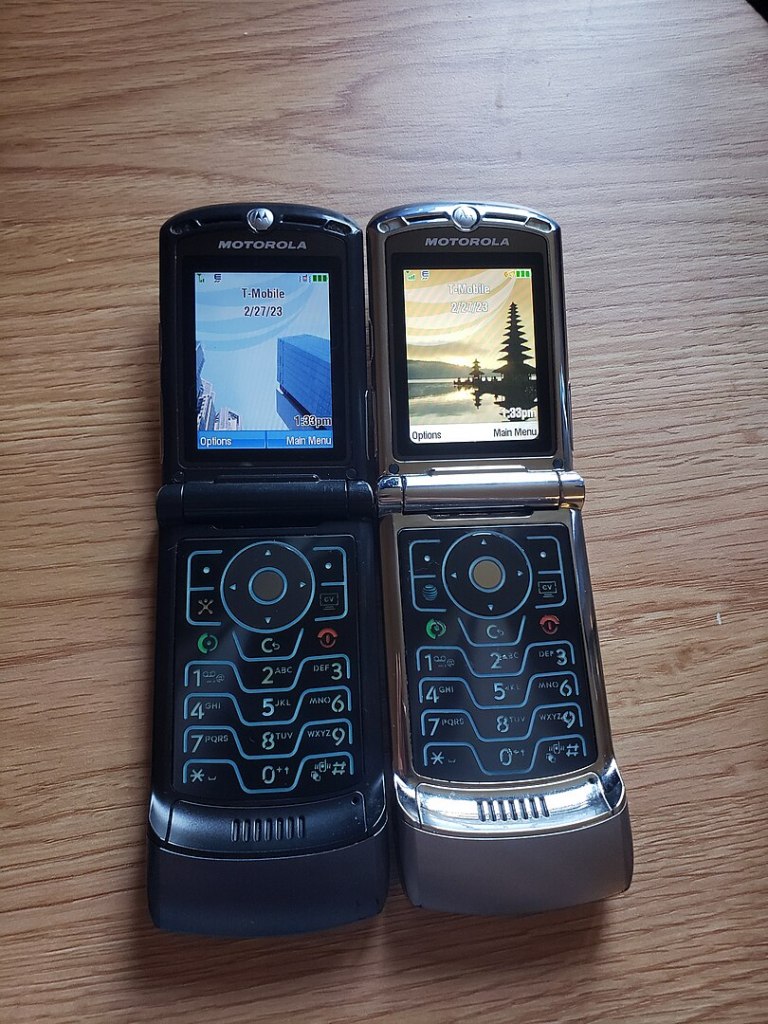
The Motorola RAZR was hugely popular…until it wasn’t. Eventually Motorola split into two companies and sold off others, including the “Printrak” Biometric Business Unit. By NextG50 – Own work, CC BY-SA 4.0, https://commons.wikimedia.org/w/index.php?curid=130206087
By 2009, Safran (resulting from the merger of Sagem and Snecma) was an international powerhouse in aerospace and defense and also had identity/biometric interests. Motorola, in the meantime, was no longer enjoying the success of its RAZR phone and was looking at trimming down (prior to its eventual, um, bifurcation). In response to these dynamics, Safran announced its intent to purchase Motorola’s Biometric Business Unit in October 2008, an effort that was finalized in April 2009. The Biometric Business Unit (adopting its former name Printrak) was acquired by Sagem Morpho and became MorphoTrak. On a personal level, Dorothy Bullard moved out of Proposals and I moved into Proposals, where I got to work with my new best friends that had previously slammed Motorola for losing the Kansas and New Mexico deals. (Seriously, Cindy and Ron are great folks.)
By 2011, Safran decided that it needed additional identity capabilities, so it acquired L-1 Identity Solutions and renamed the acquisition as MorphoTrust.
If you’re keeping notes, the Big 5 have now become the Big 3: 3M, Safran, and NEC (the one constant in all of this).
While there were subsequent changes (3M sold Cogent and other pieces to Gemalto, Safran sold all of Morpho to Advent International/Oberthur to form IDEMIA, and Gemalto was acquired by Thales), the Big 3 has remained constant over the last decade.
And that’s where we are today…pending future developments.
If Alphabet or Amazon reverse their current reluctance to market their biometric offerings to governments, the entire landscape could change again.
Or perhaps a new AI-fueled competitor could emerge.
The 1 Biometric Content Marketing Expert
This was written by John Bredehoft of Bredemarket.
If you work for the Big 3 or the Little 80+ and need marketing and writing services, the biometric content marketing expert can help you. There are several ways to get in touch:
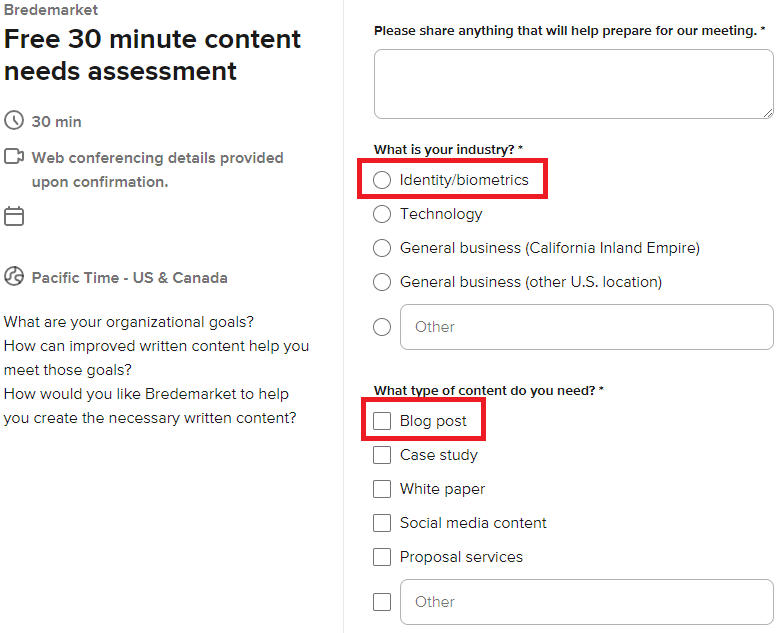
Book a meeting with me at calendly.com/bredemarket. Be sure to fill out the information form so I can best help you.
Identity and biometrics firms can achieve quantifiable benefits with prospects by blogging. Over 40 identity and biometrics firms are already blogging. Is yours?
These firms (and probably many more) already recognize the value of identity blog post writing, and some of them are blogging frequently to get valuable content to their prospects and customers.
Is your firm on the list? If so, how frequently do you update your blog?
In most cases, I can provide your blog post via my standard package, the Bredemarket 400 Short Writing Service. I offer other packages and options if you have special needs.
Get in touch with Bredemarket
Authorize Bredemarket, Ontario California’s content marketing expert, to help your firm produce words that return results.
To discuss your identity/biometrics blog post needs further,book a meeting with me at calendly.com/bredemarket. On the questionnaire, select the Identity/biometrics industry and Blog post content.
Always take advantage of your competitors’ weaknesses.
This post describes an easy way to take advantage of your competitors. If they’re not blogging, make sure your firm is blogging. And the post provides hard numbers that demonstrate why your firm should be blogging.
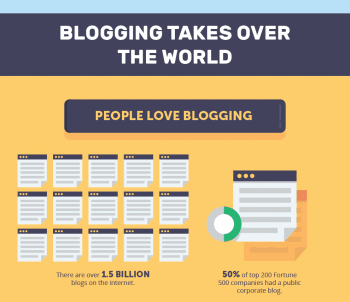
Which means that half of those companies don’t have a public corporate blog.
The same infographic also revealed the following:
86% of B2B companies are blogging. (Or, 14% are not.)
68% of social media marketers use blogs in their social media strategy. (Or, 32% don’t.)
45% of marketers saying blogging is the #1 most important piece of their content strategy.
Small businesses under 10 employees allocate 42% of their marketing budget to content marketing.
So obviously some firms believe blogging is important, while others don’t.
What difference does this make for your firm?
What results do blogging companies receive?
In my view, the figures above are way too low. 100% of all Fortune 500 companies, 100% of B2B companies should be blogging, and 100% of social media marketers should incorporate blogging.
Getting leads from blogging is nice, but show me the money! What about conversions?
Marketers who have prioritized blogging are 13x more likely to enjoy positive ROI.
92% of companies who blog multiple times per day have acquired a customer from their blog.
Take a look at those last two bullets related to conversion again. Blogging is correlated with positive ROI (I won’t claim causation, but anecdotally I believe it), and blogging helps firms acquire customers. So if your firm wants to make money, get blogging.
What should YOUR company do?
With numbers like this, shouldn’t all companies be blogging?
But don’t share these facts with your competitors. Keep them to yourself so that you gain a competitive advantage over them.
Now you just need to write those blog posts.
How can I help?
And if you need help with the actual writing, I, John E Bredehoft of Bredemarket, can help.
And if you’re not in the identity/biometric industry, my general content marketing expertise also applies to technology firms and general business firms.
In most cases, I can provide your blog post via my standard package, the Bredemarket 400 Short Writing Service. I offer other packages and options if you have special needs.
Authorize Bredemarket, Ontario California’s content marketing expert, to help your firm produce words that return results.
I mentioned something in passing in Bredemarket’s recent go-to-market post that I think needs a little more highlighting. So here is a deeper dive into the 22 types of content that product marketers create. (Well, at least 22. I’m probably missing some.)
And by the way, I have created all 22 of these types of content, from blog posts and battlecards to smartphone application content and scientific book chapters. And I can create it for you.
Why is it that so many business-to-business (B2B) marketers confuse product marketing with content marketing?
Because it requires a lot of discipline. That’s why.
B2B marketers who get it right understand the difference between these two fundamentally different types of marketing, what their purposes are and how to use them correctly.
Some firms (especially startups) don’t have the luxury to enforce such definitions. They don’t have separate teams to create awareness content, consideration content, and conversion content. They have one team (or perhaps one person) to create all that content PLUS other stuff that I’ll discuss later.
For example, during my most recent stint as a product marketing employee at a startup, the firm had no official content marketers, so the product marketers had to create a lot of non-product related content. So we product marketers were the de facto content marketers for the company too. (Sadly, we didn’t get two salaries for filling two roles.)
Why did the product marketers end up as content marketers? It turns out that it makes sense—after all, people who write about your product in the lower funnel stages can also write about your product in the upper funnel stages, and also can certainly write about OTHER things, such as company descriptions, speaker submissions, and speaker biographies.
As a result, I’ve written a ton of stuff over my last 29 years in identity/biometrics. It didn’t take a great leap for me to self-identify as the identity content marketing expert and the biometric content marketing expert (and other expert definitions; I’m an expert in creating expert titles).
I’ve compiled a summary of the types of content that I’ve created over the years, not only for Bredemarket’s clients, but also for my employers at Incode Technologies, IDEMIA, MorphoTrak, Motorola, and Printrak.
Not all of these were created when I was in a formal product marketing role, but depending upon your product or service, you may need any of these content types to support the marketing of your product/service.
It’s helpful to divide the list into two parts: the external (customer-facing) content, and the internal (company-only) content.
10 types of external content I have created
External content is what most people think of when they talk about product marketing or content marketing. After all, this is the visible stuff that the prospects see, and which can move them toward a purchase (conversion). The numbers after some content types indicate the quantities of pieces of collateral that I have created.
Articles
Blog Posts (500+, including this one)
Briefs/Data/Literature Sheets
Case Studies (12+)
Proposals (100+)
Scientific Book Chapters
Smartphone Application Content
Social Media (Facebook, Instagram, LinkedIn, Threads, TikTok, Twitter)
Web Page Content
White Papers and E-Books
Here’s an video showing some of the external content that I have created for Bredemarket.
While external content is sexy, internal content is extremely important, since it’s what equips the people inside a firm to promote your product or service. The numbers after some content types indicate the quantities of pieces of collateral that I have created.
Battlecards (80+)
Competitive Analyses
Event/Conference/Trade Show Demonstration Scripts
Plans
Playbooks
Proposal Templates
Quality Improvement Documents
Requirements
Strategic Analyses
And here are 3 more types
Some content can either be external or internal. Again, numbers indicate the quantities of pieces of collateral I have created.
Email Newsletters (200+)
FAQs
Presentations
Content I can create for you
Does your firm need help creating one of these types of content?
Maybe two?
Maybe 22?
I can create content full-time for you
If your firm needs to create a lot of content types for your products, then consider hiring me as your full-time Senior Product Marketing Manager. My LinkedIn profile is here, documenting my 29 years of experience in identity/biometric technology as a product marketer, a strategist, and in other roles.

















 Bredemarket