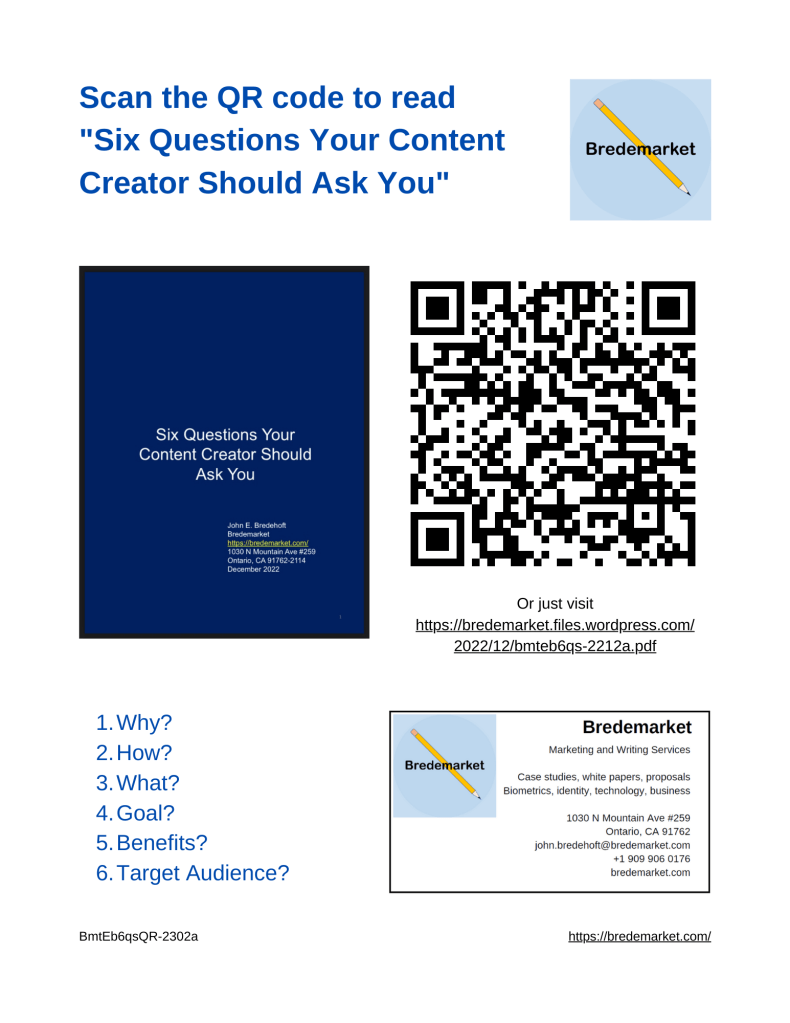
If you are reading this on your laptop (or your desktop), point your smartphone to the QR code on your laptop (or desktop) screen to read my first e-book, “Six Questions Your Content Creator Should Ask You.”
(UPDATE OCTOBER 22, 2023: “SIX QUESTIONS YOUR CONTENT CREATOR SHOULD ASK YOU IS SO 2022. DOWNLOAD THE NEWER “SEVEN QUESTIONS YOUR CONTENT CREATOR SHOULD ASK YOU” HERE.)
As I said before, QR codes are sometimes useful, and sometimes not.
If you want to know the “why” about the e-book-see what I did there?-visit my announcement of the e-book. You can view the e-book there also.
By the way, I just checked my WordPress stats. Since this e-book was published in December 2022, it’s been downloaded over 160 times. I hope it’s helping people.
We often use the phrase “four-letter word” to refer to cuss words that shouldn’t be said in polite company. Occasionally, we have our own words that we personally consider to be four-letter words. (Such as “BIPA.”)
There are some times when we resign ourselves to the fact that “tech” can be a four-letter word also. But there’s actually a good reason for the problems we have with today’s technology.
Tech can be dim
Just this week I was doing something on my smartphone and my screen got really dim all of a sudden, with no explanation.
So I went to my phone’s settings, and my brightness setting was down at the lowest level.
For no reason.
“Any sufficiently advanced technology is indistinguishable from magic.”
So I increased my screen’s brightness, and everything was back to normal. Or so I thought.
A little while later, my screen got dim again, so I went to the brightness setting…and was told that my brightness was very high. (Could have fooled me.)
I can’t remember what I did next (because when you are trying to fix something you can NEVER remember what you did next), but later my screen brightness was fine.
Was Arthur C. Clarke right? And if so, WHY was he right?
Perhaps it’s selective memory, but I don’t recall having this many technology problems when I was younger.
The shift to multi-purpose devices
Part of the reason for the increasing complexity of technology is that we make fewer and fewer single-purpose devices, and are manufacturing more and more multi-purpose devices.
One example of the shift: if I want to write a letter today, I can write it on my smartphone. (Assuming the screen is bright enough.) This same smartphone can perform my banking activities, play games, keep track of Bredemarket’s earnings…oh, and make phone calls.
Technological convergence is a term that describes bringing previously unrelated technologies together, often in a single device. Smartphones might be the best possible example of such a convergence. Prior to the widespread adoption of smartphones, consumers generally relied on a collection of single-purpose devices. Some of these devices included telephones, wrist watches, digital cameras and global positioning system (GPS) navigators. Today, even low-end smartphones combine the functionality of all these separate devices, easily replacing them in a single device.
From a consumer perspective, technological convergence is often synonymous with innovation.
And the smartphone example certainly demonstrates innovation from the previous-generation single-purpose devices.
When I was a kid, if I wanted to write a letter, I had two choices:
I could set a piece of paper on the table and write the letter with a writing implement such as a pen or pencil.
I could roll a piece of paper into a typewriter and type the letter.
These were, for the most part, single purpose devices. Sure I could make a paper airplane out of the piece of paper, but I couldn’t use the typewriter to play a game or make a phone call.
Turning our attention to the typewriter, it certainly was a manufacturing marvel, and intricate precision was required to design the hammers that would hit the typewritter ribbon and leave their impressions on the piece of paper. And typewriters could break, and repairmen (back then they were mostly men) could fix them.
A smartphone is much more innovative than a smartphone. But it’s infinitely harder to figure out what is wrong with a smartphone.
The smartphone hardware alone is incredibly complex, with components from a multitude of manufacturers. Add the complexities of the operating system and all the different types of software that are loaded on a smartphone, and a single problem could result from a myriad of causes.
No wonder it seems like magic, even for the best of us.
Explaining technology
But this complexity has provided a number of jobs:
The helpful person at your cellular service provider who has acquired just enough information to recognize and fix an errant application.
The many people in call centers (the legitimate call centers, not the “we found a problem with your Windows computer” call scammers) who perform the same tasks at a distance.
All the people who write instructions on how to use and fix all of our multi-purpose devices, from smartphones to computers to remote controls.
Oh, and the people that somehow have to succinctly explain to prospects why these multi-purpose devices are so great.
Because no one’s going to run into problems with technology unless they acquire the technology. And your firm has to get them to acquire your technology.
Crafting a technology marketing piece
So your firm’s marketer or writer has to craft some type of content that will make a prospect aware of your technology, and/or induce the prospect to consider purchasing the technology, and/or ideally convert the prospect into a paying customer.
Before your marketer or writer crafts the content, they have to answer some basic questions.
Using a very simple single-purpose example of a hammer, here are the questions with explanations:
Why does the prospect need this technology? And why do you provide this technology? This rationale for why you are in business, and why your product exists, will help you make the sale. Does your prospect want to buy a hammer from a company that got tired of manufacturing plastic drink stirrers, or do they want to buy a hammer from a forester who wants to empower people to build useful items?
How does your firm provide this technology? If I want to insert a nail into a piece of wood, do I need to attach your device to an automobile or an aircraft carrier? No, the hammer will fit in your hand. (Assuming you have hands.)
What is the technology? Notice that the “why” and “how” questions come before the “what” question, because “why” and “how” are more critical. But you still have to explain what the technology is (with the caveat I mention below). Perhaps some of your prospects have no idea what a hammer is. Don’t assume they already know.
What is the goal of the technology? Does a hammer help you floss your teeth? No, it puts nails into wood.
What are the benefitsof the technology? When I previously said that you should explain what the technology is, most prospects aren’t looking for detailed schematics. They primarily care about what the technology will do for them. For example, that hammer can keep their wooden structure from falling down. They don’t care about the exact composition of the metal in the hammer head.
Finally, who is the target audience for the technology? I don’t want to read through an entire marketing blurb and order a basic hammer, only to discover later that the product won’t help me keep two diamonds together but is really intended for wood. So don’t send an email to jewelers about your hammer. They have their own tools.
(UPDATE OCTOBER 23, 2023: “SIX QUESTIONS YOUR CONTENT CREATOR SHOULD ASK YOU IS SO 2022. DOWNLOAD THE NEWER “SEVEN QUESTIONS YOUR CONTENT CREATOR SHOULD ASK YOU” HERE.)
Once you answer these questions (more about the six questions in the Bredemarket e-book available here), your marketer or writer can craft your content.
Or, if you need help, Bredemarket (the technology content marketing expert) can craft your content, whether it’s a blog post, case study, white paper, or something else.
I’ve helped other technology firms explain their “hammers” to their target audiences, explaining the benefits, and answering the essential “why” questions about the hammers.
Can I help your technology firm communicate your message? Contact me.
But what if I want to know how to work with Bredemarket?
Glad you asked.
After reading Mace’s LinkedIn post, I realized that I have a bunch of different online sources that explain how to work with Bredemarket, but they’re scattered all over the place. This post groups them all the “how to work with Bredemarket” content together, following an outline similar (yet slightly different) to Mace’s.
And no, it’s not a stand-alone PDF, but as you read the content below you’ll discover two stand-alone PDFs that address critical portions of the process.
Question 1: Why would I work with Bredemarket?
As you’ll see below, “why” is a very important question, even more important than “how.” Here are some reasons to work with Bredemarket.
You require the words to communicate the benefits of your identity/biometrics product/service. I offer 29 years of experience in the identity/biometrics industry and am a biometric content marketing expert and an identity content marketing expert. I have created multiple types of content (see below) to share critical points about identity/biometrics offerings.
You require the words to communicate the benefits of your technology product/service. I have also created multiple types of content to share critical points about technology offerings.
You require the words to communicate the benefits of a product/service you provide to California’s Inland Empire. I’ve lived in the Inland Empire for…well, for more than 29 years. I know the area—its past, its present, and its future.
You require one of the following types of content. Blogs, case studies / testimonials, data sheets, e-books, proposals, social media posts / Xs (or whatever tweets are called today), white papers, or anything. I’ve done these for others and can do it for you.
Question 2: Why WOULDN’T I work with Bredemarket?
This question is just as important as the prior one. If you need the following, you WON’T want to work with Bredemarket.
You require high quality graphics. Sorry, that’s not me.
I did not draw this myself. Originally created by Jleedev using Inkscape and GIMP. Redrawn as SVG by Ben Liblit using Inkscape. – Own work, Public Domain, link.
You are based outside of the United States. Foreign laws and exchange rates make my brain hurt, so I only pursue business domestically. But depending upon where you are, I may be able to recommend a content marketer for you.
Question 3: What are Bredemarket’s most popular packages? How much do they cost?
Here are the three most common packages that Bredemarket offers.
Note that these are the standard packages. If your needs are different, I can adapt them, or charge you an hourly rate if the need is not well defined. (But as you will see below, I try to work with you at the outset to define the project.)
If you follow the link above for your desired package and download the first brochure on each page, you’ll get a description of the appropriate service. The pricing is at the bottom of each brochure.
Each brochure also explains how I kick off a project, but the procedure is fairly common for each package.
Question 4: What are Bredemarket’s working practices?
But that’s not all that we address in the kickoff. There are some other lower-level questions that I ask you (such as the long and short form of your company name).
Once we have defined the project, I iteratively provide draft copy and you iteratively review it. The number and length of review cycles varies depending upon the content length and your needs. For example, I use up to two review cycles of up to three days each for short content.
Eventually I provide the final copy, you publish it and pay me, and both of us are happy.
While I won’t go into all of the video details here (you should spend a few minutes and watch Putnam’s video yourself), one of the points that Putnam made was that the best content creators need to differentiate themselves from commodity content providers—in other words, to “be irreplaceable.”
If it’s not obvious how your product or service is wildly different, not just better, your ideal clients will resort to looking at you like a commodity.
One of the ways in which content creators can differentiate themselves from their competition is to have a unique process.
In addition to having the emotional appeal and positioning that we already talked about, you can employ tools like having a proprietary process. A unique way of achieving a desired result.
I’d like to look at one such process, the process in which a content creator collaborates with a client, but I’d like to take a look at how two very different content creators achieve the same outcome.
How Bredemarket collaborates with clients
One of the many differentiators between Bredemarket and its marketing and writing competitors is the way that Bredemarket kicks off projects.
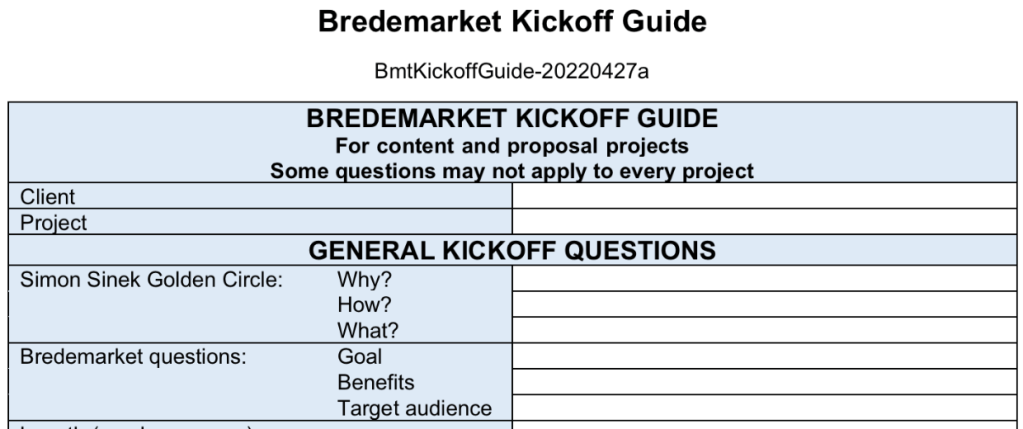
Before I work with you, I ask a series of questions to better understand what you need.
(UPDATE OCTOBER 23, 2023: “SIX QUESTIONS YOUR CONTENT CREATOR SHOULD ASK YOU IS SO 2022. DOWNLOAD THE NEWER “SEVEN QUESTIONS YOUR CONTENT CREATOR SHOULD ASK YOU” HERE.)
Now these are not all of the questions that I ask. After all, my process is, um, “Bredemarket-developed.” (I avoid the word “proprietary” because of its negative connotations.) But the limited number of questions that I did share suggests how I try to understand you. Why you do what you do. How you do it. And so forth.
(If you are interested in this topic, I have written an entire e-book focused on the first six questions that I ask you. To download the e-book, visit my blog post “Six Questions Your Content Creator Should Ask You: the e-book version.”)
Yes, this is a Rembrandt painting, anticipating the next section of the blog post. By Rembrandt – The Yorck Project (2002) 10.000 Meisterwerke der Malerei (DVD-ROM), distributed by DIRECTMEDIA Publishing GmbH. ISBN: 3936122202., Public Domain, https://commons.wikimedia.org/w/index.php?curid=157824
But not everyone is a Sage, and other content creators approach collaboration differently.
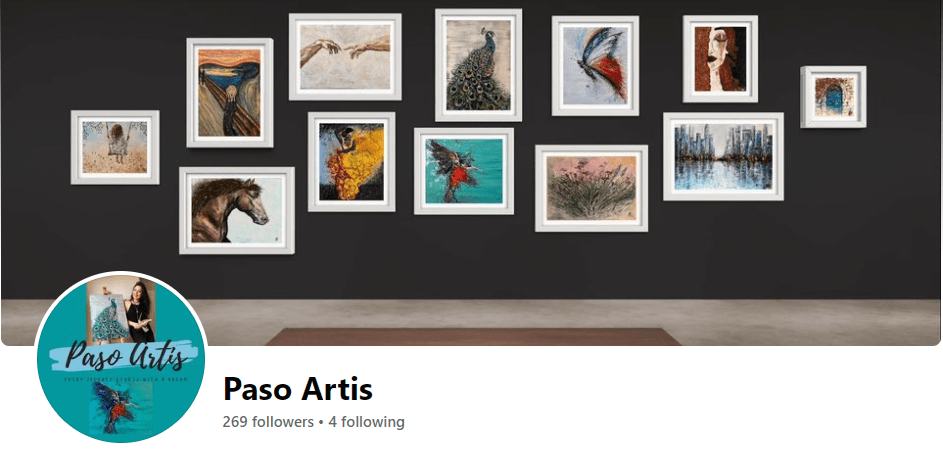
How Paso Artis collaborates with clients
As I’ve frequently said, my primary emphasis is words. My graphic execution capabilities are somewhat limited.
I did not draw this myself. Originally created by Jleedev using Inkscape and GIMP. Redrawn as SVG by Ben Liblit using Inkscape. – Own work, Public Domain, link.
But there are many, many people who have better graphic execution capabilities than I do.
Get ready to celebrate the power of your creative brand archetype! Whether you resonate with being an Artist, musician, writer, dreamer, builder, or designer, your brand has the incredible ability to amaze and inspire others.
When customers encounter your creative brand, they can’t help but feel captivated. They look at your work and think, “I want to be able to do what they can.” Your brand ignites a spark of inspiration and ignites the imagination within those who connect with it.
One of your innate advantages as a creative brand is your boundless creativity and imagination. You possess the unique ability to see the world in a different light, to think outside the box, and to breathe life into your visions.
Despite our vast differences, Paso Artis and Bredemarket have one similarity.
We both work together with our clients to create a piece of content that satisfies the clients’ needs.
With Bredemarket, it’s a written piece of content.
With Paso Artis, it’s a custom painting.
But because Paso Artis is…well, an artist, she doesn’t use Sage-like words and tables and bullet points to describe her client collaboration process. The Paso Artis-developed (again, I don’t like the word “proprietary”) collaboration process is described much more…artistically.
As an artist, I do feel the responsibility and privilege of taking a vision and turning it into a painting that will hang on the wall for years and be seen every day and regarded with affection.
Don’t be scared of handing over your dream to me.
In order to achieve a happy outcome, you and I will work together.
Note that Paso Artis uses some words that Bredemarket never uses, such as “affection” and “dream.” Now I might use “vision” and “scared” in the proper context, but most of my clients and prospects do not dream of having their customers regard their products and services, or their blog posts or white papers, with affection. Even the Bredemarket client who chose to “truly say thank you for putting these (proposal) templates together” didn’t get affectionate about them. I mean, I love Microsoft Word, but I don’t LOVE Microsoft Word.
So Bredemarket and Paso Artis use a different vocabulary. This happens to come back to another point that Putnam made, to speak the language of your clients.
If you only know Italian and your ideal clients are speaking French, you might get a few people that understand what you mean, but it’s not going to have the transformative effect that we’re looking for. You want to learn to be fluent. In the decision making language of your ideal clients.
“Jay” is a homeowner who loves art and desires a particular type of painting for his home, but does not have the artistic talent to paint it himself. Ideally, the completed painting will be one that brings Jay delight when he sees it in his home, and will also delight his guests. But can he trust anyone to realize his dream?
So Paso Artis (who has years of marketing experience in her day job work) knows that she has to address Jay’s pain points. She first does this by addressing them in her “About” text (“Don’t be scared of handing over your dream to me”), but then addresses them more deeply during her consultation with Jay.
I have never performed a competitive analysis of artists who respond to commission requests, but I’d guess that some are better at collaborating with clients than others.
And the ones that collaborate well earn a positive reputation, which translates to increased revenue over those who don’t collaborate well.
How should YOU collaborate?
But of course Bredemarket doesn’t matter, and Paso Artis doesn’t matter. You matter.
When you collaborate with a partner, either one in which the partner provides a product or service to you, or you provide a product or service to the partner, make sure that both of you are on the same page (or easel) before launching into the work project.
And if you want your blog posts, white papers, case studies, and other content to be regarded with affection (or something like that), contact Bredemarket.
This post explains what “pillar pages” are, the pros and cons of Bredemarket’s pillar pages, what I’ve learned from the “Target Audience” pillar page that I created, and how this can help your business deliver effective, converting messages to your prospects.
What are pillar pages?
I’ve been working on “pillar pages” for the Bredemarket website for over a year now.
As I stated before in an April 2022 blog post, a “pillar page” is simply a central “cluster” page on your website that discusses an important topic, and which is linked to other pages that provide more detail on the topic.
Think of a wheel with a hub and spokes. The pillar page is the hub, and the related pages are the spokes.
Now these pillar pages aren’t as mature as I’d like them to be.
I haven’t really multi-layered my keywords that link to the pillar; currently things are fairly simplistic where benefit “spoke” blog posts link to the benefits “hub” pillar. I haven’t explicitly optimized the “hub and spokes” for people who search for, say, features.
Similarly, the organization of each pillar page is fairly simplistic. Each pillar starts with a brief discussion of the topic in question, and is then followed by excerpts from and links to blog posts that provide more detail on the topic. (And the blog posts themselves link back to the pillar, providing bidirectional…um, benefits.) It’s functional, but perhaps you’d be better served if the pillars grouped subtopics together, rather than listing all the blog posts in reverse chronological order.
But the pillars do their work in terms of navigation and search engine optimization. If you want to find out what Bredemarket says about a topic such as benefits, it’s fairly easy to find this.
What have I learned from the Bredemarket Target Audience pillar page?
This post delves into the fifth of my five pillar pages, the Target Audience page.
I’ve recently worked on beefing up this pillar page by linking to more Bredemarket blog posts that discuss target audiences. And in the process of making these additions, I’ve realized some things about target audiences that I wanted to summarize here. (Repurposing content refocuses the mind, I guess.)
In the process of improving my pillar page, I’ve gleaned five truths about target audiences:
You need to define at least one target audience.
It’s not illegal to have multiple target audiences.
Different target audiences get different messages.
You can create personas, or you can not create personas. Whatever floats your boat.
Target audience definition focuses your content.
I’ll discuss each of these truths and suggest how they can improve your firm’s content.
One: You Need to Define At Least One Target Audience.
The first and most important thing is that you need a target audience before you start writing.
If you have no target audience, who is receiving your message? How do you know what to say?
For example, the primary target audience for THIS blog post is anyone from any type of company who could use Bredemarket’s marketing and writing services. It’s not limited to just the identity folks, or just the Inland Empire folks. If it were, I’d write it differently.
The content addressed two target audiences at the same time, although this post prioritized the companies looking for full-time employees.
As long as you know in advance what you’re going to do, you can define multiple target audiences. Just don’t define a dozen target audiences for a 288-character tweet.
Three: Different Target Audiences Get Different Messages.
Perhaps you are writing a single piece of content that must address multiple target audiences. A proposal is an example of this. For example, a proposal in response to a request for proposal (RFP) for an automated biometric identification system (ABIS) affects multiple target audiences.
Here’s an example of multiple target audiences for a theoretical Ontario, California ABIS proposal, taken from a May 2021 Bredemarket post:
Field investigators.
Examiners.
People who capture biometrics.
Information Technologies.
Purchasing.
The privacy advocate.
The mayor.
Others.
That’s a lot of target audiences, but if you’re submitting a 300 page proposal that answers hundreds of individual questions, you have the ability to customize each of the hundreds of responses to address the affected target audience(s).
For example, if the RFP asks about the maximum resolution of captured latent fingerprint images, your response will address the needs of the “examiner” target audience. Your response to that question won’t need to say anything about your compliance with city purchasing regulations. (Unless you have a really weird city, which is possible I guess.)
At the same time, if the RFP asks if you comply with E-Verify, this is NOT the time to brag about supporting 4,000 pixels per inch image capture.
Four: You Can Create Personas, Or You Can Not Create Personas. Whatever Floats Your Boat.
If you haven’t read the Bredemarket blog that much, you should know that I’m not very hung up on processes—unless my client (or my employer) insists on them. Then they’re the most important thing in the world.
If you find yourself trapped in a room (preferably padded) with a bunch of certified marketing professionals, they’ll probably toss around the word “persona” a lot. A persona helps you visualize your target audience by writing to someone with a particular set of attributes. Here’s an example from the October 2022 post I cited earlier:
Jane Smith is a 54 year old single white owner of a convenience store in a rural area with an MBA and a love for Limp Bizkit…
If I’m going to write a particular piece of content, this persona helps me focus my writing. As I write, I can picture Jane in my mind, fetching the giant cups for the soda dispenser, planning her next trip to the big city, and wondering if her customers would mind if she started blasting this song.
Not the Seldom Scene.
Having this persona in my mind can be an excellent writing support.
What would Jane think about a list of target audience truths?
What would Jane think if a Limp Bizkit song appeared in the middle of the list? (She’d like that.)
So you can create personas, either on the fly (take a LinkedIn profile of a real person and change a few facts so that the persona becomes Jim, a 35 year old product/content marketer who specializes in healthcare) or through an extensive and expensive persona research program.
But what if you escape from the padded room, run away from the marketing professionals, and swear up and down that you will never ever create a persona?
Will your marketing efforts die?
No they won’t.
You can still target your writing without inventing demographic information about the person reading your content.
It depends upon the effort you want to invest in the task.
Five: Target Audience Definition Focuses Your Content.
I kind of already said this, but I wanted to explicitly repeat it and emphasize it.
Regardless of whether your target audience is defined by an expensive research effort, a tweak of a real person’s LinkedIn profile, or the simple statement “we want to target latent fingerprint examiners,” the simple act of defining your target audience focuses your content.
Your text addresses the target audience, and doesn’t go off on tangents that bear no relation to your target audience.
This makes your message much more effective.
But is the message of this post resonating with companies needing content creators?
If you’re still reading, I guess it is.
Bredemarket can help you define your target audience for your content, and can help you define other things also that are necessary for effective content.
Would you like to talk to me about the content you want to create, and the message you want to deliver to your target audience?
Are you ready to take your firm to the next level with a compelling message that addresses your target audience(s) and increases awareness, consideration, conversion, and long-term revenue?
(UPDATE OCTOBER 23, 2023: “SIX QUESTIONS YOUR CONTENT CREATOR SHOULD ASK YOU IS SO 2022. DOWNLOAD THE NEWER “SEVEN QUESTIONS YOUR CONTENT CREATOR SHOULD ASK YOU” HERE.)
Just for fun, I’m going to challenge my assertion that there are six questions that your content creator must ask you before creating content.
I ought to know about these six questions. As a content marketing expert, I wrote the book on the topic.
The idea is that your content creator hosts a kickoff session, asks you the six questions, and only then starts to create the content in question—the blog post, case study, or whatever.
Are the six questions overkill?
But simplicity advocates may argue that those six questions are five questions too many.
Analysis paralysis may prevent you from moving forward at all, much less realizing your content creation goal. Perhaps you should be more efficient and just put pen to paper and, as the shoe people say, just do it.
I found a content marketing expert who agreed with this assertion, and wrote a post entitled “In marketing, move quickly.”
That content marketing expert was…well, it was me.
I ran across a local company (which I will not name) that issued a press release in December 2021. In part, the press release mentioned the local company’s new dedication to the marketing function.
The company had hired an international marketing firm “to develop comprehensive marketing strategies….We expect their work to incorporate a website redesign, brand refresh, new strategic messaging and content, as well as focused video and digital campaigns.”
So, when I wrote the “In marketing, move quickly” post three months later, what had this international marketing firm accomplished in the interim?
The website has a full slew of data sheets on the company’s products, and I found a 2017 brochure that effectively served as a white paper. But that’s it; no other white papers, and no case studies describing happy customers’ experiences.
The company’s YouTube channel has two videos from 2021.
The company’s Facebook page hasn’t posted anything since 2017.
Neither of the company’s LinkedIn pages (yes, the company has two LinkedIn pages) has any posts.
Now I have no visibility into this particular company, but I’ve been around the block to guess that the international marketing firm was probably still in the analysis stage, optimizing synergies according to “out of the box” criteria, to ensure bleeding-edge revenue maximization.
No, the six questions aren’t overkill
After reviewing what I wrote before in that blog post, I realize that my e-book lacks a very important point.
Don’t spend three months answering the six questions.
I shouldn’t HAVE to say this, but perhaps it’s safer to explicitly say it.
Now practices can very from consultation to consultation, but it’s very likely that a content creator and their client can breeze through those six questions in half an hour or less.
Or maybe the client can answer the questions on their own before the meeting.
If your content marketing expert schedules six one-hour meetings (or worse still, workshops) to address the six questions, run away!
(Is the content marketing expert billing by the hour?)
And the six questions create a content strategy
There’s something else that I failed to explicitly say in my e-book.
Not only do the answers to the six questions benefit that one piece of content, but they benefit everything else that your company does.
For example, let’s say that a content marketing expert is working with a gourmet ice cream shoppe (not a shop, but a shoppe), and the proprietor (Jane Cold) answers the “how” question as follows:
At Jane’s Gourmet Ice Cream Shoppe, we keep the internal dining temperature below 50 degrees Fahrenheit to ensure that our guests enjoy ice cream as it was meant to be enjoyed. We inform our guests of our temperature policy beforehand to ensure they bring proper attire.
While the content marketing expert will use the answer to the “how” question to create the content, the ramifications go far beyond the social media post itself.
Perhaps the new flavor could be branded “Frigid Farkleberry” to suggest how the ice cream should best be enjoyed.
Maybe in addition to branding, the “how” answer may even influence pricing. Perhaps prices incorporate the number “32,” as in a single-scoop price of $4.32. (Yes that price is high, but after all this is an ice cream shoppe.)
And what of future social media posts?
Let me clue you in on a little secret: once your content marketing expert has asked the six questions for the first piece of content, the kickoff is much quicker for subsequent pieces of content.
Chances are the basic “why” and “how” won’t change, although some of the later questions such as the target audience could change for each individual piece of content.
So without explicitly trying to do so, the six questions have created a de facto content marketing strategy. After creating five pieces of content, you’ve essentially defined your company’s mission, purpose, and differentiators, and may have defined as many as five separate vertical markets along the way.
Not a bad investment of thirty minutes of time.
(But a terrible investment of three months of time.)
Instead of writing “online,” I should have written “offline.”
I don’t know whether I just made a typo, or if I intentionally wrote “online,” but I shouldn’t have.
Why QR codes rarely make sense online
Because if you’re online, you don’t need a QR code, since you presumably have access to a clickable URL.
But if you’re offline—for example, if you’re watching a commercial on an old-fashioned TV screen—a QR code makes perfect sense. Well, as long as you explicitly identify where the QR code will lead you, something Coinbase failed to do in 2022. “Just click on the bouncing QR code and don’t worry where you’ll go!”
But there’s one more place where QR codes make sense. I didn’t explicitly refer to it in my 2021 post, but QR codes make sense when you’re looking at printed material, such as printed restaurant menus.
Or COVID questionnaires.
Which reminds me…
What I didn’t tell you about the Ontario Art Walk
…there’s one story about the Ontario Art Walk that I didn’t share in yesterday’s post.
After leaving Dragon Fruit Skincare, but before visiting the Chaffey Community Museum of Art, I visited one other location that I won’t identify. This location wanted you to answer a COVID questionnaire, which you accessed via a QR code.
I figured I’d do the right thing and answer the questionnaire, since I had nothing to worry about.
I was vaccinated.
I was boosted.
I hadn’t been around anyone with COVID.
I didn’t have a fever.
I entered the “right” response to every single question, except for the one that asked if I had a runny or stuffy nose. Since I had a stuffy nose, I indicated this.
But hey, it’s just a stuffy nose. What could go wrong?
When I finished the questionnaire, I was told that based on my answers, I was not allowed in the premises, and if I was already in the premises I should leave immediately.
Which I did.
And which is why I didn’t write about that particular location in yesterday’s post.
Bredemarket, pressing the flesh (sometimes six feet away)
But back to non-health related aspects of QR codes.
The Ontario Art Walk was actually the second in-person event that I had attended that week. As I noted on Instagram, I also went to a City of Ontario information session about a proposed bike lane.
Now that COVID has (mostly) receded, more of us are going to these in-person events. My target market (businesspeople in the United States) is mostly familiar with the century-old term “press the flesh.” While it usually applies to politicians attending in-person events, it can equally apply to non-political events.
Whenever I go out to these local events, I like to have some printed Bredemarket collateral handy in case I find a local businessperson looking for marketing services. After all, since I am the Ontario, California content marketing expert, I should let relevant people in Ontario know this.
In those cases, a QR code makes sense, since I can hand it to the person, the person can scan the QR code on their phone, and the person can immediately access whatever web page or other content I want to share with them.
On Saturday, it occurred to me that if I ran across a possible customer during the Ontario Art Walk, I could use a QR code to share my e-book “Six Questions Your Content Creator Should Ask You.”
Unfortunately, this bright idea came to my mind at 5:30 pm for an event that started at 6. I dummied up a quick and dirty page with the cover and a QR code, but it was…dirty. Just as well I didn’t share that on Saturday.
But now that I have more time, I’ve created a better-looking printed handout so that I’m ready at the next in-person event I attend.
If we meet, ask me for it.
Making myself look less smart
Well, now that I’ve gone through all of this trouble explaining how QR codes are great for offline purposes, I’m going to share the aforementioned handout…online.
(UPDATE OCTOBER 22, 2023: “SIX QUESTIONS YOUR CONTENT CREATOR SHOULD ASK YOU IS SO 2022. DOWNLOAD THE NEWER “SEVEN QUESTIONS YOUR CONTENT CREATOR SHOULD ASK YOU” HERE.)
Which has probably prompted the following question from you.
“Why?”
Four reasons:
It gave me the excuse to post the question “Why?” above, thus reiterating one of the major points of the e-book.
Because I felt like sharing it.
Just in case you don’t make “Event X” that I attend in the future, you can experience the joy of printing the flyer and scanning the QR code yourself. Just like you were there!
To demonstrate that even when you provide a piece of content with a QR code, it’s also helpful to explicitly reveal the URL where you’ll head if you scan the code. (Look just below the QR code in the flyer above.) And if you receive the flyer in online form rather than printed form, that URL is clickable.
And how do you decide who the target segments are within that target audience?
The professional marketer’s way to define a target segment
A few months ago, some marketers were writing eight pieces of content. At one point, they stepped back and defined personas that corresponded to these eight pieces of content.
A persona is a fictional, yet realistic, description of a typical or target user of the product. A persona is an archetype instead of an actual living human, but personas should be described as if they were real people.
Harley shared an example of a persona (go to her article to see it) that incorporated a lot of detail:
A name (in this case, “Rosa Cho”)
Biographical details (job title, age, city of residence)
Behavioral details (what motivates her, her frustrations, her goals)
Why all the detail? Because this detail allows us to think of this abstract persona as a living person. As marketers design their product, they can reference this persona and ask themselves if Rosa Cho would like this content.
The first of these 9 steps is to perform research to obtain reliable data (rather than mere hypotheses) about your persona. This research may be based on your own knowledge, on interviews with customers and customer-facing salespeople, or on data sources (including web analytics).
The remaining 8 steps use this research to segment the audience into individual archetypes, decide on the layout (what the persona will contain), and fill in the details. I’m not going to reproduce all of McCay’s content; you can see all 9 of his steps here.
If you’re someone who thinks that 9 steps is too many steps, perhaps you’ll prefer Louis Grenier’s 4 step process. Although frankly it’s pretty much the same.
Choose questions for your survey
Set up a survey on a popular page
Analyze your data
Build your persona
OK, the emphasis is slightly different, but in both cases you assemble data (McCay uses multiple sources, Grenier uses a survey), analyze it, and then create the personas.
And I’m sure there are a variety of other methods to create personas. If you want to go down the persona creation route, choose the one that works for you.
Why personas?
But why create personas?
Because marketing research emphasizes that persona creation is better than the alternative.
As every professional marketer knows, the data-driven method of persona creation is necessary to create accurate personas. As McCay states:
It is important to keep in mind that a persona is a collective image of a segment of your target audience (TA). It cannot be the face of the entire TA. Nor can it be just one person. You need somewhat of a golden middle.
Note that you should never base your target segment on the attributes of a single person. That’s going to skew your data and perhaps overemphasize some quirk of the individual person.
For example, if your company were marketing to part-time consultants, and chose to market to me rather than a persona created from data, then your company would erroneously conclude that all part-time consultants have prior experience with FriendFeed and an interest in orienteering.
This is not accurate for other part-time consultants, 99.99999% of whom have never heard of FriendFeed and think that orienteering is some form of Japanese study. (It isn’t.)
If you aspire to be a professional marketer, don’t read this
As professional marketers will tell you, using a real person rather than a constructed persona to define your target audience (or target segment) is an absolutely terrible thing to do.
But be terrible.
For some of you, I recommend that you consider using a real person as a starting point.
Large multi-million dollar businesses can devote the resources to the surveys, interviews, analytics, and other steps necessary for thorough persona creation.
But what if you’re a small business and don’t have the time or resources to do all that?
Don’t tell anyone, but you can cheat.
Don’t read this either: two steps to define a target segment
So you’ve read the warnings above, but you’re ready to ignore them and forgo you chance at a Super Duper Marketing Research award (application fee $899, not counting the cost of the awards dinner).
Without further ado, here are Bredemarket’s two steps to define a target segment.
Start with a real person.
Adjust.
If you read above, you realize that this method has severe problems, especially if you skip the second step altogether. By starting your focus with a real person, you could inadvertently create marketing text that emphasizes individual eccentricities that are relatively unimportant.
Is your content true north, or magnetic north?
But if you use your smarts to adjust and generalize the original person, you have a quick and dirty way to create your persona.
Rather than collecting extensive survey results and deriving an artificial persona from those results, you start with a real person.
An example
For example, let’s say that my company Bredemarket is targeting local businesses that need content or proposal creation.
I could start with a real local person who could use Bredemarket’s services, and then adjust that real biography and behavioral attributes as necessary to remove the oddities.
Or I could start with a non-local person and adjust as necessary to make the person a local person, filling in biographical and behavioral details as needed.
Either way, the end product is a quick and dirty persona that Bredemarket can use to target local businesses.
But what do professional marketers do in reality?
But are quick and dirty personas too dirty to use? Shouldn’t we stick to professional marketing techniques and create fictitious personas?
For example, when you create your Rosa Cho persona, how do you depict the persona? Do you use an illustration, or do you use an image of a real person?
A real photo is obviously a terrible thing to use, because it is based on a real individual and ignores all of the research that you performed to create the rest of the persona.
And illustrations can be fallible, since chances are that they don’t incorporate all of your research either. (Does the median 34 year old freelancer from Seattle really look like the illustration? Or does the illustration more accurately depict a 35 year old from Tacoma?)
Let’s face it: persona creation is not merely a science, but also an art. And sometimes you may take artistic license. This content marketing expert gives you permission to do so.
TL;DR Do what you want
There are valid arguments for a 4 step, 9 step, or 96 step (heh) persona creation process.
And there are valid arguments for just winging it.
The important thing is to target somebody when creating content, or having someone create content for you.
Which is why Bredemarket asks customers who their target audience is in the first place. It’s all in Bredemarket’s most recent e-book; read this post to find out how to download the e-book.
This gave me an opportunity to revisit the topic and add critical information on wildebeests, George (H.W.) Bush, and Yogi Berra.
But more importantly, it allows me to share my thoughts with a wider audience.
If you missed the October blog post, I state that there are six critical questions that your content creator must ask before creating content. These questions apply whether your content creator is a consultant, an employee at your company, or you.
The e-book discusses each of these six questions:
Why?
How?
What?
Goal?
Benefits?
Target Audience?
And as I note in the e-book, that’s just the beginning of the content creation process.
Whether you intend to use Bredemarket as your content creator, use someone else as your content creator, or create your own content, the points in this e-book are helpful. They can be applied to content creation (case studies, white papers, blog posts) or proposal work, and apply whether you are writing for Inland Empire West businesses or businesses anywhere.
And if you read the e-book, you’ll discover why I’m NOT sharing it on the Bredemarket Identity Firm Services LinkedIn page and Facebook group.
You can download the e-book here. And you can be a content marketing expert also.
(UPDATE OCTOBER 22, 2023: “SIX QUESTIONS YOUR CONTENT CREATOR SHOULD ASK YOU IS SO 2022. DOWNLOAD THE NEWER “SEVEN QUESTIONS YOUR CONTENT CREATOR SHOULD ASK YOU” HERE.)
If you want a content marketing expert to write for your business, do you just say “Write this, and make it viral”?
Not THAT viral. (Too soon?) By Alexey Solodovnikov (Idea, Producer, CG, Editor), Valeria Arkhipova (Scientific Сonsultant) – Own work. Scientific consultants:Nikitin N.A., Doctor of Biological Sciences, Department of Virology, Faculty of Biology, Lomonosov Moscow State University.Borisevich S.S. Candidate of Chemical Sciences, Specialist in Molecular Modeling of Viral Surface Proteins, Senior Researcher, Laboratory of Chemical Physics, Ufa Institute of Chemistry RASArkhipova V.I., specialization in Fundamental and Applied chemistry, senior engineer, RNA Chemistry Laboratory, Institute of chemical biology and fundamental medicine SB RAS, CC BY-SA 4.0, https://commons.wikimedia.org/w/index.php?curid=104914011
Six words of instruction will not result in great content.
Even if you just say “Write this” and leave off the viral part, this will not work either.
You and your content creator have to have a shared understanding of what the content will be.
For example, as I indicated in a previous post, you and your content creator have to agree on the tone of voice to use in the content. The content creator could write something in a tone of voice that may not match your voice at all, which would mean that the content would sound horribly wrong to your audience.
Imagine a piece for financial executives written in the style of Crazy Eddie. Ouch.
And that’s just one thing that could go wrong when you and your content creator are not on the same…um, page.
Bredemarket’s content creation process includes six questions
When Bredemarket works with you to create content, I use a content creation process. I’ve revised my original content creation process severaltimes, and I’m sure I’ll revise it more as I work with more of you.
But as of today, Bredemarket’s kickoff meetings with clients begin with six high-level questions that set the scene for everything that follows.
Question One: Why?
As I noted in my Simon Sinek post, the “why?” question needs to be answered before any other question is asked.
Before you ask a content creator to write a case study about how your Magnificent Gizmo cures bad breath, you need to understand why you’re in the good breath business in the first place. Did you have an unpleasant childhood experience? Were you abandoned at the altar? WHY did you care enough to create the Magnificent Gizmo in the first place?
(As I write this post, I’m going to look at how each of these six questions can be answered for the post itself. After all, it’s fair to ask: Why does Bredemarket do what it does? Short answer: because I write. You can pry my keyboard out of my cold dead hands. For the longer answer, read the “Who I Am” page on the Bredemarket website.)
Question Two: How?
You also need to make sure your content creator can explain how you do what you do. Have you created your own set of algorithms that make breath good? Do you conduct extensive testing with billions of people, with their consent? How is your way of doing things superior to that of your competitors?
Once these are clear in your mind, you’re ready to talk about the “what.” As Sinek notes, many people start with the “what” and then proceed to the “how,” and may or may not even answer the “why.” But when you ask the “why” first and the “how” second, your “what” description is much better.
(Again, you may be asking what Bredemarket does. I craft the words to communicate with technical and non-technical audiences. For additional clarification, read “What I Do,” which also notes what I don’t do. Sorry, finger/face/ID document vendors.)
Question Four: Goal?
Once the Golden Circle is defined, we’re ready to dig a little deeper into the specific piece of content you want. We’re not ready to talk about page count and fonts, yet, though. There’s a few other things we need to settle.
What is the goal of the content? Simple awareness of the product or service you provide? Or are you ready for consideration? Or is it time for conversion? The goal affects the content dramatically.
(In the case of this post, the goal is primarily awareness, but if you’re ready for conversion to become a paying customer, I won’t turn you away.)
Question Five: Benefits?
I’ve written ad nauseum on the difference between benefits and features, so for this question five about benefits I’ll just briefly say that written content works best when it communicates how the solution will help (benefit) the customer. A list of features will not make a difference to a customer who has specific needs. Do you meet those needs? Maintain a customer focus.
(Bredemarket’s primary benefit is focused content that meets your needs. There are others, depending upon your industry and the content you require.)
Question Six: Target Audience?
This one is simple to understand.
If you’re a lollipop maker and you’re writing for kids who buy lollipops in convenience stores, you’ll write one way.
If you’re a lollipop maker and you’re writing to the convenience stores who could carry your lollipops, you’ll write another way.
Now sometimes content creators get fancy and create personas and all that (Jane Smith is a 54 year old single white owner of a convenience store in a rural area with an MBA and a love for Limp Bizkit), but the essential thing is that you understand who you want to read your content.
(This particular piece is targeted for business owners, executives, directors, and managers, especially in California’s Inland Empire, who have a need to create focused content that speaks to their customers. The target audience not only affects how I am writing this post, but also how I will distribute it.)
What if you use a different content creator?
I am forced to admit that not everyone chooses Bredemarket to create their content.
Maybe you create your content yourself.
Maybe you already have access to content creators.
Or maybe you have a limited budget and can only pay a penny a word to your content creator. Let’s face it, a five dollar blog post does sound attractive.
But that doesn’t mean that you can’t use these six questions. I did publish them, after all, and they’re based on questions that others have asked.
If you create your own content, ask yourself these six questions before you begin. They will focus your mind and make your final content better.
If you have someone else create your content, make sure that you provide the answers for your content creator. For example, if you seek a content creator on Upwork or Fiverr, put the answers to these questions in your request for quotes. Experienced writers will appreciate that you’re explaining the why, how, what, goal, benefits, and target audience at the very beginning, and you’ll get better quotes that way. If someone knows your target audience is crime scene examiners, then you’ll (hopefully) see some quotes that describe the writer’s experience in writing for crime scene examiners.
And if you provide the answers to those six questions and your content creator says, “That doesn’t matter. I write the same for everyone,” run away.




















 Bredemarket