I’m going to describe one example of how Bredemarket has helped its customers, based upon one of my client projects from several years ago.
Stupid Word Tricks. Tell your brother, your sister and your mama too. See below.
I’ve told this story before, but I wanted to take a fresh look at the problem the firm had, and the solution Bredemarket provided. I’m not identifying the firm, but perhaps YOUR firm has a similar problem that I can solve for you. And your firm is the one that matters.
The problem
This happened several years ago, but was one of Bredemarket’s first successes.
The firm that asked for my help is one that focuses on one particular biometric modality, and provides a high-end solution for biometric identification.
In addition, the firm’s solution has multiple applications, crime solving and disaster victim identification being two of them.
The firm needed a way to perform initial prospect outreach via budgetary quotations, targeted to the application that mattered to the prospect. A simple proposal problem to be solved…or so it seemed.
Why the obvious proposal solution didn’t work
I had encountered similar problems while employed at Printrak and MorphoTrak and while consulting here at Bredemarket, so the solution was painfully obvious.
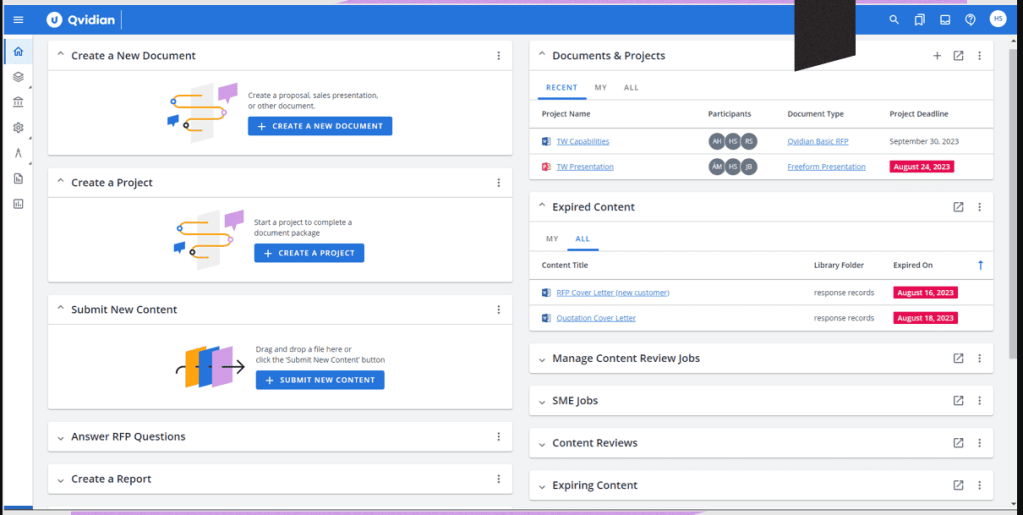
Qvidian, one proposal automation software package that I have used. But there are a LOT of proposal automation software packages out there, including some new ones that incorporate artificial intelligence. From https://uplandsoftware.com/qvidian/.
Have your proposal writers create relevant material in their proposal automation software that could target each of the audiences.
So when your salesperson wants to approach a medical examiner involved in disaster victim identification, the proposal writer could just run the proposal automation software, create the targeted budgetary quotation, populate it with the prospect’s contact information, and give the completed quotation to the salesperson.
Unfortuntely for the firm, the painfully obvious solution was truly painful, for two reasons:
This firm had no proposal automation software. Well, maybe some other division of the firm had such software, but this division didn’t have access to it. So the whole idea of adding proposal text to an existing software solution, and programming the solution to generate the appropriate budgetary quotation, wasn’t going to fly.
In addition, this firm had no proposal writers. The salespeople were doing this on their own. The only proposal writer they had was the contractor from Bredemarket. And they weren’t going to want to pay for me to generate every budgetary quotation they needed.
In this case, the firm needed a way for the salespeople to generate the necessary budgetary quotations as easily as possible, WITHOUT relying on proposal automation software or proposal writers.
Bredemarket’s solution
To solve the firm’s problem, I resorted to Stupid Word Tricks.
I created two similar budgetary quotation templates: one for crime solving, and one for disaster victim identification. (Actually I created more than two.) That way the salesperson could simply choose the budgetary quotation they wanted.
The letters were similar in format, but had little tweaks depending upon the audience.
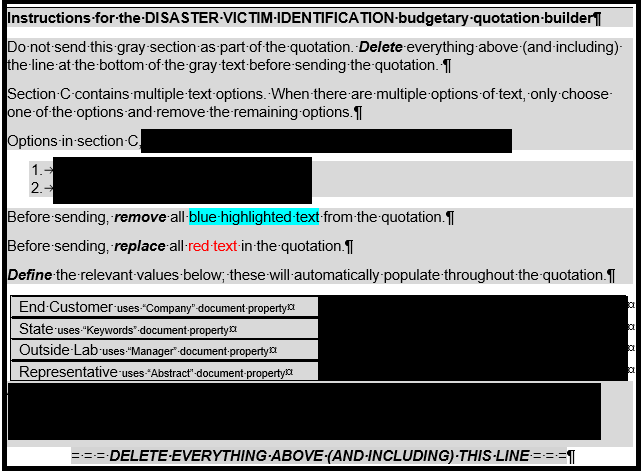
Using document properties to create easy-to-use budgetary quotations.
The Stupid Word Tricks came into play when I used Word document property features to allow the salesperson to enter the specific information for each prospect, which then rippled throughout the document, providing a customized budgetary quotation to the prospect.
The result
The firms’ salespeople used Bredemarket’s templates to generate initial outreach budgetary quotations to their clients.
And the salespeople were happy.
I’ve used this testimonial quote before, but it doesn’t hurt to use it again.
“I just wanted to truly say thank you for putting these templates together. I worked on this…last week and it was extremely simple to use and I thought really provided a professional advantage and tool to give the customer….TRULY THANK YOU!”
Comment from one of the client’s employees who used the standard proposal text
While I actively consulted for the firm I maintained the templates, updating as needed as the firm achieved additional certifications.
Why am I telling this story again?
I just want to remind people that Bredemarket doesn’t just write posts, articles, and other collateral. I can also create collateral such as these proposal templates that you can re-use.
There may be a variety of reasons for this. Perhaps your current employees are too busy doing other things. Or perhaps writing terrifies them so much that they think ChatGPT-generated content is actually a GOOD thing. (Read the content. It isn’t good.)
So you’re thinking about outsourcing the work to a content writer. One who has created content for multiple technology firms, including 9 returning clients. Here are four examples.
But how does outsourced content writing work?
How Bredemarket works with you to create content
Maybe you need an outsourced content writer because your current textual content is not compelling to your prospects, or perhaps it’s non-existent (for example, a LinkedIn company page with zero posts).
If you approach Bredemarket with your outsourced content writing request, here’s how we will work together:
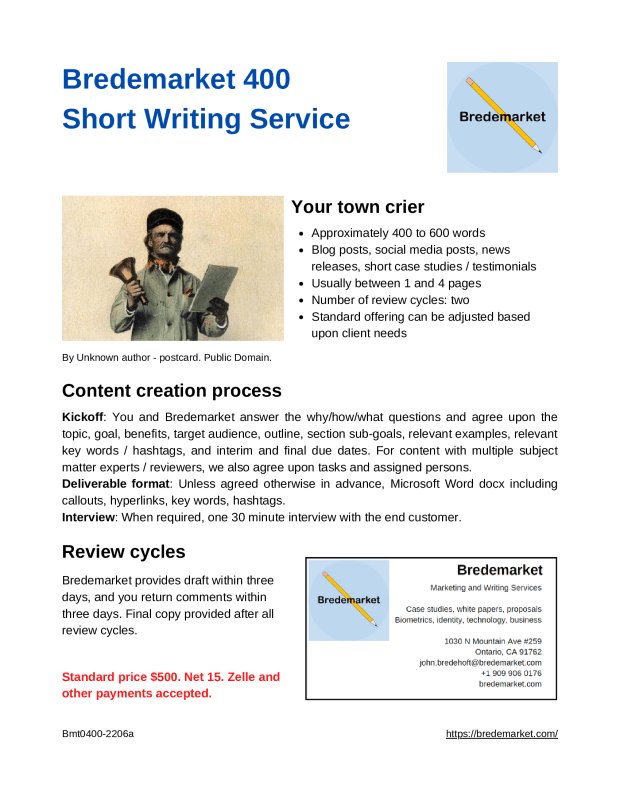
For this example, let’s assume that you need between 400 to 600 words of text to post to your company blog or to your company LinkedIn account, and therefore are purchasing my Bredemarket 400 Short Writing Service.
This is the most important step in the entire process, and I don’t write a word of text until you and I have some agreement on WHAT I am going to write.
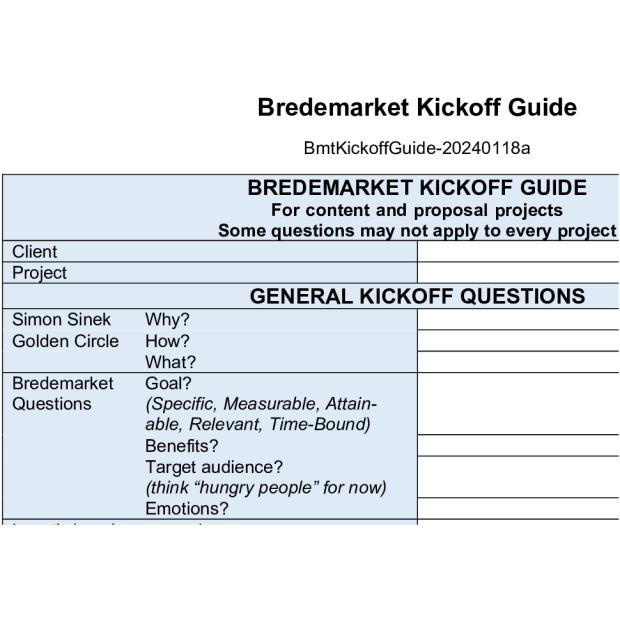
I start by asking seven questions about the content, your product, and your company.
Why?
How?
What?
Goal?
Benefits?
Target Audience?
Emotions?
I ask some additional questions which I won’t discuss in detail here. For example, you may specify the subject matter experts or articles I need to consult.
Once we’ve worked through ALL the questions, either in a synchronous meeting or asynchronously via email, I have a good idea of what the written content needs to say.
This benefits you because I love doing this, communicating your benefits to your prospects using the framework upon which we agreed in the kickoff.
Unless we agree on a different schedule, I get that first draft to you in three days for the next important step.
Step 3: First draft review
This is where you come in. Your task is to review my draft within three days and provide comments. And if I don’t hear from you within three days, you’ll hear from me. Why?
The first reason is my pure self-interest. The sooner I complete the project, the sooner I get paid. Those cold dead hands need some nice gloves.
The second reason is of mutual interest. We want to complete the project while we’re focused on thinking about it, and while it is critically important to us.
The third reason is for your own self-interest. You have a content gap, and it’s in your interest to fill that gap. If we get this draft reviewed and move forward, that gap will be filled quickly. If we don’t move forward, the gap will remain, your efforts to contract with Bredemarket will be for naught, and you’ll still have an uninteresting website and dead social media accounts.
Step 4: It depends
What happens after the first draft review varies from client to client.
Some of my clients love the first draft and don’t want to change a thing.
Some of my first drafts have embedded questions that you need to answer; once those questions are answered, the content is ready.
Some of my first drafts may need minor changes. In one case, I was asked to remove a reference to a successful hack that occurred at a well-known company; unbeknownst to me, the company was a customer of another division of the client in question. Whoops.
Occasionally more substantive changes are required, and I end up creating a second draft in three days, and you review it in three days.
In the end, we have a piece of content that is almost ready for publication.
Step 5: Finalize and publish
While the words may be ready, the entire piece is not.
I’m not a graphics person, and usually a written piece needs some accompanying images to drive the message home. I may suggest some images, or I may suggest that the client reuse an image from their website, or I may just ask the client to select an appropriate image.
Once the text and images are ready, you publish the piece. Normally I don’t have access to your website or social media accounts, so I can’t publish the piece for you. Only one client has given me such access, and even for that client I don’t have COMPLETE publishing permission.
For short projects such as a Bredemarket 400 project, I usually bill you when you publish the piece, although in certain circumstances I may bill you once the text is complete.
Are you ready to outsource your content marketing?
While other content marketers may work differently, we all have some type of process for our outsourced content writing.
If you’re ready to move forward with Bredemarket for outsourced content writing, contact me.
Last week I prepared a presentation for a conference organizer, thinking that I would give the presentation at the conference in question. Instead, the organizer emailed the presentation slides to selected conference attendees. The attendees probably liked it that way.
But I still wanted to give the presentation.
And I also wanted to generalize the presentation so that it applied to ALL technology companies, not just the ones who were attending the conference.
So I recorded myself giving the presentation “Differentiating Your Company and Your Products/Services.” It’s ten minutes long, and you can view it now.
Differentiating Your Company and Your Products/Services (April 9, 2024)
If you’re watching this video on your laptop, be sure to keep your smartphone handy because at the end of the video I display a QR code to obtain more information. Just point your phone at the QR code.
Of course, if you’re watching this video on your smartphone, you can’t read the displayed QR code. So just go to https://bredemarket.com/drive-tech/ instead.
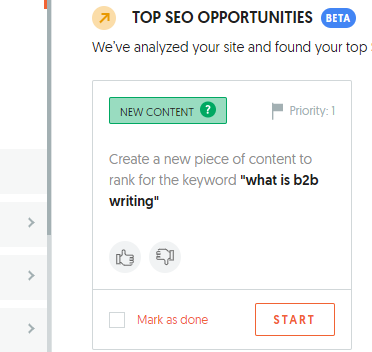
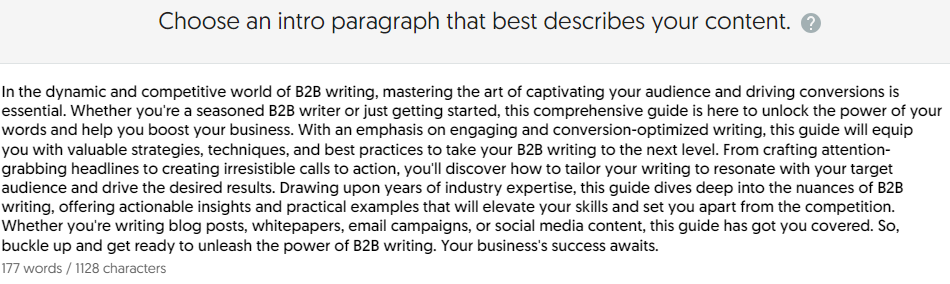
Um, thanks but no thanks. When the first sentence doesn’t even bother to define the acronym “B2B,” you know the content isn’t useful to explain the topic “what is B2B writing.”
Before I explain what B2B writing is, maybe I’d better explain what “B2B” is. And two related acronyms.
B2B stands for business to business. Bredemarket, for example, is a business that sells to other businesses. In my case, marketing and writing services.
B2G stands for business to government. Kinda sorta like B2B, but government folks are a little different. For example, these folks mourned the death of Mike Causey. (I lived outside of Washington DC early in Causey’s career. He was a big deal.) A B2G company, for example, could sell driver’s license products and services to state motor vehicle agencies.
B2C stands for business to consumer. Many businesses create products and services that are intended for consumers and marketed directly to them, not to intermediate businesses. Promotion of a fast food sandwich is an example of a B2C marketing effort.
I included the “B2G” acronym because most of my years in identity and biometrics were devoted to local, state, federal, and international government sales. My B2G experience is much deeper than my B2B experience, and way deeper than my B2C expertise.
Let’s NOT make this complicated
I’m sure that Ubersuggest could spin out a whole bunch of long-winded paragraphs that explain the critical differences between the three marketing efforts above. But let’s keep it simple and limit ourselves to two truths and no lies.
TRUTH ONE: When you market B2B or B2G products or services, you have FEWER customers than when you market B2C products or services.
That’s pretty much it in terms of differences. I’ll give you an example.
If Bredemarket promoted its marketing and writing services to all of the identity verification companies, I would target less than 200 customers.
If IDEMIA or Thales or GET Group or CBN promoted their driver’s license products and services to all of the state, provincial, and territorial motor vehicle agencies in the United States and Canada, they would target less than 100 customers.
If McDonald’s resurrects and promotes its McRib sandwich, it would target hundreds of millions of customers in the United States alone.
The sheer scale of B2C marketing vs. B2B/B2G marketing is tremendous and affects how the company markets its products and services.
But one thing is similar among all three types of writing.
TRUTH TWO: B2B writing, B2G writing, and B2C writing are all addressed to PEOPLE.
Well, until we program the bots to read stuff for us.
This is something we often forget. We think that we are addressing a blog post or a proposal to an impersonal “company.” Um, who works in companies? People.
(Again, until we program the bots.)
Whether you’re marketing a business blog post writing service, a government software system, or a pseudo rib sandwich, you’re pitching it to a person. A person with problems and needs that you can potentially solve.
So solve their needs.
Don’t make it complex.
But what IS B2B writing?
Let’s return to the original question. Sorry, I got off on a bit of a tangent. (But at least I didn’t trail off into musings about “the dynamic and competitive world.”)
When I write something for a business:
I must focus on that business and not myself (customer focus). The business doesn’t want to hear my talk about myself. The business wants to hear what I can do for it.
I must acknowledge the business’ needs and explain the benefits of my solution to meet the business needs. A feature list without any benefits is just a list of cool things; you still have to explain how the cool things will benefit the business by solving its problem.
My writing must address one, or more, different types of people who are hungry for my solution to their problem. (This is what Ubersuggest and others call a “target audience,” because I guess Ubersuggest aims lasers at the assembled anonymous crowd.)
Some firms make claims and don’t support them, while others support their claims with quantified benefits. But does quantifying help or harm the firms that do it? This pudding post answers this question…and then twists toward the identity/biometrics market at the end.
The “me too” players in the GCP market
Whoops.
In that heading above, I made a huge mistake by introducing an acronym without explaining it. So I’d better correct my error.
GCP stands for Glowing Carbonated Pudding.
I can’t assume that you already knew this acronym, because I just made it up. But I can assure you that the GCP market is a huge market…at least in my brain. All the non-existent kids love the scientifically advanced and maximally cool pudding that glows in the dark and has tiny bubbles in it.
Glowing Carbonated Pudding. Designed by Google Bard. Yeah, Google Bard creates images now.
Now if you had studied this non-existent market like I have, you’ll realize from the outset that most of the players don’t really differentiate their offerings. Here are a few examples of firms with poor product marketing:
Jane Spain GCP: “Trust us to provide good GCP.”
Betty Brazil GCP: “Trust us to provide really good GCP.”
Clara Canada GCP: “Trust us to provide great GCP.”
You can probably figure out what happened here.
The CEO at Betty Brazil told the company’s product marketers, “Do what Jane Spain did but do it better.”
After that Clara Canada’s CEO commanded, “Do what Betty Brazil did but do it better.” (I’ll let you in on a little secret. Clara Canada’s original slogan refereneced “the best GCP,” but Legal shot that down.)
But another company, Wendy Wyoming, decided to differentiate itself, and cited independent research as its differentiator.
Wendy Wyoming Out of This World GCP satisfies you, and we have independent evidence to prove it!
The U.S. National Institute of Standards and Technology, as part of its Pudding User Made (PUM, not FRTE) Test, confirmed that 80% of all Wendy Wyoming Out of This World GCP mixes result in pudding that both glows and is carbonated. (Mix WW3, submitted November 30, 2023; not omnigarde-003)
Treat your child to science-backed cuisine with Wendy Wyoming Out of This World GCP!Wendy Wyoming is a top tier (excluding Chinese mixes) GCP provider.
But there are other competitors…
The indirect competitor who questions the quantified benefits
There are direct competitors that provide the same product as Wendy Wyoming, Jane Spain, and everyone else.
And then there are indirect competitors who provide non-GCP alternatives that can substitute for GCPs.
For example, Polly Pennsylvania is NOT a GCP provider. It makes what the industry calls a POPS, or a Plain Old Pudding Sustenance. Polly Pennsylvania questions everything about GCP…and uses Wendy Wyoming’s own statistics against it.
Designed by Google Bard.
Fancy technologies have failed us.
If you think that one of these GCP puddings will make your family happy, think again. A leading GCP provider has publicly admitted that 1 out of every 5 children who buy a GCP won’t get a GCP. Either it won’t glow, or it’s not carbonated. Do you want to make your kid cry?
Treat your child to the same pudding that has satisfied many generations. Treat your child to Polly Pennsylvania Perfect POPS.
Pennsylvania Perfect remembers.
So who wins?
It looks like Polly Pennsylvania and Wendy Wyoming have a nasty fight on their hands. One that neck-deep marketers like to call a “war.” Except that nobody dies. (Sadly, that’s not true.)
Some people think that Wendy Wyoming wins because 4 out of 5 of their customers receive true GCP.
Others think that Polly Pennsylvaia wins because 5 out of 5 of their customers get POPS pudding.
But it’s clear who lost.
All the Jane Spains and Betty Brazils who didn’t bother to create a distinctive message.
Don’t be Jane Spain. Explain why your product is the best and all the other products aren’t.
Copying the competition doesn’t differentiate you. Trust me.
The “hungry people” (target audience) for THIS post
Oh, and if you didn’t figure it out already, this post was NOT intended for scientific pudding manufacturers. It was intended for identity/biometric firms who can use some marketing and writing help. Hence the references to NIST and the overused word “trust.”
If you’re hungry to kickstart your identity/biometric firm’s written content, click on the image below to learn about Bredemarket’s services.
Normally I talk about CONtent, but today I’m talking about conTENT. (OK, a little bit about CONtent also.)
There are many prospects that may be CRITICALLY IMPORTANT (the highest of my three levels of importance) to your firm—perhaps too many. You can reduce your firm’s list of critically important prospects without losing them altogether. The extra time you receive benefits your firm and your TRUE critically important prospects. And eventually the other prospects may come around anyway.
But what if the identity/biometric prospects are not HUNGRY to satisfy that need? (Hungry people = true target audience.) Addressing the need may even be “important” to the prospects—but not CRITICALLY important.
Now I can create (and have created) content addressing this need and how to fill it. If a prospect searches for this content, they will find it.
I can even proactively initiate direct contact with these prospects, and maybe even contact them a second time.
But in most cases a prospect may respond with a “not interested” message—if the prospect even responds at all.
When you “Let Them” do whatever it is that they want to do, it creates more control and emotional peace for you and a better relationship with the people in your life.
And at the same time move the prospect from your “critically important” category down to your “important” category. Focus on the critically important prospects, and be content (conTENT) with them rather than stressing out over the uncontrollable prospects.
But don’t eliminate the merely important prospects entirely, because some day they may become hungry for your services. Continue creating content (CONtent) such as your own blogs, plus social media without messaging the merely important people directly. When they DO get hungry, they will emerge from your trust funnel and contact YOU, asking for your services.
Becoming conTENT
What happens when you, in the words of Mel Robbins, “let them”?
You’re focused, your true critically important prospects are happy that you’re paying attention to them, your merely important prospects are happy that you’re no longer pestering them…
Leftover pizza is the best pizza. Preparation credit: Pizza N Such, Claremont, California. Can I earn free pizza as a powerful influencer? Probably not, but I’ll disclose on the 0.00001% chance that I do.
Now that it’s time to write the “separate post,” I really don’t want to get into the mechanics of how posts that attract prospects (hungry people, target audience) increase awareness and help you convert prospects for your products and services.
So forget that. I’m going to tell a story instead about two executives at a fictional company that has a real problem. The executives’ names are Jones and Smith.
The story
Jones was troubled. Sales weren’t increasing, prospects weren’t appearing, and if this malaise continued the company would have to conduct a second round of layoffs. Jones knew that “rightsizing” would be disastrous, so the company needed another solution.
So Jones videoconferenced Smith and asked, “How can we make 2024 better than 2023?”
Smith replied, “Increasing sales calls could help, and ads could help, but there’s another way to increase our awareness with our prospects. We could create content on our website and on our social channels that spreads knowledge of our products and services.”
Jones exclaimed, “That’s great! We could get generative AI to create content for us!”
“No, not that!” Smith replied. “Generative AI text sounds like a bot wrote it, and makes us sound boring, just like everyone else using generative AI text. Do we want to sound like that and put our prospects to sleep?”
“So we need a human writer,” Jones realized, “one who can describe all of the features of our products.”
“Absolutely not,” Smith emphasized. “Customers don’t care about our features. They care about the benefits we can provide to them. If we just list a bunch of features, they’ll say, ‘So what?'”
“OK, we’ll go with benefits,” said Jones. “But why is content so important?”
“Take blogging,” replied Smith. “The average company that blogs generates 55% more website visitors. B2B marketers that use blogs get 67% more leads than those who do not. Marketers who have prioritized blogging are 13x more likely to enjoy positive ROI. And 92% of companies who blog multiple times per day have acquired a customer from their blog.”
“Wow.” Jones was silent for a moment. “How do you know all of this stuff, Smith?”
“Because of the content that I’ve read online from a marketing and writing services company called Bredemarket. The company creates content to urge others to create content. Bredemarket eats its own wildebeest food.”
Have you ever seen those posts from self-appointed gurus?
Specifically, the ones that authoritatively state the BEST time to WRITE a post on Instagram, or LinkedIn, or TikTok, or whatever?
I religiously ignore those posts for a simple reason: My country has multiple time zones. So the best time in one time zone may be the worst time in another time zone.
However, I can tell you the WORST time to READ a post in the PACIFIC Time Zone…if the post concerns pizza.
And I’ll explain what all this means…eventually.
Ophir Tal on awareness
In addition to saying WHEN to post, the gurus also provide authoritative (and often contradictory) advice about WHAT to post.
For example, some gurus assert that you MUST prioritize bottom of funnel (conversion) content over top of funnel (awareness) content because it’s most important to get people to buy.
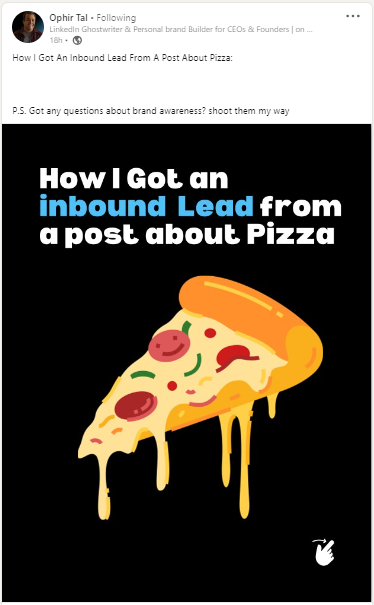
Ophir Tal disagrees, and has evidence to support his position.
This hook caught my attention. People want leads, and people like pizza, so I paid attention. But I also paid attention for a third reason that I’ll discuss later.
Tal then noted that the gurus would have recommended NOT posting this because he was “doing it wrong.” Specifically:
The post didn’t solve a problem for his potential clients. (Unless they regularly drop slices of pizza, I guess.)
It didn’t have a strong call to action.
It wasn’t targeted to his ideal clients. (Again, unless they regularly drop slices of pizza, or unless they love chicken wings.)
But despite doing everything wrong, that particular piece of content attracted the attention of someone “at a 6 figure ecom company.” After viewing the content, the reader looked at Tal’s profile and realized Tal could meet their need for ghostwriting services.
And now I’ll tell you the third reason why I paid attention to Tal’s post.
John Bredehoft on birthdays
As I noted above, I paid attention to Ophir Tal’s pizza post for two reasons:
People want leads.
People like pizza.
Now let’s jump back to a post I wrote all the way back in 2023, one that described why I’ve soured on the term “target audience.” (Or, in Tal’s words, “ideal clients.”) I started that post by wondering if the term “needy people” would be better than “target audience.” Yes, but not good enough.
I’ll grant that “needy people” has a negative connotation, like the person who is sad when people forget their birthday.
It turns out that these people had a VERY GOOD reason for forgetting my birthday. However, I cannot reveal this reason to you because the disclosure would force me to reveal someone’s personal identifiable information, or PII. (Mine.)
So after they remembered my birthday, one of them asked what I did for my birthday…and I told them that my wife, father-in-law, and brother-in-law went out to dinner.
For pizza.
And I also told them that there were leftovers, which my wife and I enjoyed a few days later.
Leftover pizza is the best pizza. Preparation credit: Pizza N Such, Claremont, California. Can I earn free pizza as a powerful influencer? Probably not, but I’ll disclose on the 0.00001% chance that I do.
A nice story, and while I was reading Ophir Tal’s story on dropped pizza, I realized that I had missed an opportunity to tell my own story about leftover pizza.
Time to channel Steve Jobs…
Oh, and there’s one more thing
I forgot to mention one thing about the Ophir Tal story.
When I read the story, it was around 4:00 pm in California.
So when I read about Tal’s dropped pizza, and thought about my leftover pizza (which I had already eaten)…I was hungry.
As we close out 2023, I’ve been thinking about a lot of things.
Will 2024 be like 2021, in which the new year (2024) offers mimimal improvement over the preceding year (2023)? Reply hazy, try again later. (“And while tech layoffs slowed down in the summer and fall, it appears that cuts are ramping up yet again.”)
What new ways will we develop to better ghost people? Or will the old ways of ghosting continue to dominate the (lack of) conversation? (And if the person who ghosts is the ghoster, and the person who is ghosted is the ghostee…who is the ghost?)
Most importantly for this post, I’ve been thinking about the following: why are target audiences TARGETS, and why are they AUDIENCES? And is the term “target audience” the best description? (TL;DR: No.) If not, what’s a better description? (TL;DR: I don’t know.)
So let’s look at target audiences. And if you don’t mind, I’ve asked William Tell, Cheap Trick, Steve Dahl, Google Bard, Andrew Loog Oldham, and others to help me examine the topic, which will probably be Bredemarket’s last blog post of 2023.
But first I’ll explain where I’m coming from. Rather than diving into great detail, I’ll take a more, um, targeted approach and just quote a bit from the relevant information page.
There are roughly 8 billion people in the world. Most businesses don’t care about 7.99999 billion of these people; the businesses only care about 0.00001 billion (or fewer) people who will buy or recommend the business’ product or service.
Your content (or proposal) needs to resonate with these people. The others don’t matter.
Daily Copywriting’s use of the word “target” as a pejorative got me thinking about my fave phrase “target audience.”
Let’s start with the first word. At its worst, “target” implies something that you shoot, in a William Tell sort of way. If your weapon hits the target, you and your son don’t die. If your weapon misses low, you kill your son. Is that what we marketers do? Hopefully not.
Even at its best, “target” is just something that you get right. You’ve narrowed the 8 billion people to the few that really matter. So what?
Then we move to the second word of the fave phrase “target audience.” An audience is a group of people that sit in chairs while you perform your song and dance in front of them. (“These are the seven questions your content creator should ask you. Thank you for coming to my BRED talk.”)
Sometimes the audience just sits. Not good.
Sometimes the audience claps. A little better.
If you’re the Beatles or Cheap Trick, the audience screams. But still not enough.
Clapping or screaming is nice, but this doesn’t count as true engagement. I mean, in a way it would be nice if you scream with joy at this post, but it counts for nothing if you don’t actually buy Bredemarket’s marketing and writing services.
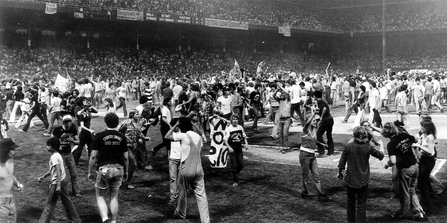
I’m forced to admit that there was one time where someone truly engaged his target audience—and that was during Steve Dahl’s “Disco Demolition Night.”
Dahl was not a disco fan, since he lost his WDAI radio job when his then-employer switched to a disco format. As a counter-reaction to disco, Dahl entertained baseball fans on Disco Demolition Night by destroying disco records between two games of a doubleheader. 7,000 fans stormed the field in delirious joy, wrecking the field, and the second game of the doubleheader was never played. This was NOT a good thing. But the White Sox survived, and even celebrated the 40th anniversary of the promotion. Dahl threw out the first pitch. Nothing exploded. But nothing was accomplished.
So if “target audience” isn’t the right term to use, what is?
I’ll grant that “needy people” has a negative connotation, like the person who is sad when people forget their birthday. (Not “ghosting” per se, but perhaps a little “boo.”) But “needy people” is certainly better than “target audience.”
“Needy” is stronger than “target.” Rather than just representing a demographic, it actually represents people who truly NEED things. Just because a company needs content for its website doesn’t necessarily mean that it needs Bredemarket. Many companies have their own people to create content.
And for the reasons stated by Daily Copyrighting, “people” is stronger than “audience.” You are not a faceless audience that claps (or screams) when Bredemarket does its song and dance. You are people who work in a certain way, which I why I talk to people before creating content for them.
This “needy people” phrase sounded good a few days ago, but now that I’ve thought about it some more I see some problems with this formulation also. In addition to the negative connotations of the phrase, the mere fact that someone is “needy” doesn’t necessary mean that they will buy Bredemarket’s services. Take my identification of “needy people” from a few days ago:
My mini-survey shows that of the 40+ identity firms with blogs, about one-third of them HAVEN’T SAID A SINGLE THING to their prospects and customers in the last two months.
Yes, these companies are damaging their future prospects and need Bredemarket. But none of these companies has approached Bredemarket, or any other marketing and writing consultant, or their in-house people.
Perhaps they don’t see the problem at all.
Perhaps they see the problem, but don’t want to spend money (even a few hundred dollars) to fix it.
Perhaps they see the problem but don’t consider it as critically important as the other problems they face. Rather than spending a few hundred dollars, some companies are saving millions of dollars by “rightsizing” by 10-20% and cutting marketing budgets. They’re just fine with spiderweb-covered blog pages.
Because “needy people” doesn’t capture my meaning, I’ll do the recommended thing and use this blog post to throw up another idea.
The problem with the term “hungry people”
My latest iteration of “target audience” is “hungry people.” I figure that unlike “needy people,” “hungry people” are more inspired to act on their needs. They don’t just clap or scream; they are motivated to search for something to eat.
Using my example of the non-blogging identity firms, perhaps some of those quiet firms are troubled by their lack of communication with their prospects and clients. Rather than doing nothing, these firms are ready to plug their communications gap. But will they plug it with healthy food, or with junk food?
Even without writers, companies can unleash a content creation boom with generative AI. By feeding the AI brand guidelines, target audience data, and product specifics, they can churn out blog posts, ad copy, product descriptions, and even social media snippets. This AI assistant generates captivating headlines, outlines engaging narratives, and drafts basic texts, all while maintaining brand voice and SEO optimization. AI handles the heavy lifting, freeing up resources for strategic planning and audience engagement, boosting content output from silence to symphony.
I know this may surprise you, but I didn’t write the paragraph above. Google Bard did. And perhaps some hungry companies will opt for the free route and let generative AI write their content rather than contracting or employing a content marketer. Silence to symphony for a $0 budget! I consider this bittersweet.
I let the melody shine, let it cleanse my mind, I feel free now. Even though the melody was from Andrew Loog Oldham, uncredited, resulting in a decades-long copyright dispute between the Verve and the Rolling Stones. From https://www.youtube.com/watch?v=1lyu1KKwC74.
So “hungry” doesn’t quite cut it, since I seek the people who are not only hungry, but who will pay for quality fare such as Bredemarket’s marketing and writing services.
To be continued
In this case, the blog post IS a temporary expression of thought. I’ve determined that “target audience” is an imperfect phrase and that I need to replace it with SOMETHING, but I haven’t figured out what that “something” is yet.
Until I get a better idea, I’ll use “hungry people” in my internal work, but I won’t change my customer-facing work (such as the e-book) until I come up with an effective alternative to “target audience.”
And one more thing
And unless I get a sudden brainstorm, this will probably be the last Bredemarket blog post for 2023, and I’m currently ruminating about the first question I asked in this post regarding prospects for 2024. While there were some positive things that happened this year, the negatives during the last seven months tended to outweigh the positives. A lot of other people are also experiencing this, so I’m sharing this song for those who are glad that 2023 is almost over, and who hope that 2024 isn’t more of the same.
A firm’s content should address the needs of its target audience. For Bredemarket, that is people in identity, biometrics, technology, and general business whose firms aren’t marketing effectively.
Narrow target audiences are the enemy of virality.
Unless you create attention-grabbing content that doesn’t contribute to your core business, but only grabs attention.
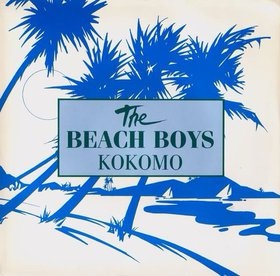
For example, you could proclaim that “Kokomo” is the absolute best Beach Boys song ever.
Fair
But I couldn’t bear to write such drivel myself, so I assigned the task to Google Bard, who wrote all the “hot take” text under this paragraph. (I hate myself now.)
Kokomo: The Underrated Gem that Shines Brighter than California Sun
Beach Boys fans, brace yourselves for a hot take. While classics like “Surfin’ U.S.A.” and “California Girls” hold their place in the pantheon of summer anthems, there’s one song, often relegated to the realm of guilty pleasures, that deserves a crown of seashells and a chorus of seagulls: “Kokomo.”
Yes, I said it. Kokomo is not just The Beach Boys’ best song, it’s a pop masterpiece, a sonic escape hatch to a tropical paradise, and a testament to the band’s enduring musical magic. Here’s why:
1. The Escape: From the first steel drum lick, “Kokomo” whisks you away from the everyday. Mike Love’s smooth vocals paint a picture of turquoise waters, swaying palm trees, and worries lost in the trade winds. It’s wanderlust in a song, a daydream of bare feet in the sand, perfectly capturing the yearning for escape that made The Beach Boys icons.
2. The Melody: It’s impossible not to hum along. The chorus, a catchy earworm built on layered harmonies and a driving beat, burrows deep into your brain and stays there like a souvenir seashell. It’s a pop hook that rivals anything in The Beach Boys’ discography, a testament to their mastery of crafting unforgettable melodies.
3. The Production: Lush, vibrant, and layered, the production on “Kokomo” is a sonic tapestry. Tropical instruments, steel drums, and gentle percussion create a soundscape that’s both playful and sophisticated. It’s a sonic cocktail that transports you to the heart of that island paradise, with every layer adding a new dimension to the musical journey.
4. The Unexpectedness: Released in 1988, “Kokomo” arrived at a time when The Beach Boys were navigating a new musical landscape. But instead of feeling dated or derivative, it embraced a contemporary sound while retaining the band’s signature harmonies and sun-drenched spirit. It’s a testament to their ability to adapt and evolve, proving their musical magic had never truly faded.
5. The Heart: At its core, “Kokomo” is a song about longing and connection. It’s about finding solace in the arms of a loved one, escaping the mundane with someone special. It’s a love letter to shared dreams and simple pleasures, reminding us that sometimes, all we need is a little sunshine, a sandy beach, and the one we love.
So, next time you reach for a Beach Boys record, don’t just skip to the hits. Give “Kokomo” a chance. Let its infectious melody wash over you, close your eyes, and imagine yourself beneath the swaying palm trees. You might just find yourself singing along, realizing you’ve stumbled upon a hidden gem, the one song that truly captures the essence of The Beach Boys and their timeless sound.
Now, go forth and spread the gospel of Kokomo! Let’s give this underrated masterpiece the recognition it deserves. After all, it’s not just a song, it’s a state of mind, a passport to paradise, and the ultimate proof that The Beach Boys’ magic truly is endless.
P.S. Don’t forget to pack your sunscreen and your dancing shoes!



























 Bredemarket