How Bredemarket Works

Bredemarket logo

(Updated question count 10/23/2023)

I’m stealing an idea from Matthew Mace and adapting it to explain how Bredemarket works.

What am I stealing from Matthew Mace?

Matthew Mace is a freelance content writer who recently posted the following on LinkedIn:

Do you need a freelance content writer but don’t know what to expect?

I created a “work with me” pdf that explains what I do and how I can help you.

From https://www.linkedin.com/posts/matthewmace-contentmarketing_cycling-running-wellness-activity-7094675414727450624-8U_Y/

His post then explains what is included in his “work with me” PDF. If you’d like his PDF, send him a message via his LinkedIn profile.

But what if I want to know how to work with Bredemarket?

Glad you asked.

After reading Mace’s LinkedIn post, I realized that I have a bunch of different online sources that explain how to work with Bredemarket, but they’re scattered all over the place. This post groups them all the “how to work with Bredemarket” content together, following an outline similar (yet slightly different) to Mace’s.

And no, it’s not a stand-alone PDF, but as you read the content below you’ll discover two stand-alone PDFs that address critical portions of the process.

Question 1: Why would I work with Bredemarket?

As you’ll see below, “why” is a very important question, even more important than “how.” Here are some reasons to work with Bredemarket.

  • You require the words to communicate the benefits of your identity/biometrics product/service. I offer 29 years of experience in the identity/biometrics industry and am a biometric content marketing expert and an identity content marketing expert. I have created multiple types of content (see below) to share critical points about identity/biometrics offerings.
  • You require the words to communicate the benefits of your technology product/service. I have also created multiple types of content to share critical points about technology offerings.
  • You require the words to communicate the benefits of a product/service you provide to California’s Inland Empire. I’ve lived in the Inland Empire for…well, for more than 29 years. I know the area—its past, its present, and its future.
  • You require one of the following types of content. Blogs, case studies / testimonials, data sheets, e-books, proposals, social media posts / Xs (or whatever tweets are called today), white papers, or anything. I’ve done these for others and can do it for you.

Question 2: Why WOULDN’T I work with Bredemarket?

This question is just as important as the prior one. If you need the following, you WON’T want to work with Bredemarket.

  • You require high quality graphics. Sorry, that’s not me.
I did not draw this myself. Originally created by Jleedev using Inkscape and GIMP. Redrawn as SVG by Ben Liblit using Inkscape. – Own work, Public Domain, link.
  • You are based outside of the United States. Foreign laws and exchange rates make my brain hurt, so I only pursue business domestically. But depending upon where you are, I may be able to recommend a content marketer for you.

Question 3: What are Bredemarket’s most popular packages? How much do they cost?

Here are the three most common packages that Bredemarket offers.

By Staff Sgt. Michael L. Casteel – [1], Public Domain, https://commons.wikimedia.org/w/index.php?curid=2407244

Note that these are the standard packages. If your needs are different, I can adapt them, or charge you an hourly rate if the need is not well defined. (But as you will see below, I try to work with you at the outset to define the project.)

If you follow the link above for your desired package and download the first brochure on each page, you’ll get a description of the appropriate service. The pricing is at the bottom of each brochure.

Each brochure also explains how I kick off a project, but the procedure is fairly common for each package.

Question 4: What are Bredemarket’s working practices?

When I work with a client, I hold a kickoff to make sure that we have a common understanding at the beginning of the project.

The first seven questions that we address are critical. In fact, I wrote an e-book that addresses these seven questions alone.

  1. Why?
  2. How?
  3. What?
  4. Goal?
  5. Benefits?
  6. Target Audience?
  7. Emotions?

But that’s not all that we address in the kickoff. There are some other lower-level questions that I ask you (such as the long and short form of your company name).

Once we have defined the project, I iteratively provide draft copy and you iteratively review it. The number and length of review cycles varies depending upon the content length and your needs. For example, I use up to two review cycles of up to three days each for short content.

Eventually I provide the final copy, you publish it and pay me, and both of us are happy.

Question 5: What about samples and testimonials?

Because I usually function as a ghostwriter, I cannot publicly provide samples or identity my clients. But I’ve written yet another e-book that anonymously describes some sample projects that I’ve performed for clients, including a testimonial from one of them.

Question 6: What are the next steps to work with Bredemarket?

If you believe that I can help you create the content your firm needs, let’s talk.

Or if Matthew Mace’s content services better fit your needs, use him.

Educational Identity: Why and How Do Educational Institutions Verify Identities?

Chaffey High School, Ontario California.

Whether a student is attending a preschool, a graduate school, or something in between, the educational institution needs to know who is accessing their services. This post discusses the types of identity verification and authentication that educational institutions may employ.

Why do educational institutions need to verify and authenticate identities?

Whether little Johnny is taking his blanket to preschool, or Johnny’s mother is taking her research notes to the local university, educational institutions such as schools, colleges, and universities need to know who the attendees are. It doesn’t matter whether the institution has a physical campus, like Chaffey High School’s campus in the video above, or if the institution has a virtual campus in which people attend via their computers, tablets, or phones.

Access boils down to two questions:

  • Who is allowed within the educational institution?
  • Who is blocked from the educational institution?

Who is allowed within the educational institution?

Regardless of the type of institution, there are certain people who are allowed within the physical and/or virtual campus.

  • Students.
  • Instructors, including teachers, teaching assistants/aides, and professors.
  • Administrators.
  • Staff.
  • Parents of minor students (but see below).
  • Others.

All of these people are entitled to access to at least portions of the campus, with different people having access to different portions of the campus. (Students usually can’t enter the teacher’s lounge, and hardly anybody has full access to the computer system where grades are kept.)

Before anyone is granted campus privileges, they have to complete identity verification. This may be really rigorous, but in some cases it can’t be THAT rigorous (how many preschoolers have a government ID?). Often, it’s not rigorous at all (“Can you show me a water bill? Is this your kid? OK then.”).

Once an authorized individual’s identity is verified, they need to be authenticated when they try to enter the campus. This is a relatively new phenomenon, in response to security threats at schools. Again, this could be really rigorous. For example, when students at a University of Rhode Island dining hall want to purchase food from the cafeteria, many of then consent to have their fingerprints scanned.

From https://www.youtube.com/watch?v=JzMDF_LN_LU

Another rigorous example: people whose biometrics are captured when taking exams, to deter cheating.

But some authentiation is much less rigorous. In these cases, people merely show an ID (hopefully not a fake ID) to authenticate themselves, or a security guard says “I know Johnny.”

(Again, all this is new. Many years ago, I accompanied a former college classmate to a class at his new college, the College of Marin. If I had kept my mouth shut, the professor wouldn’t have known that an unauthenticated student was in his class.)

Who is blocked from the educational institution?

At the same time, there are people who are clearly NOT allowed within the physical and/or virtual campus. Some of these people can enter campus with special permission, while some are completely blocked.

  • Former students. Once a student graduates, their privileges are usually revoked, and they need special permission if they want to re-enter campus to visit teachers or friends. (Admittedly this isn’t rigorously enforced.)
  • Expelled students. Well, some former students have a harder time returning to campus. If you brought a gun on campus, it’s going to be much harder for you to re-enter.
  • Former instructors, administrators, and staff. Again, people who leave the employ of the institution may not be allowed back, and certain ones definitely won’t be allowed back.
  • Non-custodial parents of minor students. In some cases, a court order prohibits a natural parent from contact with their child. So the educational institutions are responsible for enforcing this court order and ensuring that the minor student leaves campus only with someone who is authorized to take the child.
  • Others.

So how do you keep these people off campus? There are two ways.

  • If they’re not on the allowlist, they can’t enter campus anyway. As part of the identity verification process for authorized individuals, there is a list of people who can enter the campus. By definition, the 8 billion-plus people who are not on that “allowlist” can’t get on campus without special permission.
  • Sometimes they can be put on a blocklist. Or maybe you want to KNOW that certain people can’t enter campus. The inverse of an allowlist, people who are granted access, is a blocklist, people who are prevented from getting access. (You may know “blocklist” by the older term “blacklist,” and “allowlist” by the older term “whitelist.” The Security Industry Association and the National Institute of Standards and Technology recommend updated terminology.)

There’s just one teeny tiny problem with blocklists. Sometimes they’re prohibited by law.

In some cases (but not in others), a person is required to give consent before they are enrolled in a biometric system. If you’re the ex-student who was expelled for brining a gun on campus, how motivated will you be to allow that educational institution to capture your biometrics to keep you off campus?

And yes, I realize that the expelled student’s biometrics were captured while they were a student, but once they were no longer a student, the institution would have on need to retain those biometrics. Unless they felt like it.

This situation becomes especially sticky for campuses that use video surveillance systems. Like Chaffey High School.

Sign: "To reduce property damage to our facilities, this campus has installed a video surveillance system."
Chaffey High School, Ontario, California.

Now the mere installation of a video surveillance system does not (usually) result in legally prohibited behavior. It just depends upon what is done with the video.

  • If the video is not integrated with a biometric facial recognition system, there may not be an issue.
  • If Chaffey High School has its own biometric facial recognition system, then a whole host of legal factors may come into play.
  • If Chaffey High School does not have a biometric facial recognition system, but it gives the video to a police agency or private entity that does have a biometric facial recognition system, then some legal factors may emerge.

Or may not. Some facial recognition bans allow police use, and if this is true then Chaffey can give the footage to the police to use for authorized purposes. But if the jurisdiction bans police use of facial recognition, then people on the video can only be recognized manually. And you know how I feel about that.

Writing About Educational Identity

As you can see, educational identity is not as clear-cut as financial identity, both because financial institutions are more highly regulated and because blocklists are more controversial in educational identity. Vladimir Putin may not be able to open a financial account at a U.S. bank, but I bet he’d be allowed to enroll in an online course at a U.S. community college.

So if you are an educational institution or an identity firm who serves educational institutions, people who write for you need to know all of these nuances.

You need to provide the right information to your customers, and write it in a way that will motivate your customers to take the action you want them to take.

Speaking of motivating customers, are you with an identity firm or educational institution and need someone to write your marketing text?

  • Someone with 29 years of identity/biometric marketing experience?
  • Someone who understands that technological, organizational, and legal issues surrounding the use of identity solutions?
  • Someone who will explain why your customers should care about these issues, and the benefits a compliant solution provides to them?

If I can help you create your educational identity content, we need to talk.

Financial Identity: Which Firms Can Remotely Onboard Financial Customers?

Bank of America, Euclid Avenue, Ontario, California.

Here’s a sign of the times from Ontario, California. The sign at the end of this video appears on the door of a bank branch in downtown Ontario, and basically says that if you wanted to go to THIS branch on Saturday, you’re out of luck.

Of course, that assumes that you actually WANT to go to a physical bank branch location. Unlike the old days, when banks were substantive buildings that you visited to deposit and withdraw money, now banks can be found in our smartphones.

What locational, technological, and organizational changes have taken place at banks over the last 50 years? And now that you can open an account to buy crypto on your smartphone, does your financial institution’s onboarding solution actually WORK in determining financial identity?

Three changes in banking over the last fifty years

Over the last fifty years, banking has changed to the point where someone from 1973 wouldn’t even recognize “banking” today. Stick around to see a video from a company called “Apple” showing you how to use a “wallet” on a “smartphone” to pay for things even if you’re not carrying your “chip card.” Karl Malden would be spinning in his grave. So let’s talk about the three changes:

  1. The locational change.
  2. The technological change.
  3. The organizational change.

The locational change: from stand-alone buildings to partitioned grocery store sections

When I was growing up, a “bank” (or a “savings & loan,” which we will discuss later) was located in a building where you would go on weekdays (or even Saturdays!) and give money to, or get money from, a person referred to as a teller.

By Dennis Brown – Own work, CC BY 3.0, https://commons.wikimedia.org/w/index.php?curid=5214388

There was this whole idea of “going to the bank,” perhaps on your lunch hour because you couldn’t go to the bank on Sunday at midnight, could you?

The first crack in the whole idea of “going to the bank” was the ability to bank without entering the door of the bank…and being able to bank on Sunday at midnight if you felt like it. Yes, I’m talking about Automated Teller Machines (ATMs), where the “teller,” instead of being a person, was a bunch of metal and a TV screen. The first ATM appeared in 1967, but they didn’t really become popular until several years later.

Actor Reg Varney using the world’s first cash machine at Barclays Bank, Enfield, north London on 27 June 1967. https://en.wikipedia.org/w/index.php?curid=12747908

For the most part, these ATMs were located at the bank buildings themselves. But those buildings were costly, and as competition between banks increased, banks sought alternatives. By 1996, a new type of banking location emerged (PDF):

The largest U.S. commercial banks are restructuring their retail operations to reduce the cost disadvantage resulting from a stagnant deposit base and stiffer competition. As part of this effort, some banks are opening “supermarket,” or “in-store,” branches: a new type of banking office within a large retail outlet. An alternative to the traditional bank office, the supermarket branch enables banks to improve the efficiency of the branch network and offer greater convenience to customers.

From https://www.newyorkfed.org/medialibrary/media/research/current_issues/ci2-13.pdf

To traditionalists, these bank branches looked pretty flimsy. Where are the brick and (fake) marble walls that protect my cash? Heck, anyone can walk into the store and just steal all my money, right?

Well, these newfangled bank branches apparently WERE able to protect our cash, and the idea of banking right in the grocery store proved to be very popular because of its convenience.

But the changes were just beginning.

The technological change: from store sections to smartphones

As banks changed where they were located, there were technological changes also.

During the 1990s, more and more people were using home computers. As the computers and their security became more and more sophisticated, some people asked why we needed to “go to the bank” (either a stand-alone building or a partitioned area next to the cigarettes) at all. Why not just bank at the computer? So PC banking emerged.

Interpol and Deutsche Bank. The cover art can be obtained from Kling Klang and EMI Electrola., Fair use, https://en.wikipedia.org/w/index.php?curid=42639079

The term “PC banking” refers to the online access of banking information from a personal computer. A solution for both personal or business banking needs, this type of financial management allows you to conduct transactions using an Internet connection and your computer in lieu of a trip to the local bank branch or the use of an ATM. PC banking enables an account holder to perform real-time account activities and effectively manage finances in a way that avoids the hassle of daytime bank visits and eliminates the postage required to pay bills by mail.

From https://smallbusiness.chron.com/pc-banking-72403.html

Ah yes; there was another benefit. You could use the computer to pay your bills electronically. The U.S. Postal Service was NOT a fan of this change.

As we crossed into the new millennium, the online banking ideas got even wilder. Cellular telephones, which followed a modified version of the “Princess phone” form factor, became more complex devices with their own teeny-tiny screens, just like their larger computer cousins. Eventually, banks began offering their services on these “smartphones,” so that you didn’t even need a computer to perform your banking activities.

Imagine putting the video below on 8mm film and traveling back in time to show it to a 1973 banking customer. They would have no idea what was going on in the film.

From https://www.youtube.com/watch?v=znIOqQLbNFk

But are PC and smartphone banking secure? After all, smartphones don’t have brick or (fake) marble walls. We’ll get to that question.

The organizational change: from banks to…who knows what?

The third change was not locational or technological, but a change in terms of business organization. Actually, many changes.

Back in 1973, the two major types of banks were banks, and something called “savings & loans.” Banks had been around for centuries, but savings & loans were a little newer, having started in 1831. They were regulated a little differently: banks were insured by the FDIC, S&Ls by the FSLIC.

Everything was all hunky dory until the 1980s, when the S&Ls started collapsing. This had monumental effects; for example, this PDF documenting the S&L crisis is hosted on the FDIC website, because the FSLIC was abolished many years ago.

After savings & loans became less popular, other “banks” emerged.

But there was one similarity between banks, savings & loans, credit unions, and payday loans. They all dealt in U.S. dollars (or the currency of the nation where they were located).

Enter the crypto providers, who traded cryptocurrencies that weren’t backed by any government. Since they were very new entrants, they didn’t have to make the locational and technological changes that banks and related entities had to make; they zoomed straight to the newest methods. Everything was performed on your smartphone (or computer), and you never went to a physical place.

Now, let’s open a financial account

Back in 1973, the act of opening an account required you to travel to a bank branch, fill out some forms, and give the teller some form of U.S. dollars.

You can still do that today, for the most part. But it was hard to do that in the summer and fall of 2020 when Bredemarket started.

Bredemarket pretty much started because of the COVID-19 pandemic, and those first few months of Bredemarket’s existence were adversely affected by COVID-19. When I wanted to start a bank account for Bredemarket, I COULDN’T travel to my nearby bank branch to open an account. I HAD to open my account with my computer.

So, without a teller (human or otherwise) even meeting me, I had to prove that I was a real person, and give my bank enough information during onboarding so that they knew I wasn’t a money-laundering terrorist. Banks had to follow government regulations (know your customer, anti-money laundering, know your business), even in the midst of a worldwide pandemic.

This onboarding process had to be supported whether you were or were not at a physical location of a financial institution.

  • Whether you were conducting business in person, on a computer, or on a smartphone.
  • Whether you were working with U.S. dollars or (as crypto regulations tightened) something named after a dog or an entire planet or whatever.

How can you support all that?

Liminal’s “Link™ Index for
Account Opening in Financial Services”

Back in 2020 when I was onboarding the new-fashioned way, I had no way of predicting that in less than two years, I would be working for a company that helped financial institutions onboard customers the new-fashioned way.

At the time, I estimated that there were over 80 companies that provided such services.

According to Liminal, my estimate was too low. Or maybe it was too high.

Liminal’s July 2023 report, “Link™ Index for Account Opening in Financial Services,” covers companies that provide onboarding services that allow financial institutions to use their smartphone apps (or web pages) to sign up new clients.

Account opening solutions for the financial services industry are critical to ensuring compliance and preventing fraud, enabling companies to effectively identify new users during customer registration and deliver a seamless onboarding experience. The primary purpose of these solutions is to facilitate mandatory compliance checks, with a particular emphasis on the Know Your Customer (KYC) process.

From https://liminal.co/research/link-index/account-opening-financial-services/

If I can summarize KYC in layperson terms, it basically means that the person opening a financial institution account is who they say they are. For example, it ensures that Vladimir Putin can’t open a U.S. bank acccount under the name “Alan Smithee” to evade U.S. bans on Russian national transctions.

Remember how I found over 80 identify proofing vendors? Liminal found a few more who claimed to offer identity proofing, but thinks that less than 80 firms can actually deliver.

Around 150 vendors claim to offer account opening compliance and fraud solutions in banking, but only 32 (21.3%) have the necessary product features to meet buyer demands.

From https://liminal.co/research/link-index/account-opening-financial-services/

The firms identified by Liminal include my (now former) employer Incode Technologies, plus some others in the industry.

Leading Vendors Profiled

Alloy, Au10tix, Bureau, Caf, Contactable, Effectiv, Experian, FrankieOne, GBG, GeoComply, IDnow, ID.me, iDenfy, IDMERIT, Incode, Jumio, LexisNexis Risk Solutions, MetaMap, Mitek, Onfido, Persona, Plaid, Prove, Refinitiv, ShuftiPro, Signicat, Signzy, Socure, Sumsub, TransUnion, Trulioo, Veriff.

From https://liminal.co/research/link-index/account-opening-financial-services/

Now I have not purchased the entire Liminal report, and even the Executive Summary (which I do have) is “privileged and confidential” so I can’t reprint it here. But I guess that I can say that Liminal used something called the “Link Score” to determine which vendors made the top category, and which didn’t.

I’m not sure how the vendors who DIDN’T make the top category are reacting to their exclusion, but I can bet that they’re not happy.

Writing about Financial Identity

As you can gather, there are a number of issues that you have to address if you want to employ identity proofing at a financial institution.

And if you’re an identity firm or financial institution, you need to provide the right information to your customers, and write it in a way that will motivate your customers to take the action you want them to take.

Speaking of motivating customers, are you with an identity firm or financial institution and need someone to write your marketing text?

  • Someone with 29 years of identity/biometric marketing experience?
  • Someone who consistently tosses around acronyms like ABM, FRVT, KYB, KYC, and PAD, but who would never dump undefined acronyms on your readers? (If you’re not a financial/identity professional and don’t know these acronyms, they stand for anti-money laundering, Face Recognition Vendor Test, Know Your Business, Know Your Customer, and Presentation Attack Detection.)
  • Someone who will explain why your customers should care about these acronyms, and the benefits a compliant solution provides to them?

If I can help you create your financial identity content, we need to talk.

Ontario, California’s July 4 Parade From A Non-videographer

John E. Bredehoft of Bredemarket at the Ontario, California Fourth of July Parade on July 4, 2023 at Euclid and E.

Let’s start with a confession.

I am not a professional videographer.

So why did I shoot video at this morning’s July 4 parade in Ontario, California?

Because I had previously resolved that I needed to recommit myself to video.

From the Bredemarket podcast, https://open.spotify.com/episode/6e0CkM918ytlxHg518b0rc?si=vuv5WuAgQ62W4tRfpgVnkg. Also available on other platforms. This episode is only about a minute long.

And today was the obvious day to recommit.

From the Bredemarket podcast, https://open.spotify.com/episode/5g79mQZZ1w0KpGWjdkGqm4?si=1HxjWpO7R-GXi40PmEvFBg. Also available on other platforms. This episode is even shorter, less than 30 seconds.

Oh, and there were two other reasons.

  1. I know a lot of people who write today’s date as 4/7. In other words, they do not live in the United States. Most of these people have never experienced a U.S. July 4 celebration, and this post is a convenient way to share a 4th of July parade with them.
  2. There are a lot of businesspeople in California’s Inland Empire. They write the date as 7/4, and these businesspeople need to communicate with their prospects and clients. If Bredemarket can’t fulfill their videography needs, then what the heck CAN Bredemarket do for them? A lot, as I’ll explain at the end of this post.

But first let’s look at some parade videos and pictures.

Videos from before the parade

Pre-parade staging, Euclid and 4th. From https://www.youtube.com/watch?v=QbBgfRRJqAE
Euclid and I, 20 minutes before the parade began. From https://www.youtube.com/watch?v=jE5M5GIZcEE

Videos and pictures from the parade

The start of the parade. From https://www.youtube.com/watch?v=AW7wpcu14wM
The Chaffey High School marching band. To ensure that I didn’t violate copyright restrictions on various social media platforms, I made sure to create this video when the band was NOT playing its long-standing theme song, “Eye of the Tiger.” From https://www.youtube.com/watch?v=eoLiObu_l04
Ontario, California Mayor Paul Leon and his wife Cheryl.
These are just a few of the motorized vehicles that appeared in the parade. From https://www.youtube.com/watch?v=JA3CjUwXsi8
On the right you can see a U.S. Marine re-enactment of the famous Iwo Jima picture.
A banner representing Buffy Gutierrez’s Christmas on Pleasant St charity.

The videos and pictures that I DIDN’T take

Obviously this is not a complete document of today’s parade, which had well over 50 participating entries. There were a few notable omissions:

  • Horses. Sorry for not capturing any horse videos or pictures this year.
  • Twirlers. The girls (and at least one guy) who were twirling were exceptionally good.
  • Itty bitty cars. I didn’t see the Shriners this year, but there were at least a couple of participants who drove itty bitty cars around.
  • Those danged bagpipes. Locals know who I’m talking about. I lived near Upland High School for a few years, and was “blessed” to hear them practice early on some mornings. Jeff Pope, they’re yours.

But at least the videos and pictures that I DID take give you a little bit of a taste of what a U.S. July 4th is like.

IE businesses are now wondering what Bredemarket CAN do for them

My European friends can tune out here. This next part is addressed to local businesses.

Specifically, I’m talking to local businesses who need to communicate to their prospects and clients, and therefore have a need for written content that inspires your prospects to find out more about your products and services, and hopefully purchase those products and services.

But before you create that written content yourself, or have someone (such as Bredemarket’s John E. Bredehoft) work with you to create the content, you need to make sure you create the right written content.

Click below to find out how to create the right written content.

Or if you’re already familiar with the six questions, skip ahead and find out how Bredemarket works with you to create the right content for you.

How Does Ontario International Airport Affect Inland Empire Businesses?

As some of you know, I’m applying for full-time employment. Every one of my cover letters has a variation on this sentence.

I am in Southern California, five miles from Ontario International Airport, and can easily travel throughout the United States or to other countries as needed.

By Vmzp85 – Own work, CC BY-SA 4.0, https://commons.wikimedia.org/w/index.php?curid=64427385

You will note that I explicitly state that Ontario International Airport is in Southern California, not Canada. Although the phrase “Ontario CA” can be interpreted as referring to the city in the state of California, or the province in the country of Canada, depending upon how you look at it.

Not that anybody pays attention to my explicit California reference. When I was sharing pictures from the February 18 Ontario Art Walk, and labeling the pictures as originating from Ontario, California, I was still asked to promote one of the pictures on a Canadian Instagram page.

The curse that we endure in the town of the Chaffeys. I bet Mildura doesn’t have this problem.

While Ontario International Airport is not the only airport in the Inland Empire, it is (at present) the largest one, and thus has a dramatic effect on those of us who live here.

But what is that effect?

Good times

There is certainly a positive financial effect. Oxford Economics prepared a white paper entitled “The Economic Impact of Ontario International Airport, September 2022.”

One impact? Well, in the same way that I can board a flight from ONT to my future employer in San Francisco or Austin or Paris or wherever, visitors can board flights to ONT.

And some of those visitors are business visitors. Years ago, I was one of them, flying from Portland, Oregon to some town I had never heard of before for a job interview. Not only did I fly into the airport (Terminal 1 in those days), but I also stayed at the Red Lion Inn and spent other money while I was in town for the interview.

Ontario International Airport Terminal 1 as of September 2021, 20 years after airport traffic changed forever.

Postscript: I got the job. And other jobs after that.

The economists assign a monetary impact to the activity attributable to the airport.

The impact of economic activity taking place at Ontario International
Airport itself, including the activity of the airport authority, airlines
and their suppliers, government workers, airport concessions, and
logistics companies is estimated at $3.8 billion in 2022. This will
support $2.2 billion in GDP and 27,800 jobs. The bulk of these
impacts—71% of the GDP impacts and 76% of the jobs impacts—
reflect the impact of visitor spending in the region.

From https://www.flyontario.com/sites/default/files/2022-11/ONT-Economic-Report-2022.pdf

But don’t forget the government, which gets its own goodies.

This $2.2 billion of local economic activity (GDP) will result in a total
of $571 million in tax impact. This consists of $319 million in federal
tax impacts and $253 million in state and local impacts. As with the
GDP impacts, the majority (71%) of these tax impacts are driven by
the spending of visitors to the region.

From https://www.flyontario.com/sites/default/files/2022-11/ONT-Economic-Report-2022.pdf

And this doesn’t count the impact of the Inland Empire’s logistics industry.

The total economic impact of the logistics activity in the eight zip codes adjacent to Ontario International Airport was $17.8 billion of economic output, $9.9 billion of GDP, and 122,200 jobs. This activity generated $2.3 billion in federal, state, and local taxes.

From https://www.flyontario.com/sites/default/files/2022-11/ONT-Economic-Report-2022.pdf

Bad times

But what of non-monetary impacts? As the description of the Ontario International Airport – Inter Agency Collaborative (ONT-IAC) makes clear, some of those impacts are negative.

The ONT-IAC implements the policies and criteria of the Airport Land Use Compatibility Plan (ALUCP) to prevent future incompatible land uses surrounding ONT and minimizing the public’s exposure to excessivie noise and safety hazards. 

From https://www.ontarioca.gov/planning/ont-iac

There’s always a balancing act between positive and negative impacts. While I might appreciate the ability to board a flight to Dallas at 6:00 in the morning, someone who lives near the airport may not be as appreciative. And the referenced “incompatible land uses” restrict the types of businesses that can be located near the airport.

While the Amazon LGB3 warehouse in Eastvale, California is some distance from Ontario International Airport, the airport’s presence has a positive impact on the warehouse and its workers.

But the relatively large amount of open space near the airport (again, our beloved warehouses) has helped to ensure that ONT does not need to implement the severe flight restrictions found at John Wayne and our former airport overlord Los Angeles International Airport.

And for better or worse the airport will remain for some time. It’s not like it’s going to close down or anything.

Although 9/11, the 2008 recession, and COVID tried to close it.

And one more thing about your business…

Does your firm need to create content for Inland Empire residents, Inland Empire visitors, and others who use your firm’s services?

Are you ready to take your Ontario, Eastvale, or Inland Empire firm to the next level with a compelling message that increases awareness, consideration, conversion, and long-term revenue?

Let’s talk today!

Qualitative Benefits and Inland Empire Marketing

Are you an Inland Empire business who wants to promote the benefits of your products and services to your clients? If so, don’t assume that these benefits must be quantitative. You can use qualitative benefits also.

Benefits

Before we talk about quantative vs. qualitative benefits, let’s talk about benefits themselves, and how they differ from features.

As Kayla Carmichael has noted, features answer the “what” question, while benefits answer the “why” question.

She explains that your clients don’t care if your meal kit arrives ready to heat (a feature). Your clients care about saving time preparing meals (a benefit).

Quantitative benefits

In certain cases, the client may be even more impressed if the benefits can be expressed in a quantitative way. For example, if you know that your meal kit saves people an average of 37 minutes and 42.634 seconds preparing meals, let your client know this.

Am I the only one mouthing the words “these are the days of our lives” to myself? CC BY-SA 3.0, https://commons.wikimedia.org/w/index.php?curid=2949924

But maybe you don’t know this.

  • You haven’t paid for a survey of your existing customers to see how much time they’ve saved preparing meals.
  • Or maybe the data just isn’t available at all.

The power of qualitative benefits

A lack of quantifiable data won’t stop your marketing efforts, though, since qualitative benefits can be just as powerful as quantative ones.

I’m going to take the marketer’s easy way out and just cite something that Apple did.

I’ll admit that Apple sometimes has some pretty stupid marketing statements (“It’s black!“). But sometimes the company grabs people’s attention with its messaging.

Take this July 2022 article, “How Apple is empowering people with their health information.”

You probably already saw the words “empowering people” in the title. Sure, people like health information…but they really like power.

By Andreas Bohnenstengel, CC BY-SA 3.0 de, https://commons.wikimedia.org/w/index.php?curid=61536009

Later in the article, Apple’s chief operating officer (Jeff Williams) emphasizes the power theme: “…they’re no longer passengers on their own health journey. Instead, we want people to be firmly in the driver’s seat.”

Of course, this isn’t the first time that Apple has referred to empowering the individual. The company has done this for decades. Remember (then) Apple Computer’s slogan, “The Power to Be Your Best”? If you missed that particular slogan, here’s a commercial.

From https://www.youtube.com/watch?v=s5S9VvMMxhU

There are zero statistics in that commercial. It doesn’t say that the Macintosh computer would equip you to jump 5% higher, or sing on key 99.9% of the time. And Apple Computer didn’t claim that the Macintosh would equip you to draw bridge images 35.2% faster.

But the viewer could see that a Macintosh computer, with its graphical user interface, its support of then-new graphic programs, and (not shown in the ad) the ability to distribute the output of these graphic programs via laser printers, gave Macintosh users the power to…well, the power to be their best.

And some potential computer buyers perceived that this power provided infinite value.

As you work out your benefit statements, don’t give up if the benefits cannot be quantified. As long as the benefits resonate with the customer, qualitative benefits are just fine.

What are your benefits?

Let’s return to you and your Ontario, California area business that needs content marketing promotion. Before you draft your compay’s marketing material, or ask someone to draft it for you, you need to decide what your benefits are.

I’ve written a book about identifying benefits, and five other questions that you need to answer before creating marketing content.

Click on the image below, find the e-book at the bottom of the page, and skip to page 11 to read about benefits.

Feel free to read the rest of the book also.

Four Mini-Case Studies for One Inland Empire Business—My Own

I guess I can be persuasive. I just persuaded myself to do something.

On Saturday, I wrote the post “Six Benefits for Inland Empire Businesses from Case Studies.

Then I asked myself, why not write a case study for my own Inland Empire business, Bredemarket?

If I could demonstrate that Bredemarket benefited a firm via a case study, that could help Bredemarket get business from other firms. I said so myself:

A well-crafted case study can be the first step in convincing a potential customer to become a paying customer.

From https://bredemarket.com/2023/04/15/six-benefits-for-inland-empire-businesses-from-case-studies/

Achieving 400% of My Goal

But once I started writing the document, I decided that one case study wasn’t enough.

So I wrote four mini-case studies in the same document, briefly describing how I helped four Bredemarket clients create different types of content so that they could win more business.

  • I helped one client to quickly generate consistent proposals. One of the client’s salespeople even provided me with a testimonial. (You may have seen it before.)
  • I helped another client share persuasive case studies. The client kept on coming back to me for more case studies—a dozen in all—and other work.
  • I helped a third client position via blogs and a white paper.
  • Finally, I helped position a sole proprietor.

After the four mini-case studies, I briefly described how Bredemarket works with clients. (Sleep is involved.)

By Ilya Repin – Tretyakov Gallery, Moscow, Public Domain, https://commons.wikimedia.org/w/index.php?curid=60387757

I didn’t get into my six questions, since I already wrote an e-book on that topic, but I did provide an overview of the initial meeting, the content iteration process, and my work for hire policy (which explains why I didn’t name the four clients listed above).

So would you like to read my four mini-case studies?

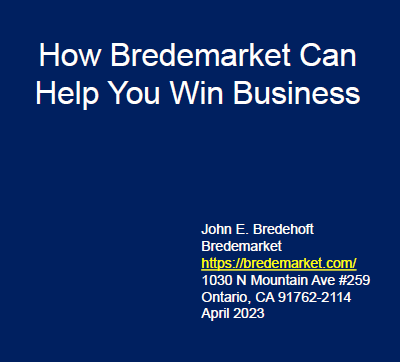
Here is my latest e-book, “How Bredemarket Can Help You Win Business.”

And if I can help you win business, let me know. I have Saturday morning office hours.

Six Benefits for Inland Empire Businesses from Case Studies

Blog posts aren’t the only way that Inland Empire businesses can market themselves. Case studies are a somewhat different format, but case studies offer six benefits to Inland Empire businesses.

The six benefits

Here are six benefits that you can realize from case studies.

Case studies build credibility for Inland Empire businesses

You can claim that you do things from here to Rialto, but you’re claims may not be credible if you don’t have independent confirmation.

Independent confirmation adds credibility.

Which is why I like to quote this testimonial that Bredemarket received from a client.

“I just wanted to truly say thank you for putting these templates together. I worked on this…last week and it was extremely simple to use and I thought really provided a professional advantage and tool to give the customer….TRULY THANK YOU!”

Although the testimonial writer wasn’t from Inland Empire business, Bredemarket can provide the same services for local firms. And I hope you are just as happy with the result.

Case studies build trust for Inland Empire businesses

With credibility comes trust. When potential customers read your case studies and find out what you’ve done for others, they’re more inclined to trust that you can provide similar benefits to them.

Case studies increase awareness for Inland Empire businesses

Traditional sales funnels start with awareness, since people won’t buy a product or service unless they’ve actually heard of it.

By Steve simple – Own work, CC BY 3.0, https://commons.wikimedia.org/w/index.php?curid=7749648

Case studies offer a mechanism to tell a good story about how someone faced a problem, chose your solution, and achieved wonderful results. Regardless of the specifics of your case study outline, it probably includes a problem, a solution, and results somewhere in there.

And entertaining stories can be told again and again as you share your case studies on social media…and others share your case studies on social media.

Case studies highlight the expertise of Inland Empire businesses

As potential clients learn about you, they also learn about your expertise, or what you can do. For example, people who need proposal templates and who read the testimonial above learn that Bredemarket can create proposal templates. And when they read a case study about your product or service, they learn about your expertise in your particular area.

Case studies increase the online visibility of Inland Empire businesses

Credibility, trust, awareness, expertise.

So what?

The “so what” here is that in the same way that your friends can refer people to your business, your case studies can refer people also.

As your case studies highlight your credibility and trust, provide awareness, and demonstrate your expertise, your products and services (as documented in the case studies) become known to search engines, especially if you’re resharing via social media. And as the search engines record your case study content, you gain a “secret salesperson.” I wrote about this a couple of years ago, quoting Rhonda Salvestrini:

Content for your business is one of the best ways to drive organic traffic. It’s your secret salesperson because it’s out there working for you 24/7. And it’s evergreen, so not only is it working…day in and day out…it’s available years down the road.

Rhonda Salvestrini

To prove the point that online content provides long-term benefits, I just conducted an incognito Google search for the words rhonda salvestrini secret salesperson.

  • Salvestrini’s own LinkedIn page was only the second result.
  • The first result was my 2020 blog post.
  • The third result wasn’t from Salvestrini either. It was a Facebook page for an old personal blog of mine that happened to reference those four words.
From https://www.google.com/search?q=rhonda+salvestrini+secret+salesperson

If you were searching for Salvestrini’s website and ended up at my blog post, I should clarify that I didn’t intentionally hijack Salvestrini’s traffic to draw it to my content. By happy accident, I just happened to use the magic words that drew searchers to my post. But if you’re interested in Salvestrini’s services, go to her website RhondaSalvestrini.com.

Now imagine the power if a potential customer is searching for their preferred terms and finds your case study.

And your secret salesperson isn’t secret any more. (Sorry Freddy.)

From https://www.youtube.com/watch?v=JwNVfFwAJdY

Case studies increase revenue for Inland Empire businesses

Credibility, trust, awareness, expertise, online visibility.

So what?

How about the bottom line? That’s important.

Bredemarket doesn’t do business in Sweden, but if it did, I’d want to get a lot of kroner. By Foto: Jonn Leffmann, CC BY 3.0, https://commons.wikimedia.org/w/index.php?curid=81842350

A well-crafted case study can be the first step in convincing a potential customer to become a paying customer.

So how do you create the case study?

Glad you asked. (Well, you sort of asked. Actually I asked. But you get the point.)

Well, you can just start writing, or get someone to start writing, and call the end result a case study.

But you need to create the right content.

And Bredemarket has a way to work with you to create the right content. To find out how to start a case study writing project or any writing project, click below.

Or just go straight to https://bredemarket.com/iehow/

4 Actions for IE Firms Needing Rapid Written Content

About a year ago, I wrote a two-part series of posts entitled “In marketing, move quickly.”

How can you move quickly?

If you’re an Inland Empire business that needs rapid written content creation, I’ll tell you how Bredemarket can help you create that content.

Why move quickly?

On the 99.9% chance that you didn’t read my two posts on this topic, here’s a brief TL;DR on what I (and others) said.

By Malene Thyssen – Own work, CC BY-SA 3.0, https://commons.wikimedia.org/w/index.php?curid=10119596
  • If you don’t move quickly, you may miss your opportunity.
  • The first post mentioned a company (whom I didn’t name) that hired an international marketing company in December 2021, but that hadn’t created any customer-facing content by March 2022.
  • The first post also mentioned a bank that put a customer-facing email test togehter in eight weeks.
  • Oh, and John DeLorean took eight years to get his car out, which didn’t help with his financing issues.
  • On the positive side, the second post described how one company moved quickly. Rather than waiting for a centralized content creator to distribute content, Intuit provided guidelines so that its employees could extend the reach of Intuit’s content through their own social media posts.
  • The second post also noted that quick generation of content is appreciated by customers, vendors, and partners.

How can you move quickly?

So let’s say you’re an Inland Empire business who needs to create between 400 and 600 words of content quickly, such as the text for a brochure, a blog post, or a LinkedIn or Facebook post.

How can you get it out quickly?

How can you avoid waiting eight weeks, or three months, or eight years for your customers to see your content?

Here are four actions you can take to get your content out.

  1. Specify your content needs.
  2. Ensure you are available.
  3. Ensure your content creator is available.
  4. Book your content creator.

I’ll describe these four actions below.

One: Specify your content needs

If you rush to create content without thinking through your needs, your content won’t be that effective. Take some time up front to plan what your content will be.

Ask yourself critical questions about your content.

(UPDATE OCTOBER 22, 2023: “SIX QUESTIONS YOUR CONTENT CREATOR SHOULD ASK YOU IS SO 2022. DOWNLOAD THE NEWER “SEVEN QUESTIONS YOUR CONTENT CREATOR SHOULD ASK YOU” HERE.)

Don’t know what to ask? I’ve written an e-book entitled “Six Questions Your Content Creator Should Ask You.”

The six questions (hint: you’ve already seen two of them in the first two parts of this post):

  1. Why?
  2. How?
  3. What?
  4. Goal?
  5. Benefits?
  6. Target Audience?

When Bredemarket meets with a customer, I ask more than these six questions, but they’re the most important ones.

If you can answer these questions, either on your own or with the help of your content creator, then you’ll have a roadmap that allows you to create the content together.

Two: Ensure you are available

Note the word “together” in the paragraph above.

After you meet with your content creator, your part of the task isn’t done. Or shouldn’t be.

When Bredemarket creates content for a customer, there are points within the process where the customer reviews the content and makes suggestions. Normally when I create between 400 and 600 words of content using the Bredemarket 400 Short Writing Service, there are two review cycles. Here’s how I explain them:

  • Bredemarket iteratively provides two review copies of the draft content within three days per review. (The number of review cycles and review time must agree with any due dates.) The draft content advances your goal, communicates your benefits, and speaks to your target audience in your preferred tone of voice. Relevant examples and key words/hashtags are included.
  • You return comments on each review copy within three days. For longer content, you may provide the draft formatted copy for the final review.

Why? (If you read my e-book, you know the “why” question is important.)

Maybe I have questions that popped up while I was drafting the content. Maybe something occurs to you after you see the draft content. Whatever the reason, these review cycles provide opportunities to improve the content as I develop it.

But to get your feedback, you have to be available. The standard process gives you three days to return your comments, although of course you can return them faster. But if you don’t return your comments for weeks or months…well, that kind of kills the idea of getting the content out quickly.

Of course, in some cases delays are unavoidable. One of my customers was dependent on a third party to complete his part of the review, but the third party was not delivering. In that case, there was nothing the customer could do, and that content was delayed.

One critical question: what if you need your content very quickly?

  • Now if you add up all the times in the Bredemarket 400 process, your total comes to fourteen days: one day for the review, three days for me to create the first draft, three days for your review, three days for my second draft, three days for your second review, and one day for the final copy.
  • If you need it in one week rather than two weeks, then we jointly need to figure out a faster cadence of reviews. I can adjust the schedule to meet your due dates.
  • But you have to be available for the reviews.
  • And as I note below, I have to be available for the creation.

So when you’re planning to have Bredemarket or another content creator generate something for you, remember that you’ll need to spend a little bit of time on reviews.

Three: Ensure your content creator is available

You know how I said that the Bredemarket 400 process gives you three days to review each content iteration? Well, at the same time it gives me three days to draft (and redraft) the content.

Can I, or the content creator you select, hold up our end of the process?

Right now I’m going to tell you something that has happened since I wrote those two “In marketing, move quickly” posts in March 2022. In May 2022, I accepted a full-time position with an identity company, and therefore no longer spend full time on Bredemarket activities.

Therefore, if you need to meet with me Monday to Friday between 8 am and 5 pm (Pacific), I can’t meet you. I have my day job to worry about.

I have regular office hours on Saturday mornings when I can meet with you, and I can arrange to be available on weekday evenings or early weekday mornings. And of course I can draft your content and incorporate your suggestions at those times also, outside of regular business hours.

But if you need a content creator that is available during regular (Inland Empire) business hours, then you’ll need to select someone else.

Just make sure that the content creator you select is available when you need them.

Four: Book your content creator

When you’re ready to move, move. If you don’t start the process of creating your critical content, by definition you’ll never finish it.

So take the next step and find someone who will create your content. There are a number of content creators who serve Inland Empire businesses.

But if you want to use the Ontario, California content marketing expert, contact me at Bredemarket and I’ll arrange a meeting. Be prepared for me to ask you a few questions.

What I Missed About QR Codes in 2021

A lot has happened with QR codes since I last wrote about them in October 2021. (For example, the Coinbase Super Bowl ad in 2022, and its demonstration of security risks.)

Now that I’m revisiting my October 2021 post on QR codes, I wish I could change one word to make myself look smarter.

See if you can guess which word I want to change.

I have since chosen to adopt QR codes for some of my Bredemarket work, especially in cases where an online reader may need additional information.

From https://bredemarket.com/2021/10/15/a-qr-code-is-not-a-way-of-life/

Did you find it?

Instead of writing “online,” I should have written “offline.”

I don’t know whether I just made a typo, or if I intentionally wrote “online,” but I shouldn’t have.

Why QR codes rarely make sense online

Because if you’re online, you don’t need a QR code, since you presumably have access to a clickable URL.

But if you’re offline—for example, if you’re watching a commercial on an old-fashioned TV screen—a QR code makes perfect sense. Well, as long as you explicitly identify where the QR code will lead you, something Coinbase failed to do in 2022. “Just click on the bouncing QR code and don’t worry where you’ll go!”

But there’s one more place where QR codes make sense. I didn’t explicitly refer to it in my 2021 post, but QR codes make sense when you’re looking at printed material, such as printed restaurant menus.

Or COVID questionnaires.

Which reminds me…

What I didn’t tell you about the Ontario Art Walk

…there’s one story about the Ontario Art Walk that I didn’t share in yesterday’s post.

After leaving Dragon Fruit Skincare, but before visiting the Chaffey Community Museum of Art, I visited one other location that I won’t identify. This location wanted you to answer a COVID questionnaire, which you accessed via a QR code.

I figured I’d do the right thing and answer the questionnaire, since I had nothing to worry about.

  • I was vaccinated.
  • I was boosted.
  • I hadn’t been around anyone with COVID.
  • I didn’t have a fever.

I entered the “right” response to every single question, except for the one that asked if I had a runny or stuffy nose. Since I had a stuffy nose, I indicated this.

But hey, it’s just a stuffy nose. What could go wrong?

When I finished the questionnaire, I was told that based on my answers, I was not allowed in the premises, and if I was already in the premises I should leave immediately.

Which I did.

And which is why I didn’t write about that particular location in yesterday’s post.

Bredemarket, pressing the flesh (sometimes six feet away)

But back to non-health related aspects of QR codes.

The Ontario Art Walk was actually the second in-person event that I had attended that week. As I noted on Instagram, I also went to a City of Ontario information session about a proposed bike lane.

Now that COVID has (mostly) receded, more of us are going to these in-person events. My target market (businesspeople in the United States) is mostly familiar with the century-old term “press the flesh.” While it usually applies to politicians attending in-person events, it can equally apply to non-political events.

Whenever I go out to these local events, I like to have some printed Bredemarket collateral handy in case I find a local businessperson looking for marketing services. After all, since I am the Ontario, California content marketing expert, I should let relevant people in Ontario know this.

In those cases, a QR code makes sense, since I can hand it to the person, the person can scan the QR code on their phone, and the person can immediately access whatever web page or other content I want to share with them.

On Saturday, it occurred to me that if I ran across a possible customer during the Ontario Art Walk, I could use a QR code to share my e-book “Six Questions Your Content Creator Should Ask You.”

Unfortunately, this bright idea came to my mind at 5:30 pm for an event that started at 6. I dummied up a quick and dirty page with the cover and a QR code, but it was…dirty. Just as well I didn’t share that on Saturday.

But now that I have more time, I’ve created a better-looking printed handout so that I’m ready at the next in-person event I attend.

If we meet, ask me for it.

Making myself look less smart

Well, now that I’ve gone through all of this trouble explaining how QR codes are great for offline purposes, I’m going to share the aforementioned handout…online.

(UPDATE OCTOBER 22, 2023: “SIX QUESTIONS YOUR CONTENT CREATOR SHOULD ASK YOU IS SO 2022. DOWNLOAD THE NEWER “SEVEN QUESTIONS YOUR CONTENT CREATOR SHOULD ASK YOU” HERE.)

Which has probably prompted the following question from you.

“Why?”

Four reasons:

  1. It gave me the excuse to post the question “Why?” above, thus reiterating one of the major points of the e-book.
  2. Because I felt like sharing it.
  3. Just in case you don’t make “Event X” that I attend in the future, you can experience the joy of printing the flyer and scanning the QR code yourself. Just like you were there!
  4. To demonstrate that even when you provide a piece of content with a QR code, it’s also helpful to explicitly reveal the URL where you’ll head if you scan the code. (Look just below the QR code in the flyer above.) And if you receive the flyer in online form rather than printed form, that URL is clickable.