Businesses are learning the difference between a word and a question.
Way back a decade ago, if we wanted something, we would choose the proper word or words—maybe something like “biometric product marketing expert”—and search for those words.
Today, we go to our favorite large language model tool and ask a question—maybe something like “Who is a biometric product marketing expert?”—and get an answer to our question.
“People talk to AI differently than they type into Google. We optimize your content to match conversational, long-tail questions (e.g., “Who is an affordable estate lawyer near Claremont?”), positioning your website as the exact source material AI tools use to answer users.”
What questions are your prospects asking? Do you want to discuss this? Talk to Bredemarket.
There is a popular practice in which people ARE well aware of the original message, but only some of them discern the hidden message, or metamessage, behind those words.
And you don’t have to look to business communication to find examples of this. Take the romantic world, in which the statement “If you go out with me I’ll treat you like the princess you are!” conveys the metamessage of predatory desperation. In the business world, “Let me take that under consideration” means that the speaker is not considering the proposal for a nanosecond.
Sometimes many of us can’t discern the metamessage until long after the message is stated.
Remember the message that Whitney Houston gave to Diane Sawyer?
Respect: We treat others as we would like to be treated ourselves. We do not tolerate abusive or disrespectful treatment. Ruthlessness, callousness and arrogance don’t belong here.
Integrity: We work with customers and prospects openly, honestly and sincerely. When we say we will do something, we will do it; when we say we cannot or will not do something, then we won’t do it.
Communication: We have an obligation to communicate. Here, we take the time to talk with one another…and to listen. We believe that information is meant to move and that information moves people.
Excellence: We are satisfied with nothing less than the very best in everything we do. We will continue to raise the bar for everyone. The great fun here will be for all of us to discover just how good we can really be.
Now to be fair to Houston, the cocaine detected in her toxicology report may not have been CRACK cocaine, and cocaine was not the only substance detected. But now we know that while crack may have been “wack,” cocaine was OK, and marijuana, Xanax, and other things were OK too.
I have no desire to be fair to Enron, but I guess we can say that “the very best in everything we do” can be defined as “maximizing personal value,” that there isn’t an “obligation to communicate” EVERYTHING, and that falsifying records does not necessarily mean ruthlessness or arrogance.
When the metamessage agrees with the message
How often do you roll your eyes in amusement when a business says something?
Conversely, how often do you nod your head in agreement when a business says something?
Now I’ll grant that there’s not universal agreement on whether Company X is truthful in its messaging. For every person who thinks that Apple is the last guardian of privacy on ths planet, there is someone else who is convinced that Apple is an evil corporation who has (and I quote an anonymous source) “become what they accused Microsoft of.”
But it doesn’t matter what the world thinks.
What matters is what your prospect thinks.
Does your prospect think your company is telling the truth?
Does your prospect think your company is lying?
Does your prospect need more information to make a decision?
How case studies help you reach message-metamessage agreement
One powerful way to convince a doubting prospect is via a case study.
It always helps when someone else is singing your company’s praises. Especially when the subject of the case study backs up what you’ve been claiming all along.
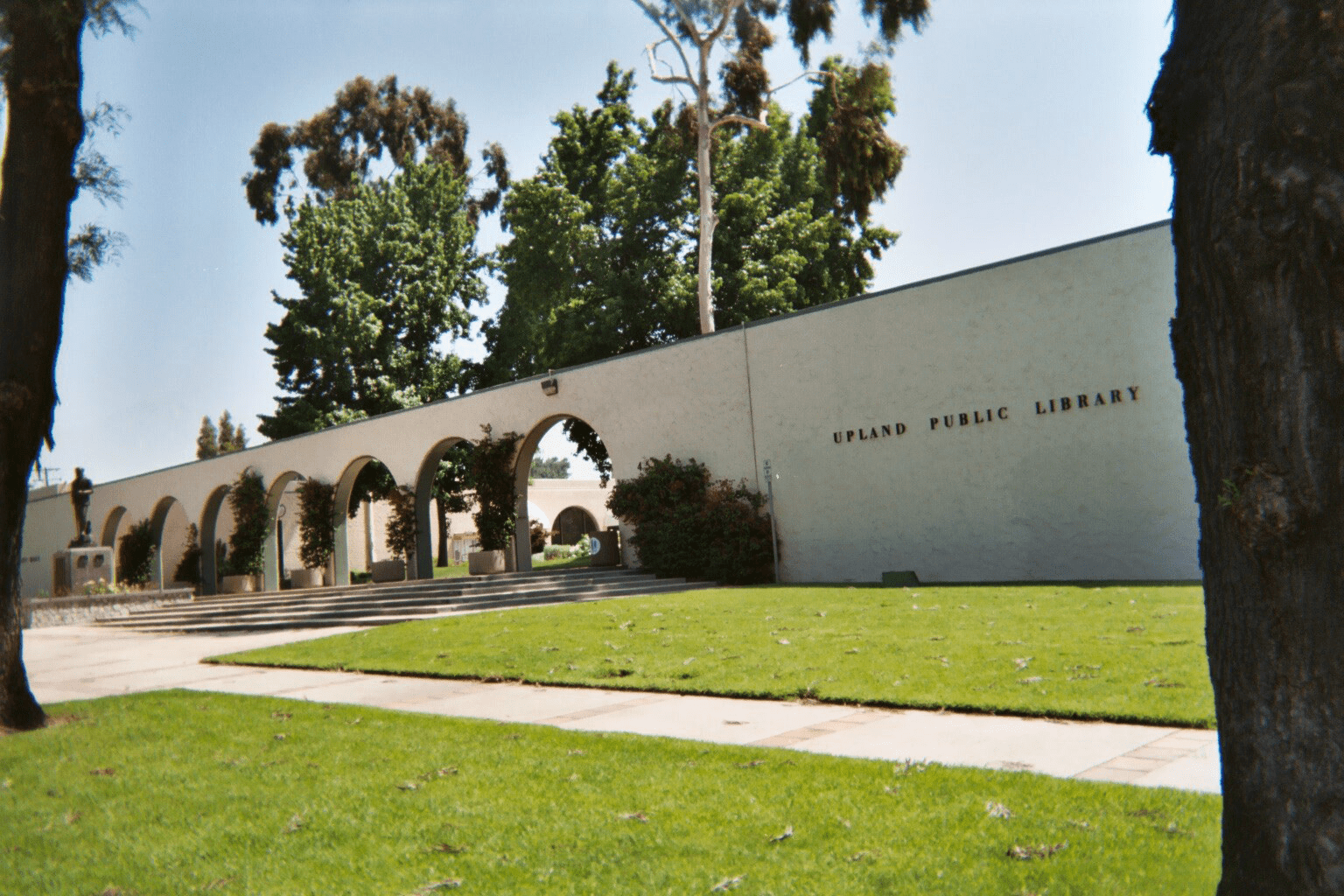
Bredemarket presently offers its services to identity/biometrics, technology, and general business firms, as well as to nonprofits. I offer my services to firms in my hometown of Ontario, California, as well as firms in Eastvale, Fontana, Montclair, Rancho Cucamonga, Upland, other cities of the Inland Empire West, and throughout the United States.
This post concentrates on the services that Bredemarket can provide to businesses in my local area. Read on if you own a small, arty business in the Emporia Arts District of Ontario…
…or perhaps a larger, less arty business north of Holt in Ontario, or perhaps even a business in one of the other cities that I mentioned, or one of the ones I didn’t (sorry Narod).
There are a lot of local businesses out there
Even if you don’t count sole proprietors (such as myself) or freelancers, there are somewhere around 7.7 million businesses in the United States. (This figure is from 2016; I’m not sure if it’s gone up or gone down in the last five years.) Now if you include sole proprietors in the total, then you’re talking about 32 million businesses. (This particular number may have actually increased over time.)
Obviously I can’t target them all. Well, I could try, but it would be a little ridiculous.
So what if I took a subset of those 32 million businesses and tried to see if Bredemarket could serve that subset?
The local small business persona
When you want to market to a particular group, you develop a persona that represents that group. You can then develop a profile of that persona: the persona’s needs, aspirations, and expectations; the persona’s underlying goals and values; and perhaps some other elements. The persona may be developed via extensive research, or perhaps via…a little less quantification.
When I initially looked at this topic last September, I concentrated on a particular persona, but my thoughts on this topic have evolved over time. While I will still serve artists as I initially proposed last September, I’m now thinking of other businesses that can best use the type of content that I provide.
For example, the business may be an incorporated business that is based on the Inland Empire West, provides its products or services to customers in the local area, provides excellent service that is loved by its existing customers, and needs to get the word out to new potential customers by creating content that can be downloaded from a company website, shared via a company social media account, or handed out at a trade show or other in-person event.
Regarding the values of this particular persona, you can probably already deduce some of them based upon the customer love for the company.
The business puts the customer first and strives to provide services that satisfy its customers.
However, the business also prioritizes the well-being of its employees.
While the business may not have explicitly articulated a vision, its actions testify to a vision of excellent service, customer satisfaction, and care for employees.
But what does this business need in terms of types of content? For my example, these businesses are ones that need customer-facing content such as the following:
A document (online or printed) that explains the product(s) or service(s) that the business provides, and that discusses the benefits that the product(s)/service(s) offers to the customers. This document may take the form of a product/service description, or it may take the form of a white paper. For example, your business might issue a white paper entitled “Seven Mandatory Requirements for a Green Widget,” and the white paper just might happen to mention at the end that your green widget just happens to meet all seven mandatory requirements. (Coincidence? I think not.)
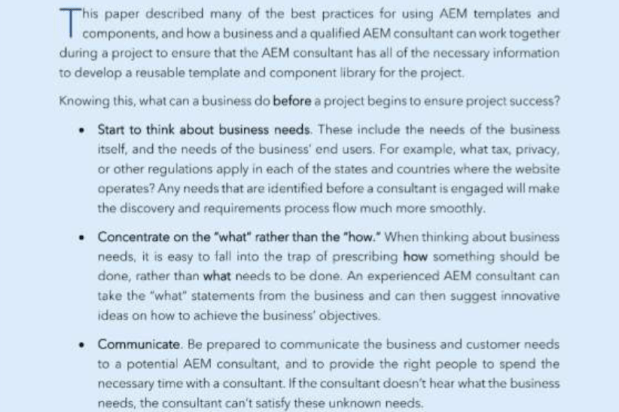
Portion of the concluding section of a white paper in which Bredemarket provided the text.
A document (online or printed) that tells a story about how an individual customer benefited from the product(s) or service(s) that the business provides. You could call such a document a case study, or you could call it a testimonial. Or you could call it a casetimonial.
These types of documents are more valuable to some businesses than to others. Your average convenience store has little need for a 3,000 word white paper. But perhaps your business has this sort of need.
How many words should your content contain?
When I originally wrote this last September, I started off by discussing my two standard packages, based on word length. But now that I’ve thought about it a bit more, there are some questions that you need to ask BEFORE deciding on the content length. (We’ll get to content length later.)
(Owen Lovejoy) “How long should a man’s legs be in proportion to his body?”
(Abraham Lincoln) “I have not given the matter much consideration, but on first blush I should judge they ought to be long enough to reach from his body to the ground.”
Abraham Lincoln. (Legs not shown.) By Hesler, Alexander, 1823-1895 – This image is available from the United States Library of Congress’s Prints and Photographs divisionunder the digital ID cph.3a36988.This tag does not indicate the copyright status of the attached work. A normal copyright tag is still required. See Commons:Licensing for more information., Public Domain, https://commons.wikimedia.org/w/index.php?curid=18705107
So how far away is the ground? Let’s ask some other questions first before we determine the answer to content length.
Bredemarket’s initial questions for you
Before I create a single word, I start by asking you some questions about your content to make sure our project starts on the right foot. (Even though I am left-footed.)
What is the topic of the content?
What is the goal that you want to achieve with the content?
What are the benefits (not features, but benefits) that your end customers can realize by using your product or service?
What is the target audience for the content?
Once I’ve asked you these and other questions (such as a potential outline), we will both have a good idea of how long the final piece needs to be.
The length of the content also dictates the length and complexity of the review process.
Returning to the content length question
Once we have a good idea of the content length, there are three options that we can pursue to actually create the content.
If your content is longer, say 2800 to 3200 words, then I create the content using a similar (but more detailed) process through my Bredemarket 2800 Medium Writing Service.
If your content falls between these two lengths, or is longer than 3200 words, or needs a more rapid delivery time, we’ll talk and come up with a solution.
(And we’ll even come up with a spiffy name if you like)
I recently talked about planning for various scenarios, but I didn’t image something like this. Consider the following:
Amazon delivery drivers are measured on their ability to deliver packages. Kinda like U.S. Postal Service employees, but Amazon has better measurement tools.
Upland, California lies just south of a sparsely inhabited mountain range. Even though the mountain range has semi-desert conditions, the mountains are teeming with wildlife.
Put those two together, and you have this story from Los Angeles’ ABC station.
Yes, that’s an Amazon driver in the foreground, raising his hands to try to scare a bear away so he can make his delivery. He was successful.
The full Storyful video can be found here. (And of course it’s a Ring video. You didn’t expect a Nest video, did you?)
By the way, if your business has a story to tell, Bredemarket can help. (Psst: Upland businesses should scroll to the end of this page for a special “locals only” discount.)
If you would like Bredemarket to help your business tell your story…








 Bredemarket