I’ve performed product marketing since 2015 (arguably earlier), and I performed that other similar-sounding role, product management, from 2000 to 2009. The two roles certainly have similarities such as customer focus, but they may be different.
Or may not. There’s no standard job description for a product marketer, and product marketing needs vary between companies.
Ignoring your prospects is NOT a winning business strategy. But a lot of companies do it anyway by not communicating regularly with their prospects.
If you ignore your prospects, your prospects will ignore you.
Meetings and money, via a third party
Of my three Bredemarket meetings (so far) today, the second was the most promising.
A person at a large company needs consulting services from me. All we need to do is work out the mechanics. The large company relies on a third party to manage its indpendent contractor relationships, including onboarding, time cards, and payments for hourly work. I wanted to learn about the third party, but I ran into walls when seeking current information about the firm.
The third party’s website is static
The third party’s website talks about its services, some unique aspects about the business, the story of its founder (a fascinating story), its technology partners, and its call to action. It provides ALMOST everything…with the exception of CURRENT information.
Luckily for me, I knew where to find current information on the company. Since the company is a B2B provider, I assumed that the company has a LinkedIn page. And I was right. But…
The third party’s LinkedIn page is also static
As you probably know, company LinkedIn pages have several subpages. The “About” supage talks about the third party company’s services, and the “People” subpage links to the profiles of the company’s employees, including the founder. So I went to the “Posts” subpage for the third party…
Use other social media outlets: TikTok, X, YouTube, whatever.
Pay attention to your prospects by providing current content.
If you ignore your prospects, your prospects will ignore you.
Are you ready to stop ignoring your prospects?
If you need help creating content for your blog, your social media platforms, or your website, Bredemarket can help you regain credibility with your prospects and customers.
Authorize Bredemarket, Ontario California’s content marketing expert, to help your firm produce words that return results.
This post talks about the Bredemarket 2800 Medium Writing Service, describes why your firm would elect that service over three of my other services, and explains how the Bredemarket 2800 Medium Writing Service works.
Four ways that Bredemarket provides written content
I know that the experts say that you’re NOT supposed to give your prospects a multitude of choices, and that you should keep your offerings simple. Sometimes REALLY simple.
But I’ve ignored the experts (again) and I’m giving Bredemarket’s prospects four options for content creation. I’ll briefly touch on three of them before describing the fourth one, the Bredemarket 2800 Medium Writing Service. Once I’m done, you’ll know when you want to elect Bredemarket 2800, and when you’ll want to elect one of the other three options:
Bredemarket 4000 (by the hour),
Bredemarket 4444 (by the month), or
Bredemarket 400 (by the small project).
One: by the hour (Bredemarket 4000 Long Writing Service)
Sometimes you don’t know the parameters of your project, or perhaps you may have multiple projects that require Bredemarket’s assistance. In those cases, Bredemarket bills by the hour using something I call the Bredemarket 4000 Long Writing Service.
Whether it’s proposal work or something else, I do the work (however much work there is) and bill you for the hours that I worked.
Two: by the month (Bredemarket 4444 Partner Retainer)
Perhaps you have ongoing needs and just need me to be available for a certain number of hours each month, yet you’re not ready to hire a full-time person to do the work. In that case, the Bredemarket 4444 Partner Retainer is the package that is best for you. With this level of commitment, I am embedded as part of your organization.
As I assert in the post “Three Levels of Engagement With Your Content Creator,” a retainer offers a happy middle ground between full-time employment and single project work. It gives you work flexibility, budget predictability, and consultant accessibility.
Three: by the small project (Bredemarket 400 Short Writing Service)
But what if you know the scope of your project, and it is a single simple project? If you only need between 400 and 600 words of text, then the ideal package for you is the Bredemarket 400 Short Writing Service.
If your project only requires 400 to 600 words (give or take), the Bredemarket 400 Short Writing Service is ideal for you.
But what if you need more words than that? A lot more?
Why would you need 3,000 words?
There are a few cases in which your firm may need roughly 3,000 words of text, rather than the roughtly 500 words of text described above.
Longer blog posts. Often blog posts are pretty short and fit well within a 400 to 600 word limit. But sometimes you need longer, more detailed blog posts that delve into a topic more deeply. If you need 3,000 words to tell your story, tell it.
Longer LinkedIn articles. In most cases, social media postings will not hit the 3,000 word mark. (For some social media platforms it’s near impossible to hit that limit anyway.) One notable exception is LinkedIn articles, which can enter into the same detail as a long blog post. If your audience is on LinkedIn, then place your content natively on LinkedIn (repurposing it to your blog for your non-LinkedIn prospects if you like).
Longer case studies. Case studies can vary in length. As it turns out, the case studies that Bredemarket has written for its clients are simple two-pagers (including graphics) and fit well within the Bredemarket 400 parameters. But perhaps your case study demands richer detail.
White papers. While one may debate about the semantics of what is a white paper vs. what is not a white paper, you may demand a document that requires around 3,000 words of detail.
The content type that you know about, but I don’t. You may require a particular piece of content that doesn’t fit into the nice neat categories above, but requires text of between 2,800 and 3,200 words.
In these cases, the Bredemarket 2800 Medium Writing Service provides the content you need.
But is Bredemarket 2800 the same as Bredemarket 400, with more words and a higher price?
No.
Longer content requires a slightly different process.
How the Bredemarket 2800 process differs from the Bredemarket 400 process
Admittedly there are some obvious similarities between Bredemarket 400 and Bredemarket 2800.
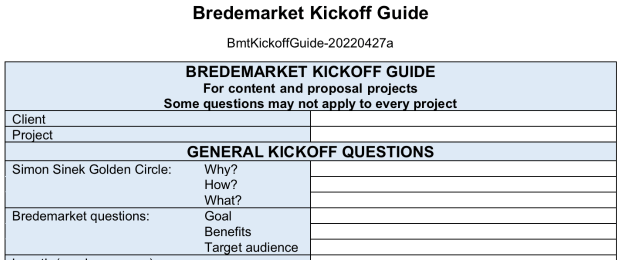
The kickoff is an important part of the content creation process, since the questions I ask during the kickoff (since expanded) ensure that I produce the right content at the end of the process.
The kickoff ensures that the final written content (a) answers the WHY/HOW/WHAT questions about you, (b) advances your GOAL, (c) communicates your BENEFITS, and (d) speaks to your TARGET AUDIENCE. It is both iterative and collaborative.
The beginning of the Bredemarket Kickoff Guide that I use. There are many, many more questions that I haven’t disclosed. Do you want to learn them? Buy the service.
The basic work during the kickoff is pretty much the same as for Bredemarket 400, although you and I will probably go in-depth on certain items, and there is a higher chance that the content specifications will be more detailed (for example, goals for each subsection of the content).
You and Bredemarket agree upon the topic, goal, benefits, and target audience (and, if necessary, outline, section sub-goals, relevant examples, and relevant key words/hashtags, and interim and final due dates).
For complex content requiring input and approval of multiple subject matter experts, you and Bredemarket agree on a preliminary list of tasks, assigned persons, and due dates.
For content that must be incorporated into your content management system, you and Bredemarket agree on the necessary format and other parameters. Otherwise, the final copy will be provided in Microsoft Word docx format, including (as appropriate) callout indicators, hyperlinks, key words, and/or hashtags.
For projects requiring multiple related pieces of content, you and Bredemarket agree upon the desired frequency of content.
The Bredemarket 2800 prework
Sometimes one or two additional things will happen before I start writing the first draft.
I may need to interview one of your customers or subject matter experts—for example, to obtain the facts necessary for a case study or white paper.
I may need to conduct additional research, as agreed upon by us during the kickoff.
The Bredemarket 2800 drafts
Once I’m ready, I start writing.
Between you and me, I create a draft 0.5, sleep on it (sometimes literally), and then create a much more succinct draft 1.0. See “Your writers (in this case me) should be succinct,” in my post “Which Words Should Your Marketers Use? My Four Suggestions.”
It shouldn’t surprise you to learn that it takes longer to write 3,000 words than it takes to write only 500 words. Therefore, I allow myself up to seven days (actual days, not working days) to produce the first draft. (Contrast this with Bredemarket 400, in which I commit to create a draft within three days.)
Then I hand the draft over to you for the first review.
After I receive your review comments, I work on the second draft (again, taking up to seven days) and hand it over for the second review.
Then (if necessary) I work on the third draft and hand it over for the third review. Unlike Bredemarket 400, which only includes two reviews, Bredemarket 2800 includes three reviews because of the higher complexity of the content.
At the end, I provide you with the final copy.
But what if you need your content much more quickly than the 1-2 months it may take to go through all three of the draft and review cycles?
Then we’ll mutually adjust the parameters (and the billing) accordingly.
However, remember that when I adjust my deliverable schedule, it also affects your deliverable schedule as described below.
The Bredemarket 2800 reviews
As decribed above, you will receive up to three review copies during the process.
Because this is a collaborative process, your participation is important to ensure that I create the proper content for your firm. So be prepared to spent the time necessary to ensure that the content is right.
I realize that you probably don’t have a lot of time to review consultant content. If you did have a lot of time, then you’d probably write the content yourself rather than asking a consultant to do it. For this reason, I give you seven days to review each draft, rather than the three days that I give to firms that elect the Bredemarket 400 Short Writing Service.
Of course, if you require a more rapid turnaround, then you’ll need to review the drafts much more quickly, in the same way that I’ll need to write the drafts much more quickly.
The Bredemarket 2800 end product
After the kickoffs, drafts, and reviews, I’ll provide the final copy in Microsoft Word docx format, unless we’ve agreed on some other format. This will give you the content you need to put in your blog, in an article on your LinkedIn page, or in whatever content you need.
I mentioned something in passing in Bredemarket’s recent go-to-market post that I think needs a little more highlighting. So here is a deeper dive into the 22 types of content that product marketers create. (Well, at least 22. I’m probably missing some.)
And by the way, I have created all 22 of these types of content, from blog posts and battlecards to smartphone application content and scientific book chapters. And I can create it for you.
Why is it that so many business-to-business (B2B) marketers confuse product marketing with content marketing?
Because it requires a lot of discipline. That’s why.
B2B marketers who get it right understand the difference between these two fundamentally different types of marketing, what their purposes are and how to use them correctly.
Some firms (especially startups) don’t have the luxury to enforce such definitions. They don’t have separate teams to create awareness content, consideration content, and conversion content. They have one team (or perhaps one person) to create all that content PLUS other stuff that I’ll discuss later.
For example, during my most recent stint as a product marketing employee at a startup, the firm had no official content marketers, so the product marketers had to create a lot of non-product related content. So we product marketers were the de facto content marketers for the company too. (Sadly, we didn’t get two salaries for filling two roles.)
Why did the product marketers end up as content marketers? It turns out that it makes sense—after all, people who write about your product in the lower funnel stages can also write about your product in the upper funnel stages, and also can certainly write about OTHER things, such as company descriptions, speaker submissions, and speaker biographies.
As a result, I’ve written a ton of stuff over my last 29 years in identity/biometrics. It didn’t take a great leap for me to self-identify as the identity content marketing expert and the biometric content marketing expert (and other expert definitions; I’m an expert in creating expert titles).
I’ve compiled a summary of the types of content that I’ve created over the years, not only for Bredemarket’s clients, but also for my employers at Incode Technologies, IDEMIA, MorphoTrak, Motorola, and Printrak.
Not all of these were created when I was in a formal product marketing role, but depending upon your product or service, you may need any of these content types to support the marketing of your product/service.
It’s helpful to divide the list into two parts: the external (customer-facing) content, and the internal (company-only) content.
10 types of external content I have created
External content is what most people think of when they talk about product marketing or content marketing. After all, this is the visible stuff that the prospects see, and which can move them toward a purchase (conversion). The numbers after some content types indicate the quantities of pieces of collateral that I have created.
Articles
Blog Posts (500+, including this one)
Briefs/Data/Literature Sheets
Case Studies (12+)
Proposals (100+)
Scientific Book Chapters
Smartphone Application Content
Social Media (Facebook, Instagram, LinkedIn, Threads, TikTok, Twitter)
Web Page Content
White Papers and E-Books
Here’s an video showing some of the external content that I have created for Bredemarket.
While external content is sexy, internal content is extremely important, since it’s what equips the people inside a firm to promote your product or service. The numbers after some content types indicate the quantities of pieces of collateral that I have created.
Battlecards (80+)
Competitive Analyses
Event/Conference/Trade Show Demonstration Scripts
Plans
Playbooks
Proposal Templates
Quality Improvement Documents
Requirements
Strategic Analyses
And here are 3 more types
Some content can either be external or internal. Again, numbers indicate the quantities of pieces of collateral I have created.
Email Newsletters (200+)
FAQs
Presentations
Content I can create for you
Does your firm need help creating one of these types of content?
Maybe two?
Maybe 22?
I can create content full-time for you
If your firm needs to create a lot of content types for your products, then consider hiring me as your full-time Senior Product Marketing Manager. My LinkedIn profile is here, documenting my 29 years of experience in identity/biometric technology as a product marketer, a strategist, and in other roles.
I’ve already talked about product launches in my recent On “Go-to-Market” post, but having worked in product marketing for some time, I know that there are a lot of tasks that your firm has to perform even when you’re not launching a new product.
One of those tasks is product positioning. And it’s important.
(UPDATE OCTOBER 23, 2023: “SIX QUESTIONS YOUR CONTENT CREATOR SHOULD ASK YOU IS SO 2022. DOWNLOAD THE NEWER “SEVEN QUESTIONS YOUR CONTENT CREATOR SHOULD ASK YOU” HERE.)
Why your product (or service) exists.
How your product benefits your customers.
What your product is (but note that I asked the first two questions before this one).
Other facets of your product (goal, benefits, target audience—if this is new to you, catch up by reading my e-book on the six questions your content creator should ask you).
Why the questions matter
If your product suddenly disappeared from the world, would your target audience (or, in marketing-speak, personas) care?
Would your target audience be just as happy with the competitive offerings, or would the target audience lose out if your product’s distinctive benefits were suddenly no longer available?
There are a number of popular memes that ask you to remove one popular food from a list of foods. What would happen if, instead of asking about pizza and tacos, you asked your target audience about your product and eight others? Would your product survive the cut, or would your prospects happily dump it?
Position your product so that it always remains top of mind for your prospects.
Answer the questions above.
Create content that is focused on the customer (not focused on your firm).
Create content that explains benefits (not features) to your prospects.
I just took a look over the last few calls to action that Bredemarket has published.
Whatever you need, talk to me. And be prepared for me to ask you six (or more) questions.
And if you’re reading this post in Janury 2025, thank you. If you want to talk to me about content creation, some of these links may still work!
Perhaps Bredemarket, the technology content marketing expert, can help you select the words to tell your story. If you’re interested in talking, let me know.
If I can help your firm:
From various Bredemarket blog posts.
All of my most recent calls to action were variations on “Contact me.”
And all the CTAs werre kinda so-so and yawn-inducing.
Since I was open to other ideas, I viewed @yourfavcontentcreator_’s recent Instagram reel with four suggestions. Two of them didn’t make sense for Bredemarket’s business, but the first and fourth resonated with me.
I’ve reproduced those two below.
👉 “Get started on your journey to [desired outcome] today.” 👉 “Ready to see real results? Explore our [product/service] now.”
At first I thought I’d simply incorporate “journey” into my CTA…
Don’t stop believin’ in your content!
…but then I decided that “results” would be better.
At the same time, the CTA has to be Brede-distinctive, captivate prospects better than “contact me,” and ideally appeal to all of Bredemarket’s target audiences (identity/biometrics, technology, local).
So, identity/biometric and technology firms, will the paragraph below the logo make you MORE likely to engage with Bredemarket for marketing and writing services? If not, I’ll continue to tweak it in an agile fashion.
After I slept on my “trust funnel” post, I decided that it was too long and took the entire “go-to-market” section out. But I saved it and am sharing it with you here.
If you are creating content as part of the formal launch of a product or service, you are creating SOME type of go-to-market (GTM) plan.
Perhaps it’s a well-defined plan.
Perhaps it’s a simple document.
Maybe it’s a haphazard dictate to “go to market in three days.”
About the “three days” thing
(C, I told you I was going to write this.)
Oh, and by the way, you can’t go to market in three days, even if someone says you can. You can’t. Or if you do, there will be significant gaps or inaccuracies.
In her LinkedIn Learning course, Deirdre Breakenridge prefers to define a four-month go-to-market plan, with specific deliverables for every one of the months in the plan. Of course, she admits that this is ideal, and sometimes you can’t take a full four months to bring a product or service to market. Whether you take four months or six months or even two months, GTM execution for any robust product or service needs a significant amount of time to get all the pieces together.
One of the reasons that it takes months to execute a GTM plan is because a GTM plan requires inputs from several departments, including
product,
marketing,
product marketing (if it is separate from the first two departments),
engineering,
customer success/customer service,
finance,
sales, and
legal.
You won’t get all of THEM to produce inputs, or even agree what the inputs should be, in three days. It takes time.
But there ARE teeny tiny GTM efforts
One exception to the four-month guidance: if your “product” or “service” is VERY small (like a single blog post), you can obviously go-to-market much more quickly.
From the private Bredemarket Asana Content Calendar, back in the days when Twitter (TW) was still Twitter.
Sometimes. At other times I skip Asana altogether and just take pictures and post stuff, like what I did with my “Coldest Beer in Town” and “Classy by Definition” posts from earlier today. Variety is good.
Back to normal GTM
But when your product or service is more complex, then you need to plan your GTM campaign and make sure that it answers all questions about your product or service.
There are all sorts of GTM guidelines out there, and I was part of a team who collaboratively created three different flavors of GTM guidelines over the course of several months, starting with the complex and ending with the ridiculously simple. And the team STILL couldn’t get the other teams to agree on the parameters of the guidelines.
I’m not going to dictate MY ideas on GTM guidelines, but I will say that whatever guidelines you create, make sure that by the time a GTM effort created under these guidelines is finished, both your prospects and your employees will gain the appropriate understanding of your product or service, and the GTM content will answer all of their questions.
(UPDATE OCTOBER 23, 2023: “SIX QUESTIONS YOUR CONTENT CREATOR SHOULD ASK YOU IS SO 2022. DOWNLOAD THE NEWER “SEVEN QUESTIONS YOUR CONTENT CREATOR SHOULD ASK YOU” HERE.)
If you don’t know what questions to ask, my six questions (why, how, what goal, benefits, target audience) can be adapted for GTM purposes.
What about your GTM content?
Are you executing a go-to-market plan and need to create some content?
Do you need customer-facing external content (blog posts, white papers, whatever)?
Do you need employee-facing internal content (FAQs, battlecards, whatever)?
Regardless of the content you need, Bredemarket can help you. Here’s a list of the types of content I’ve created over the years:
Articles • Battlecards (80+) • Blog Posts (400+) • Briefs/Data/Literature Sheets • Case Studies (12+) • Competitive Analyses • Email Newsletters (200+) • Event/Conference/Trade Show Demonstration Scripts • FAQs • Plans • Playbooks • Presentations • Proposal Templates • Proposals (100+) • Quality Improvement Documents • Requirements • Scientific Book Chapters • Smartphone Application Content • Social Media (Facebook, Instagram, LinkedIn, Threads, TikTok, Twitter) • Strategic Analyses • Web Page Content • White Papers and E-Books
Whatever you need, talk to me. And be prepared for me to ask you six (or more) questions.
Kasey Jones alerted me to the phrase “trust funnel,” and I’ve been thinking about it and its relationship to content marketing. Here are my thoughts.
The sales funnel
Many of us are familiar with the concept of sales funnels. The idea is that there are a bunch of people at the top of the funnel, and people move through the sales process.
As people move down, the funnel gets narrower and narrower as some people exit the funnel. At the bottom of the funnel, there is a very small hole that represents the customers who have converted, or who have actually purchased something.
In a rare instance of my championing simplicity, I like to use an easy three-step sales funnel model with awareness, consideration, and conversion.
From Venn Marketing, “Awareness, Consideration, Conversion: A 4 Minute Intro To Marketing 101.” (Link)
You may use a more complex sales funnel, but the exact number of steps in the funnel really doesn’t matter. What does matter is that your content marketers create content that addresses each step in your funnel.
In early steps of the funnel, the content goal is to ensure that prospects know that you’re out there and you have a solution that benefits the prospects.
In later steps of the funnel, the content goal is to move prospects to the point where they will purchase something from you, rather than purchasing it from one of your competitors or not purchasing anything at all.
Some of the approaches to sales funnel-based content marketing are based upon the faulty assumption that people progress through the funnel in a logical and predictable manner. In the logical model, you present an awareness piece of content, then follow that with a consideration piece of content, then finally present content to convert the prospect into a customer.
It’s about time we redefine the classic marketing funnel. It describes the user journey as a rather linear path, while the reality is a lot more messy, complex, and unpredictable.
Let’s scrap the dated marketing funnel and try to map out the real user journey.
It starts with a trigger, and then it goes into an almost infinite loop between exploration and evaluation – over and over again. And finally, the user exits the loop by making a decision or a purchase.
Oh, and in addition to assuming logic, standard content creation methods assume that your firm knows where every buyer is on their journey. This assumption is essential so that your firm can detect a prospect in the awareness phase and take the necessary steps to move them downward into the funnel (or toward the endless loop pictured above).
Kasey Jones and the trust funnel
I mentioned Kasey Jones at the beginning of this blog post, based upon something she shared on LinkedIn. She started with an inconvenient truth that blew the second assumption out of the water.
Your buyers will probably never like or comment on your posts.
So much for all of those fancy tools that identify the sources of interaction with your content. They don’t work if people don’t interact with your content.
Yet Jones notes that these people are still buying. Three of them reached out to her in the last two weeks.
Each mentioned my content as why they wanted to work with me.
But they have never, not once, engaged with anything I’ve done on here.
Still, they were in my trust funnel, just the same.
It’s different from the sales funnel that we are laboriously tracking in our customer relationship management (CRM) tool. For content marketers, these things literally pop up out of the blue from a “trust funnel” that we know nothing about, even though we’re building it with our content.
If I wished, I could name multiple examples of people reaching out to me because of my content or Bredemarket’s content.
Jones’ point in all this was to emphasize that you need to keep on creating “scroll-stopping content” to attract DREAM (her capitalization) clients.
Even though you don’t know who you are attracting.
You’re not a sausage grinder making sausages. You’re a flower attracting bees.
By The original uploader was Y6y6y6 at English Wikipedia. – Original image located at PDPhoto.org. Transferred from en.wikipedia to Commons by Drilnoth using CommonsHelper., Public Domain, https://commons.wikimedia.org/w/index.php?curid=7365698
Now I could end this discussion right here with Kasey Jones’ comments, but I thought I’d perform a LinkedIn search to see who else was talking about the trust funnel.
And I found Kevin Schmitz.
Kevin Schmitz and the trust funnel
Schmitz approached the topic from a different perspective in his post from earlier this week. He focused on a particular piece of content: a person’s LinkedIn profile and activity.
Schmitz asserted that if someone approaches you with a meeting request, and the person’s LinkedIn presence is (his words) “bare bones,” you’re less likely to take the meeting. But if a meeting requester posts engaging, relevant content, perhaps you’ll take that call.
Schmitz went on to say:
Your presence on LinkedIn is not a “lead funnel”.
It’s a “trust funnel”.
We work so damn hard to establish trust in the meeting.
Yet, most of us are person 1 (the “bare bones” person) with an uphill battle each and every meeting.
Kevin Schmitz LinkedIn post, 8/22/2023 ot 8/23/2023. (Link)
If you’re interested, Schmitz’s post goes on to suggest ways to make your LinkedIn presence more engaging.
The meaning for content marketing
So what does the idea of “creating content that resonates with your invisible trust funnel” mean for content marketing?
Most people realize (or I hope they realize) that organic content often does not have an immediate payoff, especially for complex B2B sales. Even if I write the most amazing automated biometric identification system (ABIS) content for a Bredemarket client, the client won’t get orders within the first three days of posting the content. (I’ll have more to say about “three days” in a future post discussing go-to-market efforts.) Even if I am the biometric content marketing expert. (I’ve been working on promoting THAT piece of content for a while now.)
It takes longer than three days for content marketing to yield results. One source estimates four to five months. Another source says six to twelve months. Joe Pulizzi (quoted by Neil Patel) estimates 15 to 17 months. And all the sources say that their estimates may not apply to your particular case.
But Bredemarket (and I in my personal communications) will continue to cater to that invisible trust funnel and see what happen.
And if you’re reading this post in Janury 2025, thank you. If you want to talk to me about content creation, some of these links may still work!
Illogical marketing slogans like “coldest beer in town” are fascinating.
If you take a moment to think about it, every mini mart and liquor store in town has to chill beer to the exact same temperature before it freezes, so no store will have colder beer than any other store. (For the specifics, including the effect of ABV on alcohol freezing temperature, see Oxbow Tavern’s blog post.)
But liquor store marketers know that we DON’T take a moment to think about it. When it’s hot and we want beer, we want the “coldest beer in town.”
Well, while it was hot this morning, and while the HK Food Store was open (unlike the C & M Classy Mart a couple of miles northwest), I opted NOT to get the coldest beer in town. I wasn’t carrying a beer bottle opener, and I didn’t feel like breaking the law by walking down Grove Avenue with a beer bottle hidden in a paper bag.
If you are reading this on your laptop (or your desktop), point your smartphone to the QR code on your laptop (or desktop) screen to read my first e-book, “Six Questions Your Content Creator Should Ask You.”
(UPDATE OCTOBER 22, 2023: “SIX QUESTIONS YOUR CONTENT CREATOR SHOULD ASK YOU IS SO 2022. DOWNLOAD THE NEWER “SEVEN QUESTIONS YOUR CONTENT CREATOR SHOULD ASK YOU” HERE.)
As I said before, QR codes are sometimes useful, and sometimes not.
If you want to know the “why” about the e-book-see what I did there?-visit my announcement of the e-book. You can view the e-book there also.
By the way, I just checked my WordPress stats. Since this e-book was published in December 2022, it’s been downloaded over 160 times. I hope it’s helping people.





















 Bredemarket