Inland Empire firms: does anyone know who you are?
Who can help your firm create content?
- Blog posts?
- Case studies?
- White papers?
- Social media?
- Market and competitive analyses?
Contact Bredemarket: https://bredemarket.com/contact/

Identity/biometrics/technology marketing and writing services

Inland Empire firms: does anyone know who you are?
Who can help your firm create content?
Contact Bredemarket: https://bredemarket.com/contact/

Identity/biometric firms: does anyone know who you are?
Who can help your firm create content?
Who knows identity/biometrics:
Who can provide content:
I know who can help.
Contact Bredemarket: https://bredemarket.com/contact/

Technology marketers, do you need written content?
If you don’t use written content to communicate with your prospects and clients, save yourself some time and stop reading this.
But if you realize that written content is essential for prospect awareness, consideration, and especially conversion…
And if you need someone adept at creating a variety of written content, from blog posts and articles to case studies and white papers to smartphone application content and scientific book chapters…
Bredemarket can help.
I have created all of these types of content, plus internal content such as market/competitor analyses and proposal templates. And I can create this content for your company.
To address your content gaps today, talk to Bredemarket via my contact page, or book a meeting.
By the way, if you’d like nore information on the 22 types of content, read “The 22 (or more) Types of Content That Product Marketers Create.”

When your company attends events, you’ll want to maximize your event return on investment (ROI) by creating marketing content that you publish before, during, and after the event.
This is how you do it.
Including:
And I’ll spill a couple of secrets along the way.
I’m going to share two secrets in this post. OK, maybe they’re not that secret, but you’d think they ARE secrets because no one acknowledges them.
The first one has to do with event attendance. You personally might be awed and amazed when you’re in the middle of an event and surrounded by hundreds, or thousands, or tens of thousands of people. All of whom are admiring your exhibit booth or listening to your CEO speak.

But guess what?
Many, many more people are NOT at the event.
They can’t see your exhibit booth, and can’t hear your speaker. They’re on the outside, TRYING to look in.

And all the money you spent on booth space and travel and light-up pens does NOTHING for the people who aren’t there…
Unless you bring the event to them. Your online content can bring the event to people who were never there.
But you need to plan, create, and approve your content before, during, and after the event. Here’s how you do that.
Yes, you can just show up at an event, take some pictures, and call it a day. But if you want to maximize your event return on investment, you’ll be a bit more deliberate in executive your event content. Ideally you should be:
Before the event begins, you need to plan your content. While you can certainly create some content on a whim as opportunity strikes, you need to have a basic idea of what content you plan to create.
Once you have planned what you want to do, you need to do it. Before, during, and after the event, you may want to create the following types of content:
Make sure that your content approval process is geared for the fast-paced nature of events. I can’t share details, but:
So how are you going to generate all this content? This brings us to my proposed solution…and the second secret.

The rest of this post talks about one of Bredemarket’s services, the Bredemarket 2800 Medium Writing Service. For those who haven’t heard about it, it’s a service where I provide between 2,800 and 3,200 words of written text.
“But John,” you’re asking. “How is a single block of 3,200 words of text going to help me with my event marketing?”
Time to reveal the second secret…
You can break up those 3,200 words any way you like.
For example, let’s say that you’re planning on attending an event. You could break the text up as follows:
For $2,000 (as of June 2024), you can benefit from written text for complete event coverage, arranged in any way you need.
So how can you and your company receive these benefits?
First, read the data sheet for the Bredemarket 2800 Medium Writing Service so you understand the offer and process.
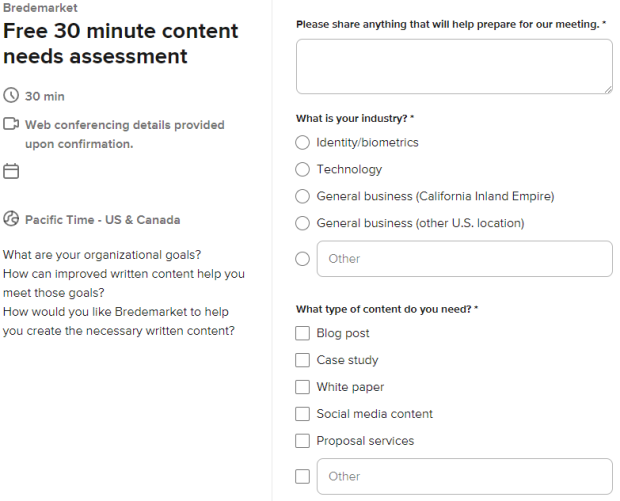
Second, contact Bredemarket to get the content process started well BEFORE your event. Book a meeting with me at calendly.com/bredemarket. Be sure to fill out the information form so I can best help you.
Alternatively, you can
But don’t wait. If your event is in September…don’t contact me in October.
(Part of the biometric product marketing expert series)
Normal people look forward to the latest album or movie. A biometric product marketing expert instead looks forward to an inaugural test report from the National Institute of Standards and Technology (NIST) on age estimation and verification using faces.
I’ve been waiting for this report for months now (since I initially mentioned it in July 2023), and in April NIST announced it would be available in the next few weeks.
Yesterday I learned of the report’s public availability via a NIST news release.
A new study from the National Institute of Standards and Technology (NIST) evaluates the performance of software that estimates a person’s age based on the physical characteristics evident in a photo of their face. Such age estimation and verification (AEV) software might be used as a gatekeeper for activities that have an age restriction, such as purchasing alcohol or accessing mature content online….
The new study is NIST’s first foray into AEV evaluation in a decade and kicks off a new, long-term effort by the agency to perform frequent, regular tests of the technology. NIST last evaluated AEV software in 2014….
(The new test) asked the algorithms to specify whether the person in the photo was over the age of 21.
Well, sort of. We’ll get to that later.
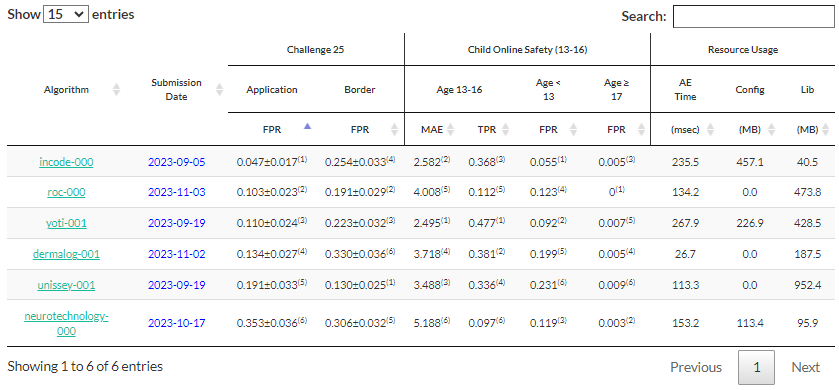
I was in the middle of a client project on Thursday and didn’t have time to read the detailed report, but I did have a second to look at the current results. Like other ongoing tests, NIST will update the age estimation and verification (AEV) results as these six vendors (and others) submit new algorithms.
This post looks at my three favorite questions:
Why does NIST test age estmation, or anything else?

One of NIST’s six research laboratories is its Information Technology Laboratory (ITL), charged “to cultivate trust in information technology (IT) and metrology.” Since NIST is part of the U.S. Department of Commerce, Americans (and others) who rely on information technology need an unbiased source on the accuracy and validity of this technology. NIST cultivates trust by a myriad of independent tests.
Some of those tests are carried out by one of ITL’s six divisions, the Information Access Division (IAD). This division focuses on “human action, behavior, characteristics and communication.”
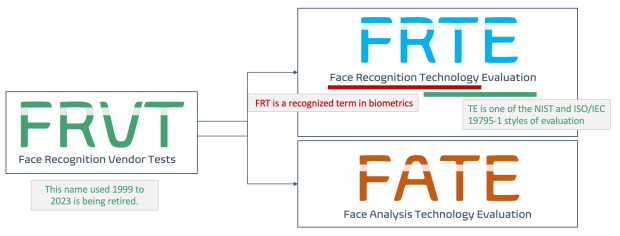
While there is a lot of IAD “characteristics” work that excites biometric folks, including ANSI/NIST standard work, contactless fingerprint capture, the Fingerprint Vendor Technology Evaluation (ugh), and other topics, we’re going to focus on our new favorite acronyms, FRTE (Face Recognition Technology Evaluation) and FATE (Face Analysis Technology Evaluation). If these acronyms are new to you, I talked about them last August (and the deprecation of the old FRVT acronym).
Basically, the difference between “recognition” and “analysis” in this context is that recognition identifies an individual, while analysis identifies a characteristic of an individual. So the infamous “Gender Shades” study, which tested the performance of three algorithms in identifying people’s sex and race, is an example of analysis.
The age of a person is another example of analysis. In and of itself an age cannot identify an individual, since around 385,000 people are born every day. Even with lower birth rates when YOU were born, there are tens or hundreds of thousands of people who share your birthday.
And your age matters in the situations I mentioned above. Even when marijuana is legal in your state, you can’t sell it to a four year old. And that four year old can’t (or shouldn’t) sign up for Facebook either.
You can check a person’s ID, but that takes time and only works when a person has an ID. The only IDs that a four year old has are their passport (for the few who have one) and their birth certificate (which is non-standard from county to county and thus difficult to verify). And not even all adults have IDs, especially in third world countries.
So companies like Yoti developed age estimation solutions that didn’t rely on government-issued identity documents. The companies tested their performance and accuracy themselves (see the PDF of Yoti’s March 2023 white paper here). However, there are two drawbacks to this:
Enter NIST, where the scientists took a break from meterological testing or whatever to conduct an independent test. NIST asked vendors to participate in a test in which NIST personnel would run the test on NIST’s computers, using NIST’s data. This prevented the vendors from skewing the results; they handed their algorithms to NIST and waited several months for NIST to tell them how they did.
I won’t go into it here, but it’s worth noting that a NIST test is just a test, and test results may not be the same when you implement a vendor’s age estimation solution on CUSTOMER computers with CUSTOMER data.
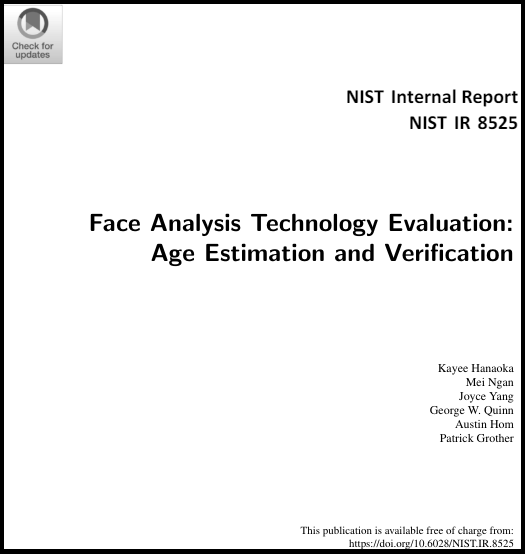
NOW let’s turn to the actual report, NIST IR 8525 “Face Analysis Technology Evaluation: Age Estimation and Verification.”
NIST needed a set of common data to test the vendor algorithms, so it used “around eleven million photos drawn from four operational repositories: immigration visas, arrest mugshots, border crossings, and immigration office photos.” (These were provided by the U.S. Departments of Homeland Security and Justice.) All of these photos include the actual ages of the persons (although mugshots only include the year of birth, not the date of birth), and some include sex and country-of-birth information.
For each algorithm and each dataset, NIST recorded the mean absolute error (MAE), which is the mean number of years between the algorithm’s estimate age and the actual age. NIST also recorded other error measurements, and for certain tests (such as a test of whether or not a person is 17 years old) the false positive rate (FPR).
Many of the tests used a “Challenge-T” policy, such as “Challenge 25.” In other words, the test doesn’t estimate whether a person IS a particular age, but whether a person is WELL ABOVE a particular age. Here’s how NIST describes it:
For restricted-age applications such as alcohol purchase, a Challenge-T policy accepts people with age estimated at or above T but requires additional age assurance checks on anyone assessed to have age below T.
So if you have to be 21 to access a good or service, the algorithm doesn’t estimate if you are over 21. Instead, it estimates whether you are over 25. If the algorithm thinks you’re over 25, you’re good to go. If it thinks you’re 24, pull out your ID card.
And if you want to be more accurate, raise the challenge age from 25 to 28.
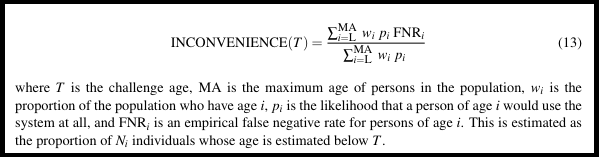
NIST admits that this procedure results in a “tradeoff between protecting young people and inconveniencing older subjects” (where “older” is someone who is above the legal age but below the challenge age).
NIST also performed a variety of demographic tests that I won’t go into here.
OK, forget about all that. Let’s dig into the results.
It depends.
I’ve covered this before with regard to facial recognition. Because NIST conducts so many different tests, a vendor can turn to any single test in which it placed first and declare it is the best vendor.
So depending upon the test, the best age estimation vendor (based upon accuracy and or resource usage) may be Dermalog, or Incode, or ROC (formerly Rank One Computing), or Unissey, or Yoti. Just look for that “(1)” superscript.

You read that right. Out of the 6 vendors, 5 are the best. And if you massage the data enough you can probably argue that Neurotechnology is the best also.
So if I were writing for one of these vendors, I’d argue that the vendor placed first in Subtest X, Subtest X is obviously the most important one in the entire test, and all the other ones are meaningless.
But the truth is what NIST said in its news release: there is no single standout algorithm. Different algorithms perform better based upon the sex or national origin of the people. Again, you can read the report for detailed results here.
NIST always clarifies what it did and didn’t test. In addition to the aforementioned caveat that this was a test environment that will differ from your operational environment, NIST provided some other comments.
The report excludes performance measured in interactive sessions, in which a person can cooperatively present and re-present to a camera. It does not measure accuracy effects related to disguises, cosmetics, or other presentation attacks. It does not address policy nor recommend AV thresholds as these differ across applications and jurisdictions.
Of course NIST is just starting this study, and could address some of these things in later studies. For example, its ongoing facial recognition accuracy tests never looked at the use case of people wearing masks until after COVID arrived and that test suddenly became important.
As noted above, the test used a Challenge 25 or Challenge 28 model which measured whether a person who needed to be 21 appeared to be 25 or 28 years old. This makes sense when current age estimation technology measures MAE in years, not days. NIST calculated the “inconvenience” to 21-25 (or 28) year olds affected by this method.
While a lot of attention is paid to the use cases for 21 year olds (buying booze) and 18 year olds (viewing porn), states and localities have also paid a lot of attention to the use cases for 13 year olds (signing up for social media). In fact, some legislators are less concerned about a 20 year old buying a beer than a 12 year old receiving text messages from a Meta user.

NIST tests for these in the “child online safety” tests, particularly these two:
However, the visa database is the only one that includes data of individuals with actual ages below age 13. The youngest ages in the other datasets are 14, or 18, or even 21, rendering them useless for the child online safety tests.
The mark of a great researcher is their ability to continue to get funding for their research, which is why so many scientific papers conclude with the statement “further study is needed.”
Here’s how NIST stated it:
Future work: The FATE AEV evaluation remains open, so we will continue to evaluate and report on newly submitted prototypes. In future reports we will: evaluate performance of implementations that can exploit having a prior known-age reference photo of a subject (see our API); consider whether video clips afford improved accuracy over still photographs; and extend demographic and quality analyses.
Translation: if Congress doesn’t continue to give NIST money, then high school students will get drunk or high, young teens will view porn, and kids will encounter fraudsters on Facebook. It’s up to you, Congress.
(TL;DR people can click here.)
Last Saturday I hoped to gain inspiration so that I could shoot a video or capture an image to promote Bredemarket’s technology writing services—namely, writing blog posts, case studies, white papers, or other content to empower technology firms.
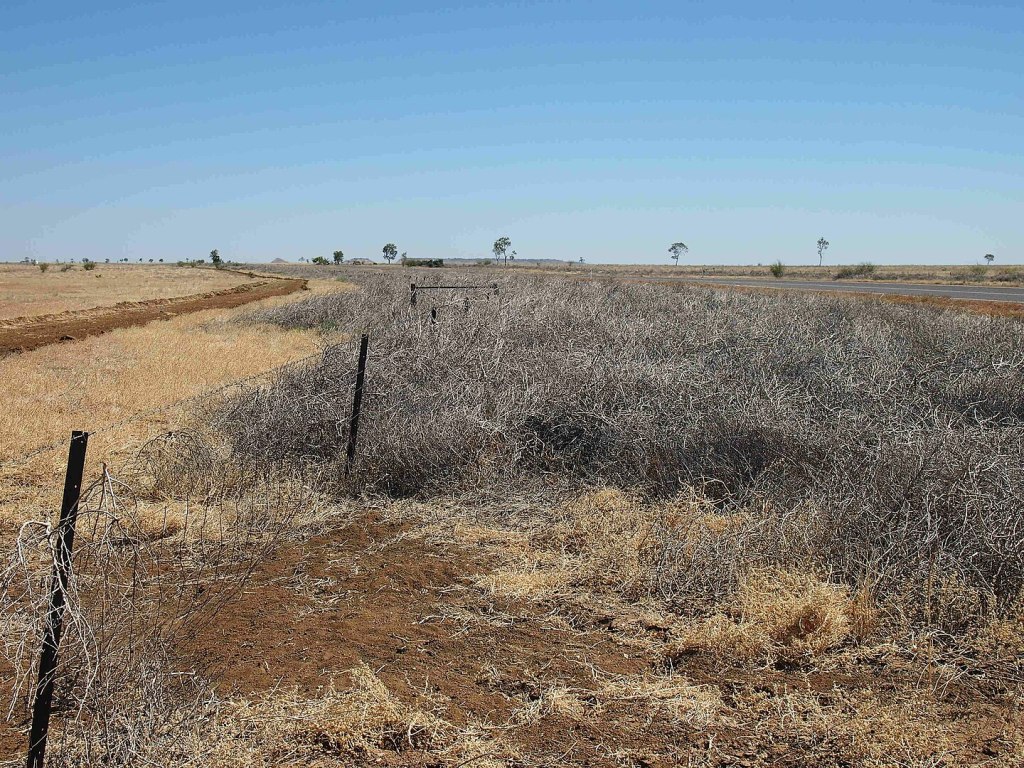
By mid-morning, with no inspiration, I captured a technology image of…something.

As I confessed in my “behind the scenes” video that day, I have no idea what this thing is, or whether this is used for water, gas, or something else entirely.
And do you want to know WHY I couldn’t describe what I saw?
Because I failed to get a collaborator to work with me.
If an appropriate person from Chaffey High School presented themselves to me, they could have described:
You’ll notice that I asked the “why” question BEFORE I asked the “how” and “what” questions. Because “why” is most important. If a student or staff member sees this thing on the Chaffey campus, they naturally want to know why it’s there. They don’t really care if it pumps 100 liters of whatever per second.
And that’s how I will work with YOUR technology firm when Bredemarket creates content. We work TOGETHER to create the content you need.
Do you need to create content that converts prospects for your technology product/service and drives content results?
Learn more by clicking on the image.
P.S. Don’t wait. There’s a cost to waiting.
As identity/biometric professionals well know, there are five authentication factors that you can use to gain access to a person’s account. (You can also use these factors for identity verification to establish the person’s account in the first place.)
I described one of these factors, “something you are,” in a 2021 post on the five authentication factors.
Something You Are. I’ve spent…a long time with this factor, since this is the factor that includes biometrics modalities (finger, face, iris, DNA, voice, vein, etc.). It also includes behavioral biometrics, provided that they are truly behavioral and relatively static.
From https://bredemarket.com/2021/03/02/the-five-authentication-factors/
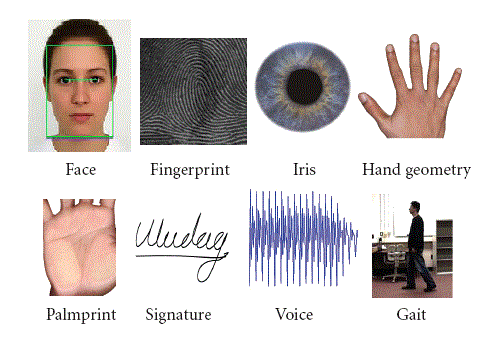
As I mentioned in August, there are a number of biometric modalities, including face, fingerprint, iris, hand geometry, palm print, signature, voice, gait, and many more.
If your firm offers an identity solution that partially depends upon “something you are,” then you need to create content (blog, case study, social media, white paper, etc.) that converts prospects for your identity/biometric product/service and drives content results.
Bredemarket can help.
Click below for details.
No, this is not déjà vu all over again.
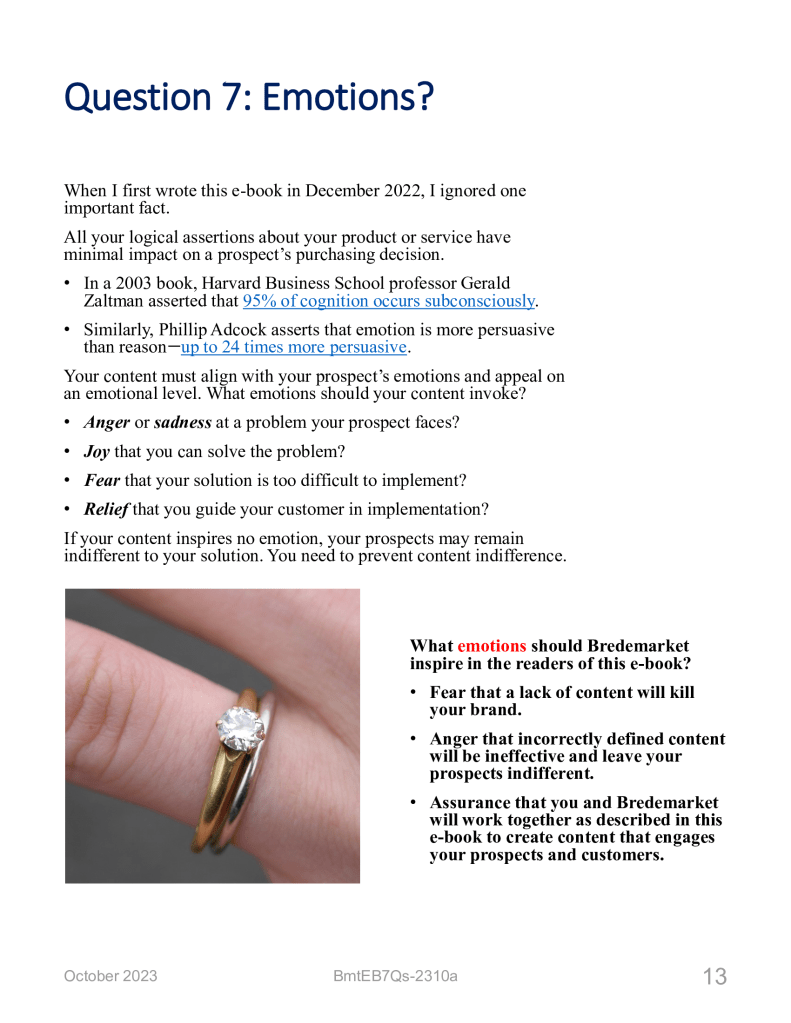
If you’re familiar with Bredemarket’s “six questions your content creator should ask you”…I came up with a seventh question because I feared the six questions were not enough, and I wanted to provide you with better confidence that Bredemarket-authored content will achieve your goals.
To no one’s surprise, I’ll tell you WHY and HOW I added a seventh question.
If you want to skip to the meat, go to the WHAT section where you can download the new e-book.
Early Sunday morning I wrote something on LinkedIn and Facebook that dealt with three “e” words: entertainment, emotion, and engagement, and how the first and second words affect the third. The content was very long, and I don’t know if the content itself was engaging. But I figured that this wasn’t the end of the story:
I know THIS content won’t receive 250 engagements, and certainly won’t receive 25,000 impressions, but maybe I can repurpose the thoughts in some future content. (#Repurposing is good.)
From LinkedIn.
But what to repurpose?
Rather than delving into my content with over 25,000 impressions but less than 250 engagements, and rather than delving into the social media group I discussed, and rather than delving into the Four Tops and the Sons of the Pioneers (not as a single supergroup), I decided that I needed to delve into a single word: indifference, and how to prevent content indifference.
Because if your prospects are indifferent to your content, nothing else matters. And indifference saddens me.
Eventually I decided that I needed to revise an old piece of content from 2022.
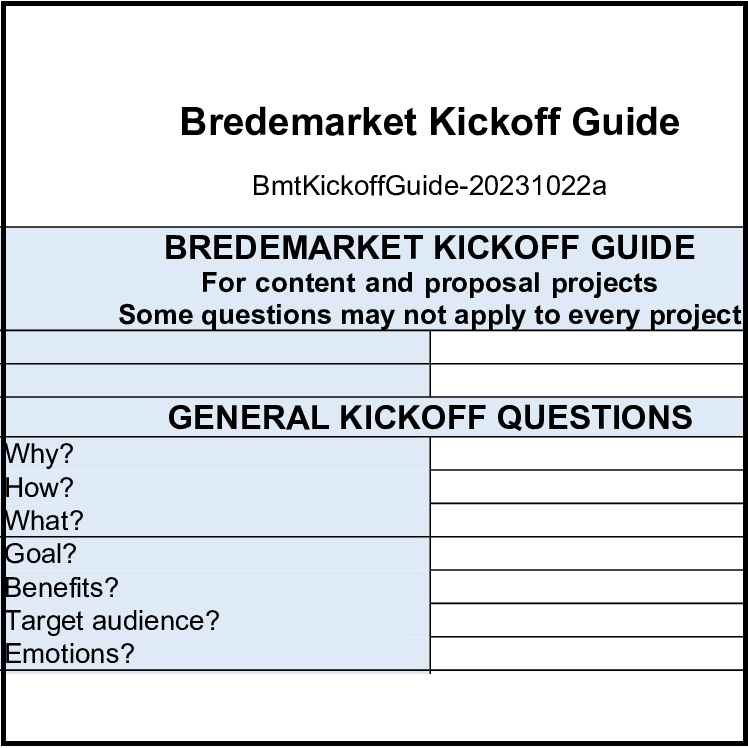
I decided that I needed to update my process, as well as that e-book, and add a seventh question, “Emotions?”
For those who have raced ahead to this section, Bredemarket has a new downloadable e-book (revised from an earlier version) entitled “Seven Questions Your Content Creator Should Ask You.” It includes a new page, “Emotions,” as well as minor revisions to the other pages. You can download it below.
You’ll have to download the e-book to find the answers to the remaining four questions.

Does your technology firm need written content—blog posts, articles, case studies, white papers?
Why do you need this content, and what is your goal?
How will you create the content? Do you need an extra, experienced hand to help out?
Learn how Bredemarket can create content that drives results for your technology firm.
Click the image below.
#contentmarketing #technology


 Bredemarket