Is Bredemarket on Your Favorite Social Platform?

(This is outdated. See the May 15, 2024 update.)

If you’re starting out in business, you’ve probably heard the advice that as your business branches out into social platforms, you shouldn’t try to do everything at once. Instead you should make sure that your business offering is really solid on one platform before branching out into others.

Yes, I’ve been naughty again and didn’t listen to the expert advice.

One reason is because of my curiosity. With one notable exception, I’m intrigued with the idea of trying out a new platform and figuring out how it works. Audio? Video? Let’s try it.

And as long as I’m trying it out, why not create a Bredemarket account and put content out there?

So there’s a reasonably good chance that Bredemarket is already on one of your favorite social platforms. If so, why not subscribe to Bredemarket so that you’ll get my content?

Here’s a list of Bredemarket’s text, image, audio, and video accounts on various social platforms. Be sure to follow or subscribe!

  • Apple Podcasts (link here)
  • Google Podcasts (link here)

Why Your Business Needs an Obsessive Content Marketer

Compulsions and obsessions can be bad things, or they can be good things if channeled correctly.

What if Bredemarket provided me an outlet to chnnel my compulsions and obsessions to help your business grow?

Compulsions and obsessions

I recently wrote a three-post series (first post in the series here) that frequently used the word “compulsion.”

I almost used the word “obsession” in conjunction with the word compulsion, but decided not to make light of a medical condition that truly debilitates some people.

I used the word compulsion to refer to two things about me:

Writing compulsion, or writing obsession. Designed by Freepik.

While compulsions and obsessions can certainly be bad things, when harnessed properly they can provide good for the world.

Like a butterfly.

Animotion on embracing an obsession

When people of a certain age hear the word “obsession,” they may think of the 1980s song by the band Animotion.

From https://www.youtube.com/watch?v=hIs5StN8J-0

Unfortunately for us, 90% of the song deals with the negative aspects of a person obsessing over another person. If you pick through the lyrics of the Animotion song “Obsession” and forget about what (or who) the singer is obsessing about, you can find isolated phrases that describe how an obsession can motivate you.

  • “I cannot sleep”
  • “Be still”
  • “I will not accept defeat”

But thankfully, there are more positive ways to embrace an obsession.

Justin Welsh on embracing an obsession

While Justin Welsh’s July 2022 post “TSS #028: Don’t Pick a Niche. Embrace an Obsession” is targeted for solopreneurs, it could just as easily apply to those who work for others. Regardless of your compensation structure, why do you choose to work where you do?

For Welsh, the practice of picking a niche risks commoditization.

They end up looking like, sounding like, and acting like all of their competition. The internet is full of copycats and duplicates.

From https://www.justinwelsh.me/blog/dont-pick-a-niche-embrace-an-obsession

(For example, I’d bet that all of the people who are picking a niche know better than to cite the Animotion song “Obsession” in a blog post promoting their business.)

Perhaps it’s semantics, but in Welsh’s way of thinking, embracing an obsession differs from picking a niche. To describe the power of embracing an obsession, Welsh references a tweet from Daniel Vassalo:

Find something you want to do really badly, and you won’t need any goals, habits, systems, discipline, rewards, or any other mental hacks. When the motivation is intrinsic, those things happen on their own.

From https://twitter.com/dvassallo/status/1547230105805754369

I trust you can see the difference between picking something you HAVE to do, versus obsessing over something you WANT to do.

What’s in it for you?

Welsh was addressing this post to me and people like me, and his message resonates with me.

But frankly, YOU don’t care about me and about whether I’m motivated. All that you care about is that YOU get YOUR content that you need from me.

So why should you care what Justin Welsh and Daniel Vassllo told me?

The obvious answer is that if you contract with Bredemarket for your marketing and writing services, you’ll get a “pry my keyboard out of my cold dead hands” person who WANTS to write your stuff, and doesn’t want to turn the writing process over to some two-year-old bot (except for very small little bits).

Regarding the use of two-year-old bots:

“Pry my keyboard,” indeed.

Do you need someone to obsess over YOUR content?

Of course, if you need someone to write YOUR stuff, then I won’t have time to work on a TikTok dance. This is a good thing for me, you, and the world.

As I’ve stated elsewhere, before I write a thing for a Bredemarket client, I make sure that I understand WHY you do what you do, and understand everything else that is relevant to the content that we create.

As I work on the content, you have opportunities to review it and provide your feedback. This ensures that both of us are happy with the final copy.

And that your end users become obsessed with YOU.

So if you need me to create content for you, please contact me.

Feel free to share YOUR favorite 1980s song if you like.

Even if it’s THIS song that your favorite temperamental writer detests.

From https://www.youtube.com/watch?v=aDgHXiWgKlE

How Can Your Identity Business Create the RIGHT Written Content?

Does your identity business provide biometric or non-biometric products and services that use finger, face, iris, DNA, voice, government documents, geolocation, or other factors or modalities?

Does your identity business need written content, such as blog posts (from the identity/biometric blog expert), case studies, data sheets, proposal text, social media posts, or white papers?

How can your identity business (with the help of an identity content marketing expert) create the right written content?

For the answer, click here.

4 Actions for IE Firms Needing Rapid Written Content

About a year ago, I wrote a two-part series of posts entitled “In marketing, move quickly.”

How can you move quickly?

If you’re an Inland Empire business that needs rapid written content creation, I’ll tell you how Bredemarket can help you create that content.

Why move quickly?

On the 99.9% chance that you didn’t read my two posts on this topic, here’s a brief TL;DR on what I (and others) said.

By Malene Thyssen – Own work, CC BY-SA 3.0, https://commons.wikimedia.org/w/index.php?curid=10119596
  • If you don’t move quickly, you may miss your opportunity.
  • The first post mentioned a company (whom I didn’t name) that hired an international marketing company in December 2021, but that hadn’t created any customer-facing content by March 2022.
  • The first post also mentioned a bank that put a customer-facing email test togehter in eight weeks.
  • Oh, and John DeLorean took eight years to get his car out, which didn’t help with his financing issues.
  • On the positive side, the second post described how one company moved quickly. Rather than waiting for a centralized content creator to distribute content, Intuit provided guidelines so that its employees could extend the reach of Intuit’s content through their own social media posts.
  • The second post also noted that quick generation of content is appreciated by customers, vendors, and partners.

How can you move quickly?

So let’s say you’re an Inland Empire business who needs to create between 400 and 600 words of content quickly, such as the text for a brochure, a blog post, or a LinkedIn or Facebook post.

How can you get it out quickly?

How can you avoid waiting eight weeks, or three months, or eight years for your customers to see your content?

Here are four actions you can take to get your content out.

  1. Specify your content needs.
  2. Ensure you are available.
  3. Ensure your content creator is available.
  4. Book your content creator.

I’ll describe these four actions below.

One: Specify your content needs

If you rush to create content without thinking through your needs, your content won’t be that effective. Take some time up front to plan what your content will be.

Ask yourself critical questions about your content.

(UPDATE OCTOBER 22, 2023: “SIX QUESTIONS YOUR CONTENT CREATOR SHOULD ASK YOU IS SO 2022. DOWNLOAD THE NEWER “SEVEN QUESTIONS YOUR CONTENT CREATOR SHOULD ASK YOU” HERE.)

Don’t know what to ask? I’ve written an e-book entitled “Six Questions Your Content Creator Should Ask You.”

The six questions (hint: you’ve already seen two of them in the first two parts of this post):

  1. Why?
  2. How?
  3. What?
  4. Goal?
  5. Benefits?
  6. Target Audience?

When Bredemarket meets with a customer, I ask more than these six questions, but they’re the most important ones.

If you can answer these questions, either on your own or with the help of your content creator, then you’ll have a roadmap that allows you to create the content together.

Two: Ensure you are available

Note the word “together” in the paragraph above.

After you meet with your content creator, your part of the task isn’t done. Or shouldn’t be.

When Bredemarket creates content for a customer, there are points within the process where the customer reviews the content and makes suggestions. Normally when I create between 400 and 600 words of content using the Bredemarket 400 Short Writing Service, there are two review cycles. Here’s how I explain them:

  • Bredemarket iteratively provides two review copies of the draft content within three days per review. (The number of review cycles and review time must agree with any due dates.) The draft content advances your goal, communicates your benefits, and speaks to your target audience in your preferred tone of voice. Relevant examples and key words/hashtags are included.
  • You return comments on each review copy within three days. For longer content, you may provide the draft formatted copy for the final review.

Why? (If you read my e-book, you know the “why” question is important.)

Maybe I have questions that popped up while I was drafting the content. Maybe something occurs to you after you see the draft content. Whatever the reason, these review cycles provide opportunities to improve the content as I develop it.

But to get your feedback, you have to be available. The standard process gives you three days to return your comments, although of course you can return them faster. But if you don’t return your comments for weeks or months…well, that kind of kills the idea of getting the content out quickly.

Of course, in some cases delays are unavoidable. One of my customers was dependent on a third party to complete his part of the review, but the third party was not delivering. In that case, there was nothing the customer could do, and that content was delayed.

One critical question: what if you need your content very quickly?

  • Now if you add up all the times in the Bredemarket 400 process, your total comes to fourteen days: one day for the review, three days for me to create the first draft, three days for your review, three days for my second draft, three days for your second review, and one day for the final copy.
  • If you need it in one week rather than two weeks, then we jointly need to figure out a faster cadence of reviews. I can adjust the schedule to meet your due dates.
  • But you have to be available for the reviews.
  • And as I note below, I have to be available for the creation.

So when you’re planning to have Bredemarket or another content creator generate something for you, remember that you’ll need to spend a little bit of time on reviews.

Three: Ensure your content creator is available

You know how I said that the Bredemarket 400 process gives you three days to review each content iteration? Well, at the same time it gives me three days to draft (and redraft) the content.

Can I, or the content creator you select, hold up our end of the process?

Right now I’m going to tell you something that has happened since I wrote those two “In marketing, move quickly” posts in March 2022. In May 2022, I accepted a full-time position with an identity company, and therefore no longer spend full time on Bredemarket activities.

Therefore, if you need to meet with me Monday to Friday between 8 am and 5 pm (Pacific), I can’t meet you. I have my day job to worry about.

I have regular office hours on Saturday mornings when I can meet with you, and I can arrange to be available on weekday evenings or early weekday mornings. And of course I can draft your content and incorporate your suggestions at those times also, outside of regular business hours.

But if you need a content creator that is available during regular (Inland Empire) business hours, then you’ll need to select someone else.

Just make sure that the content creator you select is available when you need them.

Four: Book your content creator

When you’re ready to move, move. If you don’t start the process of creating your critical content, by definition you’ll never finish it.

So take the next step and find someone who will create your content. There are a number of content creators who serve Inland Empire businesses.

But if you want to use the Ontario, California content marketing expert, contact me at Bredemarket and I’ll arrange a meeting. Be prepared for me to ask you a few questions.

Users are not stupid; systems are

For years, I have been working with computer systems that are used by people. Sometimes I forget that, but then someone like Mike Rathwell reminds me of this fact. Just like Jake Kuramoto reminded me of that fact 12 years ago. It’s all about customer focus, after all.

Mike Rathwell says that users are not stupid

Mike, a former coworker of mine whom I’ve mentioned before, just wrote an article fpr Modus Create entitled “Why ‘Techsplaining’ is a Bad Idea for System Admins.”

Rathwell begins by asking why people administer Atlassian systems (or, frankly, any system).

…the real reason we are around to administer this particular system is because real humans are using this system to do real things. Without humans using this system to do real things, administering it is purely an academic exercise. As such, we are here to ensure that this particular system supports, and continues to support, doing these things.

From https://moduscreate.com/blog/system-admin/?utm_content=221412142

Fine, and water is wet. So what?

Perhaps there are those that think that the users of an Atlassian system are required to serve the needs of the system. That’s backwards. The Atlassian system is required to serve the needs of its users.

Even if they do stupid things and ask stupid questions.

For those who think “Dumb and Dumber” is too complicated, there’s always the panned prequel. The poster art can or could be obtained from New Line Cinema. Fair use, https://en.wikipedia.org/w/index.php?curid=3132477

Except they don’t.

Rathwell emphasizes that users do NOT ask stupid questions.

Be sure to read the rest of the article, which states that “techsplaining” is a bad idea also.

But I’m going to travel back in time to another instance in which users were called “stupid.”

Jake Kuramoto says that users are not stupid

Perhaps some of you remember this one.

Most of us access social platforms by performing some type of “login” process. Now logins can take many different forms (password, fob, biometric, whatever), but the process is basically the same.

  • You go to a place on the Internet.
  • You “login.”
  • You are now able to access your social platform of choice.

Now some of us intuitively understand how to “go to a place on the Internet” and “login.”

And back in 2010, there was a group of people who had a sure-fire method of doing this. Specifically, they would go to this thing on their computer (they didn’t know what it was called, but it was on the computer), type “facebook login,” click on the link that came up, type in their login and password, and access Facebook.

Now “this thing on their computer” was the Google search page in their web browser of choice. And they would search for “facebook login,” and the first search result would happen to be facebook.com. Once they made it to facebook.com, they would type in their login and password.

This was a method that people had perfected, and it worked 100% of the time.

Until it didn’t.

Here’s Jake’s summary of what happened:

The short version is:

ReadWriteWeb posted “Facebook Wants to Be Your One True Login“.

Google indexed the post.

The post became the top result for the keywords “facebook login”.

People using Google to find their way to Facebook were misdirected to the post.

The comments on the post were littered with unhappy people, unable to login to Facebook.

From http://theappslab.com/2010/02/11/these-are-our-users/

(Incidentally, if you go to Kuramoto’s post, you’ll find a link to the ReadWriteWeb article. That link no longer works, primarily because ReadWriteWeb is now ReadWrite. Maybe the spiders sued. The current link as of 2022 is https://readwrite.com/facebook_wants_to_be_your_one_true_login/.)

So what broke down? When a new page became the top search result, people would NOT end up at facebook.com, but would instead end up at a ReadWriteWeb blog post. This blog post did NOT have anywhere to enter your Facebook login and password. So…Facebook is broken!

Now most if not all of the people reading my post right now know that you need to go to the facebook.com URL to log in to Facebook, and that you cannot log in to Facebook via (then) readwriteweb.com. But then again, the people that are reading my post right now actually know what the acronym “URL” means. (If you don’t, it stands for Uniform Resource Locator.)

Now find someone who doesn’t know the difference between a computer monitor and a web browser and explain to that person what a Uniform Resource Locator is.

Now there were two schools of thought on the whole ReadWriteWeb / Facebook login episode.

The one school of thought maintained that anyone who thought that they could login to Facebook via ReadWriteWeb was stupid, and that everybody should know to bookmark the facebook.com URL or type it into their browser rather than searching and running into an unbelievably successful SEO campaign.

But that school assumed that everyone knew what a URL is, or what SEO is. (Search engine optimization. Try explaining that one while you’re explaining Uniform Resource Locator.)

And Jake, despite his technical chops (he was with the Oracle AppsLab when he wrote this post), stated the same thought that Mike Rathwell would echo twelve years later.

I think it’s fair to say that computers shouldn’t make people feel stupid. 

From http://theappslab.com/2010/02/11/these-are-our-users/

I say that users are not stupid

If you want to get to your favorite social platform, you shouldn’t have to know acronyms like SEO or URL or HTTPS. The only thing that you need to know is the name of the platform you want to access. (Otherwise you’ll end up at MySpace. Or Grindr.)

I’ll take it one step further. If the myriad of systems that make up your computer can’t figure out what you want to do, then it’s the computer and its many systems that are stupid, not you.

Now I just have to take Rathwell’s message to heart and avoid “techsplaining” myself.

And when I write, I need to continuously keep my customers (or, more accurately, my customers’ customers) in mind. I’m writing for them, not for me. Create messages that resonate with them. And if the audience is non-technical, don’t assume that they know what SEO and URL and HTTPS mean.

Five of my identity information sources that I have created over the years (and no, most of you can’t see the fifth one)

Back in January 2021, I wrote a post on the Bredemarket blog entitled “Four of my identity information sources that I have created over the years, including one that you can access in the next ten seconds.”

This post is an update to my January 2021 post about the four identity information services. Yes, I just created a fifth one. (But most of you can’t see it.)

The first three services

The first three were created for the benefit of employees at (then) Motorola, (then) MorphoTrak, and IDEMIA. Briefly, those three were:

  • A Motorola “COMPASS” intranet page entitled “Biometric Industry Information.”
  • A MorphoTrak SharePoint intranet page entitled “Identity Industry Information.” (Note the change in wording.)
  • An IDEMIA (and previously MorphoTrust and L-1) daily email newsletter.

The fourth service

Of course, since I wrote the January 2021 post in the Bredemarket blog, the main purpose of the post was to tout the fourth identity information source, the (then) newly-created “Bredemarket Identity Firm Services” LinkedIn showcase page.

January 2021 screen shot of a post in the Bredemarket Identity Firm Services LinkedIn showcase page.

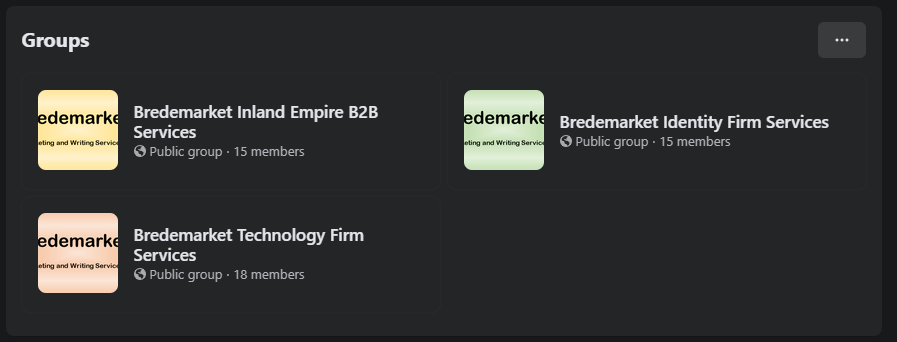
I subsequently created a companion Bredemarket Identity Firm Services Facebook group, which like the LinkedIn showcase page (and unlike my previous efforts for Motorola, MorphoTrak, and IDEMIA) were publicly accessible.

Why did I do this?

I marvel at the thought that I kept on doing this over and over again for four different companies, including Bredemarket. Why did I have this pressing need to reinvent the wheel as I traveled from company to company?

Habitually I’ve been a reader, and have found myself reading a lot of information about the biometric industry or the wider identity industry. Of course it’s not enough just to read something, you have to do something with it. COMPASS, SharePoint, email, LinkedIn, and Facebook allowed me to do two things with all of the articles that I read:

  • Save them somewhere so that I could find them in the future.
  • Share them with other people who may be interested in them.

I didn’t collect information on my impact to others in versions 1.0 and 2.0, but by the time I started managing the IDEMIA email list, I not only received comments from people who appreciated the articles, but I was also able to grow the subscriptions to the email list. (People had to opt in to receive the emails; we didn’t cram them into the inboxes of every IDEMIA employee.)

Similarly, I’ve received comments from people on LinkedIn who follow the showcase page, stating that they appreciated what I was sharing there.

And while COMPASS and the MorphoTrak SharePoint are long gone, and IDEMIA’s Daily News may or may not still be in publication, I can assure you that the Bredemarket Identity Firms services LinkedIn page and Facebook group still continue to operate for your reading pleasure.

And that’s the end of the story.

No it’s not.

The fifth service

As some of you know, Bredemarket has become a side gig because of my new day job, which is with a company in the identity industry. During my first days on the new job, I set up subscriptions to my new company email account so that I could receive information from Crunchbase and Owler, as well as relevant Google Alerts on the identity industry.

And as I began receiving these subscriptions, as well as performing my usual scans of other news sources…

…well, you can guess what happened.

“I need to store these stories and share them with my coworkers,” I thought to myself.

Finally, I created a new identity information service using the well-worn title “Identity Industry Information.” (Hey, it’s easy for me to remember.)

Now I can’t actually SHARE this service with you, because it’s just for the employees at my new company.

And THIS iteration takes advantage of a technology that’s slightly newer than COMPASS.

It’s a Slack channel.

P.S. to employees at my current company – if you’d like to access this Slack channel, DM me on Slack and I’ll send you an invite.

Bredemarket Inland Empire B2B Services: Iterating LinkedIn/Facebook Page/Group Names

Author’s Note: this is one of two seemingly unrelated Bredemarket blog posts that form a cohesive whole. Actually PART of a cohesive whole.

Introduction

It would be nice if my initial plans for my consultancy Bredemarket were perfect and addressed my consulting needs for years to come. But my plans are NOT perfect, in part because I can’t anticipate what will happen in the future.

And so I iterate. Which is why I’m renaming the Bredemarket General Business Services Facebook group and the Bredemarket Local Firm Services LinkedIn showcase page.

In this post I examine why I created Facebook groups and showcase pages in the first place, why I originally named the Facebook group “Bredemarket General Business Services,” why I subsequently named the LinkedIn showcase page “Bredemarket Local Firm Services,” and why I’m changing things.

Why create Facebook groups and LinkedIn showcase pages?

When I established Bredemarket in 2020, I knew that I wanted to target multiple customers. This sentence on the Bredemarket home page has remained unchanged since 2020:

Bredemarket presently offers its services to identity/biometrics, technology, and general business firms, as well as to nonprofits.

From https://bredemarket.com/

These four customer groups have some different needs. A nonprofit’s concerns differ from those of a fingerprint identification software vendor. Because of this, I wanted to find a way to talk directly to these customers.

Back in November 2020, I started by creating a LinkedIn showcase page entitled Bredemarket Identity Firm Services. I started with this one because I had a need to communicate with just my identity customers. As of April 21, 2022, 186 people are following this showcase page to receive identity-only content.

Why I created the Bredemarket General Business Services Facebook group

I didn’t stop with that one LinkedIn showcase page. By July 2021, I had created a second LinkedIn showcase page devoted to technology, but was also creating Facebook groups.

So Bredemarket…has Facebook groups that are somewhat similar to the Bredemarket LinkedIn showcase pages. One difference is that I have three groups on Facebook. In addition to the identity and technology groups, I also have a general business group. At this point it didn’t make sense to create a LinkedIn showcase page for general business, but it did make sense for Bredemarket to have such a group on Facebook.

From https://bredemarket.com/2021/07/16/how-and-why-a-company-should-use-linkedin-showcase-pages/

You can see how these Facebook groups (and LinkedIn showcase pages) are derived from my original 2020 statement of Bredemarket’s target markets. To a point; as I noted, I didn’t create a general business showcase page on LinkedIn, and even today I don’t have a nonprofit LinkedIn showcase page or a nonprofit Facebook group.

But I would begin to pivot Bredemarket’s business that summer.

Why I created the Bredemarket Local Firm Services LinkedIn showcase page

By September 2021, I was questioning my market segmentation.

As I write this, Bredemarket has no clients in my hometown of Ontario, California, or in any of the nearby cities. In fact, my closest clients are located in Orange County, where I worked for 25 years.

It’s no secret that I’ve been working to rectify that gap and drum up more local business.

From https://bredemarket.com/2021/09/03/shattering-my-assumptions-by-using-linkedin-for-local-marketing/

After attending Jay Clouse’s September 2021 New Client Challenge, I determined to pursue this local market more aggressively and determined how I was NOT going to pursue Inland Empire West customers.

So when I market to local businesses, I’ll want to do that via relevant Facebook Groups. Obviously I won’t market the local services via LinkedIn or Twitter, because those services are not tailored to local service marketing.

From https://bredemarket.com/2021/09/03/shattering-my-assumptions-by-using-linkedin-for-local-marketing/

Let me draw out the implied assumption in that statement above, that even the Facebook marketing would be via groups created by other people. It wasn’t like I was going to create my OWN local Facebook group or anything like that. I was going to post in the Facebook groups created by others.

Anyway, proving that my initial plans are NOT perfect, I fairly quickly changed my mind regarding LinkedIn, deciding to create a LinkedIn showcase page devoted to local services, even though I didn’t have (or need) a parallel Facebook group.

And in fact I’d cheat by adapting the artwork for the Bredemarket General Business Services Facebook group and repurpose it for use in the Bredemarket Local Business Services LinkedIn showcase page.

This appeared to be a brilliant idea, and the new local LinkedIn showcase page was successful. Not as successful as the Bredemarket Identity Firm Services LinkedIn page, but it certainly provided me with an avenue to speak just to the local community.

Aren’t I brilliant?

Why I’m changing the names of the Facebook group and LinkedIn showcase page

Well, maybe not so brilliant.

Time went on, and I would share identity stuff to the “Identity Firm Services” showcase page and group, and I would share technology stuff to the “Technology Firm Services” showcase page and group. When I wanted to share local stuff, I’d obviously share it on the Bredemarket Local Firm Services LinkedIn showcase page, and sometimes I’d also share it on the Bredemarket General Business services Facebook group.

But this raised two questions.

What is the Bredemarket General Business Services Facebook group?

The third market category that I created in 2020 isn’t making sense in 2022. If you go to the Bredemarket General Business Services Facebook group today, it’s kind of vague. In fact, you could say it’s, um, general.

If you scroll through the group posts, you’ll see a lot of posts from me that have to do with businesses in California’s Inland Empire.

Because I do not moderate the posts in the group, other people like to post, and their posts can be, um, general. For example, there is one person who occasionally posts things like this.

Now I have no reason to reject the post, because the poster isn’t violating any group rule. However, this person could use the services of a marketing and writing professional. The company is doing SOME things right. such as advertising the services provided, including illustrative pictures, and incorporating a call to action. The call to action, of course, is to call…

…061 531 5144?

For those who aren’t familliar with geography, Kempton Park is outside of Pretoria, in South Africa. Which means that if I had wanted the company to provide a quote when my own roof was damaged by winds, I would have to call the country code 27 first, THEN call the local area code 61 and the local number 531 5144.

Somehow I doubt that Ontario, California is in this company’s service area.

Now I could have posted a comment along the lines of “You idiot! Do you really think that people in this group are going to contract with a roofer on another continent?” But I didn’t do that. Instead, I simply commented with this question:

Where is the service located?

From https://www.facebook.com/groups/bredemarketbusiness/posts/1034813817123791/

Over a week later, the original poster hasn’t responded to my question. I guess the poster is too busy writing “Thought the group would like this” posts on every “general business service” Facebook group. (Terrible waste of the poster’s time, when you think about it.)

And that’s what can happen when you create a group for “general business services.” It’s too general.

What is the Bredemarket Local Firm Services LinkedIn showcase page?

Thankfully I avoided this same problem when I created the Bredemarket Local Firm Services LinkedIn showcase page.

Or did I?

If you don’t know me or my background and encounter a showcase page devoted to “local firm services,” what are you going to think?

That’s right. The page name doesn’t mention the locality that is the focus of the page.

Next thing I know, my roofing friend is going to discover my Linkedin showcase page and start posting weekly, with an equal lack of success.

How do I make these better?

So it’s obvious that both the LinkedIn showcase page and Facebook group would benefit from a refocus and a rename.

But what name?

If you had asked me this question in September 2021, I would have chosen the name “Bredemarket Inland Empire West Firm Services.” My local marketing target at that point was businesses in Ontario, California and the surrounding cities. “Inland Empire” was too broad a term for those cities, but “Inland Empire West” is a real estate term that fits nicely in my target market area.

This also tied in with a marketing promotion that I was running at the time, in which I would offer a discount for customers in this immediate area. However, I recently rescinded that promotion (as part of the numerous changes I’m currently making to Bredemarket’s business). Since I wasn’t making money (from an opportunity cost perspective) with my regular package pricing, I certainly wouldn’t make money with DISCOUNTED package pricing.

At the same time, I was getting less strict about keeping my target within the Inland Empire West, and was therefore open to extending throughout the Inland Empire. Although most of my online collateral is currently targeted to the Inland Empire West, I won’t turn down business from Moreno Valley or Redlands.

So perhaps I could use the name “Bredemarket Inland Empire Firm Services,” without the “West.”

But I didn’t like that either.

While “Firm” implies that I work with businesses and not individuals (I don’t write resumes), I figured it would be clearer if I used “B2B” instead of firm. “Business-to-Business” would be better, but that would make the page/group title awfully long. Of course some people don’t know what “B2B” means, but that could be an effective filter; if you don’t know what “B2B” means, you’re not going to use Bredemarket’s services anyway.

Having settled on the title “Bredemarket Inland Empire B2B Services,” it was now a matter of making the title change. (Without changing the legacy URLs and potentially breaking existing links.)

So now I can formally re-announce…

…the Bredemarket Inland Empire B2B Services LinkedIn showcase page.

And…

…the Bredemarket Inland Empire B2B Services Facebook group.

Bredmarket Inland Empire B2B Services Facebook group
From https://www.facebook.com/groups/bredemarketbusiness

Again, the URLs don’t match the page/group titles because of legacy issues, but I think it’s better than what was before. And hopefully this will focus the content and make it more relevant.

Unless you’re a Pretoria homeowner with a leaky roof.

What if your business has no website or web page?

In January of this year, I wrote a couple of posts about websites with outdated content.

The posts were obviously self-serving (since Bredemarket happens to sell services to update website text), but the second post backed my points up with data.

Specifically, a study noted that when people want to research a solution, 53% of them perform a web search for the solution, and 41% of them go to vendor web sites.

I used this data to make the point that your website had better be up to date, if you want your potential customers to have a good impression of your business.

An outdated website looks bad.

But I just ran across something even worse.

Worse than an outdated website

I’m not going to provide specifics, but I just saw a Facebook post in a local business group that promoted a service. This happens to be a service that is popular with individuals and businesses. The Facebook post stated that the service provider was the best provider in the local area, and was better than the competition. The post then gave the company name of the service provider, and…

…a local phone number.

You can guess what I did next. Like 53% of you, I searched for information on this particular company. I started on Facebook itself; since the individual made the post on Facebook, I figured that the company had a Facebook page.

It didn’t. The company had no Facebook presence.

So I got out of Facebook and went off into the World Wide Web and (like 41% of you) searched for the company’s web page.

I found no company web page with that name in California, but I did find a company with that name in another part of the country that coincidentally provided the same service. But I could tell that this was a separate company.

So I went back to the original Facebook post and asked a question.

Does [COMPANY NAME] have a website, or just a phone number?

I received a response from the original poster.

Bredemarket, no, just a number.

I made no further comment, but it got me thinking.

What’s worse than a website with outdated content?

No website or web page at all.

And I’m not talking about a fancy-dancy website. If you’ve seen Bredemarket’s website, it’s not fancy-dancy.

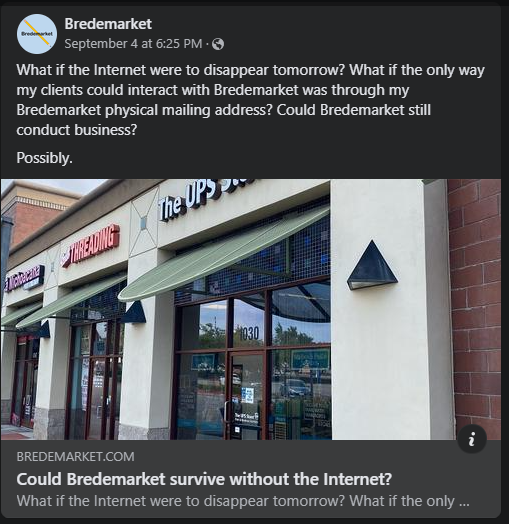
I’m just talking about a simple page. It doesn’t have to be on your own domain; it could be on wordpress.com (like my jebredcal site) or wix.com even facebook.com (Bredemarket has one of those too). Just something that ideally tells you the company name, the person who runs the company, the address of the company (yes, UPS Store addresses are acceptable; I know), a phone number, and an email address.

When all of these elements are available, and they’re present on a website, you have at least some assurance that the company is a viable concern. (I’ll grant that this can be faked, like Abdul Enterprises was faked, but at least a name, address, email, and phone number suggest that the company is real.)

A company name and a phone number with no website, no email address, and no company ownership information is…well, it’s sketchy.

So how does a company without an online presence establish one?

There are a variety of ways to establish a company online presence. You could pay for a website, you could set up a free website via a variety of service providers, or you could simply set up a social media page such as a Facebook page.

Now Bredemarket doesn’t create websites, and Bredemarket doesn’t create Facebook business pages. Facebook offers step-by-step instructions on how to create a Facebook business page, and there are guides on how to create complete websites such as a Wix site (and you can do it for free if you don’t need a custom domain and use accountname.wixsite.com/siteaddress).

Creating the site, however, is only part of the story.

Bredemarket can help you establish the initial content for a website or a Facebook page. (And if you desire, I can help you refresh the content also.)

Let’s look at the simplest example, where you just want to establish a presence with a few hundred words (say 400 to 600 words).

I’ll start by asking you a bunch of questions.

  • Topic. Well, the topic is your business, of course, but how would you summarize your business in one sentence?
  • Goal. What is the goal of your site or page? Do you want people to immediately buy something online? Do you want people to rush to your business location and buy something? Or do you just want people to talk to you about your product or service?
  • Benefits. I’ve talked about this ad nauseum, but it’s important to explain why people should want your product or service. If your explanation results in a “so what?” from the potential customer, then you need to refine your benefit statement.
  • Target audience. The message on your site or page is obviously affected by your target audience. A page intended for forensic scientists will have different messaging than a page intended for high school students who want an after school snack.
  • Other questions. These are going to vary from engagement to engagement, but it’s important to ask these questions up front to minimize any misunderstandings later.

After you and I have talked through these questions, I’ll start creating the text to place on your website. By the time we’ve gone through the process and we’re done, you’ll have an initial website presence for your business. People will be able to find your business, find out what it’s about, contact you, and give you lots of money.

But that won’t happen until the people can find out what you offer.

And it won’t happen if they only have a business name and a phone number.

If you want Bredemarket to help you establish an online presence with the correct words to woo customers:

Inland Empire West businesses should visit https://bredemarket.com/local/ for a special “locals only” discount.

Meta-repurposing

I like to publish “in case you missed it” (ICYMI) posts over the weekend, just in case my Facebook, LinkedIn, or Twitter followers might have missed something that I originally published in the preceding week.

Last weekend I tried something a little different. Now that Bredemarket has been a going concern for over a year, I chose to publish some items that my followers might have missed when I originally published them in the preceding YEAR.

Although there are some parts of 2020 that aren’t fun to revisit.

But this past weekend, I went back to October 2020 for my latest #ICYMI offerings. I want to talk about two of these offerings in particular.

The first #ICYMI item

The first item that I shared last weekend was a Bredemarket blog post from October 17, 2020 entitled “You go back, Jack, do it again” that talked about repurposing content. Here’s a brief excerpt that links to a Neil Patel post.

Why repurpose content?

To reach audiences that you didn’t reach with your original content, and thus amplify your message. (There’s data behind this.)

If you’re a data lover, check the link.

The second ICYMI item

Waylon Jennings promotional picture for RCA, circa 1974. By Waylon_Jennings_RCA.jpg: RCA Records derivative work: GDuwenTell me! – This file was derived from:  Waylon Jennings RCA.jpg:, Public Domain, https://commons.wikimedia.org/w/index.php?curid=17091525

The second item that I shared last weekend was a Bredemarket Spotify podcast episode from the same period entitled “A special episode for Spotify subscribers, with Waylon Jennings’ ‘Do It Again.'” You can probably guess that it was about repurposing content.

To answer a few questions about the podcast:

  • Yes, it was a repurposing of the blog post.
  • Yes, this particular podcast episode was only on Spotify because it included a song sample.
  • Yes, I chose Waylon’s version of the song rather than Steely Dan’s because I like Waylon’s version better.
  • Yes, you have to be on Spotify Premium to hear the whole song, rather than a 30-second snippet. (I’m not on Spotify Premium, so even I haven’t heard the entire podcast as envisioned.)

I don’t really have anything profound to say about repurposing that hasn’t been said already, so treat this as a reminder that you can easily repurpose content on new platforms to reach new readers/listeners.

As I just did.

Again.

Postscripts

For the record, I haven’t created any other Spotify-only podcast episodes with music since that initial one a year ago. So all of the other podcast episodes that I’ve recorded are available on ALL of my platforms, including Anchor.

By the way, there was a third #ICYMI item that I re-shared last weekend on Facebook, LinkedIn, and Twitter. But it didn’t deserve its own re-blog.

(You gotta know when to hold ’em. Yes, that’s Kenny, not Waylon.)