Bredemarket content marketing services for small businesses in and around Ontario, California (the April 8, 2022 iteration)

A minor refresh to what I wrote on March 31, including an updated brochure.

Here’s the text I recently added to my home page.

Bredemarket presently offers its services to identity/biometrics, technology, and general business firms, as well as to nonprofits. I offer my services to firms in my hometown of Ontario, California, as well as firms in EastvaleFontanaMontclairRancho CucamongaUpland, other cities of the Inland Empire West, and throughout the United States.

From https://bredemarket.com/

This post concentrates on the services that Bredemarket can provide to businesses in my local area. Read on if you own a small, arty business in the Emporia Arts District of Ontario…

Ontario, California Emporia Arts District.

…or perhaps a larger, less arty business north of Holt in Ontario, or perhaps even a business in one of the other cities that I mentioned, or one of the ones I didn’t (sorry Narod).

There are a lot of local businesses out there

Even if you don’t count sole proprietors (such as myself) or freelancers, there are somewhere around 7.7 million businesses in the United States. (This figure is from 2016; I’m not sure if it’s gone up or gone down in the last five years.) Now if you include sole proprietors in the total, then you’re talking about 32 million businesses. (This particular number may have actually increased over time.)

Obviously I can’t target them all. Well, I could try, but it would be a little ridiculous.

So what if I took a subset of those 32 million businesses and tried to see if Bredemarket could serve that subset?

The local small business persona

When you want to market to a particular group, you develop a persona that represents that group. You can then develop a profile of that persona: the persona’s needs, aspirations, and expectations; the persona’s underlying goals and values; and perhaps some other elements. The persona may be developed via extensive research, or perhaps via…a little less quantification.

When I initially looked at this topic last September, I concentrated on a particular persona, but my thoughts on this topic have evolved over time. While I will still serve artists as I initially proposed last September, I’m now thinking of other businesses that can best use the type of content that I provide.

For example, the business may be an incorporated business that is based on the Inland Empire West, provides its products or services to customers in the local area, provides excellent service that is loved by its existing customers, and needs to get the word out to new potential customers by creating content that can be downloaded from a company website, shared via a company social media account, or handed out at a trade show or other in-person event.

Regarding the values of this particular persona, you can probably already deduce some of them based upon the customer love for the company.

  • The business puts the customer first and strives to provide services that satisfy its customers.
  • However, the business also prioritizes the well-being of its employees.
  • While the business may not have explicitly articulated a vision, its actions testify to a vision of excellent service, customer satisfaction, and care for employees.

But what does this business need in terms of types of content? For my example, these businesses are ones that need customer-facing content such as the following:

  • A document (online or printed) that explains the product(s) or service(s) that the business provides, and that discusses the benefits that the product(s)/service(s) offers to the customers. This document may take the form of a product/service description, or it may take the form of a white paper. For example, your business might issue a white paper entitled “Seven Mandatory Requirements for a Green Widget,” and the white paper just might happen to mention at the end that your green widget just happens to meet all seven mandatory requirements. (Coincidence? I think not.)
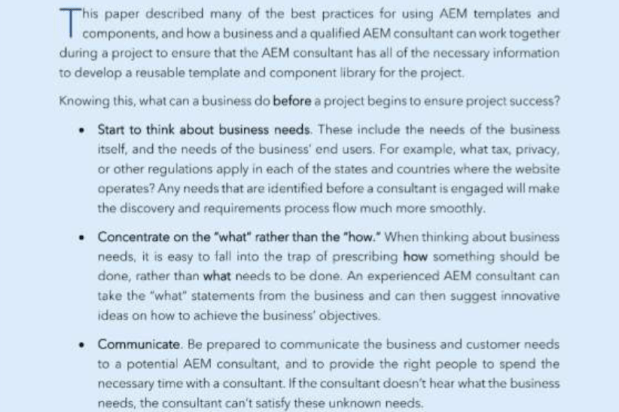
Portion of the concluding section of a white paper in which Bredemarket provided the text.
  • A document (online or printed) that tells a story about how an individual customer benefited from the product(s) or service(s) that the business provides. You could call such a document a case study, or you could call it a testimonial. Or you could call it a casetimonial.

These types of documents are more valuable to some businesses than to others. Your average convenience store has little need for a 3,000 word white paper. But perhaps your business has this sort of need.

How many words should your content contain?

When I originally wrote this last September, I started off by discussing my two standard packages, based on word length. But now that I’ve thought about it a bit more, there are some questions that you need to ask BEFORE deciding on the content length. (We’ll get to content length later.)

(Owen Lovejoy) How long should a man’s legs be in proportion to his body?”

(Abraham Lincoln) “I have not given the matter much consideration, but on first blush I should judge they ought to be long enough to reach from his body to the ground.”

Thomas Lowery, quoted at https://thelogcabinsage.com/how-long-should-a-mans-legs-be-and-2-other-lincoln-stories/
Abraham Lincoln.
Abraham Lincoln. (Legs not shown.) By Hesler, Alexander, 1823-1895 – This image is available from the United States Library of Congress’s Prints and Photographs divisionunder the digital ID cph.3a36988.This tag does not indicate the copyright status of the attached work. A normal copyright tag is still required. See Commons:Licensing for more information., Public Domain, https://commons.wikimedia.org/w/index.php?curid=18705107

So how far away is the ground? Let’s ask some other questions first before we determine the answer to content length.

Bredemarket’s initial questions for you

Before I create a single word, I start by asking you some questions about your content to make sure our project starts on the right foot. (Even though I am left-footed.)

Bredemarket Kickoff Guide header.

  • What is the topic of the content?
  • What is the goal that you want to achieve with the content?
  • What are the benefits (not features, but benefits) that your end customers can realize by using your product or service?
  • What is the target audience for the content?

Once I’ve asked you these and other questions (such as a potential outline), we will both have a good idea of how long the final piece needs to be.

The length of the content also dictates the length and complexity of the review process.

Returning to the content length question

Once we have a good idea of the content length, there are three options that we can pursue to actually create the content.

If your content consists of 400 to 600 words, then I create the content using the process detailed in my Bredemarket 400 Short Writing Service.

https://bredemarket.com/bredemarket-400-short-writing-service/

This has two review cycles with up to three days per review cycle.

Bredemarket 400 Short Writing Service
If your content is longer, say 2800 to 3200 words, then I create the content using a similar (but more detailed) process through my Bredemarket 2800 Medium Writing Service.

https://bredemarket.com/bredemarket-2800-medium-writing-service/

This has three review cycles with up to seven days per review cycle.

Bredemarket 2800 Medium Writing Service
If your content falls between these two lengths, or is longer than 3200 words, or needs a more rapid delivery time, we’ll talk and come up with a solution. (And we’ll even come up with a spiffy name if you like)
For more services, see https://bredemarket.com/what-i-do/

If you can use my services, what are the next steps?

If I can help your business, or if you have further questions about Bredemarket’s B2B content creation services, please contact me.

SEO NVI, HRF VVI (Search engine optimization not very important, human readable format very very important)

I’ve been trying to add more local (Inland Empire West) content to the Bredemarket blog. Obviously I’m attempting to promote Bredemarket’s services to local businesses by writing local-area content such as these two recent posts centered on Upland.

City Hall and Public Library, Upland, California.
By Rockero at English Wikipedia – Transferred from en.wikipedia to Commons., CC BY-SA 3.0, https://commons.wikimedia.org/w/index.php?curid=3949535

Old SEO

Back in the old days, I might have done optimized for my local audience by going to the bottom of relevant pages on the Bredemarket website and inserting hundreds of words in very small gray text that cite every single Inland Empire West community (yes, even Narod) and every single service that Bredemarket provides. In the old days, the rationale was that this additional text would positively affect search engine optimization (SEO), so that the next person searching for “case study writer in Narod, California” would automatically go to the page with all of the small gray text.

Of course, that doesn’t work any more, because Google penalizes keyword stuffers or content stuffers who make these unnatural pages.

More modern SEO

I use more acceptable forms of SEO. For example, I’ve devoted significant effort to make sure that the two phrases biometric content marketing expert and biometric proposal writing expert direct searchers to the relevant pages on this website. (Provided, of course, that someone is actually searching for a biometric content marketing expert or a biometric proposal writing expert.)

First two results (as of April 1, 2022) of a DuckDuckGo search for biometric content marketing expert. https://duckduckgo.com/?q=biometric+content+marketing+expert&t=h_&ia=web

I believe SEO is important.

However, SEO is not very important (NVI).

(As an aside, I commonly distinguish between “important” stuff and “very important” stuff. And you also have to distinguish between importance and urgency; see the Eisenhower matrix.)

What is very very important (VVI)? Human readable format (HRF).

The two audiences: the bots, and the real humans

And SEO-optimized content may differ from human-readable content because of their different audiences. SEO text is written for machines, not people. In extreme cases, SEO-optimized text is unreadable by humans, and human readable format cannot be interepreted by machine-based web crawlers.

Machine readable and human readable formats. Olav Ten Bosch. From https://www.researchgate.net/figure/Machine-readable-and-human-readable-formats_fig1_327385570

Here’s a comparison:

Machine readableHuman readable
Easily parsed and processed by systemsEasily read by humans
Hard for humans to readHard for machines to read
Adheres to FAIR principles (findable, accessible, interoperable, reusable)Communicates with humans via visual presentation
Example: machines have problems reading tables like this oneExample: humans can easily read and understand tables like this one
Google’s gonna hate me for putting this table into a post, but real human beings won’t. See https://control.com/technical-articles/machine-readable-vs-human-readable-data/ for a fuller explanation of the differences between machine-readable and human-readable data.

Here’s another example of how SEO-optimized text and human readable format sometimes diverge. I mentioned this example in a recent LinkedIn article:

I recently updated my proposal resume to include the headline “John E. Bredehoft, CF APMP,” under the assumption that this headline would impress proposal professionals. However, when I ran my resume through an ATS (applicant tracking system) simulator, it was unable to find my name because of its non-standard format. Because of this, there was a chance that a proposal professional would never even see my resume. I adjusted accordingly.

From https://www.linkedin.com/pulse/what-happens-when-proposal-evaluators-longer-human-bredemarket/
By Humanrobo – Own work, CC BY-SA 3.0, https://commons.wikimedia.org/w/index.php?curid=18947366

In this case, I had to cater to two separate audiences:

  • The computerized applicant tracking systems that read resumes and decide which resumes to pass on to human beings.
  • The human beings that read resumes, often after the applicant tracking systems have pre-selected the resumes to read.

I was able to come up with a workaround to satisfy both audiences, therefore ensuring that (a) my resume would get past the ATS, and (b) a human that viewed my ATS-approved resume could actually read it. It’s a clumsy workaround, but it works.

While that particular example is complicated by the gate-keeping ubiquity of applicant tracking systems in the employment industry, it is not unique. All industries are depending more on artificial intelligence, and almost all human beings are turning to Google, Bing, DuckDuckGo, and the like to find stuff.

These are our users (who use search engines for EVERYTHING)

There’s an old example of how dependent we are on search engines. In a famous case over a decade ago, people used the Google search engine to get to the Facebook login page, and were confused when a non-Facebook page made its way to the top of the search results. The original article that prompted the brouhaha is gone, but Jake Kuramoto’s summary still remains. TL;DR:

ReadWriteWeb posted “Facebook Wants to Be Your One True Login“.

Google indexed the post.

The post became the top result for the keywords “facebook login”.

People using Google to find their way to Facebook were misdirected to the post.

The comments on the post were littered with unhappy people, unable to login to Facebook.

There are more than 300 comments on this post, the majority of them from confused Facebook users.

Despite the fact that RWW added bold text to the post, directing users to Facebook, and the fact that the post is no longer the top result for “facebook login”, people continue to arrive there by accident, looking for Facebook.

From http://theappslab.com/2010/02/11/these-are-our-users/

What if we can only optimize for one of the two audiences?

So people who create content have to simultaneously satisfy the bots and the real people. But what if they couldn’t satisfy both? If you were forced to choose between optimizing text for a search engine, and optimizing text for a human, what would you choose?

If it were up to Google and the other search engine providers, you wouldn’t have to choose. The ultimate goal of Google Search (and other searches) is to mimic the way that real humans would search for things if they had all of the computing resources that the search engine providers have. It’s only because of our imperfect application of artificial intelligence that there is any divergence between search engines and human searches.

But until AI gets a lot better than it is now, there will continue to be a divergence.

And if I ever had to choose, I’d write for humans rather than bots.

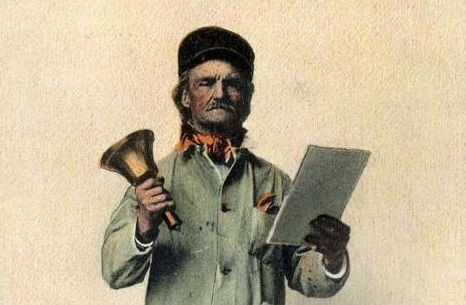
By Bundesarchiv, Bild 102-13018 / CC-BY-SA 3.0, CC BY-SA 3.0 de, https://commons.wikimedia.org/w/index.php?curid=5480820

After all, a human is going to have to read the text at some point. Might as well make the human comfortable, since the bots aren’t making final binding decisions. (Yet.)

Bredemarket content marketing services for small businesses in and around Ontario, California (the March 31, 2022 iteration)

A lot has happened since I first wrote this description of Bredemarket’s local marketing services on September 1, 2021. Time for a content refresh.

The refresh begins with the reprint of the relevant text on my home page, which was just updated this week.

Bredemarket presently offers its services to identity/biometrics, technology, and general business firms, as well as to nonprofits. I offer my services to firms in my hometown of Ontario, California, as well as firms in EastvaleFontanaMontclairRancho CucamongaUpland, other cities of the Inland Empire West, and throughout the United States.

From https://bredemarket.com/

This post concentrates on the services that Bredemarket can provide to businesses in my local area. Read on if you own a small, arty business in the Emporia Arts District of Ontario…

Ontario, California Emporia Arts District.

…or perhaps a larger, less arty business north of Holt in Ontario, or perhaps even a business in one of the other cities that I mentioned, or one of the ones I didn’t (sorry Narod).

There are a lot of local businesses out there

Even if you don’t count sole proprietors (such as myself) or freelancers, there are somewhere around 7.7 million businesses in the United States. (This figure is from 2016; I’m not sure if it’s gone up or gone down in the last five years.) Now if you include sole proprietors in the total, then you’re talking about 32 million businesses. (This particular number may have actually increased over time.)

Obviously I can’t target them all. Well, I could try, but it would be a little ridiculous.

So what if I took a subset of those 32 million businesses and tried to see if Bredemarket could serve that subset?

The local small business persona

When you want to market to a particular group, you develop a persona that represents that group. You can then develop a profile of that persona: the persona’s needs, aspirations, and expectations; the persona’s underlying goals and values; and perhaps some other elements. The persona may be developed via extensive research, or perhaps via…a little less quantification.

When I initially looked at this topic last September, I concentrated on a particular persona, but my thoughts on this topic have evolved over time. While I will still serve artists as I initially proposed last September, I’m now thinking of other businesses that can best use the type of content that I provide.

For example, the business may be an incorporated business that is based on the Inland Empire West, provides its products or services to customers in the local area, provides excellent service that is loved by its existing customers, and needs to get the word out to new potential customers by creating content that can be downloaded from a company website, shared via a company social media account, or handed out at a trade show or other in-person event.

Regarding the values of this particular persona, you can probably already deduce some of them based upon the customer love for the company.

  • The business puts the customer first and strives to provide services that satisfy its customers.
  • However, the business also prioritizes the well-being of its employees.
  • While the business may not have explicitly articulated a vision, its actions testify to a vision of excellent service, customer satisfaction, and care for employees.

But what does this business need in terms of types of content? For my example, these businesses are ones that need customer-facing content such as the following:

  • A document (online or printed) that explains the product(s) or service(s) that the business provides, and that discusses the benefits that the product(s)/service(s) offers to the customers. This document may take the form of a product/service description, or it may take the form of a white paper. For example, your business might issue a white paper entitled “Seven Mandatory Requirements for a Green Widget,” and the white paper just might happen to mention at the end that your green widget just happens to meet all seven mandatory requirements. (Coincidence? I think not.)
Portion of the concluding section of a white paper in which Bredemarket provided the text.
  • A document (online or printed) that tells a story about how an individual customer benefited from the product(s) or service(s) that the business provides. You could call such a document a case study, or you could call it a testimonial. Or you could call it a casetimonial.

These types of documents are more valuable to some businesses than to others. Your average convenience store has little need for a 3,000 word white paper. But perhaps your business has this sort of need.

How many words should your content contain?

When I originally wrote this last September, I started off by discussing my two standard packages, based on word length. But now that I’ve thought about it a bit more, there are some questions that you need to ask BEFORE deciding on the content length. (We’ll get to content length later.)

(Owen Lovejoy) How long should a man’s legs be in proportion to his body?”

(Abraham Lincoln) “I have not given the matter much consideration, but on first blush I should judge they ought to be long enough to reach from his body to the ground.”

Thomas Lowery, quoted at https://thelogcabinsage.com/how-long-should-a-mans-legs-be-and-2-other-lincoln-stories/
Abraham Lincoln.
Abraham Lincoln. (Legs not shown.) By Hesler, Alexander, 1823-1895 – This image is available from the United States Library of Congress’s Prints and Photographs divisionunder the digital ID cph.3a36988.This tag does not indicate the copyright status of the attached work. A normal copyright tag is still required. See Commons:Licensing for more information., Public Domain, https://commons.wikimedia.org/w/index.php?curid=18705107

So how far away is the ground? Let’s ask some other questions first before we determine the answer to content length.

Bredemarket’s initial questions for you

Before I create a single word, I start by asking you some questions about your content to make sure our project starts on the right foot. (Even though I am left-footed.)

Bredemarket Kickoff Guide header.

  • What is the topic of the content?
  • What is the goal that you want to achieve with the content?
  • What are the benefits (not features, but benefits) that your end customers can realize by using your product or service?
  • What is the target audience for the content?

Once I’ve asked you these and other questions (such as a potential outline), we will both have a good idea of how long the final piece needs to be.

The length of the content also dictates the length and complexity of the review process.

Returning to the content length question

Once we have a good idea of the content length, there are three options that we can pursue to actually create the content.

If your content consists of 400 to 600 words, then I create the content using the process detailed in my Bredemarket 400 Short Writing Service.

https://bredemarket.com/bredemarket-400-short-writing-service/

This has two review cycles with up to three days per review cycle.

Bredemarket 400 Short Writing Service
If your content is longer, say 2800 to 3200 words, then I create the content using a similar (but more detailed) process through my Bredemarket 2800 Medium Writing Service.

https://bredemarket.com/bredemarket-2800-medium-writing-service/

This has three review cycles with up to seven days per review cycle.

Bredemarket 2800 Medium Writing Service
If your content falls between these two lengths, or is longer than 3200 words, or needs a more rapid delivery time, we’ll talk and come up with a solution. (And we’ll even come up with a spiffy name if you like)
For more services, see https://bredemarket.com/what-i-do/

If you can use my services, what are the next steps?

If I can help your business, or if you have further questions about Bredemarket’s B2B content creation services, please contact me.

And one more thing…

Scroll down to the bottom of my general “local” page for a special “locals only” discount code!

In marketing, move quickly PART TWO: THE OTHERS SPEAK

On March 23, I wrote a post entitled “In marketing, move quickly” (while noting that I didn’t move all that quickly in posting it). After citing stories from a local (unnamed) company, my own time as a product manager, an (again unnamed) international bank, and a (named) car manufacturer, I concluded as follows:

And if you can speed up production of a car, you can speed up production of marketing content and start putting your messaging on your Facebook, LinkedIn, and YouTube accounts, as well as your website immediately so that your customers can get your message.

From https://bredemarket.com/2022/03/23/in-marketing-move-quickly/
By Malene Thyssen – Own work, CC BY-SA 3.0, https://commons.wikimedia.org/w/index.php?curid=10119596

And if you think that the idea of moving quickly in marketing was an idea that I completely originated myself, you REALLY need to get out a bit more.

This post collects a few things that others have said about moving quickly.

Empower your employees (Jim McGinnis of Intuit)

In 2015, Forbes quoted Intuit’s Jim McGinnis, who had previously worked at technology company Activision and non-technology companies Pepsi and Procter & Gamble. He left Intuit in 2017 and has since worked at two other firms, including MyCase.

A more effective strategy to engage your audience is to communicate directly with them often and through multiple touch points. At Intuit, we empower all 8,000 employees to use social media and tweet regularly, but to do so in a smart and effective way that minimizes risk. We do this by instituting principle-based management and guidelines that everybody operates within. We also have a very strong and enduring values-based organization, with the first and most important value being “Integrity without Compromise.”

McGinnis believed that with the Intuit organization, his people were empowered to communicate quickly without waiting for multiple layers of approval (as is required in a “command and control” organization).

And McGinnis’ new company MyCase? One of its marketing messages is the ability to reduce the time spent on weekly billing to 20 minutes.

Excite your customers (Adam Fridman of Mabbly)

That same year (2015), Forbes competitor Inc. ran a piece written by Adam Fridman of Mabbly, a digital marketing agency. Fridman noted that competitors are not the only ones watching how quickly a company moves.

People simply aren’t satisfied with the status quo; they want something more and they want it now. Companies must work quickly to satiate their appetites because audiences will have no qualms about moving to another product or service. 

From https://www.inc.com/adam-fridman/4-reasons-speed-is-everything-in-business.html

Don’t forget your vendors and partners (Isaiah Bollinger of Trellis)

Isaiah Bollinger, co-founder and CEO of Trellis, reiterated the points others made about competitors and customers in a 2018 piece, but he added two other stakeholders.

If you are a slow moving business vendors will (stop) putting effort into the relationship because they can find better customers….

Partners don’t want to work with a slow moving business that can’t innovate. They want fast growing innovators that will bring big impact to their bottom line. 

From https://trellis.co/blog/why-moving-fast-in-business-is-so-important

Incidentally, Bollinger may have moved a little TOO quickly. You see where I inserted the parenthetical comment “(stop)” in the first paragraph above? That’s not what he (or his copywriter) wrote. But we all know what he meant. Check the video.

From https://www.youtube.com/watch?v=M4LViCLtEPU

Conclusion

So there are a number of benefits, and relatively little downside, to moving quickly. And even if you do fail, several of the people quoted above emphasize that you fail quickly, can correct just as quickly, and learn important lessons quickly.

And maybe I’m learning. I didn’t wait two days to post this.

In marketing, move quickly

I need to step up my act regarding marketing, both for Bredemarket and my clients. In both cases, it’s critical that the word gets out quickly to potential clients.

For example, I drafted this post on Monday, but am not getting around to posting it until Wednesday. That’s two days of views lost right there!

By Malene Thyssen – Own work, CC BY-SA 3.0, https://commons.wikimedia.org/w/index.php?curid=10119596

I’m not the only one who needs to generate marketing material quickly.

The marketing goal, December 2021

I ran across a local company (which I will not name) that issued a press release in December 2021. In part, the press release mentioned the local company’s new dedication to the marketing function. The press release, in part, stated the following:

The Company has hired an international marketing firm…to support the Company’s efforts to increase revenue growth and brand recognition in the coming year.  The firm focuses on working with companies to develop comprehensive marketing strategies that identify competitive delineation, drive-focused campaigns, and develop sales leads designed to materialize revenue.  We expect their work to incorporate a website redesign, brand refresh, new strategic messaging and content, as well as focused video and digital campaigns that target markets such as [REDACTED].  We believe that a natural result of a formal marketing program, with a regular cadence of activity, will translate into market recognition of [REDACTED] as a highly-competitive brand that stands apart from the competition.

This sounds like an intelligent plan, or probably set of plans, that will address the firm’s strategic messaging, content, branding, and website, and a regular cadence of activity will keep the company visible. I certainly can’t argue with that.

The marketing results, March 2022

Well, now we’re three months into the implementation of this comprehensive marketing strategy. As an outsider posing as a potential customer for the firm’s products and services, what can I observe?

  • The website has a full slew of data sheets on the company’s products, and I found a 2017 brochure that effectively served as a white paper. But that’s it; no other white papers, and no case studies describing happy customers’ experiences.
  • The company’s YouTube channel has two videos from 2021.
  • The company’s Facebook page hasn’t posted anything since 2017.
  • Neither of the company’s LinkedIn pages (yes, the company has two LinkedIn pages) has any posts.

In short, as far as outside customers are concerned, the firm has not improved its marketing at all.

What happened? Did the international marketing firm concentrate on creating a stellar plan for the company’s content? If so, when will the content be available? Mid 2022? Late 2022? 2023?

Don’t go jumping waterfalls

When I was a product manager twenty years ago, my company used a “waterfall” product development method in which the marketing requirements document, engineering requirements document, design documents, test documents, and other documents were developed sequentially. While some companies still use the waterfall method today, others don’t because it takes so long to do anything.

These days, product developers are moving to agile methods to release products. And marketers are moving to agile methods also.

Agile marketing

Back in 2016, David Edelman, Jason Heller, and Steven Spittaels of McKinsey explained why marketing needs to be agile.

An international bank recently decided it wanted to see how customers would respond to a new email offer. They pulled together a mailing list, cleaned it up, iterated on copy and design, and checked with legal several times to get the needed approvals. Eight weeks later, they were ready to go.

In a world where people decide whether to abandon a web page after three seconds and Quicken Loans gives an answer to online mortgage applicants in less than ten minutes, eight weeks for an email test pushes a company to the boundaries of irrelevance.

From https://www.mckinsey.com/business-functions/marketing-and-sales/our-insights/agile-marketing-a-step-by-step-guide

The McKinsey authors then described how an agile marketing team organizes itself, sets goals, tests, and iterates.

The scrum master leads review sessions to go over test findings and decide how to scale the tests that yield promising results, adapt to feedback, and kill off those that aren’t working—all within a compressed timeframe.

From https://www.mckinsey.com/business-functions/marketing-and-sales/our-insights/agile-marketing-a-step-by-step-guide

While agile processes something result in things being wrong, the same agile processes can quickly correct the problem.

Back to the past

And waterfall methods can result in things being wrong also, especially when it takes so long to develop something that the initial assumptions have radically changed.

By en:user:Grenex – Wikipedia en, CC BY-SA 3.0, https://commons.wikimedia.org/w/index.php?curid=2500249

It took John DeLorean eight years to change his car concept into something coming off the production line. By that time, the automotive environment had changed.

Despite promising early sales the queue of willing buyers had dried up by the end of year – the chill wind of recession had struck the US automotive sector, and stockpiles of unsold cars started to mount up, both in Dunmurry and dockside in the USA. The worst winter in 50 years also played its part.

From https://www.aronline.co.uk/cars/de-lorean/dmc-12/the-cars-delorean-dmc-12/

This didn’t help DeLorean’s constant financing issues, and after DeLorean was caught (or entrapped by the FBI) in a $24 million cocaine deal, the DeLorean automobile was relegated to a movie prop.

If Agile processes had existed at the time, could they have reduced the 8-year gap from concept to the assembly line? Perhaps.

Conclusion

And if you can speed up production of a car, you can speed up production of marketing content and start putting your messaging on your Facebook, LinkedIn, and YouTube accounts, as well as your website immediately so that your customers can get your message.

Don’t wait two days, or eight years, for things to be just right.

Three Redlands “Shacks” Restaurants Tell a Story. What’s Your Story?

Fielding Buck of the Southern California News Group (including my local Inland Valley Daily Bulletin) recently told a story about the opening of a restaurant in Redlands called Pizza Shack.

Google Street View, 1711 West Lugonia, Redlands, California. Image captured February 2022. Fair use.

Sounds like a nice place for pizza, but Buck’s story didn’t end there.

Pizza Shack, at 1711 W. Lugonia, Suite 104, has the same owners as Taco Shack and Breakfast Shack in other parts of town.

From Redlands gets a third Shack: Pizza Shack on Lugonia – San Bernardino Sun (sbsun.com). Repurposed at other SCNG websites.

I couldn’t confirm the common ownership myself, so I’ll take Fielding Buck’s word for it. After all, he’s a professional with a quarter century of journalism experience (check his biography, which lists his 1995 award from his time at the Desert Sun), so I’m sure he got his facts straight. And you know that I like people with a quarter century of experience.

As Buck noted, the other two “Shack” restaurants are also in Redlands.

  • Taco Shack is at 510 East State Street.
  • Breakfast Shack (couldn’t find a website, but I found an Instagram page) is at 615 West State Street.

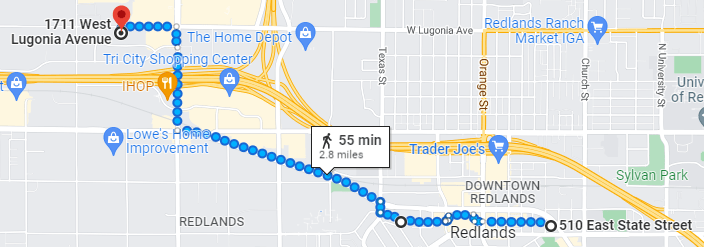
The three “shacks” are all within three miles of each other, which means that you could start the day at Breakfast Shack, go to Taco Shack for lunch, and then walk the breakfast and tacos off before enjoying a Pizza Shack dinner.

From west to east: Pizza Shack, Breakfast Shack, and Taco Shack. Via Google Maps.

I had nothing to do with Fielding Buck’s story, or with the three “shacks” in Redlands, but this story caught my eye.

Does your Inland Empire business have a story to tell?

Perhaps you don’t own a restaurant, but you may be in another type of business that has a story that you want to share.

  • Perhaps it’s a shorter story of around 400 to 600 words.
  • Or maybe it’s a medium length story of 2800 to 3200 words.
  • Something that you could share in a blog post, a social media Facebook or LinkedIn post, or in a downloadable form on your website.
  • Something that speaks to your potential customers’ needs, and clearly communicates the benefits that your business’ product or service provides to your potential customers.

Bredemarket’s content creation process ensures that the final written content (a) advances your GOAL, (b) communicates your BENEFITS, and (c) speaks to your TARGET AUDIENCE. It is both iterative and collaborative. For the full process, read this.

Bredemarket can help your Inland Empire business tell that story. Even if you’re west of Redlands and don’t serve food.

(Psst: local readers should scroll to the end of this page for a special “locals only” discount.)

If you would like Bredemarket to help your business tell your story…

Inland Empire B2B Content Services from Bredemarket.

How “Omni” is your Omnichannel?

One of Bredemarket’s clients is a consulting firm that advises other companies on the use of a particular enterprise content management system. Among other things, this consulting firm can help its client companies configure the outbound information the companies’ systems provide.

Which leads us to our word for today, omnichannel.

In marketing, “omnichannel” refers to “the process of driving customer engagement across all channels with seamless, targeted messaging.”

Across ALL marketing channels. That’s what omnichannel talks about.

Here’s what Erin O’Connor says:

Omnichannel marketing lets marketers create seamless, integrated customer experiences spanning both online and offline channels to connect with customers as they move through the buying cycle. Omnichannel marketing focuses on the life cycle of the customer. For example, when a customer is in the acquisition phase, the marketer will send a different type of message compared to a loyal customer

Omnichannel marketing is …a holistic approach in the sense that it’s looking at all of the potential touchpoints customers can use to communicate with brands, both online and offline.

From https://business.adobe.com/glossary/omnichannel-marketing.html

An omnichannel marketing strategy may encompass a number of marketing tools, including email, white paper downloads, videos, mobile SMS responses, automated call centers, and anything else that marketers use to communicate with clients.

One of the key benefits of an omnichannel marketing strategy is, or should be, consistency. If your emails say that your product is supported on Windows 11, your data sheets had better not say that your product is only supported up to Windows 10. This is a definite problem; see my checklist item 2 in this post.

(Incidentally, I recently ran across a company that is still talking about NIST FRVT results from several years ago. Since the NIST FRVT tests are ongoing, any reference to old results is outdated because of all the new algorithms that have been submitted and that have better performance.)

So factual consistency is important. Omnichannel marketing also allows for visual consistency (well, not in the automated call center) in which all of the company’s content looks like it came from the same company.

Obviously there are a number of benefits from omnichannel marketing, including easier management and consistency of marketing messages. But all of this raises a question:

Is omnichannel marketing truly OMNIchannel? Or does omnichannel marketing leave some things out?

Before you point me to the definition of “omni” and say that omnichannel marketing by definition can’t exclude anything, read on.

When product marketers don’t market

If you’re a marketer, I hope you’re sitting down.

The world does not revolve around marketing.

(My college roommates who were physics majors made sure to remind me of this.)

Thus, anything that isn’t marketing is automatically excluded from omnichannel marketing. And there are a number of things that companies do that aren’t marketing per se.

I recently held a discussion with a product marketer which got me thinking. We were talking about the things product marketers do, which include content creation (case studies/testimonials, white papers, social media content, and the like) and other product-related tasks such as competitive analysis of other products.

But then the product marketer mentioned something else.

What about having the product marketer author product technical documentation, such as user guides?

(By the way, I’ve written technical documentation in the past; see the “Benefiting from my experience and expertise” section of the Bredemarket “Who I Am” page.)

Now technical documentation is (usually) not the place for overt marketing messaging, but at the same time technical documentation authorship benefits the product marketer and the company by immersing the product marketer into the details of the product, thus increasing the marketer’s product understanding.

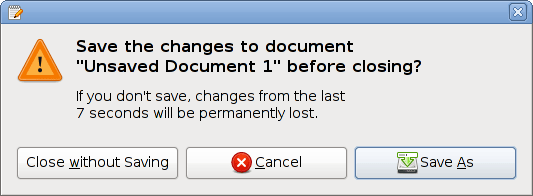
I’ll grant you need a different writing style when writing technical documentation; after all, there are no earthshaking benefits from clicking on the “Save As” button.

By Later version were uploaded by Bruce89 at en.Wikipedia. – Transfered from en.Wikipedia; en:File:Dialog1.pngtransfered to Commons by User:IngerAlHaosului using CommonsHelper., GPL, https://commons.wikimedia.org/w/index.php?curid=8988455

But you need different writing styles for the different types of marketing output anyway. The mechanics of writing a tweet differ from the mechanics of filming a video. So a marketer who isn’t experienced in technical documentation can adjust to the new style.

However, finding marketers slash technical documentation writers in the wild is unusual. Every company that I’ve worked with since 1991 has built some type of wall between the marketing function and the technical documentation function. But oddly enough, one of my former employers (MorphoTrak) moved managers around between the different functions. One manager in particular headed up the technical documentation group, then headed up the proposals group (where I worked for her), then headed up a multi-functional marketing team (where I worked for her again), then specialized in product marketing.

And now the product marketer (not the one from MorphoTrak, but the one I had been talking to) got the hamster in my brain to start generating ideas.

If omnichannel marketing is limited, and your omnichannel efforts should include activities outside of marketing such as technical documentation, what else should be included in your omnichannel efforts?

Including proposal writing in omnichannel efforts

OK, the subtitle gave it away. (But I refused to write the subtitle “This marketer wrote a user guide. You won’t believe what he did next!”)

If anything, proposal writing is closer to marketing than technical documentation is to marketing. While proposal writing is often considered a sales function (though some would disagree), there are obvious overlaps between the benefits that you espouse in a proposal and the benefits that you espouse in a case study.

Including standard proposal text/template creation as part of your omnichannel efforts also helps to ensure consistency in your product messaging. Again, if your data sheet says one thing, and your user guide says the same thing, then your proposal had better say the same thing also. (Unless you’re proposing something that won’t be implemented for another one or two years, in which case the proposal will discuss things that won’t appear in the present data sheets and user guides, but in future versions.)

Now those of you who are familiar with what Bredemarket does can appreciate why I love this idea.

By Loudon dodd – Own work, CC BY-SA 3.0, https://commons.wikimedia.org/w/index.php?curid=7404342

I’ve positioned Bredemarket as a two-headed (but not two-faced) marketing and writing service provider: for example, with separate descriptions of my status as a biometric content marketing expert and a biometric proposal writing expert. And that pretty much mirrors how I work. With one exception, most of my clients only use me for either my proposal services or my content marketing services.

What if companies entrusted Bredemarket with their total solution, both inside and outside of traditional marketing?

Of course there are complications in implementing this.

But when can you implement true omnichannel efforts?

Now most companies are ill-fitted to have one person, or even one department, handle all the omnichannel marketing (case studies, white papers, data sheets, tweets, LinkedIn posts, competitive intelligence, etc.) AND all the omnichannel non-marketing (technical documentation, proposals, and all the other stuff that my hamster brain didn’t realize yet).

So how do you get multiple departments to communicate the same messaging? It’s a difficult task, especially since most department members are so focused on their own work that they don’t have the bandwidth to worry about what another department is doing. (“I don’t care about the data sheet error. I just write the manuals.”)

There are several ways to achieve this: central ownership of the messaging for all departments, outside quality audits, and peer-to-peer interdepartmental review come to mind.

But you’re not going to solve the problem of inconsistent messaging between your departments unless you realize that the problem exists…and that “omnichannel marketing” won’t solve it.

Six methods to get your content in the hands of your customers

Whether you are an identity firm creating case studies, an Inland Empire West firm creating testimonials, or some other type of firm, creation of the content is only half the battle.

You still have to get the content into the hands of your end customers. “If you build it, they will come” is movie fiction.

By IowaPolitics.com – Field_of_Dreams, CC BY-SA 2.0, https://commons.wikimedia.org/w/index.php?curid=68597747

Here are six ways to get your created content to a place where your end customers can see it and use it. Perhaps you can use one or more of these methods to distribute your important content.

Method one: titles

Unless you have some bizarre reason to obfuscate the content by choosing an innocuous title such as “About THAT Reuters article,” you need to start by choosing the appropriate title that will induce your target audience to read your content.

For example, I want to be recognized as a biometric content marketing expert, so I created a page with that very title.

And continuously publicized it (including in this post).

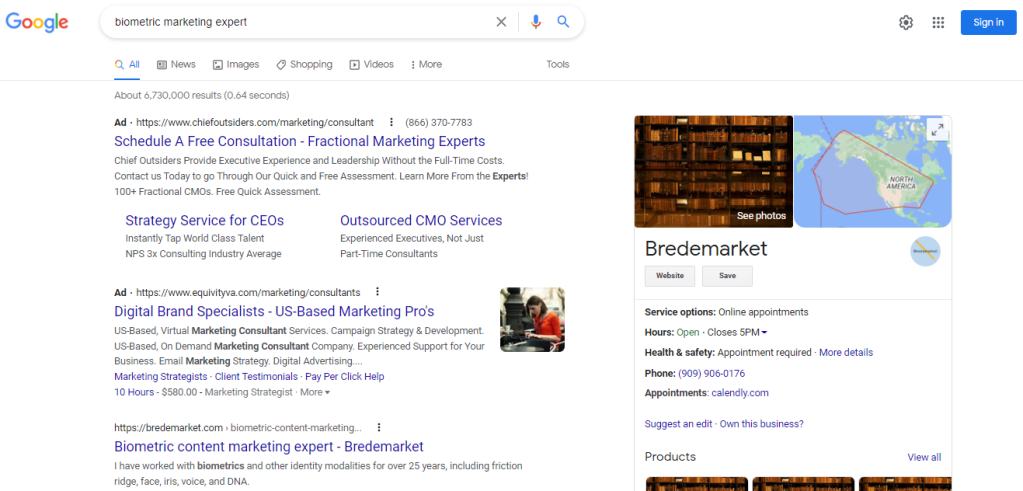
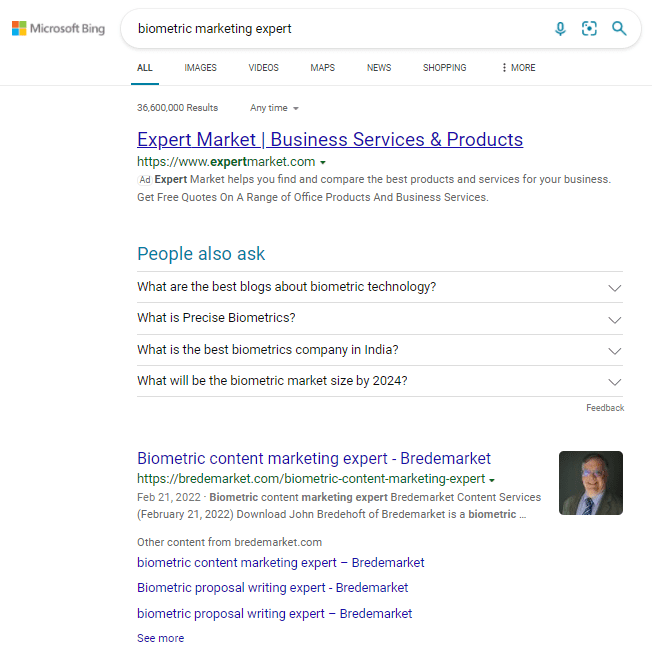
As a result, that page is now the first non-sponsored search term on several services, even for similar searches. I surveyed three search engines; here are incognito search results from two of these search engines for the words “biometric marketing expert” (without the word “content”).

Google incognito search for biometric marketing expert. This one even captured my Google company listing.
Bing incognito search for biometric marketing expert. Bing also shows related Bredemarket content.

Method two: tags

I intentionally saved the third set of search results to display here, since DuckDuckGo not only hit on my post, but on my collection of all posts tagged with “biometric content marketing expert.”

DuckDuckGo incognito search (not that it matters with DuckDuckGo) for biometric content marketing expert. This not only shows the page itself, but also identically named tag.

As another example, to date I have written over a dozen posts about case studies, all of which can be accessed via the link https://bredemarket.com/tag/case-study/.

Of course, I could step up my tagging work.

Not THAT tagging, although the terms are obviously related. By John H. White, 1945-, Photographer (NARA record: 4002141) – U.S. National Archives and Records Administration, Public Domain, https://commons.wikimedia.org/w/index.php?curid=16914422.

I have never bothered to create a tag “testimonial,” so I still have to do that, starting with this post. (I’ll slowly work my way back through the other posts so that testimonial seekers can find that content also.)

Method three: words

Remember the post “About THAT Reuters article” that I referenced earlier? As I said, I had a specific reason for choosing that vanilla title.

I could have entitled the post “Former IDEMIA employee weighs in on Advent’s possible sale of the company.” That would have got some clicks, to be sure.

But it would have misled the reader, because the reader would have gotten the idea that I have some expertise in corporate acquisitions, and an abillity to predict them.

From https://bredemarket.com/2022/02/08/about-that-reuters-article/

But despite the boring title, this post is one of my most popular posts of 2022. Why? Because even though the title is obfuscating, the content of the post itself can’t help but use some words such as Advent, IDEMIA, IPO, Reuters, and Thales. And people found the post because it included words which interested them.

(So much for obfuscation.)

Partial Google Search Console results for the “About THAT Reuters article” page.

Method four: landing pages/doors

Often you don’t land exactly at the content, but instead land at another page that directs you to the content. Because I subscribe to Jay Clouse’s “Creative Companion” newsletter, I get to read his articles before the general LinkedIn public sees them. Unless there’s an editorial change, this week’s LinkedIn article will include the following:

…the majority of my subscriber growth today doesn’t come through my front door, it comes from the dozens of side doors that I’ve created.

Jay Clouse Sunday 3/13/2022 email, “How to grow an email newsletter.”

(UPDATE 3/16: You can read the LinkedIn version of Jay’s post here.)

Does your text need to break on through? By APA-Agency for the Performing Arts-management – eBay itemphoto frontphoto back, Public Domain, https://commons.wikimedia.org/w/index.php?curid=23274437

I don’t necessarily count on my readers immediately landing at the “correct” page. If I write compellingly enough, they could arrive at that page from somewhere else.

For example, I have a page called “Bredemarket and proposal services” that talks about…(drumroll)…Bredemarket’s proposal services. But there are over three dozen pages on the Bredemarket website that link to that page.

Google Search Console list of a few of the pages linking to https://bredemarket.com/bredemarket-and-proposal-services/

So if someone is REALLY interested in a topic, and if the content link uses text that is something better than “such responses,” the person will get to the desired content and I can help the person.

Which reminds me, I need to include my call to action. Normally I stick this at the end of a post, but let’s put it in the middle of the post just for fun. If I can help your company create content or give you some ideas on how to distribute the content:

Method five: email

I could probably do better at this one, but I do perform SOME email marketing.

For example, after I wrote my post about Alaska HB389 and its foreign ownership clause, I took the time to email it to some of my contacts whose companies are directly affected by the bill. I’ve also emailed people when I want to promote some of my various Bredemarket services.

After a year and a half in business, I have discovered that my hundreds of contacts do NOT religiously read the Bredemarket blog daily (although I do have hundreds of subscribers: click the link at the bottom of this post if you would like to join the blog subscription list). So there are times when I use email to highlight items of interest to a particular person.

But only if they’re interested. No need for Microsoft Power BI contacts to learn what happens if a driver’s license production company is only 94% U.S. owned. They probably don’t care.

Method six: social media channels

I am a little better at social media content distribution than I am at email marketing. But again, it’s important to distribute the content to the correct social media channel.

Over the weekend, I wrote two nearly identical posts that were targeted to two separate markets.

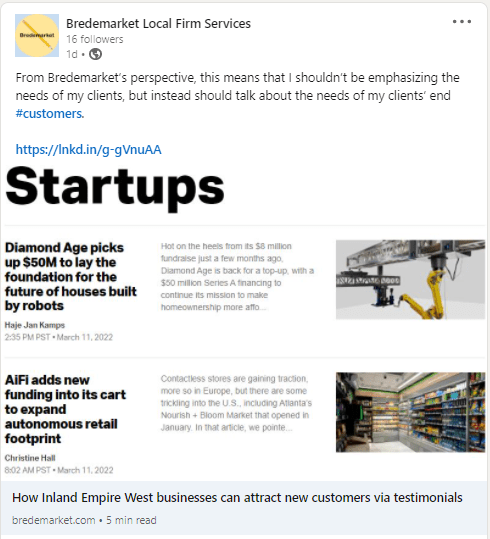
The post that was targeted to local Inland Empire West companies was reshared in my LinkedIn group Bredemarket Local Firm Services.

The post that was targeted to identity/biometric companies was reshared in my LinkedIn group Bredemarket Identity Firm Services.

So the content of interest to the locals was shared on the local page, and the content of interest to the identity companies was shared on the identity page.

And that applies to ALL of the methods listed above. Emailing content to the right people. Linking from related content. Using the right words, tags, and titles.

All of these techniques, plus all of the other techniques that this post failed to mention, serve the purpose of getting the created content into the hands of the people who can benefit from it.

If I can help you with this, or with creating the content in the first place…oh, I already included the call to action between Methods 4 and 5. No need to be redundantly repetitive.

How Inland Empire West businesses can attract new customers via testimonials

(Updated 4/18/2022 with additional customer focus information.)

I recently had the occasion to observe the digital marketing of a particular company, which I will refer to as “WidgetCo” in this post. (WidgetCo is NOT a current Bredemarket customer, and for various reasons will probably not become a future Bredemarket customer.)

Without going into detail, most of WidgetCo’s digital marketing (online information about the company on its website and its social media channels) emphasized its financial achievements, all related to startup funding.

TechCrunch’s recent funding news. (“WidgetCo” is NOT one of the companies listed.) By the time you read this, it will be updated. From https://techcrunch.com/startups/recent-funding/

If you’ve been around me for any length of time, you know how I reacted.

So what?

Let me give you an example of why bragging about your Series X funding is meaningless to your potential customers.

  • When you go to Amazon, Best Buy, or a similar online product-buying service, you can search for products based on various criteria.
  • For example, you can search for TVs based on screen size, or can search for computers based on the available storage, or search for CDs based on the artist.
  • Have you ever seen an online marketplace that lets you search for a product based upon the company’s Series C funding amount?

The reason that you can’t search for a product based upon its company’s Series C funding is because the customer doesn’t give a, um, hoot about the company’s Series C funding. You never hear a customer say, “You know, this product is good, but this other product comes from a company that just completed a $25 million Series C funding round. I’ll buy the other one instead.”

So why do people talk about this so much?

Customer-centric marketing

Marketing efforts need to begin with the customer, what the customer needs, and how you can fulfill the customer’s needs.

I think this makes the point quite nicely. From the Gary Fly / Brooks Group article “7 Tips for Implementing a Customer-Centric Strategy,” at https://brooksgroup.com/sales-training-blog/7-tips-implementing-customer-centric-strategy/

From Bredemarket’s perspective, this means that I shouldn’t be emphasizing the needs of my clients, but instead should talk about the needs of my clients’ end customers.

So, for example, my company Bredemarket shouldn’t EMPHASIZE my nearly 40 years in the Inland Empire West. It’s fine to mention it in passing, but that shouldn’t be the most important reason why you should use my marketing and writing services.

Instead, I SHOULD be emphasizing that you should use Bredemarket’s marketing and writing services because I can help you tell the stories that you need to tell to attract customers to your product or service.

  • You have the need to attract customers.
  • Bredemarket can help you attract customers.

I think you notice the theme here.

From the Gary Fly / Brooks Group article “7 Tips for Implementing a Customer-Centric Strategy,” at https://brooksgroup.com/sales-training-blog/7-tips-implementing-customer-centric-strategy/

There are various ways to tell these stories. Today I just want to talk about one of them.

Testimonials

You can say that your company provides an excellent product or service.

But it’s more important when one of your customers says that your company provides an excellent product or service. Outside praise is more important than self-praise (something I realized myself when I set Bredemarket’s second goal for 2022), and a testimonial that quotes one of your customers speaks the same language as your other customers.

As of February 16, 2022, I have created fourteen (14) case studies for clients. (“Case study” can be considered a fancy word for “testimonial”; both have the same goal.) For example, one of the case studies featured a law enforcement agency that used a product from a particular biometric firm. The law enforcement agency faced a particular need, the biometric firm provided a product that met this need, and the law enforcement agency apprehended a criminal with the product much more quickly than it could have without the product. (In fact, it’s possible that without the biometric firm’s product, the criminal may NEVER have been apprehended.)

So how does the biometric firm use this case study? It goes to OTHER law enforcement agencies and says, “Hey, YOU have this problem. Look at how another law enforcement agency solved this problem.” Because the case study was written from the perspective of a law enforcement agency, the message resonantes with other law enforcement agencies.

Cops talking to cops. It works.

From the Gary Fly / Brooks Group article “7 Tips for Implementing a Customer-Centric Strategy,” at https://brooksgroup.com/sales-training-blog/7-tips-implementing-customer-centric-strategy/

Now YOU are asking ME, “So what?”

To be fair, the Inland Empire West businesspeople who are reading this are saying, “I don’t work with law enforcement agencies. How can your testimonial services help ME?”

I have not only worked with companies that sell to law enforcement agencies, but with other types of firms, ranging from sole proprietors to huge multinationals, that need to communicate with their end users.

If you’re sick of focusing on the customer by this point, then perhaps you shouldn’t be in business. From the Gary Fly / Brooks Group article “7 Tips for Implementing a Customer-Centric Strategy,” at https://brooksgroup.com/sales-training-blog/7-tips-implementing-customer-centric-strategy/

In addition, YOU remain an essential part of the testimonial creation process. (Along with the customer that we will feature in the testimonial, of course.) When you engage with Bredemarket, we start by agreeing on the goal of the content, the benefits to communicate, and the target audience.

Bredemarket’s content creation process ensures that the final written content (a) advances your GOAL, (b) communicates your BENEFITS, and (c) speaks to your TARGET AUDIENCE. It is both iterative and collaborative….

(At the beginning) You and Bredemarket agree upon the topic, goal, benefits, and target audience (and, if necessary, outline, section sub-goals, relevant examples, and relevant key words/hashtags, and interim and final due dates).

From https://bredemarket.com/bredemarket-400-short-writing-service/

You can read about how we will work together here, in my description of the Bredemarket 400 Short Writing Service. (If you want me to prepare a really LONG testimonial or case study, I can do that also.)

But will you enjoy the final product? I just happen to have a testimonial…

“I just wanted to truly say thank you for putting these templates together. I worked on this…last week and it was extremely simple to use and I thought really provided a professional advantage and tool to give the customer….TRULY THANK YOU!”

Comment from one of the client’s employees who used the standard proposal text

Oh, and one more thing. If you’re an Inland Empire West business, be sure to read this page and find the discount code at the bottom of the page.

If my services can help you:

Hey! Didn’t I just read something similar?

Perhaps you recently read a Bredemarket blog post that included many of the same words that you saw in this post, and you’re now wondering if you’re going through deja vu all over again.

Yes, I wrote two similar (but not identical) posts.

  • This post is targeted to Inland Empire West companies who need Bredemarket services for testimonials (or case studies).
  • One post is targeted to biometric/identity customers who need Bredemarket services for case studies (or testimonials).

Why TWO posts, each of which is targeted to SEPARATE Bredemarket social media channels?

Because I need to address the needs of DIFFERENT types of customers, by using my skill set as applicable.

(4/18/2022: For additional information on customer focus, click here.)

And if I grow both sectors of my business, my Series B funding round will be HUGE.

By Beltane43 – Own work, CC BY-SA 3.0, https://commons.wikimedia.org/w/index.php?curid=30298042

How identity businesses can attract new customers via case studies

(Updated 4/18/2022 with additional customer focus information.)

I recently had the occasion to observe the digital marketing of a particular company, which I will refer to as “WidgetCo” in this post. (WidgetCo is NOT a current Bredemarket customer, and for various reasons will probably not become a future Bredemarket customer.)

Without going into detail, most of WidgetCo’s digital marketing (online information about the company on its website and its social media channels) emphasized its financial achievements, all related to startup funding.

TechCrunch’s recent funding news. (“WidgetCo” is NOT one of the companies listed.) By the time you read this, it will be updated. From https://techcrunch.com/startups/recent-funding/

If you’ve been around me for any length of time, you know how I reacted.

So what?

Let me give you an example of why bragging about your Series X funding is meaningless to your potential customers.

  • When you go to Amazon, Best Buy, or a similar online product-buying service, you can search for products based on various criteria.
  • For example, you can search for TVs based on screen size, or can search for computers based on the available storage, or search for CDs based on the artist.
  • Have you ever seen an online marketplace that lets you search for a product based upon the company’s Series C funding amount?

The reason that you can’t search for a product based upon its company’s Series C funding is because the customer doesn’t give a, um, hoot about the company’s Series C funding. You never hear a customer say, “You know, this product is good, but this other product comes from a company that just completed a $25 million Series C funding round. I’ll buy the other one instead.”

So why do people talk about this so much?

Customer-centric marketing

Marketing efforts need to begin with the customer, what the customer needs, and how you can fulfill the customer’s needs.

I think this makes the point quite nicely. From the Gary Fly / Brooks Group article “7 Tips for Implementing a Customer-Centric Strategy,” at https://brooksgroup.com/sales-training-blog/7-tips-implementing-customer-centric-strategy/

From Bredemarket’s perspective, this means that I shouldn’t be emphasizing the needs of my clients, but instead should talk about the needs of my clients’ end customers.

So, for example, my company Bredemarket shouldn’t EMPHASIZE my 25-plus years of biometric expertise. It’s fine to mention it in passing, but that shouldn’t be the most important reason why you should use my marketing and writing services.

Instead, I SHOULD be emphasizing that you should use Bredemarket’s marketing and writing services because I can help you tell the stories that you need to tell to attract customers to your product or service.

  • You have the need to attract customers.
  • Bredemarket can help you attract customers.

I think you notice the theme here.

From the Gary Fly / Brooks Group article “7 Tips for Implementing a Customer-Centric Strategy,” at https://brooksgroup.com/sales-training-blog/7-tips-implementing-customer-centric-strategy/

There are various ways to tell these stories. Today I just want to talk about one of them.

Case studies

You can say that your company provides an excellent product or service.

But it’s more important when one of your customers says that your company provides an excellent product or service. Outside praise is more important than self-praise (something I realized myself when I set Bredemarket’s second goal for 2022), and a case study that quotes one of your customers speaks the same language as your other customers.

As of February 16, 2022, I have created fourteen (14) case studies for clients. For example, one of the case studies featured a law enforcement agency that used a product from a particular biometric firm. The law enforcement agency faced a particular need, the biometric firm provided a product that met this need, and the law enforcement agency apprehended a criminal with the product much more quickly than it could have without the product. (In fact, it’s possible that without the biometric firm’s product, the criminal may NEVER have been apprehended.)

So how does the biometric firm use this case study? It goes to OTHER law enforcement agencies and says, “Hey, YOU have this problem. Look at how another law enforcement agency solved this problem.” Because the case study was written from the perspective of a law enforcement agency, the message resonantes with other law enforcement agencies.

Cops talking to cops. It works.

From the Gary Fly / Brooks Group article “7 Tips for Implementing a Customer-Centric Strategy,” at https://brooksgroup.com/sales-training-blog/7-tips-implementing-customer-centric-strategy/

Now YOU are asking ME, “So what?”

To be fair, some of the identity businesspeople who are reading this are saying, “I don’t work with law enforcement agencies. How can your case study services help ME?”

I have not only worked with companies that sell to law enforcement agencies, but with other types of firms, ranging from sole proprietors to huge multinationals, that need to communicate with their end users.

If you’re sick of focusing on the customer by this point, then perhaps you shouldn’t be in business. From the Gary Fly / Brooks Group article “7 Tips for Implementing a Customer-Centric Strategy,” at https://brooksgroup.com/sales-training-blog/7-tips-implementing-customer-centric-strategy/

In addition, YOU remain an essential part of the case study creation process. (Along with the customer that we will feature in the case study, of course.) When you engage with Bredemarket, we start by agreeing on the goal of the content, the benefits to communicate, and the target audience.

Bredemarket’s content creation process ensures that the final written content (a) advances your GOAL, (b) communicates your BENEFITS, and (c) speaks to your TARGET AUDIENCE. It is both iterative and collaborative….

(At the beginning) You and Bredemarket agree upon the topic, goal, benefits, and target audience (and, if necessary, outline, section sub-goals, relevant examples, and relevant key words/hashtags, and interim and final due dates).

From https://bredemarket.com/bredemarket-400-short-writing-service/

You can read about how we will work together here, in my description of the Bredemarket 400 Short Writing Service. (If you want me to prepare a really LONG case study or testimonial, I can do that also.)

But will you enjoy the final product? I just happen to have a testimonial…

“I just wanted to truly say thank you for putting these templates together. I worked on this…last week and it was extremely simple to use and I thought really provided a professional advantage and tool to give the customer….TRULY THANK YOU!”

Comment from one of the client’s employees who used the standard proposal text

If my services can help you:

Hey! Didn’t I just read something similar?

Perhaps you recently read a Bredemarket blog post that included many of the same words that you saw in this post, and you’re now wondering if you’re going through deja vu all over again.

Yes, I wrote two similar (but not identical) posts.

  • One post is targeted to Inland Empire West companies who need Bredemarket services for testimonials (or case studies).
  • This post is targeted to biometric/identity customers who need Bredemarket services for case studies (or testimonials).

Why TWO posts, each of which is targeted to SEPARATE Bredemarket social media channels?

Because I need to address the needs of DIFFERENT types of customers, by using my skill set as applicable.

(4/18/2022: For additional information on customer focus, click here.)

And if I grow both sectors of my business, my Series B funding round will be HUGE.

By Beltane43 – Own work, CC BY-SA 3.0, https://commons.wikimedia.org/w/index.php?curid=30298042