The reason that I redirected the purpose of my Substack posts is because much of my audience there isn’t familiar with the…um…minutiae of biometrics and identity. (For example, my reference to minutiae would probably go right past all but two of my Substack subscribers.)
My Substack audience is best served with awareness content.
But awareness content is not only informative and educational.
Awareness of you
It also makes prospects aware of your company…which is critically important.
“Technology marketers, do your prospects know who you are?
“If they don’t, then your competitors are taking your rightful revenue.
“Don’t let your competitors steal your money.”
Perhaps steal is a harsh word, but it’s accurate.
Or perhaps a better word is indifference: your actions indicate that you don’t care whether customers buy from you or not. If you cared, you’d actually market your products.
Who needs marketing?
“Nonsense, John! We have a sales staff. Who needs marketers?”
But your sales staff cannot be everywhere. If your prospects don’t know about you and aren’t reaching out to you, then you have to reach out to them.
And the calls? “Hi, I’m Tom with WidgetCorp.” “With who?”
So how is that current quarter looking now?
You need marketing, now
Your current quarter and future quarters would look better if your secret salesperson were working for you. As Rhonda Salvestrini said:
“Content for your business is one of the best ways to drive organic traffic. It’s your secret salesperson because it’s out there working for you 24/7.”
But the secret salesperson won’t engage your prospects until you act to create that content.
It’s not enough for your company’s prospects to know who you are, but it helps. But you can do more than that…with Bredemarket’s help.
Who are you?
Who are you?
I just searched for the leading software providers in a particular category. This isn’t unusual. If someone wants to purchase software, they will often conduct their own research before letting themselves be pestered by salespeople.
My category search turned up several software packages.
It DIDN’T turn up numerous others in that category.
So a whole bunch of companies are already at a disadvantage, and there’s a good chance that their competitors are going to take their money because the software buyer won’t even think of purchasing from them.
The software buyer has no AWARENESS of these other software packages.
“Two discussions of this three-step sales funnel are provided by Venn Marketing and Walker Sands (the latter of whom throws in things that happen AFTER the purchase, engagement and advocacy).
“Both sources define awareness as the first step in the funnel, and its purpose is to (drumroll) simply make prospects, um, aware that you and your product/service exist.”
Obviously there are other things you need to do to end up with a happy customer, but you’ll never get a happy customer if it doesn’t even know about you during the prospect stage.
Awareness of what?
We’re a unicorn!
Now there are all sorts of ways to raise awareness, but some are better than others.
I previously linked to the story of Beatrice’s rise and fall, in which the fall was illustrated by the infamous “We’re Beatrice” campaign. The tagline? “We’re Beatrice.” What did the tagline mean to prospects? Absolutely nothing.
I knew of another company that was slightly more successful, but not much. Instead of saying “We’re (COMPANY NAME),” they loudly proclaimed “We’re a Unicorn.” This was back during one of the periods of heated market acquisitions. But what difference did the company’s unicorn status mean for its prospects? Not much. If you’ve raised a billion dollars, I only care if you promise to give me a couple of million of it.
Here in Southern California, Honda car dealers have banded together to produce ads about the “helpful Honda people.” Unfortunately, the ads have nothing to do with cars, the products these commercials are supposed to be selling. What difference does a Honda dealer’s helpfulness make? Unless your cat is stuck in a tree, not much.
It’s not enough for your company’s prospects to have awareness about you. They need to have awareness about how you can solve their problems.
Perhaps your company needs to raise awareness of your solutions to your prospects’ problems.
Bredemarket can work with you on this, asking questions and even engaging in…um…WOMBAT to produce impactful content for your company and its products and services.
So that your prospects know about you.
Then we can work on the next steps, consideration and conversation.
Technology marketers, do your prospects know who you are?
If they don’t, then your competitors are taking your rightful revenue.
Don’t let your competitors steal your money.
Before I tell you how Bredemarket can solve your technology company’s awareness problem, let me spill the secret of why I’m asking the question in the first place.
The wildebeest’s friend
Normally I don’t let non-person entities write Bredemarket content, but today I’m making an exception.
Sources.
My usual generative AI tool is Google Gemini, so I sent this prompt:
“What are the five most important types of marketing content to create for a technology software company?”
A little secret: if you want generative AI to supply you with 3 things, ask for more than that. Some of the responses will suck, but maybe the related ones are insightful.
In this case I only wanted ONE type of marketing content, but I reserve the right to “co-author” four more posts based upon the other responses.
Of the 5 responses from Google Gemini, this was the first:
“In-depth Problem-Solving Content (Think Blog Posts, White Papers, Ebooks): Your potential customers are likely facing specific challenges. Content that dives deep into those problems and offers insightful solutions (even if it doesn’t directly pitch your product) builds trust and positions you as a thought leader. Think “The Ultimate Guide to [Industry Challenge]” or a white paper on “Navigating [Complex Technical Issue].””
Now you see where I got the idea for the title of this post. Normally I shy away from bombastic words like “ultimate,” but this sage is going a little wild.
So the bot tells me that the most important type of marketing content for a technology software company is short-form or long-form problem-solving content.
Going meta
Let’s get a little meta (small m) here.
If your prospects don’t know who you are, create customer-focused content that explains how your company can solve their problems.
Solving problems.
Now let’s get meta meta.
If you need help creating this content, whether it’s blog posts, articles, white papers, case studies, proposals, or something else, Bredemarket can help you solve your problem.
Let’s talk about your problem and how we can work together to solve it. Book a free meeting via the https://bredemarket.com/cpa/ URL.
(All AI illustrations from Imagen 3 via Google Gemini, of course)
While updating my resume today, I discovered that I have now written over 700 blog posts on the Bredemarket site alone. This is number 725, in case you’re keeping score.
And that doesn’t count the myriad of blog posts I’ve written for consulting clients or employers, plus the posts I’ve written for other blogs over the years dating back to 2003.
So in case you’re wondering: yes, I’ve written blog posts before.
And I can augment your company’s resources by writing blog posts (for example, via the Bredemarket 400 Short Writing Service) that drive awareness, consideration, and/or conversion.
With over 29 years of identity/biometric experience, John Bredehoft of Bredemarket is the biometric product marketing expert that can move your company forward.
A client is attending an in-person event and asked for advice on how to collect prospect leads at the event. (For awareness.)
Since I practice a mix of old school and new-school technologies, I’m suggesting the following:
Create a landing page for the event with a form to collect the prospect’s name, email, and other essential information, and feed those names into the client’s customer relationship management (CRM) system.
Create a printed sheet with a QR code leading to the landing page, have the prospect point their camera to the QR code, and then the prospect can enter their information directly from their phone.
There are many other ways to collect information, including specialized software and (really old school) business cards, but this way will work.
I wanted to demonstrate how to do this, but Bredemarket doesn’t have any in-person events on its calendar, and I don’t ask my prospects to sign up for my CRM.
Leftover pizza is the best pizza. Preparation credit: Pizza N Such, Claremont, California. Can I earn free pizza as a powerful influencer? Probably not, but I’ll disclose on the 0.00001% chance that I do.
Now that it’s time to write the “separate post,” I really don’t want to get into the mechanics of how posts that attract prospects (hungry people, target audience) increase awareness and help you convert prospects for your products and services.
So forget that. I’m going to tell a story instead about two executives at a fictional company that has a real problem. The executives’ names are Jones and Smith.
The story
Jones was troubled. Sales weren’t increasing, prospects weren’t appearing, and if this malaise continued the company would have to conduct a second round of layoffs. Jones knew that “rightsizing” would be disastrous, so the company needed another solution.
So Jones videoconferenced Smith and asked, “How can we make 2024 better than 2023?”
Smith replied, “Increasing sales calls could help, and ads could help, but there’s another way to increase our awareness with our prospects. We could create content on our website and on our social channels that spreads knowledge of our products and services.”
Jones exclaimed, “That’s great! We could get generative AI to create content for us!”
“No, not that!” Smith replied. “Generative AI text sounds like a bot wrote it, and makes us sound boring, just like everyone else using generative AI text. Do we want to sound like that and put our prospects to sleep?”
“So we need a human writer,” Jones realized, “one who can describe all of the features of our products.”
“Absolutely not,” Smith emphasized. “Customers don’t care about our features. They care about the benefits we can provide to them. If we just list a bunch of features, they’ll say, ‘So what?'”
“OK, we’ll go with benefits,” said Jones. “But why is content so important?”
“Take blogging,” replied Smith. “The average company that blogs generates 55% more website visitors. B2B marketers that use blogs get 67% more leads than those who do not. Marketers who have prioritized blogging are 13x more likely to enjoy positive ROI. And 92% of companies who blog multiple times per day have acquired a customer from their blog.”
“Wow.” Jones was silent for a moment. “How do you know all of this stuff, Smith?”
“Because of the content that I’ve read online from a marketing and writing services company called Bredemarket. The company creates content to urge others to create content. Bredemarket eats its own wildebeest food.”
Have you ever seen those posts from self-appointed gurus?
Specifically, the ones that authoritatively state the BEST time to WRITE a post on Instagram, or LinkedIn, or TikTok, or whatever?
I religiously ignore those posts for a simple reason: My country has multiple time zones. So the best time in one time zone may be the worst time in another time zone.
However, I can tell you the WORST time to READ a post in the PACIFIC Time Zone…if the post concerns pizza.
And I’ll explain what all this means…eventually.
Ophir Tal on awareness
In addition to saying WHEN to post, the gurus also provide authoritative (and often contradictory) advice about WHAT to post.
For example, some gurus assert that you MUST prioritize bottom of funnel (conversion) content over top of funnel (awareness) content because it’s most important to get people to buy.
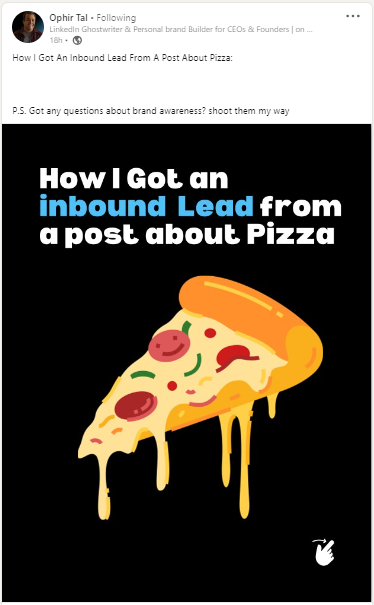
Ophir Tal disagrees, and has evidence to support his position.
This hook caught my attention. People want leads, and people like pizza, so I paid attention. But I also paid attention for a third reason that I’ll discuss later.
Tal then noted that the gurus would have recommended NOT posting this because he was “doing it wrong.” Specifically:
The post didn’t solve a problem for his potential clients. (Unless they regularly drop slices of pizza, I guess.)
It didn’t have a strong call to action.
It wasn’t targeted to his ideal clients. (Again, unless they regularly drop slices of pizza, or unless they love chicken wings.)
But despite doing everything wrong, that particular piece of content attracted the attention of someone “at a 6 figure ecom company.” After viewing the content, the reader looked at Tal’s profile and realized Tal could meet their need for ghostwriting services.
And now I’ll tell you the third reason why I paid attention to Tal’s post.
John Bredehoft on birthdays
As I noted above, I paid attention to Ophir Tal’s pizza post for two reasons:
People want leads.
People like pizza.
Now let’s jump back to a post I wrote all the way back in 2023, one that described why I’ve soured on the term “target audience.” (Or, in Tal’s words, “ideal clients.”) I started that post by wondering if the term “needy people” would be better than “target audience.” Yes, but not good enough.
I’ll grant that “needy people” has a negative connotation, like the person who is sad when people forget their birthday.
It turns out that these people had a VERY GOOD reason for forgetting my birthday. However, I cannot reveal this reason to you because the disclosure would force me to reveal someone’s personal identifiable information, or PII. (Mine.)
So after they remembered my birthday, one of them asked what I did for my birthday…and I told them that my wife, father-in-law, and brother-in-law went out to dinner.
For pizza.
And I also told them that there were leftovers, which my wife and I enjoyed a few days later.
Leftover pizza is the best pizza. Preparation credit: Pizza N Such, Claremont, California. Can I earn free pizza as a powerful influencer? Probably not, but I’ll disclose on the 0.00001% chance that I do.
A nice story, and while I was reading Ophir Tal’s story on dropped pizza, I realized that I had missed an opportunity to tell my own story about leftover pizza.
Time to channel Steve Jobs…
Oh, and there’s one more thing
I forgot to mention one thing about the Ophir Tal story.
When I read the story, it was around 4:00 pm in California.
So when I read about Tal’s dropped pizza, and thought about my leftover pizza (which I had already eaten)…I was hungry.
Technologists, you know how tough it is to create a technology product.
You have to assemble the technology, or perhaps create the technology yourself.
You have to work on the most minute details and make sure that everything is just right.
It takes a great deal of effort.
What if your product story is ignored?
But when you want to tell the story about your product, and all the effort you put into it, your prospects ignore everything you say. You might as well not be there.
Because they don’t care about you. It’s all about them.
People want to satisfy their own needs
But the “it’s all about me” attitude is actually a GOOD thing, if you can harness it in your messaging. Let’s face it; we all have an “it’s all about me” attitude because we want to satisfy our needs.
You want to satisfy your own needs because you only care about selling your product.
I want to satisfy my own needs because I only care about selling Bredemarket’s services. (I’ll get to the selling part later.)
And your prospects want to satisfy their own needs because they only care about their problems. And because of your customers’ self-focus, they’re only going to care about your product if it solves their problems.
So when it’s time to tell the story about your product, don’t talk about your technology.
Kasey Jones alerted me to the phrase “trust funnel,” and I’ve been thinking about it and its relationship to content marketing. Here are my thoughts.
The sales funnel
Many of us are familiar with the concept of sales funnels. The idea is that there are a bunch of people at the top of the funnel, and people move through the sales process.
As people move down, the funnel gets narrower and narrower as some people exit the funnel. At the bottom of the funnel, there is a very small hole that represents the customers who have converted, or who have actually purchased something.
In a rare instance of my championing simplicity, I like to use an easy three-step sales funnel model with awareness, consideration, and conversion.
From Venn Marketing, “Awareness, Consideration, Conversion: A 4 Minute Intro To Marketing 101.” (Link)
You may use a more complex sales funnel, but the exact number of steps in the funnel really doesn’t matter. What does matter is that your content marketers create content that addresses each step in your funnel.
In early steps of the funnel, the content goal is to ensure that prospects know that you’re out there and you have a solution that benefits the prospects.
In later steps of the funnel, the content goal is to move prospects to the point where they will purchase something from you, rather than purchasing it from one of your competitors or not purchasing anything at all.
Some of the approaches to sales funnel-based content marketing are based upon the faulty assumption that people progress through the funnel in a logical and predictable manner. In the logical model, you present an awareness piece of content, then follow that with a consideration piece of content, then finally present content to convert the prospect into a customer.
It’s about time we redefine the classic marketing funnel. It describes the user journey as a rather linear path, while the reality is a lot more messy, complex, and unpredictable.
Let’s scrap the dated marketing funnel and try to map out the real user journey.
It starts with a trigger, and then it goes into an almost infinite loop between exploration and evaluation – over and over again. And finally, the user exits the loop by making a decision or a purchase.
Oh, and in addition to assuming logic, standard content creation methods assume that your firm knows where every buyer is on their journey. This assumption is essential so that your firm can detect a prospect in the awareness phase and take the necessary steps to move them downward into the funnel (or toward the endless loop pictured above).
Kasey Jones and the trust funnel
I mentioned Kasey Jones at the beginning of this blog post, based upon something she shared on LinkedIn. She started with an inconvenient truth that blew the second assumption out of the water.
Your buyers will probably never like or comment on your posts.
So much for all of those fancy tools that identify the sources of interaction with your content. They don’t work if people don’t interact with your content.
Yet Jones notes that these people are still buying. Three of them reached out to her in the last two weeks.
Each mentioned my content as why they wanted to work with me.
But they have never, not once, engaged with anything I’ve done on here.
Still, they were in my trust funnel, just the same.
It’s different from the sales funnel that we are laboriously tracking in our customer relationship management (CRM) tool. For content marketers, these things literally pop up out of the blue from a “trust funnel” that we know nothing about, even though we’re building it with our content.
If I wished, I could name multiple examples of people reaching out to me because of my content or Bredemarket’s content.
Jones’ point in all this was to emphasize that you need to keep on creating “scroll-stopping content” to attract DREAM (her capitalization) clients.
Even though you don’t know who you are attracting.
You’re not a sausage grinder making sausages. You’re a flower attracting bees.
By The original uploader was Y6y6y6 at English Wikipedia. – Original image located at PDPhoto.org. Transferred from en.wikipedia to Commons by Drilnoth using CommonsHelper., Public Domain, https://commons.wikimedia.org/w/index.php?curid=7365698
Now I could end this discussion right here with Kasey Jones’ comments, but I thought I’d perform a LinkedIn search to see who else was talking about the trust funnel.
And I found Kevin Schmitz.
Kevin Schmitz and the trust funnel
Schmitz approached the topic from a different perspective in his post from earlier this week. He focused on a particular piece of content: a person’s LinkedIn profile and activity.
Schmitz asserted that if someone approaches you with a meeting request, and the person’s LinkedIn presence is (his words) “bare bones,” you’re less likely to take the meeting. But if a meeting requester posts engaging, relevant content, perhaps you’ll take that call.
Schmitz went on to say:
Your presence on LinkedIn is not a “lead funnel”.
It’s a “trust funnel”.
We work so damn hard to establish trust in the meeting.
Yet, most of us are person 1 (the “bare bones” person) with an uphill battle each and every meeting.
Kevin Schmitz LinkedIn post, 8/22/2023 ot 8/23/2023. (Link)
If you’re interested, Schmitz’s post goes on to suggest ways to make your LinkedIn presence more engaging.
The meaning for content marketing
So what does the idea of “creating content that resonates with your invisible trust funnel” mean for content marketing?
Most people realize (or I hope they realize) that organic content often does not have an immediate payoff, especially for complex B2B sales. Even if I write the most amazing automated biometric identification system (ABIS) content for a Bredemarket client, the client won’t get orders within the first three days of posting the content. (I’ll have more to say about “three days” in a future post discussing go-to-market efforts.) Even if I am the biometric content marketing expert. (I’ve been working on promoting THAT piece of content for a while now.)
It takes longer than three days for content marketing to yield results. One source estimates four to five months. Another source says six to twelve months. Joe Pulizzi (quoted by Neil Patel) estimates 15 to 17 months. And all the sources say that their estimates may not apply to your particular case.
But Bredemarket (and I in my personal communications) will continue to cater to that invisible trust funnel and see what happen.
And if you’re reading this post in Janury 2025, thank you. If you want to talk to me about content creation, some of these links may still work!

























 Bredemarket