The U.S. Census provides “quick facts” about U.S. jurisdictions, including business facts. While the business facts are ten years old, they still provide an indication of business health.
For Fontana, the U.S. Census Bureau has documented almost 14,000 firms, over $1 billion in manufacturers shipments, and over $2 billion in retail sales. These figures have presumably increased in the last ten years.
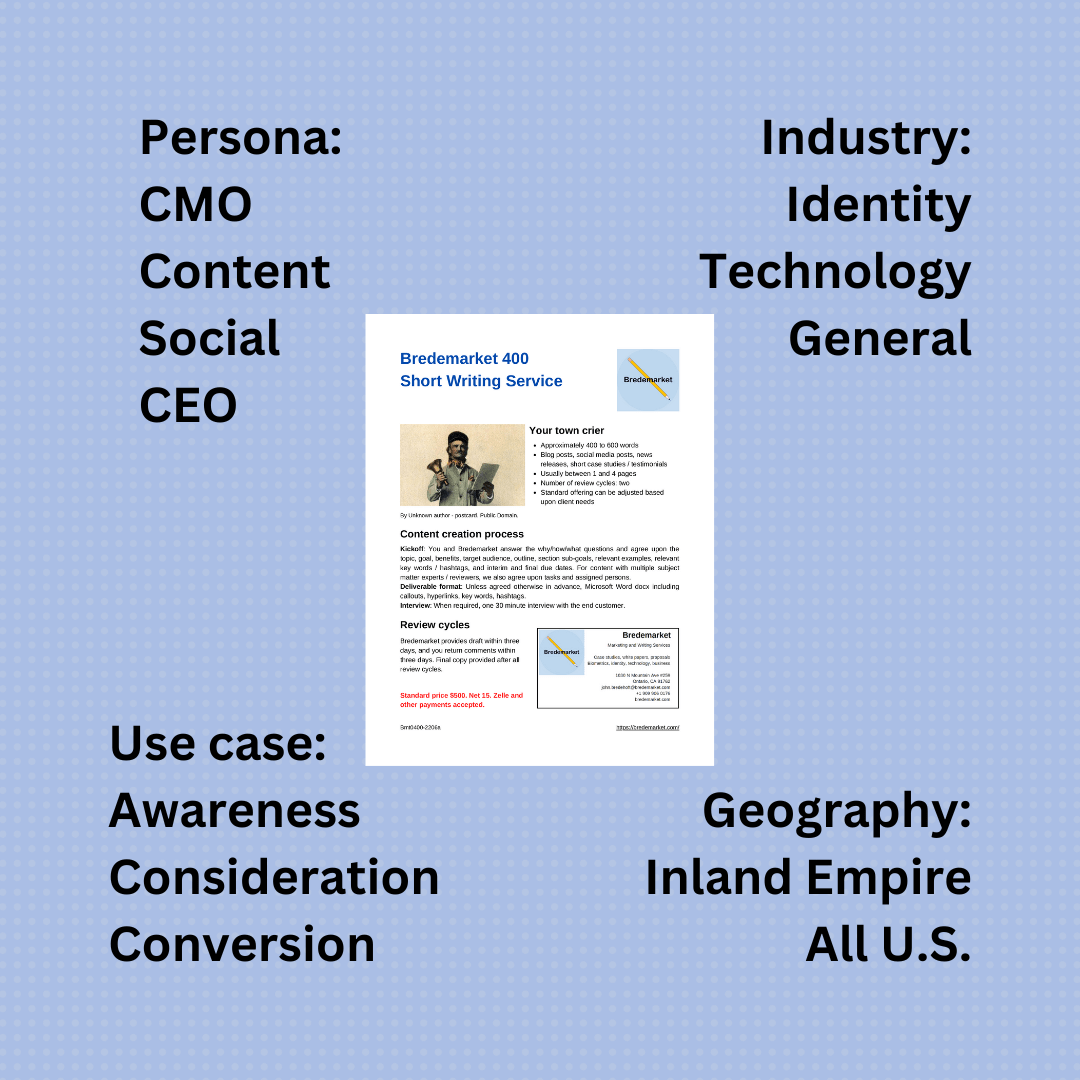
If you own or manage one of these thousands of businesses, and you need to let other businesses know about your offerings, perhaps you should turn to the Fontana, California content marketing expert. Bredemarket can assist your firm with the following:
Both small and large businesses need to attract customers to their companies, their products, and their services. Once potential customers are aware of the company’s business, then they can consider the benefits of the company’s offerings and (hopefully) decide to purchase the company’s products and services.
But what if you don’t want people to buy your company’s products and services?
Edgar Porras, 49, of Moreno Valley, was charged in a criminal information filed today with one count of bid rigging. In a plea agreement also filed today, Porras agreed to plead guilty to the offense.
During the scheme that ran from 2013 through August 2018, Porras conspired “to suppress and restrain competition by rigging bids to obtain selected food contracts offered by the BOP,” according to court documents. To further the scheme, Porras, who was a contractor to a food company identified as “Company A,” agreed with co-conspirators not to compete to obtain the BOP contracts, and collectively they decided which conspirator would submit the lowest – and presumably winning – bid for a contract.
By spending his time on rigging bids, the guilty party made sure that he couldn’t actually spend valuable time improving prison food. And we certainly don’t want that.
If you want to ensure that your business doesn’t make money, then I have two helpful tips for you.
Two TERRIBLE tips for business promotion
Tip 1: It’s all about you
When potential customers research businesses, they are usually looking for a company that can solve their problems. In other words, customers want a business that speaks to the customer’s needs.
However, we all know that the customer is always wrong, and that customers don’t realize what is important to YOU, the business owner. (What is wrong with these customers?)
Therefore, it’s important that your marketing materials talk about YOUR concerns, rather than the concerns of the customer. This will impress the customer, who will obviously realize that their concerns are unimportant compared to YOURS.
Here are three examples of things to include in your marketing materials:
Spend a lot of time talking about when the company was founded, the number of patents and awards held by the company founder, some early stories that you find funny (why isn’t the Bill Gates arrest story on the front page of Microsoft’s website?), and how the company has changed since its earliest days.
When talking about your company’s products and services, be sure to concentrate on the features that impress your employees. Don’t try to apply these products to actual customer needs; customers should be able to figure this out themselves. Or just take the word of your engineers that the product is great.
If you write company-centric rather than customer-centric materials, then you are guaranteed to have customers ignore you, or even better avoid you.
Tip 2: Never update your content
Set it and forget it. It’s an easy way to maintain online content.
Granted, when you first create a website, a blog, or a social media account, creation of initial content is unavoidable. Now it’s quite possible that you can delay the appearance of that content by not posting anything until the content is perfect, but at some point the content is going to have to go live.
But once that unavoidable posting is complete, then your job is done. If you keep the same static content on there, you’ll maintain consistency. To maintain that consistency, be sure to avoid the following three things:
Avoid posting any new content. Once you post new content, then the search engines will flag and highlight the new content. And you don’t want the new content to appear more important than the old content, do you?
Avoid updating old information on your website or social media content. Outdated content such as 2015 copyright dates and references to Windows NT support are powerful messages that accentuate the long time that your company has been in business, without cluttering it up by mentioning anything modern. If your company was established in the 1990s, then animated GIFs and automated MIDI players convey an essential lack of innovation. For example, see http://www.netanimations.net/ (and yes, that’s http, not https).
Avoid updating outdated links. If you have a Twitter account that links to your website, and you fail to pay your web hosting bill, be sure that the Twitter account continues to link to the dead website. When the potential customer encounters the dead website, this will pique the customer’s curiosity and the customer will search for your new website, if any.
Professional salespeople often talk about pre-qualifying leads. If you follow the three steps above, then you will automatically pre-qualify your leads, since any customer who takes the time to find your current information is obviously motivated.
If you want to ignore my advice
Because I am always right, you will obviously follow my advice to alienate potential customers. If you instead choose to attract customers, then you’ll ignore my advice and do the exact opposite of what I say.
But what’s the fun in customer-centric, current content?
Some people know what they will do, and what they will not do.
Other people say they will do anything.
Don’t trust the second group of people.
Checking all the boxes in a Bredemarket contact submission form
As you may know, Bredemarket has an online contact page that allows people to request information from me. The form on this page includes several checkboxes (recently edited) that allow the submitter to specify if they are interested in one of Bredemarket’s standard packages.
Occasionally I’ll get a submission from someone who checked ALL of the check boxes. In 100% of those cases, it turns out that the person is NOT interested in ANY of Bredemarket’s standard packages, but in something else. (In the most recent example, someone wanted to write a guest post on the Bredemarket blog that had NOTHING to do with marketing or writing services. No thanks.)
Checking all the boxes in a proposal
It reminds me about the time, many years ago, when I wrote an RFP. This was years before I actually began responding to RFPs, by the way. The consultant that our company brought in suggested that we create a Request for Proposal for a particular service that our company wanted. The main part of the created RFP was a check list to see if the respondent provided a particular feature that we wanted. The responses that we received fell into two categories:
Some respondents checked every check box with no further comment. We concluded that they hadn’t actually read the RFP, so we ignored these proposals.
Other respondents checked most of the check boxes, but provided text for certain responses explaining that they had a different approach. Since these people read the RFP, we paid more attention to those responses.
Now I’ll grant that this filtering method doesn’t work for all proposals. Some RFPs truly demand mandatory compliance with every requirement. But in those cases, the RFPs usually require to say how they will perform each requirement. A simple “we do it” response is not sufficient.
Checking all the boxes in a business offering
The “check everything” rule also applies in one other instance: company offerings.
When a company states the products and services it will offer, the statement usually sets a boundary between what the company will do and what the company will not do.
Usually.
For example, this post from Reddit’s HireaWriter gives a clear picture of the writer’s strengths:
…I have a bachelor’s degree in screenwriting (writing for film, TV and radio), and I’m currently studying English Literature to further my skills. I’m about to be on summer holidays for a few months and I’m looking to collaborate on some writing projects.
I have freelance experience, writing YouTube scripts and some podcast work, I’m very capable of both fiction and non- fiction…
So if I need a YouTube script, I’ll consider this person. If I need an article for Foreign Affairs, maybe not.
But other company offerings are…less focused. You’ve probably seen the posts (I won’t link to them) from people who say that they write. When you ask what they write, they say that they write anything.
Now I guess that theoretically, I can write anything. (Heck, I wrote the Eastport Enquirer, which you can probably guess wasn’t high-minded business prose.) But I’m not going to make a living by writing 19th century fiction or French political positions. I’ll stick closer to content marketing and proposals if you don’t mind.
This post explains why it feels familiar to a previous post of mine, what this certification is, and when I will (and will not) use my shiny new HubSpot Academy certification. It also includes a different call to action than the one I usually use.
Deja vu all over again: remember my CF APMP certification?
While certification in and of itself does not necessarily indicate operating confidence, it provides some level of assurance that the certified person knows what he or she is talking about.
Which is why I pursued and achieved APMP Foundation certification (CF APMP) in September 2021.
For those who don’t know, the Association of Proposal Management Professionals provides many benefits, including improved service to Bredemarket clients because of my access to the APMP Body of Knowledge.
It also provides a mechanism for proposal professionals to certify their mastery of the proposal field.
Which is great, if you’re a proposal professional.
But I also do other stuff.
What does it mean to be “Content Marketing Certified”?
My Bredemarket consultancy can be sliced and diced in several ways, one of which is to look at the proposals side of my business and the content marketing side of the business. The latter concentrates on generating content that attracts customers to a company’s offering, leading to revenue. At Bredemarket, I practice content marketing on two levels:
I create content for Bredemarket that attracts customers to use my services.
I create content for my customers that attracts THEIR customers to use THEIR services.
As you can see from the text of the certificate above, content marketing encompasses numerous subtasks:
Long-term content planning. Haphazard creation of content is not as beneficial as creation of content to achieve a particular goal.
Content creation. An important part of the process, but ONLY a part.
Content promotion. If you build it, they may not come. They have to know about it first.
Content analysis. Analyzing pertinent factors about the performance of the content.
Increasing results. Does the content increase revenue?
What about the shiny new designation that comes with the shiny new badge?
Unlike other certifications such as an academic degree, PMP certification, or my APMP Foundation certification, there is not a suffix that I can add to my name to tout my credentials. So I can’t call myself “John E. Bredehoft, HSA CMC” or something like that. (You should only use acronyms sparingly anyway.)
But I can certainly refer to my certification in certain circumstances.
Here’s a quic: which of these would be appropriate?
If you answer the correct question in this quiz…YOU GET NOTHING.
I’ve spent this afternoon posting messages to selected Facebook and LinkedIn pages, showcase pages, and groups talking about updates to blog content (and in one case a LinkedIn article).
If you look at the updated blog posts/LinkedIn article in question, you’ll see that they now start with this statement:
(Updated 4/16/2022 with additional benefits information.)
Then, when you scroll down the post/article to a benefits discussion, you’ll see this insertion:
(4/16/2022: For additional information on benefits, click here.)
This post explains
why I made those updates to the blog posts and the LinkedIn article,
how I added a new page to the Bredemarket website, and
what I still need to do to that new page to make it better.
Why I updated selected blog posts and a LinkedIn article
I talk a lot about benefits on the Bredemarket blog, but all of the conversation is in disparate, not-really-connected areas. I do have a page that talks about the benefits of benefits for identity firms, but that doesn’t really address the benefits of benefits for non-identity firms.
Then, while I was taking a HubSpot Academy course, I found a possible way to create a central page for discussion of benefits.
According to HubSpot, the need for pillar pages arose because of changes to Google’s search model.
Google is helping searchers find the most accurate information possible — even if it isn’t exactly what they searched for. For example, if you searched for “running shoes,” Google will now also serve you up results for “sneakers.” This means that bloggers and SEOs need to get even better at creating and organizing content that addresses any gaps that could prevent a searcher from getting the information they need from your site.
Now, your site needs to be organized according to different main topics, with blog posts about specific, conversational long-tail keywords hyperlinked to one another, to address as many searches as possible about a particular subject. Enter the topic cluster model.
But not all the content that I’ve written on benefits.
I’ve curated links to selected content (both on the Bredemarket website and on LinkedIn), provided a brief quote from the content in question, then provided a link to the original content for more information.
What I still need to do to the new page on the Bredemarket website
At this point the people who REALLY know search engine optimization are shaking their heads.
“John,” they are saying to me, “that’s not a pillar page!”
They’re right.
It’s just a very crude beginning to a pillar page. It lacks two things.
Multi-layered keywords associated with the “hub” topic
First, simply linking selected “benefits” pages together in a wheel is extremely simplistic. Remember how search engines can now search for both “running shoes” and “sneakers”? I need to optimize my wheel so that it drives traffic that isn’t tied to the specific word “benefits.”
Choose the broad topics you want to rank for, then create content based on specific keywords related to that topic that all link to each other, to create broader search engine authority….
For example, you might write a pillar page about content marketing — a broad topic — and a piece of cluster content about blogging — a more specific keyword within the topic.
Second, a pillar page needs better organization. Rather than having what I have now-a brief definition of benefits, followed by a reverse chronological list of posts (and the article) on benefits, the pillar page needs to address benefits, and its relevant subtopics, in an orderly fashion.
Pillar pages are longer than typical blog posts — because they cover all aspects of the topic you’re trying to rank for — but they aren’t as in-depth. That’s what cluster content is for. You want to create a pillar page that answers questions about a particular topic, but leaves room for more detail in subsequent, related cluster content.
HubSpot directs its readers to HubSpot’s own pillar page on Instagram marketing. Frankly I don’t know that I’d want to write something that long, but you can see how the pillar page provides an organized overview of Instagram marketing, rather than just a reverse chronological list of content that addresses the pillar topic.
More to come
So my pillar page on benefits certainly has room to grow.
But at least I’ve made an agile start with a first iteration, and the search engines can start processing the existing cluster of links as I make improvements.
And as I create additional pillar pages. I already have an idea for a second one.
Even people who live in Ontario, California may not know the story of the “mule car” in the median of Euclid Avenue at B St. You can see the mule car behind me in the “Cloudy days at the mule car” video below.
(And yes, sometimes the sun DOESN’T shine in Southern California.)
Four truths about the Ontario mule car
There are four things about the mule car that we know as fact.
1. The Ontario mule car began service in 1888
The single-car train line connected Ontario, North Ontario (North Ontario was later known as Upland), and San Antonio Heights (near 24th and Mountain today), and benefited local residents by providing an easy way to travel between the three establishments. As the Historical Marker Database website notes, more and more people settled on the master-planned Euclid Avenue in the years after Ontario was established in 1882, and the train line provided an easy way to travel north and south.
2. The Ontario mule car benefited from gravity
For those who are not familiar with San Antonio Heights, Upland, or Ontario, the northernmost community (San Antonio Heights) is near the mountains, and (according to the Electric Railway Historical Association) there is an elevation drop of 1200 feet over the ten miles from San Antonio Heights to Ontario.
Of course, from the southern perspective of Ontario (see this Pacific Electric Railway page for a picture of the railway looking north), there is an increase in elevation of 1200 feet, which is why the mules were needed to pull the train up the hill. The uphill climb took about an hour.
Once the train reached San Antonio Heights and began its descent back to Ontario, the mules were no longer needed to pull the car.
[O]n the return trip the motive power climbed aboard a tiny trailer and coasted down with the car.
Since this is the Bredemarket blog, I can’t let this story pass without discussing the benefits of this system:
Faster travel to on the southbound route to Ontario due to the faster downhill time.
No use of power for the southbound route.
Greater energy on the northbound route due to the rest that the mules received on the southbound journey.
(For additional information on benefits, click here.)
3. After electrification in 1895, the mule-less train line continued service until 1928
After several years, the train was electrified and the mules were no longer needed to power the train. This is when the train celebrated its heyday.
A thirty-acre amusement park was built by the company of San Antonio Heights, with a powerhouse adjoining. Heavy crowds were transported along Euclid Ave. in the early days, for the line connected Ontario with Upland, provided connections between the (Southern Pacific) Station at Ontario and the Santa Fe Station at Upland, and cared for the thongs bound for pleasure-seeking at the Park.
Unfortunately, I haven’t been able to find any additional information about the original 30-acre amusement park. Today’s “San Antonio Park” has ball fields, BBQ, picnic tables, a picnic shelter/gazebo, a playground, and restrooms, plus the historical San Antonio Heights Railroad Company Waiting Station. Fun, but not THAT fun.
And, of course, this provided benefits to various stakeholders:
The rail line benefited from increased revenue from passengers who wanted to connect from other rail lines to get to destinations on the route, most notably the park.
The park benefited from a convenient way to arrive, something that we seem to have lost today, since neither Ontario International Airport nor Los Angeles International Airport enjoy direct train service. (The Omnitrans 61 bus route goes to Ontario Airport every 20-30 minutes, and some day the Boring Company may establish a train connection.)
Passengers benefited from an easy way to get to this park.
(For additional information on benefits, click here.)
Ownership of the train line passed from the Ontario Electric Company to the Pacific Light & Power Corporation in 1908, and eventually to Southern Pacific in 1912, where it became the Pacific Electric Ontario & San Antonio Heights Line.
Eventually this rail line, like all rail lines in Southern California, ran into hard times because of our growing adoption of motor bus and automobile travel.
Line cut back to La Cima on 4 July 1924; on 1 November 1924, cut back to Upland. On 6 October. 1928, Ontario-Upland Line abandoned…. In the abandonment hearing in 1928, PE produced records which tended to show that this line was hopelessly incapable of earning even operating expenses.
If you visit the mule car at Euclid and B and wonder at how well-preserved it is, that’s because this isn’t the original 1887 mule car, which was lost to the winds of history. This is a replica, built in 1956-1957 and restored in approximately 1974. As the inscription on the plaque notes:
In 1956, William Richardson headed a group of citizens to have a replica of the original Mule Car constructed for the city’s 75th anniversary in 1957. With donated funds “a couple of prop guys from the MGM Studios in Hollywood” recreated it, working from old photos. After the 1957 Mule celebration, the Mule Car was stored in the City Yards, abandoned and forgotten.
In memory of their son Donald, who worked for the City of Ontario, Kip and Elinore Carlson and their friends restored the Mule Car and constructed this facility. On April 28, 1974, this Mule Car was dedicated “to the whole community.”
There is one thing about the mule car that may or may not be true, but it makes for a good story. Both hmdb.org and erha.org, as well as other sites such as our local Best Western website, tell the story of what happened to the mules after the train route was electrified and the mules were no longer needed.
According to the sources, the mules were sold to a farmer, who put the mules to work on his farm. This worked out for the farmer…half of the time. When the mules were required to plow uphill, they did so with no complaints.
However, according to the story, the mules refused to work downhill.
(Updated 4/16/2022 with additional benefits information.)
Everything is virtual
Many of our lives changed significantly in March 2020, when we left our offices and cubicles and decamped to makeshift desks in our homes. Since that time, those of us who are still working from home (WFH) have interacted with others via telephone, Cisco WebEx, Google Meet, Microsoft Teams, Slack, Zoom, and other virtual collaboration tools.
As part of our Sustainability Strategy and commitment to reach net zero greenhouse gas emissions by 2045, SDG&E is launching a Virtual Power Plant (VPP) Pilot Project in 2022, an initiative to strengthen community resilience and electric reliability in the unincorporated community of Shelter Valley in East San Diego County.
SDG&E realizes that you can’t just talk about the features of virtual power plants. SDG&E’s customers don’t care about features. Its customers only care about what’s in it for them. So SDG&E collected some benefits of virtual power plants.
(4/16/2022: For additional information on benefits, click here.)
The first benefit: community resilience and electric reliability
The first benefit that SDG&E identified for VPPs can be found in the text above, where it noted that virtual power plants can “strengthen community resilience and electric reliability.”
Now I’ll grant that Californa isn’t Texas, but there are more and more times where California’s electric power goes out, due either to very high temperatures, very high winds, or very high fire danger.
So SDG&E consumers (and consumers from other electric utilities) are more interested in electric reliability. If VPPs can provide that reliability, great!
So how does a VPP strengthen community resilience and electric reliability?
A key element of a VPP is its distributed energy resources, or DERs. With home-based solar power, batteries, smart thermostats, and other energy technologies, the days of a single centralized power source are over.
The second benefit: lower investment and operating costs
But rather than siloing these DERs, a VPP arranges to have them work as a single unit, just like a conventional power plant, but with a difference.
In other words, a VPP can mimic or potentially replace a conventional power plant and help address distribution network bottlenecks, but with lower investment and operating costs.
Note that SDG&E doesn’t take this a step further and say that this will result in a reduction in building of conventional power plants.
Since VPPs look like residential/commercial communities (because they are), most of us think that VPPs are prettier than many conventional power plants such as this one. By Cgord (talk) – (Cgord (talk)) created this work entirely by himself. Transferred from Wikipedia., GFDL, https://commons.wikimedia.org/w/index.php?curid=19912142
And SDG&E definitely doesn’t say that this will result in lower rates for energy consumers. But maybe some energy utility will make this commitment.
A musical postlude
A major component of a VPP is the solar energy that is generated by solar cells on people’s homes. Of course, solar energy is nothing new, as those of us who recall a certain song know all too well.
Via Bredemarket, I work with a number of clients who ask me to create content for them. Since last September, I have used an internal “kickoff guide” form to start my conversations with these clients.
While I thought that this kickoff guide was pretty good, I just revised it to make it even better.
The September 2021 iteration of the Bredemarket kickoff guide
I developed the Bredemarket kickoff guide to address a number of issues, including the style limitations of Google Docs. But the primary issue that prompted the kickoff guide was the need to capture as much information about a client project in the early stages, to reduce later rework.
The primary set of questions that I asked was a set of questions that I’ve talked about ad nauseum (literally). Before getting into the nuts and bolts of the content itself, there were three critical questions that I asked the client:
What is the goal that you want to achieve with the content?
What are the benefits (not features, but benefits) that your end customers can realize by using your product or service?
What is the target audience for the content?
There were two reasons that I asked these questions. First, I believed that the client’s final collateral would benefit if I asked these questions. Second, I believed that Bredemarket would benefit by differentiating itself from other writers who just launched into “the facts” questions about the content.
This goes beyond a particular product or service, and addresses a company’s reason for being. Here’s what HubSpot says about the need for the “Golden Circle”:
…what Sinek found is that most companies do their marketing backwards. They start with their “what” and then move to the “how.” Most of these companies neglect to even mention “why.” More alarmingly, many of them don’t even know why they do what they do!
Contrast this with companies (Apple is an oft-cited example) that know why they do what they do, and effectively communicate this. It may be hard to believe this, but for Apple, the “why” question is even more important than the latest color of its products (current iteration: “it’s green”).
So can Simon Sinek’s Golden Circle help my clients receive better marketing collateral, and can it help me (and Bredemarket) differentiate myself from other writers? And if so, what do I have do to achieve these benefits for my clients and myself?
The April 2022 iteration of the Bredemarket kickoff guide
One part of the answer was to revise my kickoff guide. In the latest iteration, I precede my goal/benefits/target audience questions with three questions derived from Sinek’s “Golden Circle,” starting with the all-important “why” question.
Of course, I still have to use the revised kickoff guide with a client, but I hope to do this shortly in one way or another. If you could like me to use this kickoff guide with your firm to help create meaningful, relevant content:
The U.S. Census provides “quick facts” about U.S. jurisdictions, including business facts. While the business facts are ten years old, they still provide an indication of business health.
For Ontario, the U.S. Census Bureau has documented over 14,000 firms, over $4 billion in manufacturers shipments, and over $4 billion in retail sales. These figures have presumably increased in the last ten years.
If you own or manage one of these thousands of businesses, and you need to let other businesses know about your offerings, perhaps you should turn to the Ontario, California content marketing expert. Bredemarket can assist your firm with the following: