Basically, I had gone through great trouble to document that Bredemarket would NOT take identity work, so I had to reverse a lot of pages to say that Bredemarket WOULD take identity work.
I may have found a few additional pages after June 1, but eventually I reached the point where everything on the Bredemarket website was completely and totally updated, and I wouldn’t have to perform any other changes.
You can predict where this is going.
Who I…was
Today it occurred to me that some of the readers of the LinkedIn Bredemarket page may not know the person behind Bredemarket, so I took the opportunity to share Bredemarket’s “Who I Am” web page on the LinkedIn page.
So yes, this biometric content marketing expert/identity content marketing expert IS available for your content marketing needs. If you’re interested in receiving my help with your identity written content, contact me.
I know that I’m the guy who likes to say that it’s all semantics. After all, I’m the person who has referred to five-page long documents as “battlecards.”
But sometimes the semantics are critically important. Take the terms “factors” and “modalities.” On the surface they sound similar, but in practice there is an extremely important difference between factors of authentication and modalities of authentication. Let’s discuss.
What is a factor?
To answer the question “what is a factor,” let me steal from something I wrote back in 2021 called “The five authentication factors.”
Something You Know. Think “password.” And no, passwords aren’t dead. But the use of your mother’s maiden name as an authentication factor is hopefully decreasing.
Something You Have. I’ve spent much of the last ten years working with this factor, primarily in the form of driver’s licenses. (Yes, MorphoTrak proposed driver’s license systems. No, they eventually stopped doing so. But obviously IDEMIA North America, the former MorphoTrust, has implemented a number of driver’s license systems.) But there are other examples, such as hardware or software tokens.
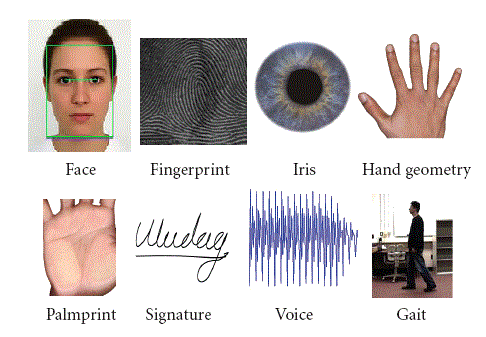
Something You Are. I’ve spent…a long time with this factor, since this is the factor that includes biometrics modalities (finger, face, iris, DNA, voice, vein, etc.). It also includes behavioral biometrics, provided that they are truly behavioral and relatively static.
Something You Do. The Cybersecurity Man chose to explain this in a non-behavioral fashion, such as using swiping patterns to unlock a device. This is different from something such as gait recognition, which supposedly remains constant and is thus classified as behavioral biometrics.
Somewhere You Are. This is an emerging factor, as smartphones become more and more prevalent and locations are therefore easier to capture. Even then, however, precision isn’t always as good as we want it to be. For example, when you and a few hundred of your closest friends have illegally entered the U.S. Capitol, you can’t use geolocation alone to determine who exactly is in Speaker Pelosi’s office.
(By the way, if you search the series of tubes for reading material on authentication factors, you’ll find a lot of references to only three authentication factors, including references from some very respectable sources. Those sources are only 60% right, since they leave off the final two factors I listed above. It’s five factors of authentication, folks. Maybe.)
The one striking thing about the five factors is that while they can all be used to authenticate (and verify) identities, they are inherently different from one another. The ridges of my fingerprint bear no relation to my 16 character password, nor do they bear any relation to my driver’s license. These differences are critical, as we shall see.
What is a modality?
In identity usage, a modality refers to different variations of the same factor. This is most commonly used with the “something you are” (biometric) factor, but it doesn’t have to be.
[M]any businesses and individuals (are adopting) biometric authentication as it been established as the most secure authentication method surpassing passwords and pins. There are many modalities of biometric authentication to pick from, but which method is the best?
After looking at fingerprints, faces, voices, and irises, Aware basically answered its “best” question by concluding “it depends.” Different modalities have their own strengths and weaknesses, depending upon the use case. (If you wear thick gloves as part of your daily work, forget about fingerprints.)
ID R&D goes a step further and argues that it’s best to use multimodal biometrics, in which the two biometrics are face and voice. (By an amazing coincidence, ID R&D offers face and voice solutions.)
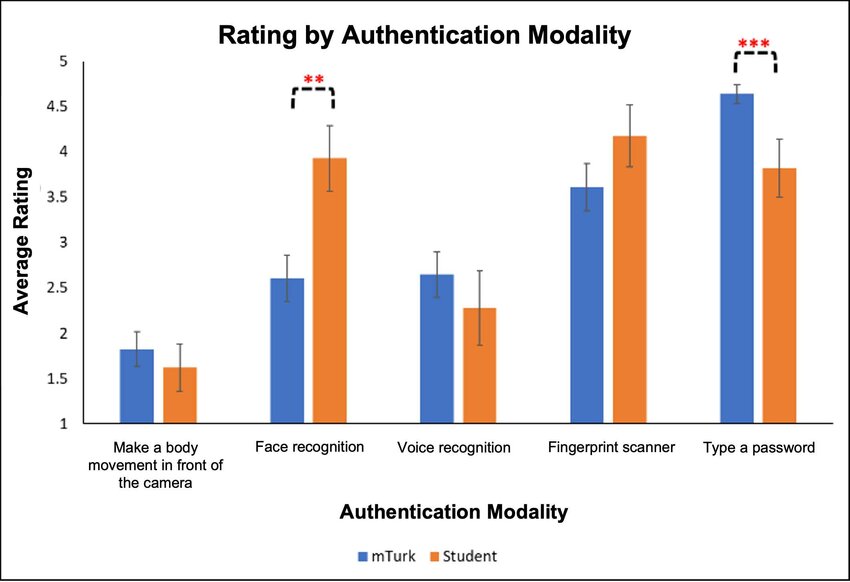
The three modalities in the middle—face, voice, and fingerprint—are all clearly biometric “something you are” modalities.
But the modality on the left, “Make a body movement in front of the camera,” is not a biometric modality (despite its reference to the body), but is an example of “something you do.”
Passwords, of course, are “something you know.”
In fact, each authentication factor has multiple modalities.
For example, a few of the modalities associated with “something you have” include driver’s licenses, passports, hardware tokens, and even smartphones.
Why multifactor is (usually) more robust than multimodal
Modalities within a single authentication factor are more closely related than modalities within multiple authentication factors. As I mentioned above when talking about factors, there is no relationship between my fingerprint, my password, and my driver’s license. However, there is SOME relationship between my driver’s license and my passport, since the two share some common information such as my legal name and my date of birth.
What does this mean?
If I’ve fraudulently created a fake driver’s license in your name, I already have some of the information that I need to create a fake passport in your name.
If I’ve fraudulently created a fake iris, there’s a chance that I might already have some of the information that I need to create a fake face.
However, if I’ve bought your Coinbase password on the dark web, that doesn’t necessarily mean that I was able to also buy your passport information on the dark web (although it is possible).
Can an identity content marketing expert help you navigate these issues?
As you can see, you need to be very careful when writing about modalities and factors.
You need a biometric content marketing expert who has worked with many of these modalities.
Actually, you need an identity content marketing expert who has worked with many of these factors.
So if you are with an identity company and need to write a blog post, LinkedIn article, white paper, or other piece of content that touches on multifactor and multimodal issues, why not engage with Bredemarket to help you out?
If you’re interested in receiving my help with your identity written content, contact me.
I didn’t either. Frankly, I didn’t even work in biometrics professionally until I was in my 30s.
If you have a mad adult desire to become a biometric content marketing expert, here are five topics that I (a self-styled biometric content marketing expert) think you need to understand.
Topic One: Biometrics
Sorry to be Captain Obvious, but if you’re going to talk about biometrics you need to know what you’re talking about.
The days in which an expert could confine themselves to a single biometric modality are long past. Why? Because once you declare yourself an iris expert, someone is bound to ask, “How does iris recognition compare to facial recognition?”
And there are a number of biometric modalities. In addition to face and iris, the Biometrics Institute has cataloged a list of other biometric modalities, including fingerprints/palmprints, voice, DNA, vein, finger/hand geometry, and some more esoteric ones such as gait, keystrokes, and odor. (I wouldn’t want to manage the NIST independent testing for odor.)
As far as I’m concerned, the point isn’t to select the best biometric and ignore all the others. I’m a huge fan of multimodal biometrics, in which a person’s identity is verified or authenticated by multiple biometric types. It’s harder to spoof multiple biometrics than it is to spoof a single one. And even if you spoof two of them, what if the system checks for odor and you haven’t spoofed that one yet?
Topic Two: All the other factors
In the same way that I don’t care for people who select one biometric and ignore the others, I don’t care for some in the “passwords are dead” crowd who go further and say, “Passwords are dead. Use biometrics instead.”
Although I admire the rhyming nature of the phrase.
If you want a robust identity system, you need to use multiple factors in identity verification and authentication.
Something you know.
Something you have.
Something you are (i.e. biometrics).
Something you do.
Somewhere you are.
Again, use of multiple factors protects against spoofing. Maybe someone can create a gummy fingerprint, but can they also create a fake passport AND spoof the city in which you are physically located?
It’s not enough to understand the technical ins and outs of biometric capture, matching, and review. You need to know how biometrics are used.
One-to-one vs. one-to-many. Is the biometric that you acquire only compared to a single biometric samples, or to a database of hundreds, thousands, millions, or billions of other biometric samples?
Markets. When I started in biometrics, I only participated in two markets: law enforcement (catch bad people) and benefits (get benefit payments to the right people). There are many other markets. Just recently I have written about financial identity and educational identity. I’ve worked with about a dozen other markets personally, and there are many more.
Use cases. Related to markets, you need to understand the use cases that biometrics can address. Taking the benefits example, there’s a use case in which a person enrolls for benefits, and the government agency wants to make sure that the person isn’t already enrolled under another name. And there’s a use cases when benefits are paid to make sure that the authorized recipient receives their benefits, and no one else receives their benefits.
Legal and privacy issues. It is imperative that you understand the legal ramifications that affect your chosen biometric use case in your locality. For example, if your house has a doorbell camera that uses “familiar face detection” to identify the faces of people that come to your door, and the people that come to your door are residents of the state of Illinois, you have a BIG BIPA (Biometric Information Privacy Act) problem.
Any identity content marketing expert or biometric content marketing expert worth their salt will understand these and related issues.
Topic Four: Content marketing
This is another Captain Obvious point. If you want to present yourself as a biometric contet marketing expert or identity content marketing expert, you have to have a feel for content marketing.
The definition of content marketing is simple: It’s the process of publishing written and visual material online with the purpose of attracting more leads to your business. These can include blog posts, pages, ebooks, infographics, videos, and more.
But content marketers need to be comfortable with creating at least one type of content.
Topic Five: How L-1 Identity Solutions came to be
Yes, an identity content marketing expert needs to thoroughly understand how L-1 Identity Solutions came to be.
I’m only half joking.
Back in the late 1990s and early 2000s (I’ll ignore FpVTE results for a moment), the fingerprint world in which I worked recognized four major vendors: Cogent, NEC, Printrak (later part of Motorola), and Sagem Morpho.
And then there were all these teeny tiny vendors that offered biometric and non-biometric solutions, including the fierce competitors Identix and Digital Biometrics, the fierce competitors Viisage and Visionics, and a bunch of other companies like Iridian.
Wel, there WERE all these teeny tiny vendors.
Until Bob LaPenta bought them all up and combined them into a single company, L-1 Identity Solutions. (LaPenta was one of the “Ls” in L-3, so he chose the name L-1 when he started his own company.)
So around 2008 the Big Four (including a post-FpVTE Motorola) became the Big Five, since L-1 Identity Solutions was now at the table with the big boys.
But then several things happened:
Motorola started selling off parts of itself. One of those parts, its Biometric Business Unit, was purchased by Safran (the company formed after Sagem and Snecma merged). This affected me because I, a Motorola employee, became an employee of MorphoTrak, the subsidiary formed when Sagem Morpho de facto acquired “Printrak” (Motorola’s Biometric Business Unit). So now the Big Five were the Big Four.
Make that the Big Three, because Safran also bought L-1 Identity Solutions, which became MorphoTrust. MorphoTrak and MorphoTrust were separate entities, and in fact competed against each other, so maybe we should say that the Big Four still existed.
Oh, and by the way, the independent company Cogent was acquired by 3M (although NEC considered buying it).
A few years later, 3M sold bits of itself (including the Cogent bit) to Gemalto.
Then in 2017, Advent International (which owned Oberthur) acquired bits of Safran (the “Morpho” part) and merged them with Oberthur to form IDEMIA. As a consequence of this, MorphoTrust de facto acquired MorphoTrak, ending the competition but requiring me to have two separate computers to access the still-separate MorphoTrust and MorphoTrak computer networks. (In passing, I have heard from two sources, but have not confirmed myself, that the possible sale of IDEMIA is on hold.)
Why do I mention all this? Because all these mergers and acquisitions have resulted in identity practitioners working for a dizzying number of firms.
As of August 2023, I myself have worked for five identity firms, but in reality four of the five are the same firm because the original Printrak International kept on getting acquired (Motorola, Safran, IDEMIA).
And that’s nothing. One of my former Printrak coworkers (R.M.) has also worked for Digital Biometrics (now part of IDEMIA), Cross Match Technologies (now part of ASSA ABLOY), Iridian (now part of IDEMIA), Datastrip, Creative Information Technology, AGNITiO, iTouch Biometrics, NDI Recognition Systems, iProov, and a few other firms here and there.
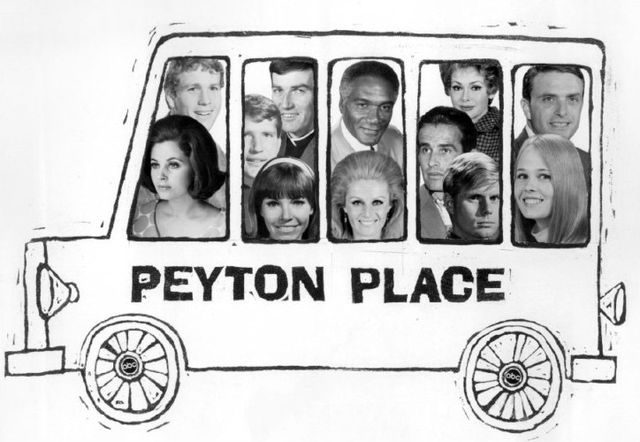
The point is that everybody knows everybody because everybody has worked with (and against) everybody. And with all the job shifts, it’s a regular Peyton Place.
Not sure which one is me, which one is R.M., and who the other people are.
Do you need an identity content marketing expert today?
Do you need someone who not only knows biometrics and content marketing, but also all the other factors, their uses, and even knows the tangled history of L-1?
As some of you know, I’m seeking full-time employment after my former employer let me go in late May. As part of my job search, I was recently invited to a second interview for a company in my industry. Before that interview, I made an important decision about how I was going to present myself.
If you’ve read any of Bredemarket’s content, there are times when it takes a light tone, in which wildebeests roam the earth while engaging in marketing activities such as elaborating the benefits of crossing the stream.
Some of that DOES NOT fly in the corporate world. (For most companies, anyway.) If you analyze a wide selection of corporate blogs, you won’t see the word “nothingburger.” But you do here.
So as I prepared for this important job interview, I made sure that I was ready to discuss the five factors of authentication, and my deep experience as an identity content marketing expert with many of those factors.
The five factors of authentication, of course, are:
For the purposes of this job interview, there isn’t! I confined myself to the five factors only during the discussion, using examples such as passwords, driver’s licenses, faces, actions, and smartphone geolocation information.
But in the end, my caution was of no avail. I DIDN’T make it to the next stage of interviews.
Maybe I SHOULD have mentioned “Somewhat you why” after all.
(UPDATE OCTOBER 23, 2023: “SIX QUESTIONS YOUR CONTENT CREATOR SHOULD ASK YOU IS SO 2022. DOWNLOAD THE NEWER “SEVEN QUESTIONS YOUR CONTENT CREATOR SHOULD ASK YOU” HERE.)
But since you care about YOUR self-promotion rather than mine, I’ll provide three tips for writing and promoting your own LinkedIn post.
How I promoted my content
Before I wrote the blog post or the LinkedIn post, I used my six questions to guide me. For my specific example, here are the questions and the answers.
Question
Primary Answer
Secondary Answer (if applicable)
Why?
I want full-time employment
I want consulting work
How?
State identity and marketing qualifications, ask employers to hire me
State identity and marketing qualifications, ask consulting clients to contract with me
What?
Blog post (jebredcal), promoted by a personal LinkedIn post
Blog post (jebredcal), promoted by a Bredemarket Identity Firm Services LinkedIn post
You’ll notice that I immediately broke a cardinal rule by having both a primary goal and a secondary goal. When you perform your own self-promotion, you will probably want to make things less messy by having only a single goal.
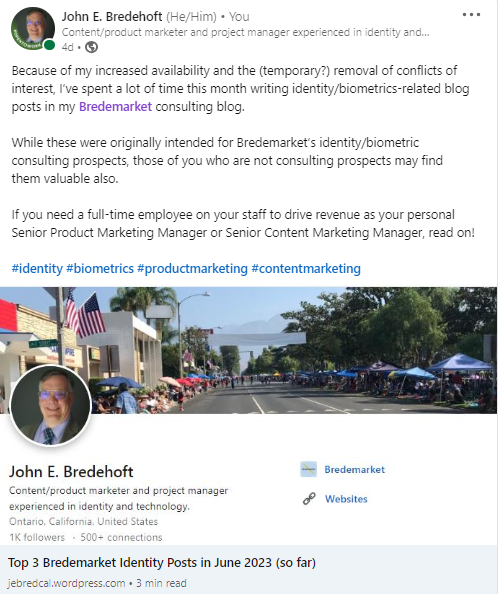
After the introduction (pictured above) with its “If you need a full-time employee” call to action, I then shared three identity-related blog posts from the Bredemarket blog to establish my “biometric content marketing expert” (and “identity content marketing expert”) credentials. I then closed with a dual call to action for employers and potential consulting clients. (I told you it is messy to have two goals.)
If you want to see my jebredcal post “Top 3 Bredemarket Identity Posts in June 2023 (so far),” click here.
So how did I get the word out about this personal blog post? I chose LinkedIn. (In my case, hiring managers probably aren’t going to check my two Instagram accounts.)
It was simple to write the LinkedIn text, since I repurposed the introduction of the blog post itself. I added four hashtags, and then the post went live. You can see it here.
And by the way, feel free to like the LinkedIn post, comment on it, or even reshare it. I’ll explain why below.
Third, the “LinkedIn Love” promotion
So how did I promote it? Via the “LinkedIn Love” concept. (Some of you know where I learned about LinkedIn Love.)
To get LinkedIn love, I asked a few trusted friends in the identity industry to like, comment, or reshare the post. This places the post on my friends’ feeds, where their identity contacts will see it.
A few comments:
I don’t do this for every post, or else I will have no friends. In fact, this is the first time that I’ve employed “LinkedIn Love” in months.
I only asked friends in the identity industry, since these friends have followers who are most likely to hire a Senior Product Marketing Manager or Senior Content Marketing Manager.
I only asked a few friends in the identity industry, although eventually some friends that I didn’t ask ended up engaging with the post anyway.
I have wonderful friends. After several of them gave “LinkedIn Love,” The post received significant engagement. As of Friday morning, the post had acquired over 1,700 impresions. That’s many, many more than my posts usually acquire.
I don’t know if this activity will directly result in full-time employment or increased consulting work. But it certainly won’t hurt.
Three steps to promote YOUR content
But the point of this post isn’t MY job search. It’s YOURS (or whatever it is you want to promote).
For example, one of my friends who is also seeking full-time employment wanted to know how to use a LinkedIn post to promote THEIR OWN job search.
Now you don’t need to use my six questions. You don’t need to create a blog post before creating the LinkedIn post. And you certainly don’t need to create two goals. (Please don’t…unless you want to.)
In fact, you can create and promote your own LinkedIn post in just THREE steps.
Step One: What do you want to say?
My six questions obviously aren’t the only method to collect your thoughts. There are many, many other tools that achieve the same purpose. The important thing is to figure out what you want to say.
Start at the end. What action do you want the reader to take after reading your LinkedIn post? Do you want them to read your LinkedIn profile, or download your resume, or watch your video, or join your mailing list, or email or call you? Whatever it is, make sure your LinkedIn post includes the appropriate “call to action.”
Work on the rest. Now that you know how your post will end, you can work on the rest of the post. Persuade your reader to follow your call to action. Explain how you will benefit them. Address the post to the reader, your customer (for example, a potential employer), and adopt a customer focus.
Step Two: Say it.
If you don’t want to write the post yourself, then ask a consultant, a friend, or even a generative AI tool to write something for you. (Just because I’m a “get off my lawn” guy regarding generative AI doesn’t mean that you have to be.)
(And before you ask, there are better consultants than Bredemarket for THIS writing job. My services are designed and priced for businesses, not individuals.)
After your post is written by you or someone (or something) else, have one of your trusted friends review it and see if the written words truly reflect how amazing and outstanding you are.
Once you’re ready, post it to LinkedIn. Don’t delay, even if it isn’t perfect. (Heaven knows this blog post isn’t perfect, but I posted it anyway.) Remember that if you don’t post your promotional LinkedIn post, you are guaranteed to get a 0% response to it.
Step Three: Promote it.
Your trusted friends will come in handy for the promotion part—if they have LinkedIn accounts. Privately ask your trusted friends to apply “LinkedIn Love” to your post in the same way that my trusted friends did it for me.
By the way—if I know you, and you’d like me to promote your LinkedIn post, contact me via LinkedIn (or one of the avenues on the Bredemarket contact page) and I’ll do what I can.
And even if I DON’T know you, I can promote it anyway.
I’ve never met Mary Smith in my life, but she says that she read my Bredemarket blog post “Applying the “Six Questions” to LinkedIn Self-promotion.” Because she selects such high-quality reading material, I’m resharing Mary’s post about how she wants to be the first human to visit Venus. If you can help her realize her dream, scroll to the bottom of her post and donate to her GoFundMe.
Hey, whatever it takes to get the word out.
Let me know if you use my tips…or if you have better ways to achieve the same purpose.
Companies often have a lot of things they want to do, but don’t have the people to do them. It takes a long time to hire someone, and it even takes time to find a consultant that knows your industry and can do the work.
This affects identity/biometric companies just like it affects other companies. When an identity/biometric company needs a specific type of expertise and needs it NOW, it’s often hard to find the person they need.
If your company needs a biometric content marketing expert (or an identity content marketing expert) NOW, you’ve come to the right place—Bredemarket. Bredemarket has no identity learning curve, no content learning curve, and offers proven results.
Identity/biometric consulting in the 1990s
I remember when I first started working as an identity/biometric consultant, long before Bredemarket was a thing.
OK, not quite THAT long ago. I started working in biometrics in the 1990s—NOT the 1940s.
In 1994, the proposals department at Printrak International needed additional writers due to the manager’s maternity leave, and she was so valuable that Printrak needed to bring in TWO consultants to take her place.
At least initially, the other consultant and I couldn’t fill the manager’s shoes.
Both of us could spell “RAID.” Not the bug spray, but the storage mechanism that stored all those “huge” fingerprint images.
But on that first night that I was cranking out proposal letters for something called a “Latent Station 2000,” I didn’t really know WHAT I was writing about.
As time went on, the other consultant and I learned much more—so much that the company brought both of us on as full-time employees.
After we were hired full-time, we spent a combined 45+ years at Printrak and its corporate successors in proposals, marketing, and product management positions, contributing to industry knowledge.
But neither of us knew biometrics before we started consuting at Printrak.
And I had never written a proposal before I started consulting at Printrak. (I had written an RFP. Sort of.)
But frankly, there weren’t a lot of identity/biometric consultants out in the field in the 1990s. There were the 20th century equivalents of Applied Forensic Services LLC, but at the time I don’t think there were any 20th century equivalents of Tandem Technical Writing LLC.
Unlike the 1990s, identity/biometric firms that need consulting help have many options. In addition to Applied Forensic Services and Tandem Technical Writing you have…me.
Mike and Laurel can tell you what they can do, and I heartily endorse both of them.
Let me share with you why I call myself a biometric content marketing expert who can help your identity/biometric company get marketing content out now:
No identity learning curve
No content learning curve
Proven results
No identity learning curve
I have worked with finger, face, iris, DNA, and other biometrics, as well as government-issued identity documents and geolocation. If you are interested, you can read my Bredemarket blog posts that mention the following topics:
Because I’ve produced both external and internal content on identity/biometric topics, I offer the experience to produce your content in a number of formats.
External content: account-based marketing content, articles, blog posts (I am the identity/biometric blog expert), case studies, data sheets, partner comarketing content, presentations, proposals, sales literature sheets, scientific book chapters, smartphone application content (events), social media posts, web page content, and white papers.
Does your identity business provide biometric or non-biometric products and services that use finger, face, iris, DNA, voice, government documents, geolocation, or other factors or modalities?
Does your identity business need written content, such as blog posts (from the identity/biometric blog expert), case studies, data sheets, proposal text, social media posts, or white papers?
How can your identity business (with the help of an identity content marketing expert) create the right written content?
I really need to update my own website more frequently.
About a year ago, I created a web page and an accompanying brochure entitled “Bredemarket and Identity Firms.” I’ve updated the web page a time or two in the last year, but until a few minutes ago both the web page and the brochure were significantly out of date, and didn’t include some of the projects that I’ve worked on during the past few months.
You can view the updated web page or download the updated brochure (at the end of this post) if you like, but I’ll create a frictionless experience for you by reproducing (repurposing) the list of ALL of Bredemarket’s biometric/identity projects as of today. (And there are more projects in work that I haven’t listed yet.)
Proposal Writing: Created five proposal letter templates to let a biometric firm’s sales staff propose two products to five separate markets. After completing the first three templates, I received this unsolicited testimonial:
“I just wanted to truly say thank you for putting these templates together. I worked on this…last week and it was extremely simple to use and I thought really provided a professional advantage and tool to give the customer….TRULY THANK YOU!”
More Proposal Writing: Responded to three Requests for Information (RFIs) for two biometric firms, positioning the firms for future work from government agencies.
Even More Proposal Writing: Assisted a biometric firm in responding to multiple Requests for Proposal (RFPs) and sole source letters.
And more…: Created a proposal letter template for a biometric firm.
And still more…: Created a Microsoft Word-based response library for a biometric firm.
Proposal Analyzing: Monitored the social media activity of a biometric firm’s competition and created responsive proposal text to position the firm against its competition.
Proposal Editing: Assisted a biometric firm in the final stages of an RFP response, editing its proposal both before and after its Gold Team review.
Strategic Marketing: Updated customer counts and technical data for a secure document firm.
More Strategic Marketing: Assisted a leading biometric vendor in analyzing its NIST FRVT 1:1 and 1:N results, providing both public information the firm could share with its clients, and private information for the firm’s internal use.
Online Marketing: Analyzed a biometric website and its social media channels, looking for broken links, outdated information, synchronization errors, and other problems, and provided a report to the firm upon completion.
More Online Marketing: Wrote three service descriptions for a biometric consulting firm.
Online Writing: Interviewed customers and wrote case study text for 14 case studies a biometric firm.
More Online Writing: Wrote blog posts for multiple biometric firms. After all, I am the identity/biometric blog expert.
Remember the four posts that I wrote earlier this week about communicating benefits to identity customers? Well, I just summarized all four of the posts on a single page on the Bredemarket website, The benefits of benefits for identity firms.
(And now I’m repurposing that page into a single, short blog post. It’s a succinct way to establish my bona fides as an identity content marketing expert.)
The page concludes with a question:
Why is Bredemarket the best choice to help your identity firm communicate its benefits?
No identity learning curve.
I’ve probably communicated in the format you need.
I work with you.
I can package my offering to meet your needs.
For the complete page, click here. And if you are an identity firm that needs my services, contact me.
I thought I had blogged about the five factors of authentication, either here or at jebredcal, but I guess I haven’t explicitly written a post just on this topic. (You’d expect an identity content marketing expert to do that.)
However, for those like me who get a little befuddled after authentication factor 3, I’m going to list all five authentication factors.
Something You Know. Think “password.” And no, passwords aren’t dead. But the use of your mother’s maiden name as an authentication factor is hopefully decreasing.
Something You Have. I’ve spent much of the last ten years working with this factor, primarily in the form of driver’s licenses. (Yes, MorphoTrak proposed driver’s license systems. No, they eventually stopped doing so. But obviously IDEMIA North America, the former MorphoTrust, has implemented a number of driver’s license systems.) But there are other examples, such as hardware or software tokens.
Something You Are. I’ve spent…a long time with this factor, since this is the factor that includes biometrics modalities (finger, face, iris, DNA, voice, vein, etc.). It also includes behavioral biometrics, provided that they are truly behavioral and relatively static.
Something You Do. The Cybersecurity Man chose to explain this in a non-behavioral fashion, such as using swiping patterns to unlock a device. This is different from something such as gait recognition, which supposedly remains constant and is thus classified as behavioral biometrics.
Somewhere You Are. This is an emerging factor, as smartphones become more and more prevalent and locations are therefore easier to capture. Even then, however, precision isn’t always as good as we want it to be. For example, when you and a few hundred of your closest friends have illegally entered the U.S. Capitol, you can’t use geolocation alone to determine who exactly is in Speaker Pelosi’s office.
Now when these factors are combined via multi-factor authentication, there is a higher probability that the person is who they claim to be. If I enter the password “12345” AND I provide a picture of my driver’s license AND I provide a picture of my face AND I demonstrate the secret finger move AND I am within 25 feet of my documented address, then there is a pretty good likelihood that I am me, despite the fact that I used an extremely poor password.
I don’t know if anyone has come up with a sixth authentication factor yet. But I’m sure someone will if it hasn’t already been done. And then I’ll update to update this post in the same way I’ve been updating my Bredemarket 2021 goals.










 Bredemarket