Fill Your Company Gap With A Biometric Content Marketing Expert

Companies often have a lot of things they want to do, but don’t have the people to do them. It takes a long time to hire someone, and it even takes time to find a consultant that knows your industry and can do the work.

This affects identity/biometric companies just like it affects other companies. When an identity/biometric company needs a specific type of expertise and needs it NOW, it’s often hard to find the person they need.

If your company needs a biometric content marketing expert (or an identity content marketing expert) NOW, you’ve come to the right place—Bredemarket. Bredemarket has no identity learning curve, no content learning curve, and offers proven results.

Identity/biometric consulting in the 1990s

I remember when I first started working as an identity/biometric consultant, long before Bredemarket was a thing.

OK, not quite THAT long ago. I started working in biometrics in the 1990s—NOT the 1940s.

In 1994, the proposals department at Printrak International needed additional writers due to the manager’s maternity leave, and she was so valuable that Printrak needed to bring in TWO consultants to take her place.

At least initially, the other consultant and I couldn’t fill the manager’s shoes.

Designed by Freepik.
  • Both of us could write.
  • Both of us could spell “AFIS.”
  • Both of us could spell “RAID.” Not the bug spray, but the storage mechanism that stored all those “huge” fingerprint images.
  • But on that first night that I was cranking out proposal letters for something called a “Latent Station 2000,” I didn’t really know WHAT I was writing about.

As time went on, the other consultant and I learned much more—so much that the company brought both of us on as full-time employees.

After we were hired full-time, we spent a combined 45+ years at Printrak and its corporate successors in proposals, marketing, and product management positions, contributing to industry knowledge.

Which shows that learning how to spell “AFIS” can have long-term benefits.

Printrak’s problem

When Printrak needed biometric proposal writing experts quickly, it found two people who filled the bill. Sort of.

But neither of us knew biometrics before we started consuting at Printrak.

And I had never written a proposal before I started consulting at Printrak. (I had written an RFP. Sort of.)

But frankly, there weren’t a lot of identity/biometric consultants out in the field in the 1990s. There were the 20th century equivalents of Applied Forensic Services LLC, but at the time I don’t think there were any 20th century equivalents of Tandem Technical Writing LLC.

The 21st century solution

Unlike the 1990s, identity/biometric firms that need consulting help have many options. In addition to Applied Forensic Services and Tandem Technical Writing you have…me.

Mike and Laurel can tell you what they can do, and I heartily endorse both of them.

Let me share with you why I call myself a biometric content marketing expert who can help your identity/biometric company get marketing content out now:

  • No identity learning curve
  • No content learning curve
  • Proven results

No identity learning curve

I have worked with finger, face, iris, DNA, and other biometrics, as well as government-issued identity documents and geolocation. If you are interested, you can read my Bredemarket blog posts that mention the following topics:

No content learning curve

Because I’ve produced both external and internal content on identity/biometric topics, I offer the experience to produce your content in a number of formats.

  • External content: account-based marketing content, articles, blog posts (I am the identity/biometric blog expert), case studies, data sheets, partner comarketing content, presentations, proposals, sales literature sheets, scientific book chapters, smartphone application content (events), social media posts, web page content, and white papers.
  • Internal content: battlecards, competitive analyses, demonstration scripts (events), email internal newsletters, FAQs, multi-year plans, playbooks, project plans, proposal templates, quality improvement documents, requirements documents, strategic analyses, and website/social media analyses.

Proven results

Read about them here.

So how can you take advantage of my identity/biometric expertise?

If you need day-one help for an identity/biometric content marketing or proposal writing project, consider Bredemarket.

Three Reasons Why You Need the Bredemarket 404 Web/Social Media Checkup

I haven’t mentioned my “Bredemarket 404 Web/Social Media Checkup” in years, but we need the service more than ever. In fact, as I mention below, I should probably buy the service for myself.

What is the Bredemarket 404 Web/Social Media Checkup?

Why do I offer the Bredemarket 404 Web/Social Media Checkup? To ensure that your web and social properties are correctly communicating your business benefits and values to prospects and customers.

How do I provide the service? I not only analyze every page on your business website, but also analyze every social media account associated with your business (and, if you choose, your personal social media accounts also).

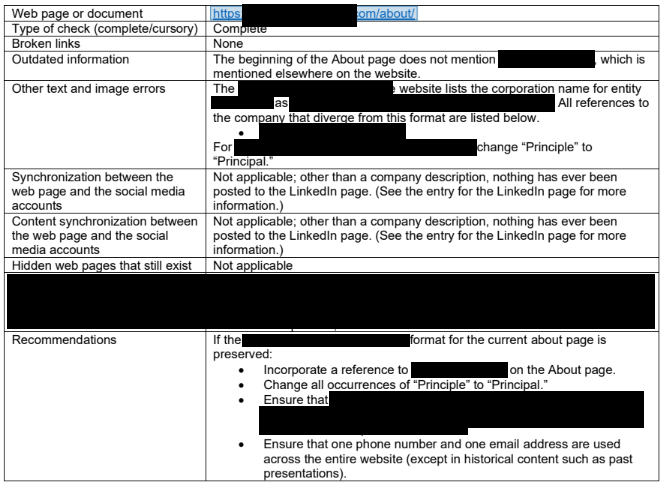
What do I do? For each social media account and page within each account, Bredemarket checks for these and other items:

  • Broken links
  • Outdated information
  • Other text and image errors
  • Synchronization between the web page and the social media accounts
  • Content synchronization between the web page and the social media accounts
  • Hidden web pages that still exist

Bredemarket then reports the results to you with recommended actions.

Redacted example of one page of a multi-page Bredemarket 404 report.

If requested, Bredemarket prepares a simple social media communications process for you.

Three reasons why you need a web/social media check

If you’re wondering why your business may need such a check, here are three things that I’ve observed over the years that adversely impact your marketing (and, um, my marketing).

Stale, dated material

Designed by Freepik.

Perhaps you wrote the text for your website or your social media page several years ago. And it was great…at the time. But as the months and years pass, the text becomes outdated.

I’ve discussed the problem of non-current content before, giving examples such as sites that mention Windows 7 support long after Microsoft stopped supporting Windows 7. But sadly, I recently ran across another offender, and this time I’m going to name names.

The company who kept stale content online was…Bredemarket.

As some of you know, last week I announced changes in Bredemarket’s scope and business hours. This necessitated some changes on my website.

Then I had to return to this website to make some hurried updates, since my April 2022 prohibition on taking certain types of work is no longer in effect as of June 2023. Hence, my home page, my “What I Do” page, and (obviously) my identity page are all corrected.

From https://bredemarket.com/2023/06/01/updates-updates-updates/

But earlier this week when I was cruising around the site, I noticed a page that I had missed:

From https://bredemarket.com/biometric-content-marketing-expert/ as of the morning of June 8, 2023.

“Biometric content marketing expert” my…(you know what). By the time you read this post, I will hopefully have fixed this. You can check for yourself to make sure I did fix it, and call me out if I didn’t. (Pressure’s on, Johnny.)

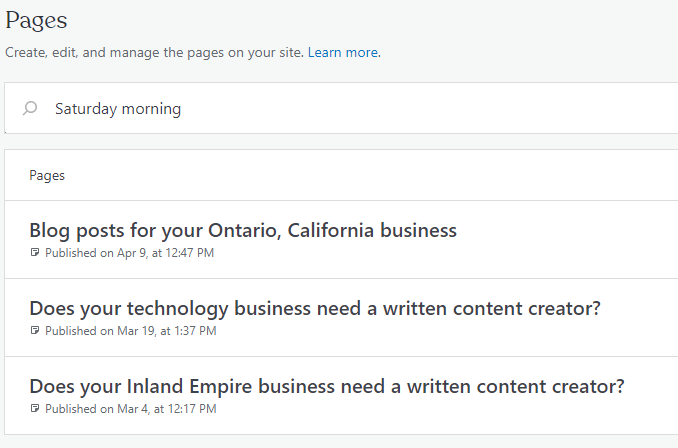
Oh, and there are three other pages that mention the words “Saturday morning” (as in booking a Saturday morning meeting with me). I have to fix those also.

WordPress listing of Bredemarket pages that include(d) the words “Saturday morning.”

Heroic sprints, only partially executed

Designed by Freepik.

In addition to stale, dated, material, sometimes the material on your online properties is only partially complete.

Perhaps you’ve worked with organizations that have sudden inspirations and want to implement them NOW.

From https://www.youtube.com/watch?v=rziG2gn-eQ0

So you’re going to mount a heroic sprint to just do it, process be damned. You’re going to steamroll ahead, working nights and weekends, and get the thing done.

And then, bleary-eyed, you get it done.

But you didn’t get all the other stuff done that needed to be completed along with the heroic sprint.

Maybe you completed a heroic sprint to document something on one of your properties…but you completely forgot to document that same thing on another of your properties. So one property mentions six items, while the other one only mentions five. Hopefully your prospect will go to the property that mentions the correct number of items.

If you’re lucky. Authentically lucky.

From https://www.youtube.com/watch?v=38mE6ba3qj8

(As an aside, a company that relies on heroic sprints is only hurting itself and its employees. See this Moira Lethbridge & Toni Collis LinkedIn article, “Why Having Superhuman Expectations Is Killing Your Career.“)

Forgotten online properties

Designed by Freepik.

A third common problem that your company may face is the existence of old online properties that you may have forgotten about.

  • Maybe you established an online property and completely forgot about it. So as you update all of your other online properties, you neglect to update that one. What happens if the only online property your prospect sees is the one you never bother to update?
  • Maybe you established an online property, then established a second one on the same platform. I previously cited an example in which a company established a Twitter account, then established a second one later without letting followers of the first account know. Guess which Twitter account had fewer followers? The new one.

Forgotten online properties result in disjointed views of your firm, and a confusing online presence.

Here’s how to obtain a web/social media check for yourself

Do your website and social media accounts suffer from these inconsistencies and errors?

Would you like an independent person to analyze your online properties and report the issues so you can fix them?

If you need Bredemarket’s services:

How Can Your Identity Business Create the RIGHT Written Content?

Does your identity business provide biometric or non-biometric products and services that use finger, face, iris, DNA, voice, government documents, geolocation, or other factors or modalities?

Does your identity business need written content, such as blog posts (from the identity/biometric blog expert), case studies, data sheets, proposal text, social media posts, or white papers?

How can your identity business (with the help of an identity content marketing expert) create the right written content?

For the answer, click here.

Using “Multispectral” and “Liveness” in the Same Sentence

(Part of the biometric product marketing expert series)

Now that I’m plunging back into the fingerprint world, I’m thinking about all the different types of fingerprint readers.

  • The optical fingerprint and palm print readers are still around.
  • And the capacitive fingerprint readers still, um, persist.
  • And of course you have the contactless fingerprint readers such as MorphoWave, one that I know about.
  • And then you have the multispectral fingerprint readers.

What is multispectral?

Bayometric offers a web page that covers some of these fingerprint reader types, and points out the drawbacks of some of the readers they discuss.

Latent prints are usually produced by sweat, skin debris or other sebaceous excretions that cover up the palmar surface of the fingertips. If a latent print is on the glass platen of the optical sensor and light is directed on it, this print can fool the optical scanner….

Capacitive sensors can be spoofed by using gelatin based soft artificial fingers.

From https://www.bayometric.com/fingerprint-reader-technology-comparison/

There is another weakness of these types of readers. Some professions damage and wear away a person’s fingerprint ridges. Examples of professions whose practitioners exhibit worn ridges include construction workers and biometric content marketing experts (who, at least in the old days, handled a lot of paper).

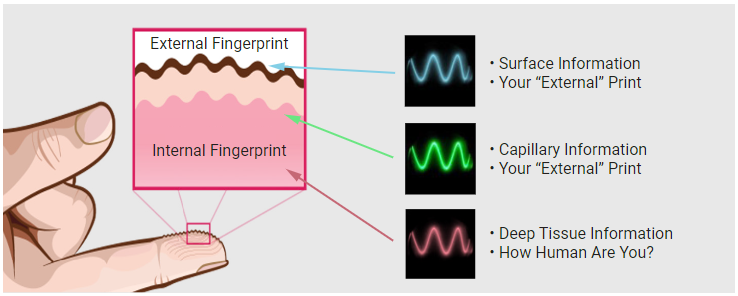
The solution is to design a fingerprint reader that not only examines the surface of the finger, but goes deeper.

From HID Global, “A Guide to MSI Technology: How It Works,” https://blog.hidglobal.com/2022/10/guide-msi-technology-how-it-works

The specialty of multispectral sensors is that it can capture the features of the tissue that lie below the skin surface as well as the usual features on the finger surface. The features under the skin surface are able to provide a second representation of the pattern on the fingerprint surface.

From https://www.bayometric.com/fingerprint-reader-technology-comparison/

Multispectral sensors are nothing new. When I worked for Motorola, Motorola Ventures had invested in a company called Lumidigm that produced multispectral fingerprint sensors; they were much more expensive than your typical optical or capacitive sensor, but were much more effective in capturing true fingerprints to the subdermal level.

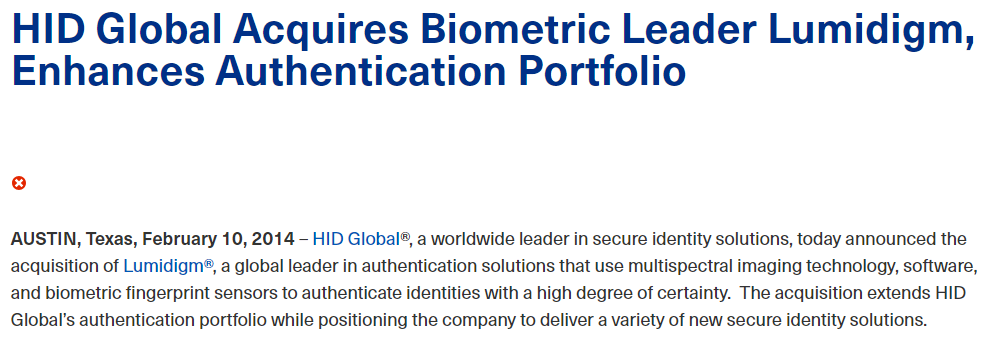
Lumidigm was eventually acquired in 2014: not by Motorola (who sold off its biometric assets such as Printrak and Symbol), but by HID Global. This company continues to produce Lumidigm-branded multispectral fingerprint sensors to this day.

But let’s take a look at the other word I bandied about.

What is liveness?

KISS, Alive! By Obtained from allmusic.com., Fair use, https://en.wikipedia.org/w/index.php?curid=2194847

“Gelatin based soft artificial fingers” aren’t the only way to fool a biometric sensor, whether you’re talking about a fingerprint sensor or some other sensor such as a face sensor.

Regardless of the biometric modality, the intent is the same; instead of capturing a true biometric from a person, the biometric sensor is fooled into capturing a fake biometric: an artificial finger, a face with a mask on it, or a face on a video screen (rather than a face of a live person).

This tomfoolery is called a “presentation attack” (becuase you’re attacking security with a fake presentation).

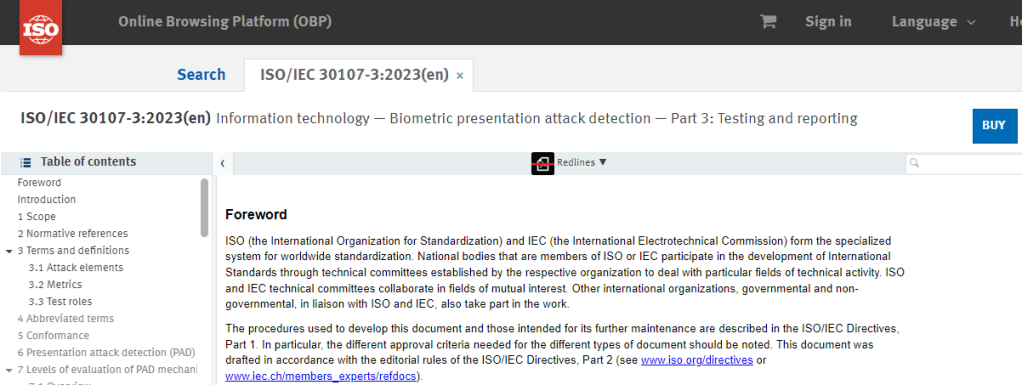
But the standards folks have developed ISO/IEC 30107-3:2023, Information technology — Biometric presentation attack detection — Part 3: Testing and reporting.

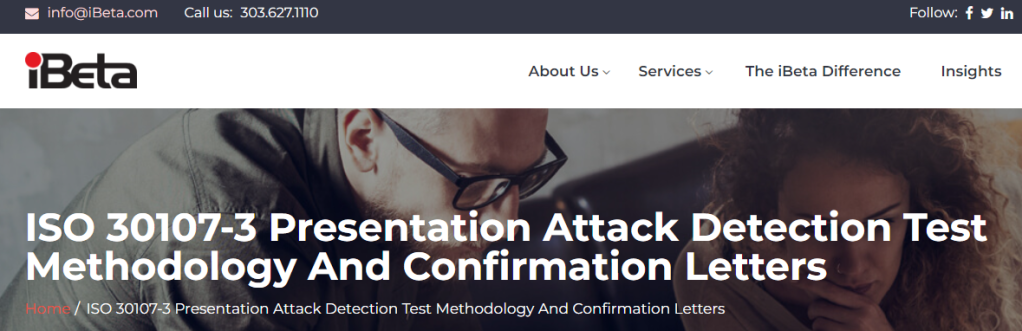
And an organization called iBeta is one of the testing facilities authorized to test in accordance with the standard and to determine whether a biometric reader can detect the “liveness” of a biometric sample.

(Friends, I’m not going to get into passive liveness and active liveness. That’s best saved for another day.)

[UPDATE 4/24/2024: I FINALLY ADDRESSED THE DIFFERENCE BETWEEN ACTIVE AND PASSIVE LIVENESS HERE.]

Multispectral liveness

While multispectral fingerprint readers aren’t the only fingerprint readers, or the only biometric readers, that iBeta has tested for liveness, the HID Global Lumidigm readers conform to Level 2 (the higher level) of iBeta testing.

There’s a confirmation letter and everything.

From the iBeta website.

This letter was issued in 2021. For some odd reason, HID Global decided to publicize this in 2023.

Oh well. It’s good to occasionally remind people of stuff.

Updates, updates, updates…

When keeping your websites updated, I advise you to do as I say, not as I do. Two of my websites were significantly out of date and needed hurried corrections.

Designed by Freepik.

I realized this morning that the “My Experience” page on my jebredcal website was roughly a year out of date, so I hurriedly added content to it. Now the page will turn up in searches for the acronym “ABM” (OK, maybe not on the first page of the search results).

Then I had to return to this website to make some hurried updates, since my April 2022 prohibition on taking certain types of work is no longer in effect as of June 2023. Hence, my home page, my “What I Do” page, and (obviously) my identity page are all corrected.

Oh yeah, I updated my Calendly availability hours also. Which is good, because I already have two meetings booked this week.

Which reminds me…if you need Bredemarket’s services:

My…Umm..Opportunity is YOUR Opportunity

A little over a year ago, Bredemarket announced two changes in my business scope and business hours. I stopped accepting work from clients who marketed systems to identify individuals, and I reduced my business hours to Saturday mornings only.

Generated at craiyon.com.

I had to change my business scope and business hours. On May 9, 2022, I started a full-time position with a company in the identity industry, which meant that I couldn’t consult on weekdays and couldn’t consult on identity projects.

But things change.

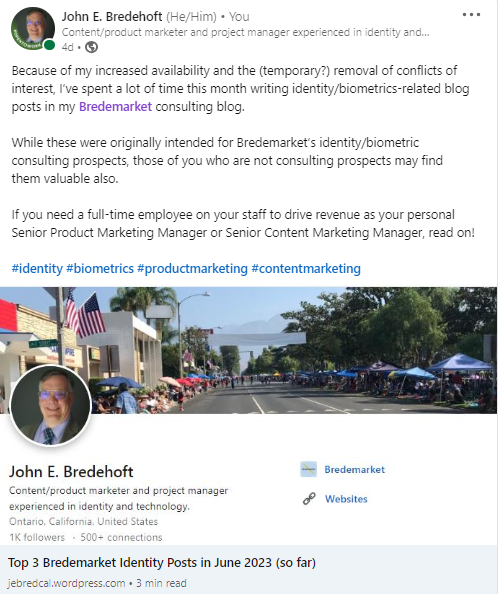
As of May 31, 2023, I will no longer be employed at my day job.

Which is my misfortune…um…opportunity.

Generated at craiyon.com.

Has Bredemarket changed its business scope and business hours a second time?

Yes.

As of June 1, 2023:

  • If you need a consultant for marketing or proposal work, and your company is involved in the identification of individuals, Bredemarket can accept the work.
  • If you need a consultant who can meet with you during normal business hours, Bredemarket can accept the work.

So what?

My…um…opportunity is your opportunity.

Now that I can expand my business scope and business hours again, you can take advantage of my extensive marketing expertise, including deep experience in the identity industry.

This means you can obtain quickly-generated and expert content with an agreed-upon focus.

This means you can get content that increases your revenue.

What kind of content?

Blog posts, case studies and testimonials, proposals and proposal text, white papers, and many other types of content.

How about e-books?

Yes I also write e-books.

These two e-books explain (a) how Bredemarket starts a project with you, and (b) how Bredemarket has helped other businesses over the years.

(UPDATE OCTOBER 22, 2023: “SIX QUESTIONS YOUR CONTENT CREATOR SHOULD ASK YOU IS SO 2022. DOWNLOAD THE NEWER “SEVEN QUESTIONS YOUR CONTENT CREATOR SHOULD ASK YOU” HERE.)

How can I find out more information about Bredemarket?

Contact me.

But wait…what if Bredemarket changes its business hours and business scope a THIRD time?

I very well could change Bredemarket’s business hours/scope again.

Maybe I’ll find a new full-time position in a couple of weeks, and I’ll again have to reduce hours and scope.

Which basically means that you have to ACT QUICKLY to ensure you can reserve my services.

(See “how to create a sense of urgency.”)

Generated at craiyon.com.

I’m still the biometric content marketing and proposal writing expert…but who benefits?

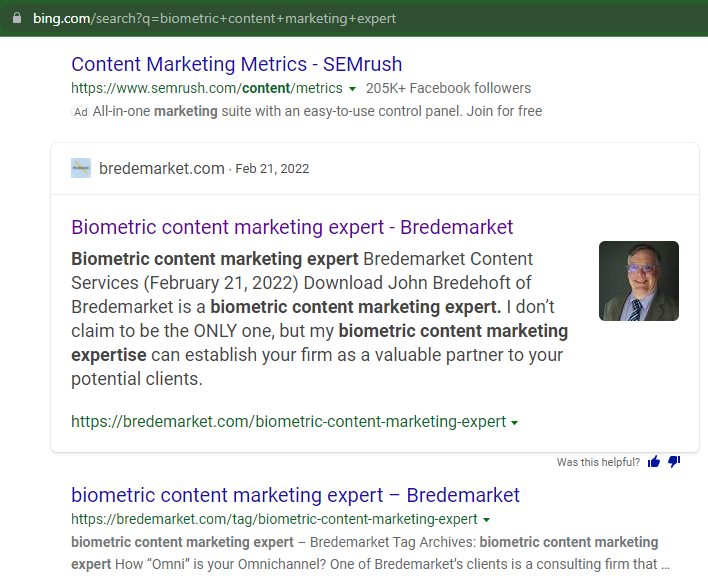
Beginning about a year ago, I began marketing myself as the biometric proposal writing expert and biometric content marketing expert. From a search engine optimization perspective, I have succeeded at this, so that Bredemarket tops the organic search results for these phrases.

Well, it seemed like a good idea at the time.

And maybe it still is.

Let’s look at why I declared myself the biometric proposal writing expert (BPWE) and biometric content marketing expert (BCME) in mid-2021, what happened over the last few months, why it happened, and who benefits.

Why am I the BPWE and BCME?

At the time that I launched this marketing effort, I wanted to establish Bredemarket’s biometric credentials. I was primarily providing my expertise to identity/biometric firms, so it made sense to emphasize my 25+ years of identity/biometric expertise, coupled with my proposal, marketing, and product experience. Some of my customers already knew this, but others did not.

So I coupled the appropriate identity words with the appropriate proposal and content words, and plunged full-on into the world of biometric proposal writing expert (BPWE within Bredemarket’s luxurious offices) and biometric content marketing expert (BCME here) marketing.

What happened?

There’s been one more thing that’s been happening in Bredemarket’s luxurious offices over the last couple of months.

I’ve been uttering the word “pivot” a lot.

Since March 2022, I’ve made a number of changes at Bredemarket, including pricing changes and modifications to my office hours. But this post concentrates on a change that affects the availability of the BPWE and BCME.

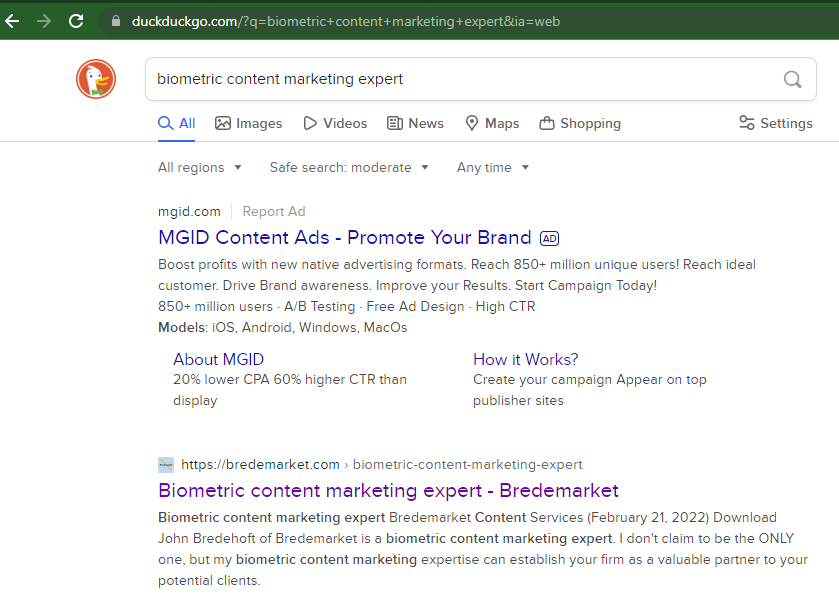
Let’s say that it’s December 2022, and someone performs a Google, Bing, or DuckDuckGo search for a biometric content marketing expert. The person finds Bredemarket, and excitedly goes to Bredemarket’s biometric content marketing expert page, only to encounter this text at the top of the page:

Update 4/25/2022: Effective immediately, Bredemarket does NOT accept client work for solutions that identify individuals using (a) friction ridges (including fingerprints and palm prints), (b) faces, and/or (c) secure documents (including driver’s licenses and passports). 

“Thanks a lot,” thinks the searcher.

Granted, there are others such as Tandem Technical Writing and Applied Forensic Services who can provide biometric consulting services, but the searcher won’t get the chance to work with ME.

Should have contacted me before April 2022.

Sheila Sund from Salem, United States, CC BY 2.0 https://creativecommons.org/licenses/by/2.0, via Wikimedia Commons

Why did it happen?

I’ve already shared some (not all) details about why I’m pivoting with the Bredemarket community, but perhaps you didn’t get the memo.

I have accepted a full-time position as a Senior Product Marketing Manager with an identity company. (I’ll post the details later on my personal LinkedIn account, https://www.linkedin.com/in/jbredehoft/.) This dramatically decreases the amount of time I can spend on my Bredemarket consultancy, and also (for non-competition reasons) limits the companies with which I can do business. 

Those of you who have followed Bredemarket from the beginning will remember that Bredemarket was only one part of a two-pronged approach. After becoming a “free agent” (also known as “being laid off”) in July 2020, my initial emphasis was on finding full-time employment. Within a month, however, I found myself accepting independent contracting projects, and formally established Bredemarket to handle that work. Therefore, I was simultaneously (a) looking for full-time work, and (b) growing my consulting business. And I’ve been doing both simultaneously for over a year and a half. 

Now that I’ve found full-time employment again, I’m not going to give up the consulting business. But it’s definitely going to have to change, as outlined in my April 25, 2022 update.

So now all of this SEO traction will not benefit you, the potential Bredemarket finger/face client, but it obviously will benefit my new employer. I can see it now when people talk about my new employer: “Isn’t that the company where the biometric content marketing expert is the Senior Product Marketing Manager?”

At least somebody will benefit.

P.S. There’s a “change” Spotify playlist. Unlike Kevin Meredith, I don’t use my playlists to make sure my presentation is within the alloted time. Especially when I create my longer 100-plus song playlists; no one wants to hear me speak for that long. Thankfully for you, this playlist is only a little over an hour long, and includes various songs on change, moving, endings, beginnings, and time.

Bredemarket announcement: change in business scope

Effective immediately:

  1. Bredemarket does not accept client work for solutions that identify individuals using (a) friction ridges (including fingerprints and palm prints) and/or (b) faces.
  2. Bredemarket does not accept client work for solutions that identify individuals using secure documents, such as driver’s licenses or passports. 

How “Omni” is your Omnichannel?

One of Bredemarket’s clients is a consulting firm that advises other companies on the use of a particular enterprise content management system. Among other things, this consulting firm can help its client companies configure the outbound information the companies’ systems provide.

Which leads us to our word for today, omnichannel.

In marketing, “omnichannel” refers to “the process of driving customer engagement across all channels with seamless, targeted messaging.”

Across ALL marketing channels. That’s what omnichannel talks about.

Here’s what Erin O’Connor says:

Omnichannel marketing lets marketers create seamless, integrated customer experiences spanning both online and offline channels to connect with customers as they move through the buying cycle. Omnichannel marketing focuses on the life cycle of the customer. For example, when a customer is in the acquisition phase, the marketer will send a different type of message compared to a loyal customer

Omnichannel marketing is …a holistic approach in the sense that it’s looking at all of the potential touchpoints customers can use to communicate with brands, both online and offline.

From https://business.adobe.com/glossary/omnichannel-marketing.html

An omnichannel marketing strategy may encompass a number of marketing tools, including email, white paper downloads, videos, mobile SMS responses, automated call centers, and anything else that marketers use to communicate with clients.

One of the key benefits of an omnichannel marketing strategy is, or should be, consistency. If your emails say that your product is supported on Windows 11, your data sheets had better not say that your product is only supported up to Windows 10. This is a definite problem; see my checklist item 2 in this post.

(Incidentally, I recently ran across a company that is still talking about NIST FRVT results from several years ago. Since the NIST FRVT tests are ongoing, any reference to old results is outdated because of all the new algorithms that have been submitted and that have better performance.)

So factual consistency is important. Omnichannel marketing also allows for visual consistency (well, not in the automated call center) in which all of the company’s content looks like it came from the same company.

Obviously there are a number of benefits from omnichannel marketing, including easier management and consistency of marketing messages. But all of this raises a question:

Is omnichannel marketing truly OMNIchannel? Or does omnichannel marketing leave some things out?

Before you point me to the definition of “omni” and say that omnichannel marketing by definition can’t exclude anything, read on.

When product marketers don’t market

If you’re a marketer, I hope you’re sitting down.

The world does not revolve around marketing.

(My college roommates who were physics majors made sure to remind me of this.)

Thus, anything that isn’t marketing is automatically excluded from omnichannel marketing. And there are a number of things that companies do that aren’t marketing per se.

I recently held a discussion with a product marketer which got me thinking. We were talking about the things product marketers do, which include content creation (case studies/testimonials, white papers, social media content, and the like) and other product-related tasks such as competitive analysis of other products.

But then the product marketer mentioned something else.

What about having the product marketer author product technical documentation, such as user guides?

(By the way, I’ve written technical documentation in the past; see the “Benefiting from my experience and expertise” section of the Bredemarket “Who I Am” page.)

Now technical documentation is (usually) not the place for overt marketing messaging, but at the same time technical documentation authorship benefits the product marketer and the company by immersing the product marketer into the details of the product, thus increasing the marketer’s product understanding.

I’ll grant you need a different writing style when writing technical documentation; after all, there are no earthshaking benefits from clicking on the “Save As” button.

By Later version were uploaded by Bruce89 at en.Wikipedia. – Transfered from en.Wikipedia; en:File:Dialog1.pngtransfered to Commons by User:IngerAlHaosului using CommonsHelper., GPL, https://commons.wikimedia.org/w/index.php?curid=8988455

But you need different writing styles for the different types of marketing output anyway. The mechanics of writing a tweet differ from the mechanics of filming a video. So a marketer who isn’t experienced in technical documentation can adjust to the new style.

However, finding marketers slash technical documentation writers in the wild is unusual. Every company that I’ve worked with since 1991 has built some type of wall between the marketing function and the technical documentation function. But oddly enough, one of my former employers (MorphoTrak) moved managers around between the different functions. One manager in particular headed up the technical documentation group, then headed up the proposals group (where I worked for her), then headed up a multi-functional marketing team (where I worked for her again), then specialized in product marketing.

And now the product marketer (not the one from MorphoTrak, but the one I had been talking to) got the hamster in my brain to start generating ideas.

If omnichannel marketing is limited, and your omnichannel efforts should include activities outside of marketing such as technical documentation, what else should be included in your omnichannel efforts?

Including proposal writing in omnichannel efforts

OK, the subtitle gave it away. (But I refused to write the subtitle “This marketer wrote a user guide. You won’t believe what he did next!”)

If anything, proposal writing is closer to marketing than technical documentation is to marketing. While proposal writing is often considered a sales function (though some would disagree), there are obvious overlaps between the benefits that you espouse in a proposal and the benefits that you espouse in a case study.

Including standard proposal text/template creation as part of your omnichannel efforts also helps to ensure consistency in your product messaging. Again, if your data sheet says one thing, and your user guide says the same thing, then your proposal had better say the same thing also. (Unless you’re proposing something that won’t be implemented for another one or two years, in which case the proposal will discuss things that won’t appear in the present data sheets and user guides, but in future versions.)

Now those of you who are familiar with what Bredemarket does can appreciate why I love this idea.

By Loudon dodd – Own work, CC BY-SA 3.0, https://commons.wikimedia.org/w/index.php?curid=7404342

I’ve positioned Bredemarket as a two-headed (but not two-faced) marketing and writing service provider: for example, with separate descriptions of my status as a biometric content marketing expert and a biometric proposal writing expert. And that pretty much mirrors how I work. With one exception, most of my clients only use me for either my proposal services or my content marketing services.

What if companies entrusted Bredemarket with their total solution, both inside and outside of traditional marketing?

Of course there are complications in implementing this.

But when can you implement true omnichannel efforts?

Now most companies are ill-fitted to have one person, or even one department, handle all the omnichannel marketing (case studies, white papers, data sheets, tweets, LinkedIn posts, competitive intelligence, etc.) AND all the omnichannel non-marketing (technical documentation, proposals, and all the other stuff that my hamster brain didn’t realize yet).

So how do you get multiple departments to communicate the same messaging? It’s a difficult task, especially since most department members are so focused on their own work that they don’t have the bandwidth to worry about what another department is doing. (“I don’t care about the data sheet error. I just write the manuals.”)

There are several ways to achieve this: central ownership of the messaging for all departments, outside quality audits, and peer-to-peer interdepartmental review come to mind.

But you’re not going to solve the problem of inconsistent messaging between your departments unless you realize that the problem exists…and that “omnichannel marketing” won’t solve it.

Why am I using the word “casetimonial”?

We often get bent out of shape trying to come up with precise definitions of things. While sometimes this precision is warranted, there are times when it is overkill.

Take the answer to this question:

What is the difference between a case study and a testimonial?

Not that type of case. By Thomas Quine – Lead type case, CC BY 2.0, https://commons.wikimedia.org/w/index.php?curid=51684202

Some people have taken some time answering the question about the difference between a case study and a testimonial. For example, here’s what Juliet Platt says:

The difference between Case Studies and Testimonials is really length and depth.

From https://casestudywriter.co.uk/whats-the-difference-between-a-case-study-and-a-testimonial/

Platt then gives examples of the longer, in-depth nature of case studies vs. the shorter nature of testimonials.

Another person who has addressed the question is Donna St. Jean Conti:

“Show me ROI, or it’s not a case study.” An editor told me this some 15 years ago, and he was so right.

From https://www.agilitypr.com/pr-news/public-relations/whats-the-difference-between-a-case-study-and-a-testimonial/

This gets into the difference between quantitative information and qualitative information. By this definition, a case study always has to address return on investment, or it’s not a case study.

I have a different view

While I respect the views of these two people (and others), I have a different view. My answer to the question “What is the difference between a case study and a testimonial” is as follows:

Who cares?

From https://bredemarket.com/bredemarket-and-case-studies/

Let me explain.

Regardless of what you call the document, a case study or a testimonial allows a firm to attract new customers by showcasing the successes of existing customers.

From https://bredemarket.com/bredemarket-and-case-studies/

And as far as I’m concerned, the length of the piece and the choice to use quantitative or qualitative data (or both) is secondary to the primary purpose, which is to present an example that resonates with a potential customer.

Not that I don’t have ANY rules. Whether you’re writing a case study or testimonial, I like to structure it with the following format:

  1. The problem.
  2. The solution.
  3. The results (from using the solution to solve the problem).

This format allows a customer-centric presentation with which the reader can identify. “Hey, Joe’s Garage used this widget to solve their problem. Maybe I can use this widget to solve a similar problem.”

Now perhaps others use a different outline for their case studies or testimonials. And that’s…OK.

For those of you old enough to remember Stuart Smalley. By http://www.tvacres.com/words_stuart.htm, Fair use, https://en.wikipedia.org/w/index.php?curid=31855280

My own term

So for ease of communication, I’ve decided to adopt a different term. It’s not original with me, but it doesn’t look like anyone else is currently using the term on a regular basis.

Instead of using awkward references to “case studies and/or testimonials,” I’m just going to refer to casetimonials.

I used the casetimonial term a lot on this page (recently revised) on the Bredemarket website, which not only includes a shorter form of the discussion above about the difference between a case study and a testimonial, but also discusses how a casetimonial can be used, how it can be repurposed, the types of firms that can benefit from casetimonials, and how Bredemarket can help you create your own casetimonials.

If you can use Bredemarket’s assistance with communicating past customer successes to future clients: