How Bredemarket’s Six Questions Support Strategic Content Marketing

(UPDATE OCTOBER 23, 2023: “SIX QUESTIONS YOUR CONTENT CREATOR SHOULD ASK YOU IS SO 2022. DOWNLOAD THE NEWER “SEVEN QUESTIONS YOUR CONTENT CREATOR SHOULD ASK YOU” HERE.)

Just for fun, I’m going to challenge my assertion that there are six questions that your content creator must ask you before creating content.

I ought to know about these six questions. As a content marketing expert, I wrote the book on the topic.

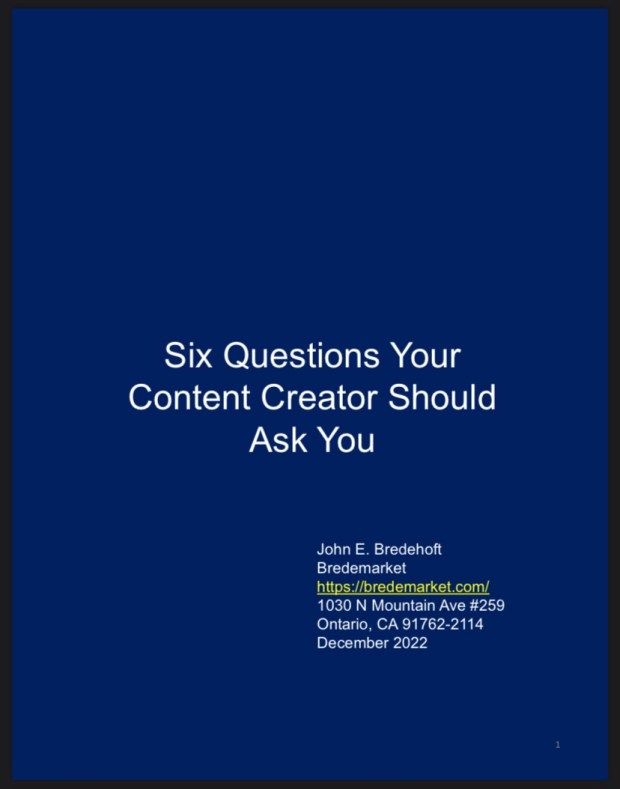
To download this e-book, go to https://bredemarket.com/2022/12/18/six-questions-your-content-creator-should-ask-you-the-e-book-version/.

If you haven’t read the e-book, the six questions are:

  1. Why?
  2. How?
  3. What?
  4. Goal?
  5. Benefits?
  6. Target Audience?

The idea is that your content creator hosts a kickoff session, asks you the six questions, and only then starts to create the content in question—the blog post, case study, or whatever.

Are the six questions overkill?

But simplicity advocates may argue that those six questions are five questions too many.

Analysis paralysis may prevent you from moving forward at all, much less realizing your content creation goal. Perhaps you should be more efficient and just put pen to paper and, as the shoe people say, just do it.

I found a content marketing expert who agreed with this assertion, and wrote a post entitled “In marketing, move quickly.”

That content marketing expert was…well, it was me.

I ran across a local company (which I will not name) that issued a press release in December 2021. In part, the press release mentioned the local company’s new dedication to the marketing function.

From https://bredemarket.com/2022/03/23/in-marketing-move-quickly/

The company had hired an international marketing firm “to develop comprehensive marketing strategies….We expect their work to incorporate a website redesign, brand refresh, new strategic messaging and content, as well as focused video and digital campaigns.”

So, when I wrote the “In marketing, move quickly” post three months later, what had this international marketing firm accomplished in the interim?

The website has a full slew of data sheets on the company’s products, and I found a 2017 brochure that effectively served as a white paper. But that’s it; no other white papers, and no case studies describing happy customers’ experiences.

The company’s YouTube channel has two videos from 2021.

The company’s Facebook page hasn’t posted anything since 2017.

Neither of the company’s LinkedIn pages (yes, the company has two LinkedIn pages) has any posts.

From https://bredemarket.com/2022/03/23/in-marketing-move-quickly/

Now I have no visibility into this particular company, but I’ve been around the block to guess that the international marketing firm was probably still in the analysis stage, optimizing synergies according to “out of the box” criteria, to ensure bleeding-edge revenue maximization.

No, the six questions aren’t overkill

After reviewing what I wrote before in that blog post, I realize that my e-book lacks a very important point.

Don’t spend three months answering the six questions.

I shouldn’t HAVE to say this, but perhaps it’s safer to explicitly say it.

Now practices can very from consultation to consultation, but it’s very likely that a content creator and their client can breeze through those six questions in half an hour or less.

Or maybe the client can answer the questions on their own before the meeting.

If your content marketing expert schedules six one-hour meetings (or worse still, workshops) to address the six questions, run away!

(Is the content marketing expert billing by the hour?)

And the six questions create a content strategy

There’s something else that I failed to explicitly say in my e-book.

Not only do the answers to the six questions benefit that one piece of content, but they benefit everything else that your company does.

For example, let’s say that a content marketing expert is working with a gourmet ice cream shoppe (not a shop, but a shoppe), and the proprietor (Jane Cold) answers the “how” question as follows:

At Jane’s Gourmet Ice Cream Shoppe, we keep the internal dining temperature below 50 degrees Fahrenheit to ensure that our guests enjoy ice cream as it was meant to be enjoyed. We inform our guests of our temperature policy beforehand to ensure they bring proper attire.

By Edward S. Curtis – This file was derived from: Inupiat Family from Noatak, Alaska, 1929, Edward S. Curtis.jpg, Public Domain, https://commons.wikimedia.org/w/index.php?curid=24953870

Now let’s say that the piece of content in question is a social media post describing a new farkleberry ice cream flavor. (Thanks, Live Eat Learn.)

By Eric Hunt – Own work, CC BY-SA 4.0, https://commons.wikimedia.org/w/index.php?curid=85068643

While the content marketing expert will use the answer to the “how” question to create the content, the ramifications go far beyond the social media post itself.

  • Perhaps the new flavor could be branded “Frigid Farkleberry” to suggest how the ice cream should best be enjoyed.
  • Maybe in addition to branding, the “how” answer may even influence pricing. Perhaps prices incorporate the number “32,” as in a single-scoop price of $4.32. (Yes that price is high, but after all this is an ice cream shoppe.)

And what of future social media posts?

Let me clue you in on a little secret: once your content marketing expert has asked the six questions for the first piece of content, the kickoff is much quicker for subsequent pieces of content.

Chances are the basic “why” and “how” won’t change, although some of the later questions such as the target audience could change for each individual piece of content.

So without explicitly trying to do so, the six questions have created a de facto content marketing strategy. After creating five pieces of content, you’ve essentially defined your company’s mission, purpose, and differentiators, and may have defined as many as five separate vertical markets along the way.

Not a bad investment of thirty minutes of time.

(But a terrible investment of three months of time.)

An exercise for you

Normally this is the point where I’d tell you to contact me if you want to use Bredemarket’s content marketing expertise. But this time I’m going to do something different.

  • Why don’t you think of a piece of content you want to create?
  • Once you’ve decided on that, why don’t you ask yourself the six questions?
  • Once you have the answers, why don’t you see what type of overall content marketing strategy you can shape, solely based on those six responses?

Lockheed Martin’s Anti-biofouling Customer Focus

Businesses exist to serve their customers, something Lockheed Martin says when talking about itself.

Lockheed Martin’s customer-first mentality is a big way the company stands out from its competitors. 

From https://www.lockheedmartin.com/en-us/news/features/2020/how-lockheed-martin-anticipates-customer-needs.html

It’s nice to claim a “customer-first mentality,” but Lockheed Martin has provided an example of how it demonstrates customer focus.

The problem

Here’s how Lockheed Martin defined the problem that one of its customers was facing.

Barnacle on a boat propeller. By Foto: Jonn Leffmann, CC BY 3.0, https://commons.wikimedia.org/w/index.php?curid=23069484

Biofouling is the buildup of barnacles and microorganisms on ocean-going vessels such as ships and unmanned underwater vehicles (UUVs). This buildup is a naturally occurring process which can increase drag and decrease ship fuel economy, ultimately costing customers hundreds of millions of dollars. The United States Navy needs to eliminate biofouling growth along the underside of its ships, which involves a cleaning process that requires a ship to be out of commission for up to 18 months and hundreds of hours of manual labor. 

From https://www.lockheedmartin.com/en-us/news/features/2020/how-lockheed-martin-anticipates-customer-needs.html

Maybe your customers aren’t quite as big as the United States Navy, but your customers have problems also, and they’re relying on you to solve them.

A solution from nature

For aeronautical engineer Joseph Keegan, the solution to the Navy’s problem lay in the sea snake.

Because defense contractors think about sea snakes all the time. Or at least Keegan did.

Keegan decided to apply for funding for a project that mimicked how a sea snake mitigates biofouling growth. The sea snake has a clever way to mitigate growth by organically shedding its skin to rid itself of biofouling growth and disease when the growth begins to affect its movement. 

From https://www.lockheedmartin.com/en-us/news/features/2020/how-lockheed-martin-anticipates-customer-needs.html

OK, an ocean vessel isn’t going to literally shed its hull. But that’s why Keegan needed research funding. And the researchers came up with a solution, and started to test it.

Ventura Harbor in the sunshine. By Platinummedia – Own work, CC BY-SA 4.0, https://commons.wikimedia.org/w/index.php?curid=110032114

A Lockheed Martin team took the idea from paper to prototype and went to Ventura Harbor, California to conduct static testing of a multilayer mylar skin on various surfaces including fiberglass, steel and aluminum. After leaving the prototype in the harbor for a little over a month, results confirmed that the films were effective in demonstrating that biofouling growth could be easily removed by peeling a layer of the film. The test was also successful in proving that the films did not allow for biofouling growth to occur between the multiple layers of film or underneath the four-layer prototype. No degradation to the films has been observed in the five months of testing.

From https://www.lockheedmartin.com/en-us/news/features/2020/how-lockheed-martin-anticipates-customer-needs.html

Anticipated benefits

While Lockheed Martin’s write-up includes the common researcher statement “further efforts are needed to successfully implement this biofouling film technology,” it looks like the project is moving forward.

And Lockheed Martin has already identified the benefits of the completed project. Not the benefits to Lockheed Martin, but the benefits to its customer, the U.S. Navy.

With the potential to reduce the time a Navy ship remains out of commission for cleaning, this nature-inspired design idea could…save money and enable greater mission readiness…

From https://www.lockheedmartin.com/en-us/news/features/2020/how-lockheed-martin-anticipates-customer-needs.html

Saving money and getting ships out to battle more quickly. Stuff that the Navy likes.

Of course this benefits Lockheed Martin also, but the company kept the focus on the Navy.

How does this apply to my company?

Even if your customers don’t battle biofouling barnacles, and even if your customers don’t face problems that put their equipment out of commission for 18 months or cost hundreds of hours in labor, there’s a lesson to be learned from Lockheed Martin’s customer focus.

  1. Keep your focus on your customer, not you.
  2. Describe the problem your customer faces.
  3. Define your solution to the problem.
  4. List the benefits your customer receives from your solution.

If your solutions benefit your customers, then you’ll receive benefits also.

What I Missed About QR Codes in 2021

A lot has happened with QR codes since I last wrote about them in October 2021. (For example, the Coinbase Super Bowl ad in 2022, and its demonstration of security risks.)

Now that I’m revisiting my October 2021 post on QR codes, I wish I could change one word to make myself look smarter.

See if you can guess which word I want to change.

I have since chosen to adopt QR codes for some of my Bredemarket work, especially in cases where an online reader may need additional information.

From https://bredemarket.com/2021/10/15/a-qr-code-is-not-a-way-of-life/

Did you find it?

Instead of writing “online,” I should have written “offline.”

I don’t know whether I just made a typo, or if I intentionally wrote “online,” but I shouldn’t have.

Why QR codes rarely make sense online

Because if you’re online, you don’t need a QR code, since you presumably have access to a clickable URL.

But if you’re offline—for example, if you’re watching a commercial on an old-fashioned TV screen—a QR code makes perfect sense. Well, as long as you explicitly identify where the QR code will lead you, something Coinbase failed to do in 2022. “Just click on the bouncing QR code and don’t worry where you’ll go!”

But there’s one more place where QR codes make sense. I didn’t explicitly refer to it in my 2021 post, but QR codes make sense when you’re looking at printed material, such as printed restaurant menus.

Or COVID questionnaires.

Which reminds me…

What I didn’t tell you about the Ontario Art Walk

…there’s one story about the Ontario Art Walk that I didn’t share in yesterday’s post.

After leaving Dragon Fruit Skincare, but before visiting the Chaffey Community Museum of Art, I visited one other location that I won’t identify. This location wanted you to answer a COVID questionnaire, which you accessed via a QR code.

I figured I’d do the right thing and answer the questionnaire, since I had nothing to worry about.

  • I was vaccinated.
  • I was boosted.
  • I hadn’t been around anyone with COVID.
  • I didn’t have a fever.

I entered the “right” response to every single question, except for the one that asked if I had a runny or stuffy nose. Since I had a stuffy nose, I indicated this.

But hey, it’s just a stuffy nose. What could go wrong?

When I finished the questionnaire, I was told that based on my answers, I was not allowed in the premises, and if I was already in the premises I should leave immediately.

Which I did.

And which is why I didn’t write about that particular location in yesterday’s post.

Bredemarket, pressing the flesh (sometimes six feet away)

But back to non-health related aspects of QR codes.

The Ontario Art Walk was actually the second in-person event that I had attended that week. As I noted on Instagram, I also went to a City of Ontario information session about a proposed bike lane.

Now that COVID has (mostly) receded, more of us are going to these in-person events. My target market (businesspeople in the United States) is mostly familiar with the century-old term “press the flesh.” While it usually applies to politicians attending in-person events, it can equally apply to non-political events.

Whenever I go out to these local events, I like to have some printed Bredemarket collateral handy in case I find a local businessperson looking for marketing services. After all, since I am the Ontario, California content marketing expert, I should let relevant people in Ontario know this.

In those cases, a QR code makes sense, since I can hand it to the person, the person can scan the QR code on their phone, and the person can immediately access whatever web page or other content I want to share with them.

On Saturday, it occurred to me that if I ran across a possible customer during the Ontario Art Walk, I could use a QR code to share my e-book “Six Questions Your Content Creator Should Ask You.”

Unfortunately, this bright idea came to my mind at 5:30 pm for an event that started at 6. I dummied up a quick and dirty page with the cover and a QR code, but it was…dirty. Just as well I didn’t share that on Saturday.

But now that I have more time, I’ve created a better-looking printed handout so that I’m ready at the next in-person event I attend.

If we meet, ask me for it.

Making myself look less smart

Well, now that I’ve gone through all of this trouble explaining how QR codes are great for offline purposes, I’m going to share the aforementioned handout…online.

(UPDATE OCTOBER 22, 2023: “SIX QUESTIONS YOUR CONTENT CREATOR SHOULD ASK YOU IS SO 2022. DOWNLOAD THE NEWER “SEVEN QUESTIONS YOUR CONTENT CREATOR SHOULD ASK YOU” HERE.)

Which has probably prompted the following question from you.

“Why?”

Four reasons:

  1. It gave me the excuse to post the question “Why?” above, thus reiterating one of the major points of the e-book.
  2. Because I felt like sharing it.
  3. Just in case you don’t make “Event X” that I attend in the future, you can experience the joy of printing the flyer and scanning the QR code yourself. Just like you were there!
  4. To demonstrate that even when you provide a piece of content with a QR code, it’s also helpful to explicitly reveal the URL where you’ll head if you scan the code. (Look just below the QR code in the flyer above.) And if you receive the flyer in online form rather than printed form, that URL is clickable.

Six Questions Your Content Creator Should Ask You: the e-book version

I love repurposing.

So I’ve repurposed my October 30 blog post into an e-book.

This gave me an opportunity to revisit the topic and add critical information on wildebeests, George (H.W.) Bush, and Yogi Berra.

But more importantly, it allows me to share my thoughts with a wider audience.

If you missed the October blog post, I state that there are six critical questions that your content creator must ask before creating content. These questions apply whether your content creator is a consultant, an employee at your company, or you.

The e-book discusses each of these six questions:

  1. Why?
  2. How?
  3. What?
  4. Goal?
  5. Benefits?
  6. Target Audience?

And as I note in the e-book, that’s just the beginning of the content creation process.

Whether you intend to use Bredemarket as your content creator, use someone else as your content creator, or create your own content, the points in this e-book are helpful. They can be applied to content creation (case studies, white papers, blog posts) or proposal work, and apply whether you are writing for Inland Empire West businesses or businesses anywhere.

And if you read the e-book, you’ll discover why I’m NOT sharing it on the Bredemarket Identity Firm Services LinkedIn page and Facebook group.

You can download the e-book here. And you can be a content marketing expert also.

(UPDATE OCTOBER 22, 2023: “SIX QUESTIONS YOUR CONTENT CREATOR SHOULD ASK YOU IS SO 2022. DOWNLOAD THE NEWER “SEVEN QUESTIONS YOUR CONTENT CREATOR SHOULD ASK YOU” HERE.)

Six questions your content creator should ask you

If you want a content marketing expert to write for your business, do you just say “Write this, and make it viral”?

Not THAT viral. (Too soon?) By Alexey Solodovnikov (Idea, Producer, CG, Editor), Valeria Arkhipova (Scientific Сonsultant) – Own work. Scientific consultants:Nikitin N.A., Doctor of Biological Sciences, Department of Virology, Faculty of Biology, Lomonosov Moscow State University.Borisevich S.S. Candidate of Chemical Sciences, Specialist in Molecular Modeling of Viral Surface Proteins, Senior Researcher, Laboratory of Chemical Physics, Ufa Institute of Chemistry RASArkhipova V.I., specialization in Fundamental and Applied chemistry, senior engineer, RNA Chemistry Laboratory, Institute of chemical biology and fundamental medicine SB RAS, CC BY-SA 4.0, https://commons.wikimedia.org/w/index.php?curid=104914011

Six words of instruction will not result in great content.

Even if you just say “Write this” and leave off the viral part, this will not work either.

You and your content creator have to have a shared understanding of what the content will be.

For example, as I indicated in a previous post, you and your content creator have to agree on the tone of voice to use in the content. The content creator could write something in a tone of voice that may not match your voice at all, which would mean that the content would sound horribly wrong to your audience.

Imagine a piece for financial executives written in the style of Crazy Eddie. Ouch.

From https://www.youtube.com/watch?v=Ml6S2yiuSWE

And that’s just one thing that could go wrong when you and your content creator are not on the same…um, page.

Bredemarket’s content creation process includes six questions

When Bredemarket works with you to create content, I use a content creation process. I’ve revised my original content creation process several times, and I’m sure I’ll revise it more as I work with more of you.

But as of today, Bredemarket’s kickoff meetings with clients begin with six high-level questions that set the scene for everything that follows.

Question One: Why?

As I noted in my Simon Sinek post, the “why?” question needs to be answered before any other question is asked.

Before you ask a content creator to write a case study about how your Magnificent Gizmo cures bad breath, you need to understand why you’re in the good breath business in the first place. Did you have an unpleasant childhood experience? Were you abandoned at the altar? WHY did you care enough to create the Magnificent Gizmo in the first place?

(As I write this post, I’m going to look at how each of these six questions can be answered for the post itself. After all, it’s fair to ask: Why does Bredemarket do what it does? Short answer: because I write. You can pry my keyboard out of my cold dead hands. For the longer answer, read the “Who I Am” page on the Bredemarket website.)

Question Two: How?

You also need to make sure your content creator can explain how you do what you do. Have you created your own set of algorithms that make breath good? Do you conduct extensive testing with billions of people, with their consent? How is your way of doing things superior to that of your competitors?

(Now if you’re asking the “how” of Bredemarket, my content creation process is the “how.” After these initial six questions, there are other things that I do, and things that you do. Here’s how I create content of 400 to 600 words. Here’s how I create content of 2,800 to 3,200 words.)

Question Three: What?

Once these are clear in your mind, you’re ready to talk about the “what.” As Sinek notes, many people start with the “what” and then proceed to the “how,” and may or may not even answer the “why.” But when you ask the “why” first and the “how” second, your “what” description is much better.

(Again, you may be asking what Bredemarket does. I craft the words to communicate with technical and non-technical audiences. For additional clarification, read “What I Do,” which also notes what I don’t do. Sorry, finger/face/ID document vendors.)

Question Four: Goal?

Once the Golden Circle is defined, we’re ready to dig a little deeper into the specific piece of content you want. We’re not ready to talk about page count and fonts, yet, though. There’s a few other things we need to settle.

What is the goal of the content? Simple awareness of the product or service you provide? Or are you ready for consideration? Or is it time for conversion? The goal affects the content dramatically.

(In the case of this post, the goal is primarily awareness, but if you’re ready for conversion to become a paying customer, I won’t turn you away.)

Question Five: Benefits?

I’ve written ad nauseum on the difference between benefits and features, so for this question five about benefits I’ll just briefly say that written content works best when it communicates how the solution will help (benefit) the customer. A list of features will not make a difference to a customer who has specific needs. Do you meet those needs? Maintain a customer focus.

(Bredemarket’s primary benefit is focused content that meets your needs. There are others, depending upon your industry and the content you require.)

Question Six: Target Audience?

This one is simple to understand.

  • If you’re a lollipop maker and you’re writing for kids who buy lollipops in convenience stores, you’ll write one way.
  • If you’re a lollipop maker and you’re writing to the convenience stores who could carry your lollipops, you’ll write another way.

Now sometimes content creators get fancy and create personas and all that (Jane Smith is a 54 year old single white owner of a convenience store in a rural area with an MBA and a love for Limp Bizkit), but the essential thing is that you understand who you want to read your content.

(This particular piece is targeted for business owners, executives, directors, and managers, especially in California’s Inland Empire, who have a need to create focused content that speaks to their customers. The target audience not only affects how I am writing this post, but also how I will distribute it.)

What if you use a different content creator?

I am forced to admit that not everyone chooses Bredemarket to create their content.

  • Maybe you create your content yourself.
  • Maybe you already have access to content creators.
  • Or maybe you have a limited budget and can only pay a penny a word to your content creator. Let’s face it, a five dollar blog post does sound attractive.

But that doesn’t mean that you can’t use these six questions. I did publish them, after all, and they’re based on questions that others have asked.

If you create your own content, ask yourself these six questions before you begin. They will focus your mind and make your final content better.

If you have someone else create your content, make sure that you provide the answers for your content creator. For example, if you seek a content creator on Upwork or Fiverr, put the answers to these questions in your request for quotes. Experienced writers will appreciate that you’re explaining the why, how, what, goal, benefits, and target audience at the very beginning, and you’ll get better quotes that way. If someone knows your target audience is crime scene examiners, then you’ll (hopefully) see some quotes that describe the writer’s experience in writing for crime scene examiners.

And if you provide the answers to those six questions and your content creator says, “That doesn’t matter. I write the same for everyone,” run away.

You’ve probably seen the film. By Wikifan75 – Own work, CC BY-SA 3.0, https://commons.wikimedia.org/w/index.php?curid=29042440

Maybe the resulting content will even go viral. (The good viral.)

What if you want to use Bredemarket?

Or perhaps you’ve decided that you don’t want to trust your content to someone on Upwork and Fiverr, and you want to work with me instead. After all, I can help you with white paperscase studiesblog postsproposal responses, or other written content. (Well, unless the written content involves finger, face, driver’s license, or related identity services. There’s the day job, you know.)

Ah, we’ve moved from awareness to consideration. Great.

If I can work with you to create your written content, please contact me.

And to make our meeting even smoother, start thinking about the answers to the six questions I posed above.

Why Visionaries Keep Their Mouths Shut

(To the person who has been waiting for this post: yes, I finally got it out.)

I’ve followed Brian Brackeen for years, starting when I worked for IDEMIA. He posted the following observation on Saturday August 13:

Is anyone who puts visionary in their LinkedIn title actually a visionary?

From https://twitter.com/BrianBrackeen/status/1558463913771016193

Most if not all of us on Twitter agreed with Brackeen, with some noting that an exception should be granted for opthamologists and optometrists. My contribution to the discussion was to note that Reid Hoffman, the co-founder of LinkedIn, didn’t call himself a visionary.

I also observed:

Actual visionaries probably DO think of themselves as such. Whether they explicitly say so publicly is another matter.

From https://twitter.com/JEBredCal/status/1558645370397175809

But there was something that I didn’t tweet regarding calling yourself a visionary. Namely, what visionaries say instead of saying “I’m a visionary.”

They’re more intent on communicating the vision, rather than their place as a visionary.

What Steve Jobs said about the successful iMac

Let’s go back to the 1990s, when Steve Jobs returned to the company then known as Apple Computer.

By Rob Janoff – This vector image was created by converting the Encapsulated PostScript file available at Brands of the World (view • download).Remember not all content there is in general free, see Commons:Fair use for more.This tag does not indicate the copyright status of the attached work. A normal copyright tag is still required. See Commons:Licensing., Public Domain, https://commons.wikimedia.org/w/index.php?curid=10326626

While some would probably disagree, many would argue that Steve Jobs was truly a visionary. Throughout his life, he shared several visions for technology, many of which changed the world.

One of those visions was Jobs’ vision of the iMac. People anticipated that Jobs’ return to the company he co-founded would result in some new insanely great thing. But when Jobs talked about the iMac, he didn’t say, “I’m Steve Jobs, and this is my next revolution.” Instead, he took a customer focus and talked about what his next revolution would do.

(The iMac) comes from the marriage of the excitement of the Internet with the simplicity of Macintosh. Even though this is a full-blooded Macintosh, we are targeting this for the #1 use consumers tell us they want a computer for, which is to get on the Internet, simply and fast.

From https://appleinsider.com/articles/18/08/15/apples-revolutionary-imac-is-20-years-old-and-still-going-strong

Nothing about “I am Steve Jobs.”

Nothing about “This is Apple Computer.”

No, his message was that consumers want to “get on the Internet, simply and fast.”

Of course, because it was Jobs, there also had to be a design component in the iMac, and this is the time that we learned that Jony could be spelled with only one “n” and no “h.”

By Stephen Hackett – 512 Pixels; license appears at footer, All iMac G3 images are licensed under a Creative Commons Attribution-ShareAlike 4.0 International License., CC BY-SA 4.0, https://commons.wikimedia.org/w/index.php?curid=98724350

In some ways, the iMac message was more compelling because the consumer market was catching up with Jobs’ vision.

  • When the original Macintosh was introduced, the market wasn’t necessarily convinced that an easy-to-use computer was a necessity. (The market would take a few years to catch up.)
From https://www.youtube.com/watch?v=R706isyDrqI
  • Back when the first Apple I was introduced, the market didn’t necessarily believe that many people needed a home computer.
By Apple Computer Company, Palo Alto, CA. – Scanned from page 11 of the October 1976 Interface Age magazine by Michael Holley Swtpc6800, Public Domain, https://commons.wikimedia.org/w/index.php?curid=14202549
  • But by the late 1990s, there was a strong desire for people to surf the World Wide Web on the Internet, and therefore people were more receptive to Jobs’ message.

What happened? The iMac was introduced, and while some predicted that the lack of a floppy drive would doom the product, it seemed that Internet access made the floppy drive less significant.

Oh, and one more thing:

Of course, (Ken) Segall also noted that the use of the “i” could later be adapted to future Apple products. Which, of course, it was.

From https://appleinsider.com/articles/18/08/15/apples-revolutionary-imac-is-20-years-old-and-still-going-strong

And Apple Computer changed its name, because it was no longer just an insanely great computer company.

What John Sculley said about the unsuccessful Knowledge Navigator…or was it actually a success?

Now at the time, critics could argue that Apple Computer lacked customer focus. After all, why release a computer that didn’t have a floppy drive? That’s as customer-unfriendly as releasing a non-DOS computer in 1984.

But there’s a difference between short-term customer focus and long-term customer focus.

There are many points in Apple’s long history in which it could have opted for the safe and sane approach. And perhaps that could have yielded a nice quarterly profit without pouring all that money into silly stuff, including the 1987 Knowledge Navigator concept video.

From https://www.youtube.com/watch?v=umJsITGzXd0

Apple never built the Knowledge Navigator. I don’t think that even John Sculley expected Apple to build the Knowledge Navigator. And even if he had tried to get it built, the public loudly told him that the idea was stupid and he didn’t know what he was talking about.

But Sculley’s concept (for which he credited Alan Kay) had more customer focus than the customers of 1987 realized. Over the years, actual products were released that could trace their lineage back to Knowledge Navigator, ranging from Clippy to Google Assistant to Teams/Zoom/et al…

…to the iMac.

Sometimes it takes some time, and several visionaries, to realize the vision.

What Bredemarket says about communicating your vision

Perhaps you’re a visionary in the Inland Empire that is readying your own iMac or Knowledge Navigator or better pizza topping.

And you want to communicate your vision to potential customers via some type of written content.

But before you write a single word of that content, you need to ask yourself some questions (even for a short piece of content):

  • Why does your offering change your customers’ lives?
  • How will it change their lives?
  • What is the offering?
  • What is the goal of the piece of content?
  • What are the benefits (not the features, the benefits) of your offering?
  • Who is the target audience for this content?

When Bredemarket works with you to create written content, these are just some of the questions that I ask you to ensure that the final written product will achieve results.

If I can work with you to create your written content, please contact me.

I’m still the biometric content marketing and proposal writing expert…but who benefits?

Beginning about a year ago, I began marketing myself as the biometric proposal writing expert and biometric content marketing expert. From a search engine optimization perspective, I have succeeded at this, so that Bredemarket tops the organic search results for these phrases.

Well, it seemed like a good idea at the time.

And maybe it still is.

Let’s look at why I declared myself the biometric proposal writing expert (BPWE) and biometric content marketing expert (BCME) in mid-2021, what happened over the last few months, why it happened, and who benefits.

Why am I the BPWE and BCME?

At the time that I launched this marketing effort, I wanted to establish Bredemarket’s biometric credentials. I was primarily providing my expertise to identity/biometric firms, so it made sense to emphasize my 25+ years of identity/biometric expertise, coupled with my proposal, marketing, and product experience. Some of my customers already knew this, but others did not.

So I coupled the appropriate identity words with the appropriate proposal and content words, and plunged full-on into the world of biometric proposal writing expert (BPWE within Bredemarket’s luxurious offices) and biometric content marketing expert (BCME here) marketing.

What happened?

There’s been one more thing that’s been happening in Bredemarket’s luxurious offices over the last couple of months.

I’ve been uttering the word “pivot” a lot.

Since March 2022, I’ve made a number of changes at Bredemarket, including pricing changes and modifications to my office hours. But this post concentrates on a change that affects the availability of the BPWE and BCME.

Let’s say that it’s December 2022, and someone performs a Google, Bing, or DuckDuckGo search for a biometric content marketing expert. The person finds Bredemarket, and excitedly goes to Bredemarket’s biometric content marketing expert page, only to encounter this text at the top of the page:

Update 4/25/2022: Effective immediately, Bredemarket does NOT accept client work for solutions that identify individuals using (a) friction ridges (including fingerprints and palm prints), (b) faces, and/or (c) secure documents (including driver’s licenses and passports). 

“Thanks a lot,” thinks the searcher.

Granted, there are others such as Tandem Technical Writing and Applied Forensic Services who can provide biometric consulting services, but the searcher won’t get the chance to work with ME.

Should have contacted me before April 2022.

Sheila Sund from Salem, United States, CC BY 2.0 https://creativecommons.org/licenses/by/2.0, via Wikimedia Commons

Why did it happen?

I’ve already shared some (not all) details about why I’m pivoting with the Bredemarket community, but perhaps you didn’t get the memo.

I have accepted a full-time position as a Senior Product Marketing Manager with an identity company. (I’ll post the details later on my personal LinkedIn account, https://www.linkedin.com/in/jbredehoft/.) This dramatically decreases the amount of time I can spend on my Bredemarket consultancy, and also (for non-competition reasons) limits the companies with which I can do business. 

Those of you who have followed Bredemarket from the beginning will remember that Bredemarket was only one part of a two-pronged approach. After becoming a “free agent” (also known as “being laid off”) in July 2020, my initial emphasis was on finding full-time employment. Within a month, however, I found myself accepting independent contracting projects, and formally established Bredemarket to handle that work. Therefore, I was simultaneously (a) looking for full-time work, and (b) growing my consulting business. And I’ve been doing both simultaneously for over a year and a half. 

Now that I’ve found full-time employment again, I’m not going to give up the consulting business. But it’s definitely going to have to change, as outlined in my April 25, 2022 update.

So now all of this SEO traction will not benefit you, the potential Bredemarket finger/face client, but it obviously will benefit my new employer. I can see it now when people talk about my new employer: “Isn’t that the company where the biometric content marketing expert is the Senior Product Marketing Manager?”

At least somebody will benefit.

P.S. There’s a “change” Spotify playlist. Unlike Kevin Meredith, I don’t use my playlists to make sure my presentation is within the alloted time. Especially when I create my longer 100-plus song playlists; no one wants to hear me speak for that long. Thankfully for you, this playlist is only a little over an hour long, and includes various songs on change, moving, endings, beginnings, and time.

Is Calendly customer focused?

Blake Morgan of Forbes just released his list of the top 100 most customer-centric companies of 2022. Why does he do it? Because he’s identified a benefit in a company having customer focus.

What is it they do? They make customers feel GOOD. That is why recent research shows that 89% of companies that lead with customer experience perform better financially than their peers.

From https://www.forbes.com/sites/blakemorgan/2022/05/01/the-top-100-most-customer-centric-companies-of-2022/?sh=244040502b38

If you want to initiate something at your company, it’s always good to note that it will help the company make money. Focusing on customers seems like a no-brainer, but you’d be surprised to learn how many companies focus on themselves rather than their customers.

I perused Morgan’s list of customer-centric companies and noticed that Calendly was on the list, in the B2B category. Since I use Calendly to set appointments for Bredemarket (more about that later, I promise), I thought I’d read further.

Calendly. Calendly was created to solve a common business problem: the hassle of scheduling meetings and appointments. The simple interface makes it easy for companies to schedule any type of meeting or appointment. Calendly saw huge growth during the pandemic as teams worked remotely.

From https://www.forbes.com/sites/blakemorgan/2022/05/01/the-top-100-most-customer-centric-companies-of-2022/?sh=244040502b38

Since Morgan was covering 100 companies, this three sentence description had to suffice. So I dug deeper and found a story (or, if you will, a case study) that showed how Calendly exhibits customer focus.

The problem with making connections at Conductor

Calendly’s website includes a case study page entitled “Enhanced customer support at Conductor adds value, boosts retention.” Conductor, one of Calendly’s clients, improves the organic marketing of its own customers.

As any good case study (casetimonial) does, the Calendly page begins by talking about Conductor’s problem. Here’s an excerpt:

Mergim Selimaj worried he had a problem. As the customer success manager at Conductor, he could see the company’s small accounts weren’t getting the personalized attention they really needed. As a SaaS company specializing in intelligent content and SEO improvement, Conductor helps companies customize marketing to fit their needs. Mergim needed to find ways of helping his reps deliver tailor-made service to match.

From https://calendly.com/blog/customers/conductor

Yes, a company that “helps companies customize marketing” faced a problem in customizing its own marketing for its small accounts. More importantly, it recognized the problem and realized that the problem needed attention.

So how was Selimaj going to focus on its smaller customers?

First, Selimaj had to identify the problem(s) to solve.

Reps spent hours just scheduling — not to mention re-scheduling — calls. A week of hectic service calls would come on the heels of months of limited activity.

Even when the service finally did connect with customers, they rarely had a clear picture of their individual needs. Some clients only needed to speak once per year, while others had hoped for many more touchpoints. There just had to be a way to spread meetings more evenly, Mergim thought. Meanwhile, the customer care team needed a way to know more about the needs of each client. If only there were a way for clients to specify the kind of help they needed, whenever they wanted.

From https://calendly.com/blog/customers/conductor

There’s at least three problems that Mergim identified:

  1. It was hard to schedule calls with Conductor’s small accounts.
  2. It was hard to know the customers’ desired frequency of contacts.
  3. It was hard to know the specific help that Conductor’s customers desired.

How would Conductor benefit by solving these problems?

Improved experience, and simpler ways of interfacing with customers, would only aid Conductor’s ability to deliver organic traffic and higher returns on customers’ tight marketing budgets.

From https://calendly.com/blog/customers/conductor

You probably noted that these were stated as benefits rather than features. If Calendly were to say, “We offer Scheduling Gizmo 2800,” Conductor could reply, “So what?” But when Calendly said that its solution delivers organic traffic and higher return on investment, Conductor paid attention.

The solution that Calendly provided to Conductor

So what three things did Selimaj do in an attempt to solve the problem?

He started by embedding a Calendly customer success scheduling page on the Help page of Conductor’s website.

From https://calendly.com/blog/customers/conductor

(Apparently you have to log in to see this page, because I couldn’t find it on any publicly available page. I’ll take Calendly’s word for it that this page exists.)

Second, Selimaj also created a scheduling link in Conductor’s app itself, to ensure that Conductor’s customers had easy access to meeting scheduling.

And third, he did one more thing: he instructed each of the company’s customer success reps to include a scheduling link in their email signatures.

I’d like to highlight two things:

  1. Now, rather than requiring the reps to spend huge amounts of time scheduling meetings, the scheduling process was now driven by the customers. When customers needed help, they could easily schedule meetings. When they didn’t need help, they wouldn’t schedule meetings.
  2. Also note that there were three ways for customers to access the scheduler: the web page, the app, and the email signature. Selimaj didn’t tell Conductor’s customers that there was only one approved way to schedule meetings. (And I’d be willing to bet that if a customer called a customer success rep on the phone, the rep would answer.)

So what happened?

The results

The article lists the benefits of Conductor’s Calendly implementation.

  • More tailored customer solutions via available information from integration with Salesforce, Slack and Trello.
  • Better service of large accounts as reps spent less time servicing small accounts.
  • Better engagement through quadrupling of customer contacts.
  • Maintenance of high customer quality, even as quantities increase.
  • Those quantities are increasing because of a 30% boost in renewals.

In short, Calendly’s focus on Conductor allowed Conductor to better focus on the needs of its own customers, thus letting Conductor make more money. And Conductor’s customers presumably made more money also. Customer focus benefits everyone in the B2B chain.

Can a customer focus benefit YOUR company?

Perhaps you own a business, large or small, that could use an increased customer focus and an elaboration of benefits that your company can provide to your customers. Part of this is the need to create customer focused content.

Maybe you, like Calendly and Conductor, have a story of your own you’d like to share with your customers. If so, consider working with Bredemarket (the Ontario, California content marketing expert) to create a case study.

Bredemarket uses a collaborative process with you to ensure that the final written product communicates your desired message. Bredemarket’s content creation process ensures that the final written content (a) answers the WHY/HOW/WHAT questions about you, (b) advances your GOAL, (c) communicates your BENEFITS, and (d) speaks to your TARGET AUDIENCE. It is both iterative and collaborative.

Often my clients provide specific feedback at certain stages of the process to ensure that the messaging is on track. I combine my client’s desires with my communications expertise to create a final written product that pleases both of us.

If you’d like Bredemarket to help you create a case study or other content, you can go to calendly.com/bredemarket to book a meeting with me. Or if you don’t like Calendly, there are two other ways to contact me:

Iterating Bredemarket’s first pillar page

I’ve spent this afternoon posting messages to selected Facebook and LinkedIn pages, showcase pages, and groups talking about updates to blog content (and in one case a LinkedIn article).

If you look at the updated blog posts/LinkedIn article in question, you’ll see that they now start with this statement:

(Updated 4/16/2022 with additional benefits information.)

Then, when you scroll down the post/article to a benefits discussion, you’ll see this insertion:

(4/16/2022: For additional information on benefits, click here.)

This post explains

  • why I made those updates to the blog posts and the LinkedIn article,
  • how I added a new page to the Bredemarket website, and
  • what I still need to do to that new page to make it better.

(Why, how, what: get it?)

Why I updated selected blog posts and a LinkedIn article

I talk a lot about benefits on the Bredemarket blog, but all of the conversation is in disparate, not-really-connected areas. I do have a page that talks about the benefits of benefits for identity firms, but that doesn’t really address the benefits of benefits for non-identity firms.

Then, while I was taking a HubSpot Academy course, I found a possible way to create a central page for discussion of benefits.

A pillar page.

By Rama – Own work, CC BY-SA 2.0 fr, https://commons.wikimedia.org/w/index.php?curid=638837

According to HubSpot, the need for pillar pages arose because of changes to Google’s search model.

Google is helping searchers find the most accurate information possible — even if it isn’t exactly what they searched for. For example, if you searched for “running shoes,” Google will now also serve you up results for “sneakers.” This means that bloggers and SEOs need to get even better at creating and organizing content that addresses any gaps that could prevent a searcher from getting the information they need from your site.

From https://blog.hubspot.com/marketing/what-is-a-pillar-page

What does this mean?

Now, your site needs to be organized according to different main topics, with blog posts about specific, conversational long-tail keywords hyperlinked to one another, to address as many searches as possible about a particular subject. Enter the topic cluster model.

From https://blog.hubspot.com/marketing/what-is-a-pillar-page

How I added a new page to the Bredemarket website

So I created the page https://bredemarket.com/benefits/ to work as the hub of a wheel of content regarding benefits.

But not all the content that I’ve written on benefits.

I’ve curated links to selected content (both on the Bredemarket website and on LinkedIn), provided a brief quote from the content in question, then provided a link to the original content for more information.

After that, I went out to each of the “spokes” in the topic cluster and linked back to the new content hub on benefits as illustrated above.

What I still need to do to the new page on the Bredemarket website

At this point the people who REALLY know search engine optimization are shaking their heads.

“John,” they are saying to me, “that’s not a pillar page!”

They’re right.

It’s just a very crude beginning to a pillar page. It lacks two things.

Multi-layered keywords associated with the “hub” topic

First, simply linking selected “benefits” pages together in a wheel is extremely simplistic. Remember how search engines can now search for both “running shoes” and “sneakers”? I need to optimize my wheel so that it drives traffic that isn’t tied to the specific word “benefits.”

Choose the broad topics you want to rank for, then create content based on specific keywords related to that topic that all link to each other, to create broader search engine authority….

For example, you might write a pillar page about content marketing — a broad topic — and a piece of cluster content about blogging — a more specific keyword within the topic. 

From https://blog.hubspot.com/marketing/what-is-a-pillar-page

A logical organization of the pillar page

Second, a pillar page needs better organization. Rather than having what I have now-a brief definition of benefits, followed by a reverse chronological list of posts (and the article) on benefits, the pillar page needs to address benefits, and its relevant subtopics, in an orderly fashion.

Pillar pages are longer than typical blog posts — because they cover all aspects of the topic you’re trying to rank for — but they aren’t as in-depth. That’s what cluster content is for. You want to create a pillar page that answers questions about a particular topic, but leaves room for more detail in subsequent, related cluster content.

From https://blog.hubspot.com/marketing/what-is-a-pillar-page
Example of a REAL pillar page. From https://www.hubspot.com/instagram-marketing

HubSpot directs its readers to HubSpot’s own pillar page on Instagram marketing. Frankly I don’t know that I’d want to write something that long, but you can see how the pillar page provides an organized overview of Instagram marketing, rather than just a reverse chronological list of content that addresses the pillar topic.

More to come

So my pillar page on benefits certainly has room to grow.

But at least I’ve made an agile start with a first iteration, and the search engines can start processing the existing cluster of links as I make improvements.

And as I create additional pillar pages. I already have an idea for a second one.

Four truths and a fable about the Ontario-San Antonio Heights “Mule Car”

Even people who live in Ontario, California may not know the story of the “mule car” in the median of Euclid Avenue at B St. You can see the mule car behind me in the “Cloudy days at the mule car” video below.

From https://www.youtube.com/watch?v=sw5Uc2VKCI8

(And yes, sometimes the sun DOESN’T shine in Southern California.)

Four truths about the Ontario mule car

There are four things about the mule car that we know as fact.

1. The Ontario mule car began service in 1888

The single-car train line connected Ontario, North Ontario (North Ontario was later known as Upland), and San Antonio Heights (near 24th and Mountain today), and benefited local residents by providing an easy way to travel between the three establishments. As the Historical Marker Database website notes, more and more people settled on the master-planned Euclid Avenue in the years after Ontario was established in 1882, and the train line provided an easy way to travel north and south.

2. The Ontario mule car benefited from gravity

For those who are not familiar with San Antonio Heights, Upland, or Ontario, the northernmost community (San Antonio Heights) is near the mountains, and (according to the Electric Railway Historical Association) there is an elevation drop of 1200 feet over the ten miles from San Antonio Heights to Ontario.

Of course, from the southern perspective of Ontario (see this Pacific Electric Railway page for a picture of the railway looking north), there is an increase in elevation of 1200 feet, which is why the mules were needed to pull the train up the hill. The uphill climb took about an hour.

Once the train reached San Antonio Heights and began its descent back to Ontario, the mules were no longer needed to pull the car.

[O]n the return trip the motive power climbed aboard a tiny trailer and coasted down with the car.

From http://www.erha.org/peeosah.htm

The downhill descent for the passengers (and the mules) took only 20 minutes. We’ll return to this later.

Mule use was not confined to the Inland Empire West. Mules were famously used in Death Valley. By NPS image from [1], Public Domain, https://commons.wikimedia.org/w/index.php?curid=124025

Since this is the Bredemarket blog, I can’t let this story pass without discussing the benefits of this system:

  1. Faster travel to on the southbound route to Ontario due to the faster downhill time.
  2. No use of power for the southbound route.
  3. Greater energy on the northbound route due to the rest that the mules received on the southbound journey.

(For additional information on benefits, click here.)

3. After electrification in 1895, the mule-less train line continued service until 1928

After several years, the train was electrified and the mules were no longer needed to power the train. This is when the train celebrated its heyday.

A thirty-acre amusement park was built by the company of San Antonio Heights, with a powerhouse adjoining. Heavy crowds were transported along Euclid Ave. in the early days, for the line connected Ontario with Upland, provided connections between the (Southern Pacific) Station at Ontario and the Santa Fe Station at Upland, and cared for the thongs bound for pleasure-seeking at the Park. 

From http://www.erha.org/peeosah.htm

Unfortunately, I haven’t been able to find any additional information about the original 30-acre amusement park. Today’s “San Antonio Park” has ball fields, BBQ, picnic tables, a picnic shelter/gazebo, a playground, and restrooms, plus the historical San Antonio Heights Railroad Company Waiting Station. Fun, but not THAT fun.

And, of course, this provided benefits to various stakeholders:

  1. The rail line benefited from increased revenue from passengers who wanted to connect from other rail lines to get to destinations on the route, most notably the park.
  2. The park benefited from a convenient way to arrive, something that we seem to have lost today, since neither Ontario International Airport nor Los Angeles International Airport enjoy direct train service. (The Omnitrans 61 bus route goes to Ontario Airport every 20-30 minutes, and some day the Boring Company may establish a train connection.)
  3. Passengers benefited from an easy way to get to this park.

(For additional information on benefits, click here.)

Ownership of the train line passed from the Ontario Electric Company to the Pacific Light & Power Corporation in 1908, and eventually to Southern Pacific in 1912, where it became the Pacific Electric Ontario & San Antonio Heights Line.

Eventually this rail line, like all rail lines in Southern California, ran into hard times because of our growing adoption of motor bus and automobile travel.

Line cut back to La Cima on 4 July 1924; on 1 November 1924, cut back to Upland. On 6 October. 1928, Ontario-Upland Line abandoned…. In the abandonment hearing in 1928, PE produced records which tended to show that this line was hopelessly incapable of earning even operating expenses.

From http://www.erha.org/peeosah.htm

4. Today’s mule car at Euclid and B is a replica

If you visit the mule car at Euclid and B and wonder at how well-preserved it is, that’s because this isn’t the original 1887 mule car, which was lost to the winds of history. This is a replica, built in 1956-1957 and restored in approximately 1974. As the inscription on the plaque notes:

Photographed By Joseph Beeman, April 9, 2006. From https://www.hmdb.org/m.asp?m=37512

In 1956, William Richardson headed a group of citizens to have a replica of the original Mule Car constructed for the city’s 75th anniversary in 1957. With donated funds “a couple of prop guys from the MGM Studios in Hollywood” recreated it, working from old photos. After the 1957 Mule celebration, the Mule Car was stored in the City Yards, abandoned and forgotten.

In memory of their son Donald, who worked for the City of Ontario, Kip and Elinore Carlson and their friends restored the Mule Car and constructed this facility. On April 28, 1974, this Mule Car was dedicated “to the whole community.”

From https://www.hmdb.org/m.asp?m=37512

One fable about the Ontario mule car

There is one thing about the mule car that may or may not be true, but it makes for a good story. Both hmdb.org and erha.org, as well as other sites such as our local Best Western website, tell the story of what happened to the mules after the train route was electrified and the mules were no longer needed.

According to the sources, the mules were sold to a farmer, who put the mules to work on his farm. This worked out for the farmer…half of the time. When the mules were required to plow uphill, they did so with no complaints.

However, according to the story, the mules refused to work downhill.

They expected a ride for the downhill part.