Do your technology company’s prospects know about you?
How can your technology company increase product benefit awareness right now?
(“Right Now” is a song. Keep tuned for another song reference.)
Before showing you how to do this, let’s take a closer look at three words in the title: product, benefit, and awareness.
Then we’ll get into the how: have, know, write, and publish.
And one more “how” if blogging is hard.
Three words break the code of indifference
No apologies for the section heading, but since her dad died, Kelly Osbourne’s best song (albeit with a curious history) has been on my mind.
While Osbourne’s one word breaks the code of silence, the three words that I chose for my post title break the code of indifference. And I chose each of them—product, benefit, and awareness—carefully.
Word One: Product
Companies talk about a lot of things. Their “why” story. Their great place to work award. Their social/moral/ethical conscience.
Right now I don’t care about any of that. I care about the company’s products or services: the way they make money.
Product firms need products. Imagen 4.
Because if prospects don’t buy these products and become customers, then their why story and awards and conscience count for zilch. There’s a time to share those stories, but for now let’s focus on the product story.
Word Two: Benefit
Now once you look at those products, they have a bunch of features. The ability to capture fingerprints at 1,000 pixels per inch. The ability to complete a third-party risk management analysis in hours, not months. The ability to deliver a completely vetted blog post in days, not weeks.
Right now I don’t care about any of that. I care about the benefits the product brings to the prospect: the things that will make them become a customer.
Revenue is definitely beneficial. Imagen 4.
Because prospects don’t care about you; they only care about themselves. And if your product doesn’t provide tangible benefits to them, they’ll ignore it.
Word Three: Awareness
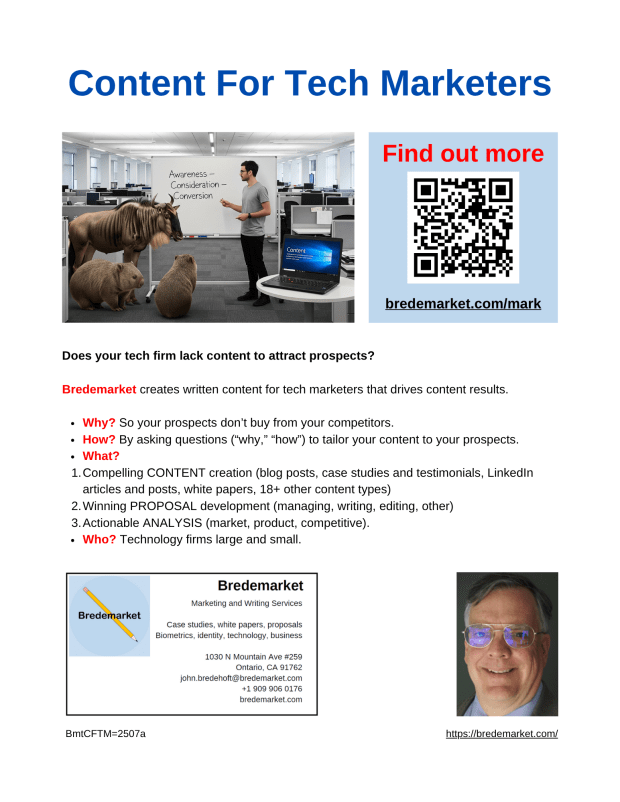
The third word differs from the other two, because there are multiple answers that are equally valid. I’ve just chosen to focus on one. If you subscribe to the notion of an ordered funnel (some marketers instead believe in a messy middle), then all prospects enter at the beginning of the funnel, and a subset of those prospects exit as buying customers at the end of the funnel. Using a simple three-stage funnel model, you can define those three stages as awareness, consideration, and conversion.
Right now I don’t care about consideration or conversion, although they’re obviously important. (If you have no conversions, you have no revenue, and you have no company.) For my purposes I’m focusing on awareness, or the stage in which a prospect discovers that your company has a product or service that benefits them.
Awareness. Imagen 4.
So how can you raise awareness of the benefits of your product to your prospects? There are multiple methods: text, images, videos, quizzes, contests, webinars, and podcasts. Bredemarket uses many of these methods via its social media channels. But today I’m going to focus on one particular method: blog posts. But we’ll cover some of the other ones also.
One blog breaks the lack of knowledge
The reason that I’m so gung-ho about blog posts is that they can be created and distributed very quickly. Press releases can take a long time. Videos, even longer. Webinars, even longer still.
Compare that to a blog post. A sole proprietor can generate a blog post in an hour. A company can get an emergency blog post out in the same time, provided the right people are in the room.
But before you can wow the world with your product’s benefits to your prospects, you have to go through several steps. The four steps listed here (have, know, write, and publish) are somewhat, but they paint the broad brush strokes.
Step One: Have a blog site (or equivalent)
This sounds obvious, but if you don’t have a blog site, you can’t post a blog.
Using myself as an example, my Bredemarket website is hosted by WordPress. And the website has an area where I’ve filed over a thousand blog posts, including this one.
Step Two: Know what you’re going to say, and why you’re saying it (I ask…)
I could spend ten blog posts talking about this step alone. It’s a loaded step encompassing both strategic and tactical elements. Vision. Mission. Positioning and messaging. And finally, the topic that you want to address in this single blog post.
For now I’ll just say that you should take a deep breath before putting pen to paper (or keyboard to file).
Step Three: Write and rewrite what you want to say (…then I act)
I ask, then I act.
But I act iteratively.
In most cases, I don’t just write and post.
I often create what I call a “draft 0.5,” where I get my ideas down, sleep on them, and then take a fresh second look. Often during that second look I cut out half the text.
When working on a project for a Bredemarket client, the text bounces between me and the client. I’ll write the first draft, then the client will review it and offer suggestions, and then I’ll rewrite it. For shorter text I’ll usually have two review cycles, with three review cycles for longer text.
The important thing is to get the piece written, reviewed, and approved. While I’ve drafted pieces and sat on them for months, the true benefits of blogging occur when you publish the piece as soon as possible.
Step four: Publish and publicize
When you’re ready, publish the blog post.
Perhaps you want to schedule the post to appear at an optimum time. For example, I am typing these words (or draft 0.5 of them anyway) on Sunday afternoon, knowing full well I won’t post this on Sunday afternoon. I’m thinking Tuesday morning.
And maybe there’s a reason why you want to publish a post at a particular time. If a trade show begins on Monday September 15, you may want to publish the promotional blog post on Friday September 12.
Once you’ve posted, publicize it.
If your company has an array of social media channels, you have two choices. Either you can post a link to the blog post on the social channel, or you can encapsulate the message from the blog post and repurpose it for the social channel without linking externally. Whatever gets the message out.
Taking an example from myself, I created a video entitled “Landscape (Biometric Product Marketing Expert)” on Sunday morning. I shared this video in a blog post. I also shared it in social media posts on Bluesky, Facebook, Instagram, LinkedIn, Substack, Threads, TikTok, WhatsApp, and YouTube. The only current social channels where I didn’t share it were Flip (because it’s…landscape). If I wanted to, I could have assembled a video or created a podcast or hosted a webinar. Oh, and I’m sharing it again. (Right now.)
Landscape (Biometric Product Marketing Expert).
Depending upon your thinking time, your drafting time, and your review cycles, you can get your message out to your prospects within a week…or even within a day.
Not too bad.
But I can’t do all that!
For some people, the idea of writing a blog post can be overwhelming.
That’s why Bredemarket is here to help you increase your tech company’s product benefit awareness. (Right now.)
If you have a blog site (or a LinkedIn, Facebook, or other equivalent) and are ready to get your message out, let’s talk about next steps.
Biometric marketing leaders already know that I’ve talked about reader personas to death. But what about WRITER personas? And what happens when you try to address ALL the reader and writer personas?
Reader personas
While there are drawbacks to using personas, they are useful in both content marketing and proposal work when you want to tailor your words to resonate with particular types of readers (target audiences, or hungry people).
I still love my example from 2021 in which a mythical Request for Proposal (RFP) was issued by my hometown of Ontario, California for an Automated Biometric Identification System (ABIS). The proposal manager had to bear the following target audiences (hungry people) in mind for different parts of the proposal.
The field investigators who run across biometric evidence at the scene of a crime, such as a knife with a fingerprint on it or a video feed showing someone breaking into a liquor store.
The examiners who look at crime scene evidence and use it to identify individuals.
The people who capture biometrics from arrested individuals at livescan stations.
The information technologies (IT) people who are responsible for ensuring that Ontario, California’s biometric data is sent to San Bernardino County, the state of California, perhaps other systems such as the Western Identification Network, and the Federal Bureau of Investigation.
The purchasing agent who has to make sure that all of Ontario’s purchases comply with purchasing laws and regulations.
The privacy advocate who needs to ensure that the biometric data complies with state and national privacy laws.
The mayor (Paul Leon back in 2021, and still in 2025), who has to deal with angry citizens asking why their catalytic converters are being stolen from their vehicles, and demanding to know what the mayor is doing about it.
Probably a dozen other stakeholders that I haven’t talked about yet, but who are influenced by the city’s purchasing decision.
Writer personas
But who is actually writing the text to address these different types of readers?
Now in this case I’m not talking about archetypes (a topic in itself), but about the roles of the subject matter experts who write or help write the content.
I am currently working on some internal content for a Bredemarket biometric client. I can’t reveal what type of content, but it’s a variant of one of the 22 types of content I’ve previously addressed. A 23rd type, I guess.
But what would happen if someone in a role other than product marketing consultant wrote this content?
An engineer would emphasize different things. Maybe a focus on the APIs.
A finance manager would emphasize different things. Maybe an ROI focus.
A salesperson may focus on different things. Maybe qualification of a prospect. Or eventually conversion.
So the final content is not only shaped by the reader, but by the writer.
You can’t please everyone so you’ve got to please yourself
With all the different reader and writer personas, how should you respond?
Do all the things?
Perhaps you can address everyone in a 500 page proposal, but the internal content Bredemarket is creating is less than 10 pages long.
Which is possibly already too long for MY internal target audience.
So I will NOT create the internal content that addresses the needs of EVERY reader and writer persona.
Which is one truth about (reader) personas in general. If you need to address three personas, it’s more effective to create 3 separate pieces than a single one.
Which is what I’m doing in another project for this same Bredemarket biometric client, this one customer-facing.
And the content targeted to latent examiners won’t mention the needs of Paul Leon.
In which I address the marketing leader reader persona
So now I, the biometric product marketing expert writer persona, will re-address you, the biometric marketing leader reader persona.
You need content, or proposal content.
But maybe you’re not getting it because your existing staff is overwhelmed.
So you’re delaying content creation or proposal responses, or just plain not doing it. And letting opportunities slip through your fingers.
Etymologically, the opposite of impostor syndrome would be expositor syndrome. I asked my buddy Google Gemini to hallucinate a definition, and this is what I got:
“Expositor Syndrome is a hypothetical, non-clinical psychological pattern characterized by an overwhelming and often compulsive urge to explain, clarify, or elaborate upon concepts, ideas, or events, even when such detailed exposition is unsolicited, unnecessary, or redundant. Individuals exhibiting Expositor Syndrome experience a profound discomfort or anxiety if they perceive a potential for misunderstanding or an unstated implication, feeling an internal pressure to “lay bare” all facets of a topic.
“Note: This is a fictional construct, not a recognized medical or psychological condition.”
Gemini actually said a lot more, but I chose not to elaborate.
This, rather than a delusion of grandeur, is considered the opposite of impostor syndrome because an impostor HIDES their true talented self, whereas an expositor ELABORATES and goes on and on about their knowledge. Until their friends become former friends and stop speaking to them.
But can someone exhibit both expositor syndrome and a delusion of grandeur?
Perhaps such a person—if they exist—can still make positive contributions to society.
Such as the Bredemarket 2800 Medium Writing Service, approximately 2800 to 3200 words that (a) answers the WHY/HOW/WHAT questions about you, (b) advances your GOAL, (c) communicates your BENEFITS, and (d) speaks to your TARGET AUDIENCE.
“Shoppers said they preferred being able to track their spending during a shop, access receipts instantly, and easily find products—all things that are harder with a fully automated system.
“The new solution—smart trolleys known as Dash Carts—lets customers scan items as they shop, view their basket total in real time, and pay using contactless payment at the end.”
Most product marketing references to artificial intelligence are meaningless. Some companies think that they can simply promote their product by saying “We use AI,” as if this is a sufficient reason for prospects to buy.
I’ve previously observed that saying “we use AI” is the 2020s equivalent to saying “we use Pentium.”
“(Several organizations) received a three-year, $1.3 million National Science Foundation grant to teach Florida middle school teachers and students how to use artificial intelligence (AI) to identify fossil shark teeth….Florida teachers learn to use a branch of AI called “machine learning,” to teach computers how to use shape, color, and texture to identify the teeth of the extinct giant shark megalodon.”
Now I come from the identity/biometrics industry, which uses machine learning extensively. But customers in this industry don’t really care about the “how,” (machine learning). They care about the “why” (identify individuals). For all the customers care, the vendors could use Pentium for identification. Or blockchain. Or Beatrice. As Loren Feldman says, “It doesn’t matter.”
Remember this the next time you want to identify extinct megalodon shark teeth. Now I admit the exercise serves an educational purpose by exposing teachers to the capabilities of machine learning. But if your sole interest is tooth classification, you can simply purchase the non-expurgated version of Olsen’s Standard Book of Extinct Sharks and get the job done.
Marketing executives, AI is no longer a differentiator. Trust me. If you need assistance with a real differentiator, I can help.
If you want to win business, learn more about Bredemarket’s content – proposal – analysis services here.
AAL1 (some confidence). AAL1, in the words of NIST, “provides some assurance.” Single-factor authentication is OK, but multi-factor authentication can be used also. All sorts of authentication methods, including knowledge-based authentication, satisfy the requirements of AAL1. In short, AAL1 isn’t exactly a “nothingburger” as I characterized IAL1, but AAL1 doesn’t provide a ton of assurance.
AAL2 (high confidence). AAL2 increases the assurance by requiring “two distinct authentication factors,” not just one. There are specific requirements regarding the authentication factors you can use. And the security must conform to the “moderate” security level, such as the moderate security level in FedRAMP. So AAL2 is satisfactory for a lot of organizations…but not all of them.
AAL3 (very high confidence). AAL3 is the highest authenticator assurance level. It “is based on proof of possession of a key through a cryptographic protocol.” Of course, two distinct authentication factors are required, including “a hardware-based authenticator and an authenticator that provides verifier impersonation resistance — the same device MAY fulfill both these requirements.”
This is of course a very high overview, and there are a lot of…um…minutiae that go into each of these definitions. If you’re interested in that further detail, please read section 4 of NIST Special Publication 800-63B for yourself.
Which authenticator assurance level should you use?
NIST has provided a handy dandy AAL decision flowchart in section 6.2 of NIST Special Publication 800-63-3, similar to the IAL decision flowchart in section 6.1 that I reproduced earlier. If you go through the flowchart, you can decide whether you need AAL1, AAL2, or the very high AAL3.
One of the key questions is the question flagged as 2, “Are you making personal data accessible?” The answer to this question in the flowchart moves you between AAL2 (if personal data is made accessible) and AAL1 (if it isn’t).
So what?
Do the different authenticator assurance levels provide any true benefits, or are they just items in a government agency’s technical check-off list?
Perhaps the better question to ask is this: what happens if the WRONG person obtains access to the data?
Could the fraudster cause financial loss to a government agency?
Threaten personal safety?
Commit civil or criminal violations?
Or, most frightening to agency heads who could be fired at any time, could the fraudster damage an agency’s reputation?
If some or all of these are true, then a high authenticator assurance level is VERY beneficial.
(T)here were 7,887 nurses who recently ended their healthcare careers between 2018 and 2021….39% of respondents said their decision to leave healthcare was due to a planned retirement. However, 26% of respondents cited burnout or emotional exhaustion, and 21% cited insufficient staffing.
And this is ALL nurses. Not just the forensic nurses who have to deal with upsetting examinations that (literally) probe into sexual assault and child abuse. All nurses have it tough.
At Artisight we are committed to reversing this trend through AI-driven technology that is bringing the joy back to medicine!!
Can artificial intelligence bots truly relieve the exhaustion of overworked health professionals? Let’s look at two AI solutions from 3M and Artisight and see whether they truly benefit medical staff.
3M, a former competitor to MorphoTrak until 3M sold its biometric offerings (as did MorphoTrak’s parent Safran), has invested heavily into healthcare artificial intelligence solutions. This includes a solution that addresses the bane of medical professionals everywhere—keeping up with the paperwork (and checking for potentially catastrophic errors).
Our solutions use artificial intelligence (AI) to alleviate administrative burden and proactively identify gaps and inconsistencies within clinical documentation. Supporting completeness and accuracy every step of the way, from capture to code, means rework doesn’t end up on the physician’s plate before or even after discharge. That enables you to keep your focus where it needs to be – on the patient right in front of you.
But what about Artisight, whose assertion inspired this post in the first place?
A recent PYMNTS article interviewed Artisight President Stephanie Lahr to uncover Artight’s approach.
The Artisight platform marries IoT sensors with machine learning and large language models. The overall goal in a hospital setting is to streamline safe patient care, including virtual nursing. Compliance with HIPAA, according to Lahr, has been an important part of the platform’s development, which includes computer vision, voice recognition, vital sign monitoring, indoor positioning capabilities and actionable analytics reports.
In more detail, a hospital patient room is equipped with Al-powered devices such as high-quality, two-way audio and video with multiple participants for virtual care. Ultra-wideband technology tracks the movement and flow of assets throughout the hospital. Remote nurses and observers monitor patient room activity off-site and interact virtually with patients and clinicians.
At a minimum, this reduces the need for nurses to run down the hall just to check things. At a maximum, tracking of asset flows and actionable analytics reports make the job of everyone in the hospital easier.
So how can 3M’s and Artisight’s artificial intelligence offerings benefit medical facilities?
Allow medical professionals to concentrate on care. Patients don’t need medical professionals who are buried in paperwork. Patients need medical professionals who are spending time with them. The circumstances that land a patient in a hospital are bad enough, and to have people who are forced to ignore patient needs makes it worse. Maybe some day we’ll even get back to Welbycare.
Free medical professionals from routine tasks. Assuming the solutions work as advertised, they eliminate the need to double-check a report for errors, or the need to walk down the hall to capture vital signs.
Save lives. Yeah, medical professionals do that. If the Marcus Welby AI bot spots an error in a report, or if the bot detects a negative change in vital signs while a nurse is occupied with another patient, the technology could very well save a life.


















 Bredemarket