What is an “antimicrobial” contact fingerprint reader? And what is it NOT?

(Part of the biometric product marketing expert series)

In the COVID and (soon) post-COVID area, people don’t want to touch things. That impacts how identity products are marketed, including biometric readers.

Why contactless biometrics are “better” than contact biometrics

In the biometric world, this reluctance to touch things has served to promote CONTACTLESS biometric technologies, such as facial recognition, other other technologies. The loser in this has been fingerprint-based technologies, as several facial and iris vendors have made the claim that face/iris biometrics are contactless, while fingerprint biometrics are NOT contactless.

Well, my friends at my former employer IDEMIA might take issue with that claim, since you literally do NOT touch the fingerprint reader in IDEMIA’s MorphoWave product. IDEMIA does not (to my knowledge) make any medical claims about MorphoWave, but the company does emphasize that its contactless fingerprint reader allows for fast capture of four-finger slaps.

To protect their premises, organizations need access control solutions that are efficient, fast, and convenient. A contactless fingerprint scanner provides an optimum answer high throughput workplaces. IDEMIA’s MorphoWave contactless fingerprint solution scans and verifies 4 fingerprints in less than 1 second, through a fully touchless hand wave gesture. Thanks to the simplicity of this gesture, the throughput can reach up to 50 people per minute.

An antimicrobial contact fingerprint reader?

But what if there were a CONTACT solution that allowed you to capture prints with a reduced fear of “bad things”?

That’s what Integrated Biometrics appears to be claiming.

Integrated Biometrics (IB), the world leader in mobile, FBI-certified biometric fingerprint scanners, and NBD Nanotechnologies (NBD Nano), the surface coating experts, today announced the inclusion of NBD’s RepelFlex MBED transparent coating on IB’s entire line of fingerprint scanners.

An ultra-thin, transparent coating, RepelFlex MBED is designed to provide outstanding antimicrobial, anti-scratch, and anti-stain protection to devices. Long-lasting and multi-functional, RepelFlex MBED is ideal for surfaces that must stand up to high throughput and harsh conditions without compromising accuracy.

So what exactly does “antimicrobial” mean?

cluster of Escherichia coli bacteria magnified 10,000 times. By Photo by Eric Erbe, digital colorization by Christopher Pooley, both of USDA, ARS, EMU. – This image was released by the Agricultural Research Service, the research agency of the United States Department of Agriculture, with the ID K11077-1 (next)., Public Domain, https://commons.wikimedia.org/w/index.php?curid=958857

Let’s see how NBD Nano describes it.

Preventing the presence and growth of microbials on surfaces is becoming increasingly important. Antimicrobial performance is especially critical on surfaces that are accessible to the public in order to prevent the spread of stain and odor causing bacteria and microbes.

And if you drill further down in NBD Nano’s website, you find this information in a technical data sheet (PDF).

Antimicrobial Performance: Japanese Industrial Standard (JIS) Z 2801 – PASS*
*as tested by Microchem Laboratory, Round Rock, TX

Now since I’m not up to date on my Japanese Industrial Standards, I had to rely on the good folks at the aforementioned Microchem Laboratory to explain what the standard actually means.

The JIS Z 2801 method tests the ability of plastics, metals, ceramics and other antimicrobial surfaces to inhibit the growth of microorganisms or kill them. The procedure is very sensitive to antimicrobial activity and has a number of real world applications anywhere from the hospital/clinical environment to a household consumer company concerned with the ability of a material they have to allow bacterial growth.

The JIS Z 2801 method is the most commonly chosen test and has become the industry standard for antimicrobial hard surface performance in the United States.

It may be antimicrobial, but what about preventing the “C” word?

Now you may have noticed that Microchem Laboratory, NBD Nano, and Integrated Biometrics did not make any medical claims regarding their products. None of them, for example, used the “C” word in any of their materials.

There’s a very, very good reason for that.

If any of these product providers were to make specific MEDICAL claims, then any sales in the United States would come under the purview of the U.S. Food and Drug Administration.

This is something that temperature scanner manufacturers learned the hard way.

Digression: if fever scanners are fever scanners, does that mean they are fever scanners?

Remember “fever scanners”? Those devices that were (and in some cases still are) pointed at your forehead as you enter a building or another secure area? I won’t get into the issues with these devices (what happens when the scanner is placed next to a building’s front entrance on a hot day?), but I will look at some of the claims about those scanners.

About a year ago, John Honovich of IPVM began asking some uncomfortable questions about the marketing of those devices, especially after the FDA clarified what thermal imaging systems could and could not do.

When used correctly, thermal imaging systems generally have been shown to accurately measure someone’s surface skin temperature without being physically close to the person being evaluated….

Thermal imaging systems have not been shown to be accurate when used to take the temperature of multiple people at the same time. The accuracy of these systems depends on careful set-up and operation, as well as proper preparation of the person being evaluated….

Room temperature should be 68-76 °F (20-24 °C) and relative humidity 10-50 percent….

The person handling the system should make sure the person being evaluated…(h)as waited at least 15 minutes in the measurement room or 30 minutes after exercising, strenuous physical activity, bathing, or using hot or cold compresses on the face.

Let’s stop right there. For any of you who have undergone a temperature scan in the last year: how many of you have waited in a measurement room for at least 15 minutes BEFORE your temperature was taken?

Last summer I had a dentist appointment. My dentist is in Ontario, California, where the summers can get kind of hot. The protocol at this dentist’s office was to have you call the office from your car when you arrived in the parking lot, then wait for someone from the office to come outside and take your temperature before you could enter the building.

I was no dummy. I left my car and its air conditioner running while waiting for my temperature to be taken. Otherwise, who knows what my temperature reading would have been? (I also chose NOT to walk to the dentist’s office that day for the same reason.)

Back to John Honovich. He had read the FDA advice on the medical nature of thermal imaging systems, and then noted that some of the manufacturers of said systems were sort of getting around this by stating that their devices were not medical devices.

Even though the manufacturers still referred to them as “fever cameras.”

For example, one vendor (who has since changed its advertising) declared at the time that “thermal temperature-monitoring technology assists in reducing the spread of viral diseases,” even though that vendor’s device “is not a medical device and is not designed or intended for diagnosis, prevention, or treatment of any disease or condition.”

Fever scanners, testosterone supplements…and fingerprint readers

Yes, that language is similar to the language used by providers of natural supplements that, according to anecdotal evidence, work wonders. The FDA really polices this stuff.

So you really don’t want to make medical claims about ANY product unless you can back them up with the FDA. You can say that a particular product passed a particular antimicrobial standard…but you’d better not say anything else.

In fact, Integrated Biometrics only mentions the “antimicrobial” claim in passing, but spends some time discussing other benefits of the NBD Nano technology:

The inclusion of RepelFlex MBED coatings enable IB’s scanners to deliver an even higher level of performance. Surfaces are tougher and more difficult to scratch or stain, increasing their longevity while maintaining print quality even when regular cleaning is not possible due to conditions or times of heavy use.

So the treated Integrated Biometrics products are tough…like those famous 1970s crime fighters Kojak, Columbo, and Danno and the other people from Five-O. (Not that Sherlock and Watson were slouches.)

Book ’em, Danno! By CBS Television – eBay item photo front photo back, Public Domain, https://commons.wikimedia.org/w/index.php?curid=19674714

On win themes and proposal themes

Once you’ve figured out the benefits of your solution for various customer stakeholders, you need to communicate the benefits in your proposal.

Sorry, this is a different type of “WIN.” Whip Inflation Now needlework picture. By Unknown author – Gerald R. Ford Presidential Museum, Public Domain, https://commons.wikimedia.org/w/index.php?curid=20829024

While I try to avoid complexity where possible, there are times when the communication of benefits will follow a hierarchy. Cheryl Smith describes two levels of the hierarchy in her Privia blog post:

Win Themes. These subtle messages are woven into your proposal narrative, reinforcing your Win Strategy. Knowing specifically what they are upfront will help reviewers know what to look for and identify how and where to improve them.

Proposal Themes. These explicit, section-specific statements are used to guide the evaluator as they read. Knowing specifically what they are upfront will help reviewers test how well they support your Win Theme(s) and identify how to improve them.

As you may recall, different evaluators read different sections of a proposal. For an automated fingerprint identification system (AFIS) proposal, you may have a certified latent examiner reading the latent entry section of the proposal, while an information technology person might read the network and security section of the proposal.

Unless you’re a sole proprietor, your win themes, proposal themes, and benefits will probably need some level of buyoff from multiple people. Perhaps your salesperson will advance some themes, but maybe his or her boss will need to approve them. (Approvals are a necessary evil in the proposal process.)

And then when the writers actually write the proposal, the writing will be measured (among other methods) for its faithfulness to the themes. Smith addresses this measurement also:

Be careful what you ask for. When you ask reviewers a generic question like “feedback,” you should expect a generic answer like, “this is weak.” Instead, ask reviewers a specific question like “how can I improve this section” or “how can I support this Win Theme”? This small adjustment in reviewer mind-set will transform a “this is weak” comment into an “add this proof point to strengthen the section” instruction. 

This is something discussed by Carl Dickson (someone I’ve mentioned before in another context).

In the perfect world, a proposal—even a proposal hundreds of pages long—will have consistent themes throughout. It won’t sound like it was written by a bunch of different people—even though it probably WAS written by a bunch of different people.

One of my clients is a practitioner of something called a “book of truth,” a short document distributed to all of the writers for a particular proposal. The book of truth not only states the win themes and proposal themes, but also has some rules for consistency, such as how to refer to the customer. You don’t want to refer to the customer as “Los Angeles County” on page 2, “the County of Los Angeles” on page 7, “L.A. County” on page 9, and “San Francisco” on page 11.

Yes, the latter can happen when you repurpose text and don’t check it carefully. Watch out, because despite the fact that San Francisco and Los Angeles are in the same state, they are not the same city, despite what some people might think.

Calendarizing content

(And verbing nouns, but that’s an entirely different topic.)

You may have heard of the acronym WiFLi, which stands for Wider, Faster, Lighter and is used by one manufacturer within the bicycling community.

WiFLi is SRAM’s name for a 2x drivetrain with wide-range cassette. The short cage eTap rear derailleur officially maxes out with a 28-tooth cog; the eTap WiFLi rear derailleur can take up to a 32-tooth cog. This provides lower gears—for higher cadences and easier hill climbing—than a traditional 2x drivetrain, without needing to sign up for a triple-chainring drivetrain.

(Um, has anyone in the bicycling industry heard of benefit statements rather than feature statements? Is the 28-tooth cog missing the wisdom teeth?)

So maybe you’ve heard of bicycling’s WiFLI. But you may not have heard of MY acronym WIFLI, which stands for “when I feel like it.”

For the most part, my blogging at Bredemarket and other places is conducted in a WIFLI fashion. I’ll get an idea, jot down some things about it, sleep on it (sometimes), and then distribute it to the world at the Bredemarket blog and other online locations.

More often than not I DO “feel like it,” so my social outlets don’t necessarily suffer from lack of content. But do my momentary whims lead me to create the RIGHT content?

And this, my friends, is why people suggest content calendars. Although you don’t need to keep them on paper these days.

A calendar from the Petaluma and Santa Rosa Railroad. By Visitor7 – Own work, CC BY-SA 3.0, https://commons.wikimedia.org/w/index.php?curid=26340569

Content calendars exist not only to make sure that you’re generating enough content, but that you’re generating the right content.

One of my goals at Bredemarket is to assist general technology customers, so this, my first post under my new Bredemarket content calendar schedule, is supposed to be a technology post. (I can’t post about identity all the time, after all.)

And I chose to write this technology post about content calendar technology.

I think that’s cheating. (If it were identity day, would I have posted an autobiography?)

But there ARE technology issues to consider when creating a content calendar. You can either adapt common tools such as Excel (example) or Trello (example) to create your content calendar, or you can use special-purpose applications such as Agorapulse or DivvyHQ or Loomly or Monday to do it.

As of now, I’m leaning toward the “adapt common tools” route, and the common tool that I adapted was…Google Calendar. I just created an additional calendar, called it “blog/social content calendar,” and marked the days on which I wanted to address different topics. I’m putting notes in the calendar entries as needed to spur my creation, distribution, and so forth.

Perhaps I can get fancy later, but for now this is getting me started. In the future I may iterate toward something more complex, or alternatively I may iterate away from the entire idea of a content calendar altogether.

The important thing is to start, evaluate, and then adjust.

Now I obviously can’t go to clients and tell them that I am an expert at content calendars, with deep knowledge of the topic. But I at least know the questions to ask.

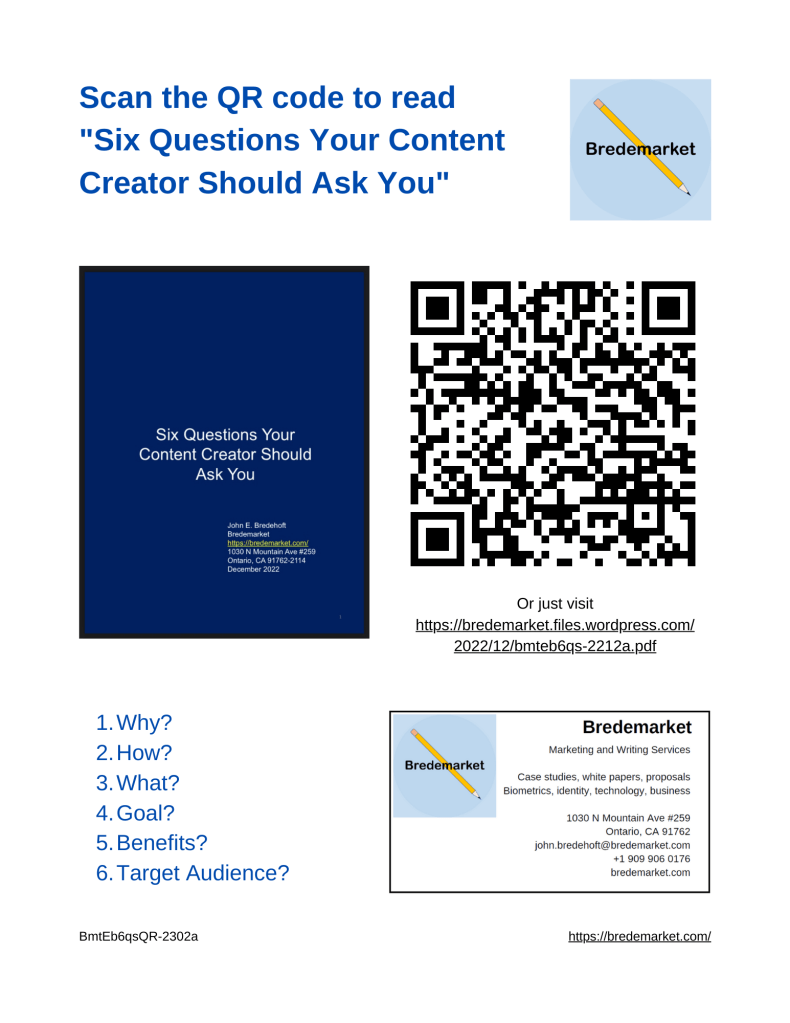
  • What are the important topics that your company wants to address?
  • How will you address those topics? Blogging? LinkedIn? Paper planes flown through potential clients’ open windows?
  • How often do you want to create content?
  • Can you truly create content at that pace?

If you want me to fire a bunch of these and similar questions at you, and possibly to help you create content that aligns with your content calendar, contact me.

(Past illustrations) Deriving determinants of bid prices

(This past illustration describes something that I performed in my career, either for a Bredemarket client, for an employer, or as a volunteer. The entity for which I performed the work, or proposed to perform the work, is not listed for confidentiality reasons.)

PROBLEM

For a particular product line, a company wanted to know which variables could be used to predict how a particular bid would be priced.

By Bernard Gagnon – Own work, CC BY-SA 3.0, https://commons.wikimedia.org/w/index.php?curid=18185578

SOLUTION

Using data from FOIA requests, I identified and collected variables that were perceived to have an effect on bid price. In addition to the final price for each bid, I also collected relevant technical requirements from the bid, customer characteristics, bid evaluation scores where available, and other data.

After I collected the data, my colleague analyzed the data statistically, both to try to derive equations that fit the data, and also to illustrate the data in graphical form.

RESULTS

For this particular product line, the data did not closely correlate to any particular equation that could be used to predict bid price. (A separate analysis of a different product line yielded better correlation results.)

If you have a paid version of Microsoft Office 365, you have an audio transcription tool

I’ve been meaning to write about the tools that I’ve found to be most useful in my Bredemarket work, but I’ve never gotten around to actually write about them. Maybe one of the companies will sponsor my post or something.

Well, this post isn’t a sponsored post, because I don’t think that Microsoft regards me as an important enough influencer to throw money Bredemarket’s way. But I recently used a Microsoft feature to save myself some significant time on a client project.

As part of the work that I do for one of my clients, I participate in half-hour interviews with the client’s customers and ask them questions about the client’s software. Before the interview begins, the client asks the customer for permission to record the conversation. After the interview is over, I can then refer to that recording to extract nuggets of information.

You can imagine the process.

  • Advance two minutes on the recording to get past the preliminaries.
  • Listen for a few seconds.
  • Fast forward 30 seconds.
  • Fast forward 30 seconds again.
  • Oh, that’s good! Back up 10 seconds.
  • Listen for a few seconds while typing.
  • Stop.
  • Listen and type more.
  • Fast forward 30 seconds.

As you can see, it takes a while. So I began thinking about transcribing the recording to make things easier.

My first attempt didn’t go so well. I opened up a copy of Microsoft Word on my computer and opened up the recording, then I pressed Word’s “Dictate” button while starting the recording.

Good idea in theory, but it didn’t work in practice. And even if it had worked, it would have taken 30 minutes to dictate the entire interview.

So I did some research and found this article from Beebom. It described a “transcribe” feature in Microsoft Word, but you could only use it under certain conditions.

  • You have to have a paid version of Microsoft Office 365.
  • You have to use the web version of Word, not the on-computer version.
  • Your audio file cannot be larger than 200 megabytes.
  • Your audio has doesn’t have to be in the English language. While this was apparently true at the time the Beebom article was written, it looks like the transcription software now supports dozens of languages.
  • You cannot transcribe more than five hours’ worth of audio in any month.

I was able to meet all of these conditions, luckily. When you use the online version of Word, the “Dictate” button becomes a “Dictate/Transcribe” button, allowing you to upload an audio file to OneDrive and then transcribe it.

Transcription is much faster than real time. In my case, the service transcribed 30 minutes’ worth of audio in a few minutes.

You can then save the transcription to Microsoft Word (cloud or on-premise), and can include timestamps if you desire. The transcription also attempts to identify speakers separately.

I can say that the transcription was fairly good. I did not need five nines’ accuracy on the transcription; I just needed to figure out what we were talking about. And if I had needed to clean up any portion of the transcript, the timestamps could guide me to the exact place in the audio.

So this provided time savings for me, and also provided benefits for my client, since I was able to easily identify more “nuggets of information” than I could have the old fashioned way.

Now there are certainly other services out there, and this particular service isn’t technically a free service (since I had to pay for the Microsoft Office 365 subscription), but in certain cases transcription services are worth the money you paid for them.

Shorter and sweeter? The benefits of benefits for identity firms

Repurposing is fun.

Remember the four posts that I wrote earlier this week about communicating benefits to identity customers? Well, I just summarized all four of the posts on a single page on the Bredemarket website, The benefits of benefits for identity firms.

(And now I’m repurposing that page into a single, short blog post. It’s a succinct way to establish my bona fides as an identity content marketing expert.)

The page concludes with a question:

Why is Bredemarket the best choice to help your identity firm communicate its benefits?

  • No identity learning curve.
  • I’ve probably communicated in the format you need.
  • I work with you.
  • I can package my offering to meet your needs.

For the complete page, click here. And if you are an identity firm that needs my services, contact me.

Communicating benefits (not features) to identity customers (Part 4 of 3)

[Link to part 1] | [Link to part 2] | [Link to part 3]

I knew I’d think of something else after I thought this whole post series was complete. But this post will be brief.

Benefit statements are not only affected by the target customers, but are also affected by the “personality” of the company stating the benefits.

As we all know, different companies use different tones of voice in their communications. A benefit statement from Procter & Gamble will read differently than a benefit statement from Apple, for example.

With that in mind, let’s turn to the example that I used in the third post in this series-namely, that the benefit of a one-second response time for computer aided dispatch (CAD) systems is that it keeps people from dying.

Death personified in Punch. By Punch Magazine – Original: Cartoon from Punch Magazine, Volume 35 Page 137; 10 July 1858 This copy: City and Water Blog, Public Domain, https://commons.wikimedia.org/w/index.php?curid=4465060

Not all companies are going to be that blunt about this particular benefit.

To my knowledge, SCC, Printrak, or Motorola have never explicitly talked about avoiding death as a benefit or their computer aided dispatch systems. Perhaps there IS a CAD company that does this, though.

This is why the development of benefit statements is often a collaborative affair, in part to ensure that the benefit statements align with the character of the company issuing them. Imagine the reaction if P&G promoted one of its soap products with a high-tech advertisement loudly proclaiming “PURPLE!” like the recent Apple ad.

Procter & Gamble ads are usually a bit more restrained.

Well, at least they used to be.

To be frank, Procter & Gamble is better at explicitly stating benefits than Apple is. Saving $100 a year on your energy bill is a benefit; purple is not. But Apple is communicating an implicit “Apple owners are cooler than mere mortals” benefit. Cold vs. cool, I guess, as well as an entirely different definition of “identity” that doesn’t rely on individualization. (If thousands of people have purple iPhones, this fact cannot be used to individually identify them.)

So you not only have to know your customer, but you need to know yourself so that you can describe benefits that are important to your customer in a voice that is accurate to your company’s “personality.”

This is why Bredemarket uses an iterative process in developing communications for its clients. If you’re an identity product/service provider that needs help in communicating customer benefits in proposals, case studies, white papers, blog posts, and similar written output, Bredemarket can implement such an iterative process to help you develop that output. Contact me.

Communicating benefits (not features) to identity customers (Part 3 of 3)

[Link to part 1] | [Link to part 2] | [Link to part 4]

(Updated 4/16/2022 with additional benefits information.)

NOTE: After publishing the second post in this series, but before publishing this third post, I ran across other people in the identity industry who were asking the “So what?” question, but from a strategic perspective rather than a sales enablement perspective. I discuss this in my personal JEBredCal blog, in this post.

This is a continuation of two previous posts. In the first and second posts in this series, I initially explained the difference between benefits and features, and why you sometimes have to act like an irritating two-year old to convert a feature into a benefit (the “so what?” test). I also explained how benefit statements need to be tailored to particular stakeholders, and how there can be many stakeholders even for a simple procurement.

I promised in the second post that I planned to dive into issues more specific to identity customers, such as when a two hour response time matters, when a one minute response time matters, and when a one second response time matters. Unfortunately, I spent so much time talking about all the stakeholders that I never got around to that particular question.

I promise that I’ll get into it right now.

Two hours vs. one minute vs. one second

You may remember that in the first post, I listed several things that some people thought were benefits, but were actually features. The final three items in that list were the following:

  • This product can complete its processing in less than two hours.
  • This product can complete its processing in less than a minute.
  • This product can complete its processing in less than a second.

These feature statements are very similar, yet at the same time very different. As you might have guessed, these feature statements are associated with three different products that are targeted to different markets.

Two hours: rapid DNA

I already alluded to the first of the three feature statements, two hour response time, in an earlier post in this series. Although I didn’t say so that the time, this is an important feature for the “rapid DNA” systems sold by Thermo Fisher Scientific and ANDE. These systems are used for multiple purposes, including

  • examining crime scene DNA evidence,
  • identifying deceased disaster victims, and
  • checking to see if arrested individuals are wanted for more serious crimes.

The two hour rapid DNA processing time offers different benefits for these different use cases.

  • As I previously stated in my first example of a “so what?” test, the ability to run rapid DNA at booking keeps dangerous criminals from being released by identifying those who are wanted for serious crimes.
  • A two hour processing time for crime scene evidence solves crimes more quickly, and again potentially puts dangerous criminals in jail more quickly.
  • A two hour response for disaster victim identification brings peace of mind to family members whose relatives may have perished in a disaster.

(4/16/2022: For additional information on benefits, click here.)

Depending upon the target audience, a rapid DNA vendor must tailor its benefit statements accordingly.

One minute: real time AFIS

Next, I want to look at the one minute response time, which is something that I used to talk about over twenty-five years ago when “real time AFIS” became a reality.

Because of the limitations of early computers, it used to take hours or days to compare the features from a latent fingerprint against the features of fingerprints in a database of known criminals. The old computers, even when souped up with special processing equipment such as hardware matchers and hardware fingerprint processors, took a long time to perform all of the calculations needed to compare a fingerprint’s features against hundreds of thousands of other fingerprint features.

Around the time that I joined Printrak, real time AFIS became a reality, where it became cost-effective and technologically feasible to size systems to deliver those fingerprint matching results in a minute. Today, the FBI’s Repository for Individuals of Special Concern (RISC) advertises that it can identify high-priority criminals within seconds.

At the time (1994), real time AFIS was a big deal, and the proposals that I helped to write emphasized that crimes could be solved more quickly (for latent/crime scene fingerprint searches), and individuals could be identified more quickly (for tenprint/booking searches).

One second: computer aided dispatch

To explain the third feature statement about one second response times, I have to fast forward three years to 1997, when the company then known as Printrak acquired the computer aided dispatch (CAD) and records management systems (RMS) unit of SCC Communications Corp. Printrak acquired other companies that year, but the SCC acquisition ended up being the most important, since it led to Printrak’s acquisition by Motorola.

(Allow me to go off on a tangent for a minute. When Motorola sold the biometric part of the business to Safran, it chose to retain the CAD and RMS portions, which remain part of Motorola Solutions’ portfolio today. One other tidbit: one of the key SCC people who joined Printrak at the time eventually left Motorola, and now works for rapid DNA vendor ANDE. As we Californians would say, it’s a small world after all.)

Now while there are some parallels between CAD and the systems then known as automated FINGERPRINT identification systems (AFIS), there are some key differences in the markets that the two products address. We on the AFIS side learned this the hard way when we introduced ourselves to our new colleagues.

“Hi, SCC folks, welcome to Printrak. You’re joining a company that sells REAL TIME AFIS that delivers results within one minute! Aren’t you impressed?”

A screenshot of computer-aided dispatch as being used by Toronto Fire Services. By Hillelfrei – Own work, CC BY-SA 4.0, https://commons.wikimedia.org/w/index.php?curid=88913432

The ex-SCC people responded, gently disabusing us of our pretensions to speed.

“Hello, new corporate overlords. We provide computer aided dispatch systems that send police, fire, and medical personnel to crime scenes and emergency sites as soon as possible. If our CAD systems took AN ENTIRE MINUTE to dispatch personnel, PEOPLE WOULD DIE. We use really powerful computers to get personnel dispatched in a second. Enjoy your real time AFIS…amateurs.”

So the company Printrak learned that it needed separate benefit statements, depending upon the product line the company was promoting at any given time. The CAD customers received one set of benefit statements, while the AFIS customers received a separate set.

Conclusion (finally)

In short, you have to know your customer so that you can describe benefits that are important to your customer.

And if you’re an identity product/service provider that needs help in communicating customer benefits in proposals, case studies, white papers, blog posts, and similar written output, Bredemarket can help. Contact me.

Communicating benefits (not features) to identity customers (Part 2 of 3)

[Link to part 1] | [Link to part 3] | [Link to part 4]

(Updated 4/16/2022 with additional information on benefits.)

This is a continuation of a previous post, in which I explained the difference between benefits and features, and why you sometimes have to act like an irritating two-year old to convert a feature into a benefit (the “so what?” test).

As I promised in that previous post, I plan to dive into issues more specific to identity customers, such as when a two hour response time matters, when a one minute response time matters, and when a one second response time matters.

Who are identity customers?

Before I dive into response times, let’s explain who identity customers are, because not all identity customers are alike.

When I use the term “identity” at Bredemarket, I am referring to any technology that can be used to identify an individual. This does not just relate to biometrics (fingerprint identification, facial recognition, etc.), but to any of the five factors of authentication that can identify an individual. A physical or digital driver’s license. A fob. A secret handshake. A geographic location. Even a password.

Obviously there are a ton of customers that use identification technologies, and they care about a ton of things.

Well, what if we focus our discussion and talk about a SINGLE product, such as automated biometric identification systems (ABIS)? We can market to all ABIS customers with a single set of benefit statements, right?

Um, no.

ABIS can be sold to all sorts of different customers, ranging from local police agencies to state welfare benefit administrators to national passport issuing agencies.

Well, what if we focus our discussion and talk about a SINGLE type of customer for a single product, such as the local law enforcement agencies that buy ABIS? We can market to all local law enforcement ABIS customers with a single set of benefit statements, right?

Um, no.

If I am going to sell an ABIS to the city of Ontario, California (sorry Thales), these are the types of customers (or target audiences) that I have to cover with separate benefit statements:

By FBI – http://www.fbi.gov/news/photos, Public Domain, https://commons.wikimedia.org/w/index.php?curid=18500900
  • The field investigators who run across biometric evidence at the scene of a crime, such as a knife with a fingerprint on it or a video feed showing someone breaking into a liquor store.
  • The examiners who look at crime scene evidence and use it to identify individuals.
  • The people who capture biometrics from arrested individuals at livescan stations.
  • The information technologies (IT) people who are responsible for ensuring that Ontario, California’s biometric data is sent to San Bernardino County, the state of California, perhaps other systems such as the Western Identification Network, and the Federal Bureau of Investigation.
  • The purchasing agent who has to make sure that all of Ontario’s purchases comply with purchasing laws and regulations.
  • The privacy advocate who needs to ensure that the biometric data complies with state and national privacy laws.
  • The mayor (Paul Leon as I write this), who has to deal with angry citizens asking why their catalytic converters are being stolen from their vehicles, and demanding to know what the mayor is doing about it.
  • Probably a dozen other stakeholders that I haven’t talked about yet, but who are influenced by the city’s purchasing decision.

As you can see, there are a ton of people who are going to read a proposal to provide an ABIS to a city, and they all have differing needs that need to be addressed…and different benefits that have to be emphasized.

Benefits of a feature are customer-dependent

Now let’s take one of my feature statements from my first post and try to convert it to a benefit for one or more of these stakeholders. I’m going to choose this one:

  • This product captures latent fingerprints at 1000 pixels per inch.

Right off the bat, I’ll tell you that 1000 ppi latent fingerprint capture doesn’t make a bit of difference to the majority of the stakeholders. Paul Leon isn’t going to care. The purchasing agent SHOULD care (1000 ppi data requires more storage than 500 ppi data, which translates to more cost), but probably isn’t going to know that he/she should care.

With the possible exception of the IT personnel, the only people that care about 1000 ppi capture are the examiners who use crime scene evidence and use it to identify individuals. And needless to say, the examiners that concentrate on face or iris or voice or DNA data aren’t going to care about a fingerprint capture specification.

So if I’m writing a proposal to the city of Ontario, California, I’m going to make sure that the latent fingerprint capture section of the proposal discusses my product’s ability to capture latent fingerprints at 1000 ppi.

Wait for it…

SO WHAT?

Absent the benefit of standards compliance that ensures that Ontario data can be processed by state and national systems, the chief benefit of 1000 ppi latent fingerprint capture is that it provides a higher probability that examiners can positively identify criminals and solve more crimes.

An explanation: because latent fingerprints are often of poor quality – the criminals don’t usually take the time to ensure that the fingerprint evidence they leave at crime scenes is readable – latent examiners often benefit from having higher-resolution 1000 ppi latent fingerprint images, rather than the lower-resolution 500 ppi latent fingerprint images that were common in 20th century fingerprint systems. This higher resolution can make it easier for a latent fingerprint examiner to match a latent to a criminal’s tenprint fingerprint from a previous arrest, leading to the “solve more crimes” benefit.

So you’re going to come up with separate benefit statements for examiners, separate ones for livescan operators, and separate benefit statements for each of the stakeholders. And each of these benefits will be enumerated in the section of the proposal that the individual stakeholder will read. (News flash: hardly anyone reads the entire proposal; they only read the section that pertains to them.)

(4/16/2022: For additional information on benefits, click here.)

What’s next?

Well, I never got around to my two hour vs. one minute vs. one second question, and this post is getting long, so I guess I’ll address that topic in a third post.

In the meantime, if you’re an identity product/service provider that needs help in communicating customer benefits in proposals, case studies, white papers, blog posts, and similar written output, Bredemarket can help. Contact me.

Communicating benefits (not features) to identity customers (Part 1 of 3)

[Link to part 2] | [Link to part 3] | [Link to part 4]

(Updated 4/16/2022 and 4/18/2022 with additional benefits and customer focus information.)

I wanted to take some time to specifically explain how to communicate benefits to identity customers. And I’ll take a lot of time, addressing the topic in three planned posts.

What are benefits?

When you write a proposal, case study, or other document that is targeted to identity customers, you need to communicate the benefits to the target audience.

But what are benefits?

It turns out that many people don’t know what benefits are.

Over the years I’ve had occasion to ask people to suggest some benefits to include in a document. Sometimes I’ve received responses that are similar to these:

  • This product is dual-purpose and supports both detection of speeders and detection of red light runners.
  • This product captures latent fingerprints at 1000 pixels per inch.
  • This product was a top tier performer in the recent NIST tests.
  • This product can complete its processing in less than two hours.
  • This product can complete its processing in less than a minute.
  • This product can complete its processing in less than a second.

These are all nice statements, but these aren’t BENEFIT statements.

These are statements of FEATURES.

The last three examples illustrate the issue. In certain markets, a two hour response time is very impressive In other markets, a one minute response time will result in getting somebody killed. (I’ll address the differences later.)

In my recent post about case studies, I linked to a Hubspot article that explained the difference between benefits and features. I didn’t dive into that article at the time, but I’ll do so now. Here is how Kayla Carmichael’s article explains the difference between the two.

Features describe what the product does, setting it apart from the competition. Benefits describe how the product can help the audience. For marketing messages, it’s typically better to go with a benefits-heavy approach, because benefits are what makes consumers purchase.

The “so what?” test

As you can see, benefits are customer-centric. In another Hubsport article, Aja Frost notes that one way to tell whether you’re dealing with a benefit or a feature is to ask the question “So what?”

(4/18/2022: For additional information on customer focus, click here.)

Let’s return to my first example above, “This product is dual-purpose and supports both detection of speeders and detection of red light runners.” Even if you’re a road safety customer, you may not care whether a particular device is dual-purpose or not.

Maybe you don’t care about both issues at a particular location on the road. If the road safety camera is placed on an interstate highway, red lights are obviously not an issue.

Maybe you don’t care about one of the issues at all. Perhaps local laws don’t allow for unmonitored devices that detect speeders.

Perhaps your agency doesn’t care if you have to put two devices—one for speed detection, one for red light detection—at the same location.

So if you encounter a statement that isn’t a benefit, you have to act like an irritating two-year old and ask “so what?” until you actually get a benefit statement.

By Mindaugas Danys from Vilnius, Lithuania, Lithuania – scream and shout, CC BY 2.0, https://commons.wikimedia.org/w/index.php?curid=44907034

This product can complete its processing in less than two hours.

SO WHAT?

“This product can complete its processing while the arrestee is still in custody, before the suspect is released.”

SO WHAT?

“This product can detect whether the arrestee is wanted for more serious charges while the arrestee is still in custody.”

SO WHAT?

“This product can identify arrestees who have outstanding warrants for murder before they are released to murder more people.”

That’s better.

(4/16/2022: For additional information on benefits, click here.)

What’s next?

Anyway, that’s the general concept of benefits vs. features. In a future post, I’ll dive into issues more specific to identity customers, such as when a two hour response time matters, when a one minute response time matters, and when a one second response time matters.

These differences make all the…um difference to identity customers.

Stay tuned.

In the meantime, if you’re an identity product/service provider that needs help in communicating customer benefits in proposals, case studies, white papers, blog posts, and similar written output, Bredemarket can help. Contact me.