There’s a Reason Why “Tech” is a Four-Letter Word

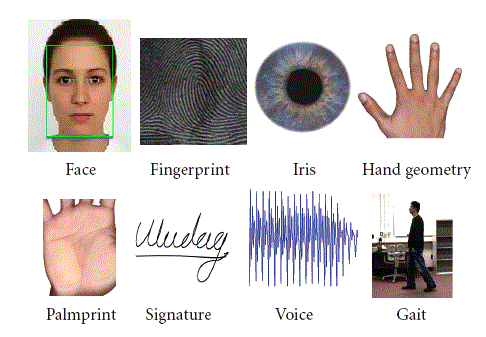
By Tomia, original image en:User:Polylerus – Own work (Vector drawing based on Image:Profanity.JPG), Public Domain, https://commons.wikimedia.org/w/index.php?curid=3332425

We often use the phrase “four-letter word” to refer to cuss words that shouldn’t be said in polite company. Occasionally, we have our own words that we personally consider to be four-letter words. (Such as “BIPA.”)

There are some times when we resign ourselves to the fact that “tech” can be a four-letter word also. But there’s actually a good reason for the problems we have with today’s technology.

Tech can be dim

Just this week I was doing something on my smartphone and my screen got really dim all of a sudden, with no explanation.

So I went to my phone’s settings, and my brightness setting was down at the lowest level.

For no reason.

“Any sufficiently advanced technology is indistinguishable from magic.”

– Arthur C. Clarke, quoted here.

So I increased my screen’s brightness, and everything was back to normal. Or so I thought.

A little while later, my screen got dim again, so I went to the brightness setting…and was told that my brightness was very high. (Could have fooled me.)

I can’t remember what I did next (because when you are trying to fix something you can NEVER remember what you did next), but later my screen brightness was fine.

For no reason.

Was Arthur C. Clarke right? And if so, WHY was he right?

Perhaps it’s selective memory, but I don’t recall having this many technology problems when I was younger.

The shift to multi-purpose devices

Part of the reason for the increasing complexity of technology is that we make fewer and fewer single-purpose devices, and are manufacturing more and more multi-purpose devices.

One example of the shift: if I want to write a letter today, I can write it on my smartphone. (Assuming the screen is bright enough.) This same smartphone can perform my banking activities, play games, keep track of Bredemarket’s earnings…oh, and make phone calls.

Smartphones are an example of technologial convergence:

Technological convergence is a term that describes bringing previously unrelated technologies together, often in a single device. Smartphones might be the best possible example of such a convergence. Prior to the widespread adoption of smartphones, consumers generally relied on a collection of single-purpose devices. Some of these devices included telephones, wrist watches, digital cameras and global positioning system (GPS) navigators. Today, even low-end smartphones combine the functionality of all these separate devices, easily replacing them in a single device.

From a consumer perspective, technological convergence is often synonymous with innovation.

From https://www.techtarget.com/searchdatacenter/definition/technological-convergence

And the smartphone example certainly demonstrates innovation from the previous-generation single-purpose devices.

When I was a kid, if I wanted to write a letter, I had two choices:

  1. I could set a piece of paper on the table and write the letter with a writing implement such as a pen or pencil.
  2. I could roll a piece of paper into a typewriter and type the letter.

These were, for the most part, single purpose devices. Sure I could make a paper airplane out of the piece of paper, but I couldn’t use the typewriter to play a game or make a phone call.

Turning our attention to the typewriter, it certainly was a manufacturing marvel, and intricate precision was required to design the hammers that would hit the typewritter ribbon and leave their impressions on the piece of paper. And typewriters could break, and repairmen (back then they were mostly men) could fix them.

A smartphone is much more innovative than a smartphone. But it’s infinitely harder to figure out what is wrong with a smartphone.

The smartphone hardware alone is incredibly complex, with components from a multitude of manufacturers. Add the complexities of the operating system and all the different types of software that are loaded on a smartphone, and a single problem could result from a myriad of causes.

No wonder it seems like magic, even for the best of us.

Explaining technology

But this complexity has provided a number of jobs:

  • The helpful person at your cellular service provider who has acquired just enough information to recognize and fix an errant application.
  • The many people in call centers (the legitimate call centers, not the “we found a problem with your Windows computer” call scammers) who perform the same tasks at a distance.
By Earl Andrew at English Wikipedia – Own work, Public Domain, https://commons.wikimedia.org/w/index.php?curid=17793658
  • All the people who write instructions on how to use and fix all of our multi-purpose devices, from smartphones to computers to remote controls.

Oh, and the people that somehow have to succinctly explain to prospects why these multi-purpose devices are so great.

Because no one’s going to run into problems with technology unless they acquire the technology. And your firm has to get them to acquire your technology.

Crafting a technology marketing piece

So your firm’s marketer or writer has to craft some type of content that will make a prospect aware of your technology, and/or induce the prospect to consider purchasing the technology, and/or ideally convert the prospect into a paying customer.

Before your marketer or writer crafts the content, they have to answer some basic questions.

By Evan-Amos – Own work, Public Domain, https://commons.wikimedia.org/w/index.php?curid=11293857

Using a very simple single-purpose example of a hammer, here are the questions with explanations:

  • Why does the prospect need this technology? And why do you provide this technology? This rationale for why you are in business, and why your product exists, will help you make the sale. Does your prospect want to buy a hammer from a company that got tired of manufacturing plastic drink stirrers, or do they want to buy a hammer from a forester who wants to empower people to build useful items?
  • How does your firm provide this technology? If I want to insert a nail into a piece of wood, do I need to attach your device to an automobile or an aircraft carrier? No, the hammer will fit in your hand. (Assuming you have hands.)
  • What is the technology? Notice that the “why” and “how” questions come before the “what” question, because “why” and “how” are more critical. But you still have to explain what the technology is (with the caveat I mention below). Perhaps some of your prospects have no idea what a hammer is. Don’t assume they already know.
  • What is the goal of the technology? Does a hammer help you floss your teeth? No, it puts nails into wood.
  • What are the benefits of the technology? When I previously said that you should explain what the technology is, most prospects aren’t looking for detailed schematics. They primarily care about what the technology will do for them. For example, that hammer can keep their wooden structure from falling down. They don’t care about the exact composition of the metal in the hammer head.
  • Finally, who is the target audience for the technology? I don’t want to read through an entire marketing blurb and order a basic hammer, only to discover later that the product won’t help me keep two diamonds together but is really intended for wood. So don’t send an email to jewelers about your hammer. They have their own tools.
By Mauro Cateb – Own work, CC BY-SA 4.0, https://commons.wikimedia.org/w/index.php?curid=90944472

(UPDATE OCTOBER 23, 2023: “SIX QUESTIONS YOUR CONTENT CREATOR SHOULD ASK YOU IS SO 2022. DOWNLOAD THE NEWER “SEVEN QUESTIONS YOUR CONTENT CREATOR SHOULD ASK YOU” HERE.)

Once you answer these questions (more about the six questions in the Bredemarket e-book available here), your marketer or writer can craft your content.

Or, if you need help, Bredemarket (the technology content marketing expert) can craft your content, whether it’s a blog post, case study, white paper, or something else.

I’ve helped other technology firms explain their “hammers” to their target audiences, explaining the benefits, and answering the essential “why” questions about the hammers.

Can I help your technology firm communicate your message? Contact me.

Bredemarket logo

Time to Check the Current NIST Face Recognition Vendor Test Results (well, three of them)

It’s been a while since I’ve peeked at the NIST Face Recognition Vendor Test (FRVT) results.

As I’ve stated before, the results can be sliced and diced in so many ways that many vendors can claim to be the #1 NIST FRVT vendor.

What’s more, these results change on a monthly basis, so it’s quite possible that the #1 vendor in some category in February 2022 was no longer than #1 vendor in March 2022. (And if your company markets years-old FRVT results, stop it!)

This is the August 15, 2023 peek at three ways to slice and dice the NIST FRVT results.

And a bunch of vendors will be mad at me because I didn’t choose THEIR preferred slicing and dicing, or their ways to exclude results (not including Chinese algorithms, not including algorithms used in surveillance, etc.). The mad vendors can write their own blog posts (or ask Bredemarket to ghostwrite them on their behalf).

NIST FRVT 1:1, VISABORDER

The phrase “NIST FRVT 1:1, VISABORDER” is shorthand for the NIST one-to-one version of the Face Recognition Vendor Test, using the VISABORDER probe and gallery data. This happens to be the default way in which NIST sorts the 1:1 accuracy results, but of course you can sort them against any other probe/gallery combination, and get a different #1 vendor.

As of August 15, the top two accuracy algorithms for VISABORDER came from Cloudwalk. Here are all of the top ten.

Captured 8/15/2023, sorted by VISABORDER. From https://pages.nist.gov/frvt/html/frvt11.html

NIST FRVT 1:1, Comparison Time (Mate)

But NIST doesn’t just measure accuracy for a bunch of different probe-target combinations. It also measures performance, since the most accurate algorithm in the world won’t do you any good if it takes forever to compare the face templates.

One caveat regarding these measures is that NIST conducts the tests on a standardized set of equipment, so that results between vendors can be compared. This is important to note, because a comparison that takes 103 milliseconds on NIST’s equipment will yield a different time on a customer’s equipment.

One of the many performance measures is “Comparison Time (Mate).” There is also a performance measure for “Comparison Time (Non-mate).”

So in this test, the fastest vendor algorithm comes from Trueface. Again, here are the top 10.

Captured 8/15/2023, sorted by Comparison Time (Mate). From https://pages.nist.gov/frvt/html/frvt11.html

NIST FRVT 1:N, VISABORDER 1.6M

Now I know what some of you are saying. “John,” you say, “the 1:1 test only measures a comparison against one face against one other face, or what NIST calls verification. What if you’re searching against a database of faces, or identification?”

Well, NIST has a 1:N test to measure that particular use case. Or use cases, because again you can slice and dice the results in so many different ways.

When looking at accuracy, the default NIST 1:N sort is by:

  • Probe images from the BORDER database.
  • Gallery images from a 1,600,000 record VISA database.

Cloudwalk happens to be the #1 vendor in this slicing and dicing of the test. Here are the top ten.

Captured 8/15/2023, sorted by Visa, Border, N=1600000. From https://pages.nist.gov/frvt/html/frvt1N.html

Test data is test data

The usual cautions apply that everyone, including NIST, emphasizes that these test results do not guarantee similar results in an operational environment. Even if the algorithm author ported its algorithm to an operational system with absolutely no changes, the operational system will have a different hardware configuration and will have different data.

For example, none of the NIST 1:N tests use databases with more than 12 million records. Even 20 years ago, Behnam Bavarian correctly noted that biometric databases would eventually surpass hundreds of millions of records, or even billions of records. There is no way that NIST could assemble a test database that large.

So you should certianly consider the NIST tests, but before you deploy an operational ABIS, you should follow Mike French’s advice and conduct an ABIS benchmark on your own equipment, with your own data.

Communicating How Your Firm Fights Synthetic Identities

(Updated question count 10/23/2023)

Does your firm fight crooks who try to fraudulently use synthetic identities? If so, how do you communicate your solution?

This post explains what synthetic identities are (with examples), tells four ways to detect synthetic identities, and closes by providing an answer to the communication question.

While this post is primarily intended for identity firms who can use Bredemarket’s marketing and writing services, anyone else who is interested in synthetic identities can read along.

What are synthetic identities?

To explain what synthetic identities are, let me start by telling you about Jason Brown.

Jason Brown wasn’t Jason Brown

You may not have heard of him unless you lived in Atlanta, Georgia in 2019 and lived near the apartment he rented.

Jason Brown’s renting of an apartment isn’t all that unusual.

If you were to visit Brown’s apartment in February 2019, you would find credit cards and financial information for Adam M. Lopez and Carlos Rivera.

Now that’s a little unusual, especially since Lopez and Rivera never existed.

For that matter, Jason Brown never existed either.

Brown was synthetically created from a stolen social security number and a fake California driver’s license. The creator was a man named Corey Cato, who was engaged in massive synthetic identity fraud. If you want to talk about a case that emphasizes the importance of determining financial identity, this is it.

A Georgia man was sentenced Sept. 1 (2022) to more than seven years in federal prison for participating in a nationwide fraud ring that used stolen social security numbers, including those belonging to children, to create synthetic identities used to open lines of credit, create shell companies, and steal nearly $2 million from financial institutions….

Cato joined conspiracies to defraud banks and illegally possess credit cards. Cato and his co-conspirators created “synthetic identities” by combining false personal information such as fake names and dates of birth with the information of real people, such as their social security numbers. Cato and others then used the synthetic identities and fake ID documents to open bank and credit card accounts at financial institutions. Cato and his co-conspirators used the unlawfully obtained credit cards to fund their lifestyles.

From https://www.ice.gov/news/releases/hsi-investigates-synthetic-identities-scheme-defrauded-banks-nearly-2m

Talking about synthetic identity at Victoria Gardens

Here’s a video that I created on Saturday that describes, at a very high level, how synthetic identities can be used fraudulently. People who live near Rancho Cucamonga, California will recognize the Victoria Gardens shopping center, proof that synthetic identity theft can occur far away from Georgia.

From https://www.youtube.com/watch?v=oDrSBlDJVCk

Note that synthetic identity theft different from stealing someone else’s existing identity. In this case, a new identity is created.

So how do you catch these fraudsters?

Catching the identity synthesizers

If you’re renting out an apartment, and Jason Brown shows you his driver’s license and provides his Social Security Number, how can you detect if Brown is a crook? There are four methods to verify that Jason Brown exists, and that he’s the person renting your apartment.

Method One: Private Databases

One way to check Jason Brown’s story is to perform credit checks and other data investigations using financial databases.

  • Did Jason Brown just spring into existence within the past year, with no earlier credit record? That seems suspicious.
  • Does Jason Brown’s credit record appear TOO clean? That seems suspicious.
  • Does Jason Brown share information such as a common social security number with other people? Are any of those other identities also fraudulent? That is DEFINITELY suspicious.

This is one way that many firms detect synthetic identities, and for some firms it is the ONLY way they detect synthetic identities. And these firms have to tell their story to their prospects.

If your firm offers a tool to verify identities via private databases, how do you let your prospects know the benefits of your tool, and why your solution is better than all other solutions?

Method Two: Check That Driver’s License (or other government document)

What about that driver’s license that Brown presented? There are a wide variety of software tools that can check the authenticity of driver’s licenses, passports, and other government-issued documents. Some of these tools existed back in 2019 when “Brown” was renting his apartment, and a number of them exist today.

Maybe your firm has created such a tool, or uses a tool from a third party.

If your firm offers this capability, how can your prospects learn about its benefits, and why your solution excels?

Method Three: Check Government Databases

Checking the authenticity of a government-issued document may not be enough, since the document itself may be legitimate, but the implied credentials may no longer be legitimate. For example, if my California driver’s license expires in 2025, but I move to Minnesota in 2023 and get a new license, my California driver’s license is no longer valid, even though I have it in my possession.

Why not check the database of the Department of Motor Vehicles (or the equivalent in your state) to see if there is still an active driver’s license for that person?

The American Association of Motor Vehicle Administrators (AAMVA) maintains a Driver’s License Data Verification (DLDV) Service in which participating jurisdictions allow other entities to verify the license data for individuals. Your firm may be able to access the DLDV data for selected jurisdictions, providing an extra identity verification tool.

If your firm offers this capability, how can your prospects learn where it is available, what its benefits are, and why it is an important part of your solution?

Method Four: Conduct the “Who You Are” Test

There is one more way to confirm that a person is real, and that is to check the person. Literally.

If someone on a smartphone or videoconference says that they are Jason Brown, how do you know that it’s the real Jason Brown and not Jim Smith, or a previous recording or simulation of Jason Brown?

This is where tools such as facial recognition and liveness detection come to play.

  • You can ensure that the live face matches any face on record.
  • You can also confirm that the face is truly a live face.

In addition to these two tests, you can compare the face against the face on the presented driver’s license or passport to offer additional confirmation of true identity.

Now some companies offer facial recognition, others offer liveness detection, others match the live face to a face on a government ID, and many companies offer two or three of these capabilities.

One more time: if your firm offers these capabilities—either your own or someone else’s—what are the benefits of your algorithms? (For example, are they more accurate than competing algorithms? And under what conditions?) And why is your solution better than the others?

This is for the firms who fight synthetic identities

While most of this post is of general interest to anyone dealing with synthetic identities, this part of this post is specifically addressed to identity and biometric firms who provide synthetic identity-fighting solutions.

When you communicate about your solutions, your communicator needs to have certain types of experience.

  • Industry experience. Perhaps you sell your identity solution to financial institutions, or educational institutions , or a host of other industries (gambling/gaming, healthcare, hospitality, retailers, or sport/concert venues, or others). You need someone with this industry experience.
  • Solution experience. Perhaps your communications require someone with 29 years of experience in identity, biometrics, and technology marketing, including experience with all five factors of authentication (and verification).
  • Communication experience. Perhaps you need to effectively communicate with your prospects in a customer focused, benefits-oriented way. (Content that is all about you and your features won’t win business.)

Perhaps you can use Bredemarket, the identity content marketing expert. I work with you (and I have worked with others) to ensure that your content meets your awareness, consideration, and/or conversion goals.

How can I work with you to communicate your firm’s anti-synthetic identity message? For example, I can apply my identity/biometric blog expert knowledge to create an identity blog post for your firm. Blog posts provide an immediate business impact to your firm, and are easy to reshare and repurpose. For B2B needs, LinkedIn articles provide similar benefits.

If Bredemarket can help your firm convey your message about synthetic identity, let’s talk.

And thirteen more things

If you haven’t read a Bredemarket blog post before, or even if you have, you may not realize that this post is jam-packed with additional information well beyond the post itself. This post alone links to the following Bredemarket posts and other content. You may want to follow one or more of the 13 links below if you need additional information on a particular topic:

  1. Synthetic Identity video (YouTube), August 12, 2023. https://www.youtube.com/watch?v=oDrSBlDJVCk
  2. Using “Multispectral” and “Liveness” in the Same Sentence (Bredemarket blog), June 6, 2023. https://bredemarket.com/2023/06/06/using-multispectral-and-liveness-in-the-same-sentence/
  3. Who is THE #1 NIST facial recognition vendor? (Bredemarket blog), February 23, 2022. https://bredemarket.com/2022/02/23/number1frvt/
  4. Financial Identity (Bredemarket website). https://bredemarket.com/financial-identity/
  5. Educational Identity (Bredemarket website). https://bredemarket.com/educational-identity/
  6. The five authentication factors (Bredemarket blog), March 2, 2021. https://bredemarket.com/2021/03/02/the-five-authentication-factors/
  7. Customer Focus (Bredemarket website). https://bredemarket.com/customer-focus/
  8. Benefits (Bredemarket website). https://bredemarket.com/benefits/
  9. Seven Questions Your Content Creator Should Ask You: the e-book version (Bredemarket blog and e-book), October 22, 2023. https://bredemarket.com/2023/10/22/seven-questions-your-content-creator-should-ask-you-the-e-book-version/
  10. Four Mini-Case Studies for One Inland Empire Business—My Own (Bredemarket blog and e-book), April 16, 2023. https://bredemarket.com/2023/04/16/four-mini-case-studies-for-one-inland-empire-business-my-own/
  11. Identity blog post writing (Bredemarket website). https://bredemarket.com/identity-blog-post-writing/
  12. Blog About Your Identity Firm’s Benefits Now. Why Wait? (Bredemarket blog), August 11, 2023. https://bredemarket.com/2023/08/11/blog-about-your-identity-firms-benefits-now-why-wait/
  13. Why Your Company Should Write LinkedIn Articles (Bredemarket LinkedIn article), July 31, 2023. https://www.linkedin.com/pulse/why-your-company-should-write-linkedin-articles-bredemarket/

That’s twelve more things than the Cupertino guys do, although my office isn’t as cool as theirs.

Well, why not one more?

Here’s my latest brochure for the Bredemarket 400 Short Writing Service, my standard package to create your 400 to 600 word blog posts and LinkedIn articles. Be sure to check the Bredemarket 400 Short Writing Service page for updates.

If that doesn’t fit your needs, I have other offerings.

Plus, I’m real. I’m not a bot.

Bredemarket Work Samples, the Video Edition

I can’t share work samples that I created for Bredemarket clients, because they are ghostwritten “works for hire” that are not publicly attributed to Bredemarket.

(For the same reason, I can’t share most work samples that I created for my previous employers.)

But I CAN share work samples that I created for…Bredemarket.

The video containing this image can be found on various Bredemarket properties.

Actually, you can search through the entire Bredemarket website and social media outlets and find them.

Or you can just watch the video below, which summarizes everything.

Bredemarket Work Samples, August 2023.

Blog About Your Identity Firm’s Benefits Now. Why Wait?

As content creators accelerate information generation and distribution, content consumers demand information NOW. Perhaps my prediction of five-minute content creation hasn’t occurred—yet—but firms need to distribute their messages as fast as possible.

OK, maybe not as fast as Brazilian race car driver Antonella Bassani, but fast enough. Fair use, from https://www.racers-behindthehelmet.com/post/first-historic-pole-position-and-podium-for-antonella-bassani-in-porsche-cup-brasil. Photo credits: Porsche Cup Brasil.

This Bredemarket blog post discusses a rapid way for identity/biometric firms to communicate the benefits of their solutions and capture their prospects’ attention immediately.

  • Blogging provides the rapid content generation your identity/biometric firm needs.
  • Benefits are essential in your blog post to help convert your readers.
  • Bredemarket can generate a benefits-laced blog post for your identity/biometric firm…with no learning curve necessary, allowing you to distribute your message quickly.

Why blogging?

While my consultancy Bredemarket creates identity content in a variety of customer-facing formats, including white papers, case studies, and e-books, one of my favorite ways to write about identity is via blog posts.

Why?

  • Blog posts provide an immediate business impact. It’s easier to create a blog post than it is to create a downloadable document. If Bredemarket needs to generate content for its self-marketing, I can get a blog post out in two hours, if not sooner. For a breaking news story, your company’s blogged take may hit your prospects before they’ve even heard about the breaking news story in the first place.
  • Blog posts are easy to share. You can’t just post your blog content and let it sit there. While over 200 people subscribe to the Bredemarket blog, that means that almost 8 billion people will never see it. I increase my viewing odds (slightly) by resharing my blog posts to my hundreds of additional followers on LinkedIn, Instagram, Facebook, and other platforms.
  • Blog posts are easy to repurpose. Once people have read your blog post, your work is not done. It’s easy to repurpose blog content into other forms. For example, I created an e-book from a blog post.

Why benefits?

However, if your identity/biometric blog post merely consists of a list of features of your product or service, then you’re wasting your time.

If your post simply states that your new latent fingerprint station captures print evidence at 2000 pixels per inch, most of your prospects are going to say, “So what?”

On the other hand, if your post talks about how your latent fingerprint station’s high capture resolution benefits your prospects by helping experts to solve crimes more quickly and getting bad people off the street, then your prospects are going to care about your product/service—and will convert from prospects to paying customers.

Why Bredemarket?

That little tip about benefits vs. features is just one of numerous tips that I’ve picked up over my many years as an identity/biometric blog expert. And you can benefit from my ability to start writing immediately because I require no learning curve. My 29 years of identity/biometric expertise comes in handy when your firm requires identity blog post writing.

OK, perhaps it’s an exaggeration to say that I can start writing immediately. Before I type a single word, we need to ensure a common understanding of why we’re writing this blog post. If you want to know how we achieve this common understanding, read the e-book I mentioned earlier.

If you are ready to purchase my Bredemarket 400 Short Writing Service to create a blog post (or other short content) describing the benefits of your identity/biometric product or service, then we should start talking sooner rather than later.

Bredemarket logo

When Writers Talk: Hanging on the Telephone

I self-describe as a “you can pry my keyboard out of my cold dead hands” person who likes to use physical or virtual keyboards to communicate. But what about using a telephone handset (when used for voice rather than data purposes)? That’s a different matter entirely.

By Jonathan Mauer – Own work, CC BY-SA 4.0, https://commons.wikimedia.org/w/index.php?curid=50534668

If you have a personality that gravitates away from verbal communication, you sometimes find that you need to get out of your comfort z…I mean, you need to stray from your normal routine and use your non-preferred communication method.

I just did that earlier this week, and refrained from sending an email or other written message, instead choosing to use good old-fashioned voice communications to contact someone. And it worked, showing that voice and written communication do not have to compete with each other, and can complement each other.

This post takes a look at how writers function, both in textual and verbal environments, and what can happen when writers stray from their normal routine (or comfort zone).

The flip side of my written compulsion

I’ve talked before about my compulsion to write. Whether on a piece of paper, a typewriter (yes, I’m that old), a computer, or a smartphone, I am very accustomed to putting words to a text-based medium.

Writing compulsion, or writing obsession. Designed by Freepik.

Maybe I’m TOO accustomed to typing words into devices.

  • I communicate to a number of different people on WhatsApp, but recently took a break from non-business WhatsApp communications for a few days—probably to the relief of my friends who saw my FREQUENT written comments at ALL hours. (“Not a text from John again…”)
  • Which reminds me; I have to ask my younger German daughter if she has returned from her out-of-country trip.
  • And I also need to ask my artist friend if she has set up her art room yet…

It may not surprise you to learn that my VERBAL communications are less frequent. While I’m not mute in front of crowds, I gravitate toward written rather than verbal communications when I have the choice.

This preference is not uncommon, and Highly Sensitive Refuge speculates that there is a reason for this.

If you have noticed that it’s easier and more enjoyable for you to write rather than speak out your emotions, thoughts, and experiences, you might be a highly sensitive person (HSP). Highly sensitive people are the roughly 30% of the population who are wired at a brain level to process all information more deeply. This makes them more sensitive to the world around them, both emotionally and physically.

In other words: if you’re a highly sensitive person, you’re experiencing the world very differently than others do. You think more deeply, feel more strongly, and have a lot going on in your head. That can make it hard to get your words out — unless you have the time to sort them out in writing.

From https://highlysensitiverefuge.com/do-you-prefer-writing-to-speaking/
By Eleven authors named in the source journal article. – Greven, Corina U.; Lionetti, Francesca; Booth, Charlotte; Aron, Elaine N.; Fox, Elaine; Schendan, Haline E.; Pluess, Michael; Bruining, Hilgo; Acevedo, Bianca; Bijttebier, Patricia; Homberg, Judith (March 2019). “Sensory Processing Sensitivity in the context of Environmental Sensitivity: A critical review and development of research agenda”. Neuroscience and Biobehavioral Reviews 98: 287-305. Elsevier. DOI:10.1016/j.neubiorev.2019.01.009. “This is an open access article under the CC BY license (https://creativecommons.org/licenses/BY/4.0/)”.This SVG file contains embedded text that can be translated into your language, using any capable SVG editor, text editor or the SVG Translate tool. For more information see: About translating SVG files., CC BY-SA 4.0, https://commons.wikimedia.org/w/index.php?curid=96282736

I’m not sure if I am a 100% match to the descriptions above; for example, I believe I have a LESSER awareness to environmental subtleties. However, I certainly tend to be sensitive about some things. (Are my WhatsApp friends tired of my incessant messages?) And you already know that I enjoy the process of working in my brain through drafts 0.5 and 1.0 of a piece of content.

But there are drawbacks to staying within your comfort zone.

Excuse me. Sorry, but there’s something going on in my head that I have to address.

Why I’m tired of the phrase “comfort zone”

I’ve decided that I’m tired of the phrase “comfort zone,” in the same way that I’m tired of “game changer,” “thinking out of the box,” and (shudder) “best of breed.”

There’s nothing inherently wrong with the phrase “comfort zone.” Unlike the other phrases above, the literal meaning does not radically differ from the common usage. But “comfort zone” has reached an oversaturation point.

Google search results for the phrase "comfort zone." About 65,200,000 results (0.59 seconds).
Google search results for the phrase “comfort zone.”

Now I’ll grant that some of these 65,200,000 search results are non-psychological and refer to air conditioning and other things, but the phrase “comfort zone” is used an awful lot.

I wasn’t sure what would be better. So I asked my buddy Google Bard.

In my view, a couple of these (“safe space,” “your comfort bubble”) are just as bad as “comfort zone,” but “normal routine” and “what you’re used to” are much better and less jargon-y than “comfort zone.”

So I’ll use that instead.

OK now, where we were?

Returning to the flip side of my words obsession

Sorry about that.

But there are drawbacks to straying from your normal routine. Sometimes written communication just doesn’t cut it. (“Doesn’t cut it” is another piece of jargon I should eliminate. But one per post is enough.)

I don’t know how many times I’ve had this exchange with coworkers, friends, and family.

PERSON: Did you resolve the issue with Jane?

ME: I emailed her a couple of days ago but haven’t heard back.

PERSON: Why don’t you pick up the phone and call her?

ME: I’ll email her again. Or maybe I’ll text her.

PERSON: CALL HER!

ME, IRRITATED: OK, I’ll call her!

From a meaningful apocryphal conversation. Not put to music…yet.

When I strayed from my normal routine, good things happened

I thought about this during a recent interchange with one of my Bredemarket clients.

I had emailed a question to the client, and the very busy client said they would get back to me with the answer. After a while, I emailed the client again. And again.

At this point I started to get worried. (Maybe I am sensitive. A bit.)

But before I jumped to the wrong conclusion, I decided that I had better pick up the phone and call the client.

Not that day, but the next day. I mean, you can’t be rash about things like that.

So the next day I did pick up the phone and called the client…but the client wasn’t available.

A few minutes later, I received an email with an explanation for the delay (the busy client had been even busier than usual due to unanticipated circumstances), AND the client provided the answer to my question. Everything was very good.

All solved by a simple phone call.

Maybe I should do this more often.

Hanging on the telephone.

“Not a phone call from John again…”

How Bredemarket Works

Bredemarket logo

(Updated question count 10/23/2023)

I’m stealing an idea from Matthew Mace and adapting it to explain how Bredemarket works.

What am I stealing from Matthew Mace?

Matthew Mace is a freelance content writer who recently posted the following on LinkedIn:

Do you need a freelance content writer but don’t know what to expect?

I created a “work with me” pdf that explains what I do and how I can help you.

From https://www.linkedin.com/posts/matthewmace-contentmarketing_cycling-running-wellness-activity-7094675414727450624-8U_Y/

His post then explains what is included in his “work with me” PDF. If you’d like his PDF, send him a message via his LinkedIn profile.

But what if I want to know how to work with Bredemarket?

Glad you asked.

After reading Mace’s LinkedIn post, I realized that I have a bunch of different online sources that explain how to work with Bredemarket, but they’re scattered all over the place. This post groups them all the “how to work with Bredemarket” content together, following an outline similar (yet slightly different) to Mace’s.

And no, it’s not a stand-alone PDF, but as you read the content below you’ll discover two stand-alone PDFs that address critical portions of the process.

Question 1: Why would I work with Bredemarket?

As you’ll see below, “why” is a very important question, even more important than “how.” Here are some reasons to work with Bredemarket.

  • You require the words to communicate the benefits of your identity/biometrics product/service. I offer 29 years of experience in the identity/biometrics industry and am a biometric content marketing expert and an identity content marketing expert. I have created multiple types of content (see below) to share critical points about identity/biometrics offerings.
  • You require the words to communicate the benefits of your technology product/service. I have also created multiple types of content to share critical points about technology offerings.
  • You require the words to communicate the benefits of a product/service you provide to California’s Inland Empire. I’ve lived in the Inland Empire for…well, for more than 29 years. I know the area—its past, its present, and its future.
  • You require one of the following types of content. Blogs, case studies / testimonials, data sheets, e-books, proposals, social media posts / Xs (or whatever tweets are called today), white papers, or anything. I’ve done these for others and can do it for you.

Question 2: Why WOULDN’T I work with Bredemarket?

This question is just as important as the prior one. If you need the following, you WON’T want to work with Bredemarket.

  • You require high quality graphics. Sorry, that’s not me.
I did not draw this myself. Originally created by Jleedev using Inkscape and GIMP. Redrawn as SVG by Ben Liblit using Inkscape. – Own work, Public Domain, link.
  • You are based outside of the United States. Foreign laws and exchange rates make my brain hurt, so I only pursue business domestically. But depending upon where you are, I may be able to recommend a content marketer for you.

Question 3: What are Bredemarket’s most popular packages? How much do they cost?

Here are the three most common packages that Bredemarket offers.

By Staff Sgt. Michael L. Casteel – [1], Public Domain, https://commons.wikimedia.org/w/index.php?curid=2407244

Note that these are the standard packages. If your needs are different, I can adapt them, or charge you an hourly rate if the need is not well defined. (But as you will see below, I try to work with you at the outset to define the project.)

If you follow the link above for your desired package and download the first brochure on each page, you’ll get a description of the appropriate service. The pricing is at the bottom of each brochure.

Each brochure also explains how I kick off a project, but the procedure is fairly common for each package.

Question 4: What are Bredemarket’s working practices?

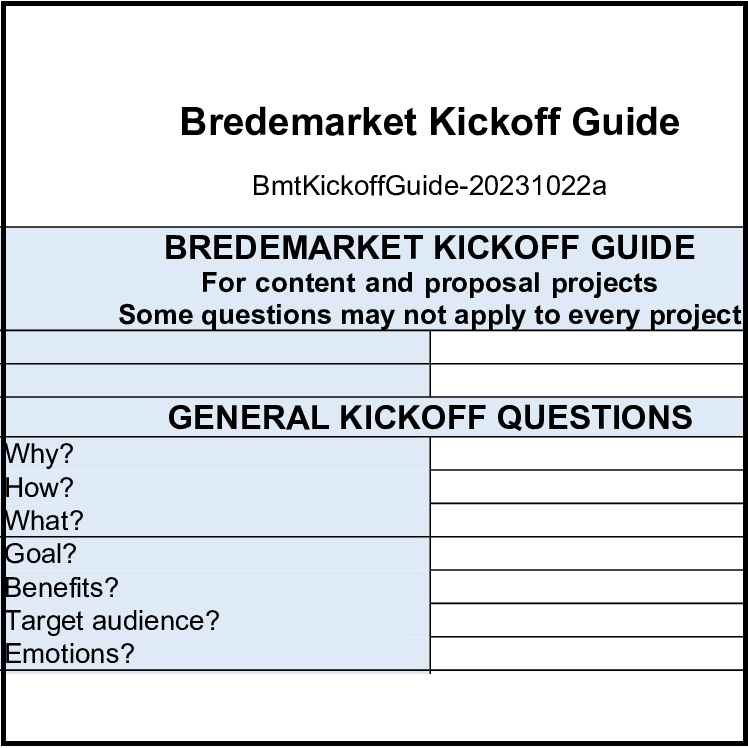
When I work with a client, I hold a kickoff to make sure that we have a common understanding at the beginning of the project.

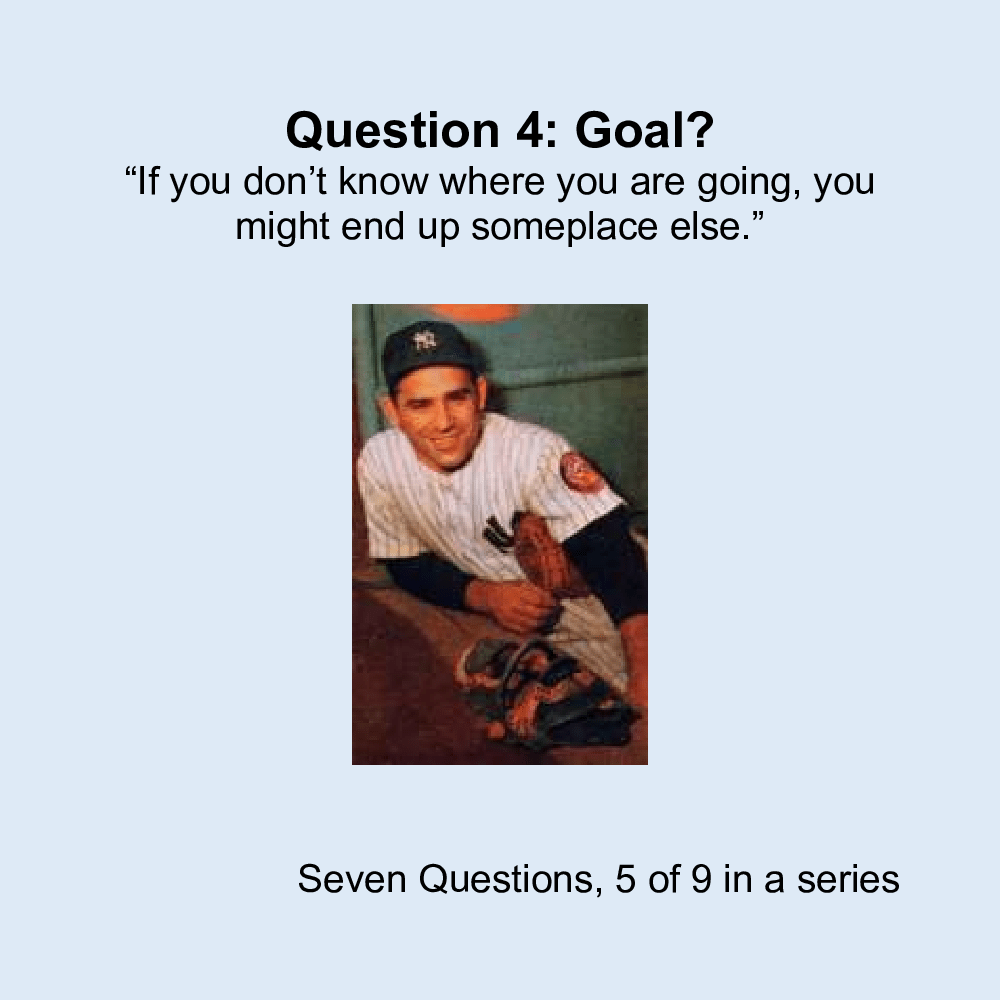
The first seven questions that we address are critical. In fact, I wrote an e-book that addresses these seven questions alone.

  1. Why?
  2. How?
  3. What?
  4. Goal?
  5. Benefits?
  6. Target Audience?
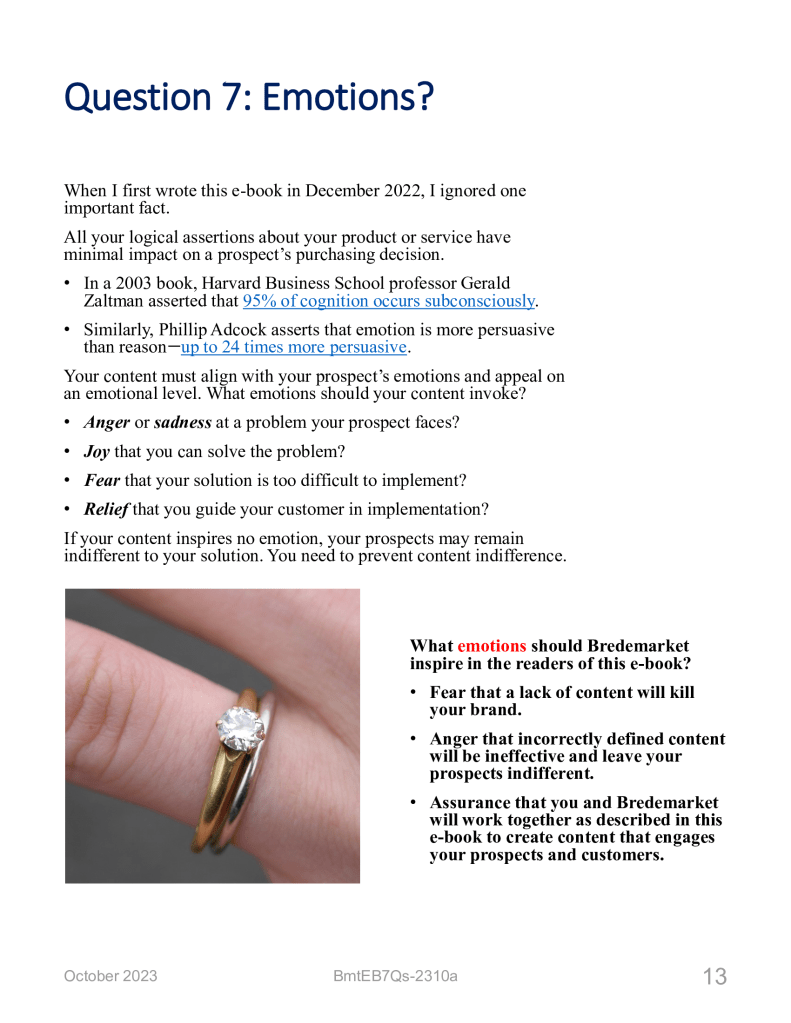
  7. Emotions?

But that’s not all that we address in the kickoff. There are some other lower-level questions that I ask you (such as the long and short form of your company name).

Once we have defined the project, I iteratively provide draft copy and you iteratively review it. The number and length of review cycles varies depending upon the content length and your needs. For example, I use up to two review cycles of up to three days each for short content.

Eventually I provide the final copy, you publish it and pay me, and both of us are happy.

Question 5: What about samples and testimonials?

Because I usually function as a ghostwriter, I cannot publicly provide samples or identity my clients. But I’ve written yet another e-book that anonymously describes some sample projects that I’ve performed for clients, including a testimonial from one of them.

Question 6: What are the next steps to work with Bredemarket?

If you believe that I can help you create the content your firm needs, let’s talk.

Or if Matthew Mace’s content services better fit your needs, use him.

Three Key Ways to Receive Bredemarket Information

Are you considering contracting with a marketing and writing service?

Would you like to know more about Bredemarket’s marketing and writing services to provide the right words for identity/biometrics, technology, and local B2B firms?

Would you like multiple options to learn about Bredemarket?

This post is ONLY intended for people who want to stay up-to-date with information from Bredemarket. If you have no such interest, you can skip reading this post and I’ll “give a couple of minutes back to you.”

There are a number of ways to get the latest Bredemarket information, but these three are probably the most important.

Bredemarket blog

To subscribe to the Bredemarket blog and get the latest information directly from Bredemarket:

The Bredemarket blog contains over 400 posts on marketing, writing, identity and biometrics, technology, and California’s Inland Empire. It also lets you know how you can use Bredemarket’s marketing and writing services for your company.

LinkedIn Bredemarket page

To subscribe to the LinkedIn page and see the latest content from Bredemarket, and special content from Bredemarket’s market-oriented LinkedIn pages:

I’ve found LinkedIn to be a valuable source of information, and much of the third-party information I find on LinkedIn is reshared on the Bredemarket LinkedIn page and its market-oriented “showcase” pages on identity, technology, and local business. (You can follow those three pages also.)

Bredemarket mailing list

To subscribe to the mailing list and receive special private content in advance of everyone else:

I’m revitalizing the mailing list to let those with a keen interest in Bredemarket know about my future plans.