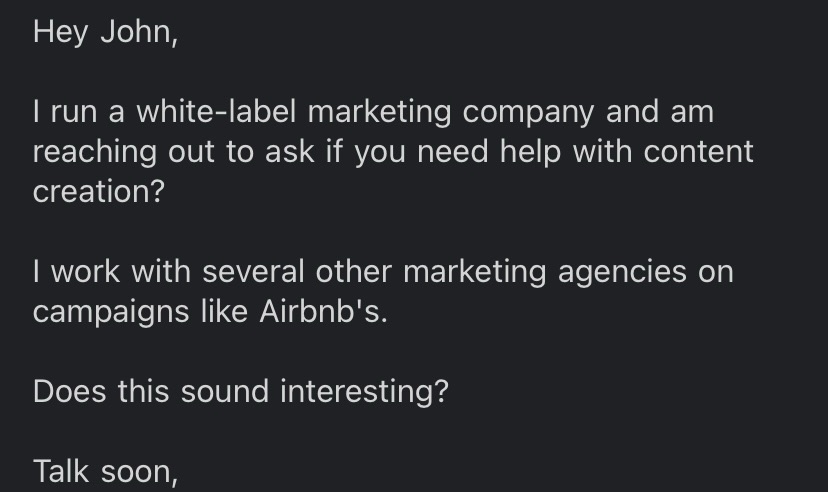
But a recent pitch excelled in its, um, genericism. Here’s the relevant part:
I run a white-label marketing company and am reaching out to ask if you need help with content creation? I work with several other marketing agencies on campaigns like Airbnb’s.
I’m not sure how Bredemarket relates to Airbnb, but it really doesn’t matter because they have worked on campaigns LIKE Airbnb. So I do not know what they’ve done. (Although ghostwriters have this problem.)
Ghostwriters like me. But I’ve never worked for companies like Airbnb.
I recently sent out a mailing that was hopefully much more targeted. I knew my hungry people (target audience), so even though it was a mass mailing (OK, not “mass”), it was relevant.
If you didn’t receive the mailing, you can view the repurposed version here.
Contact Bredemarket if you need content that benefits from my 29+ years of identity/biometrics experience.
This week has been a busy week in Bredemarket-land, including work on some of the following client projects:
Creating the first deliverable as part of a three-part series of deliverables.
Reworking that first deliverable for more precision.
Preparing to start work on the second deliverable.
Drafting a blog post for a client.
Gathering information for an email newsletter for a client.
Following up on a couple of consulting opportunities that take advantage of my identity/biometric expertise.
Creating a promotional reel based upon the grapes in my backyard. (Yet another reel. I plan to reveal it next week.)
Engaging in other promotional activities on Bredemarket’s key social media channels.
Plus I’ve been working on some non-Bredemarket deliverables and meetings with a significant time commitment.
But there’s one more Bredemarket deliverable that I haven’t mentioned—because I’m about to discuss it now.
The task
Without going into detail, a client required me to repurpose a piece of third-party government-authored (i.e. non-copyrighted) text, originally written for a particular market.
Shorten the text so it would be more attractive to the new market.
Simplify the presentation of the text to make it even more attractive to the new market.
The request was clear, and I’ve already completed the first draft of the text and am working on the second draft.
But I wanted to dive into the three steps above—not regarding this particular client writing project, but in a more general way.
Step 1: Rewrite
When you’ve worked in a lot of different industries, you learn that each industry has its own language, including things you say—and things you don’t say.
I’ll give you an example that doesn’t reflect the particular project I was working on, but does reflect why rewriting is often necessary.
When I started in biometrics, the first two industries that I wrote about were law enforcement and benefits administration.
Law enforcement’s primary purpose is to catch bad people, although sometimes it can exonerate good people. So when you’re talking about law enforcement applications, you frequently use a lot of terms that are negative in nature, such as “surveillance,” “suspect,” and “mugshot.”
Benefits administration’s primary purpose is to help good people, although sometimes it can catch bad people who steal benefits from good people. So when you’re talking about benefits administration applications, you tend toward more positive terms such as “beneficiary.” And if you take a picture of a beneficiary’s face, for heaven’s sake DON’T REFER TO THE FACIAL IMAGE AS A “MUGSHOT.”
These two examples illustrate why something originally written for “market 1” must often be rewritten for “market 2.”
But sometimes a simple rewrite isn’t enough.
Step 2: Shorten
Now I don’t play in the B2C market in which crisp text is extremely necessary. But it’s needed in the various B2G and B2B markets also—some more than others.
If you are writing for more scientific markets, your readers are more accustomed to reading long, academic, “Sage”-like blocks of text.
But if you are writing for other markets, such as hospitality, your readers not only don’t want to read long blocks of text, but actively despise it.
You need to “get to the point.”
Tim Conway (Sr.), as repeatedly played during Jim Healy’s old radio show. Sourced from the Jim Healy Tribute Site.
In my particular project, “market 1” was one of those markets that valued long-windedness, while “market 2” clearly didn’t. So I had to cut the text down significantly, using the same techniques that I use when rewriting my “draft 0.5” (which a client NEVER sees) to my “draft 1” (which I turn over to the client).
But sometimes a simple shorten isn’t enough.
Step 3: Simplify
If you know me, you know I’m not graphically inclined.
Someday I will reach this level of graphic creativity. Originally created by Jleedev using Inkscape and GIMP. Redrawn as SVG by Ben Liblit using Inkscape. – Own work, Public Domain, link.
But I still pay attention to the presentation of my words.
Remember those long blocks of text that I mentioned earlier? One way to break them up is to use bullets.
Bullets break up long blocks of text into manageable chunks.
Bullets are easier to read.
So your reader will be very happy.
But as I was editing this particular piece of content, sometimes I ran into long lists of bullets, which weren’t really conducive to the reading experience.
Question
Answer
What does this mean?
Why are long lists of bullets bad?
Because with enough repetition, they’re just as bad as long blocks of text.
Your readers will tune you out.
How can you format long lists of bullets into something easier to read?
One way is to convert the bullets into a table with separate entries.
Your readers will enjoy a more attractive presentation.
What do tables do for your reader?
They arrange the content in two dimensions rather than one.
The readers’ eyes move in two directions, rather than just one.
Hey, wait a minute…
Yeah, I just plugged my seven questions again by intentionally using the first three: why, how, and what.
You can go here to download the e-book “Seven Questions Your Content Creator Should Ask You.”
I don’t have the skill to make WordPress tables look as attractive as Microsoft Word tables. But even this table breaks up the monotony of paragraphs and lists, don’t you think?
So what happened?
After I had moved through the three steps of rewriting, shortening, and simplifying the original content, I had a repurposed piece of content that was much more attractive to the “hungry people” (target audience) who were going to read it.
These people wouldn’t fall asleep while reading the content, and they wouldn’t be offended by some word that didn’t apply to them (such as “mugshot”).
So don’t be afraid to repurpose—even for a completely different market.
I do it all the time.
Look at two of my recent reels. Note the differences. But note the similarities.
The identity/biometrics version of the reel.
The Inland Empire version of the same reel.
So which of Bredemarket’s markets do you think will receive the “grapes” reel?
Bredemarket’s services are grouped into two distinct and separate functions: content marketing (blog posts, white papers, etc.) and proposals (RFI responses, RFP responses, sole source letters, etc.).
My division of my services makes sense in the real world. After all, in some employment situations, content marketing and proposals employ distinct and separate sets of employees.
But other companies are different. In fact, I’ve seen employment ads seeking marketing/proposals managers. Sounds like a lot of work, unless the company submits few proposals or performs minimal marketing.
And in many companies there are NOT dedicated proposals specialists. Which is why Bredemarket makes its money by helping the salespeople at these firms get the documents out.
Time for the truth
And if we’re truthful with ourselves, content marketing and proposals are pretty much the same thing.
I know this angers some people, who insist that they are content marketing professionals or proposal professionals, with all the proper certifications that a mere mortal could never attain. Or they did attain it, but it lapsed. Or is about to lapse unless I renew it in time.
But hear me out. I’m going to list four aspects of a particular document, and you tell me whether I’m talking about a piece of marketing content, or a proposal.
The document describes benefits the customer will realize.
The document targets one or more sets of people hungry for the solution.
The document shall be in Aptos 12 point, single spaced, with 1 inch margins, and shall not exceed 20 pages.
Guess what? From that description you CAN’T tell if it’s a piece of content or a proposal.
Yes, I know some of you thought item 4 was a dead giveaway because it sounded like an RFP requirement, but maybe some company’s brand guidelines dictate that the firm’s white papers must conform to that format. You never know.
And I know that when you get into the minutiae, there are certain things that proposal writers do that content marketers don’t have to worry about, and vice versa.
But at a high level, the content marketer already knows 90% of the things they need to know to write proposals. And vice versa.
I’m going to describe one example of how Bredemarket has helped its customers, based upon one of my client projects from several years ago.
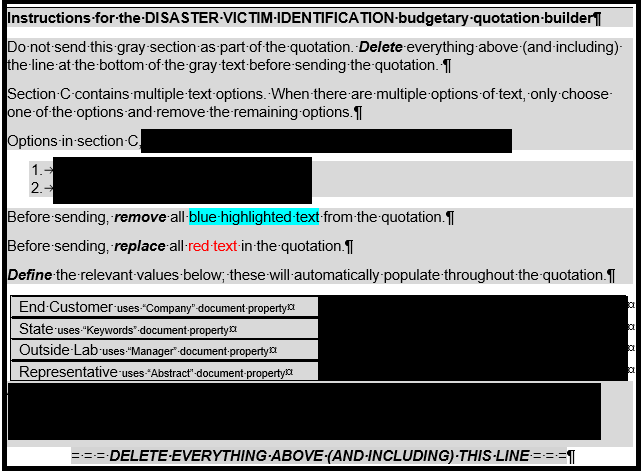
Stupid Word Tricks. Tell your brother, your sister and your mama too. See below.
I’ve told this story before, but I wanted to take a fresh look at the problem the firm had, and the solution Bredemarket provided. I’m not identifying the firm, but perhaps YOUR firm has a similar problem that I can solve for you. And your firm is the one that matters.
The problem
This happened several years ago, but was one of Bredemarket’s first successes.
The firm that asked for my help is one that focuses on one particular biometric modality, and provides a high-end solution for biometric identification.
In addition, the firm’s solution has multiple applications, crime solving and disaster victim identification being two of them.
The firm needed a way to perform initial prospect outreach via budgetary quotations, targeted to the application that mattered to the prospect. A simple proposal problem to be solved…or so it seemed.
Why the obvious proposal solution didn’t work
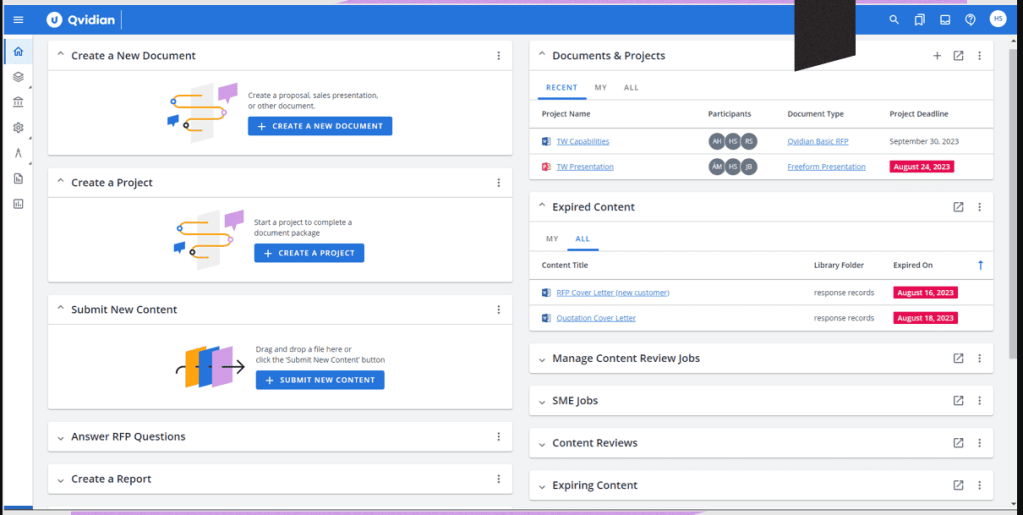
I had encountered similar problems while employed at Printrak and MorphoTrak and while consulting here at Bredemarket, so the solution was painfully obvious.
Qvidian, one proposal automation software package that I have used. But there are a LOT of proposal automation software packages out there, including some new ones that incorporate artificial intelligence. From https://uplandsoftware.com/qvidian/.
Have your proposal writers create relevant material in their proposal automation software that could target each of the audiences.
So when your salesperson wants to approach a medical examiner involved in disaster victim identification, the proposal writer could just run the proposal automation software, create the targeted budgetary quotation, populate it with the prospect’s contact information, and give the completed quotation to the salesperson.
Unfortuntely for the firm, the painfully obvious solution was truly painful, for two reasons:
This firm had no proposal automation software. Well, maybe some other division of the firm had such software, but this division didn’t have access to it. So the whole idea of adding proposal text to an existing software solution, and programming the solution to generate the appropriate budgetary quotation, wasn’t going to fly.
In addition, this firm had no proposal writers. The salespeople were doing this on their own. The only proposal writer they had was the contractor from Bredemarket. And they weren’t going to want to pay for me to generate every budgetary quotation they needed.
In this case, the firm needed a way for the salespeople to generate the necessary budgetary quotations as easily as possible, WITHOUT relying on proposal automation software or proposal writers.
Bredemarket’s solution
To solve the firm’s problem, I resorted to Stupid Word Tricks.
I created two similar budgetary quotation templates: one for crime solving, and one for disaster victim identification. (Actually I created more than two.) That way the salesperson could simply choose the budgetary quotation they wanted.
The letters were similar in format, but had little tweaks depending upon the audience.
Using document properties to create easy-to-use budgetary quotations.
The Stupid Word Tricks came into play when I used Word document property features to allow the salesperson to enter the specific information for each prospect, which then rippled throughout the document, providing a customized budgetary quotation to the prospect.
The result
The firms’ salespeople used Bredemarket’s templates to generate initial outreach budgetary quotations to their clients.
And the salespeople were happy.
I’ve used this testimonial quote before, but it doesn’t hurt to use it again.
“I just wanted to truly say thank you for putting these templates together. I worked on this…last week and it was extremely simple to use and I thought really provided a professional advantage and tool to give the customer….TRULY THANK YOU!”
Comment from one of the client’s employees who used the standard proposal text
While I actively consulted for the firm I maintained the templates, updating as needed as the firm achieved additional certifications.
Why am I telling this story again?
I just want to remind people that Bredemarket doesn’t just write posts, articles, and other collateral. I can also create collateral such as these proposal templates that you can re-use.
There may be a variety of reasons for this. Perhaps your current employees are too busy doing other things. Or perhaps writing terrifies them so much that they think ChatGPT-generated content is actually a GOOD thing. (Read the content. It isn’t good.)
So you’re thinking about outsourcing the work to a content writer. One who has created content for multiple technology firms, including 9 returning clients. Here are four examples.
But how does outsourced content writing work?
How Bredemarket works with you to create content
Maybe you need an outsourced content writer because your current textual content is not compelling to your prospects, or perhaps it’s non-existent (for example, a LinkedIn company page with zero posts).
If you approach Bredemarket with your outsourced content writing request, here’s how we will work together:
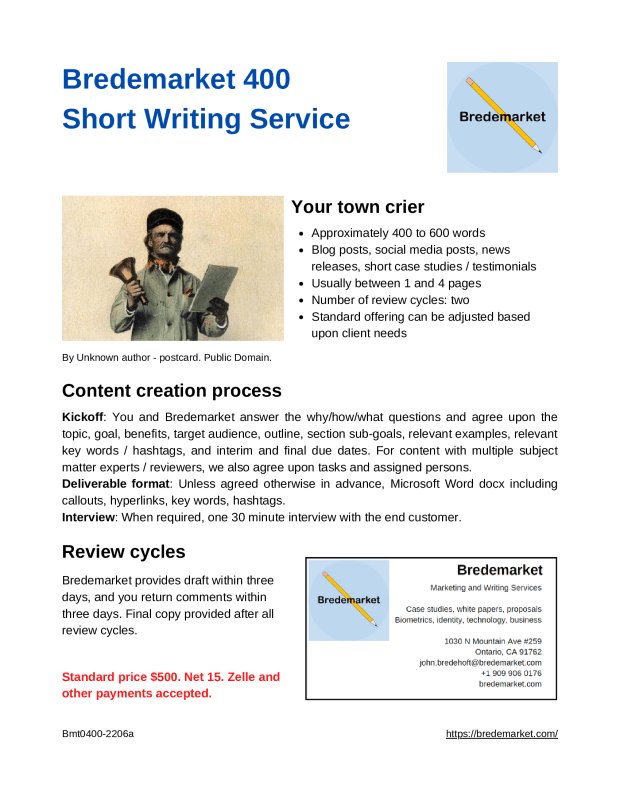
For this example, let’s assume that you need between 400 to 600 words of text to post to your company blog or to your company LinkedIn account, and therefore are purchasing my Bredemarket 400 Short Writing Service.
This is the most important step in the entire process, and I don’t write a word of text until you and I have some agreement on WHAT I am going to write.
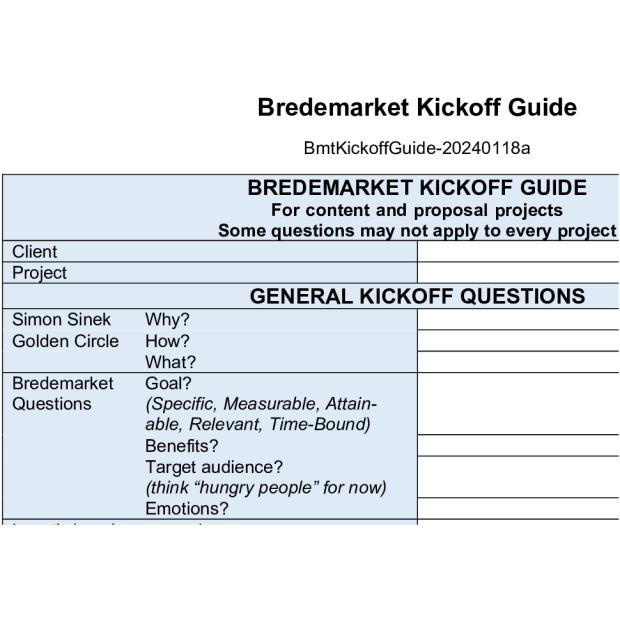
I start by asking seven questions about the content, your product, and your company.
Why?
How?
What?
Goal?
Benefits?
Target Audience?
Emotions?
I ask some additional questions which I won’t discuss in detail here. For example, you may specify the subject matter experts or articles I need to consult.
Once we’ve worked through ALL the questions, either in a synchronous meeting or asynchronously via email, I have a good idea of what the written content needs to say.
This benefits you because I love doing this, communicating your benefits to your prospects using the framework upon which we agreed in the kickoff.
Unless we agree on a different schedule, I get that first draft to you in three days for the next important step.
Step 3: First draft review
This is where you come in. Your task is to review my draft within three days and provide comments. And if I don’t hear from you within three days, you’ll hear from me. Why?
The first reason is my pure self-interest. The sooner I complete the project, the sooner I get paid. Those cold dead hands need some nice gloves.
The second reason is of mutual interest. We want to complete the project while we’re focused on thinking about it, and while it is critically important to us.
The third reason is for your own self-interest. You have a content gap, and it’s in your interest to fill that gap. If we get this draft reviewed and move forward, that gap will be filled quickly. If we don’t move forward, the gap will remain, your efforts to contract with Bredemarket will be for naught, and you’ll still have an uninteresting website and dead social media accounts.
Step 4: It depends
What happens after the first draft review varies from client to client.
Some of my clients love the first draft and don’t want to change a thing.
Some of my first drafts have embedded questions that you need to answer; once those questions are answered, the content is ready.
Some of my first drafts may need minor changes. In one case, I was asked to remove a reference to a successful hack that occurred at a well-known company; unbeknownst to me, the company was a customer of another division of the client in question. Whoops.
Occasionally more substantive changes are required, and I end up creating a second draft in three days, and you review it in three days.
In the end, we have a piece of content that is almost ready for publication.
Step 5: Finalize and publish
While the words may be ready, the entire piece is not.
I’m not a graphics person, and usually a written piece needs some accompanying images to drive the message home. I may suggest some images, or I may suggest that the client reuse an image from their website, or I may just ask the client to select an appropriate image.
Once the text and images are ready, you publish the piece. Normally I don’t have access to your website or social media accounts, so I can’t publish the piece for you. Only one client has given me such access, and even for that client I don’t have COMPLETE publishing permission.
For short projects such as a Bredemarket 400 project, I usually bill you when you publish the piece, although in certain circumstances I may bill you once the text is complete.
Are you ready to outsource your content marketing?
While other content marketers may work differently, we all have some type of process for our outsourced content writing.
If you’re ready to move forward with Bredemarket for outsourced content writing, contact me.
Last week I prepared a presentation for a conference organizer, thinking that I would give the presentation at the conference in question. Instead, the organizer emailed the presentation slides to selected conference attendees. The attendees probably liked it that way.
But I still wanted to give the presentation.
And I also wanted to generalize the presentation so that it applied to ALL technology companies, not just the ones who were attending the conference.
So I recorded myself giving the presentation “Differentiating Your Company and Your Products/Services.” It’s ten minutes long, and you can view it now.
Differentiating Your Company and Your Products/Services (April 9, 2024)
If you’re watching this video on your laptop, be sure to keep your smartphone handy because at the end of the video I display a QR code to obtain more information. Just point your phone at the QR code.
Of course, if you’re watching this video on your smartphone, you can’t read the displayed QR code. So just go to https://bredemarket.com/drive-tech/ instead.
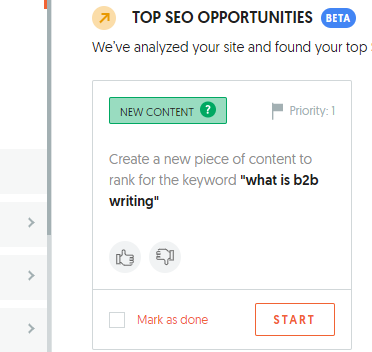
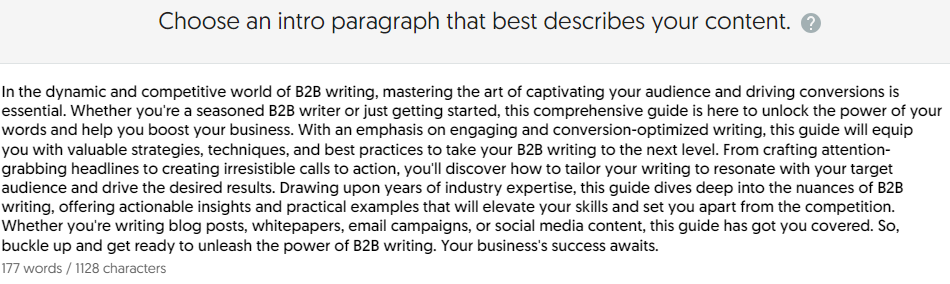
Um, thanks but no thanks. When the first sentence doesn’t even bother to define the acronym “B2B,” you know the content isn’t useful to explain the topic “what is B2B writing.”
Before I explain what B2B writing is, maybe I’d better explain what “B2B” is. And two related acronyms.
B2B stands for business to business. Bredemarket, for example, is a business that sells to other businesses. In my case, marketing and writing services.
B2G stands for business to government. Kinda sorta like B2B, but government folks are a little different. For example, these folks mourned the death of Mike Causey. (I lived outside of Washington DC early in Causey’s career. He was a big deal.) A B2G company, for example, could sell driver’s license products and services to state motor vehicle agencies.
B2C stands for business to consumer. Many businesses create products and services that are intended for consumers and marketed directly to them, not to intermediate businesses. Promotion of a fast food sandwich is an example of a B2C marketing effort.
I included the “B2G” acronym because most of my years in identity and biometrics were devoted to local, state, federal, and international government sales. My B2G experience is much deeper than my B2B experience, and way deeper than my B2C expertise.
Let’s NOT make this complicated
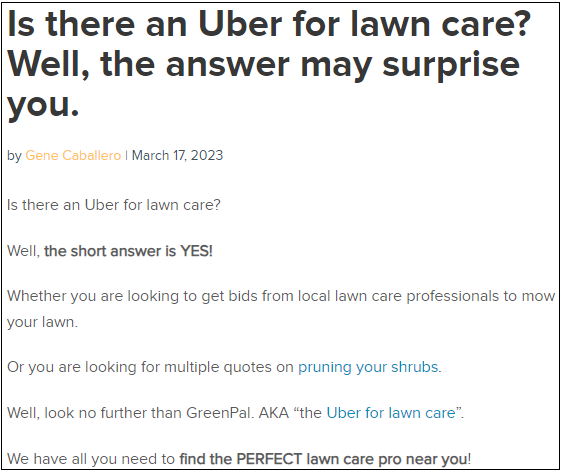
I’m sure that Ubersuggest could spin out a whole bunch of long-winded paragraphs that explain the critical differences between the three marketing efforts above. But let’s keep it simple and limit ourselves to two truths and no lies.
TRUTH ONE: When you market B2B or B2G products or services, you have FEWER customers than when you market B2C products or services.
That’s pretty much it in terms of differences. I’ll give you an example.
If Bredemarket promoted its marketing and writing services to all of the identity verification companies, I would target less than 200 customers.
If IDEMIA or Thales or GET Group or CBN promoted their driver’s license products and services to all of the state, provincial, and territorial motor vehicle agencies in the United States and Canada, they would target less than 100 customers.
If McDonald’s resurrects and promotes its McRib sandwich, it would target hundreds of millions of customers in the United States alone.
The sheer scale of B2C marketing vs. B2B/B2G marketing is tremendous and affects how the company markets its products and services.
But one thing is similar among all three types of writing.
TRUTH TWO: B2B writing, B2G writing, and B2C writing are all addressed to PEOPLE.
Well, until we program the bots to read stuff for us.
This is something we often forget. We think that we are addressing a blog post or a proposal to an impersonal “company.” Um, who works in companies? People.
(Again, until we program the bots.)
Whether you’re marketing a business blog post writing service, a government software system, or a pseudo rib sandwich, you’re pitching it to a person. A person with problems and needs that you can potentially solve.
So solve their needs.
Don’t make it complex.
But what IS B2B writing?
Let’s return to the original question. Sorry, I got off on a bit of a tangent. (But at least I didn’t trail off into musings about “the dynamic and competitive world.”)
When I write something for a business:
I must focus on that business and not myself (customer focus). The business doesn’t want to hear my talk about myself. The business wants to hear what I can do for it.
I must acknowledge the business’ needs and explain the benefits of my solution to meet the business needs. A feature list without any benefits is just a list of cool things; you still have to explain how the cool things will benefit the business by solving its problem.
My writing must address one, or more, different types of people who are hungry for my solution to their problem. (This is what Ubersuggest and others call a “target audience,” because I guess Ubersuggest aims lasers at the assembled anonymous crowd.)
Some firms make claims and don’t support them, while others support their claims with quantified benefits. But does quantifying help or harm the firms that do it? This pudding post answers this question…and then twists toward the identity/biometrics market at the end.
The “me too” players in the GCP market
Whoops.
In that heading above, I made a huge mistake by introducing an acronym without explaining it. So I’d better correct my error.
GCP stands for Glowing Carbonated Pudding.
I can’t assume that you already knew this acronym, because I just made it up. But I can assure you that the GCP market is a huge market…at least in my brain. All the non-existent kids love the scientifically advanced and maximally cool pudding that glows in the dark and has tiny bubbles in it.
Glowing Carbonated Pudding. Designed by Google Bard. Yeah, Google Bard creates images now.
Now if you had studied this non-existent market like I have, you’ll realize from the outset that most of the players don’t really differentiate their offerings. Here are a few examples of firms with poor product marketing:
Jane Spain GCP: “Trust us to provide good GCP.”
Betty Brazil GCP: “Trust us to provide really good GCP.”
Clara Canada GCP: “Trust us to provide great GCP.”
You can probably figure out what happened here.
The CEO at Betty Brazil told the company’s product marketers, “Do what Jane Spain did but do it better.”
After that Clara Canada’s CEO commanded, “Do what Betty Brazil did but do it better.” (I’ll let you in on a little secret. Clara Canada’s original slogan refereneced “the best GCP,” but Legal shot that down.)
But another company, Wendy Wyoming, decided to differentiate itself, and cited independent research as its differentiator.
Wendy Wyoming Out of This World GCP satisfies you, and we have independent evidence to prove it!
The U.S. National Institute of Standards and Technology, as part of its Pudding User Made (PUM, not FRTE) Test, confirmed that 80% of all Wendy Wyoming Out of This World GCP mixes result in pudding that both glows and is carbonated. (Mix WW3, submitted November 30, 2023; not omnigarde-003)
Treat your child to science-backed cuisine with Wendy Wyoming Out of This World GCP!Wendy Wyoming is a top tier (excluding Chinese mixes) GCP provider.
But there are other competitors…
The indirect competitor who questions the quantified benefits
There are direct competitors that provide the same product as Wendy Wyoming, Jane Spain, and everyone else.
And then there are indirect competitors who provide non-GCP alternatives that can substitute for GCPs.
For example, Polly Pennsylvania is NOT a GCP provider. It makes what the industry calls a POPS, or a Plain Old Pudding Sustenance. Polly Pennsylvania questions everything about GCP…and uses Wendy Wyoming’s own statistics against it.
Designed by Google Bard.
Fancy technologies have failed us.
If you think that one of these GCP puddings will make your family happy, think again. A leading GCP provider has publicly admitted that 1 out of every 5 children who buy a GCP won’t get a GCP. Either it won’t glow, or it’s not carbonated. Do you want to make your kid cry?
Treat your child to the same pudding that has satisfied many generations. Treat your child to Polly Pennsylvania Perfect POPS.
Pennsylvania Perfect remembers.
So who wins?
It looks like Polly Pennsylvania and Wendy Wyoming have a nasty fight on their hands. One that neck-deep marketers like to call a “war.” Except that nobody dies. (Sadly, that’s not true.)
Some people think that Wendy Wyoming wins because 4 out of 5 of their customers receive true GCP.
Others think that Polly Pennsylvaia wins because 5 out of 5 of their customers get POPS pudding.
But it’s clear who lost.
All the Jane Spains and Betty Brazils who didn’t bother to create a distinctive message.
Don’t be Jane Spain. Explain why your product is the best and all the other products aren’t.
Copying the competition doesn’t differentiate you. Trust me.
The “hungry people” (target audience) for THIS post
Oh, and if you didn’t figure it out already, this post was NOT intended for scientific pudding manufacturers. It was intended for identity/biometric firms who can use some marketing and writing help. Hence the references to NIST and the overused word “trust.”
If you’re hungry to kickstart your identity/biometric firm’s written content, click on the image below to learn about Bredemarket’s services.
Normally I talk about CONtent, but today I’m talking about conTENT. (OK, a little bit about CONtent also.)
There are many prospects that may be CRITICALLY IMPORTANT (the highest of my three levels of importance) to your firm—perhaps too many. You can reduce your firm’s list of critically important prospects without losing them altogether. The extra time you receive benefits your firm and your TRUE critically important prospects. And eventually the other prospects may come around anyway.
But what if the identity/biometric prospects are not HUNGRY to satisfy that need? (Hungry people = true target audience.) Addressing the need may even be “important” to the prospects—but not CRITICALLY important.
Now I can create (and have created) content addressing this need and how to fill it. If a prospect searches for this content, they will find it.
I can even proactively initiate direct contact with these prospects, and maybe even contact them a second time.
But in most cases a prospect may respond with a “not interested” message—if the prospect even responds at all.
When you “Let Them” do whatever it is that they want to do, it creates more control and emotional peace for you and a better relationship with the people in your life.
And at the same time move the prospect from your “critically important” category down to your “important” category. Focus on the critically important prospects, and be content (conTENT) with them rather than stressing out over the uncontrollable prospects.
But don’t eliminate the merely important prospects entirely, because some day they may become hungry for your services. Continue creating content (CONtent) such as your own blogs, plus social media without messaging the merely important people directly. When they DO get hungry, they will emerge from your trust funnel and contact YOU, asking for your services.
Becoming conTENT
What happens when you, in the words of Mel Robbins, “let them”?
You’re focused, your true critically important prospects are happy that you’re paying attention to them, your merely important prospects are happy that you’re no longer pestering them…
Leftover pizza is the best pizza. Preparation credit: Pizza N Such, Claremont, California. Can I earn free pizza as a powerful influencer? Probably not, but I’ll disclose on the 0.00001% chance that I do.
Now that it’s time to write the “separate post,” I really don’t want to get into the mechanics of how posts that attract prospects (hungry people, target audience) increase awareness and help you convert prospects for your products and services.
So forget that. I’m going to tell a story instead about two executives at a fictional company that has a real problem. The executives’ names are Jones and Smith.
The story
Jones was troubled. Sales weren’t increasing, prospects weren’t appearing, and if this malaise continued the company would have to conduct a second round of layoffs. Jones knew that “rightsizing” would be disastrous, so the company needed another solution.
So Jones videoconferenced Smith and asked, “How can we make 2024 better than 2023?”
Smith replied, “Increasing sales calls could help, and ads could help, but there’s another way to increase our awareness with our prospects. We could create content on our website and on our social channels that spreads knowledge of our products and services.”
Jones exclaimed, “That’s great! We could get generative AI to create content for us!”
“No, not that!” Smith replied. “Generative AI text sounds like a bot wrote it, and makes us sound boring, just like everyone else using generative AI text. Do we want to sound like that and put our prospects to sleep?”
“So we need a human writer,” Jones realized, “one who can describe all of the features of our products.”
“Absolutely not,” Smith emphasized. “Customers don’t care about our features. They care about the benefits we can provide to them. If we just list a bunch of features, they’ll say, ‘So what?'”
“OK, we’ll go with benefits,” said Jones. “But why is content so important?”
“Take blogging,” replied Smith. “The average company that blogs generates 55% more website visitors. B2B marketers that use blogs get 67% more leads than those who do not. Marketers who have prioritized blogging are 13x more likely to enjoy positive ROI. And 92% of companies who blog multiple times per day have acquired a customer from their blog.”
“Wow.” Jones was silent for a moment. “How do you know all of this stuff, Smith?”
“Because of the content that I’ve read online from a marketing and writing services company called Bredemarket. The company creates content to urge others to create content. Bredemarket eats its own wildebeest food.”


























 Bredemarket