I recall one product in particular (not a Segway, but a biometric product housed in a tower) that was an impressive fusion of algorithmic and mechanical excellence. The complex design that went into developing the tower product resulted in a device that performed its function superbly.
The complex engineering also caused the product to have such a high price that no one would ever buy it…but I digress.
But there was another issue with the product. I was writing proposals at the time, and we certainly could have written up a product description that emphasized the product’s lengthy set of features.
But the people receiving our proposals wouldn’t have cared one bit.
Prospects don’t care about lengthy feature lists
You see, prospects don’t care about lengthy feature lists.
If your product stops terrorists from boarding airplanes, then and only then will they care about your company or your product.
If your product can’t stop terrorists from boarding airplanes, or if there is another product that is better at stopping terrorists from boarding airplanes, then your prospects won’t care about your product.
So how do you get prospects to care?
You don’t get prospects to care by talking about your extensive feature lists.
Let me give you a tip. If you find an employee at the prospect’s company who wants to spend a lot of time talking about your extensive feature lists, that employee probably DOESN’T have the authority to approve the purchase.
The people who DO have the authority to approve the purchase don’t have time to talk about extensive feature lists.
The approvers want to know, in 30 seconds or less, how your solution BENEFITS them.
Do you need help explaining your benefits?
Talking about benefits rather than features is just one tactic to successfully appeal to your prospects.
If you need help ensuring that your written materials (blog posts, white papers, web pages) resonate with your prospects, you can ask Bredemarket to help you.
For example, during my most recent stint as a product marketing employee at a startup, the firm had no official content marketers, so the product marketers had to create a lot of non-product related content. So we product marketers were the de facto content marketers for the company too. (Sadly, we didn’t get two salaries for filling two roles.)
Why did the product marketers end up as content marketers? It turns out that it makes sense—after all, people who write about your product in the lower funnel stages can also write about your product in the upper funnel stages, and also can certainly write about OTHER things, such as company descriptions, speaker submissions, and speaker biographies.
The Hippocratic Oath imposes duties on medical professionals, including this one:
I will follow that system of regimen which, according to my ability and judgment, I consider for the benefit of my patients, and abstain from whatever is deleterious and mischievous.
As 1NURSE.COM notes, forensic nursing is multidisciplinary, operating “at the critical juncture of medical science and the legal system.”
Forensic nursing is a specialized branch that integrates medical expertise with forensic science to provide comprehensive care for individuals impacted by violence, abuse, or criminal activities. These professionals serve as a crucial link between the realms of healthcare and the legal system, collaborating with law enforcement, attorneys, and other professionals to gather evidence, provide expert testimony, and ensure justice for victims.
When I started my forensic career 29 years ago, I was solely involved in the capture and processing of fingerprints from criminals. If I may be honest, the well-being of the individual who provided the forensic evidence was NOT an overriding concern.
But within a year or two I started to get involved in the capture and processing of fingerprints from NON-criminals who were applying for and receiving government benefits.
For that market we HAD to concern ourselves with the well-being of our clients, to make fingerprint capture as easy as possible, and to treat our clients with the utmost respect.
In the end it didn’t matter, because in the popular mind fingerprinting was associated with criminals, and benefits recipients didn’t want to be treated like criminals no matter how nice we were. To my knowledge, all of the benefits recipient fingerprint programs in the United States have all ceased.
Forensic nursing needs to gather the necessary forensic evidence while preserving the compassionate care that nurses are required to provide.
Invasive forensic techniques
So if we have to take care when gathering information from benefits recipients, imagine the level of care we need to take when gathering information from crime victims. Returning to 1NURSE.COM’s article, here are two of the tasks that forensic nurses must perform:
Sexual Assault Forensics: Specializing in sexual assault examination, forensic nurses provide not only compassionate care but also play a pivotal role in collecting evidence essential for legal proceedings. Their expertise ensures a sensitive approach while preserving the integrity of forensic evidence. Example: A forensic nurse conducting a sexual assault examination may collect biological samples and document injuries to aid in prosecuting the assailant.
Child Abuse Investigation: Forensic nurses are instrumental in assessing and documenting cases of child abuse. They collaborate with child protective services and law enforcement to ensure the safety and well-being of the child. Example: A forensic nurse working on a child abuse case may conduct a thorough examination to document injuries and provide expert testimony in court.
We have focussed a lot on how the investigation works when looking for crimes of a distressing nature but not actually how this investigation process can affect the victim of these crimes and put the victim first. This period can be incredibly distressing for the victim, and the investigation can make this worse as it is making the victim re-live this experience.
As part of their duties, the forensic nurse has to capture evidence from the very parts of the body that were assaulted during the abuse crime itself. No one wants to go through that again. How can evidence capture be less invasive?
Three ways to minimize invasive evidence capture
While it’s not possible to completely erase the pain that crime victims suffer during a forensic investigation, there are ways to minimize it. The Foster+Freeman article highlights three ways to do this:
Capture evidence via non-invasive techniques. As a supplier of alternate light source (ALS) technology, Foster+Freeman notes that its products can discover evidence, even at the subdermal layers, without touching the victim. “Using an ALS is a non-invasive and non-destructive way to examine potential evidence on the skin. This is especially important when dealing with fragile or sensitive skin, as it minimizes the risk of causing further harm during the examination process.”
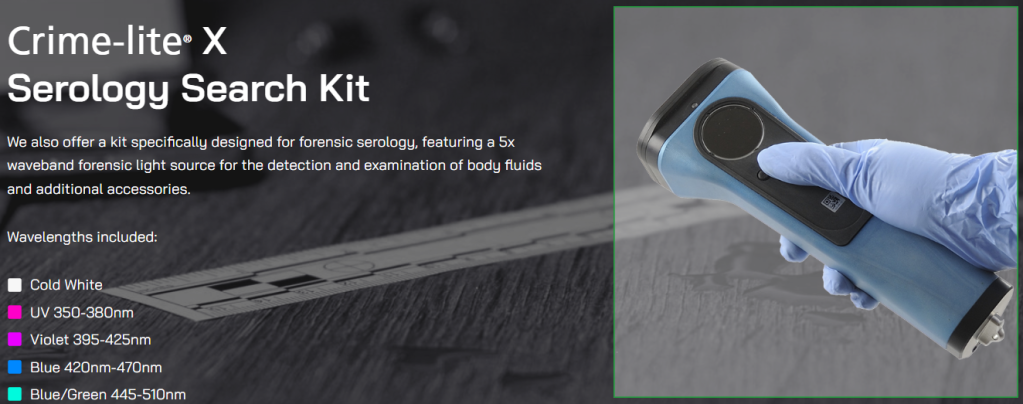
Capture evidence quickly. Forensic nurses do not want to prolong an examination. There are ways to gather evidence as quickly as possible. For example, rather than using multiple ALS devices, you can use a single one; Foster+Freeman’s Crime-lite® X Serology Search Kit is “a multispectral light source that has been made with five wavelengths of light integrated into one unit.”
Capture evidence thoroughly. What’s the point of putting a victim through the trauma of evidence capture if it doesn’t result in a conviction? Because of this, it’s important to capture as much evidence as possible. A variety of alternate light sources accomplishes this.
Foster+Freeman is just one of a multifarious array of companies that supply evidence collection solutions to forensic nurses and other forensic professionals.
And no, Foster+Freeman didn’t sponsor this post, although Bredemarket is available to provide writing services to Foster+Freeman or to other companies who need to drive content results.
And now that I’ve successfully used “multifarious,” I need to find a way to use “deleterious.” Keep your eyes open.
So far the best alternative to “target audience” that I’ve found is “hungry people,” which not only focuses on people rather than an abstraction, but also focuses on those who are ready to purchase your product or service.
But I just found an instance in which “thirsty people” may be better than “hungry people.” Specifically, for the Colorado spirits company Friday Deployment, which engages in product marketing in a very…um…targeted way. Including the use of a micro-influencer who is well-known to Friday Deployment’s thirsty people.
Heads up for regular Bredemarket blog readers: the “why” and “how” questions are coming.
Why are Friday Deployment’s “thirsty people” technologists?
Why does Friday Deployment aim its product marketing at technologists?
Presumably because of this background, Friday Deployment’s product marketing is filled with tech references. Here’s a sample from Friday Deployment’s web page (as of Friday, February 2, 2024).
It was inevitable. The tree is out of date, the history is a mess, and you just want to start your weekend. Maybe you just do a quick little git push --force? Maybe someone already did, and you now get to figure out the correct commit history?
But that isn’t the only way that Friday Deployment markets to its “thirsty people.”
How does Friday Deployment’s marketing resonate with its thirsty people?
How else does Friday Deployment address a technologist audience?
Those of you who are familiar with LinkedIn’s tempests in a teapot realize that LinkedIn users don’t spend all of their time talking about green banners or vaping during remote interviews.
Well, she was until one day when she and about 40 others were terminated.
Pietsch was terminated by two people that she didn’t know and who could not tell her why she was terminated.
This story would have disappeared under the rug…except that Pietsch knew that people were losing their jobs, so when she was invited to a meeting she videorecorded the first part of the termination, and shared it on the tubes.
The video went viral and launched a ton of discussion both for and against what Pietsch did. I lean toward the “for,” if you’re wondering.
Since Friday Deployment’s “thirsty people” were probably familiar with the Brittany Pietsch story, the company worked with her to re-create her termination video…with a twist. (Not literally, since Pietsch drank the gin straight.)
Well, the product marketing ploy worked, since I clicked on the website of a spirits company that was new to me, and now I’m on their mailing list.
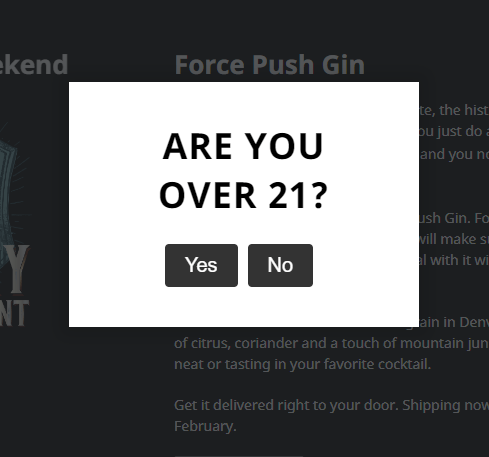
But let’s talk alcohol age verification
The Friday Deployment product marketing partnership with Brittany Pietsch worked…mostly. Except that I have one word of advice for company owner Rishi Malik.
With your Varo Bank engineering experience, you of all people should realize that Friday Deployment’s age verification system is hopelessly inadequate. A robust age verification system, or even an age estimation system, or even a question asking you to provide your date of birth would be better.
Bredemarket can’t create a viral video for your tech firm, but…
But enough about Friday Deployment. Let’s talk about YOUR technology firm.
How can your company market to your thirsty (or hungry) people? Bredemarket can’t create funny videos with micro-influencers, but Bredemarket can craft the words that speak to your audience.
To learn more about Bredemarket’s marketing and writing services for technology firms, click on the image below.
Some firms make claims and don’t support them, while others support their claims with quantified benefits. But does quantifying help or harm the firms that do it? This pudding post answers this question…and then twists toward the identity/biometrics market at the end.
The “me too” players in the GCP market
Whoops.
In that heading above, I made a huge mistake by introducing an acronym without explaining it. So I’d better correct my error.
GCP stands for Glowing Carbonated Pudding.
I can’t assume that you already knew this acronym, because I just made it up. But I can assure you that the GCP market is a huge market…at least in my brain. All the non-existent kids love the scientifically advanced and maximally cool pudding that glows in the dark and has tiny bubbles in it.
Glowing Carbonated Pudding. Designed by Google Bard. Yeah, Google Bard creates images now.
Now if you had studied this non-existent market like I have, you’ll realize from the outset that most of the players don’t really differentiate their offerings. Here are a few examples of firms with poor product marketing:
Jane Spain GCP: “Trust us to provide good GCP.”
Betty Brazil GCP: “Trust us to provide really good GCP.”
Clara Canada GCP: “Trust us to provide great GCP.”
You can probably figure out what happened here.
The CEO at Betty Brazil told the company’s product marketers, “Do what Jane Spain did but do it better.”
After that Clara Canada’s CEO commanded, “Do what Betty Brazil did but do it better.” (I’ll let you in on a little secret. Clara Canada’s original slogan refereneced “the best GCP,” but Legal shot that down.)
But another company, Wendy Wyoming, decided to differentiate itself, and cited independent research as its differentiator.
Wendy Wyoming Out of This World GCP satisfies you, and we have independent evidence to prove it!
The U.S. National Institute of Standards and Technology, as part of its Pudding User Made (PUM, not FRTE) Test, confirmed that 80% of all Wendy Wyoming Out of This World GCP mixes result in pudding that both glows and is carbonated. (Mix WW3, submitted November 30, 2023; not omnigarde-003)
Treat your child to science-backed cuisine with Wendy Wyoming Out of This World GCP!Wendy Wyoming is a top tier (excluding Chinese mixes) GCP provider.
But there are other competitors…
The indirect competitor who questions the quantified benefits
There are direct competitors that provide the same product as Wendy Wyoming, Jane Spain, and everyone else.
And then there are indirect competitors who provide non-GCP alternatives that can substitute for GCPs.
For example, Polly Pennsylvania is NOT a GCP provider. It makes what the industry calls a POPS, or a Plain Old Pudding Sustenance. Polly Pennsylvania questions everything about GCP…and uses Wendy Wyoming’s own statistics against it.
Designed by Google Bard.
Fancy technologies have failed us.
If you think that one of these GCP puddings will make your family happy, think again. A leading GCP provider has publicly admitted that 1 out of every 5 children who buy a GCP won’t get a GCP. Either it won’t glow, or it’s not carbonated. Do you want to make your kid cry?
Treat your child to the same pudding that has satisfied many generations. Treat your child to Polly Pennsylvania Perfect POPS.
Pennsylvania Perfect remembers.
So who wins?
It looks like Polly Pennsylvania and Wendy Wyoming have a nasty fight on their hands. One that neck-deep marketers like to call a “war.” Except that nobody dies. (Sadly, that’s not true.)
Some people think that Wendy Wyoming wins because 4 out of 5 of their customers receive true GCP.
Others think that Polly Pennsylvaia wins because 5 out of 5 of their customers get POPS pudding.
But it’s clear who lost.
All the Jane Spains and Betty Brazils who didn’t bother to create a distinctive message.
Don’t be Jane Spain. Explain why your product is the best and all the other products aren’t.
Copying the competition doesn’t differentiate you. Trust me.
The “hungry people” (target audience) for THIS post
Oh, and if you didn’t figure it out already, this post was NOT intended for scientific pudding manufacturers. It was intended for identity/biometric firms who can use some marketing and writing help. Hence the references to NIST and the overused word “trust.”
If you’re hungry to kickstart your identity/biometric firm’s written content, click on the image below to learn about Bredemarket’s services.
Time for me to make a cryptic LinkedIn post. Although now that I’m sharing the secret here, I’ll have to lower the score to 89.
Bredemarket’s first rule
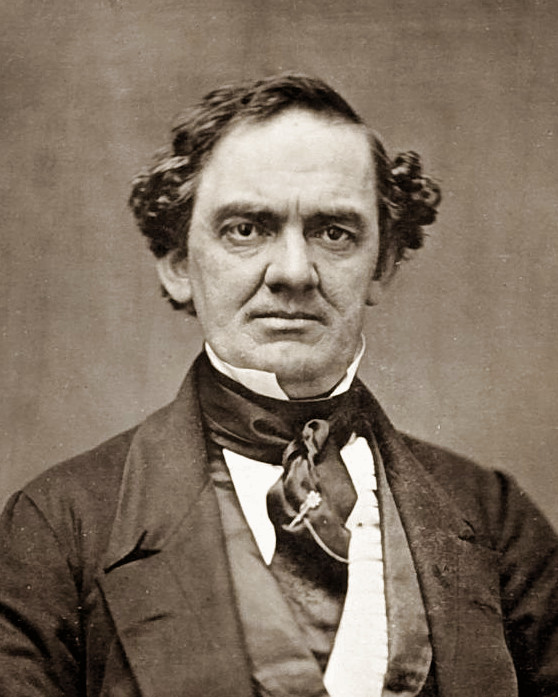
But before I share my revised Phineas-Hirshfield score, I need to share the first Bredemarket Rule, the Bredemarket Rule of Corporate Tool Adoption. (Copyright 2023 Bredemarket.)
In any organization, the number of adopted tools that perform the exact same function is always in excess of one.
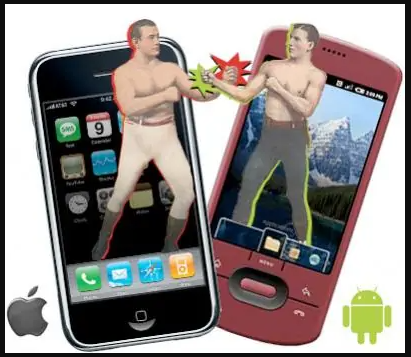
In other words, if there’s someone in your organization who is using an iPhone, there is someone else in your organization who is using an Android phone.
Or someone has a Mac, and another person has a Windows computer.
Or someone has one brand of software, while someone else has the competitior brand.
Even if an organization dictates that everyone will use a single tool, there will be someone somewhere who will rebel against the organization and use a different tool.
Presumably the first panelist was exposed to Asana at one point and liked it, while the second panelist was exposed to Monday and liked it.
Or, since the panelists were from two different companies, maybe each company standardized on one or the other. Or maybe the departments within their companies standardized on a particular tool, but if you poll the entire company, you’ll find some Monday departments and some Asana departments.
Multiple tools in a single department
Even in the same department you may find multiple tools. Let me cite an example.
Several of the people who were in the Marketing department of Incode Technologies have since left the company, and I’m working with one of them on a project this week.
I had to send a PDF to him, and was also going to also send him the source Microsoft Word document…until I remembered from our days at Incode that he was (and I guess still is) a Google Docs guy.
Of course, there are times in which an entire organization agrees on a single tool, but those times never last.
My mid-1990s employer, Printrak International, was preparing to go public. The head of Printrak determined that the company needed some help in this, and brought several staffers on board who were expert in Initial Public Offerings (IPOs).
One of these people took the role of Chief Financial Officer, preparing Printrak for its IPO and for two post-IPO acquisitions, one of which profoundly and positively impacted the future of the firm.
Along the way, he established the rule that Printrak would become a Lotus Notes shop.
For those who don’t remember Lotus Notes, it was one of those Lotus-like products that could do multiple things out of the box. And because the CFO was the CFO, he could enforce Lotus Notes usage.
Until the CFO left a couple of years later to assist another company, and the impetus to use Lotus Notes dropped off significantly.
And that, my friends, is why my former colleagues in IDEMIA aren’t using HCL Notes (the successor to Lotus Notes and IBM Notes) today.
So how do you settle the Tool Wars?
Do you know how you settle the Tool Wars?
You don’t. It’s an eternal battle.
In the case of Bredemarket, I can dictate which tools I use…unless my clients tell me otherwise. Then the client’s word is law…unless there’s a compelling reason why my tool should be used instead of the client’s tool. In Bredemarket’s 3+ years of existence, I haven’t encountered such a compelling reason…yet.
Just be flexible enough to use whatever tool you need to use, and you’ll be fine.
You can express a single thought on multiple channels. And as far as I’m concerned, the more the merrier.
Me on “expert” advice on social media channel adoption
Incidentally, that’s why I object to the “expert” advice that I master one social media channel first before branching out into others.
If I adopt that strategy and ONLY market on LinkedIn and ignore Instagram and TikTok, I am automatically GUARANTEEING that the potential Instagram and TikTok audiences will never hear about my offer.
“How I Expanded 1 Idea into 31 Pieces of Content”
I’ve expressed my thoughts on this social media “expert” advice before:
The latter post, entitled “How I Expanded 1 Idea into 31 Pieces of Content,” described how…well, the title is pretty self-explanatory. I created 31 pieces of content based on a single idea.
The 31 pieces of content, published both through the Bredemarket channels (see above) and via my personal channels (including my jebredcal blog and my LinkedIn page), all increased the chance that SOMEONE would see the underlying message: “Your prospects don’t care about your technology.” Each piece of content was tuned for the particular channel and its target audience, ensuring that the message would resonate.
Speaking of repurposing, I’ve already adapted the words above and published them in four different ways (this is the fourth)…and counting. No TikTok video yet though.
Can Bredemarket help you repurpose or create content?
And if I can do this for me, I can do this for you.
Bredemarket can help you create content that converts prospects and drives content results. Why?
If you’re sold on using Bredemarket to create customer-focused messaging (remember: your prospects don’t care about your technology), or even if you’re not and just want to talk about your needs, there are three ways to move forward with your content project. Or you can just join the Bredemarket mailing list to stay informed.
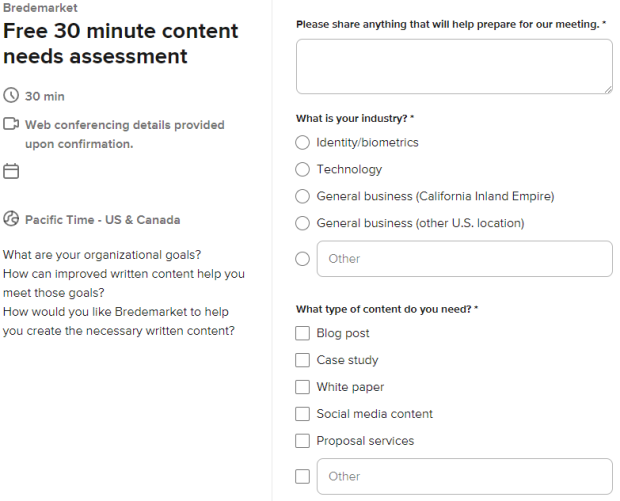
Book a meeting with me at calendly.com/bredemarket. Be sure to fill out the information form so I can best help you.
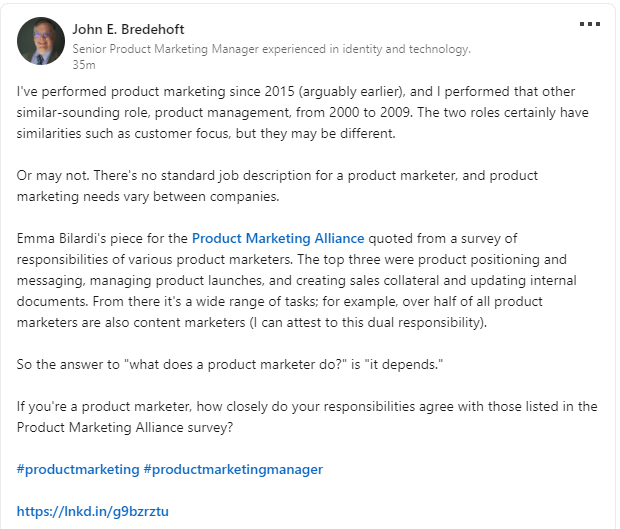
I’ve performed product marketing since 2015 (arguably earlier), and I performed that other similar-sounding role, product management, from 2000 to 2009. The two roles certainly have similarities such as customer focus, but they may be different.
Or may not. There’s no standard job description for a product marketer, and product marketing needs vary between companies.
I mentioned something in passing in Bredemarket’s recent go-to-market post that I think needs a little more highlighting. So here is a deeper dive into the 22 types of content that product marketers create. (Well, at least 22. I’m probably missing some.)
And by the way, I have created all 22 of these types of content, from blog posts and battlecards to smartphone application content and scientific book chapters. And I can create it for you.
Why is it that so many business-to-business (B2B) marketers confuse product marketing with content marketing?
Because it requires a lot of discipline. That’s why.
B2B marketers who get it right understand the difference between these two fundamentally different types of marketing, what their purposes are and how to use them correctly.
Some firms (especially startups) don’t have the luxury to enforce such definitions. They don’t have separate teams to create awareness content, consideration content, and conversion content. They have one team (or perhaps one person) to create all that content PLUS other stuff that I’ll discuss later.
For example, during my most recent stint as a product marketing employee at a startup, the firm had no official content marketers, so the product marketers had to create a lot of non-product related content. So we product marketers were the de facto content marketers for the company too. (Sadly, we didn’t get two salaries for filling two roles.)
Why did the product marketers end up as content marketers? It turns out that it makes sense—after all, people who write about your product in the lower funnel stages can also write about your product in the upper funnel stages, and also can certainly write about OTHER things, such as company descriptions, speaker submissions, and speaker biographies.
As a result, I’ve written a ton of stuff over my last 29 years in identity/biometrics. It didn’t take a great leap for me to self-identify as the identity content marketing expert and the biometric content marketing expert (and other expert definitions; I’m an expert in creating expert titles).
I’ve compiled a summary of the types of content that I’ve created over the years, not only for Bredemarket’s clients, but also for my employers at Incode Technologies, IDEMIA, MorphoTrak, Motorola, and Printrak.
Not all of these were created when I was in a formal product marketing role, but depending upon your product or service, you may need any of these content types to support the marketing of your product/service.
It’s helpful to divide the list into two parts: the external (customer-facing) content, and the internal (company-only) content.
10 types of external content I have created
External content is what most people think of when they talk about product marketing or content marketing. After all, this is the visible stuff that the prospects see, and which can move them toward a purchase (conversion). The numbers after some content types indicate the quantities of pieces of collateral that I have created.
Articles
Blog Posts (500+, including this one)
Briefs/Data/Literature Sheets
Case Studies (12+)
Proposals (100+)
Scientific Book Chapters
Smartphone Application Content
Social Media (Facebook, Instagram, LinkedIn, Threads, TikTok, Twitter)
Web Page Content
White Papers and E-Books
Here’s an video showing some of the external content that I have created for Bredemarket.
While external content is sexy, internal content is extremely important, since it’s what equips the people inside a firm to promote your product or service. The numbers after some content types indicate the quantities of pieces of collateral that I have created.
Battlecards (80+)
Competitive Analyses
Event/Conference/Trade Show Demonstration Scripts
Plans
Playbooks
Proposal Templates
Quality Improvement Documents
Requirements
Strategic Analyses
And here are 3 more types
Some content can either be external or internal. Again, numbers indicate the quantities of pieces of collateral I have created.
Email Newsletters (200+)
FAQs
Presentations
Content I can create for you
Does your firm need help creating one of these types of content?
Maybe two?
Maybe 22?
I can create content full-time for you
If your firm needs to create a lot of content types for your products, then consider hiring me as your full-time Senior Product Marketing Manager. My LinkedIn profile is here, documenting my 29 years of experience in identity/biometric technology as a product marketer, a strategist, and in other roles.




















 Bredemarket
