I’ve written up a description of my technology product marketing expertise and repurposed it to four platforms: my consulting blog, LinkedIn, Substack, and Instagram. Actually more platforms than those four, but these are the biggies.
If you are on one of these platforms, and are so inclined, feel free to share this with any technology marketing leaders in your circles. I am open to both employment and consulting opportunities.
Are you a technology marketing leader, struggling to market your products to your prospects for maximum awareness, consideration, and conversion?
I’m John E. Bredehoft. For over 30 years, I’ve created strategy and tactics to market technical products for over 20 B2B/B2G companies and consulting clients.
I last discussed Syneos Health on August 15, in a popular post on early stage commercialization. When I checked for recent news I discovered that Syneos Health received a commercialization setback in India for the QL2107 Injection.
[T]he Subject Expert Committee (SEC) functional under the Central Drugs Standard Control Organization (CDSCO) has rejected its Phase III clinical trial proposal for QL2107 Injection….
After detailed deliberation, the committee opined that, “the proposed clinical trial is focused completely on Pharmacokinetic (pK) parameters. Moreover, primary objective and secondary objective of phase-III study protocol has not been demonstrated for confirmation of therapeutic benefit and efficacy end point. Hence, the committee didn’t recommend to conduct the clinical trial in India.”
So what is the QL2107 Injection? First off, it comes from a Chinese company.
Qilu Pharmaceutical is one of the leading vertically integrated pharmaceutical companies in China focusing on the development, manufacturing and marketing of active pharmaceutical ingredients (APIs) & finished formulations….Dedicated to offering more affordable medicines to the world and improving people’s well-being, Qilu has exported its products to over 100 countries.
The literature on QL2107 repeatedly refers to Qilu Pharmaceutical rather than Syneos Health. But presumably there’s a partnership somewhere.
According to this website, QL2107 is a “pembrolizumab biosimilar,” a fancy way to say that it is similar to pembrolizumab (brand name Keytruda®), a monoclonal antibody with possible anti-cancer applications. It’s already undergone clinical trials.
But a Phase III clinical trial is special. The Gilead Clinical Trials website defines the four phases of clinical trials, including the third:
Phase 3 trials continue to evaluate a treatment’s safety, effectiveness, and side effects by studying it among different populations with the condition and at different dosages. The potential treatment is also compared to existing treatments, or in combination with other treatments to demonstrate whether it offers a benefit to the trial participants. Once completed, the treatment may be approved by regulatory agencies.
Although there is a fourth phase, continuous monitoring, that is obviously important.
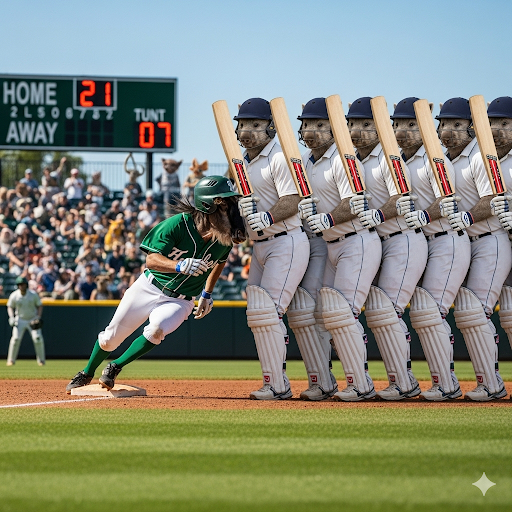
Imagen 4.
In summary, QL2107 is not a home run or even a triple. At least in India, it’s stuck at second.
If you compete with Zoominfo, you have to understand Zoominfo…so you can exploit its weaknesses.
Highlights from the Zoominfo podcast
I could have listened to a long podcast with CEO Henry Schuck to understand the company’s weaknesses, but I didn’t have to because Matthew Robinson provided a time-stamped list of highlights. Or maybe Robinson didn’t do it himself, because Robinson is no longer necessary.
This first one caught my attention as the biometric product marketing expert, for obvious reasons.
(13:34) How they automated product marketing: From 26 people translating product info into content, down to 2 people managing AI agents.
Basically, mining data and auto-creating content.
And this second one just plain caught my attention.
(27:32) When you know the AI pressure is working: His CMO literally dreamed she disappointed him because her kids weren’t AI algorithms yet.
It’s good to know that Zoominfo has a distracted CMO. And that the CEO thinks it’s funny.
When Zoominfo’s headcount hits zero
And it’s awfully amusing that 24 product marketers lost their jobs. Remember the claims that AI wouldn’t replace you, but would let you do your job better? Lies.
Zoominfo’s business, by the way, is providing information on companies and the people who work for them. And as companies like Zoominfo right size, there is less demand for their services.
And that’s when Zoominfo will eliminate the position of the CMO and automate it.
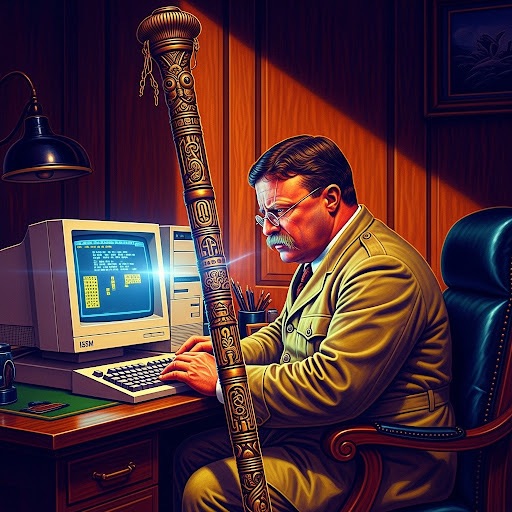
So I just created a short reel for no purpose other than to illustrate Theodore Roosevelt’s famous saying “Speak softly and carry a big stick.”
But then I began thinking. For product marketers, is “speaking softly” an idea that should be relegated to the early 20th century? The answer to that question partially depends on whether you are marketing in an earlier awareness stage, or a later conversion stage.
But the reel doesn’t get that deep.
Speak softly.
An aside (overly serious product marketers skip this part)
Originally this reel was supposed to be a single image, with no stick, showing President Roosevelt to the audio accompaniment of Paul Simon’s “Loves Me Like a Rock.”
To be honest, ORIGINALLY the President was supposed to be Nixon, whose mama loved him and was a saint.
But once Roosevelt got behind the Presidential podium, my mind traveled to earlier times in the Dakotas and Cuba, and the stick—softly—inserted itself.
Excluded from the reel but not forgotten: my earlier fictional conception of Roosevelt overseeing the construction of the Panama Canal, previously shared here.
A man, a plan…
And if you haven’t already figured it out, Teddy appears to be safe from the restrictions from Google’s guidelines on depictions of famous figures. As I said before, no picture generation of President Richard Nixon, or President Taylor Swift.
“This quote often attributed to Theodore Roosevelt is actually a West African proverb. Roosevelt writes this in a letter to Henry Sprague on January 26, 1900.”
A year and a half later, after Roosevelt’s political enemies had maneuvered him into the then-obscure position of Vice President of the United States (subsequently characterized as a bucket of warm…spit), he expounded upon the phrase at the Minnesota State Fair on September 2, 1901.
Deep fried pizza on a stick. Not historically accurate.
(He and his political enemies had no way of knowing that later that month McKinley would be assassinated and Roosevelt would be President. Oops.)
“”Speak softly and carry a big stick—you will go far.” If a man continually blusters, if he lacks civility, a big stick will not save him from trouble; and neither will speaking softly avail, if back of the softness there does not lie strength, power. In private life there are few things more obnoxious than the man who is always loudly boasting; and if the boaster is not prepared to back up his words his position becomes absolutely contemptible. So it is with the nation. It is both foolish and undignified to indulge in undue self-glorification, and above all, in loose-tongued denunciation of other peoples.”
As Roosevelt noted, the “and” it’s important. A soft speaker without a big stick will not be persuasive.
But is speaking softly all that important?
Speaking loudly: Berliners, Crazy Eddie
There are certainly instances, both in diplomacy/politics and product marketing, in which speaking loudly is extremely effective. Avoiding the 21st century (we really don’t want to go there) and confining myself to the 20th, the masses of people at the Berlin Wall were very loud.
“The Treaty of Portsmouth formally ended the Russo-Japanese War of 1904–05. The negotiations took place in August in Portsmouth, New Hampshire, and were brokered in part by U.S. President Theodore Roosevelt….Although the actual importance of Roosevelt’s mediation and personal pressure on the leadership in Moscow and Tokyo to the final agreement is unclear, he won the Nobel Peace Prize for his efforts in moderating the talks and pushing toward peace.”
Of course, everyone knew that negotiations were taking place in Portsmouth, just like everyone knew that Egypt and Israel were negotiating at Camp David 70+ years later.
“The world of golf was left stunned on Tuesday as the PGA Tour, DP World Tour and rival Saudi-backed LIV circuit, who have been involved in a bitter fight that has split the sport, announced a shock agreement to merge and form one unified commercial entity….The bombshell announcement was slammed by many PGA Tour players who were left in the dark about the merger…”
Not historically accurate. I don’t think.
For the moment, ignore the fact that the merger hasn’t happened two years later. The heated war between the PGA and the LIV meant that while a merger made financial sense (see the NFL and the AFL bidding up football player prices in the 1960s), no one expected a PGA-LIV merger to happen.





 Bredemarket