When I write about space aliens, there’s a reason. And that reason may be to warn identity vendors that silence is NOT golden.
Fake LinkedIn stories
As a frequent reader and writer on LinkedIn, I’ve seen all the tips and tricks to drive engagement. One popular trick is to make up a story that will resonate with the LinkedIn audience.
For example, the writer (usually a self-proclaimed career expert who is ex-FAANG) will tell the entirely fictional story of a clueless hiring manager and an infinitely wise recruiter. The clueless hiring manager is shocked that a candidate accepted a competing job offer. “Didn’t she like us?” asks the hiring manager. The wise recruiter reminds the clueless hiring manager that the candidate had endured countless delays in numerous interviews with the company, allowing another company to express interest in and snatch her.
Job seekers have endured countless delays in their own employment searches. When they read the post, they hoot and holler for the candidate and boo the clueless hiring manager. Most importantly, readers like and love the writer’s post until it goes viral, making the author an ex-FAANG top recruiting voice.
Even though no sources are cited and the story is fictional, it is very powerful.
Well…until you’ve read the same story a dozen times from a dozen recruiters. Then it gets tiresome.
My improvement on fake stories
But those fake stories powerfully drive clicks on LinkedIn, so I wanted to get in on the action. But I was going to add two wrinkles to my fake story.
First, I would explicitly admit that my story is fake. Because authenticity. Sort of.
Second, my story would include space aliens to make it riveting. And to hammer the point that the story is fake.
Now I just had to write a fake story with space aliens.
Or did I?
A repurposed and adapted fake story with space aliens
I just needed to make one of the characters a space alien, and since Jones was based on the striking Grace Jones, I went ahead and did it. If you can imagine Grace Jones with tentacles, two noses, and eight legs.
As the space alien’s tentacles quivered, I snuck something else into the LinkedIn story—some facts.
Kids who watched Fat Albert on TV not only enjoyed the antics, but also learned an Important Life Lessons. Now I don’t have multiple advanced degrees like Cosby, but then again I never had multiple degrees rescinded either.
But my life lesson wasn’t to stay in school or pull your pants up. My life lesson was to blog. The lesson was in the form of a statement by Jones’ humanoid colleague Smith, taken verbatim from the Pizza Stories post.
“Take blogging,” replied Smith. “The average company that blogs generates 55% more website visitors. B2B marketers that use blogs get 67% more leads than those who do not. Marketers who have prioritized blogging are 13x more likely to enjoy positive ROI. And 92% of companies who blog multiple times per day have acquired a customer from their blog.”
The third image in the “houseboat” series of posts that I’ve run on SOME social media outlets.
Beginning May 2, Bredemarket is on fewer social channels. The information in this post is not new.
If you were reading some of Bredemarket’s social channels, you may have seen a similar announcement on May 15, but that announcement listed the services where I was no longer posting.
If you were reading some of Bredemarket’s OTHER social channels, you may NOT have seen that announcement. Because those other social channels were the precise ones where I was no longer posting.
The May 15 social media account is a follow-up to a prior announcement from May 2, which said in part that I was “pausing activity on some Bredemarket social channels (and some related personal channels) that have no subscribers, exhibit no interest, or yield no responses.”
The second image in the “houseboat” series of posts that I’ve run on SOME social media outlets.
But rather than dwelling on the negative aspects of the social channels where Bredemarket has suspended activity, I’m going to concentrate on the social channels where Bredemarket is still active.
Of all the technologies I don’t know about, jobseeker technology is the most important. Between July 2000 and today, I’ve spent over 30 months searching for full-time employment. So it helps to know how employers search for potential employees.
And a lot of those 30-plus months have been filled with self-styled experts advising people “how to beat the applicant tracking system (ATS)” (as if there were only one) and “how to access the hidden job market” (because of course employers don’t want anyone to know that they’re searching for talent).
So when Melanie Woods of CGL Recruiting offered 20 jobseekers the chance to see how their LinkedIn Profile appears to users of LinkedIn Recruiter, I really wanted to win one of those 20 slots.
If I could boil all 7 tips down to 1, I’d emphasize that recruiters have limited time, and something a recruiter can understand in 0 seconds is much better than something that would take a recruiter 5 seconds to understand.
Instead of spending money on advertising, my team is going to be taking a different approach and it involves YOU #jobseekers!
Sounds like a plan, since a word-of-mouth testimonial converts more effectively than copy written by a marketing hack. (But what if the testimonial is FROM a marketing hack?)
The offer
She then described the offer.
We are going to be offering 20 free 20 minute sessions to job seekers who are currently out of work. During your session I will pull you up live in LinkedIn Recruiter and test your profile to show you where you are coming up in searches and where you are falling out. I will help you adjust your profile so you can appear in more searches for the jobs you are targeting.
What is LinkedIn Recruiter?
As you can probably guess, LinkedIn Recruiter is the premium-priced service that recruiters use to search LinkedIn for job candidates. The top-tier package (“contact Sales” for the price) includes:
Unlimited LinkedIn network access: Find and engage anyone on LinkedIn
150 InMail messages/month per license and bulk messaging
40+ advanced search filters, including “Open to work” and “More likely to respond”
Multi-user collaboration tools
Prepaid slots to rotate job postings in and out as needed
If your company is recruiting more than 4 positions a year, the high-end version of LinkedIn Recruiter could be the tool for you.
But when recruiters use LinkedIn Recruiter, they don’t look at a candidate’s LinkedIn profile—they look at the LinkedIn Recruiter view of the candidate’s profile, optimized for their purposes.
Hence Melanie was offering job applicants the opportunity to see how their profile appears to a recruiter. Valuable information to have.
What CGL Recruiting wanted in return
But remember that the lucky winners had to provide “advertising” to CGL Recruiting in return.
Here is where the advertising piece comes in….if you feel that the 20 minutes was helpful to you and your job search, we would appreciate you doing a review of our services on LinkedIn and one other social media platform (your choice), sharing how the time spent was useful to you and your job search.
Melanie and I met via Zoom early Monday afternoon Pacific Time (late afternoon Central Time), and I received a firehose of information during the 20-minute session. I’m not going to cover ALL the information she provided; instead, I’ll confine myself to the top 7 tips.
The first job on the LinkedIn profile is the most important.
Use all 5 “job title” slots.
Some employers AREN’T 1st and 2nd degree connections.
You can have 6 on-site job locations, not just 5.
Consider listing at least one college-related date.
Ampersands are bad.
Temperamental writers shouldn’t fall in love with pet phrases.
Tip 1: The first job on the LinkedIn profile is the most important
For my job search for a Senior Product Marketing Manager role, my Incode position is (maybe) more important than my current Bredemarket position. On my resume, I take care of this by listing Incode BEFORE Bredemarket. But because LinkedIn profiles are chronological, and Bredemarket is my current “employer,” I can’t reorder like that.
The LinkedIn Recruiter view of the profile doesn’t show all the positions, but only the top 3. And the first position takes great prominence.
LinkedIn Recruiter view of my LinkedIn profile, Monday, May 13, 2024, 1:30 pm PDT.
In the default view, the recruiter can’t see my fourth position (Strategic/Product Marketing Manager from 2015 to 2017), but only the first three. And only one of those three positions is product marketing-related.
Melanie zeroed in on my “Sole Proprietor” position, which tells a recruiter nothing about what I actually DO at Bredemarket. Sure the recruiter could click through and read about the marketing and writing services that Bredemarket provides…but recruiters have limited time.
I thought about her advice after the call, and for LinkedIn (and resume) purposes I’m changing my Bredemarket job title to “Product Marketing Consultant.” My work for my clients is all product/service-related, so the job title makes sense.
Now recruiters will see that two of my three most recent positions were product marketing-related, which makes me more attractive to the one position that I’m targeting.
One position? Wait a minute…
Tip 2: Use all 5 “job title” slots
That’s right. In my “job preferences,” my only listed job title was “Senior Product Marketing Manager.”
I can list up to 5.
Why not use all 5?
So now my job titles include the following:
Senior Product Marketing Manager
Product Marketing Manager
Marketing Content Manager
Global Product Marketing Manager
Product Marketing Consultant
So I have the position title from Incode, the consulting title from Bredemarket, two product marketing title variants, and a content marketing title for good measure (Bredemarket readers know why).
Now some people question why I’d list all these similar titles, since anyone who takes a few seconds can figure out that I’d be interested in a global product marketing manager position or whatever.
That’s the problem. Recruiters DON’T HAVE a few seconds. When hundreds or thousands of people apply for positions, recruiters need to get through the profiles as quickly as possible.
So Melanie wanted me to make her job easier.
Tip 3: Some employers AREN’T 1st and 2nd degree connections
You can control the visibility of your email address and your phone number on LinkedIn. While I don’t list a phone number on my LinkedIn profile, I do make my jobseeking email address (which is separate from my Bredemarket email address) visible. In fact, I configured my email address visibility for viewing by my 1st degree and 2nd degree connections.
But there was a fallacy in that tactic.
It became obvious in the session because Melanie (not a connection since her LinkedIn connections are maxed out) could NOT see my email address. Therefore, if recruiter Melanie wanted to contact me, she could ONLY contact me via InMail.
If you want ANY potential recruiter to see your email, increase its visibility to all connections. Obviously there are risks to this, so you need to judge what visibility is right for you. (Especially for phone numbers.)
Tip 4: You can have 6 on-site job locations, not just 5
While all of Bredemarket’s work is remote, and my previous work at Incode was remote, I’m not averse to on-site work. As long as it’s within driving distance.
To help local companies, I listed a selected five cities (the maximum) where I am available for on-site work:
Ontario, California, United States
San Bernardino, California, United States
Covina, California, United States
Pasadena, California, United States
Anaheim, California, United States
But Melanie pointed out that I didn’t need to list Ontario, since my profile already states that I live in Ontario. That freed up one slot to add another city. I chose to list Riverside, although I could have listed Brea or Fullerton or Industry or Pomona or Corona or many other cities. (LinkedIn, your on-site locations feature needs work.)
Tip 5: Consider listing at least one college-related date
Now let’s get into age discrimination talk.
If a company desires to discriminate against job applicants due to age, one effective way to do so is to look at the dates the applicants attended college. It’s pretty easy to quietly filter out the geezer applicants with no one the wiser.
For this reason I didn’t bother to add my college attendance dates to my LinkedIn profile. Why give the discriminating (in a negative way, not a positive way) firm the ammo they need to get the young, cheap workers they really want? (Of course those workers are inexperienced, but that’s another topic entirely.)
But Melanie pointed out one truth about companies that want to discriminate: if they don’t discriminate against you when they read your LinkedIn profile or resume, they can easily discriminate against you when they SEE you.
Oh, and there’s one more thing: if recruiters search for candidates based upon their graduation dates, profiles without graduation dates will never been seen by recruiters.
So I mulled over her advice.
I decided not to list the date that I started attending Cal State Fullerton’s MBA program.
And I decided not to list the date I graduated from Reed College.
I certainly didn’t list the date I started attending Reed College. (But I will confess that this song blasted from the Old Dorm Block. And I’ll also confess that I could lose the last 4 1/2 minutes.)
But I did pencil in my 1991 graduation date from Cal State Fullerton’s MBA program. Since my LinkedIn profile includes ALL my biometric positions going back to 1994, this isn’t a shocking revelation.
Tip 6: Ampersands are bad
LinkedIn profiles can include skills. I’ve listed near the limit of 50 skills, some of which are tied to particular positions, LinkedIn Learning courses, and other education and certifications.
Among many others, two of my listed skills are “identity & access management” and “sales & marketing management.”
Technology experts immediately see where this is going. So why didn’t I?
Melanie immediately noted that the ampersand character in those two skill descriptions can wreak havoc with some computerized systems.
I swapped out those skills for some new ones: identity and access management, and sales and marketing management, removing the problem.
Tip 7: Temperamental writers shouldn’t fall in love with pet phrases
Melanie’s biggest concern about my LinkedIn profile involved the very first sentence.
The one that appears below my profile, name, and preferred pronouns, but above my city of residence.
John Bredehoft LinkedIn profile, public view, Monday, May 13, 2024, 1:30 pm PDT.
Senior Product Marketing Manager in identity/technology who is expert in describing why customers benefit.
She read that sentence word for word.
“Senior Product Marketing Manager”? She liked that.
“In identity/technology”? I guess she liked that; at least she didn’t comment on it.
The rest of the sentence? Not so much.
Regular Bredemarket readers are familiar with the last three words of that sentence, and realize that every one of those three words is critically important. Why rather than what, customers rather than producers, and benefits rather than features. I’ve devoted a post (plus another post) to those three words. If I only had a few seconds to explain the importance of those three words…
Um, yet again, recruiters aren’t interested in taking a few minutes to read everything I have written about Simon Sinek’s Golden Circle, customer focus, or benefits. They don’t even want to watch a short reel on the topic.
So I have to rewrite the last part of that first sentence. As I write this post, I’m still mulling over alternatives.
CGL Recruiting’s expertise was highly beneficial
The 7 items above were just some of the tips that Melanie Woods imparted to me, all in the space of 20 minutes.
Again, the common theme is that recruiters have limited time, LinkedIn Recruiter lets them maximize that limited time, and jobseeker data also has to let recruiters maximize that limited time. If you can do something in 0 seconds, don’t take 5 seconds to do it.
I haven’t even explored some of the other features that CGL Recruiting offers, including Melanie Woods’ YouTube channel.
But the 20 minutes I spent with her were certainly valuable.
Now I just have to figure out another way to say “why customers benefit.”
Checking the purported identity against private databases, such as credit records.
Checking the person’s driver’s license or other government document to ensure it’s real and not a fake.
Checking the purported identity against government databases, such as driver’s license databases. (What if the person presents a real driver’s license, but that license was subsequently revoked?)
Perform a “who you are” biometric test against the purported identity.
If you conduct all four tests, then you have used multiple factors of authentication to confirm that the person is who they say they are. If the identity is synthetic, chances are the purported person will fail at least one of these tests.
Do you fight synthetic identity fraud?
If you fight synthetic identity fraud, you should let people know about your solution.
There may be a variety of reasons for this. Perhaps your current employees are too busy doing other things. Or perhaps writing terrifies them so much that they think ChatGPT-generated content is actually a GOOD thing. (Read the content. It isn’t good.)
So you’re thinking about outsourcing the work to a content writer. One who has created content for multiple technology firms, including 9 returning clients. Here are four examples.
But how does outsourced content writing work?
How Bredemarket works with you to create content
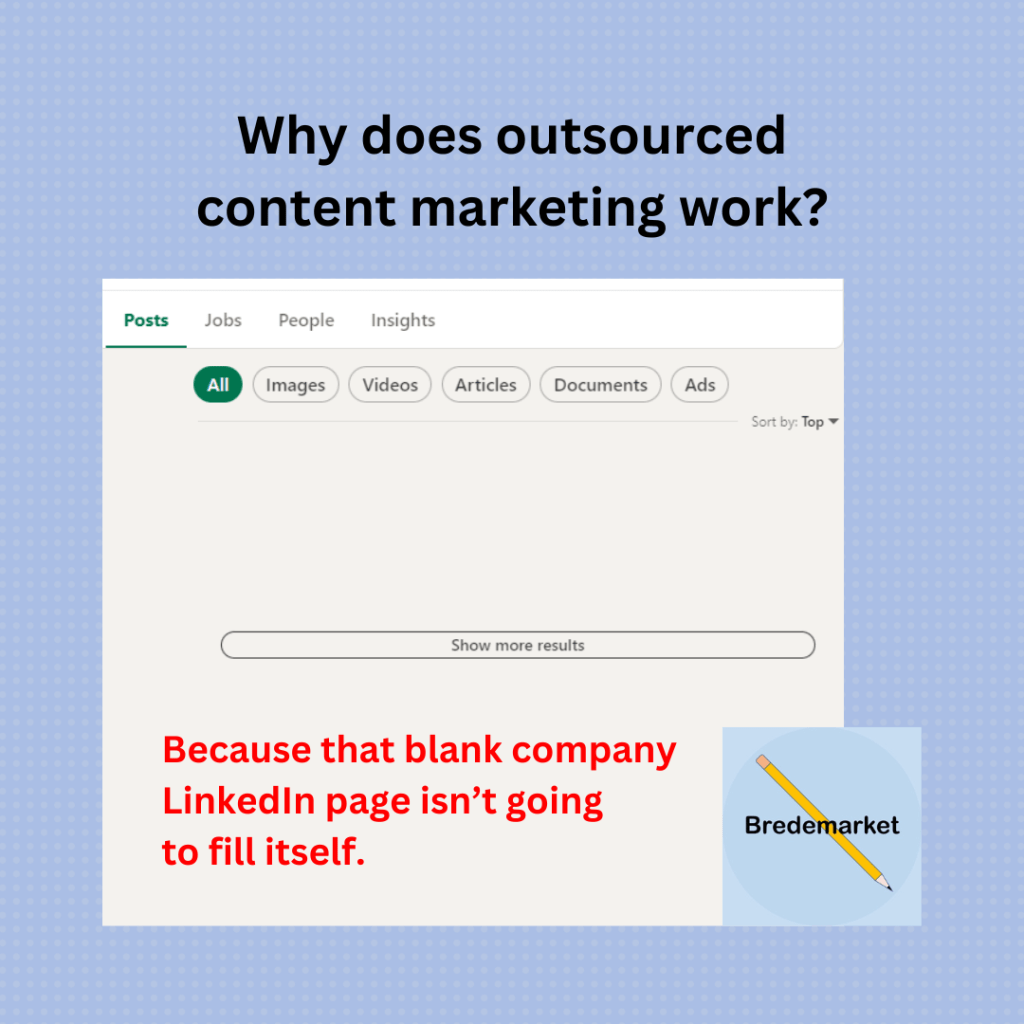
Maybe you need an outsourced content writer because your current textual content is not compelling to your prospects, or perhaps it’s non-existent (for example, a LinkedIn company page with zero posts).
If you approach Bredemarket with your outsourced content writing request, here’s how we will work together:
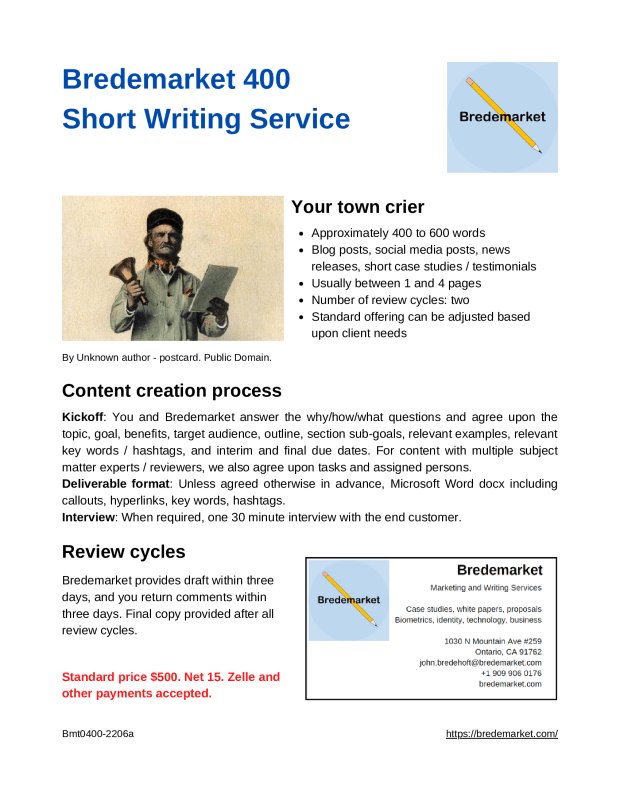
For this example, let’s assume that you need between 400 to 600 words of text to post to your company blog or to your company LinkedIn account, and therefore are purchasing my Bredemarket 400 Short Writing Service.
This is the most important step in the entire process, and I don’t write a word of text until you and I have some agreement on WHAT I am going to write.
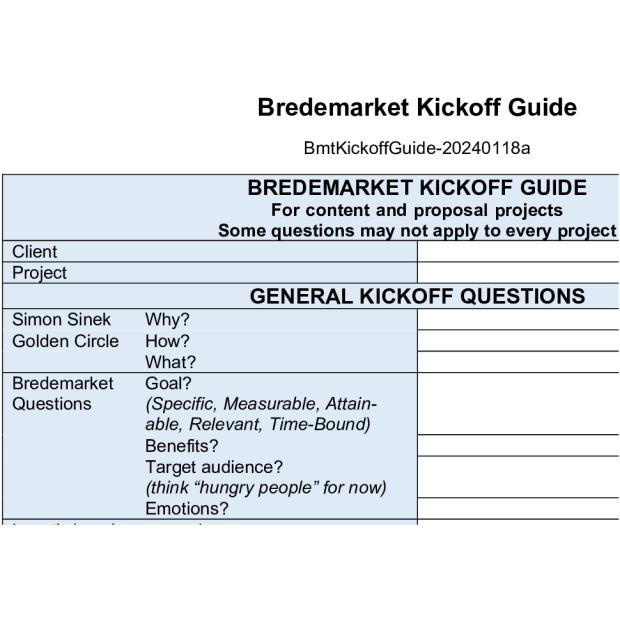
I start by asking seven questions about the content, your product, and your company.
Why?
How?
What?
Goal?
Benefits?
Target Audience?
Emotions?
I ask some additional questions which I won’t discuss in detail here. For example, you may specify the subject matter experts or articles I need to consult.
Once we’ve worked through ALL the questions, either in a synchronous meeting or asynchronously via email, I have a good idea of what the written content needs to say.
This benefits you because I love doing this, communicating your benefits to your prospects using the framework upon which we agreed in the kickoff.
Unless we agree on a different schedule, I get that first draft to you in three days for the next important step.
Step 3: First draft review
This is where you come in. Your task is to review my draft within three days and provide comments. And if I don’t hear from you within three days, you’ll hear from me. Why?
The first reason is my pure self-interest. The sooner I complete the project, the sooner I get paid. Those cold dead hands need some nice gloves.
The second reason is of mutual interest. We want to complete the project while we’re focused on thinking about it, and while it is critically important to us.
The third reason is for your own self-interest. You have a content gap, and it’s in your interest to fill that gap. If we get this draft reviewed and move forward, that gap will be filled quickly. If we don’t move forward, the gap will remain, your efforts to contract with Bredemarket will be for naught, and you’ll still have an uninteresting website and dead social media accounts.
Step 4: It depends
What happens after the first draft review varies from client to client.
Some of my clients love the first draft and don’t want to change a thing.
Some of my first drafts have embedded questions that you need to answer; once those questions are answered, the content is ready.
Some of my first drafts may need minor changes. In one case, I was asked to remove a reference to a successful hack that occurred at a well-known company; unbeknownst to me, the company was a customer of another division of the client in question. Whoops.
Occasionally more substantive changes are required, and I end up creating a second draft in three days, and you review it in three days.
In the end, we have a piece of content that is almost ready for publication.
Step 5: Finalize and publish
While the words may be ready, the entire piece is not.
I’m not a graphics person, and usually a written piece needs some accompanying images to drive the message home. I may suggest some images, or I may suggest that the client reuse an image from their website, or I may just ask the client to select an appropriate image.
Once the text and images are ready, you publish the piece. Normally I don’t have access to your website or social media accounts, so I can’t publish the piece for you. Only one client has given me such access, and even for that client I don’t have COMPLETE publishing permission.
For short projects such as a Bredemarket 400 project, I usually bill you when you publish the piece, although in certain circumstances I may bill you once the text is complete.
Are you ready to outsource your content marketing?
While other content marketers may work differently, we all have some type of process for our outsourced content writing.
If you’re ready to move forward with Bredemarket for outsourced content writing, contact me.
The Digital Trust & Safety Partnership (DTSP) consists of “leading technology companies,” including Apple, Google, Meta (parent of Facebook, Instagram, and WhatsApp), Microsoft (and its LinkedIn subsidiary), TikTok, and others.
DTSP appreciates and shares Ofcom’s view that there is no one-size-fits-all approach to trust and safety and to protecting people online. We agree that size is not the only factor that should be considered, and our assessment methodology, the Safe Framework, uses a tailoring framework that combines objective measures of organizational size and scale for the product or service in scope of assessment, as well as risk factors.
We’ll get to the “Safe Framework” later. DTSP continues:
Overly prescriptive codes may have unintended effects: Although there is significant overlap between the content of the DTSP Best Practices Framework and the proposed Illegal Content Codes of Practice, the level of prescription in the codes, their status as a safe harbor, and the burden of documenting alternative approaches will discourage services from using other measures that might be more effective. Our framework allows companies to use whatever combination of practices most effectively fulfills their overarching commitments to product development, governance, enforcement, improvement, and transparency. This helps ensure that our practices can evolve in the face of new risks and new technologies.
But remember that the UK’s neighbors in the EU recently prescribed that USB-3 cables are the way to go. This not only forced DTSP member Apple to abandon the Lightning cable worldwide, but it affects Google and others because there will be no efforts to come up with better cables. Who wants to fight the bureaucratic battle with Brussels? Or alternatively we will have the advanced “world” versions of cables and the deprecated “EU” standards-compliant cables.
So forget Ofcom’s so-called overbearing approach and just adopt the Safe Framework. Big tech will take care of everything, including all those age assurance issues.
Incorporating each characteristic comes with trade-offs, and there is no one-size-fits-all solution. Highly accurate age assurance methods may depend on collection of new personal data such as facial imagery or government-issued ID. Some methods that may be economical may have the consequence of creating inequities among the user base. And each service and even feature may present a different risk profile for younger users; for example, features that are designed to facilitate users meeting in real life pose a very different set of risks than services that provide access to different types of content….
Instead of a single approach, we acknowledge that appropriate age assurance will vary among services, based on an assessment of the risks and benefits of a given context. A single service may also use different approaches for different aspects or features of the service, taking a multi-layered approach.
















 Bredemarket