My interests are admittedly niche (I created a YouTube video about it that most people won’t watch), but I’m still devoted to feeding the few who are also interested in this niche.
So if you’re interested in identity and technology content, ensure you’re following the Bredemarket blog and current social channels. They’ve changed since my original list and the May 2024 contraction, but…
in addition to the Bredemarket website, you can currently search for Bredemarket on Bluesky, Facebook, Instagram, LinkedIn, Threads, the aforementioned YouTube, a well-known site that may or may not disappear in the next three weeks, and other places.
It all started with “Know Your Customer,” a shorthand phrase used by financial institutions and related entities who need to know who their customers are.
But then various governments, industries, and entities got into the act with their own variants, such as “Know Your Business.”
I was curious about how many of these “know your” variants I’ve discussed in the Bredemarket blog. Here’s what I found:
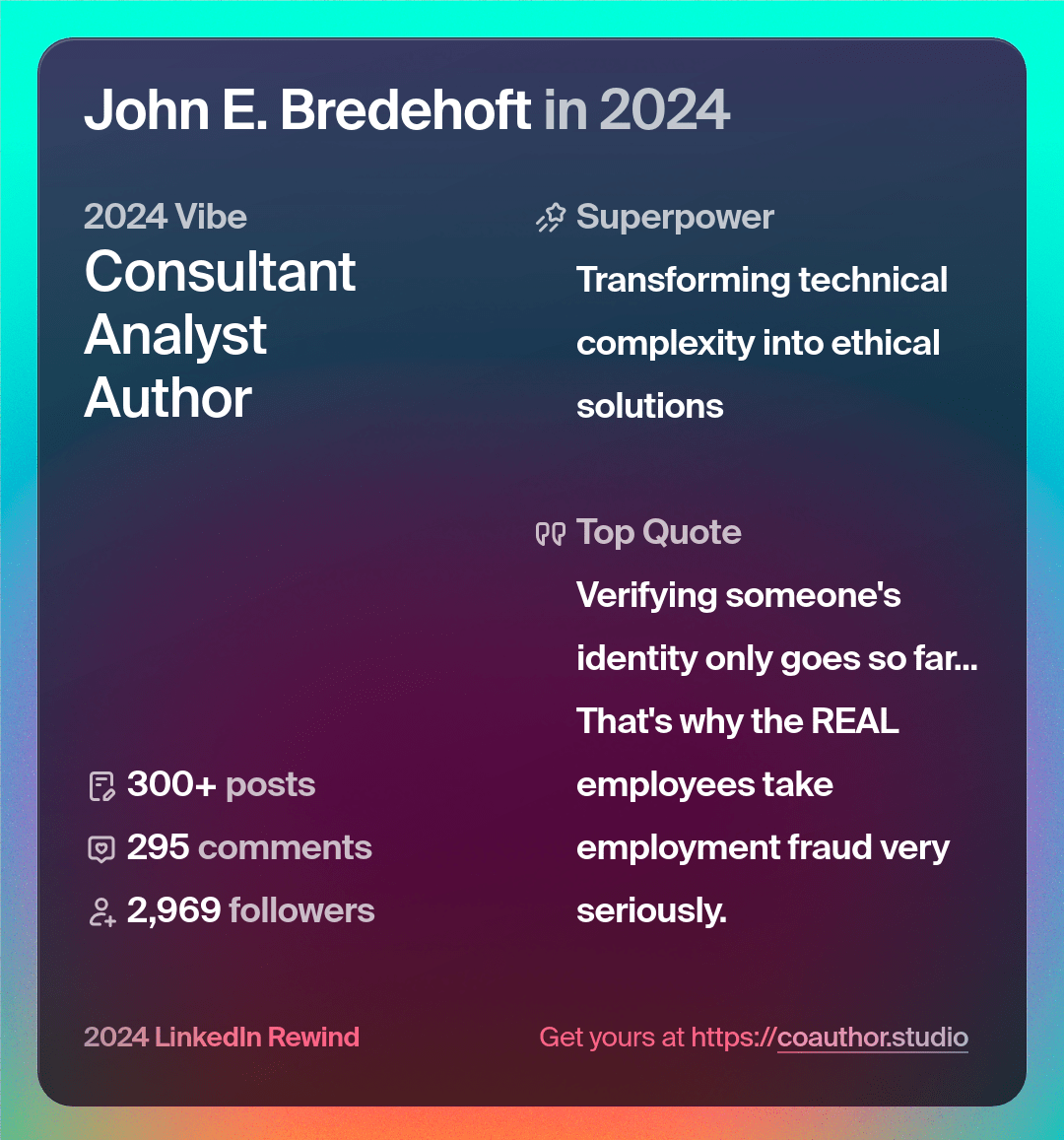
So I checked out Coauthor’s me-too LinkedIn-themed copycat of Spotify Wrapped, like many of you did. Here’s the (unedited) post it wrote for me—not too bad:
= = =
Here’s my 2024 LinkedIn Rewind, by Coauthor.studio:
After 30 years in identity and biometrics, 2024 showed me that verification only goes so far. The real challenge isn’t just confirming who someone is – it’s understanding what they might do.
From employment fraudsters with verified credentials to healthcare imposters with stolen birthdates, this year proved that identity verification alone can’t prevent deception. But it also showed how combining technical expertise with human insight can help protect organizations and individuals.
Key observations from 2024:
Identity verification without intent analysis is incomplete
Employment fraud evolves faster than verification methods
Through Bredemarket, I delivered over 100 content and analysis projects helping organizations navigate these challenges. I also conducted research on employment fraud tactics and moderated communities helping others avoid scams.
Looking ahead: 2025 will require even more sophisticated approaches to identity verification and fraud prevention. The fraudsters aren’t going away – but neither am I. I’ll continue helping organizations implement effective identity strategies while advocating for ethical AI use and employment practices.
To the wildebeests following along: remember that verification is just the start. The real value comes from understanding intent and building trust.
#fraud #identity #security #productmarketing
—
Get your 2024 LinkedIn Rewind! Go to coauthor.studio
I’m seeking a Senior Product Marketing Manager role in software (biometrics, government IDs, geolocation, identity and access management, cybersecurity, health) as an individual contributor on a collaborative team.
Key Accomplishments
Product launches (Confidential software product, Know Your Business offering, Morpho Video Investigator, MorphoBIS Cloud, Printrak BIS, Omnitrak).
Multiple enablement, competitive analysis, and strategy efforts.
Exploration of growth markets.
Multiple technologies.
Multiple industries.
Over 22 types of content.
Currently available for full-time employment or consulting work (Bredemarket).
(The original honeypot can be found in a post on my LinkedIn profile.)
As previously promised…
I’ve spent over 10 years in identity and biometrics, and other factors, including one-to-many identification, one-to-one verification, and classification (e.g. how old you are).
But as I have noted in a recent article in the Bredemarket newsletter The Wildebeest Speaks, verifying someone’s identity only goes so far.
(For people reading this on LinkedIn: here comes #honeypot1129, for those paying attention.)
For example, how many LinkedIn users sporting a green banner and an #opentowork hashtag have been approached by a person claiming to be from Company X…who is NOT from Company X?
That, my friends, is #employmentfraud – something that the REAL employees at all the Company X’s out there take very seriously.
Of course, no #fraudster who is doing something like that would be foolish enough to send me a LinkedIn InMail with such a claim…would they?
Upload PDFs, websites, YouTube videos, audio files, Google Docs, or Google Slides, and NotebookLM will summarize them and make interesting connections between topics, all powered by Gemini 1.5’s multimodal understanding capabilities.
With all of your sources in place, NotebookLM gets to work and becomes a personalized AI expert in the information that matters most to you….
Our new Audio Overview feature can turn your sources into engaging “Deep Dive” discussions with one click.
I uploaded the most recent version of my resume to NotebookLM.
Technically, this is not my resume; this is a PDF version of a portion of my LinkedIn profile. But my resume has similar information.
NotebookLM used the resume as source material to create a 20+ minute podcast called “Career Detective.” In the podcast, a male and a female pair of bots took turns discussing the insights they gleaned from the resume of John E. “Breedehoft.” (I use a short e, not a long e, but people can call me anything if I get business from it.)
Surprisingly, they didn’t really hallucinate. Or at least I don’t think they did. When the bots said I was deeply qualified, as far as I’m concerned they were speaking the truth.
They even filled in some gaps. For example, I used the acronyms for KYC, KYB, and AML on my resume to save space, so one of the bots explained to the other what those acronyms meant, and why they were important.
Probably the most amusing part of the podcast was when they noted that I had worked at two very large companies. (Just so you know, my resume only goes back to 2015, so Motorola isn’t even discussed.) While Incode and IDEMIA are both multinationals, I wouldn’t characterize Incode as massive.
Anyway, judge for yourself
So here’s the audio episode of “Career Detective” that focuses on…me.
By the way, I learned about NotebookLM via the Never Search Alone Slack workspace, but still need to explore NotebookLM’s other features.
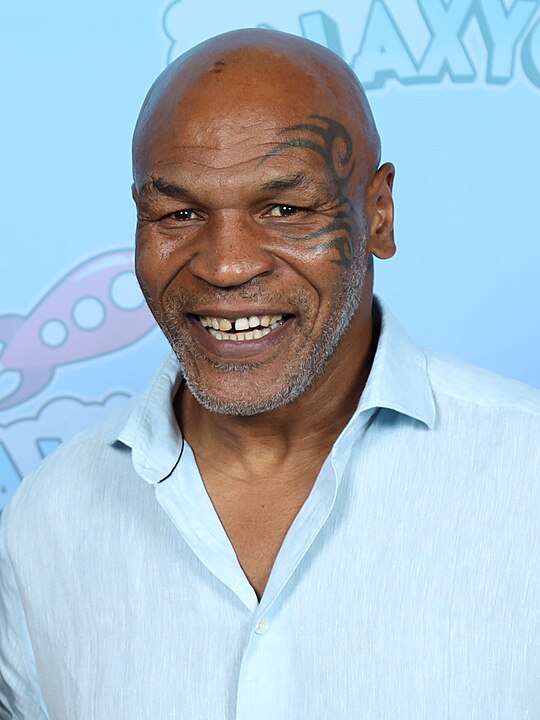
I don’t know, I don’t believe in the word “legacy.” I just think that’s another word for ego. Legacy doesn’t mean nothing. It’s just some word everybody grabbed onto.
It means absolutely nothing to me. I’m just passing through. I’m going to die and it’s going to be over. Who cares about legacy after that?
We’re nothing. We’re just dead. We’re dust. We’re absolutely nothing. Our legacy is nothing.
With the life that Tyson has lived, it’s understandable why he’s echoing Ecclesiastes in this interview.
But you don’t have to have had Tyson’s experiences to realize that legacy does not last.
Neither wanted nor needed
In business (and in life), there are companies (and people) who don’t need you or want you.
This may be temporary. The company that doesn’t need you today may urgently (and importantly) need you tomorrow.
Or it may NOT be temporary. There are companies that will NEVER need you or want you.
I recently ran across three such companies that will never need Bredemarket.
Six weeks (now less than six weeks)
Six weeks, the still image version.
Perhaps you noticed Bredemarket’s “six weeks” promotion over the weekend. It was addressed to companies that may have a final project that they want to complete before the year ends in six weeks. (Now 5 1/2 weeks.) I emphasized that Bredemarket can help companies complete those content, proposal, and analysis projects.
I also included email in this campaign, targeting prospects whom I haven’t worked with recently, or whom I’ve never worked with at all. I didn’t go overboard in my emails; although I have over 400 contacts in Bredemarket’s customer relationship management system, I sent the email to less than 40 of them.
As of this morning, none of the recipients has booked a meeting with me to discuss their end of year needs.
Some explicitly told me that they were fine now and did not need or want Bredemarket’s services for end of year projects.
Some didn’t respond, which probably indicates that they did not need or want Bredemarket’s services either.
And I discovered that three companies (four contacts) will NEVER need or want Bredemarket’s services.
Delivery incomplete
How did I discover that?
Via four “delivery status notification” messages.
Delivery incomplete.
So I visited the web pages in question, and they no longer existed.
This site can’t be reached.
I’ve been building up my CRM for over four years, so it’s not shocking that some companies have disappeared.
But one of the companies (“Company X”) DID exist a mere eight months ago.
I know this because I prepared a presentation on differentiation (see version 2 of the presentation here), and two representatives from Company X received the presentation in advance of a conference.
After the conference organizer distributed the presentation, I offered to meet with the companies individually (no charge) to discuss their content and differentiation needs, or anything else they wanted to discuss.
While some conference attendees took advantage of my April offer, the representatives from Company X did not.
And now in November, Company X no longer exists.
Tumbleweed image public domain.
Could Bredemarket have created the necessary content to keep Company X afloat? Who knows?
But EVERY company needs content to differentiate it from its competitors. Otherwise the competitors will attack you. And your competitors may not be as merciful with you as Jake Paul was with Mike Tyson.
If you need Bredemarket’s help with content, proposal, or analysis services, book a meeting with me.
In my circles, people generally understand ‘biometrics’ to refer to one of several ways to identify an individual.
But for the folks at Merriam-Webster, this is only a secondary definition of the word “biometrics.” From their perspective, biometrics is primarily biometry, which can refer to “the statistical analysis of biological observations and phenomena” or to “measurement (as by ultrasound or MRI) of living tissue or bodily structures.” In other words, someone’s health, not someone’s identity.
Fun fact: if you go to the International Biometric Society and ask it for its opinion on the most recent FRVT 1:N tests, it won’t have an answer for you.
So Abbott salespeople, real or imagined, won’t be interested in what I’ve been doing for the last 30 years. ‘Cause you know sometimes words have two meanings.
But those of you who use biometrics (and other factors) for individualization WILL be interested. Click on the image to find out more.
Drive content results with Bredemarket Identity Firm Services.
Perhaps I was a little agitated or excited this afternoon.
Perhaps I was a little agitated because five (or maybe more; I lost count) scammers had sent me LinkedIn DMs when they gravitated to my #opentowork LinkedIn banner…like flies speeding to a carcass. (Which gave me an excuse to write about identity management on LinkedIn.)
Or perhaps I was a little excited because a Never Search Alone participant had shared an identity management product marketing position with me.
The bot says hello
After applying for said job, I was reading the company’s website to learn about its identity management product when the company’s bot kept on messaging me.
At 2:30 pm Chat Bot says: Hello, this is an AI Rep from [COMPANY]. If you need any assistance, feel free to ask.
At 2:30 pm Chat Bot says: Saw that you’re interested in our SaaS management and identity governance software. Any questions?
Being the curious type (after all, I worked for IDEMIA), I wondered how the chat bot would deal with what I REALLY wanted to ask about.
Not about a demo.
Not about the company’s recent funding round. (Series B, $35 million.)
At 2:47 pm I say: With 30 years’ identity experience and 9 years as a PMM, I just applied for your Sr PMM Identity Management role. So the only question that I have is when you will interview me.
And yes, my assumption that the company would immediately drop everything and interview me may have been a little overconfident. But it’s better than imposter syndrome.
And after all, this was just a bot. I assumed that the bot would be completely confused by my question, so no harm would come from overconfidence.
You know what they say about people who assume?
The bot exceeds expectations
At 2:47 pm Chat Bot says: Thanks for applying for the Sr PMM Identity Management role! Could you provide your email address so we can follow up on your application status?
One note here: the bot parroted my response back to me. The company’s job description does not include a job title with the “PMM” acronym.
Regardless, I was pleasantly surprised. The bot was trained to respond to job applicants. So I provided the email address that I used for my job application.
The bot does not meet expectations
That’s when I was UNPLEASANTLY surprised.
At 2:47 pm Chat Bot says: Thank you for your interest. Please provide a business email address so we can follow up on your application status.
Apparently the training wasn’t thorough enough. Think about it; if you’re an individual applying for a job, why would you apply with a “business email address”? Which one? From your current employer? THAT is not a good idea.
But as it turns out, I DO have a business email address-the one for Bredemarket. So I entered that, even though that email address does not appear anywhere on the job application that I had just submitted.
At 2:47 pm Chat Bot says: Thank you for providing your email. Our team will review the conversation and follow up if necessary. How else can I assist you today?
So it will be interesting to see whether the company contacts me at both of my email addresses.
(Post image generated at craiyon.com)
Postscript for those who don’t click on every link in a Bredemarket post
You missed Brian May’s collaboration with the Weebl folks.
This resonated with me because in mid-September I spent some Instagram time thinking about the word “flash” (as in how fast a human can create content).
Well, I posted a follow-up on LinkedIn (as part of my “The Wildebeest Speaks” series) about one of those seven documents.
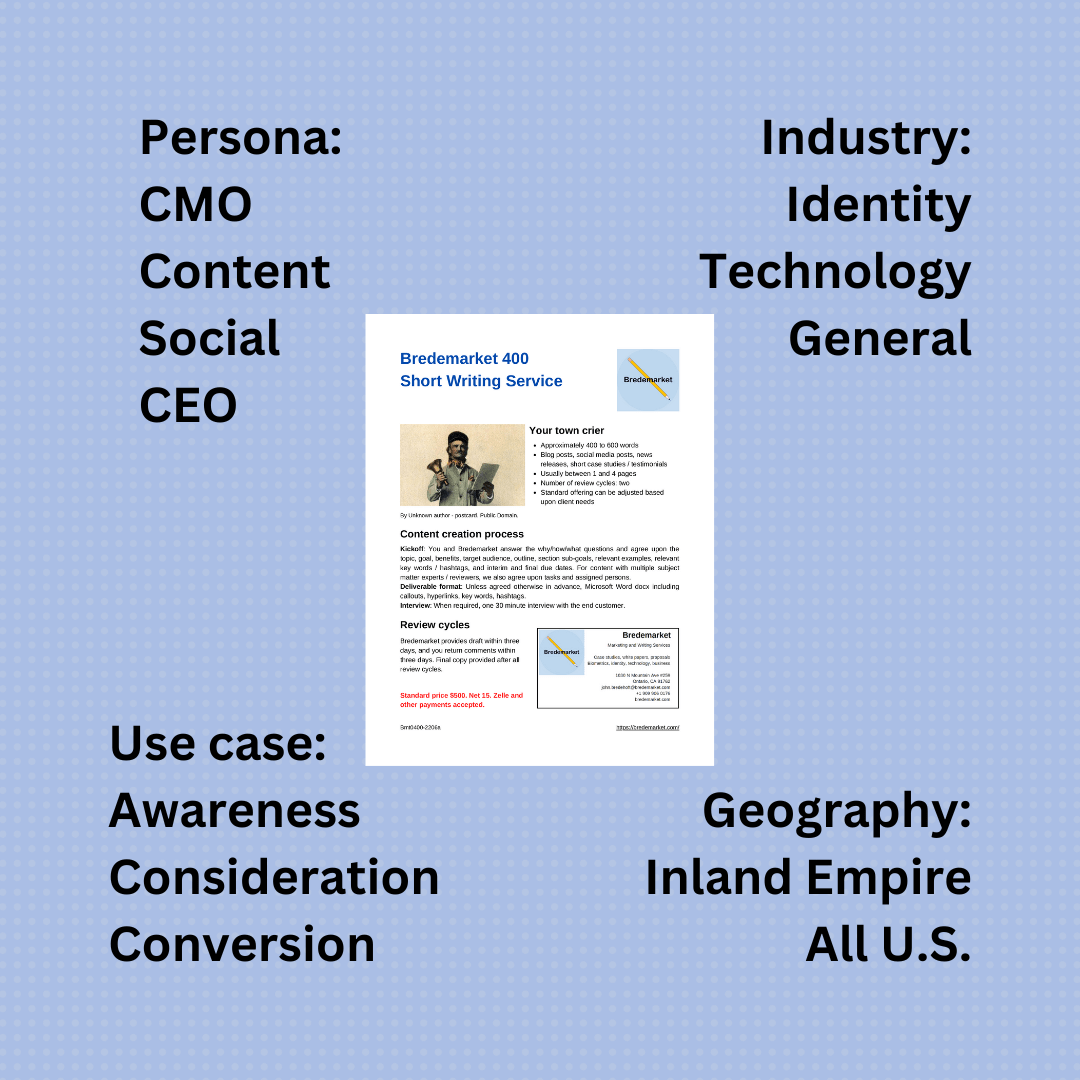
If you’re not already following Bredemarket on LinkedIn (why not?), be sure to read “A Deeper Dive Into Positioning,” and the complexities that occur when you have to position and message for multiple products, personas, industries, use cases, and geographies.














 Bredemarket