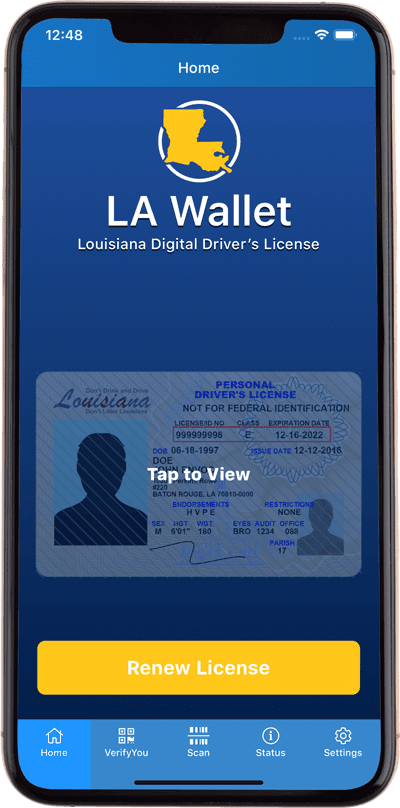
Android mobile driver’s licenses? It’s complicated.

At least in the United States, the mobile driver’s license world is fragmented.

Because driver’s license issuance in the U.S. is a state and not a federal responsibility, each state has to develop its own mobile driver’s license implementation. Subject to federal and international standards, of course.

To date there have been two parties helping the states with this:

  • mDL vendors such as Envoc and IDEMIA, who work with the states to create mDLs.
  • Operating system vendors such as Apple and Google, who work with the states to incorporate mDLs in smartphone wallets.

But because the Android ecosystem is more fragmented than the iOS ecosystem, we now have a third party that is involved in mDLs. In addition to mDL vendors and operating system vendors, we also have really large smartphone providers.

Enter Samsung:

Samsung Electronics America today announced it is bringing mobile driver’s licenses and state IDs to Samsung Wallet. Arizona and Iowa will be the first states to offer a mobile version of its driver’s license to their residents. The update expands the Samsung Wallet experience by adding a convenient and secure way to use state-issued IDs and driver’s licenses

From https://news.samsung.com/us/samsung-idemia-bring-mobile-drivers-licenses-samsung-wallet-arizona-iowa-first-states-rollout/

(For those who have seen prior references to Samsung in the Bredemarket blog, rest assured that this information is public and Samsung won’t get harmed if you feed it to ChatGPT or Bard or whoever.)

In this particular case Samsung is working with IDEMIA (the mDL provider for Arizona and Iowa), but Samsung announced that it is working with other states and with the Transportation Security Administration (TSA).

While there are underlying standards (most notably ISO/IEC 18013-5, previously discussed here) that govern the implementation of mobile driver’s licenses, there is still a dizzying array of options.

On a personal note, I’m still working on validating my driver’s license for California’s pilot mDL program. It probably didn’t help that I renewed my physical driver’s license right in the middle of the mDL validation process.

The Secret to Beating Half of All Fortune 500 Marketers and Growing Your Business

(Updated blog post count 10/23/2023)

Always take advantage of your competitors’ weaknesses.

This post describes an easy way to take advantage of your competitors. If they’re not blogging, make sure your firm is blogging. And the post provides hard numbers that demonstrate why your firm should be blogging.

Who uses blogging?

According to an infographic using 2017 data, 50% of the top 200 Fortune 500 companies had a public corporate blog.

Which means that half of those companies don’t have a public corporate blog.

The same infographic also revealed the following:

  • 86% of B2B companies are blogging. (Or, 14% are not.)
  • 68% of social media marketers use blogs in their social media strategy. (Or, 32% don’t.)
  • 45% of marketers saying blogging is the #1 most important piece of their content strategy.
  • Small businesses under 10 employees allocate 42% of their marketing budget to content marketing.

So obviously some firms believe blogging is important, while others don’t.

What difference does this make for your firm?

What results do blogging companies receive?

In my view, the figures above are way too low. 100% of all Fortune 500 companies, 100% of B2B companies should be blogging, and 100% of social media marketers should incorporate blogging.

Why? Because blogging produces tangible results.

Blogging produces awareness

Blogging is an ideal way to promote awareness of your firm and its offerings. From the same infographic:

  • 77% of internet users read blogs.
  • Internet users in the US spend 3x more time on blogs than they do on email.
  • Companies who blog receive 97% more links to their websites.
  • 70% of consumers learn about a company through articles rather than ads.
  • The average company that blogs generates 55% more website visitors.

Blogging produces leads

Awareness is nice, but does awareness convert into leads?

  • Small businesses that blog get 126% more lead growth than those who don’t.
  • B2B marketers that use blogs get 67% more leads than those who do not.

Blogging produces conversions

From https://www.youtube.com/watch?v=B8EnslW6Uao

Getting leads from blogging is nice, but show me the money! What about conversions?

  • Marketers who have prioritized blogging are 13x more likely to enjoy positive ROI.
  • 92% of companies who blog multiple times per day have acquired a customer from their blog.

Take a look at those last two bullets related to conversion again. Blogging is correlated with positive ROI (I won’t claim causation, but anecdotally I believe it), and blogging helps firms acquire customers. So if your firm wants to make money, get blogging.

What should YOUR company do?

With numbers like this, shouldn’t all companies be blogging?

But don’t share these facts with your competitors. Keep them to yourself so that you gain a competitive advantage over them.

Now you just need to write those blog posts.

How can I help?

And if you need help with the actual writing, I, John E Bredehoft of Bredemarket, can help.

From Sandeep Kumar, A. Sony, Rahul Hooda, Yashpal Singh, in Journal of Advances and Scholarly Researches in Allied Education | Multidisciplinary Academic Research, “Multimodal Biometric Authentication System for Automatic Certificate Generation.”
By Unknown author – postcard, Public Domain, https://commons.wikimedia.org/w/index.php?curid=7691878

In most cases, I can provide your blog post via my standard package, the Bredemarket 400 Short Writing Service. I offer other packages and options if you have special needs.

Authorize Bredemarket, Ontario California’s content marketing expert, to help your firm produce words that return results.

Bredemarket logo

How Unusual Gambling Portals Drive the Need for Age Verification and Estimation

Gambling is becoming acceptable in more and more places.

When I was young, and even when I got older, the idea of locating a pro sports team in Las Vegas, Nevada was unthinkable. In the last few years, that has changed dramatically.

The Roblox “Robux” gambing lawsuit

Well, now that gambling for adults has become more and more acceptable (although adults in my home state of California still can’t gamble by phone), now attention is focusing on child gambling.

Designed by Freepik.

And no, the kids aren’t gambling U.S. currency, according to TechCrunch.

In a new class action lawsuit filed in the Northern District of California this week, two parents accuse Roblox of illegally facilitating child gambling.

While gambling is not allowed on the platform, which hosts millions of virtual games that cater to children and teens, the lawsuit points to third-party gambling sites that invite users to play blackjack, slots, roulette and other games of chance using Roblox’s in-game currency.

From https://techcrunch.com/2023/08/18/roblox-children-gambling-class-action-lawsuit-robux/?_hsmi=271025889

But the gambling sites’ terms of service prohibit underage gambling!

I’m not going to concentrate on Roblox here, but on the other defendants—the ones who actually operate the sites that allegedly allow child gambling.

The lawsuit specifically names RBXFlip, Bloxflip and RBLXWild as participants in “an illegal gambling operation that is preying on children nationwide.” 

From https://techcrunch.com/2023/08/18/roblox-children-gambling-class-action-lawsuit-robux/?_hsmi=271025889

But according to Bloxflip’s Terms of Service, it’s impossible that children can be using the site, because the Terms of Service prohibit this.

By accessing Bloxflip or using the Services, you accept and agree to our website policies, including these Terms of Service, and you certify to us that (i) you are eighteen (18) years of age or older, and are at least the age of majority in your jurisdiction, (ii) you are not a resident of Washington, (iii) you have the legal capacity to enter into and agree to these Terms of Service, (iv) you are using the Services freely, voluntarily, willingly, and for your own personal enjoyment, and (v) you will only provide accurate and complete information to us and promptly update this information as necessary to maintain its accuracy and completeness.

From https://bloxflip.com/terms

However, stating a minimum age in your TOS is even less effective than other common age verification methods, such as

  1. Asking your customer to check a box to say that they are over 18 years old.
  2. Asking your customer to type in their birthday.
  3. Requiring your customer to read a detailed description of IRA/401(k) funding strategies and the medical need for colonoscopies. (This would be more effective than the first two methods.)

A better way to verify and estimate ages

As more and more companies are realizing, however, there are other ways to measure customer ages, including a comparison of a live face with a government-issued identification card (driver’s license or passport), or the use of “age estimation” software to ensure that a 12 year old isn’t gambling. (And don’t forget that NIST will test age estimation software as part of its FATE testing.)

Even when the kids aren’t gambling legal currency.

Communicating How Your Firm Fights Synthetic Identities

(Updated question count 10/23/2023)

Does your firm fight crooks who try to fraudulently use synthetic identities? If so, how do you communicate your solution?

This post explains what synthetic identities are (with examples), tells four ways to detect synthetic identities, and closes by providing an answer to the communication question.

While this post is primarily intended for identity firms who can use Bredemarket’s marketing and writing services, anyone else who is interested in synthetic identities can read along.

What are synthetic identities?

To explain what synthetic identities are, let me start by telling you about Jason Brown.

Jason Brown wasn’t Jason Brown

You may not have heard of him unless you lived in Atlanta, Georgia in 2019 and lived near the apartment he rented.

Jason Brown’s renting of an apartment isn’t all that unusual.

If you were to visit Brown’s apartment in February 2019, you would find credit cards and financial information for Adam M. Lopez and Carlos Rivera.

Now that’s a little unusual, especially since Lopez and Rivera never existed.

For that matter, Jason Brown never existed either.

Brown was synthetically created from a stolen social security number and a fake California driver’s license. The creator was a man named Corey Cato, who was engaged in massive synthetic identity fraud. If you want to talk about a case that emphasizes the importance of determining financial identity, this is it.

A Georgia man was sentenced Sept. 1 (2022) to more than seven years in federal prison for participating in a nationwide fraud ring that used stolen social security numbers, including those belonging to children, to create synthetic identities used to open lines of credit, create shell companies, and steal nearly $2 million from financial institutions….

Cato joined conspiracies to defraud banks and illegally possess credit cards. Cato and his co-conspirators created “synthetic identities” by combining false personal information such as fake names and dates of birth with the information of real people, such as their social security numbers. Cato and others then used the synthetic identities and fake ID documents to open bank and credit card accounts at financial institutions. Cato and his co-conspirators used the unlawfully obtained credit cards to fund their lifestyles.

From https://www.ice.gov/news/releases/hsi-investigates-synthetic-identities-scheme-defrauded-banks-nearly-2m

Talking about synthetic identity at Victoria Gardens

Here’s a video that I created on Saturday that describes, at a very high level, how synthetic identities can be used fraudulently. People who live near Rancho Cucamonga, California will recognize the Victoria Gardens shopping center, proof that synthetic identity theft can occur far away from Georgia.

From https://www.youtube.com/watch?v=oDrSBlDJVCk

Note that synthetic identity theft different from stealing someone else’s existing identity. In this case, a new identity is created.

So how do you catch these fraudsters?

Catching the identity synthesizers

If you’re renting out an apartment, and Jason Brown shows you his driver’s license and provides his Social Security Number, how can you detect if Brown is a crook? There are four methods to verify that Jason Brown exists, and that he’s the person renting your apartment.

Method One: Private Databases

One way to check Jason Brown’s story is to perform credit checks and other data investigations using financial databases.

  • Did Jason Brown just spring into existence within the past year, with no earlier credit record? That seems suspicious.
  • Does Jason Brown’s credit record appear TOO clean? That seems suspicious.
  • Does Jason Brown share information such as a common social security number with other people? Are any of those other identities also fraudulent? That is DEFINITELY suspicious.

This is one way that many firms detect synthetic identities, and for some firms it is the ONLY way they detect synthetic identities. And these firms have to tell their story to their prospects.

If your firm offers a tool to verify identities via private databases, how do you let your prospects know the benefits of your tool, and why your solution is better than all other solutions?

Method Two: Check That Driver’s License (or other government document)

What about that driver’s license that Brown presented? There are a wide variety of software tools that can check the authenticity of driver’s licenses, passports, and other government-issued documents. Some of these tools existed back in 2019 when “Brown” was renting his apartment, and a number of them exist today.

Maybe your firm has created such a tool, or uses a tool from a third party.

If your firm offers this capability, how can your prospects learn about its benefits, and why your solution excels?

Method Three: Check Government Databases

Checking the authenticity of a government-issued document may not be enough, since the document itself may be legitimate, but the implied credentials may no longer be legitimate. For example, if my California driver’s license expires in 2025, but I move to Minnesota in 2023 and get a new license, my California driver’s license is no longer valid, even though I have it in my possession.

Why not check the database of the Department of Motor Vehicles (or the equivalent in your state) to see if there is still an active driver’s license for that person?

The American Association of Motor Vehicle Administrators (AAMVA) maintains a Driver’s License Data Verification (DLDV) Service in which participating jurisdictions allow other entities to verify the license data for individuals. Your firm may be able to access the DLDV data for selected jurisdictions, providing an extra identity verification tool.

If your firm offers this capability, how can your prospects learn where it is available, what its benefits are, and why it is an important part of your solution?

Method Four: Conduct the “Who You Are” Test

There is one more way to confirm that a person is real, and that is to check the person. Literally.

If someone on a smartphone or videoconference says that they are Jason Brown, how do you know that it’s the real Jason Brown and not Jim Smith, or a previous recording or simulation of Jason Brown?

This is where tools such as facial recognition and liveness detection come to play.

  • You can ensure that the live face matches any face on record.
  • You can also confirm that the face is truly a live face.

In addition to these two tests, you can compare the face against the face on the presented driver’s license or passport to offer additional confirmation of true identity.

Now some companies offer facial recognition, others offer liveness detection, others match the live face to a face on a government ID, and many companies offer two or three of these capabilities.

One more time: if your firm offers these capabilities—either your own or someone else’s—what are the benefits of your algorithms? (For example, are they more accurate than competing algorithms? And under what conditions?) And why is your solution better than the others?

This is for the firms who fight synthetic identities

While most of this post is of general interest to anyone dealing with synthetic identities, this part of this post is specifically addressed to identity and biometric firms who provide synthetic identity-fighting solutions.

When you communicate about your solutions, your communicator needs to have certain types of experience.

  • Industry experience. Perhaps you sell your identity solution to financial institutions, or educational institutions , or a host of other industries (gambling/gaming, healthcare, hospitality, retailers, or sport/concert venues, or others). You need someone with this industry experience.
  • Solution experience. Perhaps your communications require someone with 29 years of experience in identity, biometrics, and technology marketing, including experience with all five factors of authentication (and verification).
  • Communication experience. Perhaps you need to effectively communicate with your prospects in a customer focused, benefits-oriented way. (Content that is all about you and your features won’t win business.)

Perhaps you can use Bredemarket, the identity content marketing expert. I work with you (and I have worked with others) to ensure that your content meets your awareness, consideration, and/or conversion goals.

How can I work with you to communicate your firm’s anti-synthetic identity message? For example, I can apply my identity/biometric blog expert knowledge to create an identity blog post for your firm. Blog posts provide an immediate business impact to your firm, and are easy to reshare and repurpose. For B2B needs, LinkedIn articles provide similar benefits.

If Bredemarket can help your firm convey your message about synthetic identity, let’s talk.

And thirteen more things

If you haven’t read a Bredemarket blog post before, or even if you have, you may not realize that this post is jam-packed with additional information well beyond the post itself. This post alone links to the following Bredemarket posts and other content. You may want to follow one or more of the 13 links below if you need additional information on a particular topic:

  1. Synthetic Identity video (YouTube), August 12, 2023. https://www.youtube.com/watch?v=oDrSBlDJVCk
  2. Using “Multispectral” and “Liveness” in the Same Sentence (Bredemarket blog), June 6, 2023. https://bredemarket.com/2023/06/06/using-multispectral-and-liveness-in-the-same-sentence/
  3. Who is THE #1 NIST facial recognition vendor? (Bredemarket blog), February 23, 2022. https://bredemarket.com/2022/02/23/number1frvt/
  4. Financial Identity (Bredemarket website). https://bredemarket.com/financial-identity/
  5. Educational Identity (Bredemarket website). https://bredemarket.com/educational-identity/
  6. The five authentication factors (Bredemarket blog), March 2, 2021. https://bredemarket.com/2021/03/02/the-five-authentication-factors/
  7. Customer Focus (Bredemarket website). https://bredemarket.com/customer-focus/
  8. Benefits (Bredemarket website). https://bredemarket.com/benefits/
  9. Seven Questions Your Content Creator Should Ask You: the e-book version (Bredemarket blog and e-book), October 22, 2023. https://bredemarket.com/2023/10/22/seven-questions-your-content-creator-should-ask-you-the-e-book-version/
  10. Four Mini-Case Studies for One Inland Empire Business—My Own (Bredemarket blog and e-book), April 16, 2023. https://bredemarket.com/2023/04/16/four-mini-case-studies-for-one-inland-empire-business-my-own/
  11. Identity blog post writing (Bredemarket website). https://bredemarket.com/identity-blog-post-writing/
  12. Blog About Your Identity Firm’s Benefits Now. Why Wait? (Bredemarket blog), August 11, 2023. https://bredemarket.com/2023/08/11/blog-about-your-identity-firms-benefits-now-why-wait/
  13. Why Your Company Should Write LinkedIn Articles (Bredemarket LinkedIn article), July 31, 2023. https://www.linkedin.com/pulse/why-your-company-should-write-linkedin-articles-bredemarket/

That’s twelve more things than the Cupertino guys do, although my office isn’t as cool as theirs.

Well, why not one more?

Here’s my latest brochure for the Bredemarket 400 Short Writing Service, my standard package to create your 400 to 600 word blog posts and LinkedIn articles. Be sure to check the Bredemarket 400 Short Writing Service page for updates.

If that doesn’t fit your needs, I have other offerings.

Plus, I’m real. I’m not a bot.

Catching Financial Fraudsters with Physical Evidence

There are a variety of ways that you can catch fraudsters who try to steal someone’s financial identity, but sometimes the simple ones work best.

The U.S. Department of Justice recently reported on a traffic stop that occurred three years ago.

Monroe County Sheriff’s deputies found eight debit cards and three driver’s licenses belonging to other people in (Jamal Denzel) Austin’s possession during a traffic stop for reckless driving and failing to maintain lane on Jan. 19, 2020. A subsequent investigation revealed that Austin, who worked at an Atlanta club, had used two stolen identities to register two separate fictious (sic) businesses with the Georgia Secretary of State’s Office to obtain two Capital One business credit cards with credit limits of $30,000 and $20,000.

From https://www.justice.gov/usao-mdga/pr/macon-man-sentenced-prison-resulting-identity-theft-investigation

Three driver’s licenses? Yikes.

The investigation, which also included participation by the United States Secret Service and other local, state, and federal agencies, also uncovered a stolen $49,000 check.

Well, Austin lost the stolen money and his freedom. He was sentenced to 48 months in federal prison.

Now I’ll grant the early stages of this investigation aren’t as sexy as other fraud detection methods, but it worked.

Fraudsters, stay in your lane.

There Are Just Five Factors of Authentication. (I want the job.)

As some of you know, I’m seeking full-time employment after my former employer let me go in late May. As part of my job search, I was recently invited to a second interview for a company in my industry. Before that interview, I made an important decision about how I was going to present myself.

If you’ve read any of Bredemarket’s content, there are times when it takes a light tone, in which wildebeests roam the earth while engaging in marketing activities such as elaborating the benefits of crossing the stream.

By Danijel Mihajlovic – https://thenextcrossing.com/wildebeest-migration-kenya, CC BY-SA 4.0, https://commons.wikimedia.org/w/index.php?curid=96024366

Some of that DOES NOT fly in the corporate world. (For most companies, anyway.) If you analyze a wide selection of corporate blogs, you won’t see the word “nothingburger.” But you do here.

So as I prepared for this important job interview, I made sure that I was ready to discuss the five factors of authentication, and my deep experience as an identity content marketing expert with many of those factors.

The five factors of authentication, of course, are:

  • Something you know.
  • Something you have.
  • Something you are.
  • Something you do.
  • Somewhere you are.

“But wait a minute,” some of you are saying. “Didn’t you just say that there is a sixth factor of authentication, ‘Somewhat you why?'”

For the purposes of this job interview, there isn’t! I confined myself to the five factors only during the discussion, using examples such as passwords, driver’s licenses, faces, actions, and smartphone geolocation information.

But in the end, my caution was of no avail. I DIDN’T make it to the next stage of interviews.

Maybe I SHOULD have mentioned “Somewhat you why” after all.

Bredemarket’s Name for the Sixth Factor of Authentication

Depending upon whom you ask, there are either three or five factors of authentication.

Unless you ask me.

I say that there are six.

Let me explain.

First I’ll discuss what factors of authentication are, then I’ll talk about the three factor and five factor school, then I’ll briefly review my thoughts on the sixth factor—now that I know what I’ll call it.

What are factors of authentication?

Before proceeding to factors of authentication, let’s review TechTarget’s definition of authentication.

Authentication is the process of determining whether someone or something is, in fact, who or what it says it is.

From https://www.techtarget.com/searchsecurity/definition/authentication

For purposes of this post I’m going to stay away from the “something” part and concentrate on the “someone” part.

For example, if Warren Buffett has a bank account, and I claim that I am Warren Buffett and am entitled to take money from that bank account, I must complete an authentication process to determine whether I am entitled to Warren Buffett’s money. (Spoiler alert: I’m not.)

So how do I authenticate? There are many different ways to authenticate, which can be grouped into several authentication factors. Here’s how Sumo Logic defines “authentication factor.”

An authentication factor is a special category of security credential that is used to verify the identity and authorization of a user attempting to gain access, send communications, or request data from a secured network, system or application….Each authentication factor represents a category of security controls of the same type. 

From https://www.sumologic.com/glossary/authentication-factor/

When considering authentication factors, the whole group/category/type definition is important. For example, while a certain system may require both a 12-character password and a 4-digit personal identification number (PIN), these are pretty much the same type of authentication. It’s just that the password is longer than the PIN. From a security perspective, you don’t gain a lot by requiring both a password and a PIN. You would gain more by choosing a type of authentication that is substantially different from passwords and PIN.

How many factors of authentication are there?

So how do we define the factors of authentication? Different people have different definitions.

Three factors of authentication

For the most part, I believe that everyone agrees on at least three factors of authentication. As I noted in a prior post on factors of authentication, NIST defines the following three factors:

Factors include: (i) something you know (e.g. password/personal identification number (PIN)); (ii) something you have (e.g., cryptographic identification device, token); or (iii) something you are (e.g., biometric).

From https://csrc.nist.gov/glossary/term/Multi_Factor_Authentication, cited in https://bredemarket.com/2022/03/19/remember-the-newer-factors-of-authentication/

Note that NIST’s three factors are very different from one another. Knowing something (such as a password or a PIN) differs from having something (such as a driver’s license) or being something (a fingerprint or a face).

But some people believe that there are more than three factors of authentication.

Five factors of authentication

Let’s add two factors to the definition trumpeted by NIST. People such as The Cybersecurity Man have included all five in their definition.

  • Something you know.
  • Something you have.
  • Something you are.
  • Something you do.
  • Somewhere you are.

For more information, see my March 2021 post on the five factors of authentication.

But are there only five?

Six factors of authentication

In April 2022, I began wondering if there is a sixth authentication factor. While I struggled to put it into the “some xxx you xxx” format, I was able to encapsulate what this sixth factor was.

What about the authentication factor “why”?

This proposed factor, separate from the other factors, applies a test of intent or reasonableness to any identification request.

From https://bredemarket.com/2022/04/12/the-sixth-factor-of-multi-factor-authentication-you-heard-it-here-first/
Why is this man smoking a cigarette outdoors? By Marek Slusarczyk, CC BY 3.0, https://commons.wikimedia.org/w/index.php?curid=108924712

Over the months, I struggled through some examples of the “why” factor.

  • Why is a person using a credit card at a McDonald’s in Atlantic City? (Link) Or, was the credit card stolen, or was it being used legitimately?
  • Why is a person boarding a bus? (Link) Or, was the bus pass stolen, or was it being used legitimately?
  • Why is a person standing outside a corporate office with a laptop and monitor? (Link) Or, is there a legitimate reason for an ex-employee to gain access to the corporate office?

As I refined my thinking, I came to the conclusion that “why” is a reasonable factor of authentication, and that this was separate from the other authentication factors (such as “something you do”).

And the sixth factor of authentication is called…

You’ll recall that I wanted to cast this sixth authentication factor into the “some xxx you xxx” format.

So, as of today, here is the official Bredemarket list of the six factors of authentication:

  • Something you know.
  • Something you have.
  • Something you are.
  • Something you do.
  • Somewhere you are.

(Drumroll…)

  • Somewhat you why.

Yes, the name of this factor stands out from the others like a sore thumb (probably a loop).

However, the performance of this factor stands out from the others. If we can develop algorithms that accurately measure the “why” reasonableness of something as a way to authenticate identity, then our authentication capabilities will become much more powerful.

How Can Your Identity Business Create the RIGHT Written Content?

Does your identity business provide biometric or non-biometric products and services that use finger, face, iris, DNA, voice, government documents, geolocation, or other factors or modalities?

Does your identity business need written content, such as blog posts (from the identity/biometric blog expert), case studies, data sheets, proposal text, social media posts, or white papers?

How can your identity business (with the help of an identity content marketing expert) create the right written content?

For the answer, click here.

Alaska HB389 does NOT repeal REAL ID. But it has a “foreign ownership” clause.

The title of Alaska HB389, introduced last month, sounds grandiose:

“An Act repealing the implementation of the federal REAL ID Act of 2005; relating to identification cards; relating to drivers’ licenses; and providing for an effective date.”

Does HB389 prevent Alaska from issuing REAL IDs?

When you read the title of the bill, alarms go off in your head.

If the title is true, it’s a true setback. After many years, the entire country (perhaps minus a territory or two) has finally gotten on board with REAL ID in advance of the due date, and now one of the states is pulling out.

Except that when you read the detail of the bill (at least as originally written; it could change in committee), it doesn’t repeal Alaska’s compliance of REAL ID.

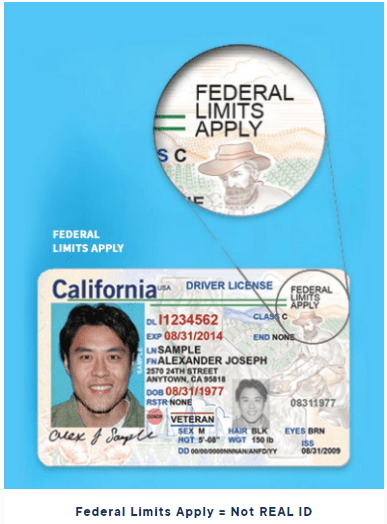
As Chris Burt notes in a Biometric Updatre post, it only provides an option for the Alaska Division of Motor Vehicles to issue an identification card that is non-REAL ID compliant. This is not different from any other state (for example, California) that issues non-REAL ID cards that are “not for federal purposes” or “not for federal identification” or “federal limits apply.”

So Alaskans, don’t panic. If you want to get a REAL ID to board a plane, you can still do this. Note the [BRACKETED ALL CAPS] text in Section 1 of HB389 as originally written, illustrated below.

So Alaska can still issue “federally compliant” (i.e., REAL ID) driver’s licenses.

But what about foreign ownership?

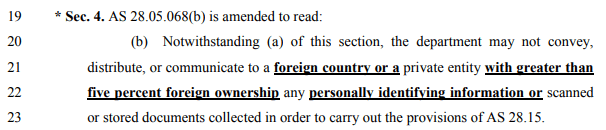
But as long as I was reading the text of the bill, I thought I’d see what else it proposed to change, and ran across this text in Section 4.

Now THAT caught my eye. (Alaska Statutes Chapter 15 is the portion of the statutes that governs driver’s licenses in general, so this clause affects EVERYTHING.)

If your company is 94% U.S.-owned, that’s not good enough in Alaska.

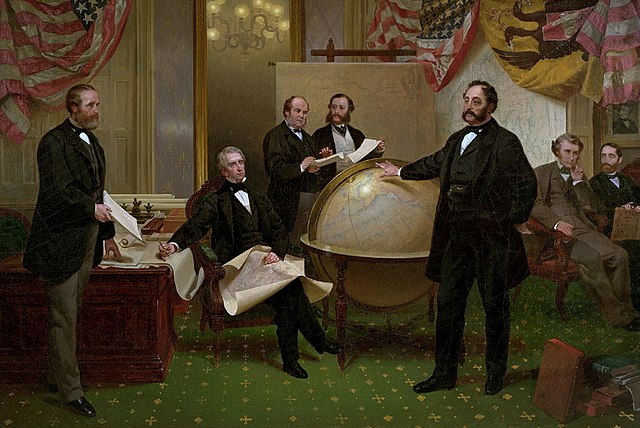
(Well, at least until Putin decides that Edouard de Stoeckl’s 1867 sale of Alaska was illegal…)

The signing of the Alaska Treaty of Cessation on March 30, 1867. Left to right: Robert S. Chew, William H. Seward, William Hunter, Mr. Bodisco, Eduard de StoecklCharles Sumner, and Frederick W. Seward. By Emanuel Leutze (d. 1868) – http://www.akhistorycourse.org/articles/article.php?artID=202, Public Domain, https://commons.wikimedia.org/w/index.php?curid=4246381

Most if not all U.S. state agencies do not produce driver’s licenses themselves, but instead contract with private companies to do the work. These private companies either produce the licenses at state agency offices, or produce them as a service (DLaaS) at a secure production center (which may produce licenses for multiple states). To my knowledge, all of the production centers for U.S. driver’s licenses are located within the United States.

But who are the “private entities” that provide driver’s license manufacturing services? Let’s look at the major ones and see if they’re affected by Section 4 of the draft of Alaska HB389.

IDEMIA

It is a matter of public record that the majority of U.S. states use IDEMIA to produce their driver’s licenses, either within agency offices or in secure IDEMIA production centers. When I was an employee of IDEMIA, I did not have the necessary security clearance to enter any of these production centers. Employees should only have the security permissions that they need, and my job had no need for me to access the PII of IDEMIA’s driver’s license customers, or to enter the facilities in which these secure documents are manufactured. There are security requirements governing this.

…our state-of-the-art central issuance facilities…are highly secure and meet North American Security Products Organization (NASPO) Level I security requirements. 

From https://na.idemia.com/dmv/physical-drivers-licenses-and-id-cards/

We’ll return to NASPO later in this post.

As I’ve noted before, IDEMIA is (currently) majority owned by Advent International, a U.S. based investment firm. IDEMIA entered the U.S. driver’s license market by acquiring Morpho (French), which had previously acquired MorphoTrust/L-1 Identity Solutions (U.S.), which had previously acquired Digimarc’s ID Systems business (also U.S.).

And, as I’ve noted, Advent International will probably choose to sell IDEMIA at some point in the future.

However, Advent International is not the exclusive owner of IDEMIA, because part of the company is owned by Bpifrance, which is (drumroll) French.

Alaska’s HB389, if passed in its original form, would prohibit the state from “communicating” personally identifying information (PII) to a private entity with more than five percent foreign ownership. I do not know the percentage that Bpifrance owns (all of the press releases failed to include that little tidbit), so I don’t know if IDEMIA would run afoul of the law or not.

HB389, if unmodified, is just one thing that any company that purchases IDEMIA must keep in mind.

IDEMIA doesn’t produce Alaska driver’s licenses. Who does?

But that doesn’t matter, because IDEMIA isn’t the Alaska driver’s license vendor anyway. That contract is controlled by another company.

Austin, TX – October 31, 2018 – Gemalto (Euronext NL0000400653 GTO),  and Alaska’s Division of Motor Vehicles will continue their work of providing credentials to citizens with the additional goal of helping the state become Real ID compliant by increasing security of the state’s driver’s license and identification cards.

From https://www.thalesgroup.com/en/markets/digital-identity-and-security/government/press-release/alaska-extends-contract-with-gemalto-to-enhance-drivers-license-security

Gemalto (a Dutch company) was subsequently acquired by Thales, which is a French company. Gemalto entered the U.S. driver’s license market when it acquired Marquis ID Systems.

Now I do not know the details of Alaska’s contract with Thales, but it stands to reason that if Thales is “providing credentials to citizens” (implying a service bureau relationship), then at some point the state is going to have to “convey, distribute, or communicate” PII to Thales.

Other vendors

But don’t worry. IDEMIA and Thales are not the only driver’s license manufacturers out there, so you don’t have to worry about foreigners getting your data. Just select an American company!

For example, Veridos can provide driver’s licenses. Veridos is a joint venture between Giesecke+Devrient and Bundesdruckerei…whoops, that’s not a U.S. company.

And there’s another driver’s license manufacturer out there. It’s called…Canadian Bank Note.

There’s also Valid, which is…Brazilian.

Let’s look at NASPO

Despite the fact that these entities are foreign-owned, all of them (either on their own, or through parents or acquired companies) are members of NASPO, and many of them have NASPO certification.

So what?

NASPO international was formed as the North American Security Products Organization.  The non-profit organization was founded in 2002 by companies and individuals in industry that recognized the need for security focused standards to prevent fraudulent acts that support criminal and terrorist activity….

NASPO INTERNATIONAL was formed to combat the ever increasing amount of fraud within the areas of brand protection, document security, and identity.  Our focus is to produce credible, structured, and, when appropriate, certifiable standards.  NASPO INTERNATIONAL has created a risk reduction standard and auditing process to certify security focused organizations.  This structure also provides the end user with the ability to create a secure supply chain from supplier to end users.

From https://naspo.info/about-us/faq/

From my point of view, NASPO tries to achieve what HB389 clumsily tries to achieve by its “minimal foreign ownership” clause. 100% U.S. ownership does not guarantee the security of your data, and 94% U.S. ownership does not guarantee that your data will wind up in a foreign capital.

So what happens next?

I have no idea whether HB389 will get passed, but unless it is substantially amended, Alaskans can still get REAL ID driver’s licenses so that they can board planes, enter secure federal facilities, and the like without getting a passport or other authorized document.

But I’m not sure what’s going to happen regarding the foreign ownership clause. Maybe people at some of the firms listed above are already looking into this.

But if my assumptions on HB389 are correct, and it passes with Section 4 intact, perhaps Alaska may not be able to rely on a private entity to provide driver’s licenses as a service (DLaaS). In that case, the state will have to produce its own driver’s licenses, free from foreign influence.

About THAT Reuters article

I intentionally chose an obscure title for this post.

I could have entitled the post “Ricardo Montalban.” Just because.

In a more relevant way, I could have entitled the post “Former IDEMIA employee weighs in on Advent’s possible sale of the company.” That would have got some clicks, to be sure.

But it would have misled the reader, because the reader would have gotten the idea that I have some expertise in corporate acquisitions, and an abillity to predict them.

And as past history has shown, I do not have any such expertise.

  • In 2000, I was completely and totally surprised when I learned that Printrak wanted to sell itself to Motorola. I didn’t have a clue that any such thing was going to happen.
  • In 2008, I was reading online late one evening and was completely and totally surprised when I learned that Motorola wanted to sell off half of Printrak to the French company Safran, the Sagem Morpho folks. Yes, Motorola was in trouble, but I didn’t have any idea that we would be sold off.
  • Years later, I was kinda sorta surprised when Safran decided that it wanted to get rid of its entire identity and security business, and was completely and totally surprised when the buyer was an American investment firm that owned Oberthur Technologies.

So my record on really understanding these acquisitions is pretty low.

With that caveat, I’ll go ahead and use a really eye-catching SUBtitle. Better late than never.

Former IDEMIA employee weighs in on Advent’s possible sale of the company

Impressive, isn’t it?

But before proceeding, I should let you know about THAT Reuters article that I referenced in the real post title.

On Friday, Reuters published an exclusive article entitled “Advent gears up for $4.6 bln sale of French biometrics firm IDEMIA – sources.”

So who is Advent?

Advent (actually, Advent International) is the American investment firm that I mentioned earlier. As an investment firm, its purpose in life is to buy businesses, improve them, and sell them for a profit.

Back in 2011, Advent bought Oberthur Technologies with this intent. To that end, Advent announced in 2015 that Oberthur Technologies planned an Initial Public Offering. Within a month, those plans were shelved. Advent determined that an Oberthur IPO wouldn’t do so well.

So Advent began thinking about ways to make Oberthur more attractive.

At the same time, Safran was trying to decide what to do with its identity and security business. The purchase of Printrak was just a blip in Safran’s plans, as it acquired L-1 Identity Solutions (renamed MorphoTrust) and other businesses. But Safran is not an identity and security company. It’s a “de plane” company.

By ABC Television – eBay itemphoto frontphoto back, Public Domain, https://commons.wikimedia.org/w/index.php?curid=20143137

And Safran is also a defense company to protect France and other countries from evil forces.

The identity part of the business was clearly the odd one out. Heck, rich Corinthian leather would have fit better into the Safran product line.

By dave_7 – originally posted to Flickr as Chrysler Cordoba, CC BY 2.0, https://commons.wikimedia.org/w/index.php?curid=6890171

OK, I’ll stop now.

Anyway, in the end Advent announced in 2016 that it had entered into an agreement to negotiate the purchase of Safran’s identity and security business. The purchase was completed on May 31, 2017, and Advent combined Oberthur (OT) and the portion of Safran (Morpho) into OT-Morpho, which was quickly renamed IDEMIA.

I was an employee of IDEMIA at the time, and I don’t think I’m spilling any company secrets if I reveal that Advent wanted IDEMIA to do really really well, so that it could make a profit on the two acquisitions. I wasn’t at the highest executive level that was setting the high-level strategy, but I was often working on initiatives to help realize Advent’s profitability goal.

The possibility of an IDEMIA IPO or sale receded somewhat in early 2020. Among other things, COVID adversely affected two of IDEMIA’s core businesses in the United States, TSA PreCheck (nobody was flying) and driver’s licenses (the DMV offices were all closed).

Back to THAT Reuters article

Fast forward to 2022 and Reuters’ exclusive revelations.

Advent International is looking to sell its French biometrics and fingerprint identification firm IDEMIA in a deal worth up to $4.6 billion as it seeks to capitalise on growing demand for cybersecurity assets in Europe, two sources told Reuters.

The U.S. buyout fund is reviewing a series of options to sell IDEMIA, including a possible break-up of the company which was formed in 2016 by combining Safran’s identity and security business with Oberthur Technologies, the sources said.

From https://www.reuters.com/business/exclusive-advent-gears-up-46-bln-sale-french-biometrics-firm-idemia-sources-2022-02-04/

As you, the wise reader, know, Reuters goofed here.

IDEMIA was NOT formed in 2016. The formation of IDEMIA was ANNOUNCED in 2016, but the deal wasn’t actually COMPLETED until 2017. Hey, at least Biometric Update got it right.

Anyway, if you read either Reuters or Biometric Update, you’ll learn that nothing is going to happen immediately (France is holding an election in April, and the composition of the new government could impact any sale), and that the possible split-up may separate the part of the business that sells to governments from the part that sells to commercial firms.

Of course, the big question about any sale of IDEMIA would be the identity of the buyer. Would Advent try (again) to issue an IPO, or would Advent look for one or more existing companies to purchase IDEMIA?

Both Reuters and Biometric Updare speculate that Thales could be a potential buyer. While Safran was slimming down to concentrate on its aircraft business, Thales has been beefing to to diversify its business, most notably in its purchase of Gemalto. (As people in my industry know, that purchase provided Thales with the technology of the old Cogent Systems.)

However, there are two possible issues with a Thales purchase of all or part of IDEMIA.

  • Antitrust issues. Automated fingerprint identification systems isn’t the only product that Thales and IDEMIA have in common. For example, both companies provide driver’s licenses in the United States. As any Thales purchase of IDEMIA is considered by the United States, France, and dozens of other countries, the deal could be opposed on antitrust grounds. This can be mitigated by limiting what Thales can buy, but it could complicate matters.
  • Thales is French. Some of the driver’s license and biometric technology that IDEMIA sells was developed in the United States, and is used by many government agencies, including the Federal Bureau of Investigation and the Department of Homeland Security. At present, while IDEMIA is headquartered in France, it is primarily owned by Americans, so there’s a teeny bit of comfort in that. But what if a French firm were to own IDEMIA? The horror! (Many years ago, when Cogent Systems first sold itself, it intentionally chose a U.S. buyer, 3M, for this very reason.) Never mind that the U.S. government has been using French (and Japanese) technology for years, and that some very specific arrangements have been set up to mitigate the risks of foreign ownership. Some Senator or another is guaranteed to raise a big stink if U.S. government institutions are dependent upon a French company.

So perhaps Thales could buy all or part of IDEMIA, or perhaps it may pass. But if Thales passes, are there any U.S.-owned companies that may have an interest in IDEMIA’s technology?

Because of my biometric bias, the first thing that I would consider would be American companies that are active in the biometric market. However, many of the U.S. companies are small, and don’t have a few billion dollars lying around to buy IDEMIA. So don’t look for Aware, Clearview AI, Paravision, Rank One Computing, or the like to be a buyer.

There are of course much bigger U.S. firms in high tech that have dipped their fingers into the biometrics market. Amazon, Apple, Facebook, Google, and Microsoft all come to mind. However, those same customers that are of prime concern to U.S. Senators are also or prime concern to the employees of some of those firms, who don’t want their employers to do business with the “evil” Department of Homeland Security or even the “evil” local police departments that should all be defunded. (Amazon quit selling Rekognition to police agencies, for example.) Even Apple, which is developing its own digital driver’s license technology, is probably reluctant to own IDEMIA.

But there’s one tech company that intrigues me as possibly having an interest in IDEMIA.

Oracle.

It’s big enough to make the purchase, certainly likes to make acquisitions, and has no hesitation about working with government agencies.

ANY government agency.

After all, the name “Oracle” came from a database project that Ellison worked on before founding the company with the same name.

His client was the Central Intelligence Agency.

If you’ve paid attention to this article, then you already know that since I have speculated that Oracle could purchase IDEMIA, that puts the chances of Oracle actually purchasing IDEMIA at zero.

And for all we know, Reuters’ two sources might be unreliable, or something else might happen (another COVID variant?) that could cause Advent to hold on to IDEMIA for a few more years.

So we’ll have to see what happens.