How can you speak the truth about your greatness to your prospects?
Compelling CONTENT creation.
Winning PROPOSAL development.
Actionable ANALYSIS.
Speak the truth.
Differentiation equals conversion. When Bredemarket creates content for an identity, biometric, or technology client, my primary focus isn’t on copying what the competition is doing.
My primary focus? I ask why you do what you do. (And how you do it. And five other questions.)
Then I act.
Then your prospects pay attention.
As my converting Bredemarket clients can attest:
The complete go-to-market campaign, including both customer-facing and internal-facing content, that I created for one client. With additional go-to-market content for this and other clients.
The over $2 million of winning proposals I have written for multiple consulting clients since 2020.
The analyses, covering everything from market competitors to NIST FRTE results, that I have written for other clients.
What’s next?
I’m John E. Bredehoft, product marketing consultant at Bredemarket. And I’ve differentiated products in the identity, biometric, and technology sector for 30 years, generating over $50 million in conversions for my employers and consulting clients.
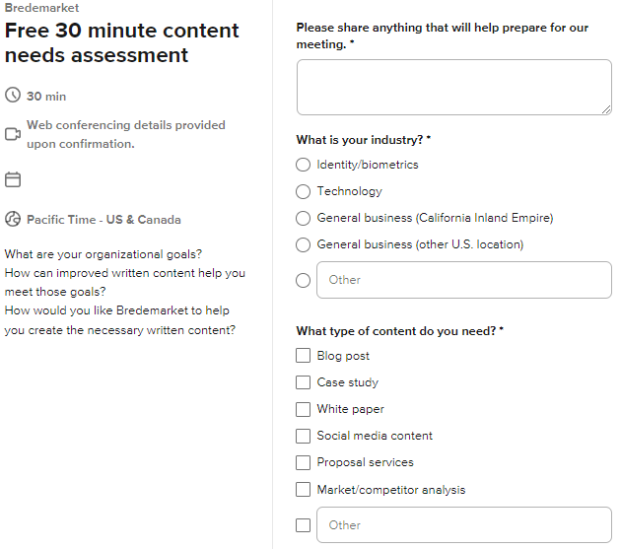
Take the first step to end your company’s silence. Let’s discuss your whys, and we can work out the hows in a free 30 minute consultation.
(Stop losing prospects! Use Bredemarket content for tech marketers)
Have you friends frequently and warmly connected with you…until they didn’t? Becoming former friends, ignoring and abandoning you, becoming silent and indifferent?
Sales prospecting can be similar. Someone eagerly wants your product or service immediately. But they delay in getting back to you, plead that other critically important issues have arisen, then go silent entirely, their former desire evaporated.
Evaporated. Imagen 4.
I’m sure some hard-boiled salespeople believe EVERY prospect can convert, but it ain’t so. And my earlier advice applies to business prospects as well as to personal relationships:
“If my former friends’ focus is elsewhere, my focus won’t impede on theirs.”
Are you a technology marketing leader, struggling to market your products to your prospects for maximum awareness, consideration, and conversion?
I’m John E. Bredehoft. For over 30 years, I’ve created strategy and tactics to market technical products for over 20 B2B/B2G companies and consulting clients.
Biometric marketing leaders already know that I’ve talked about reader personas to death. But what about WRITER personas? And what happens when you try to address ALL the reader and writer personas?
Reader personas
While there are drawbacks to using personas, they are useful in both content marketing and proposal work when you want to tailor your words to resonate with particular types of readers (target audiences, or hungry people).
I still love my example from 2021 in which a mythical Request for Proposal (RFP) was issued by my hometown of Ontario, California for an Automated Biometric Identification System (ABIS). The proposal manager had to bear the following target audiences (hungry people) in mind for different parts of the proposal.
The field investigators who run across biometric evidence at the scene of a crime, such as a knife with a fingerprint on it or a video feed showing someone breaking into a liquor store.
The examiners who look at crime scene evidence and use it to identify individuals.
The people who capture biometrics from arrested individuals at livescan stations.
The information technologies (IT) people who are responsible for ensuring that Ontario, California’s biometric data is sent to San Bernardino County, the state of California, perhaps other systems such as the Western Identification Network, and the Federal Bureau of Investigation.
The purchasing agent who has to make sure that all of Ontario’s purchases comply with purchasing laws and regulations.
The privacy advocate who needs to ensure that the biometric data complies with state and national privacy laws.
The mayor (Paul Leon back in 2021, and still in 2025), who has to deal with angry citizens asking why their catalytic converters are being stolen from their vehicles, and demanding to know what the mayor is doing about it.
Probably a dozen other stakeholders that I haven’t talked about yet, but who are influenced by the city’s purchasing decision.
Writer personas
But who is actually writing the text to address these different types of readers?
Now in this case I’m not talking about archetypes (a topic in itself), but about the roles of the subject matter experts who write or help write the content.
I am currently working on some internal content for a Bredemarket biometric client. I can’t reveal what type of content, but it’s a variant of one of the 22 types of content I’ve previously addressed. A 23rd type, I guess.
But what would happen if someone in a role other than product marketing consultant wrote this content?
An engineer would emphasize different things. Maybe a focus on the APIs.
A finance manager would emphasize different things. Maybe an ROI focus.
A salesperson may focus on different things. Maybe qualification of a prospect. Or eventually conversion.
So the final content is not only shaped by the reader, but by the writer.
You can’t please everyone so you’ve got to please yourself
With all the different reader and writer personas, how should you respond?
Do all the things?
Perhaps you can address everyone in a 500 page proposal, but the internal content Bredemarket is creating is less than 10 pages long.
Which is possibly already too long for MY internal target audience.
So I will NOT create the internal content that addresses the needs of EVERY reader and writer persona.
Which is one truth about (reader) personas in general. If you need to address three personas, it’s more effective to create 3 separate pieces than a single one.
Which is what I’m doing in another project for this same Bredemarket biometric client, this one customer-facing.
And the content targeted to latent examiners won’t mention the needs of Paul Leon.
In which I address the marketing leader reader persona
So now I, the biometric product marketing expert writer persona, will re-address you, the biometric marketing leader reader persona.
You need content, or proposal content.
But maybe you’re not getting it because your existing staff is overwhelmed.
So you’re delaying content creation or proposal responses, or just plain not doing it. And letting opportunities slip through your fingers.
While updating my resume today, I discovered that I have now written over 700 blog posts on the Bredemarket site alone. This is number 725, in case you’re keeping score.
And that doesn’t count the myriad of blog posts I’ve written for consulting clients or employers, plus the posts I’ve written for other blogs over the years dating back to 2003.
So in case you’re wondering: yes, I’ve written blog posts before.
And I can augment your company’s resources by writing blog posts (for example, via the Bredemarket 400 Short Writing Service) that drive awareness, consideration, and/or conversion.
With over 29 years of identity/biometric experience, John Bredehoft of Bredemarket is the biometric product marketing expert that can move your company forward.
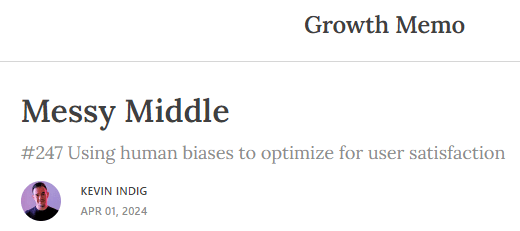
I’ve previously written about the “messy middle,” or the way that people REALLY decide on what to purchase. It’s not as logical as the theories suggest.
Kevin Indig’s article touches upon a lot of topics, most of which I won’t discuss. Read his article. Instead, I’m going to focus on the second of Indig’s three items (on attribution model limitations) because it intersects with my interests, including the trust funnel.
Instead of trying to figure out where to be, try to be everywhere. It’s more important to understand where your competitors are, and you’re not….The surround sound approach seems intuitive but is a very different approach to what’s happening at companies today….Surround Sound doesn’t mean to do everything, but to carefully observe where competitors are and pull even.
At this point I only want to interject that you should also carefully observe where competitors AREN’T.
But what are the analysts going to analyze? What they can.
We should also rethink the numbers we look at. Recurring visits and the average number of visits until conversion reflect user behavior and improvements better than bounce rate or pages per visit since users hop around so much.
While much of the activity remains invisible to us, we can still look at the activity that we CAN see.
Some things remain secret
And yes, much of the activity does remain invisible. A former coworker messaged me on Sunday with a question, and he closed his message with the following.
Btw, enjoy your posts
From a private message.
I’m tossing that message over to Bredemarket’s chief analyst.
Have you ever seen those posts from self-appointed gurus?
Specifically, the ones that authoritatively state the BEST time to WRITE a post on Instagram, or LinkedIn, or TikTok, or whatever?
I religiously ignore those posts for a simple reason: My country has multiple time zones. So the best time in one time zone may be the worst time in another time zone.
However, I can tell you the WORST time to READ a post in the PACIFIC Time Zone…if the post concerns pizza.
And I’ll explain what all this means…eventually.
Ophir Tal on awareness
In addition to saying WHEN to post, the gurus also provide authoritative (and often contradictory) advice about WHAT to post.
For example, some gurus assert that you MUST prioritize bottom of funnel (conversion) content over top of funnel (awareness) content because it’s most important to get people to buy.
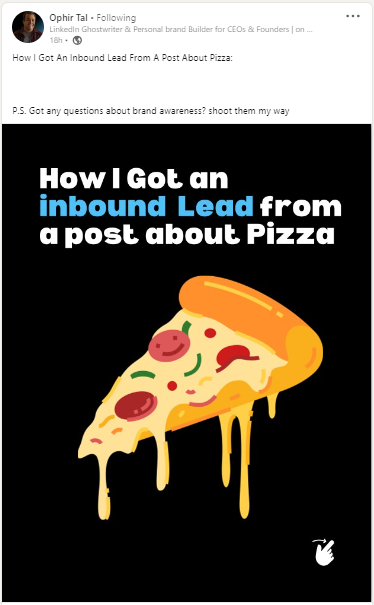
Ophir Tal disagrees, and has evidence to support his position.
This hook caught my attention. People want leads, and people like pizza, so I paid attention. But I also paid attention for a third reason that I’ll discuss later.
Tal then noted that the gurus would have recommended NOT posting this because he was “doing it wrong.” Specifically:
The post didn’t solve a problem for his potential clients. (Unless they regularly drop slices of pizza, I guess.)
It didn’t have a strong call to action.
It wasn’t targeted to his ideal clients. (Again, unless they regularly drop slices of pizza, or unless they love chicken wings.)
But despite doing everything wrong, that particular piece of content attracted the attention of someone “at a 6 figure ecom company.” After viewing the content, the reader looked at Tal’s profile and realized Tal could meet their need for ghostwriting services.
And now I’ll tell you the third reason why I paid attention to Tal’s post.
John Bredehoft on birthdays
As I noted above, I paid attention to Ophir Tal’s pizza post for two reasons:
People want leads.
People like pizza.
Now let’s jump back to a post I wrote all the way back in 2023, one that described why I’ve soured on the term “target audience.” (Or, in Tal’s words, “ideal clients.”) I started that post by wondering if the term “needy people” would be better than “target audience.” Yes, but not good enough.
I’ll grant that “needy people” has a negative connotation, like the person who is sad when people forget their birthday.
It turns out that these people had a VERY GOOD reason for forgetting my birthday. However, I cannot reveal this reason to you because the disclosure would force me to reveal someone’s personal identifiable information, or PII. (Mine.)
So after they remembered my birthday, one of them asked what I did for my birthday…and I told them that my wife, father-in-law, and brother-in-law went out to dinner.
For pizza.
And I also told them that there were leftovers, which my wife and I enjoyed a few days later.
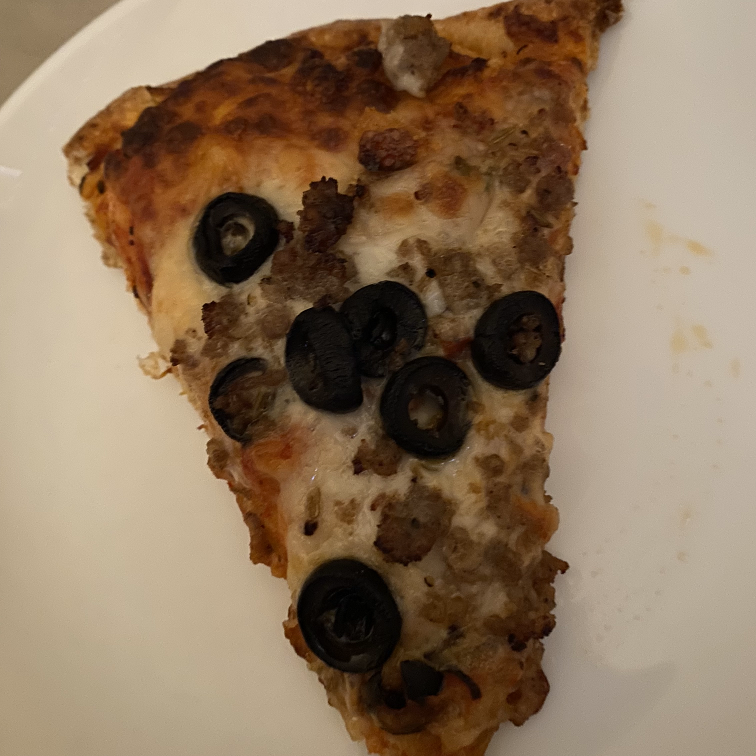
Leftover pizza is the best pizza. Preparation credit: Pizza N Such, Claremont, California. Can I earn free pizza as a powerful influencer? Probably not, but I’ll disclose on the 0.00001% chance that I do.
A nice story, and while I was reading Ophir Tal’s story on dropped pizza, I realized that I had missed an opportunity to tell my own story about leftover pizza.
Time to channel Steve Jobs…
Oh, and there’s one more thing
I forgot to mention one thing about the Ophir Tal story.
When I read the story, it was around 4:00 pm in California.
So when I read about Tal’s dropped pizza, and thought about my leftover pizza (which I had already eaten)…I was hungry.










 Bredemarket