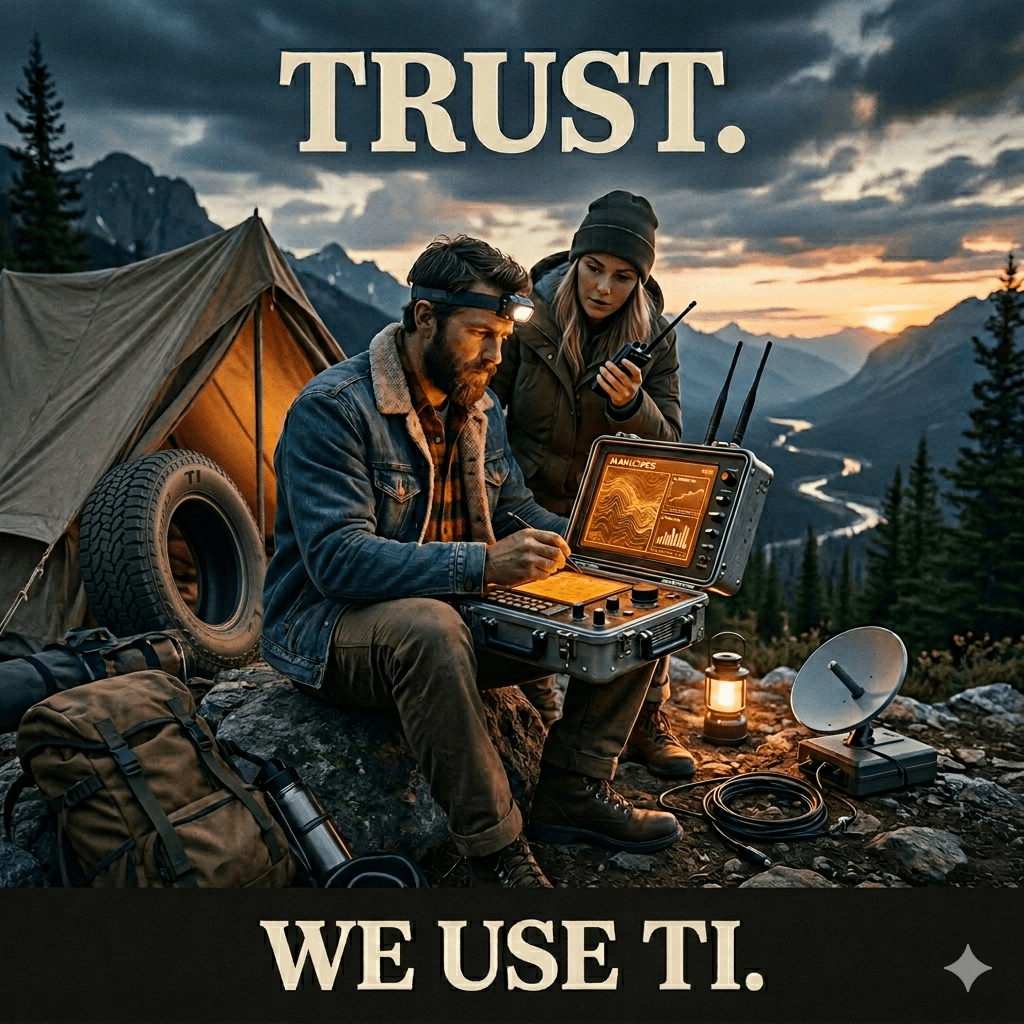
“Trust. We use AI.”
Stop it!
Bredemarket can help: https://bredemarket.com/mark/
Identity/biometrics/technology marketing and writing services
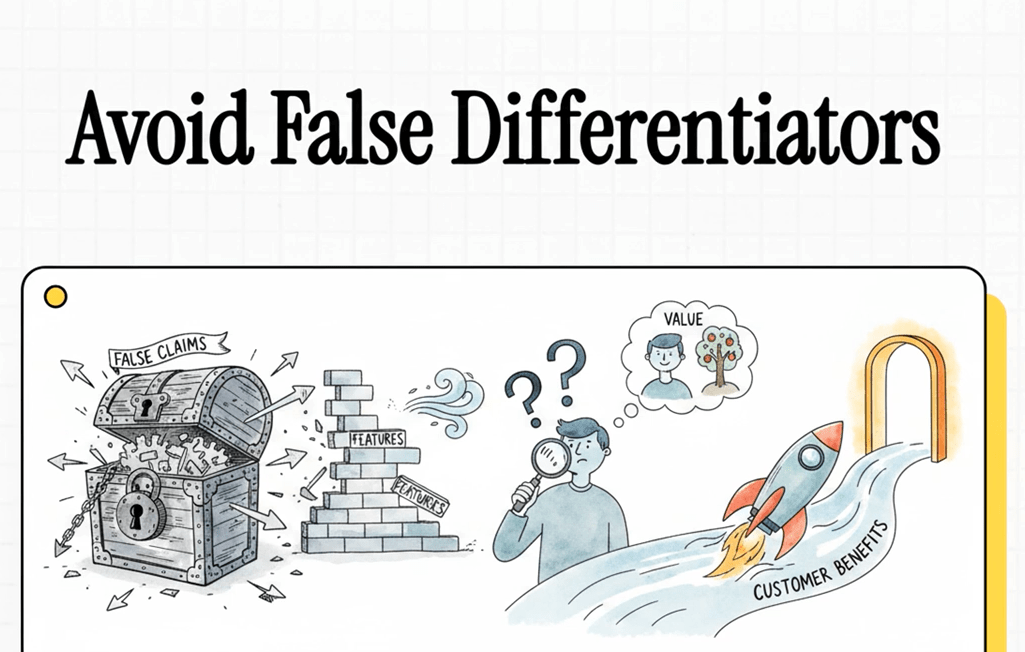
Bredemarket has consistently argued AGAINST “me too” product marketing, and FOR differentiating your identity/biometric product from its competitors. But your differentiators must resonate with your prospects.
This post lists three false differentiators, and why you should avoid them.
Does your company description place undue emphasis on the shiny happy people who work for you? Their competitive salaries? Their unlimited PTO? Their community days? Their “best place to work” awards?
Who cares?
While you would think happy employees are important to prospects, they really aren’t. Enron was a best company to work for, but definitely did not deliver for its customers. Other companies are slave drivers, but customers love their products.
Save the “best place to work” mumbo jumbo for your careers page, not your prospect-facing content.
Other companies take a different tack. Some emphasize their financial might: they’re a unicorn, a Series C, a NASDAQ-listed firm. Others take the opposite tack, asserting they are small and scrappy. (Bredemarket is in the latter category.)
So what?
Your prospects don’t care how big you are. Size doesn’t matter to them. Your performance does.
Stick the “unicorn” talk in your investor pitch decks, not on stuff your prospects read.
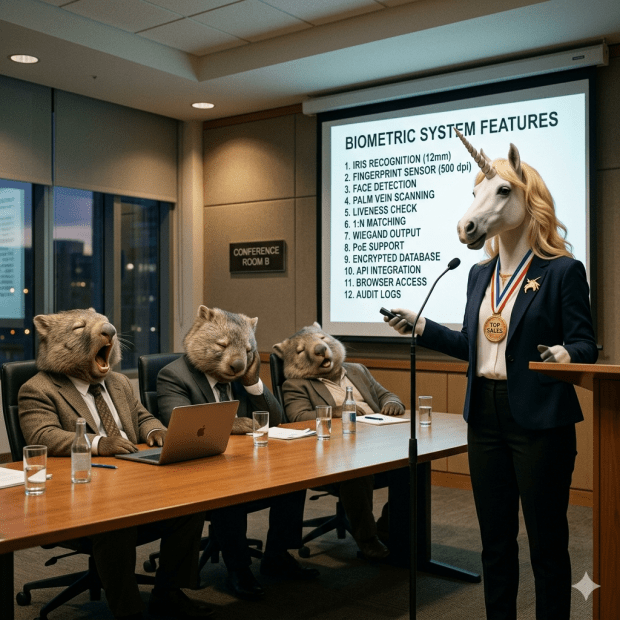
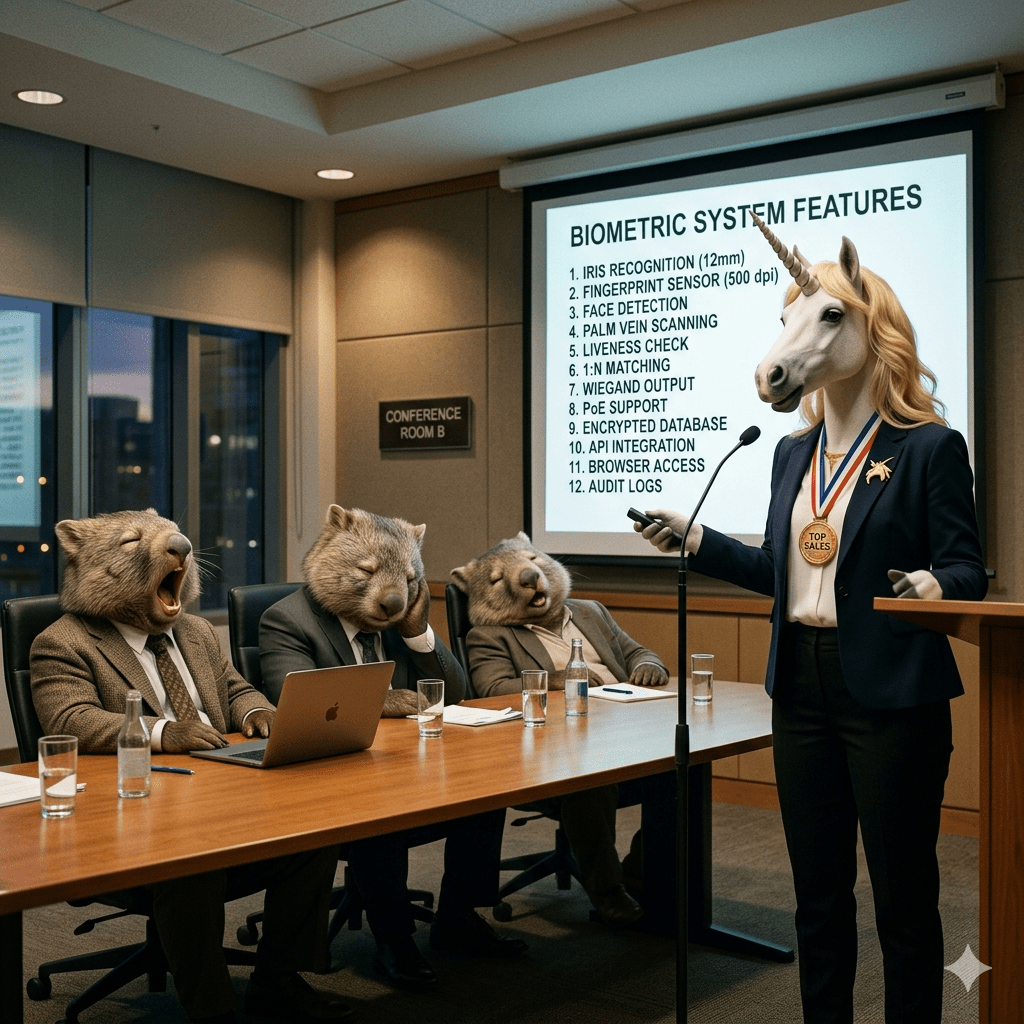
By now you’ve probably figured out that your customers care about your product, not your employee satisfaction or your valuation. So you start talking about your product and its impressive array of features. 1000 ppi fingerprint capture. Sub-second matching. Integration with over 100 third-party systems.
How so?
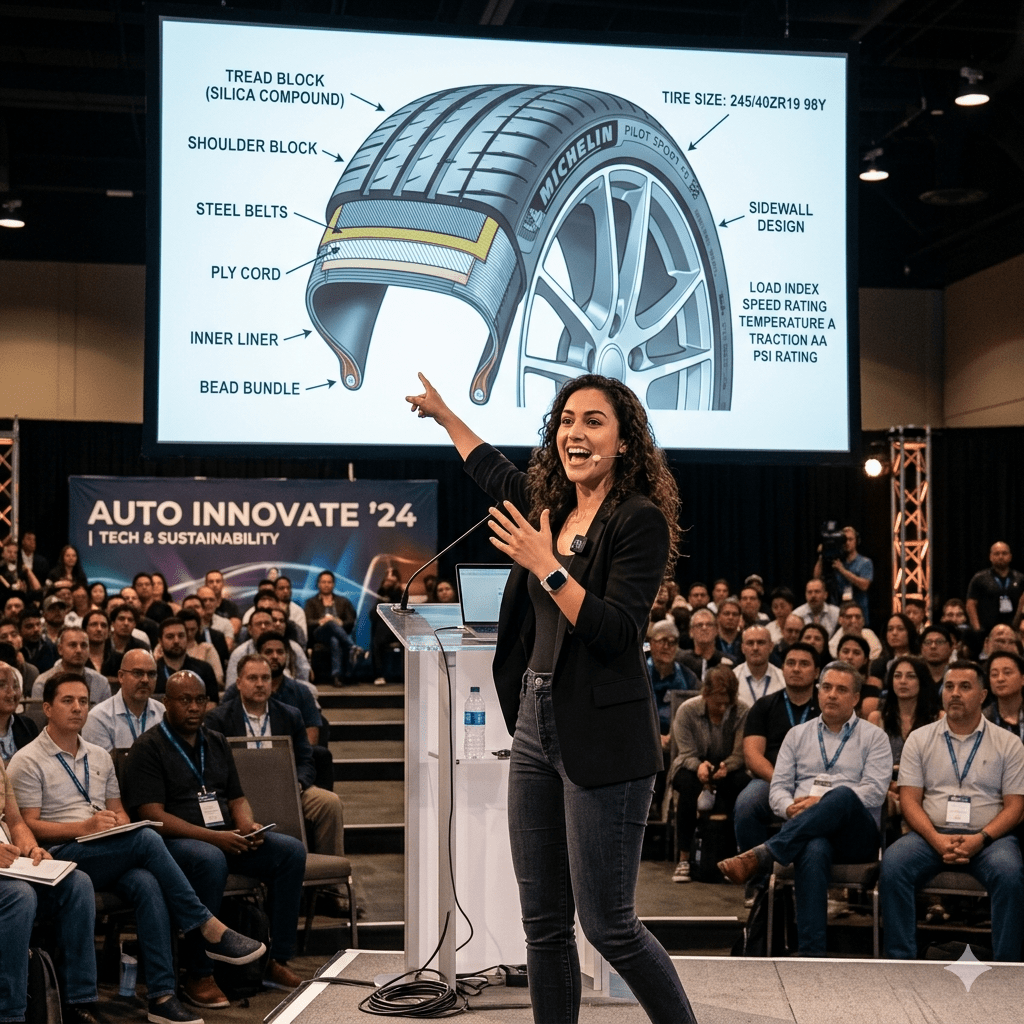
Prospects don’t care about your product and what it does. They care about what it does FOR THEM. Does it solve crimes and keep bad people off the streets? Does it ensure that bank account applicants really are who they say they are? Does it complete its checks quickly before e-commerce buyers abandon their shopping carts?
Talk benefits, not features. Save the feature lists for your sprints.
Your prospects need to see why your product is great for them, and why competitor products are terrible for them. How your product achieves their objectives: get stuff done, make money.
So what are the differentiators and benefits of your product?
Bredemarket can help your identity/biometric firm with the strategy and tactics of marketing your product. My services and process help you position your product for your prospects.
Do you want to learn more? Go to https://bredemarket.com/mark/ and schedule a free meeting with me to learn how Bredemarket can benefit you, so you can fulfill the needs of your prospects.
I know that the experts say that “too much knowledge is actually bad in tech.” But based upon what I just saw from an (unnamed) identity verification company, I assert that too little knowledge is much worse.
As a biometric product marketing expert and biometric product marketing writer, I pay a lot of attention to how identity verification companies and other biometric and identity companies market themselves. Many companies know how to speak to their prospects…and many don’t.
Take a particular company, which I will not name. Here is the “marketing” from this company.


So what is the difference between this company and the other 100+ identity verification companies…many of which explicitly state their benefits, trumpet their NIST FRTE performance, and trumpet their third-party liveness detection confirmation letters?
If you claim great accuracy and great liveness detection but can’t support it via independent third-party verification, your claim is “so what?” worthless. Prove your claims.
Now I’m sure I could help this company. Even if they have none of the certifications or confirmations I mentioned, I could at least get the company to focus on meaningful differentiation and meaningful benefits. But there’s no need to even craft a Bredemarket pitch to the company, since the only marketer on staff is an intern who is indifferent to strategy.

Because while many companies assert that all they need is a salesperson, an engineer, an African data labeler, and someone to run the generative AI for everything else…there are dozens of competitors doing the exact same thing.
But some aren’t. Some identity/biometric companies are paying attention to their long-term viability, and are creating content, proposals, and analyses that support that viability.
Take a look at your company’s marketing. Does it speak to prospects? Does it prove that you will meet your customers’ needs? Or does it sound like every other company that’s saying “We use AI. Trust us“?
And if YOUR company needs experienced help in conveying customer-focused benefits to your prospects…contact Bredemarket. I’ve delivered meaningful biometric materials to two dozen companies over the years. And yes, I have experience. Let me use it for your advantage.
I recently mentioned again how ALL the identity verification companies use the following two elements in their product marketing:
If you read three marketing messages from three IDV vendors, I defy you to tell them apart. Admittedly my last comparison took place years ago, so I took a fresh look at the 2026 versions. Here are two:
“Industry-leading AI-driven Technology”
“We make it easy to safeguard your customers with AI-driven identity verification.”
Thankfully the companies are finally mentioning differentiators other than trust, but the magic letters AI still persist.
But you can’t really blame the IDV vendors when everyone is injecting the two letter word in their messaging.
20 years ago, anyone who talked about an AI-powered vacuum cleaner would have been relegated to the back of the hall and told to put on his Vulcan ears.
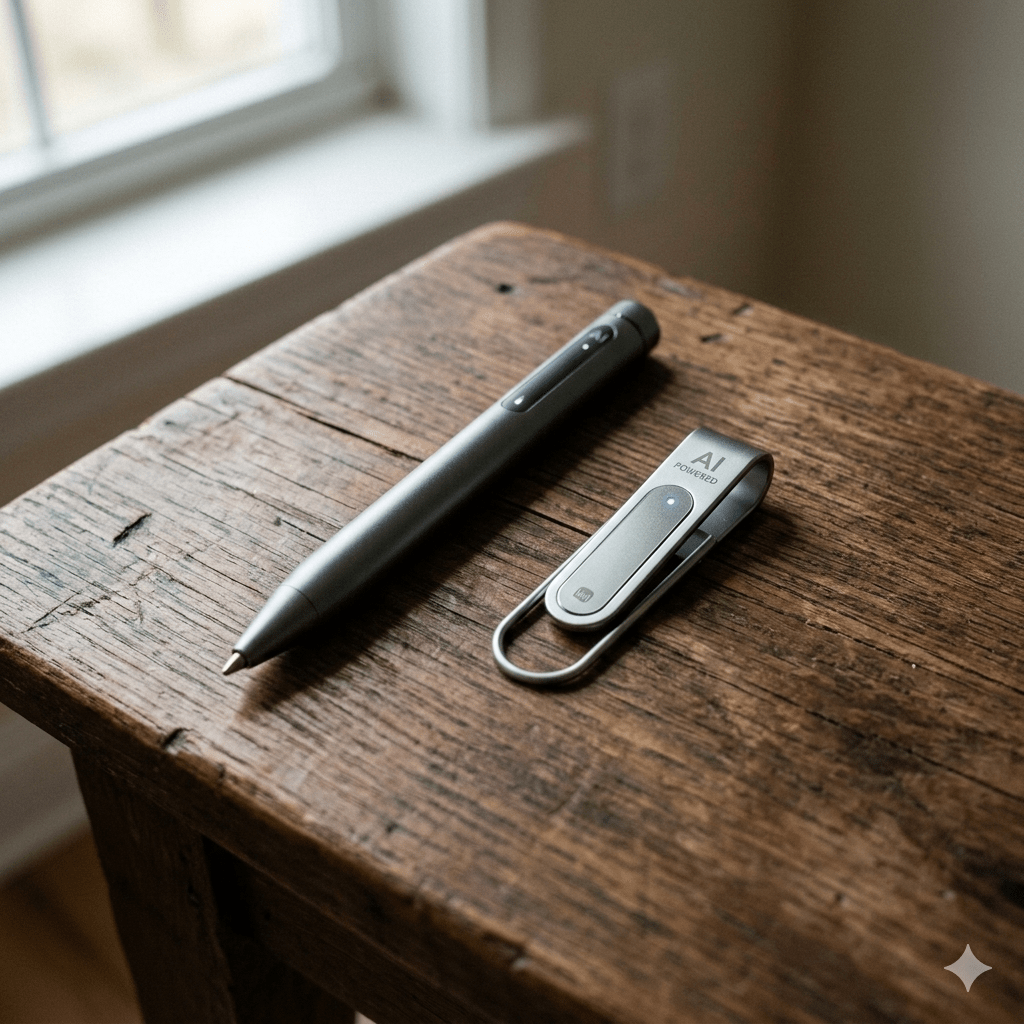
Now we have things like AI pens.
“Handwrite only the critical points. Let Flowtica AI summarize and visualize the rest-audio, photo and even your sketches – into insights. Stay focused in the flow”
And lest you think that such efforts are fringe, Open AI and Jony Ive are reportedly working on one.
But AI pens make as much sense as AI influencers. If you have AI, why do you need the influencers? And if you have AI, why have a pen?
But that won’t stop people from hawking AI pens, and pencils, and erasers, and 3 hole punches, and maybe even…paperclips.
Which IDV solution is this?
I will give you another hint. In addition to using the word “AI” in its product marketing, the company also uses the word trust.

Hope that narrows it down for you.
Slop is everywhere, and even I generate slop. (For experimental purposes only, of course.) But slop makes it hard for product marketers to share their messages with prospects.
Bredemarket has adopted two tactics to cut through the slop and ensure my clients’ messages reach those who need to hear it.
To bound the message I am about to create for an identity/biometric client (or any client), I ask a number of questions. These questions ensure that the question addresses the right people, their concerns, and their fears. I’ve shared seven of my questions elsewhere.
When all the questions are answered, I have a clear roadmap to start writing.
In writing, generative artificial intelligence’s proper place is as an outside advisor, not an author. I’ve shared my thoughts on this on LinkedIn.
I don’t feed the answers to Bredebot and have it churn out something. I pick the words myself.

Now perhaps I might use generative AI to tweak a phrase or two, but I remain in complete control of the entire creative process.
I believe, and my clients also believe, that this careful approach to content results in pieces that are differentiated from the mass-churned content of others.
So my clients stand out and aren’t confused with their competitors.
After all, even though Bredebot fakes thirty years of experience in identity and biometrics, it doesn’t really have such experience. I do. That’s why I’m the biometric product marketing expert.
So if you want me, not a bot, to polish your biometric product marketing sentences “until they shine,” let’s talk about how we can move forward.
Bredemarket can write your biometric company’s product marketing content.
Are your talkative competitors eating your lunch?
How can you speak the truth about your greatness to your prospects?
Differentiation equals conversion. When Bredemarket creates content for an identity, biometric, or technology client, my primary focus isn’t on copying what the competition is doing.
My primary focus? I ask why you do what you do. (And how you do it. And five other questions.)
Then I act.
Then your prospects pay attention.
As my converting Bredemarket clients can attest:
What’s next?
I’m John E. Bredehoft, product marketing consultant at Bredemarket. And I’ve differentiated products in the identity, biometric, and technology sector for 30 years, generating over $50 million in conversions for my employers and consulting clients.
Take the first step to end your company’s silence. Let’s discuss your whys, and we can work out the hows in a free 30 minute consultation.
(Stop losing prospects! Use Bredemarket content for tech marketers)
You already know how Bredemarket launches a content project with a client.
But Bredemarket may not be the source of all knowledge.
Let’s look at Chris Allsop’s process to launch a writing project.
“Step 1: Talk with your client, whether by email, on the phone, or in person. This will give you a clear understanding of the project, the audience and your client’s goals.”
Allsop asks multiple questions, including why, what, and who.
“[A]nswers to these questions will help you write copy that resonates with your audience….”
Great. Bredemarket and Allsop are pretty much in alignment.
But Chris is only on Step 1.
“Step 2: Take your conversation with your client a step further with thorough research.”
I gloss over this but it’s important. If you don’t know an industry it’s important to understand it. And if you do know an industry it’s important to understand it better. Even if a biometric product marketing expert is writing biometric content, it always helps to conduct research.
(Yeah, I’ll share the video. Later.)
Oh, and Chris isn’t done yet.
“Step 3: Study successful promotions, websites, and content in the topic or industry you’re working in. Ask yourself how each promotion got your attention.”
Good idea…to a point. Don’t slavishly imitate other promotions. The content from your client still needs to differentiate from the content from the competitors. And aping some popular brand to call yourself the “Uber of lawn care” just sounds bad when you spend two seconds thinking about it.

But whether you ask my seven questions or perform some other type of preparation, the act of preparation is important.
And for those who were waiting for me to share the “landscape” video…
And I might as well share the third of the three.
You’ve heard me use the phrase “eat your own wildebeest food.” (Like eating your own dog food, but I differentiate myself from the rest of the world.) When can you eat your own wildebeest food? Let’s take a product marketing example.
I recently encountered a company that does NOT use the product it sells for its own in-house purposes.
The company has a good reason for this. The product is meant for a particular market category, and the company itself doesn’t fall into that category.
Without revealing anything confidential, it’s akin to a bus agency executive using a limo to get to a board of directors meeting. Yes, the executive could take the 61 to the 83 to the 66, but that takes time.

It would be a stretch for the firm to use its product internally. So it uses a semi-competing product for internal use.
Sounds reasonable, right?
I don’t care about reasonable.
The company is sharing a subliminal message, or perhaps a super liminal one: yeah, our product is great, but this semi-competitor is good enough for us so we don’t bother to try to use our own.
By not jerry-rigging its product for its internal needs, the company’s missing an opportunity.
So try to use your own product, even when you shouldn’t. You, your prospects, and your customers will learn a, um, bunch.

I participate in several public and private AI communities, and one fun exercise is to take another creator’s image generation prompt, run it yourself (using the same AI tool or a different tool), and see what happens. But certain tools can yield similar results, for explicable reasons.
On Saturday morning in a private community Zayne Harbison shared his Nano Banana prompt (which I cannot share here) and the resulting output. So I ran his prompt in Nano Banana and other tools, including Microsoft Copilot and OpenAI ChatGPT.
The outputs from those two generative AI engines were remarkably similar.


Not surprising, given the history of Microsoft and OpenAI. (It got more tangled later.)
But Harbison’s prompt was relatively simple. What if I provided a much more detailed prompt to both engines?
Create a realistic photograph of a coworking space in San Francisco in which coffee and hash brownies are available to the guests. A wildebeest, who is only partaking in a green bottle of sparkling water, is sitting at a laptop. A book next to the wildebeest is entitled “AI Image Generation Platforms.” There is a Grateful Dead poster on the brick wall behind the wildebeest, next to the hash brownies.
So here’s what I got from the Copilot and ChatGPT platforms.


For comparison, here is Google Gemini’s output for the same prompt.

So while there are more differences when using the more detailed prompt (see ChatGPT’s brownie placement), the Copilot and ChatGPT results still show similarities, most notably in the Grateful Dead logo and the color used in the book.
So what have we learned, Johnny? Not much, since Copilot and ChatGPT can perform many tasks other than image generation. There may be more differentiation when they perform SWOT analyses or other operations. As any good researcher would say, more funding is needed for further research.
But I will hazard two lessons learned: