Three Ways to Identify and Share Your Identity Firm’s Differentiators

(Part of the biometric product marketing expert series)

Are you an executive with a small or medium sized identity/biometrics firm?

If so, you want to share the story of your identity firm. But what are you going to say?

How will you figure out what makes your firm better than all the inferior identity firms that compete with you?

How will you get the word out about why your identity firm beats all the others?

Are you getting tired of my repeated questions?

Are you ready for the answers?

Your identity firm differs from all others

Over the last 29 years, I (John E. Bredehoft of Bredemarket) have worked for and with over a dozen identity firms, either as an employee or as a consultant.

You’d think that since I have worked for so many different identity firms, it’s an easy thing to start working with a new firm by simply slapping down the messaging that I’ve created for all the other identity firms.

Nothing could be further from the truth.

Designed by Freepik.

Every identity firm needs different messaging.

  • The messaging that I created in my various roles at IDEMIA and its corporate predecessors was dramatically different than the messaging I created as a Senior Product Marketing Manager at Incode Technologies, which was also very different from the messaging that I created for my previous Bredemarket clients.
  • IDEMIA benefits such as “servicing your needs anywhere in the world” and “applying our decades of identity experience to solve your problems” are not going to help with a U.S.-only firm that’s only a decade old.
  • Similarly, messaging for a company that develops its own facial recognition algorithms will necessarily differ from messaging for a company that chooses the best third-party facial recognition algorithms on the market.

So which messaging is right?

It depends on who is paying me.

How your differences affect your firm’s messaging

When creating messaging for your identity firm, one size does not fit all, for the reasons listed above.

The content of your messaging will differ, based upon your differentiators.

  • For example, if you were the U.S.-only firm established less than ten years ago, your messaging would emphasize the newness of your solution and approach, as opposed to the stodgy legacy companies that never updated their ideas.
  • And if your firm has certain types of end users, such as law enforcement users, your messaging would probably feature an abundance of U.S. flags.

In addition, the channels that you use for your messaging will differ.

Identity firms will not want to market on every single social media channel. They will only market on the channels where their most motivated buyers are present.

  • That may be your own website.
  • Or LinkedIn.
  • Or Facebook.
  • Or Twitter.
  • Or Instagram.
  • Or YouTube.
  • Or TikTok.
  • Or a private system only accessible to people with a Top Secret Clearance.
  • Or display advertisements located in airports.
From https://www.youtube.com/watch?v=H02iwWCrXew

It may be more than one of these channels, but it probably won’t be all of them.

But before you work on your content or channels, you need to know what to say, and how to communicate it.

How to know and communicate your differentiators

As we’ve noted, your firm is different than all others.

  • How do you know the differences?
  • How do you know what you want to talk about?
  • How do you know what you DON’T want to talk about?

Here are three methods to get you started on knowing and communicating your differentiators in your content.

Method One: The time-tested SWOT analysis

If you talk to a marketer for more than two seconds about positioning a company, the marketer will probably throw the acronym “SWOT” back at you. I’ve mentioned the SWOT acronym before.

For those who don’t know the acronym, SWOT stands for

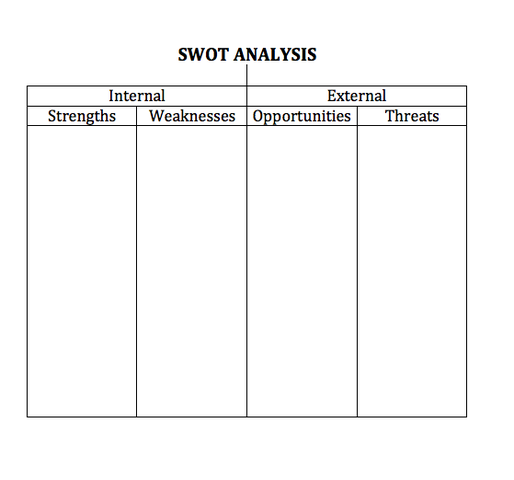
  • Strengths. These are internal attributes that benefit your firm. For example, your firm is winning a lot of business and growing in customer count and market share.
  • Weaknesses. These are also internal attributes, but in this case the attributes that detract from your firm. For example, you have very few customers.
  • Opportunities. These are external factors that enhance your firm. One example is a COVID or similar event that creates a surge in demand for contactless solutions.
  • Threats. The flip side is external factors that can harm your firm. One example is increasing privacy regulations that can slow or halt adoption of your product or service.

If you’re interested in more detail on the topic, there are a number of online sources that discuss SWOT analyses. Here’s TechTarget’s discussion of SWOT.

The common way to create the output from a SWOT analysis is to create four boxes and list each element (S, W, O, and T) within a box.

By Syassine – Own work, CC BY-SA 3.0, https://commons.wikimedia.org/w/index.php?curid=31368987

Once this is done, you’ll know that your messaging should emphasize the strengths and opportunities, and downplay or avoid the weaknesses and threats.

Or alternatively argue that the weaknesses and threats are really strengths and opportunities. (I’ve done this before.)

Method Two: Think before you create

Personally, I believe that a SWOT analysis is not enough. Before you use the SWOT findings to create content, there’s a little more work you have to do.

I recommend that before you create content, you should hold a kickoff of the content creation process and figure out what you want to do before you do it.

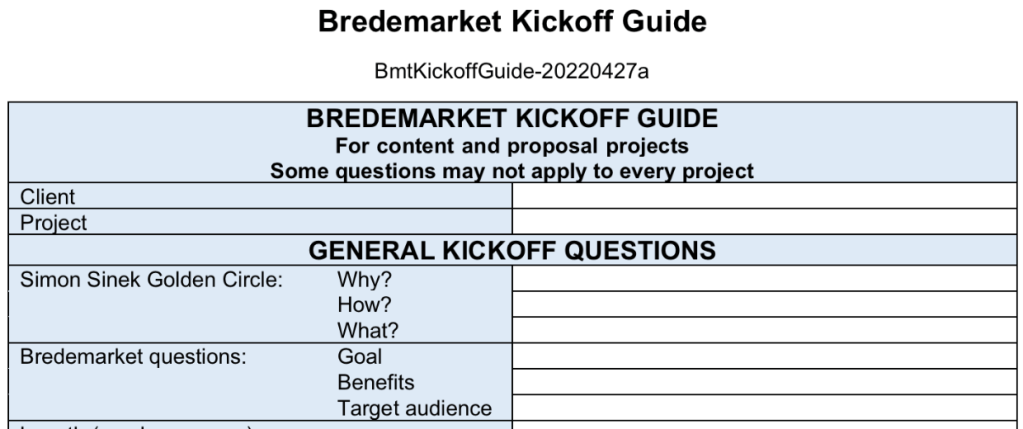
During that kickoff meeting, you should ask some questions to make sure you understand what needs to be done.

I’ve written about kickoffs and questions before, and I’m not going to repeat what I already said. If you want to know more:

Method Three: Send in the reinforcements

Now that you’ve locked down the messaging, it’s time to actually create the content that differentiates your identity firm from all the inferior identity firms in the market. While some companies can proceed right to content creation, others may run into one of two problems.

  • The identity firm doesn’t have any knowledgeable writers on staff. To create the content, you need people who understand the identity industry, and who know how to write. Some firms lack people with this knowledge and capability.
  • The identity firm has knowledgeable writers on staff, but they’re busy. Some companies have too many things to do at once, and any knowledgeable writers that are on staff may be unavailable due to other priorities.
Your current staff may have too much to do. By Backlit – Own work, CC BY-SA 3.0, https://commons.wikimedia.org/w/index.php?curid=12225421

This is where you supplement you identity firm’s existing staff with one or more knowledgeable writers who can work with you to create the content that leaves your inferior competitors in the dust.

What is next?

So do you need a knowledgeable biometric content marketing expert to create your content?

One who has been in the biometric industry for 29 years?

One who has been writing short and long form content for more than 29 years?

Are you getting tired of my repeated questions again?

Well then I’ll just tell you that Bredemarket is the answer to your identity/biometric content marketing needs.

Are you ready to take your identity firm to the next level with a compelling message that increases awareness, consideration, conversion, and long-term revenue? Let’s talk today!

Six questions your content creator should ask you

If you want a content marketing expert to write for your business, do you just say “Write this, and make it viral”?

Not THAT viral. (Too soon?) By Alexey Solodovnikov (Idea, Producer, CG, Editor), Valeria Arkhipova (Scientific Сonsultant) – Own work. Scientific consultants:Nikitin N.A., Doctor of Biological Sciences, Department of Virology, Faculty of Biology, Lomonosov Moscow State University.Borisevich S.S. Candidate of Chemical Sciences, Specialist in Molecular Modeling of Viral Surface Proteins, Senior Researcher, Laboratory of Chemical Physics, Ufa Institute of Chemistry RASArkhipova V.I., specialization in Fundamental and Applied chemistry, senior engineer, RNA Chemistry Laboratory, Institute of chemical biology and fundamental medicine SB RAS, CC BY-SA 4.0, https://commons.wikimedia.org/w/index.php?curid=104914011

Six words of instruction will not result in great content.

Even if you just say “Write this” and leave off the viral part, this will not work either.

You and your content creator have to have a shared understanding of what the content will be.

For example, as I indicated in a previous post, you and your content creator have to agree on the tone of voice to use in the content. The content creator could write something in a tone of voice that may not match your voice at all, which would mean that the content would sound horribly wrong to your audience.

Imagine a piece for financial executives written in the style of Crazy Eddie. Ouch.

From https://www.youtube.com/watch?v=Ml6S2yiuSWE

And that’s just one thing that could go wrong when you and your content creator are not on the same…um, page.

Bredemarket’s content creation process includes six questions

When Bredemarket works with you to create content, I use a content creation process. I’ve revised my original content creation process several times, and I’m sure I’ll revise it more as I work with more of you.

But as of today, Bredemarket’s kickoff meetings with clients begin with six high-level questions that set the scene for everything that follows.

Question One: Why?

As I noted in my Simon Sinek post, the “why?” question needs to be answered before any other question is asked.

Before you ask a content creator to write a case study about how your Magnificent Gizmo cures bad breath, you need to understand why you’re in the good breath business in the first place. Did you have an unpleasant childhood experience? Were you abandoned at the altar? WHY did you care enough to create the Magnificent Gizmo in the first place?

(As I write this post, I’m going to look at how each of these six questions can be answered for the post itself. After all, it’s fair to ask: Why does Bredemarket do what it does? Short answer: because I write. You can pry my keyboard out of my cold dead hands. For the longer answer, read the “Who I Am” page on the Bredemarket website.)

Question Two: How?

You also need to make sure your content creator can explain how you do what you do. Have you created your own set of algorithms that make breath good? Do you conduct extensive testing with billions of people, with their consent? How is your way of doing things superior to that of your competitors?

(Now if you’re asking the “how” of Bredemarket, my content creation process is the “how.” After these initial six questions, there are other things that I do, and things that you do. Here’s how I create content of 400 to 600 words. Here’s how I create content of 2,800 to 3,200 words.)

Question Three: What?

Once these are clear in your mind, you’re ready to talk about the “what.” As Sinek notes, many people start with the “what” and then proceed to the “how,” and may or may not even answer the “why.” But when you ask the “why” first and the “how” second, your “what” description is much better.

(Again, you may be asking what Bredemarket does. I craft the words to communicate with technical and non-technical audiences. For additional clarification, read “What I Do,” which also notes what I don’t do. Sorry, finger/face/ID document vendors.)

Question Four: Goal?

Once the Golden Circle is defined, we’re ready to dig a little deeper into the specific piece of content you want. We’re not ready to talk about page count and fonts, yet, though. There’s a few other things we need to settle.

What is the goal of the content? Simple awareness of the product or service you provide? Or are you ready for consideration? Or is it time for conversion? The goal affects the content dramatically.

(In the case of this post, the goal is primarily awareness, but if you’re ready for conversion to become a paying customer, I won’t turn you away.)

Question Five: Benefits?

I’ve written ad nauseum on the difference between benefits and features, so for this question five about benefits I’ll just briefly say that written content works best when it communicates how the solution will help (benefit) the customer. A list of features will not make a difference to a customer who has specific needs. Do you meet those needs? Maintain a customer focus.

(Bredemarket’s primary benefit is focused content that meets your needs. There are others, depending upon your industry and the content you require.)

Question Six: Target Audience?

This one is simple to understand.

  • If you’re a lollipop maker and you’re writing for kids who buy lollipops in convenience stores, you’ll write one way.
  • If you’re a lollipop maker and you’re writing to the convenience stores who could carry your lollipops, you’ll write another way.

Now sometimes content creators get fancy and create personas and all that (Jane Smith is a 54 year old single white owner of a convenience store in a rural area with an MBA and a love for Limp Bizkit), but the essential thing is that you understand who you want to read your content.

(This particular piece is targeted for business owners, executives, directors, and managers, especially in California’s Inland Empire, who have a need to create focused content that speaks to their customers. The target audience not only affects how I am writing this post, but also how I will distribute it.)

What if you use a different content creator?

I am forced to admit that not everyone chooses Bredemarket to create their content.

  • Maybe you create your content yourself.
  • Maybe you already have access to content creators.
  • Or maybe you have a limited budget and can only pay a penny a word to your content creator. Let’s face it, a five dollar blog post does sound attractive.

But that doesn’t mean that you can’t use these six questions. I did publish them, after all, and they’re based on questions that others have asked.

If you create your own content, ask yourself these six questions before you begin. They will focus your mind and make your final content better.

If you have someone else create your content, make sure that you provide the answers for your content creator. For example, if you seek a content creator on Upwork or Fiverr, put the answers to these questions in your request for quotes. Experienced writers will appreciate that you’re explaining the why, how, what, goal, benefits, and target audience at the very beginning, and you’ll get better quotes that way. If someone knows your target audience is crime scene examiners, then you’ll (hopefully) see some quotes that describe the writer’s experience in writing for crime scene examiners.

And if you provide the answers to those six questions and your content creator says, “That doesn’t matter. I write the same for everyone,” run away.

You’ve probably seen the film. By Wikifan75 – Own work, CC BY-SA 3.0, https://commons.wikimedia.org/w/index.php?curid=29042440

Maybe the resulting content will even go viral. (The good viral.)

What if you want to use Bredemarket?

Or perhaps you’ve decided that you don’t want to trust your content to someone on Upwork and Fiverr, and you want to work with me instead. After all, I can help you with white paperscase studiesblog postsproposal responses, or other written content. (Well, unless the written content involves finger, face, driver’s license, or related identity services. There’s the day job, you know.)

Ah, we’ve moved from awareness to consideration. Great.

If I can work with you to create your written content, please contact me.

And to make our meeting even smoother, start thinking about the answers to the six questions I posed above.